
Vox clamantis in deserto





An intriguing conversation
From Robert Whitcomb's "Digital Diary'' in GoLocal24.com
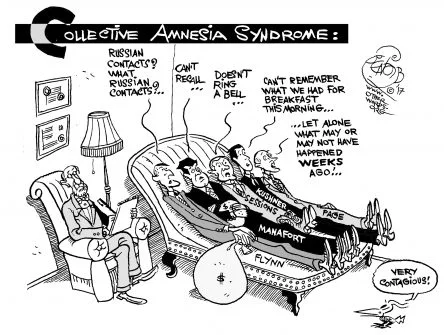
Many of the people around Donald Trump are simply amoral/immoral climbers and operators (like him), united only by their desire for money, power and attention. As Trump’s power seems to fade you’ll see an accelerating exit from his chaotic administration. Meanwhile, it will be amusing to see how well the oily pseudo-“policy wonk’’ and Sammy Glick-style House Speaker Paul Ryan and the very smart survivor Senate Majority Leader Mitch McConnell handle the challenges of dealing with a sociopath in the White House.
Given Trump’s at least 40-year history of fraud, interspersed with loans from some dubious people (especially Russian oligarchs in the past 20 years), and mental and emotional instability why would anyone be surprised by what has been happening?
The latest (?) exciting report, from The Washington Post:
“A month before Donald Trump clinched the Republican nomination, one of his closest allies in Congress — House Majority Leader Kevin McCarthy — made a politically explosive assertion in a private conversation on Capitol Hill with his fellow GOP leaders: that Trump could be the beneficiary of payments from Russian President Vladimir Putin.
“’There’s two people I think Putin pays: Rohrabacher and Trump,” McCarthy (R-Calif.) said, according to a recording of the June 15, 2016, exchange, which was listened to and verified by The Washington Post. Rep. Dana Rohrabacher is a California Republican long known in Congress as a fervent defender of Putin and Russia.
“House Speaker Paul D. Ryan (R-Wis.) immediately interjected, stopping the conversation from further exploring McCarthy’s assertion, and swore the Republicans present to secrecy.’’
“Some of the lawmakers laughed at McCarthy’s comment. Then McCarthy quickly added: ‘Swear to God.’
“Ryan instructed his Republican lieutenants to keep the conversation private, saying: ‘No leaks. . . . This is how we know we’re a real family here.”’
My hunch is that the Russians didn’t pay Trump directly but rather the secretive Trump Organization has continuedto get big loans and “investments’’ from people close to Russian dictator Vladimir Putin. Let’s hope that special counsel Robert Mueller will get to the bottom of it. As for Rohrabacker, who knows?
Unapologetically romantic
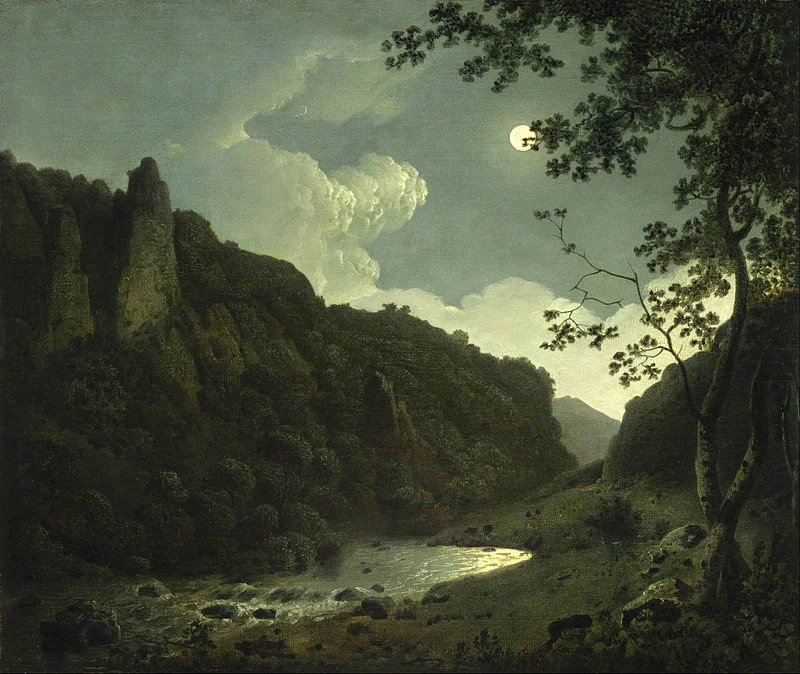
''Ten o'clock: the broken moon
Hangs not yet a half hour high,
Yellow as a shield of brass,
In the dewy air of June,
Poised between the vaulted sky
And the ocean's liquid glass.
Earth lies in the shadow still;
Low black bushes, trees, and lawn
Night's ambrosial dews absorb;
Through the foliage creeps a thrill,
Whispering of yon spectral dawn
And the hidden climbing orb.
Higher, higher, gathering light,
Veiling with a golden gauze
All the trembling atmosphere,
See, the rayless disk grows white!
Hark, the glittering billows pause!
Faint, far sounds possess the ear.
Elves on such a night as this
Spin their rings upon the grass;
On the beach the water-fay
Greets her lover with a kiss;
Through the air swift spirits pass,
Laugh, caress, and float away.
Shut thy lids and thou shalt see
Angel faces wreathed with light,
Mystic forms long vanished hence.
Ah, too fine, too rare, they be
For the grosser mortal sight,
And they foil our waking sense.
Yet we feel them floating near,
Know that we are not alone,
Though our open eyes behold
Nothing save the moon's bright sphere,
In the vacant heavens shown,
And the ocean's path of gold. ''
-- "A June Night,'' by Emma Lazarus
Jim Hightower: Trump trade plan means more offshoring of U.S. jobs
Via OtherWords.org
Like rose blossoms, a politician’s promises can be beautiful when they burst into full, glorious bloom — only to fade over time and, petal by petal, fall away.
Take Donald Trump’s glorious pledge last year to renegotiate the NAFTA trade deal and provide a “much better” deal for working families who lost manufacturing jobs as a result of it. Beautiful! This particular blossom is what convinced many hard-hit former factory workers to vote Trump into the White House.
But the bloom is now off Trump’s rosy promise, and it looks like working families will get nothing but thorns from him.
A recently leaked copy of Trump’s NAFTA plan reveals that, far from scrapping the U.S.-Mexico-Canada trade deal, White House negotiators are goosing it up with even more power for multinational corporations.
In particular, it includes new “investor incentives” to offshore thousands more of our middle-class jobs. Where did this come from? Right out of last year’s discredited and defeated Trans-Pacific Partnership, a scam intended to enthrone corporate supremacy over our own laws.
Indeed, the 500 corporate executives and lobbyists who essentially wrote that raw TPP deal have quietly been huddling with Trump’s team to draft the plan for this “new” NAFTA, the consumer advocacy group Public Citizen reports.
What about those working people Trump promised to help? They’re locked out, not even allowed to watch the negotiations, much less have a say in them. The same goes for consumers, environmentalists, and farmers. Even members of Congress are being left in the dark, allowed no voice in shaping the deal.
But I’m guessing that the six Goldman Sachs executives Trump brought in to run our economic policy do have a say, along with his daughter and son-in-law who oversee both our government and the extended Trump family’s global business empire.
It’s the same old NAFTA story: Corporate powers are at the table — and you and I are on the menu.
Jim Hightower is a radio commentator, writer, and public speaker. He’s also the editor of the populist newsletter, The Hightower Lowdown, and a member of the Public Citizen board.
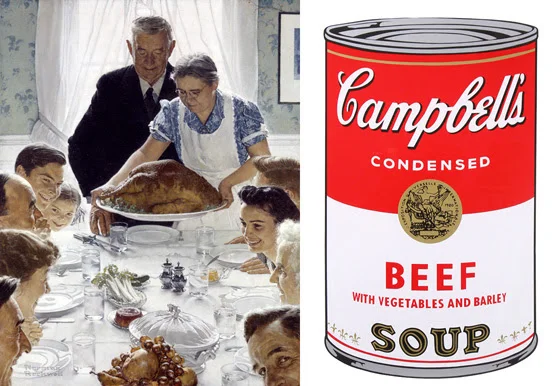
Rockwell and Warhol: An unlikely pairing?
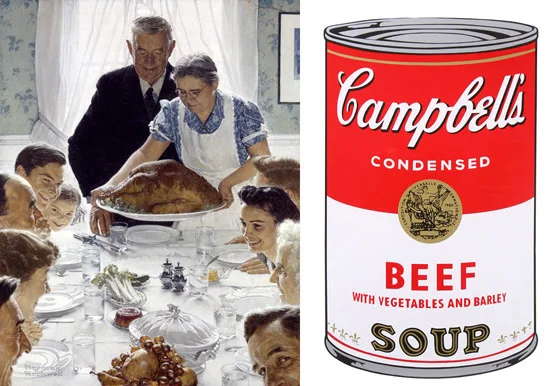
Left, "Freedom from Want'' (oil on canvas), by Norman Rockwell, 1943; right, "Campbell's Soup Can'' (color silkscreen on paper) 1969, in the show "Inventing America: Rockwell and Warhol,'' at the Rockwell Museum, Stockbridge, Mass., June 10-Oct. 29.
Both of these artists portrayed a kind of romanticism. Rockwell liked to say that he painted things the way he wanted life to be. But as he gotolder, he got tougher in recognizing and representing American society's flaws and the contradictions of human emotions and behavior. The nostalgia in his pictures thinned a bit.
I remember with mild fondness his covers for the old Saturday Evening Post, one of about a dozen magazines we got at our house in the '50s and early '60s, before TV killed so many of them. I looked forward much more to the weekly arrival of Life magazine, with its great photos, than to the rather musty Post.
As a kid, I saw the Rockwell covers as corny. Now, in part because I know a lot more about Rockwell's sometimes troubled life, and having read many of his comments on art, his life and America, I see that his work, besides being technically superb, has far more depth than you'd see from glancing at a Post cover. By the way, one reason he and his wife moved to Stockbridge from Vermont is that Austen Riggs, the famous mental hospital is there. Mrs. Rockwell would be treated at the institution from time to time.
As for Warhol, he deeply appreciated the commercial romanticism (the passion for colorful consumer goods) and the craft of Madison Avenue's high-concept popular art during its post-World War II golden age.
When I lived in New York I saw him a couple of times from a few feet away at downtown Manhattan parties. He seemed expressionless --- cold and creepy.
Both Rockwell and Warhol presented longing --- the former for a safer and friendlier world, the latter for a world of color and humor, in which even the seemingly banal could be infused with a kind of goofy joy.
-- Robert Whitcomb
Chris Powell: A clearer view of Aetna's travel plans
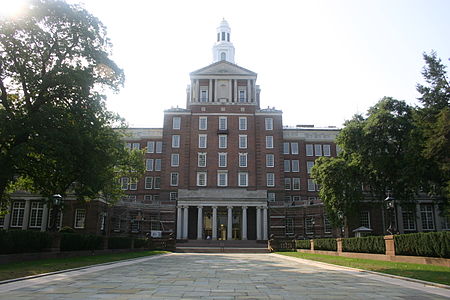
Aetna's current headquarters, in Hartford.
Aetna's supposed departure from Hartford may be recorded as the signature humiliation of Gov. Dannel Malloy's administration, the capstone of the last decade of Connecticut's decline. At least the governor's political opponents will portray it that way.
But they will be wrong, for several reasons. First, the company really doesn't plan to leave Hartford but rather to relocate its top executives. Most of the company's nearly 6,000 employees in Hartford are expected to remain.
Second, the move seems mainly a matter of the personal preference of Aetna CEO Mark Bertolini, who has no particular affection for Connecticut.
Third, the assertion by some "experts" that Aetna wants to attract young workers by being based in a livelier city is nonsense. For the top executives Aetna will be relocating will not be hipsters. Young workers don't start at the top.
More likely Aetna's top executives would like to be big fish in a big pond rather than in a small one.
Fourth, even those who deplore the corporate welfare of the Malloy administration can't deny that the governor was ready to do nearly anything to induce Aetna to stay, starting with his promise to match any financial incentives offered to Aetna by any other state.
That the company declined to pursue the governor's offer suggests that its decision has little to do with business climate, taxes, workforce skills, or anything else under state government's control. Commenting on Aetna's plans, the governor said, "Hartford is not ever going to be New York or Boston. And that's fine." Fine? He might have said, "Thank God!"
Of course those cities have their virtues, but congestion, noise, pollution and being prime targets for terrorism aren't among them. Connecticut is close enough to those cities to use them any time but conveniently set apart enough so that there is space for the reflection and privacy without which life provides little comfort and sense.
"The Connecticut countryside," the historian and sometime politician Odell Shepard wrote in 1939, "seldom obviously picturesque, has been made by long collaboration between earth and man. It is saturated with humanity. Vermont has far more landscape to the square mile but we mix more people with the view.
"This little place of ours is homely, used, and worn, like a weather-beaten homespun coat that has often been patched and turned. Or it is like some wise old face written with character and wrinkled deep in time.
"Jonathan Edwards it was, I think, who defined a certain sort of beauty as ‘the visible fitness of a thing to its use,' like the exact adjustment of a mortise to its tenon.
"That is what we have here -- a beauty homemade and blood-warm, moderate, honest, and utterly our own. There is no glozing and seductive glamour about it, no mirage of a fairer land than earth affords. It renders the sober truth of things, no more."
The sober truth of things today is that Connecticut indeed is in danger but not particularly because of Aetna's departure or anyone else's. Instead the state's decline is a consequence of the corruption brought about by its former prosperity, which caused elected officials to think that they could not just appease every selfish or unproductive special interest but also lock that appeasement into perpetuity by contract, nullifying democracy for all time. That's not a natural disaster but a political one, and it has a remedy: a revival of civic virtue.
Chris Powell is managing editor of the Journal Inquirer ,in Manchester, Conn.
Astrophysics at the Art Club
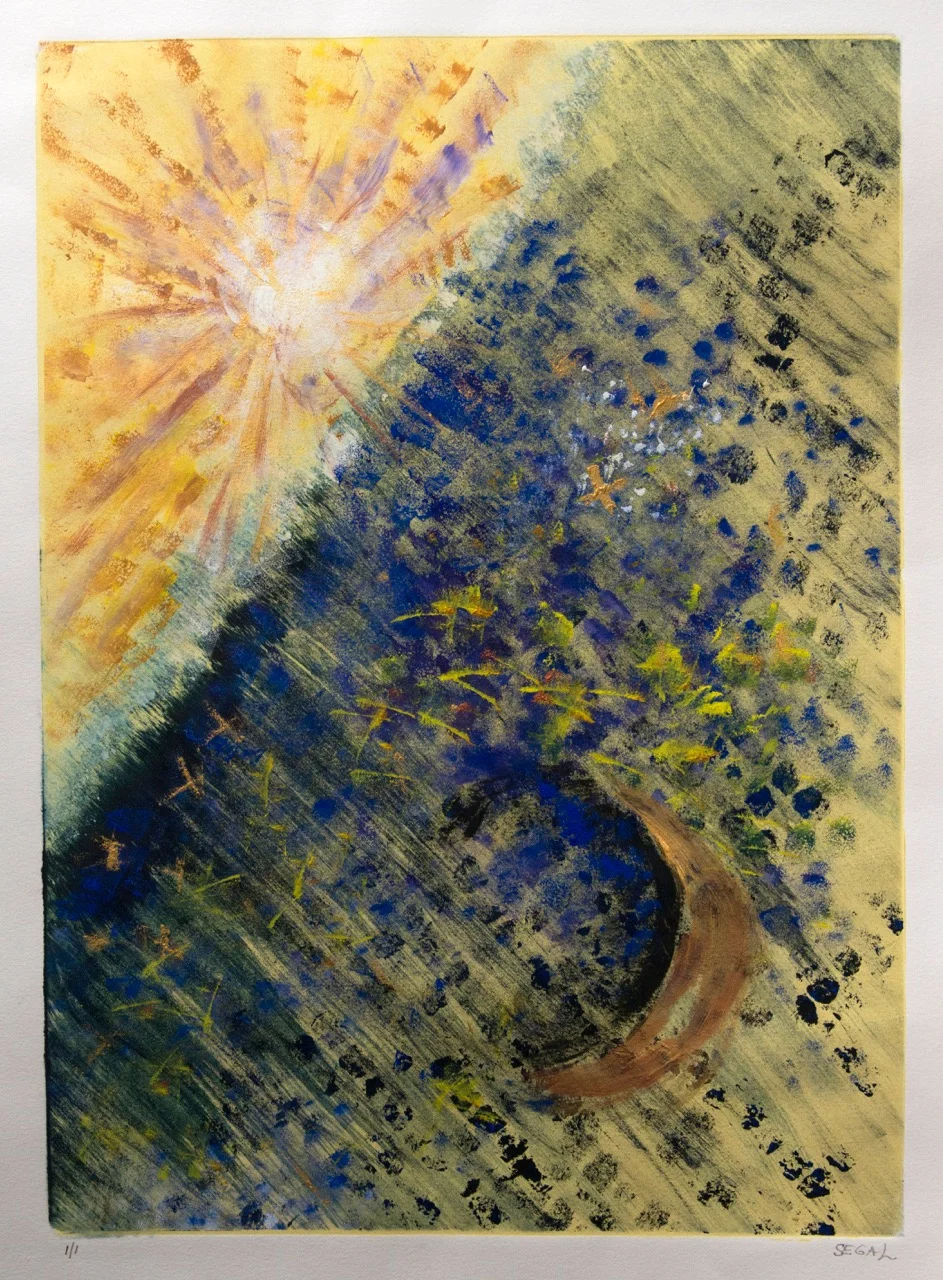
"The Sun, The Moon, The Stars'' (monotype print), by Roberta Segal, in her joint show with Nina Ackmann, "A Sense of Design,'' at the Providence Art Club, June 4-23.
Moving toward Atlantic Time
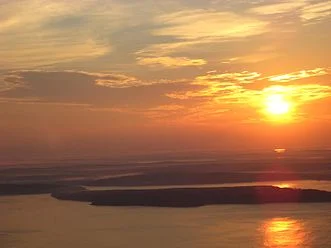
Sunrise from the top of Cadillac Mountain, on Mt. Desert Island, Maine. In the fall and winter, when the sun rises south of due east, it's the first place in the U.S from which you can see the sunrise.
Adapted from Robert Whitcomb's "Digital Diary,'' in GoLocalPov.24
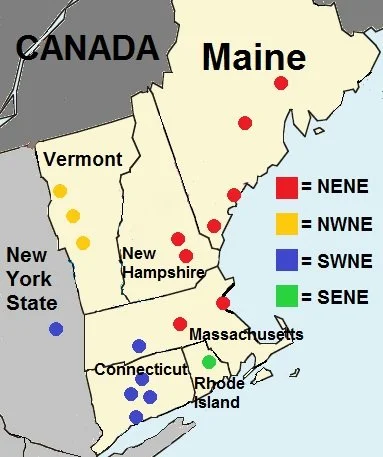
I predict that the New England states, with the possible exception of Connecticut, whose southwestern corner is tightly connected with New York, will eventually adopt year-round Daylight Savings Time – or call it Atlantic Time, which is used in Canada’s Maritime Provinces.
This will ensure more light year-round in the afternoon and address how far east New England is. In the past few weeks, legislators in all six states in the region have been more seriously looking at the shift.

Exploring the nautical life

"Glass Boat'' (plantpaper, twigs and glass), by Jane Balsgaard (photp by Tom Grotta, courtesy of browngrotta arts.) in the group show "Plunge: Explorations From Above and Below,'' at the New Bedford Art Museum, through Oct. 8, in collaboration with the browngrotta arts gallery .Sixteen artists from around the world present their ideasabout, and methods of expressing, nautical life. The work ranges from photographs to large paintings and sculpture.
In Conn., 'the sober truth of things'
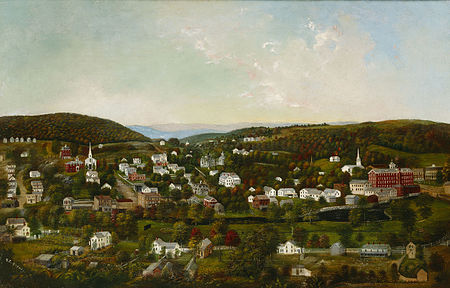
"Winsted, Connecticut'' (oil), by Sarah E. Harvey, circa 1879.
"The Connecticut countryside, seldom obviously picturesque, has been made by long collaboration between earth and man. It is saturated with humanity. Vermont has far more landscape to the square mile but we mix more people with the view.
"This little place of ours is homely, used, and worn, like a weather-beaten homespun coat that has often been patched and turned. Or it is like some wise old face written with character and wrinkled deep in time.
"Jonathan Edwards it was, I think, who defined a certain sort of beauty as ‘the visible fitness of a thing to its use,' like the exact adjustment of a mortise to its tenon.
"That is what we have here -- a beauty homemade and blood-warm, moderate, honest, and utterly our own. There is no ... seductive glamour about it, no mirage of a fairer land than earth affords. It renders the sober truth of things, no more."
-- Odell Shepard (historian), writing in 1939
'Literary Soil'
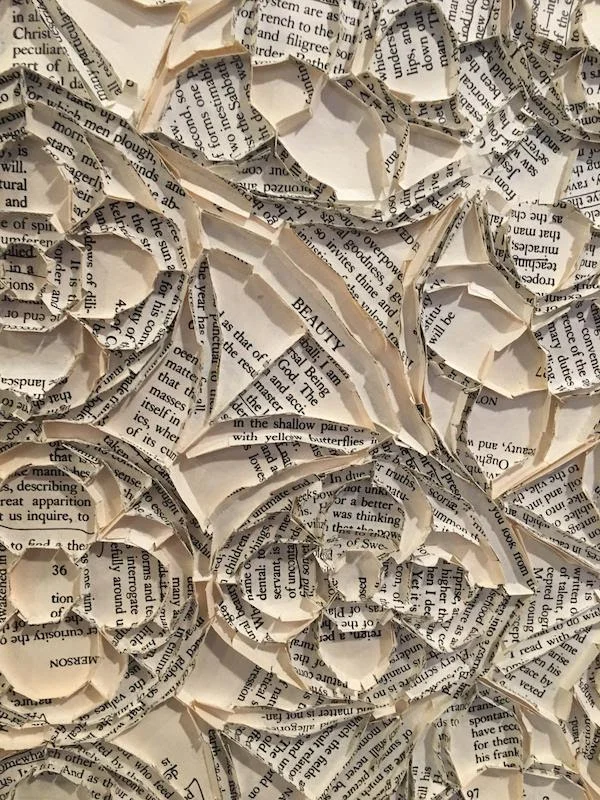
"The Emersonian Rose'' (cut and folded book pages), by Greg Lookerse, in his show "Literary Soil,'' at the Fruitlands Museum, Harvard, Mass. The exhibition refers to the shared cultural tradition of the Transcendentalists and the museum.
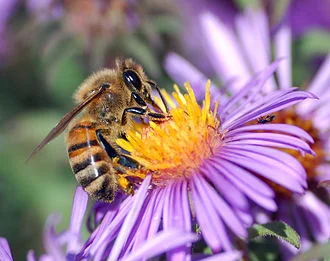
We must protect the pollinators
Via ecoRI News (ecori.org)
Pollinators are vital to the health of natural food chains and the functioning of ecosystems. They are also often the key to agricultural success. Through foraging and natural movements, pollinators — invertebrates such as bees, butterflies and beetles, and vertebrates such as bats and birds — transfer pollen, allowing the fertilization and subsequent fruiting of trees and plants.
Of all flowering plants, 85 percent require an animal — mostly insects — to transfer pollen for fertilization. Pollinators account for the fertilization of 35 percent of crop production worldwide, with a value of $217 billion annually. Both European honeybees and the 3,500 species of native bees account for most of agricultural pollination. Their bodies are designed to attract the electrostatically charged pollen with their bristly thorax and hairy “pollen baskets” on their legs.
Since the 1950s, however, there has been a 50 percent decline in managed honeybee hives, according to the Audubon Society. Wild hives have fared even worse. Nearly 17percent of vertebrate pollinators and more than 40 percent of invertebrate pollinators are facing the threat of extinction.
Also, more than 140 species of butterflies in North America are at risk, while monarch butterflies alone have declined by 90 percent during the past two decades, according to the Audubon Society.
The Audubon Society offers some reasons as to why is this happening:
Pesticide exposure. Heavy pesticide use in agriculture and landscaping shows direct correlation to declines in all insects, especially bees. The synergistic effects of pesticides aren’t well understood and the application of different pesticides on the same property may intensify toxicity to pollinators.
Changes in land use. Natural habitats and open space are being lost to development. In the past eight years, more than 8 million acres of former farmland and natural space has been paved or developed. Urbanization reduces nesting habitat for bees and limits the floral resources they require for food.
Invasive species. As foreign species of plants, insects, fungi and bacteria become introduced, they alter and interfere with the proper functioning of ecosystems by pushing out native species, changing the availability of food resources, and introducing diseases for which endemic species have no defense.
Pathogens, parasites and disease. Honeybees have been hard hit hard by diseases and varroa mite infestations. Colony collapse disorder has impacted bees worldwide, and the causes are still being investigated.
Climate change. Weather patterns are becoming more extreme, growing seasons are altering, and average temperatures are warming. For pollinators, climate change affects food sources that may not be available at times when they are expected and needed.
Changes in agricultural methods. Bees need a diversity of plants that flower throughout the growing season. Small farms and gardens that supplied diverse crops are in steep decline. This has resulted in reduced nutrition for bees. They are also less likely to bounce back from environmental crises such as drought and floods. The loss of field borders and scrubland also means less habitat for native bees.
The Audubon Society offers some tips to support and encourage the diversity and health of pollinators:
Go natural with your lawn. Allow flowers such as clover and dandelions to grow. Minimize or eliminate the use of pesticides.
Select native New England flowering plants and bushes. Use pollen-producing plants in planters and on apartment balconies.
Refrain from clearing leaf litter and old plant stalks in spring as bees lay their eggs in these.
Minimize or eliminate pesticide use in your gardens. Predatory insects will come for those beetles and cutworms. Garden plants can tolerate a little bit of defoliation without much harm.
Leave dead trees on your property, as many pollinators use decaying trees to lay their eggs and pupate into adults. Bumblebees use brush piles, old burrows and tree cavities for nests.
'and slips away'
"There are days in June that seem to be December.
Thus sometimes the substance of this room
or more accurately the people in it who pray silently
start up in the midst of happiness and alter,
bewitched by a murmur from the calm foliage.
Our hearts are shifting as the winds
changing,
pliable as gold.
See this windless sail,
motionless?
Almost before one feels the subtle breeze,
it stirs up
and slips away.''
- Francis Jammes
Multiple explosions
"In June, as many as a dozen species may burst their buds on a single day. No man can heed all of these anniversaries; no man can ignore all of them."
-- Aldo Leopold
Llewellyn King: Trump's foreign policy: Punish friends, reward enemies
The Great Rift Valley extends from Syria down through east Africa to Mozambique. It is a huge depression with volcanic action, lakes and steep-sided gorges. Think of the Grand Canyon and start multiplying.
When contemplating President Trump’s foreign policy, I think of the Great Rift Valley: the largest gash in the Earth’s surface.
The president, in the incoherence of his foreign policy, is creating great gashes between traditional allies that will leave scars down through history. He also appears to be set on empowering our putative enemies, Russia and China.
Many of us White House watchers think that it is quite possible that some of those around the president had questionable relations with the Russians both during the campaign and after the election. Their motivation remains unclear. Also unclear is why Trump is so pro-Russian.
Russia’s motivation is known: It wants the United States to lift the sanctions imposed after Russia invaded Crimea and started a surrogate war in eastern Ukraine.
It is also clear that Russia has an interest in destabilizing Europe, whether it is by manipulating its energy supply or interfering in its elections, as it tried to do most recently in France. Russia has a policy and it is hostile to European and North American interests from the Arctic to the Balkan states.
Trump could end the whole Russian business very quickly by finding out — if he doesn’t already know — who in his immediate circle did what, why and when. He could tell us himself of his involvement.
China is another Trumpian riddle. He campaigned against China for job snatching, currency manipulation, the trade deficit and its incursions into the South China Sea.
In a classic East meets West scenario, Trump, the self-styled dealmaker, was going to sit opposite Chinese President Xi Jinping and negotiate. But when they met at the White House, all points of contention evaporated; even freedom-of-navigation operations by U.S. warships in international waters near contested reefs in the South China Sea were curtailed. Either there was no negotiation, or Trump folded.
There is a Potemkin village quality to Trump’s claims to have opened opportunities for U.S. firms in China. China has not abridged its local participation laws, so U.S. companies doing business there still have to have a Chinese partner, which must have equity control. It is a system the Chinese use to steal U.S. expertise and technology. As to Trump’s claim of Chinese currency manipulation, it has disappeared — maybe it was a dubious issue all along.
If all of this is in the hope that China might stop North Korea building nuclear weapons and delivery systems for them. Well, that has been a vain hope of other presidents. China has no interest in curbing Kim Jong-un for its own reasons and because of the leverage, paradoxically, it gives China with the United States.
But what history might judge as the more egregious Trumpian folly in Asia is his abandonment of the Trans-Pacific Partnership, a carefully crafted deal to keep the economies of United States and 11 other Pacific nations growing without China, which would not have been a partner. Now the gap left by the United States is being filled by China, as are other gaps. Europe, deeply disturbed by U.S. softness to Russia, climate-change policies, protectionist rhetoric, and vitiation of past practices and agreements, is looking reluctantly to China for stability in a crumbling world order.
The goals of Trump’s foreign policy are obtuse, subject to stimuli known only to him — examples include his unexplained enthusiasm for Saudi Arabia, and his complete hostility to everything done by President Obama, including the Cuba opening. The results, though, are not in doubt: gladness in Moscow and Beijing and sadness and confusion in London, Paris, Berlin and among our other (former?) friends worldwide.
So far Trump’s exploits are not only capricious, but also very dangerous, slamming those countries that share U.S. values and encouraging those who oppose our interests. These rifts will not heal quickly. Once a nation is labeled untrustworthy, it is distrusted long after the creator of the distrust has left the field. The rifts remain, great gashes in global confidence.
Llewellyn King (llewellynking1@gmail.com) is executive producer and host of White House Chronicle, on PBS.
Ruefully considering his past

"Portrait of an Old Man'' (oil on linen), by Ruzanna Teterina, in the current show "Young Russian Artists'' at the Dedee Shattuck Gallery, Westport, Mass.

Woods Hole Oceanographic to study ecosystem south of Martha's Vineyard
-- Photo by Ben Frantz Dale
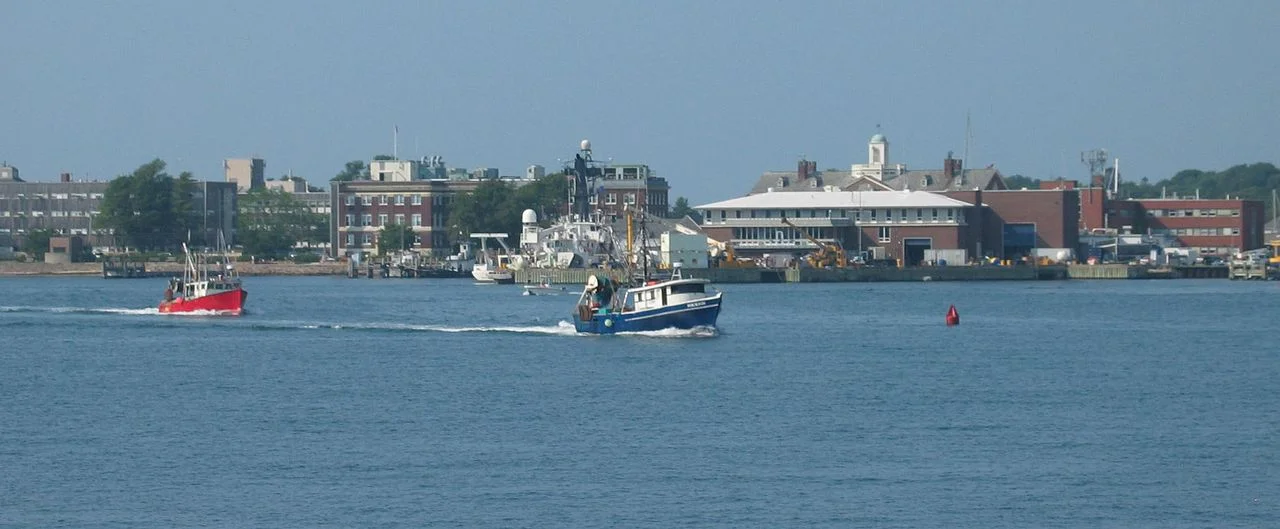
View of the Woods Hole section of Falmouth, Mass., showing Woods Hole Oceanographic Institution and Marine Biological Laboratory buildings.
This from the New England Council:
"The Woods Hole Oceanographic Institution, a New England Council member, recently announced that scientists from the institution will lead a long-term research project to study the ecosystem of the Northeast Shelf of the Atlantic Ocean.
"The study will focus on studying plankton in the waters south of Martha’s Vineyard in order to record how environmental changes are affecting the plankton population, which serves as the backbone for the entire ecosystem. By identifying changes year to year, the scientists can determine how the aquatic food chain may be changing over time and how healthy the ecosystem is. To collect data, the scientists will use two ocean observatory sites, deploy 'sophisticated sensors,' and carry out field research via boat trips to the area. The National Science Foundation awarded $6 million for five years of the study, with the possibility of extending funding when the research team present their results to the National Science Foundation at the end of the five years.
"Heidi Sosik, project leader and senior scientist at the Institute, explained that the study results could hold meaning for the region’s fishing industry because the health of the region’s plankton population can impact fishery production. 'The environment is changing. I know it, and the fishermen know it,' explained Sosik. 'But by keeping the lines of communication open, we can preserve the environment while still not disrupting business.'
"The New England Council congratulates Woods Hole Oceanographic Institution on the grant for this latest study focusing on the health of New England’s aquatic ecosystem. Read more in The Boston Globe and Cape Cod Times
Season come and gone
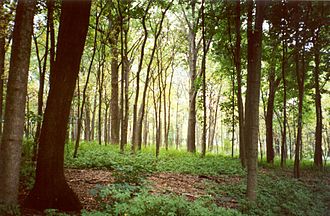
"This is June, the month of grass and leaves. The deciduous trees are investing the evergreens and revealing how dark they are. Already the aspens are trembling again, and a new summer is offered me. I feel a little fluttered in my thoughts, as if I might be too late. Each season is but an infinitesimal point. It no sooner comes than it is gone. It has no duration. It simply gives a tone and hue to my thought. Each annual phenomenon is a reminiscence and prompting. Our thoughts and sentiments answer to to the revolutions of the seasons as two cog-wheels fit into each other. We are conversant with only one point of contact at a time, from which we receive a prompting and impulse, and instantly pass to a new season or point of contact.''
- From Henry David Thoreau's Journal; June 6, 1857
'Imperfection is beautiful'
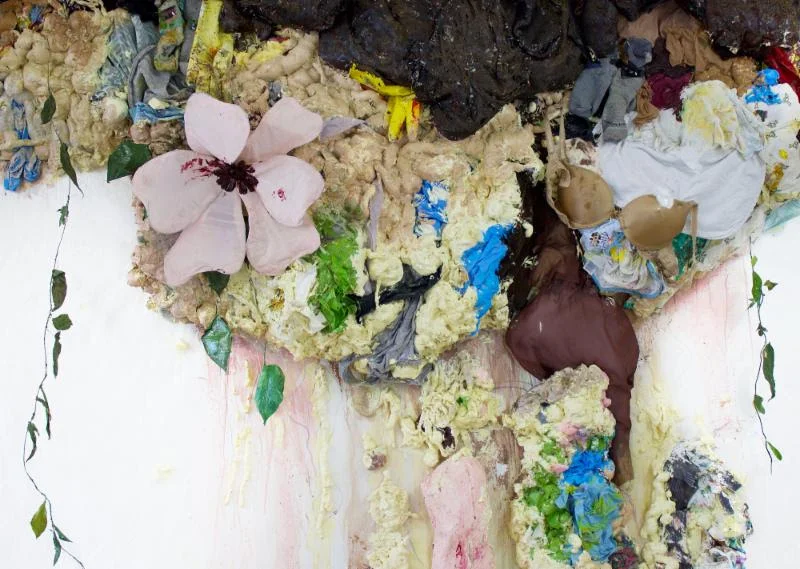
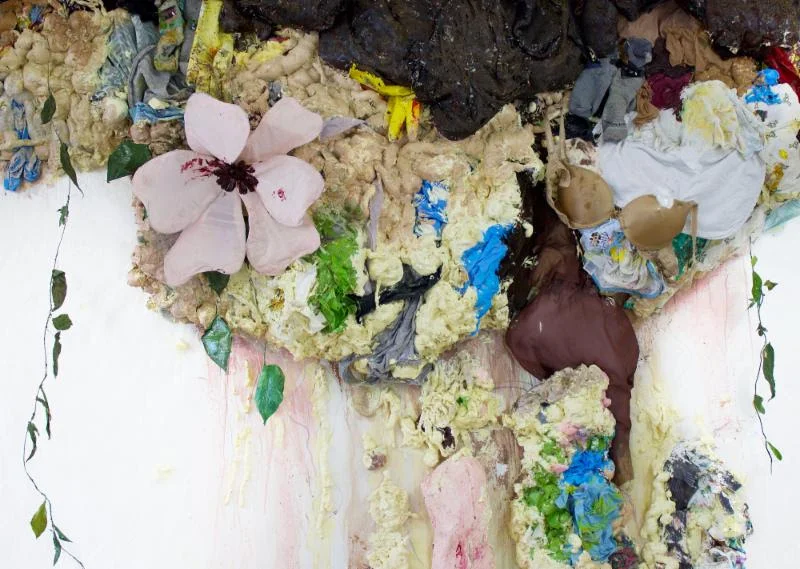
"Beautiful Decay'' (acrylic, foam, and mixed media on cloth and wire), by Sarah Meyers Brent, in her show "Growth and Decay, at Kingston Gallery, Boston, through June 25.
The gallery says:
"Sarah Meyers Brent pushes the boundaries of beauty and ugliness in 'Growth and Decay' with visceral, living works that traverse painting, sculpture and installation. Utilizing lush paint, recycled fabric, foam, decaying flowers, dirt and vines, her mixed-media pieces pour out of and accrete to the canvas and walls. Natural elements of flowers and plant materials appear throughout, drooping and decaying, maintaining beauty in muted colors. Brent's work is both personal and universal in theme, symbolizing how life feels, from anxieties about parenting to climate change, and trying to represent the good and bad. 'Imperfection,' she says, 'is beautiful because it is alive and feels real.' Brent sees richness in material that might otherwise be considered trash. Combining remnants of the natural world with collected detritus, she transforms these fragments to powerfully organic forms simultaneously growing and decaying.''
Urban gentrification marches on
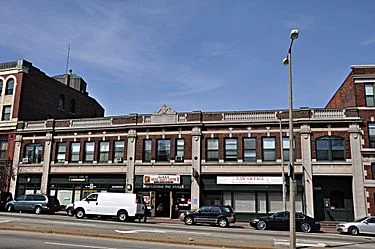
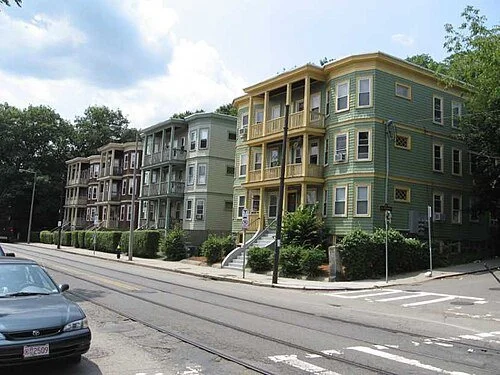
In the Upham's Corner neighborhood of Boston's Dorchester section.
Adapted from a recent item in Robert Whitcomb's "Digital Diary,' in GoLocal24.com
One of my daughters lives in the middle of Bedford-Stuyvesant, in Brooklyn. Bed-Stuy, as it is usually called, has long been infamous as one of the most dangerous, highest-crime urban neighborhoods in the nation. But it has a superb stock of beautiful old brownstones and even some lovely parks.
Real-estate speculators developed most of these homes for the expanding middle to upper middle class from the 1890s to the late 1910s. Many have beautiful ornamental detailing inside and out.
As New York City has boomed in the past couple of decades, gentrification has spread even to such areas as Bed Stuy. So now there’s even a fancy, over-priced French restaurant a few streets from my daughter’s apartment, epitomizing the cycle of prosperity, decline, poverty/crime and revival that seems to happen in virtually every American city. The downside of the economic revival, of course, is that people (usually of color) who could afford to live in what had become a slum are forced out by the much higher rents and housing-purchase costs that accompany gentrification.
Consider a New England example: Parts of South Boston and Dorchester, which were once mostly lower-middle-class-to-poor sections of Boston. Large parts of them are now very expensive -places to live in -- and., it must be said -- much safer than they were 47 years ago, when I worked in Boston. They are sharing in the burgeoning wealth of the higher-education, healthcare, technology and financial-services powerhouse that is Greater Boston.
Boston's nickname was "The Hub'' when I was a boy. It certainly applies now, in some ways more than when I was young and the old city seemed tired and gritty.