
Vox clamantis in deserto






Gas pipeline arouses opposition in the Berkshires
By MIRANDA WILLSON, for ecoRI News (ecori.org)
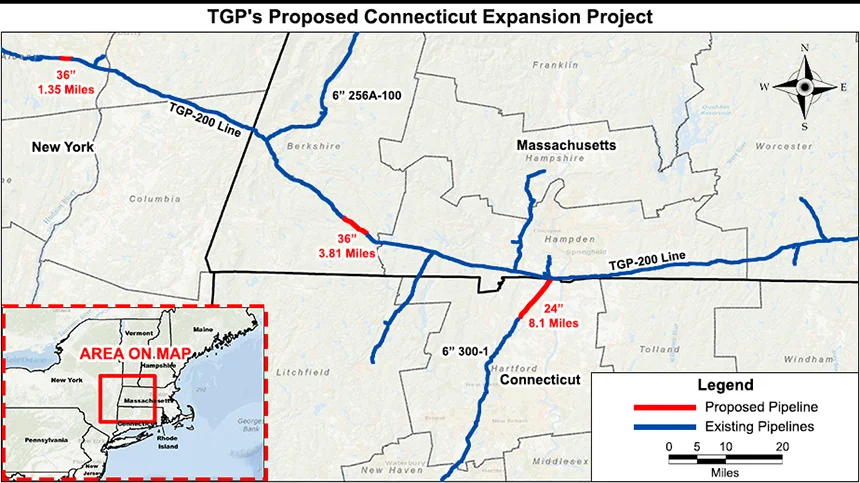
Compared to high-profile pipeline projects such as the Keystone XL oil pipeline and the Dakota Access Pipeline, the proposed Connecticut Expansion Project seems relatively innocuous at first glance, only spanning 13.4 miles in three distinct locations in New York, Massachusetts and Connecticut.
But the 3.8-mile stretch of pipeline proposed in Berkshire County, Mass., has been met with resistance from environmental activists, local and state officials, state agencies, a Native American organization and residents of Sandisfield, the town of 915 through which the pipeline would run.
Criticisms of the project include: its passing through Otis State Forest; the environmental impacts of the natural gas it would transport; a perceived lack of market need for that gas; the damaging of ceremonial stones along the route of the pipeline sacred to an Indian tribe; the process by which the Federal Energy Regulatory Committee (FERC) approved the project.
As a result of multiple legal challenges, the project is more than a year behind schedule. But as the Tennessee Gas Pipeline Co. (TGP), the subsidiary of Kinder Morgan that is developing the project, finished clearing the 30 affected acres of Otis State Forest last week, the likelihood of stopping or significantly delaying the pipeline’s construction is decreasing.
Otis State Forest had been conserved under Article 97 of the Massachusetts Constitution for decades, until Kinder Morgan sued the state in March 2016 for a 2-mile easement through the forest. Two months later, Berkshire County Superior Court ruled in favor of Kinder Morgan, arguing that the Natural Gas Act of 1938, which permits eminent domain powers to interstate pipeline companies, overruled the Massachusetts Constitution.
One activist coalition in opposition to the pipeline, Sugar Shack Alliance, protested in the forest in late April and early May of 2016 in the hopes of preventing TGP from felling trees. At least 24 members of the coalition have been arrested for attempting to block construction and charged with trespassing and disorderly conduct. Their charges were recently reduced to civil citations, according to Abby Ferla, a spokeswoman for the Sugar Shack Alliance.
Ferla said that though the group was unable to save the affected forestland, its members will continue to fight the project.
“We’re looking at a stage in our resistance where we’re shifting away from trying to protect the forest, because that ship has sailed, and refocusing our energies on keeping this pipeline out of the ground,” she said.
Ferla noted that the Sugar Shack Alliance aims to resist all new investments in fossil fuels because of the threat of climate change and what the group characterizes as negative environmental health and justice issues associated with fossil fuels.
Another organization, No Fracked Gas in Mass!, opposes the pipeline project for similar reasons. Co-founder Rosemary Wessel questioned the market need for the gas, likely being obtained via hydraulic fracturing (fracking), that the pipeline will transport to customers in Connecticut.
“This [pipeline] was based on an old projection of an increase in gas use that never manifested,” Wessel said. “As far as Connecticut goes, there hasn’t been an increased use in gas; it’s actually stalled. ... So why bring all of this destruction to the environment and put people’s lives at risk?”
FERC’s March 11, 2016 Certificate of Public Convenience and Necessity for the project, however, asserts that the need for the gas for Connecticut customers is evident and that No Fracked Gas in Mass! and another opposition group, Massachusetts PipeLine Awareness Network (MassPLAN), cited studies that “do not support the commenters’ arguments.”
Another issue brought up by project opponents is FERC’s approval process. According to Katy Eiseman, director of MassPLAN, a group of Sandisfield residents requested a rehearing of the Certificate of Public Convenience and Necessity shortly after it was issued. In response, FERC issued a tolling order to give itself more time to decide on the request.
“The effect of [the tolling order] is that because there’s not a final decision from the agency, the petitioners or landowners are not able to go to court, so they’re just stuck in this bureaucratic, regulatory limbo,” Eiseman said. “This is a common practice; FERC just doesn’t do anything.”
Sandisfield resident Jean Atwater-Williams also complained of the commission’s tolling order. Atwater-Williams is one of several Sandisfield homeowners whose property is being acquired by TGP, as part of the pipeline route in Massachusetts goes through private land.
Atwater-Williams said FERC told her that it couldn’t grant a rehearing request because it has lacked a quorum since Feb. 3, 2017, when commissioner Norman Bay stepped down. She and others, however, note that FERC nevertheless issued a “notice to proceed” with the project on April 12, despite three of its five commissioner positions were vacant.
Mary O’Driscoll, FERC’s director of media relations, said the commission’s issuing of the tolling order was done so that it could have more time to consider the landowners’ request, and that it ultimately chose not to grant the rehearing. She also noted that FERC didn’t approve the project without a quorum, but only issued a notice to proceed, and that the commission has granted some authority to other staff members due to its lack of a quorum, which she said is within its right.
But three prominent Massachusetts politicians have criticized FERC’s issuing of the notice to proceed. Senators Elizabeth Warren and Ed Markey co-signed an April 19 letter to FERC asking the commission to revoke the notice because of its lack of a quorum. Rep. Richard Neal, D-Mass., whose district includes Sandisfield, wrote a similar letter to FERC on April 25.
Another legal player in the opposition camp, the Narragansett Indian Tribal Historic Preservation Office (NITHPO), also issued FERC a request for a rehearing on the notice to proceed. Anne Marie Garti, an attorney for NITHPO, said the tribe is opposed to the project because it impacts ceremonial stone landscapes that are sacred.
She said that because FERC issued a certificate to TGP before the company had completed an archeological survey of the site, FERC violated Section 106 of the National Historic Preservation Act, which requires federal agencies to “take into account the effects of their undertakings on historic properties” and obtain public input before approving of a project.
Though TGP has insisted that it consulted with the tribe and that it will return all affected ceremonial stones after the pipeline is constructed, Garti said removing the stones destroys their religious and cultural significance.
NITHPO is currently awaiting a response from FERC on its request for a rehearing and on other papers it has filed.
TGP has asked FERC to address the claims and motions of NITHPO and MassPLAN, which the company characterized as exaggerated and unfounded. Representatives from Kinder Morgan and TGP declined to comment for this story.
Meanwhile, MassPLAN is shifting its efforts to lobby the Massachusetts Department of Environmental Protection to ensure that TGP complies with water quality and other environmental regulations.
Atwater-Williams said Sandisfield residents are unsure what, if anything, they will do next.
“At this point, we’re considering our legal options, but there aren’t many avenues left for us,” she said.
As the pipeline is expected to be in service by Nov. 1, Atwater-Williams worries about potential impacts it could have on her property, which is 270 feet from the pipeline, and on area wildlife. Though she and her husband were compensated for the portions of their property that the company acquired, she feels it’s not enough to make up for the permanent damage it has caused.
“My husband [always says], ‘I would pay them to go away,’” Atwater-Williams said. “We didn’t want the money and we didn’t need the money. We wanted to be left alone.”
Woodland water cycle
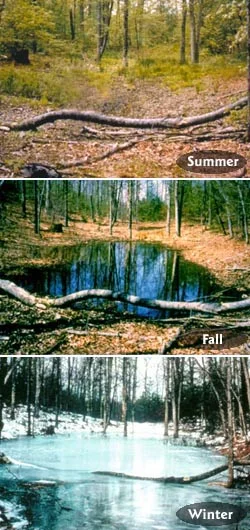
''The trees that have it in their pent-up buds
To darken nature and be summer woods -
Let them think twice before they use their powers
To blot out and drink up and sweep away
These flowery waters and these watery flowers
From snow that melted only yesterday. ''
From "Spring Pools,'' by Robert Frost

Proustian painting

"Not Enough Walking'' (oil on canvas) by James Kinny, in his show "Roil & Hush,'' at Matter & Light Fine Art, Boston, through June 30.
The gallery comments:
"The thick, rich and matted surface of Kinny's art serves as a visual journal; through sensitive handling of color and texture. Kinny maps out and explores the canvas through thought and emotion, building over time into a subtle, varied and vast landscape of human experience. When someone views a piece of art that strikes a chord within them, they in turn will have added their own thoughts and emotions to the overall interpretation of Kinny's art.
"'Sometimes a piece can either take up to six months or ten years--there are parts of the canvas completely covered and other times one spot of the canvas hasn't been touched," Kinny said while describing his methods; he wants the viewer to ... be able to see how he approaches the canvas. One way this can be done is that the viewer examines how they relate to each painting. These layers of oil are representing a memory, either an argument or tender moment.''
David Warsh: A 'Red Diaper Baby's' clear-eyed reportage of Russia
Fred Weir, of The Christian Science Monitor, has long seemed to me the most dependable and best-informed North American correspondent in Moscow. His reporting stood out on the agglomeration site Johnson’s Russia List, even before David Johnson offered a collection of 50 of Weir’s dispatches, 1999-2016, as a subscription premium.
Last week provided a striking example. The occasion was a Vladimir Putin press conference in Sochi, where the Italian prime minister was visiting.
The New York Times headlined:
“Putin Butts In To Claim There Were No Secrets And Says He’ll Prove it’’
“By Andrew Higgins
“MOSCOW – Asserting himself abroad with his customary disruptive panache, President Vladimir V. Putin on Wednesday jumped into the furor over President Trump’s disclosure of classified information to Russian diplomats, declaring that nothing secret had been revealed and that he could prove it.
“Mr. Putin, who has a long record of seizing on foreign crises to make Russia’s voice heard, announced during a news conference in Sochi, Russia, the Black Sea resort that has become his equivalent of Mr. Trump’s Mar-a-Lago, that he has a “record” of the American president’s meeting at the White House with two senior Russian officials and was ready to give it to Congress — so long as Mr. Trump does not object.’’
In contrast, the Monitor’s account tells a substantially different story:
“As controversy swirls around Trump, Russia watches helplessly’’
“Many in Russia had hoped that the new president could help smooth relations between Moscow and Washington. But as Russia-tied scandals paralyze Trump’s administration, now the Kremlin just want US-Russia diplomacy not to get worse’’
“By Fred Weir
“MOSCOW —When Russian President Vladimir Putin offered on Wednesday to provide Congress with a transcript of his foreign minister’s controversial meeting last week with President Trump in the Oval Office, it was not warmly received by US politicians.
“But debating the legitimacy of the offer – nominally to prove that no classified information changed hands – may be missing the point, Russian foreign-policy experts say.
“Rather, its greater significance may be as a sign of just how alarmed Mr. Putin and the Kremlin are becoming about what’s happening in Washington.
“Kremlin watchers say they feel like helpless observers amid the firestorm of the Russia-related scandals engulfing the Trump administration. While the Kremlin tries to advance what Russian observers say are sincere efforts to establish normal dialogue with a new US president, it is taken in Washington to be further evidence of political collusion between Mr. Trump and Russia.’’
There was no snappy language in Weir’s story, no sly equation of Sochi with Mar-a-Lago, no dwelling on Putin’s insulting diagnosis of the Washington outcry (“Either they don’t understand the damage they’re doing to their own country, in which case they are simply stupid, or they understand everything, in which case they are dangerous and corrupt”).
Instead, Weir reminded readers of the context of the discussion – a Russian airliner lost to an ISIS bomb over Egypt’s Sinai Peninsula in November 2015. He quoted at length several Russian sources on their general perplexity at American developments, including Fyodor Lukyanov, a senior Russian foreign-policy analyst:
“We are very confused and even a bit terrified by what we see unfolding in Washington. The name of Russia keeps coming up, but we don’t feel like we have anything to do with this. This level of paranoia is beyond rational, and the only way we can make sense of it is that there is an attempt by political forces to play the Russia card as a weapon to destroy Trump. It’s not that we especially want to save Trump, but the growing fear is that any chance of improved US-Russia relations will be vaporized in this war against him.’’
A Canadian citizen, Weir moved to Moscow in 1986 as a correspondent for the Canadian Tribune, a now-defunct weekly newspaper published by Canada’s Communist Party. He was a third-generation “red diaper baby,” nephew of an influential Comintern agent, a member of the party himself. He had studied Russia as a graduate student but had not contemplated living in the Soviet Union. Now Gorbachev had come to power, the first general secretary born after the 1917 revolution. Weir wanted to see the situation close up.
He traveled widely in the late Eighties for the Tribune, as the Soviet empire began to come apart. He wrote a book on Gorbachev’s reforms, conducted two cross- country tours of Canada as well, promoting his work and sampling opinion He witnessed the optimism of perestroika, the enthusiasm for open elections, the surfacing of ancient ethnic hatreds, as the Soviet regime loosened its grip.
By the Nineties, the economy was falling apart, all but the “cooperatives,” the private firms Gorbachev had permitted to be formed. Weir’s friends, members of the educated elite, had begun complaining of “the theater of democracy.”
In an autobiographical account that he wrote in 2009 (“A Red Diaper baby in Russia witnesses the Rise of Vladimir Putin,” unfortunately no longer online), Weir wrote,
“Sometime in the spring of 1991, I realized how far they had taken this. I was invited to a garden party at the country home, of Andrei Brezhnev, nephew of former Soviet leader Leonid Brezhnev, in Zhukovna, an elite dacha settlement outside of Moscow. One of the guests, whom I had known for years as a functionary of the Komsomol (the Young Communist League) rolled up in a shiny white Volvo and told me he was now president of an export-import firm. Another, whom I’d often dealt with as an official of the Tribune’s fraternal newspaper, the Soviet Communist Party organ Pravda, boasted that he’d just been hired at a private bank. A third, even more surprising because he was the son of renowned Soviet dissident Andrei Sakharov, leaned over the table and handed me a card that announced him as an “international business consultant.”
Over the next few years after that gathering], Weir worked on a book with David Kotz, a professor of economics at the University of Massachusetts at Amherst, Revolution from Above: The Demise of the Soviet System and the New Russia (Routledge 1997), was revised and reissued in 2007 as Russia’s Path from Gorbachev to Putin. The authors’ thesis – that the Soviet system had been overthrown by its own ruling elite – was novel and controversial when first proposed, but has come to be more widely accepted for having been borne out by events. Kotz’s own book about the United States, The Rise and Fall of Neoliberal Capitalism (Harvard, 2015) has fared less well, though perhaps it is too soon to tell. (“The analysis offered in this book suggests that capitalism is not only in a period of structural crisis at this time but in a structural crisis that has no easy path to desirable resolution. This historical turning point may indeed be a turning point for humanity.”)
Instead of morphing into a businessman like his friends, Weir became a mainstream journalist. He pieced together a living writing for the Hindustan Times; The Independent, of London; South China Morning Post; and, since 1998, as the Monitor’s correspondent. (The venerable Boston-based daily discontinued its print editions in 2008, but maintains a string of excellent correspondents around the world for its digital operations; its Moscow correspondents over the years — Edmund Stevens, Charlotte Saikowski, Ned Temko, and Paul Quinn-Judge — have been especially admired.)
Married, with two children, Weir lives in a small village near Moscow. He is a latter-day John Reed who has lived to tell the story. To read through his Monitor clips over the years is to glimpse the present day in the making.
It seems clear, not just from Weir’s reporting, that the Russian president doesn’t understand the situation that has developed in the United States. Nor have Putin and his counselors taken public account of their own part in making matters worse, by encouraging hacking of e-mail and servers during the campaign.
It’s true that Democrats are using Trump’s longstanding and extensive conflicts of interest in Russia to attack the American president. Yet there were legitimate questions about various relationships during the campaign that led to the appointment last week of former FBI Director Robert Mueller to oversee the Department of Justice investigation.
The fracas has to do mainly with Trump’s unsuitability to the job he sought and won – the dog who chased and caught the car. As Slate’s Jacob Weisberg wrote yesterday, in the Financial Times, “The US president violates democratic norms and expectations around presidential conduct. And with each fresh outrage, the American system’s ultimate political sanction [impeachment] becomes more thinkable.” Trump has no powerful friends in Washington – only allies whose loyalty is tested with each new gaffe. It will take time, but, as of this week, a Pence administration seems almost inevitable.
David Warsh is a veteran business, media and political columnist, economic historian and proprietor of economicprincipals.com, where this first ran.
Maine has a people deficit
-- Photo by Bob Walker
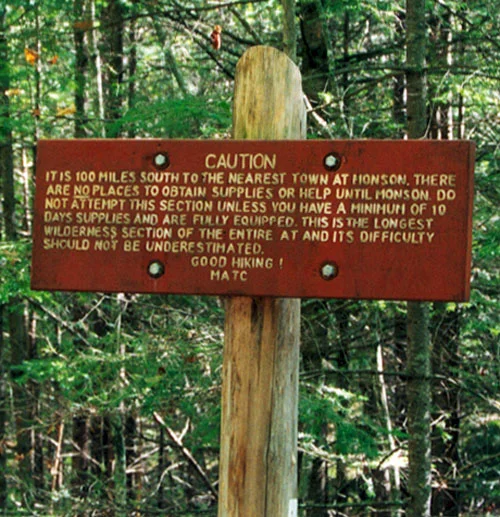
Entrance to the "100-Mile Wilderness'' in Maine.
"I think Maine needs people. It needs diversity. It needs to be able to respect people. Openness is crucial for this state because we don't want to be known for having the oldest state in the nation. We want young families.''
-- John Baldacci, former Maine governor
Safe from the summer people?
From Robert Whitcomb's "Digital Diary'' in GoLocal24.com
Avangrid Renewables, a U.S. unit of the Spanish company Iberdrola Group, and Vineyard Wind have formed a partnership to jointly develop a large wind-energy project about 15 milessouth of Martha’s Vineyard. Avangrid is acquiring a 50 percent ownership interest in Vineyard Wind, an offshore wind-energy developer that’s part of the Copenhagen Infrastructure Partners portfolio.
The sea south of New England has some of the most reliable offshore wind in the world.
The project follows last summer’s enactment of a Massachusetts law requiring utilities to obtain 1,600 megawatts (MW) of offshore wind energy within the next decade. The 1,600 MW would mean homegrown energy to power the equivalent of more than 750,000 Massachusetts homes (with a total of over 2 million people) every year.
Three companies to date have acquired lease rights to build projects off the coast, including Vineyard Wind.
Vineyard Wind plans to begin building its project in early 2020.
It’s possible that renewable energy could provide southern New England with all its electricity needs within a couple of decades, in a huge boon for its economy and environment.
The area eyed for development is presumably far enough offshore to avoid the sort of opposition by rich summer people that blocked the Cape Wind project in Nantucket Sound. However, siting it so far offshore will also make it cost a lot more than Cape Wind would have cost.
Chris Powell: How about shrinking UConn's imperial president?
Connecticut Gov. Dannel Malloy says negotiations over the state budget, which began last week, have a long way to go, but after wobbling on taxes he has accomplished something remarkable. He has pushed his party's majority in the General Assembly, the Democrats, to agree that state government's financial collapse must be fixed mainly by cutting spending, and has induced the Republican minority, which is just a few votes short of displacing the Democrats, to propose cutting spending even more and to get specific about some spending cuts.
It's amazing what a Democratic governor can accomplish when, forswearing re-election, he no longer must play the tool of the special interests that run the party, the state employee and teacher unions, and can pursue the public interest instead. Of course the unions, working through Democratic legislators, will try to induce the governor to go wobbly on taxes again.
After all, government in Connecticut long has been less a mechanism of public service than of financing the Democratic Party, keeping the party's most active members on the government payroll. This makes ironic the Republican opposition to the Citizens' Election Program, which makes all election campaigns, not just campaigns supported by government employee unions, eligible for government funding. Now that Connecticut's financial collapse has become shocking -- the budget deficit exploding, businesses and residents leaving for lower-taxed states, bond ratings being downgraded -- even the public is awakening to the danger.
As the Russian revolutionaries used to say, "The worse, the better." That's because so much is wrong about the premises of public policy in Connecticut that only collapse can force elected officials to make the necessary changes, which are far more profound than transitory spending reductions. The big money is in getting rid of those mistaken policies themselves.
Cutting spending while leaving those policies in place only guarantees that the money will be spent mistakenly again someday. In their negotiations the governor and legislative leaders are looking at the budget largely as a matter of line items. More importantly they should be asking: What is the cost of forfeiting the public's authority over government employment through collective bargaining and binding arbitration of contracts? What is the cost of social promotion in public schools and colleges? What is the cost of welfare subsidies for childbearing outside marriage and the cycle of poverty they cause?
Those costs are surely in the billions every year. As negligent as state government's labor management is, with discipline and dismissal of state employees being nearly impossible and the gold-plating of their fringe benefits, the danger here is that state employees will be scapegoated when so much else in government is wrong. The Hartford Courant's Dan Haar notes that the governor's objective of $700 million per year in union concessions amounts to $30,000 per employee. The Republican budget seeks far more in concessions.
That just evades other needed changes. While there is a lot of room to cut with state employees -- just canceling their six gratuitous paid holidays, like Columbus Day,, would save about $40 million a year -- for the average state employee $30,000 in savings would be impractical and unfair. So why is no one talking about University of Connecticut President Susan Herbst's $900,000 in annual salary and benefits, which doesn't count her two university mansions? Especially in higher education, state government is full of similarly overpaid executives.
Chris Powell is managing editor of the Journal Inquirer, in Manchester, Conn.

Back to our origins

"Tidal Pool'' (oil), by Elli Crocker, in her show "Knotted Earth,'' at Gallery 53, Gloucester, Mass., May 25-June 13.
"The knot as an image is both common and sacred - these patterns of line without beginning or end signify the interconnectedness of everything and a sense of timelessness. The knot binds and entangles, secures and ensnares. We humans are bound to the earth and all the things of it, to our own ancient stories, and the life that is yet to unfold," says Crocker in her artist statement. The gallery says: "Primarily a figurative artist, Crocker has long been intrigued with the human relationship to the natural world and how it informs her artistic work.''
The saline solution

"Golden Cutter'' (oil), by Gary Davis, in the show "At Sea: National Maritime Show,'' at the Copley Society of Art, Boston, through July 3.
'Swindle every citizen'

Th Rudyard Kipling House, in Dummerston, Vt., where he lived in 1893-96 and wrote some of his famous works.
It’s forty in the shade to-day, the spouting eaves declare;
The boulders nose above the drift, the southern slopes are bare;
Hub-deep in slush Apollo’s car swings north along the Zod-
iac. Good luck, the Spring is back, and Pan is on the road!
His house is Gee & Tellus’ Sons, – so goes his jest with men –
He sold us Zeus knows what last year; he’ll take us in again.
Disguised behind the livery-team, fur-coated, rubber-shod –
Yet Apis from the bull-pen lows – he knows his brother God!
Now down the lines of tasseled pines the yearning whispers wake –
Pithys of old thy love behold! Come in for Hermes’s sake!
How long since that so-Boston boot with reeling Maenads ran!
Numen adest! Let be the rest. Pipe and we pay, O Pan.
(What though his phlox and hollyhocks ere half a month demised?
What though his ampelopsis clambered not as advertised?
Though every seed was guaranteed and every standard true –
Forget, forgive they did not live! Believe, and buy anew!)
Now o’er a careless knee he flings the painted page abroad –
Such bloom hath never eye beheld this side of Eden Sword;
Such fruit Pomona marks her own, yea, Liber oversees,
That we may reach (one dollar each) the Lost Hesperides!
Serene, assenting, unabashed, he writes our orders down: –
Blue Asphodel on all our paths – a few true bays for crown –
Uncankered bud, immoral flower, and leaves that never fall –
Apples of Gold, of Youth, of Health – and – thank you, Pan, that’s all….
He’s off along the drifted pent to catch the Windsor train,
And swindle every citizen from Keene to Lake Champlain.
But where his goat’s-hoof cut the crust – beloved, look below –
He’s left us (I’ll forgive him all) the may-flower ‘neath her snow!
-- Rudyard Kipling, "Pan in Vermont''
Get out of town
"Hee that is in a towne in May loseth his spring.''
~George Herbert (1593-1633)

Llewellyn King: Improve, don't privatize, America's air-traffic-control system

Air-traffic controller talking with pilots.
The air-traffic control system is one of the miracles of our infrastructure: an essential and silent cornerstone of modern transportation. Not only is it the largest and most complex air traffic system on earth, but it is the most egalitarian. It integrates little Textron Cessnas into the same airways as Airbus A380s and Boeing 747s. It manages flights to the smallest airports and the largest.
To know how it works and to have been involved with it as a pilot is to love the system, to venerate it and to want to see it survive. The system was celebrated in Pushing Tin, the 1999 film with John Cusack and Cate Blanchett.
But it is falling behind the times. Like so much of the infrastructure it is getting old and has suffered from inadequate sustained funding for years. Attempts to modernize it have been haphazard, underfunded and subject to whims of contractors and Congress.
The first thing about the air-traffic control system we have is that it works and it works safely. The second is that it is in real time: You can’t park airplanes in the sky while you fool with new ways of doing things.
The system’s governance has grown to sluggish and bureaucratic, but is the solution to create a corporation? Isn’t that the kind of thinking that gave us Amtrak?
The technical plans for the future of the air-traffic control system come under the rubric of “NextGen.” That means using new technologies and changing from the present radar-based system to a GPS-based one. There is no doubt that it will be more efficient and get more airplanes into the sky and onto the ground with the same number of runways. FedEx has already proved that with a privately funded experiment in Memphis.
But NextGen will be a great upheaval. It involves converting from a system that works perfectly with humans at every stage to one that relies on advanced technology for the grunt work of air- traffic separation.
It also will affect the air-traffic controllers — the heroes of today’s system — who love what they do as much as the pilots whom they direct. It is a band of brothers and sisters tied together by tension, excitement and the certainty that they make a difference and that what they do is unforgiving of sloth, stupidity or moodiness.
New systems will affect these extraordinary people bound together by the camaraderie of aviation – which is as strong a bond as I’ve ever found.
They will go, as airline pilots have, from being people who control things to people who manage systems; the art of air traffic control will be subsumed to the technology of air-traffic control. No more seat-of-the-pants, just systems management. No more controllers like the one at Atlanta’s Hartsfield-Jackson International Airport who told me and my flying partner Mike Skov in bad weather, “Get in here! I’ve got a hole.” Or the controller at New York’s LaGuardia who said at 5 p.m., when I was stuck behind a line of jets, and the jet wash was causing my little plane difficulties, “Gentlemen, let me get the single out ahead of you, if you don’t mind.” I went. Machines don’t do kindness, people do.
Now the future of the air-traffic controllers and, for that matter, the future of the whole system is in President Donald Trump’s sights. Tighten your seat belts, turbulence ahead.
The case for privatization is that the Federal Aviation Administration is too bureaucratic to manage the changes in the system that are needed. It suggests that the current system is failing. It isn’t. But it is falling behind the technology available: Its computers are old, systems date back to the post-World War II era.
What the FAA’s system needs now is steady funding to facilitate the technological revolution. It doesn’t need a system that will favor the airlines, UPS and FedEx. Can a company be expected to treat the small, rural airport and the small airplane with the same care it does now when money is the rationale?
Surely, there are other ways of streamlining the FAA bureaucracy and guaranteeing multi-year funding without flying into the clear blue yonder of privatization.
Llewellyn King (llwellyngking1@gmail.com) is host and executive producer of White House Chronicle, on PBS, and a veteran publisher, editor, columnist and international business consultant. This piece first ran in Inside Sources.
The North Korean threat
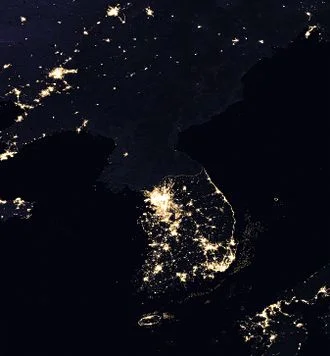
The Korean Peninsula at night. Note the brightness of Seoul, the South Korean capital, and the darkness of North Korea.
May 19, 2017
To members and friends of the Providence Committee on Foreign Relations (pcfremail@gmail.com; thepcfr.org).
Our next dinner meeting comes on Thursday, June 1, with our speaker Terence Roehrig, of the U.S. Naval War College, where he is a professor of National Security Affairs, the Director of the Asia-Pacific Studies Group, and teaches in the Security Strategies sub-course. He has been a Research Fellow at the Kennedy School at Harvard University in the International Security Program and the Project on Managing the Atom and a past President of the Association of Korean Political Studies.
As usual, the event will be in the Hope Club, at 6 Benevolent St., Providence, across the street from the Unitarian Church. Drinks start at 6, dinner by about 6:40, the talk starts at or a little before dessert, followed by a Q&A and the evening ends at 9 (except for those who wish to repair to the bar). .
Joining us on Wednesday, June 14, our last dinner meeting of the season, will be Laura Freid, who has been serving as CEO of the Silk Road Project, founded and chaired by famed cellist Yo-Yo Ma in 1998, promoting collaboration among artists and institutions and studying the ebb and flow of ideas across nations and time. The project was first inspired by the cultural traditions of the historical Silk Road. Ms. Freid was recently named president of the Maine College of Art. There will be visuals and perhaps music.

Notice to Lovers: Study the month of May

"May,'' by Leandro Bassano.
“And thus it passed on from Candlemass until after Easter, that the month of May was come, when every lusty heart beginneth to blossom, and to bring forth fruit; for like as herbs and trees bring forth fruit and flourish in May, in like wise every lusty heart that is in any manner a lover, springeth and flourisheth in lusty deeds. For it giveth unto all lovers courage, that lusty month of May, in something to constrain him to some manner of thing more in that month than in any other month, for divers causes. For then all herbs and trees renew a man and woman, and likewise lovers call again to their mind old gentleness and old service, and many kind deeds that were forgotten by negligence. For like as winter rasure doth alway arase and deface green summer, so fareth it by unstable love in man and woman. For in many persons there is no stability; for we may see all day, for a little blast of winter's rasure, anon we shall deface and lay apart true love for little or nought, that cost much thing; this is no wisdom nor stability, but it is feebleness of nature and great disworship, whosomever useth this. Therefore, like as May month flowereth and flourisheth in many gardens, so in like wise let every man of worship flourish his heart in this world, first unto God, and next unto the joy of them that he promised his faith unto; for there was never worshipful man or worshipful woman, but they loved one better than another; and worship in arms may never be foiled, but first reserve the honour to God, and secondly the quarrel must come of thy lady: and such love I call virtuous love.
But nowadays men can not love seven night but they must have all their desires: that love may not endure by reason; for where they be soon accorded and hasty heat, soon it cooleth. Right so fareth love nowadays, soon hot soon cold: this is no stability. But the old love was not so; men and women could love together seven years, and no licours lusts were between them, and then was love, truth, and faithfulness: and lo, in like wise was used love in King Arthur's days. Wherefore I liken love nowadays unto summer and winter; for like as the one is hot and the other cold, so fareth love nowadays; therefore all ye that be lovers call unto your remembrance the month of May, like as did Queen Guenever, for whom I make here a little mention, that while she lived she was a true lover, and therefore she had a good end.”
― Thomas Malory, from Le Morte d'Arthur: King Arthur and the Legends of the Round Table
Eerie Earth
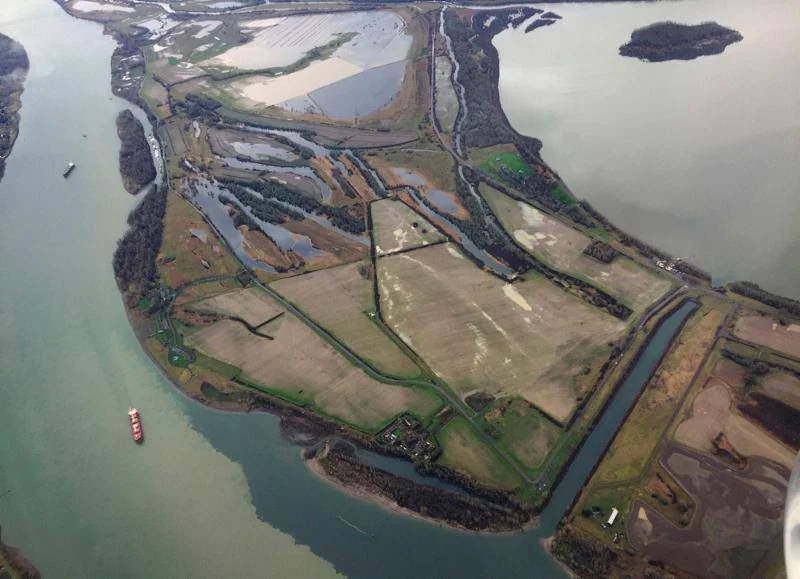
"Leaving PDX'' (archival pigment print), by Mary Lang, in her show "Wonderland: Landscape Photographs by Mary Lang, at the Kingston Gallery, through May 28. (PDX refers to Portland, Oregon's airport). Remember when flying was glamorous?
Then call your maid

"Rise to Meet the Dawn'' (watercolor), by Peter Hussey, in the show "Stops Along the Way,'' at the Newport Art Museum, through Aug. 6. Mr. Hussey finds immense beauty in old New England buildings.
Anti-vaxers Trump, RFK Jr. threaten public health

Boy with measles.
From Robert Whitcomb's "Digital Diary,'' in GoLocal24.com
Science-free lies by anti-vaccine campaigners have led to an increase in measles epidemics. Among the most notable ones now are in Minnesota, Italy and Rumania. The refusal of some parents to vaccinate their children is putting the public at risk. Science ignoramuses such as Donald Trump and the emotionally disturbed crank Robert F. Kennedy Jr., with their idiotic negative remarks about vaccines, are making things worse. No, vaccines don't cause autism.
In some rare cases measles can cause permanent physical damage or even kill.
'New England everywhere'?'
"Having lived here the years that are my best,
I call it home. I am content to stay.
I have no bird's desire to fly away.
I envy neither north, east, south, nor west.
"My outer world and inner make a pair.
But would the two be always of a kind?
Another latitude, another mind?
Or would I be New England anywhere? ''
-- From "New England Mind,'' by Robert Francis
Chuck Collins: Healthcare costs, not taxes, are the big hit on businesses
Members of the House GOP were in a hurry on May 4 to pass their bill to gut Obamacare. They rushed it through before anyone even had a chance to check its cost or calculate its impact on people’s access to insurance.
Their urgency, however, had little to do with health care. The real reason for the rush? To set the table for massive tax cuts.
Indeed, the House health plan would give a $1 trillion boon to wealthy households and pave the way for still bigger corporate tax cuts to come, as part of the so-called “tax reform” they’re pushing.
Meanwhile, dismantling the Affordable Care Act will cause up to 24 million people to lose their health coverage, according to the non-partisan Congressional Budget Office. (Though even that estimate is based on the less extreme version of the bill that failed to pass in April. The new plan may be even worse.)
Why would a GOP politician support an unpopular bill that fewer than 20 percent of voters think is a good idea? Why risk angry constituents showing up at town hall meetings?
Put simply, to please their wealthy donors and Wall Street corporations. For complex legislative reasons, repealing Obamacare’s taxes on the rich first will make it easier for them to slash corporate taxes next.
As the “tax reform” debate begins, prepare for sermons about how cutting taxes for rich and global corporations will be great for the economy. Slashing the corporate tax rate, we’ll be told, will boost U.S. competitiveness.
But if Congress were really concerned about the economy, policy wouldn’t be driven by tax cuts. The real parasite eating the insides of the U.S. economy isn’t taxes, billionaire investor Warren Buffett explained recently, but health care.
In fact, taxes have been steadily going down, especially for the very wealthy and global corporations. “As a percent of GDP,” Buffett told shareholders of his investment firm, the corporate tax haul “has gone down.” But “medical costs, which are borne to a great extent by business,” have increased.
In 1960, corporate taxes in the U.S. were about 4 percent of the economy. Today, they’re less than half that. As taxes have fallen, meanwhile, the share of GDP spent on health care has gone from 5 percent of the economy in the 1960s to 17 percent today.
These costs are the real “tax” on businesses. As any small business owner can tell you, health care costs are one of the biggest expenses in maintaining a healthy and productive work force.
Yet the GOP bill will weaken healthcare coverage and regulation, which will increase costs and hurt U.S. companies.
U.S. employers, remember, must compete with countries that have superior universal health insurance for their citizens and significantly lower costs. While health care eats up 17 percent of the U.S. economy, it’s around just 11 percent in Germany, 10 percent in Japan, 9 percent in Britain and 5.5 percent in China.
No wonder Buffett concluded that “medical costs are the tapeworm of American economic competitiveness.”
Buffett observed that the House healthcare bill would give him an immediate $680,000 annual tax cut, a break he doesn’t really need, while only allowing that tapeworm to bore deeper.
For all its limitations, the Affordable Care Act has expanded coverage and the quality of life for millions of Americans. It’s also put in place important provisions to contain exploding health care expenses, slowing the rise of costs.
The GOP plan to reduce coverage and deregulate health care will take us in the wrong direction. That’s a pretty poor bargain for yet another tax cut for the richest Americans.
Chuck Collins is a senior scholar at the Institute for Policy Studies and a co-editor of Inequality.org. He’s the author of the recent book Born on Third Base.