
Vox clamantis in deserto




Details, details

"Mandelas,'' by Ann-Marie Gillett, in the group show "Mix It,'' at Gallery 175, Pawtucket, through June 23.
The gallery tells is: "Ann-Marie Gillett ... creates conscientious intricate floral mandalas from painted tape. Assembled from many small pieces of carefully cut tape, the rich organic forms radiate and spiral against a backdrop of black, creating an effect of jewel-like tapestry. The pieces shown above are also reminiscent of the detail that went into faberge eggs, each one being more complex and compelling as the last.''
A bit of cultural arrogance
"I sing New England, as she lights her fire
In every Prairie's midst; and where the bright
Enchanting stars shine pure through Southern night,
She still is there, the guardian on the tower,
To open for the world a purer hour.''
William Ellery Channing, "New England''
Sarah Anderson: Conn. businessman seeks to narrow yawning economic divide with CEO tax
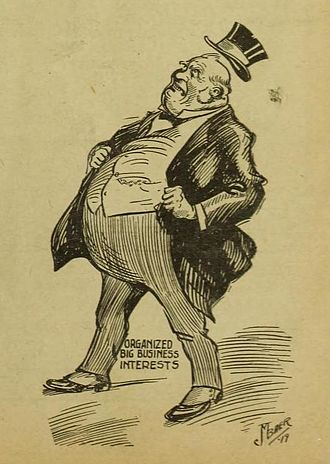
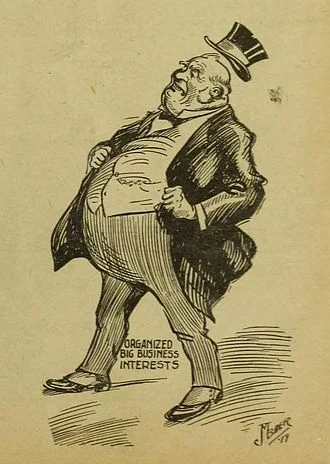
1917 caricature.
Via OtherWords.org
Josh Elliott is fed up with overpaid CEOs. As the owner of Thyme and Seasons, a Hamden, Conn., natural-foods market with 40 employees, he says he could never justify pocketing hundreds of times more pay than his employees.
“I’m very much a capitalist,” Elliott told me in an interview. “But there need to be limits.”
Skyrocketing CEO pay and inequality last year motivated this 32-year-old businessman to launch a successful bid for a seat in the Connecticut General Assembly. Elliott hit back hard on the campaign trail against right-wing claims about high taxes driving wealthy job creators out of his state.
“This is not an issue of over-taxation — it’s an issue of taxing the wrong people and the wrong entities,” he told the New Haven Register. “When the middle class has to subsidize huge corporations like Walmart that criminally underpay their workers, the narrative that we are overtaxed ought to be outed as ludicrous.”
Since taking office, Representative Elliott has co-sponsored several bills aimed at narrowing our economic divide, including two that directly address the CEO pay problem.
One of these bills mirrors a Portland, Ore., law enacted last December that imposes a tax penalty on publicly traded corporations with CEOs making more than 100 times their typical worker pay.
These laws don’t set a ceiling on how much corporations can pay their executives. But they do provide an incentive to rein in excess CEO pay and lift up workers at the bottom end. They can also generate significant revenue for urgent needs like funding pre-school programs or fixing roads and bridges.
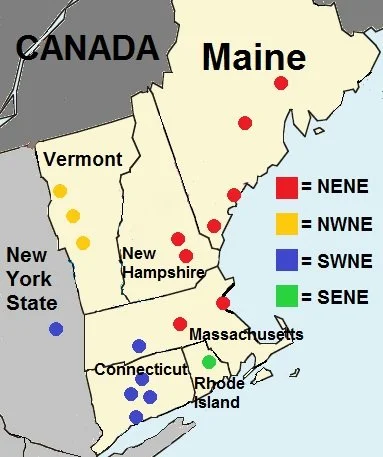
Legislators in Illinois, Minnesota, Massachusetts, Rhode Island, and San Francisco are also considering CEO pay tax proposals.
Elliott’s other bill would use the power of the public purse to reduce pay disparities. If enacted, companies with CEO-worker pay ratios of more than 100 to 1 wouldn’t qualify for state subsidies and grants.
That would help ensure taxpayer dollars are used wisely. Research has shown that narrower pay gaps make businesses more effective by boosting employee morale and reducing turnover rates.
Elliott pointed out that he’s able to go to the state capital in Hartford four times a week when the General Assembly is in session because he trusts his managers to do a good job running the market in his absence. “You need to have good employees to make money,” he told me.
While efforts to narrow CEO-worker pay gaps are spreading around the country, Republicans in Washington are working to undercut them.
How? By killing a federal disclosure law requiring corporations to report the gap between their CEO and median worker pay. This data, scheduled to become available in early 2018, would make the kinds of policies Elliott is promoting much easier to administer.
But overpaid CEOs — and their lobbyists — want to throw up as many obstacles as they can. The massive Financial CHOICE Act, which just passed a House committee, would eliminate the pay-ratio disclosure regulation, along with loosening other regulations on big Wall Street banks. It could come up for a full House vote soon.
But as the debate shifts, Elliott is confident that bold proposals for change will eventually gain traction.
“The conservative narrative is that business owners are the job creators,” he told me. “But if the CEOs and owners of capital have unlimited potential for their own compensation, they’re just taking money away from their employees. And that’s a system that is simply unsustainable.”
Sarah Anderson directs the Global Economy Project at the Institute for Policy Studies and is a co-editor of Inequality.org. @Anderson_IPS
Classic New England engineering
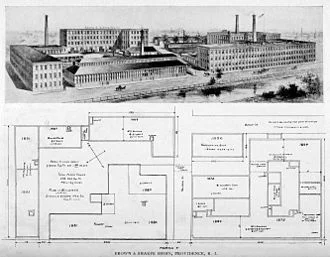
Brown & Sharpe Shops, Providence, 1896.
Kudos to Gerald Carbone and the Rhode Island Historical Society for creating the book Brown & Sharpe and the Measure of American Industry, about the company’s historic role in American high technology. The company’s measuring devices, machine tools and precision machinery set world standards and indeed the company was a sort of early version of Silicon Valley high technology.
Adapted from Robert Whitcomb's "Digital Diary,'' in GoLocal24.com
Brown & Sharpe, now part of Hexagon AB, of Sweden, is now gone from Rhode Island, as is the labor strife that characterized too many of its last years in the state. But Brown & Sharpe’s history provides a highly edifying study of the New England economy, and the “Yankee ingenuity’’ that continues to drive it.
The story of Brown & Sharpe reminds me of the long-gone but at one time huge United Shoe Machinery Corp., with its gold-topped Art Deco skyscraper headquarters in downtown Boston.
This Boston-based company made a wide range of industrial machinery, particularly for shoe manufacturing, but for many other sectors, too, including various land and aircraft armaments, as well as components for the military hardware made by other manufacturers.. It was also a major player in developing synthetic leather.
It exemplified New England's engineering and industrial expertise.

Vintage postcard of the biggest United Shoe Machinery plant, in Beverly, Mass.
'Transcendence of medium'

"Spiral'' (detail), (paint chips on paper), by (the late) Stacey Alickman, in her show "In memory: works by Stacey Alickman,'' at the Kingston Gallery, Boston, through May 28.
The gallery says the show "exemplifies a fascination with paint and free-flowing experimentation with additive and reductive techniques, sanding down layers of paint to allow for underpainting to come through, and building surface that speaks to the perception of texture rather than just texture itself. Often allowing the physical aspects of the paint to assert itself, Alickman conveys a transcendence of medium.''
The abuse of language in politics
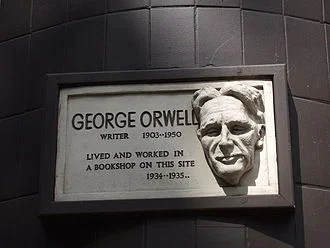
Plaque marking where George Orwell worked in the Hampstead section of London. "Political language is designed to make lies sound truthful,'' he wrote.
Politicians have succeeded in creating a mythical entity, “the media,” Llewellyn King, host of White House Chronicle, says in this week's episode of the television and radio program.
“We are not a monolithic whole but a disparate, irregular army,” King says of journalists. “To believe that we are somehow a single entity that reacts in unison to events is to know nothing about journalists and how they work, investigate and behave.”
In this week's episode, scheduled to air beginning Friday at 7:30 p.m. on Rhode Island PBS, among other places,, King and co-host Linda Gasparello discuss the new words that are dominating political conversation.
The episode centers around a column King wrote for InsideSources, a newspaper syndicate, and published in newspapers across America, in which he deconstructs words and phrases that are subverting the political dialogue. Those include “takeaway,” “double down,” and “walk back.” He also includes those that demean journalists by calling their work “fake news” and them “enemies of the people.”
King and Gasparello, both lifelong journalists, are scathing on the episode about the use of language to obscure political incompetence and mendacity. For example, they conclude that a "walkback'' has become a synonym for a lie, a mistake, an insult, an unsupportable allegation and ignorance.
Fake news, according to the pair, is a case of attacking the messenger because the message is unpalatable. This is a tool used promiscuously by President Trump, alleges King. “He does not just attack reporters, he vilifies honorable organizations like The New York Times and CNN.”
Their discussion also wanders into the smokescreens of euphemisms that politicians use to describe war and killing, and whether Republicans or Democrats communicate more effectively. Gasparello weaves quotes from Winston Churchill and George Orwell, who railed against political language, into the episode. She reads what Orwell wrote, “Political language is designed to make lies sound truthful and murder respectable, and to give an appearance of solidarity to pure wind.”
White House Chronicle is a weekly news and public affairs program, airing nationwide on 200 PBS, public, educational and government (PEG) stations, and the commercial AMG TV network; and worldwide on Voice of America television and radio. An audio version of the program airs four times weekends on SiriusXM Radio's P.O.T.U.S. (Politics of the United States), Channel 124.
For more information, contact Llewellyn King at (202) 441-2702, or llewellynking1@gmail.com.
Prince of Plymouth

Plymouth Notch, Vt.
''Calvin Coolidge was the greatest man who ever came out of Plymouth Notch, Vermont.''
-- Clarence Darrow (famed and sardonic trial lawyer)
Editor's note: It might surprise some readers that President Coolidge was a graceful writer.

Frank Carini: Rumpus continues over Amtrak's plan to speed NYC-Boston travel time with bypass

Amtrak Acela train in Old Saybrook, Conn. The Acela is a fast train by U.S. standards but much slower than high-speed trains in most of the rest of the Developed World.
via ecoRI News (ecori.org)
The Federal Railroad Administration has proposed the straightening of Northeast Corridor tracks, from Washington, D.C., to Boston. The new railroad path would cut off an estimated 45 minutes of travel time between New York City and Boston, but both public and private property in southern New England could be impacted, including some sensitive areas.
Politicians, the public, and various agencies and organizations have expressed concerns about the NEC Future proposal. With a final record of decision on the project expected as soon as this month, the Connecticut Trust for Historic Preservation, for one, has reached out to the National Passenger Rail Corporation (Amtrak) as the agency prepares to inherit the Federal Railroad Administration’s controversial plan to build new high-speed rail routes through coastal towns in Connecticut and Rhode Island.
The Connecticut Trust sent a letter to Amtrak that asked the agency to clarify and reconsider its role in the controversial plan. Since early 2016, when the public and legislators first became aware of the impacts of planned bypasses through southeastern Connecticut and Rhode Island, the Federal Railroad Administration (FRA) has faced withering opposition across a broad political spectrum. Project opposition has spread from Branford, Guilford and Fairfield County to Westerly and Charlestown, R.I.
“Eighty miles of new bypasses may be the Federal Railroad Administration’s dream for rail travel through Connecticut, but I fear this portion of the NEC Future plan will become Amtrak’s nightmare,” Daniel Mackay, executive director of the Connecticut Trust, wrote in the May 4 letter. “If the Record of Decision contains proposed bypasses from Old Saybrook to Kenyon, R.I. or in Fairfield County (Conn.), Amtrak will be risking decades of opposition from congressional leadership, communities, and potential customers in Connecticut and Rhode Island.”
An Amtrak spokesman and its director of business development attended a Jan. 10 meeting in Charlestown to discuss the proposed Old Saybrook to Kenyon Bypass. The public meeting gave the agency a preview of the anger that NEC Future has generated in southern New England, as more than 400 residents packed the cafeteria of a local school. Person after person voiced unanimous, and at times fiery, opposition to the plan.
“Amtrak officials took the blame for the plan when FRA officials wouldn’t attend,” said Gregory Stroud, director of special projects for the Connecticut Trust, who spoke at the January meeting.
Stroud also noted that Amtrak supported an alternative route, without either the bypasses or the planned expansion between Guilford and Branford, in its earlier comments on the draft proposal.
“This isn’t Amtrak’s preferred plan, but it is the one Amtrak and taxpayers will be stuck with for the next 40 years,” he said. “We’re hoping that Amtrak will advocate for removal of the bypasses.”
Frank Carini is editor of ecoRI News.
Six views of photography

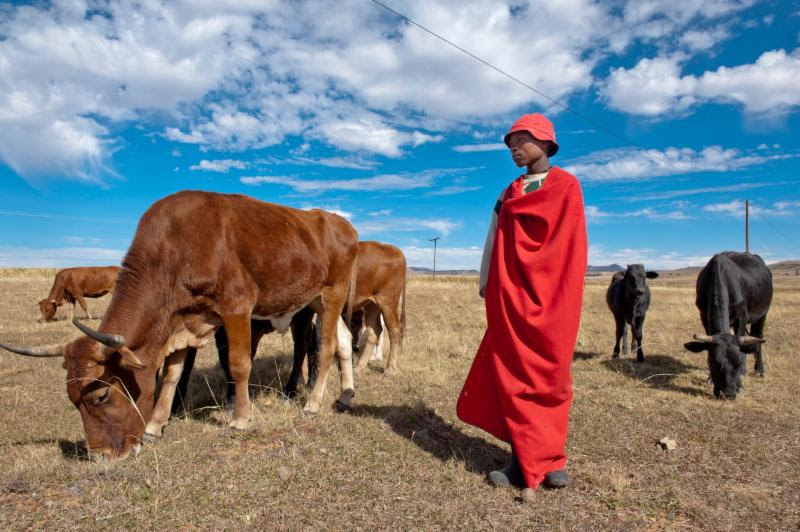
"Lesotho,'' by Lou Jones, in the show "Contrasts: Varying Visions from Six Master Photographers,'' at the Cape Cod Museum of Art, Dennis, Mass., through June 25.
The show is a group exhibition featuring six seasoned photographers inside the Cape Cod Museum of Art and two off-site pieces of public art. Edith Tonelli, the museum's director, says that the show "juxtaposes contrasting styles and techniques in photography through a series of pieces from six New England photographers .These photographers are respected nationally and internationally for their artistic prowess in this art form. From Massachusetts, Connecticut, and Maine ,the photographers are: Fran Forman, Cig Harvey, Andrew K. Howard, Lou Jones, Sean Kernan,and Karin Rosenthal. The work focuses on the diversity of emotionally compelling images, camera types, lighting methods, development processes and technology. The...exhibition raises the question being asked in our photographic world today: Is the art of photography changing? It's often directly or indirectly affected by new technology. We want to celebrate the fascinating variety of approaches, from the traditional to the computer- generated, that photographers are using to communicate their personal and aesthetic expressions today.''
Chris Powell: ACA a mistake, GOP bill is worse
MANCHESTER, Conn.
The Affordable Care Act, better known as Obamacare, lost last week at the hands of the Republican majority in the House because it didn't work well.
While it extended coverage to millions of people, for many the coverage was not so affordable. It failed to cover millions more and failed to enroll millions of young people whose premiums were necessary to the scheme's solvency. As a result it exploded premiums even without covering everyone. Cynics suspected that Obamacare was planned to fail like this to become an inducement for the country to adopt a "single-payer" medical insurance system.
But the Republican "repeal and replace" legislation really isn't even insurance at all. It would reduce premiums mainly by eliminating coverage, giving states discretion to allow medical insurance policies to exclude treatment for serious ailments and to jeopardize coverage for the millions of people already afflicted with something.
The Freedom Caucus of House Republicans, which the new legislation was designed to placate, is celebrating only the freedom to be devastated medically and financially by catastrophic illness.
The Republicans in the House seem to know this, for they rushed the bill to a vote without waiting for an analysis by the Congressional Budget Office. Some Republicans admitted that they voted on the bill without even reading it, which was a Republican criticism of Democrats back when the Democratic majorities in Congress hastened to enact "Obamacare".
But maybe the Republican bill is meant only as a pose -- to show that the party, at least in the House, can keep its "repeal and replace" pledge and advance legislation supported by President Trump. For Republicans in the Senate don't seem to be taking it seriously. Instead they say they will revise it or offer their own insurance bill. Since Democrats control 49 of the Senate's 100 seats, the outcome will be determined by moderate Republican senators.
Congress's objectives should remain the unachieved objectives of "Obamacare" -- getting basic coverage for everyone efficiently, preserving substantial choice among policies and insurers, socializing the burdens of catastrophic illness, lifting the insurance burden on business, and taking advantage of the progressive income tax system.
This might be accomplished in part simply by extending Medicare coverage to all catastrophic illnesses, those causing annual expense of more than $100,000. If achieving these objectives costs a little more money, the country's constant and stupid imperial wars in Afghanistan, Iraq, Syria, Libya, and elsewhere might be liquidated. Call it "America first."
Ask more from Indian tribes -- and MGM
Connecticut's casino Indian tribes are distributing a video attacking MGM for wanting to make money by drawing Connecticut residents to its casino under construction in Springfield. The tribes say that with their proposal to build a casino in East Windsor to intercept Springfield gambling traffic, they want to save jobs for Connecticut and revenue for state government. Of course the tribes want money as much as MGM does.
State government, collapsing financially, should want money more than all of them. But state government assumes that the only way of getting more from the tribes is to give them the "interceptor" casino, though their only real asset is the state's own property, the casino monopoly the state has given them in exchange for a share of their slot machine revenue.
State government has more options than the "interceptor" casino. It should tell the tribes that they must pay more for their monopoly from the state, and it should ask MGM how much it would pay the state every year not to authorize an "interceptor" casino.
Chris Powell is managing editor of the Journal Inquirer, in Manchester, Conn.


David Warsh: Watergate lessons for the last days of the 2016 election

SOMERVILLE, Mass.
It has become an article of faith among many Democrats that FBI Director James Comey’s letter last Oct. 28 disclosing that agents had discovered one last trove of unexamined e-mails, cost Hillary Clinton the election. Clinton herself said as much last week: “If the election had been on Oct. 27, I would be your president.”
The New York Times had lent support few days before, in a lead story running across four full inside pages, “In Trying to Avoid Politics, Comey Shaped an Election”. And last week, statistician Nate Silver weighed in with a lengthy analysis, “The Comey Letter probably Cost Clinton the Election.”
This view is almost certainly mistaken. Let me explain why I think so. The argument begins with the Watergate affair, and the cloak of protection that, without quite meaning to, The Washington Post threw over the FBI after June 1973.
xxx
If you are like most people, what you remember about Watergate is an Academy Award-winning film, All the President’s Men, and, in particular, actor Hal Holbrook role as “Deep Throat,’’ the high-ranking government official “trying to protect the office [of the presidency]” from the Nixon White House’s lawless ways. Parking garages have never seemed the same since.
It turns out that the real Deep Throat was not like the tormented, principled whistle-blower that Holbrook portrayal. Instead, it was FBI Deputy Director Mark Felt, who provided guidance to reporter Bob Woodward in exchange for a promise of lifelong confidentiality. J. Edgar Hoover had died in May 1972, and Felt considered that he deserved to replace him. Instead, Nixon appointed an outsider, L. Patrick Gray III. Felt was out to get Gray. He never intended to bring down the administration.
This information is not to be found in the 1974 best-seller that Bob Woodward and Carl Bernstein wrote about their Watergate stories, also called All the President’s Men, still less in director Alan Pakula’s film. Only 30 years later, when an increasingly senescent Felt publish an account, in Vanity Fair, of the role he played in the affair, were the reporters freed from the promise of lifetime confidentiality given Felt in exchange for his periodic guidance. Woodward followed with his own account, The Secret Man: The Story of Watergate’s Deep Throat, in 2006. Even then, he muddied this issue, ascribing a complexity to Felt’s motivation that doesn’t stand up to scrutiny. As for the difficulty of sorting things out at the time, Woodward wrote:
“With a story as enticing, complex, and competitive and quickly unfolding as Watergate, there was little tendency or time to consider the motives of our sources. What was important was whether the information checked out and whether it was true…. The cliché about drinking from a fire hose was true. There was no time to ask our sources, Why are you talking? Do you have an ax to grind? Why don’t you blow the whistle publicly, stand up there and tell all you know? This was the case with Mark Felt.
“ .…His words and guidance had immense, at times even staggering, authority. The weight, authenticity, and restraint were more important than his design, if he had one.’’
To their credit, Woodward and Bernstein sought to badger Felt into going on the record in 1973, first when they disclosed the existence of “a wary informer” in a New York magazine story about the Watergate saga by a friend, then by contributing, anonymously but identifiably to close readers, to a story by star Washington Post reporter Laurence Stern, “Bureau Hurt by Watergate.” The past year had seen develop “a form of guerrilla warfare against the administration from within the ranks of the FBI,” wrote Stern.
“Reporters who covered the case acknowledge the role of [FBI] agents in opening up the initial peep-holes in the cover-up façade some administration officials were trying to erect.’’
“’It wasn’t a matter of getting rancorous leaks dumped in your lap,”’ said one Watergate reportorial specialist. ‘You’d have to go to them and say, what about this or what about that? They’d respond, ‘Yes, that’s right.’ I can think of one guy in the Bureau without whom we wouldn’t have gotten anywhere.”
Felt declined to take the suggestion, despite the fact that his role had already been discovered by the White House. Indeed, he had been unceremoniously forced into retirement between the New York magazine and Stern stories. He ignored the hint that going public might be good for his reputation. Instead he continued to advise Woodward a little while longer, and artfully denied speculation whenever he was asked about his role.
Then came the book, the first anyone had ever heard of Post editors’ nickname for “the wary informer,” followed by the movie, establishing Deep Throat as a mythic figure – a truth-teller in Richard Nixon’s war against the system of justice. Official Washington lost interest in the specifics. The task of identifying Deep Throat shifted to a platoon of independent sleuths.
All this is laid out in satisfying detail in Leak: Why Mark Felt Became Deep Throat, an excellent book published by the University of Kansas Press in 2012, which finally appeared in a paperback edition last year. Author Max Holland, an independent journalist, produced a taut if linear account of what was learned, and when, by all the interested parties about Felt’s role in Watergate. He was greatly aided by the White House tapes. For anyone who savored the Watergate story at the time, the book is deeply satisfying.
“Contrary to the widely held perception that The Washington Post ‘uncovered’ Watergate,” wrote Holland, “the newspaper essentially tracked the progress of the FBI’s investigation, with a time delay ranging from weeks to days, and published elements of the prosecutors’ case well in advance of the trial.” This was, he acknowledges, a tremendous public service. But The Post never followed up to establish that their key breaks in the story stemmed from a succession war in the FBI.
Nor did The New York Timespursue the matter, despite having gradually taken over eventual leadership on the Watergate story. Their major phase on the story began in May 1973, when John Crewdson first reported – thanks to Felt – the existence of wire taps of severalreporters and former aides to National Security Adviser Henry Kissinger that had been ordered by the White House.
Marveling at the newspapers’ willingness to print the legend of Felt’s public spirited truth-telling rather than explore his motives, Holland concluded in 2012 that the damage done was no longer to an individual (Patrick Gray, who resigned in disgrace after admitting to destroying documents in the wake of the Watergate burglary) or to the FBI itself, but rather “to history, to public understanding….”
“Felt’s success in manipulating the media is a cautionary tale, and one that remains a potent lesson even now, forty years later. While he clearly contributed to Richard Nixon’s undoing, that was not his original intent. More broadly, Felt’s machinations make the history of Watergate, and how the scandal brought Nixon down, considerably messier and less of a fairy tale.’’
Alas, Leak was not reviewed either by The Post or by The Times. Thus Woodward and his editors’ reputations have not suffered the modest write-downs that Holland’s account requires. The story of the FBI meltdown after 1972 and its subsequent internal efforts to repair its integrity and credibility are not widely understood. Journalists for the most part have been unprepared for the possibilities for mischief in FBI ranks – most, but not all reporters.
xxx
What roles did leaks play in the 2016 election? None, actually, and therein lies the story of Director Comey’s letter of Oct. 28. Three days before the director’sannouncement, former New York Mayor RudolphGiuliani, an adviser to Donald Trump, said on Fox News that the campaign had “a couple of surprises” in store. The day after, Trump told a Colorado crowd, “I’ll bet you without any knowledge there was as revolt in the FBI.”
In fact, reporter Devlin Barrett, of The Wall Street Journal, on Oct. 31, described an intricate argument within the FBI, and between FBI leadership and Obama’s Justice Department, as some agents sought to refocus the investigation on the Clinton Foundation after the probe of Hillary Clinton’s e-mail practices wrapped up. Four FBI field offices – New York, Los Angeles, Washington, D.C., and Little Rock – had been investigating charges of influence-peddling for most of the year.
Fierce arguments had taken place. Some agents felt they had been all but ordered to shut down what was considered an adequately predicated investigation. No mention was made of that the lengthy Times story two weeks ago, even though The Times in November had corroborated and extended somewhat the WSJ account. Meanwhile, reporter Barrett has left the WSJ for The Post. It seems that someone in Washington has absorbed the lessons of Leak.
Mutiny was brewing in the FBI in the weeks before the election. If Comey hadn’t gone public, rebellious agents would have, with leaks – probably with even more disruptive results. In other words, the FBI director made the best of a bad hand. In congressional hearings last week, Comey acknowledged that the FBI was investigating itself. “If I find out that people were leaking information about our investigations, whether to reporters or private parties, there will be severe consequences.”
It wasn’t Comey who cost Clinton the election. It was Trump adviser Steve Bannon and the Mercer family, who funded the publication of Clinton Cash Machine, by Peter Schweizer, and a movie based on it, which in turn apparently formed the basis of the second FBI investigation. Let’s hope that the story is illuminated sooner than the Deep Throat yarn. It’s time for Democrats to stop scapegoating Comey and Russian hackers and get on with the business of choosing new leaders.
David Warsh is a veteran financial and political writer and economic historian and proprietor of economicprincipals.com, where this first ran. He and the editor of New England Diary, Robert Whitcomb, worked at The Wall Street Journal during Watergate.
Warren: Trump budget would whomp New England's economy
Sen. Elizabeth Warren's (D.-Mass.) remarks to the New England Council last week included her saying that:
President Trump's proposed budget cuts would be “devastating” to Massachusetts, such as the "meat axe'' against the National Institutes of Health. Massachusetts is a huge bio-tech center.
She said that Mr. Trump’s executive actions on immigration “threaten how we have really built an economy in New England going forward”.
“It’s a serious problem because it hurts our families, it’s a serious problem because it has the potential to hurt our economy, but it’s a serious problem because it threatens how we have really built an economy in New England going forward, with our colleges and our universities, with our innovation economy, with our tourism economy.''

Spring perfume

"Cows on Old Jerusalem Road'' (in Salisbury, Vt.) (oil on panel), by Hannah Sessions, at Alpers Fine Art, Andover, Mass.
One indication of high spring in the little town I lived in as a boy was the aroma of grass and manure that wafted over from a small farm on the other side of the road we lived on. Very rich indeed. The smell wasn't quite as pleasant in July. The road we lived on, in Cohasset, Mass., was an extension of another Jerusalem Road, this one along the ocean. Those old New Englanders liked their biblical references.
-- Robert Whitcomb
'Taken to the fire escape'
''E.B. White's essays are the best things I've read about Maine - especially the one in which he's not sure if he can go out sailing any more in his sloop. ''
-- Nicholson Baker (author)
''Most of us, out of a politeness made up of faint curiosity and profound resignation, go out to meet the smiling stranger with a gesture of surrender and a fixed grin, but White has always taken to the fire escape. He has avoided the Man in the Reception Room as he has avoided the interviewer, the photographer, the microphone, the rostrum, the literary tea, and the Stork Club. His life is his own. He is the only writer of prominence I know of who could walk through the Algonquin lobby or between the tables at Jack and Charlie's and be recognized only by his friends.''
— James Thurber, E.B.W., "Credos and Curios"
The late E.B. White lived for many years in North Brooklin, Maine, after moving from New York City.
'Synthesis'

"Synthesis'' (oak, driftwood), by C.C. White, at Patricia Ladd Carega Gallery, Center Sandwich, N.H.
The GOP eyes gutting Social Security
Adapted From Robert Whitcomb's "Digital Diary'' in GoLocal24.com:
There's a move underway by some Trump advisers and Republican lobbyists to eliminate payroll taxes used to fund Social Security and Medicare Part A. (Medicaid is financed from general budget funds), with the ultimate aim of throwing more people on the tender mercies of Wall Street to finance their retirements.
Associated Press writers Josh Boak and Stephen Ohlemacher reported: “This approach would give a worker earning $60,000 a year an additional $3,720 in take-home pay, a possible win that lawmakers could highlight back in their districts even though it would involve changing the funding mechanism for Social Security, according to a lobbyist, who asked for anonymity to discuss the proposal without disrupting early negotiations.’’
Well, yes, that might be an initially popular way to destroy Social Security. The George W. Bush administration tried to give Wall Street lots of Social Security cash. But the public, understandably doubtful that people in the financial-services industry would put customers’ interests first, pushed back. Then came the Great Crash of 2008….
Llewellyn King: Writing books vs. newswriting; the unsheltered; of theater and food
-- Photo by Benjamin Brock
Notebook
As opportunities in journalism have tightened, many of my colleagues have tuned to writing books. I admire them. Actually, I more than admire them: I'm astounded by them.
Among them is my friend Richard Whittle, a former Pentagon correspondent for The Dallas Morning News, who has written two first-rate books. His first was about the V-22 Osprey vertical takeoff aircraft and his second was about drones.
Whittle is hard at it on a third. He tells me that he loves his second career – and, as an elegant writer and an impeccable reporter, he's doing well.
I'm frequently asked why I don’t take this path and write books about the subjects I know something about or, to be exact, subjects about which I’m supposed to know something. The answer is simple: fear. Not fear about my ability, but fear of boredom. Fear of waking up every day and having to take up where I left off the day before.
The peripatetic journalistic life suits me; maybe too well. I love the idea that each day could bring something new, unexpected and thrilling, just because it's new.
Like many newspapermen, I answer phones with alacrity because the next call might, as it says in “The Rubaiyat of Omar Khayyam,” could “in a trice life’s leaden metal into gold transmute.”
The poet was referring to liquor, and it might be why liquor and newspapering have been so indelibly linked. Certainly, the drinking by newpapermen -- and I've worked on newspapers in colonial Africa, London, New York, Baltimore and Washington, D.C. -- was endemic and awesome.
Less now, I gather. The venerable National Press Club in Washington used to support two bars and, at lunch and in the evening, drinkers crowded them 15-deep. Now the only bar is sadly empty most of the time.
Once I ran into a colleague at the end of the day at the Paris Air Show. “How are you?” I asked. “I’m cold, I’m wet, my feet hurt and I haven’t found a story,” he said. I knew why he was miserable: Life's leaden metal hadn’t been transmuted into gold nuggets of news.
The book writers, if they’re any good, unearth many stories, but the thrill of publication isn’t daily. It can take a year or longer. Not for me.
News writing, like drinking, produces its thrills predictably, and I’m for the early gratification. More power to my colleagues who are undaunted by the long haul.
Why Are the Bus Riders Left Out in the Cold?
Rhode Island, where I live, is, as I have found, a kindly place: people look out for one another. So why, I wonder, are there so few bus shelters and even benches?
I find the public transportation users (I’m one) standing forlornly, in all kinds of weather, waiting for a bus. Recently, in the heavy rains, they were especially bedraggled. This must negatively affect ridership. Since I have difficulty standing for long periods, I don’t take the buses in Providence and its surrounding communities. But I'd take them if I could sit down while waiting.
In Washington, D.C., where I’m often, I take the buses a lot. There are seats in shelters that don’t keep you warm but do keep you dry.
It's cruel to leave those who ride buses without shelter or seating.
Sleeping Rough in a Place of Learning
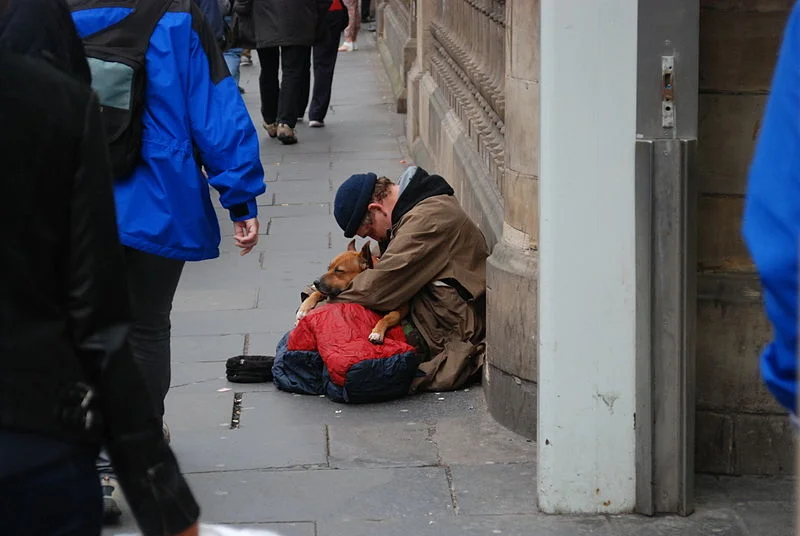
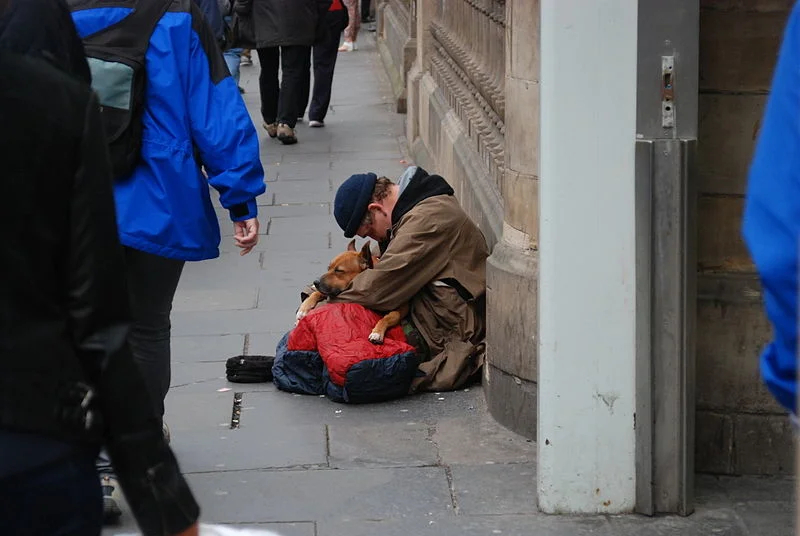
I travel to Cambridge, Mass., quite a bit. But recently, in this self-regarding gyre of great ideas, I’ve noticed more homeless people than ever sleeping on the streets. One wonders, wandering the streets so close to the Great Minds, whether some of them haven’t thought of a solution? Is it a step too far from the ivory towers to the hard pavement where the luckless sleep?
Second Story To Add Restaurant, Lose One Stage
I went to Warren, R.I., to see “Art” at 2nd Story Theatre. At the end Ed Shea, the dominant force there – by turns actor, director and manager -- came on stage to announce that the building, which now includes two small theaters and a very pleasant bar, is to be refurbished, and that the first-story theater will be transformed into a restaurant.
I wish them well, but it's unclear how this will work. Will the restaurant be complimentary or competitive? If I'm going to eat and go to the theater, I favor supper after rather than dinner before. Going to a good restaurant is, in itself, a theatrical experience and competes with theater for entertainment hours.
One of the joys of Rhode Island is its profusion of really good places to eat. Warren is no exception. New Orleans has the reputation, but Rhode Island has the vittles.
Second story will lose a stage, but Shea still plans to cook up some imaginative theater on the remaining one.
Llewellyn King is executive producer and host of White House Chronicle, on PBS. His e-mail is llewellynking1@kingpublishing.com.
Spring moves in faster in the city

"The country ever has a lagging Spring,
Waiting for May to call its violets forth,
And June its roses--showers and sunshine bring,
Slowly, the deepening verdure o'er the earth;
To put their foliage out, the woods are slack,
And one by one the singing-birds come back.
"Within the city's bounds the time of flowers
Comes earlier. Let a mild and sunny day,
Such as full often, for a few bright hours,
Breathes through the sky of March the airs of May,
Shine on our roofs and chase the wintry gloom--
And lo! our borders glow with sudden bloom."
-- William Cullen Bryant, "Spring in Town'', 1850
Spring pointillism

"Verdant Constellation'' (acrylic on canvas on panel), by Jung Hur, at the Corey Daniels Gallery, Wells, Maine, May 18-June 17.