
Vox clamantis in deserto








Culling turkeys with crossbows?

By TIM FAULKNER
For ecoRI News (ecori.org)
Wild turkeys can be found just about anywhere these days. Since the 1980s, these short-distance flyers have migrated from rural western Rhode Island to urban and suburban neighborhoods, where they dine from bird feeders and on handouts from humans.
“They get used to being fed by people, and they don’t fear people and then they don’t leave,” said Josh Beuth, wildlife biologist and head of the turkey program at the Rhode Island Department of Environmental Management (DEM).
Many of these well-fed birds feel comfortable around humans, as they roam backyards in Barrington and parking lots on Reservoir Avenue in Cranston.
Despite regular sightings, the number of wild turkeys in Rhode Island has fallen from its peak of about 6,000 in 2001 to some 3,000 today. Beuth said the drop-off isn’t likely due to hunting or development but an influx of predators such as coyotes, foxes and hawks that eat turkey chicks, called poults.
Eastern wild turkeys were reintroduced to Exeter in the early 1980s, as part of a DEM swap with Pennsylvania for snowshoe hare rabbits. Their numbers increased steadily as they discovered new territory with few predators. Predators, though, soon followed, so turkeys migrated to eastern Rhode Island. Today, wild turkeys can be found across the state, except on Block Island and Prudence Island. Tiverton currently has the highest wild turkey population, according to surveys and public sightings.
Hunters now want to expand turkey hunting to include crossbows. Currently, seasonal hunting is allowed with a shotgun or bow and arrow. For the second year, a bill was introduced in the General Assembly to allow hunting by crossbow. The bill changes state hunting laws to allow hunting of wild birds with a crossbow. If passed, the law would amend state hunting regulations to designate wild turkeys as the only wild bird to be hunted by crossbow.
Hunting-safety instructor Jack Peters of Riverside noted that crossbows are safer than shotguns, because they require less space than a firearm requires for discharging. Crossbows also allow elderly and disabled hunters greater access to hunting, he said.
“The crossbow is the ideal device for harvesting a turkey,” Peters said.
Despite the state's reduced turkey population, Beuth said the turkey broods are healthy and could withstand a loss of 200 birds in each of the two annual hunting seasons. Currently, only mature male turkeys can be hunted. In 2016, 122 turkeys were taken by hunters in Rhode Island.
New Hampshire is the only state in New England that allows wild turkey hunting by crossbow. Peters said crossbow hunting of turkey would draw more hunters, just as it did with deer hunting. Deer hunting with crossbows was approved four years ago to cull populations and curb the transmission of Lyme disease. While turkeys feed on some insects, but research is not conclusive that they eat Lyme-carrying ticks.
Peters said proceeds from hunting licenses support buying and protecting wildlife habitat. Hunting also brings in hundreds of million of dollars to the local economy, he said.
“A lot of people have become frustrated in the last few years because they can hunt deer with a crossbow but not turkey,” Peters said.
The kids will keep Greater Boston cooking
Population growth is slowing in Greater Boston, and expensive housing is said to be at least partly to blame. Housing analysts say that a big factor is the relatively low number of houses for sale in Boston’s inner suburbs. The fear is that this will send too many Millennials out the region, hurting economic growth.
I think that’s an exaggerated fear. Greater Boston’s huge and internationally prestigious higher-education complex and its quality of life will keep these younger adults coming. A bigger threat to the region’s prosperity may be President Trump’s anti-immigrant policies. Immigrants, most of them legal, have played a big role in eastern Massachusetts’s boom. Many of these immigrants are very well-educated and do a disproportionate percentage of the work in the Greater Boston’s powerful technology, engineering andhealth-care sectors.

'Flipping' in Mystic

''The Politics of a Glace (acrylic), by Lisa Lyman Adams, in the "Flipped '' show at the Mystic (Conn.) Museum of Art, through June 3.
"Flipped'' is an exhibition of works from the museum's permanent collection focused on women artists. Erika Neenan, a curatorial assistant at the museum, said that the title of the exhibition reflects the under-representation of women artists in major permanent art collections in the United States, where women account only 3-5 percent of total holdings. So "Flipped'' flips the numbers so that male artists account for only 4 percent of the work on display. Many of the museum's founders were women.
'Scarcely know that we were gone'
There will come soft rains and the smell of the ground,
And swallows circling with their shimmering sound;
And frogs in the pools singing at night,
And wild plum trees in tremulous white,
Robins will wear their feathery fire
Whistling their whims on a low fence-wire;
And not one will know of the war, not one
Will care at last when it is done.
Not one would mind, neither bird nor tree
If mankind perished utterly;
And Spring herself, when she woke at dawn,
Would scarcely know that we were gone.
-- Sara Teasdale, "There Will Come Soft Rains''
New PawSox stadium? Alluring but dubious economics for the state
Updated from Robert Whitcomb's "Digital Diary'' column in GoLocal24.com
The Pawtucket Red Sox want the State of Rhode Island to cough up some money to help the Boston Red Sox farm team build a new stadium, either keeping it where McCoy Stadium is or somewhere else in the old mill town, perhaps at the site of the Mayan pyramid of the Apex store. Pawtucket is attractive because, among other things, it’s close to Massachusetts. (Actually, most of tiny Rhode Island is close to the Bay State. Indeed, many Rhode Islanders drive through parts of Massachusetts daily to get to parts of Rhode Island.)
The new -- and tough -- state Senate president, Dominick Ruggerio, who knows a lot about construction, likes the idea of a new stadium and having the state pay for some of this project, which would benefit some very rich people. Apparently Gov. Gina Raimondo also likes the idea, which might involve putting up a replica of Fenway Park.
Would it be worth it? Years ago, when I worked in the newspaper business, the line was that while only about 25 percent of daily newspaper readers read the sports pages regularly, that 25 percent is intensely interested in their teams andapt to buy the products advertised in the sports pages (especially car stuff). Should the state spend a lot of money to please the minority of people who are baseball enthusiasts, and in a time when tax revenues are falling behind projections?
And a new stadium in downtown Pawtucket would remove from the city a lot of land that could be used for a diversified mix of business and give it to one business that, of course, could up and leave.
Of course, there would be perhaps a couple of hundred temporary construction jobs to build a new stadium but only a few dozen permanent ones (if that) at a new stadium.
Still, having a shiny new stadium in a well-landscaped setting and access to public transit might raise some animal spirits in Greater Providence. I think it would be very dubious “economic development’’ from a macro viewpoint. But if it’s to be done, why not get a really exciting design for it and put it where many people could see it, including its very own “Green Monster,’’ from some distance away.
How about along the water in East Providence?
Back to nature

"Staircase'' (digital pigment print), by Suzanne Moxhay, in show "Interiors,'' at Wallace Anderson Gallery, Bridgewater, Mass., through April 14.
The show displays digital pigment prints inspired by the composite photographic images produced in the mid-19th Century and later in early movies. Ms. Moxhay uses images from a various vintage and contemporary sources.
Artscope notes that she "borrows from the photomontage process developed in the early days of filmmaking in which movie backdrops were matte painted on sheets of glass and then integrated with live-action.
"In her mysterious and memory filled images Moxhay seeks to achieve an ambiguous narrative where fact and fiction intermingle. To create the environments, she experiments with texture, surface, depth, space, scale, movement and architecture, to, 'involve the viewer in the construction of the image, and to make them question it."'
'The budding groves'
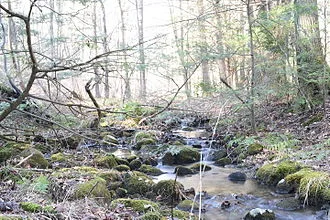
In Southbury, Conn.
It was an April morning: fresh and clear
The Rivulet, delighting in its strength,
Ran with a young man's speed; and yet the voice
Of waters which the winter had supplied
Was softened down into a vernal tone.
The spirit of enjoyment and desire,
And hopes and wishes, from all living things
Went circling, like a multitude of sounds.
The budding groves seemed eager to urge on
The steps of June; as if their various hues
Were only hindrances that stood between
Them and their object: but, meanwhile, prevailed
Such an entire contentment in the air
That every naked ash, and tardy tree
Yet leafless, showed as if the countenance
With which it looked on this delightful day
Were native to the summer.--Up the brook
I roamed in the confusion of my heart,
Alive to all things and forgetting all.
At length I to a sudden turning came
In this continuous glen, where down a rock
The Stream, so ardent in its course before,
Sent forth such sallies of glad sound, that all
Which I till then had heard, appeared the voice
Of common pleasure: beast and bird, the lamb,
The shepherd's dog, the linnet and the thrush
Vied with this waterfall, and made a song,
Which, while I listened, seemed like the wild growth
Or like some natural produce of the air,
That could not cease to be. Green leaves were here;
But 'twas the foliage of the rocks--the birch,
The yew, the holly, and the bright green thorn,
With hanging islands of resplendent furze:
And, on a summit, distant a short space,
By any who should look beyond the dell,
A single mountain-cottage might be seen.
I gazed and gazed, and to myself I said,
'Our thoughts at least are ours; and this wild nook,
My EMMA, I will dedicate to thee.'
----Soon did the spot become my other home,
My dwelling, and my out-of-doors abode.
And, of the Shepherds who have seen me there,
To whom I sometimes in our idle talk
Have told this fancy, two or three, perhaps,
Years after we are gone and in our graves,
When they have cause to speak of this wild place,
May call it by the name of EMMA'S DELL.
-- William Wordsworth, "April Morning''
Llewellyn King: The power of electricity to transform Africa
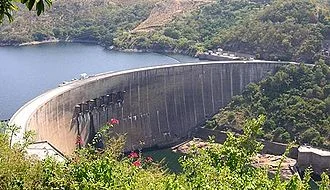
The Kariba Dam, between Zimbabwe and Zambia.
He is generic Africa Man. You can see him everywhere, walking barefoot across theSavannah and desert landscapes. He is on a mission that gets harder as time goes on.
His mission is to find enough wood -- a few dry sticks here, some roots there -- to make a fire for a hot meal and to bathe. He walks and walks, adding a stick and a piece of scrub wood to the bundle carried, in the traditional way, on his head.
Generic Africa Woman is busy, too. Her mission is to draw water. She carries a container on her head, filled with water from a distant well, to make dinner -- a meal of maize (corn) porridge with maybe a stew of some meat or even caterpillar – and to bathe.
African life is picturesque, but it is not pretty. Hardship is in daily attendance much of Africa, blighted from deforestation and polluted water.
Yet Western aid has not been easily delivered. Much of it has been stolen, some of it has been misapplied and some of it has led to aid dependency.
So, as an old Africa hand (I was born in what is now Zimbabwe, and left when I was 20 years old), I was elated to learn of a new and critical partnership just announced between the Edison Electric Institute (EEI) and the U.S. Department of State’s Power Africa initiative. Electricity anywhere is the gift that gives and gives, but especially when it begins to transform lives of hard struggle to ones that are less so.
When I was a boy, the opening of a power station or the building of a power line were events that brought forth celebration. Electricity signaled a better tomorrow.
When a village -- whether it is in Bolivia, India or Uganda -- is electrified, good things flow. A simple hotplate replaces days of firewood collection and those who can read can do so after the sun sets: hygiene improves, education is facilitated and expectations soar.
When the shantytowns that surround Johannesburg, South Africa, were electrified, the productivity of workers who flood into the city every day went up. Simply, they were saved from the drudgery of collecting animal droppings, wood scraps and other combustible stuff to burn.
The colonizers of Africa realized the need for electricity. Hence, in my part of the continent, two great dams were built on the Zambezi River: the Kariba, between Zimbabwe and Zambia, and the Cahora Bassa, in Mozambique.
As a very young reporter, I covered the construction of the Kariba Dam, and its near destruction by unusually heavy flooding, in 1957. It has been the backbone of electricity supply for Zimbabwe and Zambia for more than 50 years.
But in recent years the dam, holding back the world’s largest, man-made impoundment of water, has begun to show deterioration in the concave wall, but especially behind the wall. The outflow has been eroding the plunge pool and threatening the wall. Hundreds of millions of dollars have had to be raised internationally for remediation, which is yet to begin in earnest. If the dam should fail, about 4 million people would die downstream.
The dam also has been producing much less electricity than it had been previously due to multi-year drought in the region. Copper production in Zambia, a vital industry, has had to be curtailed because of severe electric shortages. Blackouts are routine throughout the region.
Electricity is also a problem in South Africa, the industrial and commercial giant of Africa. Delay in ordering new generation, political interference in the decision processes and other problems, stemming from the end of apartheid, have damaged the system. Blackouts are affecting South Africa’s competitive posture.
Now the government is being romanced by Russia, hoping to sell it a new nuclear plant on favorable terms. It would join the two-unit, 1,860-MW Koeberg Nuclear Power Station, which has been operating since 1984. Unfortunately emerging countries have a fascination with big, showy projects, like the national airlines and steel mills that have cost them so dearly in their post-colonial phase.
EEI and the State Department need to guide the countries of Africa to today’s energy solutions, not yesterday’s. Africa needs to turn to its most abundant resource: sunshine. In North Africa, Morocco is building the world’s largest solar installation. Way to go.
Llewellyn King is executive producer and host of White House Chronicle, on PBS, and a veteran publisher, editor, columnist and international business consultant. His e-mail is llewellynking1@gmail.com. He is based in Rhode Island and Washington, D.C.
Jim Hightower: Trump/Ryan Care would be bonanza for insurance company CEOs
It appears that House Speaker Paul Ryan’s 123-page legislative plan for Trumpcare, the GOP’s so-called “replacement” for Obamacare, is dead — for now, anyway.
Republicans tried to rush it through, but not before the Congressional Budget Office discovered it was actually a displacement plan.
That is, if it had passed, 24 million Americans who are now insured would have lost their insurance. Moreover, the premiums paid by senior citizens would have been jacked up, and the benefits for practically everyone would have been cut.
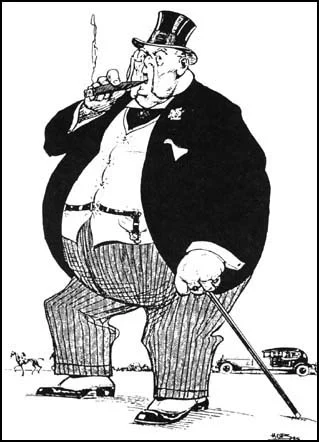
But Ryan did make sure that one group with special needs would have benefited from his legislative wizardry: the CEOs of giant insurance corporations.
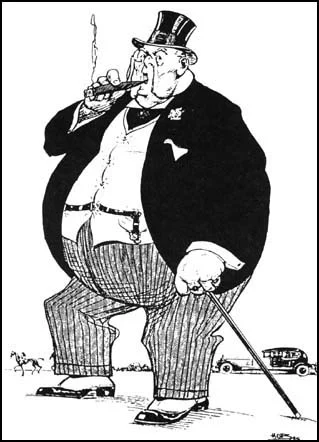
Understandably, none of the GOP lawmakers who’ve been loudly crowing about killing Obamacare mentioned a little, six-line provision hidden on page 67, discretely titled “Remuneration from Certain Insurers.” In plain English, this gob of gobbledygook offers a tax subsidy that encourages insurance conglomerates to increase the pay of their top executives.
Current tax law says insurers can pay as much as they want to top executives, but they can only deduct $500,000 per executive from their corporate taxes. Under Ryan’s rip-off, however, we taxpayers would have at least doubled — and possibly quadrupled — the unconscionable salary subsidies we dole out to these enormously profitable corporations.
The White House and GOP Congress proclaimed that their replacement of Obamacare was “the will of the people.” Really? How many Americans think that jacking up the pay of super-rich insurance chiefs is a proper use of our tax dollars?
And I’d say a big majority of the people would think it immoral to steal lifesaving healthcare benefits from working-class and poor families just to subsidize corporate elites who are already overpaid.
If Republicans actually thought their executive pay subsidy was the will of the people, why did they try so hard to keep it a secret
Jim Hightower is a radio commentator, writer and public speaker. He’s also the editor of the populist newsletter, The Hightower Lowdown.
Sic transit gloria
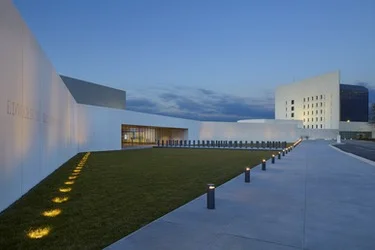
Exterior of the grandiose Edward M. Kennedy Institute for the United States Senate, in Boston.
Adapted from an item in Robert Whitcomb's "Digital Diary'' column in GoLocal24.com
Perhaps memories are short, people are just sick of politics or it’s the effect of the failure of the schools to teach civics. Or maybe most citizens don’t want to worship recently departed politicians, even if they’re from a celebrity family.
I’m talking about the taxpayer-subsidized (through its tax exemption) Edward M. Kennedy Institute for the United States Senate, which is next door to another hagiographic temple --- the John F. Kennedy Presidential Library and Museum – on Columbia Point in Boston’s Dorchester section. Promoters of the monument to the long-serving U.S. senator had projected that the facility would draw up to 150,000 a year, but it has only been luring about 62,000. (Columbia Point, by the way., used to be the site of a grim, gritty and a crime-ridden public housing project.)
That’s despite such over-the-top features as replicas of the Senate Chamber (!) and of the senator’s office in the Capitol.
Life speeds on and memories are short, even regarding someone who served in the Senate from 1962 until his death in 2009 and sponsored important legislation, some good and some bad. The Kennedy clan (with its retainers) has long been among the most self-promotional in American history but the number of those who remember and adore it from its glory days is falling fast. Perhaps its latest star, the bright, modest, congenial and hard-working Massachusetts Congressman Joseph P. Kennedy III, can revive the clan’s national fortunes.
'Bookish New England life'

"The Bookworm'' (1850), by Carl Spitzweg.
"I always wanted to grow up in a house full of books, English books, and I wanted the sort of fireplaces that worked, overstuffed chairs, that whole kind of fantasy of a bookish New England life. So the library gave me that; for the hours that I was there, I was surrounded by that atmosphere that I craved in my life.''
-- Jhumpa Lahiri (fiction writer of Bengali background who grew up in Rhode Island)

James P. Freeman: Boston shows that Charlie Baker was right about charter schools

Plaque on School Street in Boston marking the first site of the Boston Latin School, founded in 1635 as the first public school in what would become the United States.
Boston's charter schools have received a record number of applications. This welcome development should prompt Massachusetts Gov. Charlie Baker, who rightly and robustly supports charter schools, to renew efforts to reconsider expansion of these schools.
As reported in The Boston Globe, 16 charter schools in Boston “collectively received 35,000 applications for about 2,100 available seats,” according to the Massachusetts Charter Public School Association. Those same schools received 13,000 applications in the previous period. It is believed that a new online application system contributed to this year’s spike, making it easier for applicants to apply to multiple schools.
It is yet unclear if the number of applicants increased. Unquestionably, though, demand far outweighs supply; the odds of getting into one of these schools this fall have risen to 16 to one. Previously, there were three or four applicants per seat, The Globe notes, citing a Massachusetts Institute of Technology study.
Such a surge in applications may be surprising since a ballot measure in Massachusetts last fall seeking to expand the number of charter schools failed overwhelmingly, by a margin of 38 percent to 62 percent. Baker supported the measure.
“Opponents,” wrote wbur.com last November, “apparently swayed voters with their arguments that charter schools do not serve the neediest students, drain money from district schools, and could have proved ‘apocalyptic’ for city budgets and led to less state oversight of how charters are run.” (Under a reimbursement formula, the state pays school districts 100 percent of per pupil revenue lost to charters in the first year and 25 percent for the next five years.
In the same article, WBUR quoted Boston City Councilor Tito Jackson (now a mayoral candidate) as saying: “We need to have a communal mentality -- one where we elevate all of our young people.” And Jackson was “calling on state lawmakers to fully fund education -- and focus on building up schools in areas like Boston.”
Describing himself as a “longtime supporter” of Boston’s charter schools, in an opinion piece that appeared in The Globe before the ballot measure vote, Boston Mayor Marty Walsh (now running as an incumbent for mayor) nevertheless also opposed the ballot question. The “reckless growth” of more charter schools, he feared, “would change our charter culture and greatly increase the likelihood of school failures that hurt kids and discredit the reform movement.” And he added, bizarrely, that charter expansion would have been “fundamentally hostile to the progress of school improvement, the financial health of municipalities, and the principle of local control.”
Last January, in another editorial for The Globe, Walsh called for a 10-year, $1 billion investment plan to build “beautiful, innovative new buildings,” and to presumably renovate Boston’s existing 127 schools. The initiative, part of BuildBPS, is “an incredible opportunity,” he said. He ruefully asserts that “generations of struggle for equity in urban schools have left trust gaps.”
Both Jackson’s and Walsh’s statements -- along with those who oppose increasing the number of charter schools -- reflect today’s progressive orthodoxy and expose the weakness of today’s progressive impulses. For progressivism demands greater access to everything -- healthcare, contraception, happiness -- but not greater access to better education, which charter schools provide. And the progressive state -- harking back to the days of classic liberalism -- believes that an endless stream of monetary inputs (“equity”) results in higher cognitive outputs for public school students, who are threatened by additional charter schools.
What do progressives tell those students whose names this week were not be selected in the lottery that determines enrollment? That Boston Public Schools are a better alternative to charter schools?
Charter Schools, independent public schools that operate under five-year charters granted by Massachusetts’s Board of Elementary and Secondary Education, were first authorized by the Education Reform Act of 1993. The first 15 schools opened during the 1995-1996 school year, serving 2,500 students. In 2000 and 2010, legislation was passed to add more schools, to satisfy demand. Today, 78 charter schools educate over 42,000 students annually (representing 4.2 percent of all PK-12 public school population), with nearly 30,000 on waiting lists; Boston is home to 22 charter schools while another 38 are in spread among urban areas outside of Boston.
According to statistics released by the Massachusetts Department of Education, they are remarkably diverse. For the 2016-2017 period, students deemed economically disadvantaged constitute 35.5 percent of charter school population (compared with 27.4 percent for the overall state school population). African-Americans comprise 29.9 percent of charter school population (8.9 percent for the state), while Hispanics are 31.7 percent of charter population (19.4 percent for the state).
And charter schools are remarkably effective. “Charter School Performance in Massachusetts,” a comprehensive study at Stanford University, concluded in 2013 that, “Compared to the educational gains that charter students would have had in TPS [traditional public schools], the analysis shows on average that students in Boston charter schools have significantly larger gains in both reading and mathematics.”
The Baker administration refutes charges that charter schools siphon funds from public schools, to their detriment. In an email communication, Brendon Moss, Baker’s deputy communications director, said that the administration “will continue to make investments in our public schools at historic levels.” Indeed, Moss wrote, funding local schools under the current administration is at an all-time high, now $4.68 billion. The proposed fiscal 2018 budget includes increasing support by more than $90 million, twice the amount required under state law.
Baker understands fully the benefits provided by charter schools and he was right to support their expansion last year. Armed with a record number of applications this year, he should now demand that the legislature correct the mistake clearly made by misguided voters by approving charter school expansion – action that conservatives should robustly support, too.
James P. Freeman, an occasional contributor to New England Diary, is a New England-based writer and former columnist with The Cape Cod Times.
'Natural topographies'

"Play'' (mixed materials on panel), by Luanne E. Witkowski, in her show "Burning Desire,'' at the Kingston Gallery, Boston, through April 30.
The gallery says: "Combining a wide range of art materials Witkowski uses the patterns of woodgrain on panels to emphasize her response to shape and texture repeated and carried throughout the natural world. Burning and marking the surface suggests natural geographies and topographies, while the simplicity of line, relationships of shapes, and the content of color reveal the meaning and power of Witkowski's exploration.''
Bad news for Fidelity analysts?
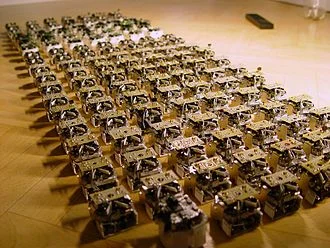
A swarm of robots from the open-source micro-robotic project.
Adapted from an item in Robert Whitcomb's "Digital Diary'' column in GoLocal24.com.
The longest golden age on Wall Street –which began in the 1980s with Reagan era deregulation and tax changes – may be closing for many financial-industry denizens.
As with other industries, computers and automation will wipe out many very high-paying jobs. Consider BlackRock Inc., the world’s largest asset manager. It’s shifting resources away from human stock pickers running funds and charging big fees to lower-cost quantitative stock funds run, in effect, by robots. These analyze data and automatically make predictions and adjust investments accordingly.
While some “actively managed’’ (by real humans) investment funds have done well, in general, “passive investments’’ – e.g., money in index funds that reflect the performance of the stock and bond markets as a whole or industry sectors of them – have generally done better and with lower fees.
What this means is that there will be fewer jobs for stock analysts, stockbrokers and so on. This will slam New York City and its suburbs particularly hard after decades of vast wealth accruing to people on Wall Street. Employment in the financial districts of Boston and some other big U.S. cities will also take a hit. Consider such big Boston financial-services firms as Fidelity and State Street. Of course, the senior executives of the likes of BlackRock, etc., will continue to make a mint.
This recalls the hollowing out of parts of some other white-collar occupations, such as lawyering, where much of the routine work can now be done by low-paid legal assistants (some working in India) using computers.
Ultimately this computerization may also devastate the tax-prep business; many taxpayers already use such programs as TurboTax. But Congress keeps changing the tax laws in response to lobbying from special-interest groups slows the process. Many of us will continue to need to talk to a human to keep up with the relentless fiddling on Capitol Hill.
It being tax time, I’ll slide in here my annual tribute to the underfunded and understaffed Internal Revenue Service. Taxpayers are always blaming the IRS for their tax problems, including the impossibility of understanding much of the tax-law swamp, which grows every year. But citizens blame the wrong people: It’s Congress, sometimes acting on the recommendation of the president, that has produced our abomination of a tax code as legislators respond to interest groups and overuse the tax code for social, economic and political engineering. A prime example is how they create ever more tax credits instead of doing things in a straightforward way, such as directly appropriating federal money for desired programs.
Anyway, remember Oliver Wendell Holmes’s famous line: “Taxes are the price we pay for civilization.’’
Westport River salt marshes eroding away fast
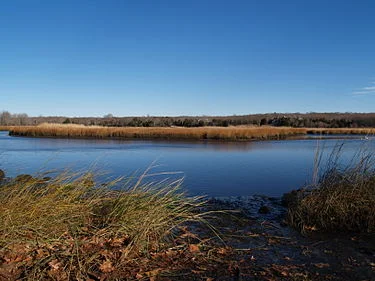
The West Branch of the Westport River.
Via ecoRI News (ecori.org)
WESTPORT, Mass. — Salt-marsh islands in the West Branch of the Westport River have declined by nearly half during the past 80 years, according to a recent report.
By studying aerial imagery of six salt-marsh islands in the river’s West Branch, scientists found that the total area of salt marshes have consistently declined during the past eight decades, with losses dramatically increasing in the past 15 years. Altogether, the six islands lost a total of 12 acres of salt marsh since 1938.
Each island lost between 26 percent and 66 percent of its marsh area, according to the 16-page study conducted by the Buzzards Bay Coalition, the Buzzards Bay National Estuary Program, the Marine Biological Laboratory Ecosystems Center, the Westport Fishermen’s Association and the Woods Hole Research Center.
If marsh losses continue at the accelerated rate observed during the past 15 years, the Westport River’s marsh islands could disappear within 15 to 58 years, according to the researchers.
“If you do a projection, it’s really discouraging,” said Rachel Jakuba, science director at the Buzzards Bay Coalition and the study’s coordinator. “The salt-marsh islands that are currently a characteristic feature of the Westport River could be gone in 50 years.”
Salt marshes are highly productive ecosystems that filter out pollution, provide habitat for wildlife and protect homes from flooding. More than half of commercial fish species on the East Coast use salt marshes for some part of their lives.
The study didn’t find a single cause of the accelerating loss of salt marshes, but cited nitrogen pollution and sea-level rise as two key factors. Dredging projects, erosion from large storms and grazing from crabs may also further increase losses.
Nitrogen pollution is increasingly being identified as a cause. Long-term data collected through the Baywatchers monitoring program show that the Westport River suffers from too much nitrogen pollution, with the largest source being residential septic systems. Although nitrogen pollution fuels the growth of plants, it can also cause the underground root network of salt marshes to become sparse and weak.
By examining samples of marsh plants and sediment, scientists found a relatively low ratio of underground roots and rhizomes to above-ground plant parts at all six islands. This low “roots-to-shoots” ratio suggests that all of the river’s salt-marsh islands are affected by nitrogen pollution, according to the report.
“Nitrogen concentration in the water is one factor that can contribute to marsh deterioration and loss,” said Linda Deegan, senior scientist at the Woods Hole Research Center and the Marine Biological Laboratory Ecosystems Center.
In an experiment she conducted in the Plum Island estuary in northeastern Massachusetts that began in 2003, Deegan and her colleagues found that long-term exposure to high concentrations of nitrogen in the water caused marsh plants to produce fewer roots and decomposition to increase, which led to marsh loss.
“The low roots-to-shoots ratio finding in the Westport River is very similar to our experimental results in Plum Island,” she said.
As sea-level rise accelerates, salt marshes are at risk of drowning from the rising waters. Of the six salt-marsh islands studied, the island with the lowest elevation lost the greatest number of acres since 1938, whereas the two islands with the highest elevations lost the fewest.
“The lowest elevation islands are the most vulnerable to effects of accelerating sea-level rise, but marshes on these islands also receive the most nitrogen from contact with flooding tides,” said Christopher Neill, senior scientist at the Woods Hole Research Center and former director of the Ecosystems Center at the Marine Biological Laboratory. “We strongly suspect these multiple stresses likely combine to accelerate marsh disappearance in many places.”
In addition to field work, the study analyzed at least nine aerial images of each salt-marsh island from 1938 to 2016. Using specialized mapping software, researchers determined how many acres of marsh existed in each aerial image to measure loss over time.
“We were able to ‘go back in time’ and look at changes over the decades at a level of detail that few people have,” said Joe Costa, executive director of the Buzzards Bay National Estuary Program. “Over time you can see tide pools forming on top of the marsh and growing, and you can see the boundaries of salt-marsh islands receding.”
Marsh loss isn’t unique to the Westport River. Marsh loss has been observed in other rivers, harbors and coves around Buzzards Bay and along the entire East Coast. The findings in Westport could be an indicator of the future of salt marshes throughout southeastern Massachusetts.
“Global climate change, exacerbated by nitrogen pollution from local wastewater sources, is having real effects here in our backyard on Buzzards Bay,” said Mark Rasmussen, president of the Buzzards Bay Coalition.
Trump anti-immigrant move hits Boston hospital group hard
The Trump administration is throwing a monkey wrench into plans of 3,814 foreigners who have won hard-to-get positions as residents in U.S. hospitals staring this summer. It’s uncertain how many will be able to start work on time. The administration’s actions might produce serious staffing problems at some hospitals.
The problem is that a program that lets employers fast-track H-1B visa applications (by highly skilled people) for their employees has been suspended as of Monday April 3. Match Day, when new residents learn where they will be placed was March 17. So some hospitals are “rushing to figure out who needed this kind of visa and to apply before ‘premium processing’ would no longer be an option,” reports STAT.
“They are battling against the clock,” Claire Ayer told STAT in reference to her staff in the Partners HealthCare Office for International Professionals and Students, which handles visa applications for the international staff and students of its Boston-area hospitals, including world-famed Massachusetts General and Brigham and Women’s. She said that they had been ”working evenings, weekend and early mornings to get ‘premium processing’ for as many international residents as possible before Monday.”
STAT explains: “The faster turnaround costs $1,225 per applicant, but it makes a difference. With ‘premium processing,’ a visa application is answered in 15 days. Without it, the evaluation can take more than six months — and the government does not allow you to apply for an H-1B visa more than six months in advance.”
Not all international medical residents come to America on an H-1B visa. Most get a J-1, which offers “cultural or educational exchange opportunities.” But, STAT reports, “some either aren’t eligible for a J-1, or don’t want that type of visa because it requires that you return to your home country at the end of your training for two years. And the only way to get around the mandatory trip back home is to work in an underserved community — which, in turn, requires that you get an H-1B.”
Be wary in April

"Poets in other climes may rhapsodize about the vagaries of April weather, its laughter and tears, but in New England the month has inspired few local bards to lyric praise of the region's early spring weather,'' which can be very problematic and often unpredictable.
-- David Ludlum
Perhaps the most famous poetic reference to April is by T.S. Eliot, who although he was born in St. Louis and, after Harvard, moved to England, came from an old and influential Massachusetts family. His chilling words at the opening of his poem "The Wasteland'':
"April is the cruellest month, breeding
Lilacs out of the dead land, mixing
Memory and desire, stirring
Dull roots with spring rain.
Winter kept us warm, covering
Earth in forgetful snow, feeding
A little life with dried tubers. ''

The way we talk now

"Twitter'' (soot, silver foil and acrylic on panel), by Steven Spazuk, in his current show, "Spazuk: Hubris, Beauty & Greed,'' at Adelson Galleries, Boston.
Heaven and hell in colonial art

From the show "Highest Heaven: Spanish and Portuguese Colonial Art From the Collection of Roberta and Richard Huber,'' at the Worcester Art Museum, through July 9.
Despite it all

''Spring is when you feel like whistling even with a shoe full of slush. ''
-- Doug Larson