
Vox clamantis in deserto




A higher order
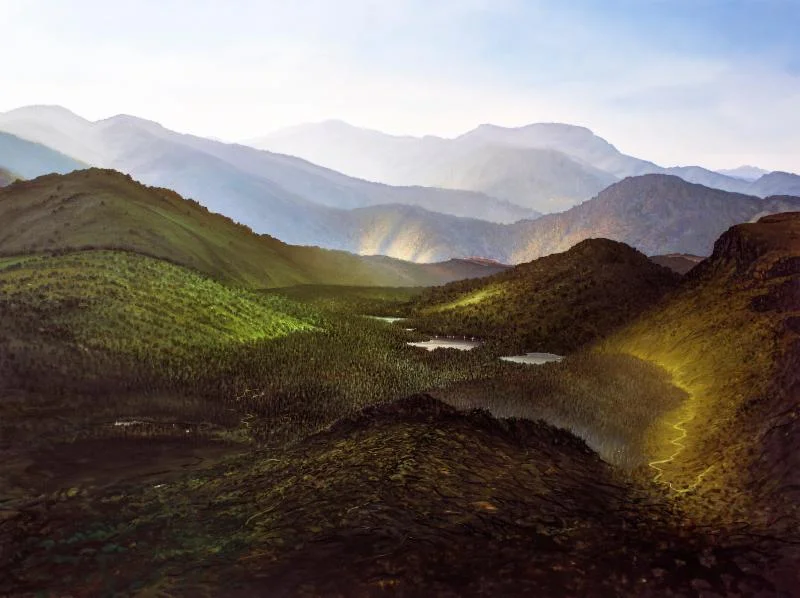
"Between Acceptance and Desire'' (oil on canvas), by Tula Telfair, in the show "Invented Landscapes,'' at Heather Gaudio Fine Art, New Canaan, Conn., through March 25.
An eerie tension

Painting by Andrew Nixon in the grpup show "Between Stillness and Motion,'' at the Bristol (R.I.)) Art Museum through May 28.
How much can governors really help their states' economies?
From Robert Whitcomb's "Digital Diary'' column in GoLocal24.com
Rhode Island Gov. Gina Raimondo was understandably pleased when the state’s unemployment rate fell below the national average in January, to 4.7 percent, for the first time in almost 12 years. Meanwhile, some high-profile companies have moved to the state or expanded there and there’s quite a lot of newconstruction underway. To me, the best news has been that the big projects at the Route 195 relocation land are starting to get cooking and that rapidly growingUnited NaturalFoods Inc. is now based in Providence.
How much of this was due to Ms. Raimondo’s leadership? Economics has so many variables that it’s hard to say. For that matter, the Ocean State is so tiny it’s hard to say that there’s a “Rhode Island economy.’’ It’s part of the much bigger regional, national and international economies. And note that a shrinking state work force explains at least some of the recent jobless-rate drops.
I would say, however, that Ms. Raimondo’s knowledge of business and national connections as a former venture capitalist, her willingness to implement long-overdue reforms and her calm and intelligence have indeed inspired confidence in firms that might be candidates for moving to or expanding in the state. That she’s willing to get very able people from outside the state with fresh perspectives to join her administration rather than automatically pick well-connected Rhode Islanders (“I know aguy…’’) has also been good, although it has, along with her fancy education, gotten her labeled an “elitist,’’ which I don’t believe this daughter of middle-class Rhode Islanders considers herself. The more new people moving into Rhode Island the better, to dilute the parochialism that is at the root of many of its political and economic problems.
As in many states, her administration has had headaches with big computer systems (e.g., public benefits and the Division of Motor Vehicles). Could she have headed these headaches off by firing people faster who were charged with getting them going but didn’t succeed? Probably.
Hire Republican Ken Block, a brilliant systems guy, to oversee state computer systems? That would be exciting.
Ms. Raimondo has gotten a lot of flak from some people about what former Gov. Lincoln Chafee calls the “candy store’’ approach of using tax incentives to lure businesses. I share a lot of this dislike. It can create a race to the bottom as states compete to get sexy companies. As I’ve written here before, for long-term economic success, jurisdictions must focus on broad improvements, especially in education and infrastructure. The governor says she is focusing on those things but the $130 million in tax incentives so far in her term understandably get a lot of attention. And how do you make these companies stay?
Pretty much every state and large city play the tax-incentive game in varying degrees.
Of course, the governor thinks that attracting such big companiesas General Electric to set up new operations in the state signals to other companies that it’s now a good place to do business and, they find, a beautiful place to live for many.
She has had some success in changing the perception of out-of-staters about the Ocean State so that many have come to believe that the Rhode Island is finally, if slowly, fixing its business climate. The deeply embedded tribalism, negativity and cynicism in the state militate against her but I believe she’s making progress – two steps ahead, one step back.
Meanwhile, I’m sure that Rhode Islanders would like to see a updated list of companies that have decided to stay and grow in the state as a result of Raimondo administration policies.
On two big issues she’s been embroiled in: the car tax, about which she is less enthusiastic about cutting than some other politicians, and “free college’’ for two years:
Cutting or eliminating the car tax, as hated as it is, will have little or no effect on the state’s economy. And rather than “free college,’’ it might make far more sense to put some of the tax revenue to be spent on subsidizing students into creating a public-private vocational education system (including apprenticeships) like that which has been so successful in Germany. And even more important is pushing asideRhode Island special interests in order to adopt a K-12 public-education system with the rigor of Massachusetts’s, which has helped make the Bay State so prosperous in the past couple of decades.
'Minor Matterhorn' overlooking 'agricultural failure'

Mt. Chocorua.
"Written over the great New Hampshire region at least, and stamped, in particular, in the shadow of the admirable high-perched cone of Chocorua, which rears itself, all granite, over a huge interposing shoulder, quite with the allure of a minor Matterhorn -- everywhere legible was the hard little historic record of agricultural failure and defeat. It had to pass for the historic background, that traceable truth that a stout human experiment had been tried, had broken down. One was in presence, everywhere, of the refusal to consent to history, and of the consciousness, on the part of every site, that this precious compound is in no small degree being insolently made, on the other side of the continent, at the expense of such sites. The touching appeal of nature, as I have called it therefore, the 'Do something kind for me,' is not so much a 'Live upon me and thrive by me' as a 'Live with me, somehow, and let us make out together what we may do for each other -- something that is not merely estimable in more or less greasy greenbacks.'''
-- Henry James from his book The AmerIcan Scene (1907)

'My avocation and my vocation'

Out of the mud two strangers came
And caught me splitting wood in the yard,
And one of them put me off my aim
By hailing cheerily "Hit them hard!"
I knew pretty well why he had dropped behind
And let the other go on a way.
I knew pretty well what he had in mind:
He wanted to take my job for pay.
Good blocks of oak it was I split,
As large around as the chopping block;
And every piece I squarely hit
Fell splinterless as a cloven rock.
The blows that a life of self-control
Spares to strike for the common good,
That day, giving a loose my soul,
I spent on the unimportant wood.
The sun was warm but the wind was chill.
You know how it is with an April day
When the sun is out and the wind is still,
You're one month on in the middle of May.
But if you so much as dare to speak,
A cloud comes over the sunlit arch,
A wind comes off a frozen peak,
And you're two months back in the middle of March.
A bluebird comes tenderly up to alight
And turns to the wind to unruffle a plume,
His song so pitched as not to excite
A single flower as yet to bloom.
It is snowing a flake; and he half knew
Winter was only playing possum.
Except in color he isn't blue,
But he wouldn't advise a thing to blossom.
The water for which we may have to look
In summertime with a witching wand,
In every wheelrut's now a brook,
In every print of a hoof a pond.
Be glad of water, but don't forget
The lurking frost in the earth beneath
That will steal forth after the sun is set
And show on the water its crystal teeth.
The time when most I loved my task
The two must make me love it more
By coming with what they came to ask.
You'd think I never had felt before
The weight of an ax-head poised aloft,
The grip of earth on outspread feet,
The life of muscles rocking soft
And smooth and moist in vernal heat.
Out of the wood two hulking tramps
(From sleeping God knows where last night,
But not long since in the lumber camps).
They thought all chopping was theirs of right.
Men of the woods and lumberjacks,
The judged me by their appropriate tool.
Except as a fellow handled an ax
They had no way of knowing a fool.
Nothing on either side was said.
They knew they had but to stay their stay
And all their logic would fill my head:
As that I had no right to play
With what was another man's work for gain.
My right might be love but theirs was need.
And where the two exist in twain
Theirs was the better right -- agreed.
But yield who will to their separation,
My object in living is to unite
My avocation and my vocation
As my two eyes make one in sight.
Only where love and need are one,
And the work is play for mortal stakes,
Is the deed ever really done.
-- Robert Frost, "Two Tramps in Mud Time''
Wet reverie

"Abalone'' (oil on canvas), by Reisha Perlmutter, at Dedee Shattuck Gallery, Westport, Mass.
Jim Hightower: Trump's 'jobs' panel consists of fat cats who rip off workers
Via OtherWords.org
By golly, The Donald delivers.
Trump and his new blue-ribbon panel of working-class champions have announced a bold new initiative to create millions of American jobs. A spokesman for the panel, Steve Schwarzman, praised Trump as a leader who wants to “do things a lot better in our country, for all Americans.”
Wait a minute — Steve Schwarzman? Isn’t he a billionaire hedge-fund huckster on Wall Street? Yes — and holy money bags, there’s Jamie Dimon, head of the scandal-ridden bank JPMorgan Chase.
Working-class champions? Hardly.
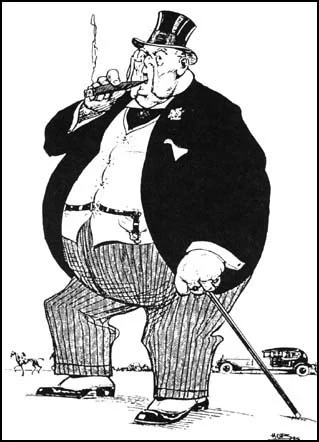
Trump’s whole “jobs” panel, it turns out, is made up of Wall Street banksters and corporate powers like Wal-Mart that are notorious for laying off and ripping off workers.
Trump-the-candidate fulminated against such moneyed elites, calling them “responsible for the economic decisions that have robbed our working class.” But now, in a spectacular flip-flop, he’s brought these robbers directly inside his presidency, asking them to be architects of his economic strategy.
Worse, he’s doing this in the name of helping workers.
Hello! To develop policies beneficial to working stiffs, bring in some working stiffs! But there’s not a single labor advocate on his policy council, in his cabinet, or anywhere near his White House.
Thus, the so-called “job-creation plan” announced by Trump and his corporate cohorts doesn’t create any jobs, but calls instead for deregulating Wall Street.
These flim-flammers actually want us rubes to believe that “freeing” banksters to return to casino-style speculation and consumer scams will give them more money to invest in American jobs.
Do they think we have sucker wrappers around our heads? Trump’s scheme will let banks make a killing, but it doesn’t require them to invest in jobs — so they won’t.
There’s a name for this: fraud.
Jim Hightower is a radio commentator, writer, and public speaker. He’s also the editor of the populist newsletter, The Hightower Lowdown.
Let the kids worry about it!

The carbon-dioxide cycle between the atmosphere and the ocean.
From Robert Whitcomb's "Digital Diary'' in GoLocal24.com.
Not unexpectedly, President Trump is pushing to roll back Obama administration rules requiring that cars run at 54.4 miles a gallon of fuel by 2025, up from 27.5 miles a gallon. That is projected to reduce greenhouse-gas emissions by 6 billion tons over the lifetime of new vehicles and save 2 million gallons of oil a day by 2025. Thus the Obama rules would be good for the environment and good for national security by reducing our need for oil, much of which still comes from nasty places abroad.
Car company senior executives always say that they can’t meet new fuel standards but because of always developing technology they always do. In so doing, they’re making more efficient, better-engineered cars. But they’ll take the easy way out if they can to maximize their short-term profits. Senior execs rarely hold their jobs for more than five years so why should they worry much about bad PR about the long-term environment? Their children and grandchildren can fret about global warming.
But global warming aside, what about cleaner air?
Meanwhile such nasties associated with global warming as acidification of the oceans and the consequent death of coral reefs goes on.
'I'm a tribal chieftain as well'

James Michael Curley in 1922.
“You see,’’ he said, my position is slightly complicated because I’m not just an elected official of the city; I’m a tribal chieftain as well. It’s a necessary kind of dual officeholding, you might say; without the second, I wouldn’t be the first.’’
“The tribe,’’ said Adam, being the Irish?’’
“Exactly.’’
Conversation between fictional Mayor Frank Skeffington, based on the corrupt and charming Boston Mayor James Michael Curley, and his nephew in Edwin O’Connor’s novel The Last Hurrah, which was made into a movie with Spencer Tracy starring as Skeffington.
Mr. Curley was mayor in 1914-1918, 1922–1926, 1930–1934 and 1946–1950, and governor of Massachusetts in 1935-1937.
Good morning

"Amrit Vela'' (encaustic on wood), by Sharon Ligorner, in the group show "Encaustic Art,'' at Francesca Anderson Fine Art, Lexington, Mass., through March 25. "Amrit Vela'' is a Hindi phrase meaning the time few hours before sunrise.
'scandal of Mrs. N and Professor D'
the Cambridge ladies who live in furnished souls
are unbeautiful and have comfortable minds
(also, with the church's protestant blessings
daughters,unscented shapeless spirited)
they believe in Christ and Longfellow, both dead,
are invariably interested in so many things—
at the present writing one still finds
delighted fingers knitting for the is it Poles?
perhaps. While permanent faces coyly bandy
scandal of Mrs. N and Professor D
.... the Cambridge ladies do not care, above
Cambridge if sometimes in its box of
sky lavender and cornerless, the
moon rattles like a fragment of angry candy
-- E.E. Cummings, "the Cambridge ladies who live in furnished souls''
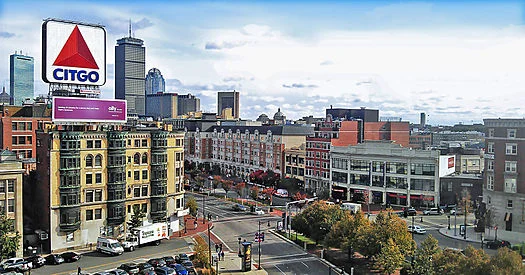
A sign for the '60s
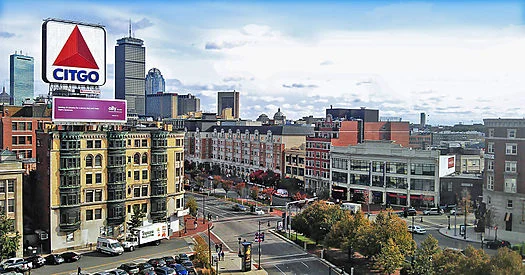
Kenmore Square, with the world's most-famous Citgo sign.
Adapted from an item in Robert Whitcomb's "Digital Diary'' in GoLocal24.com
The famous glowing Citgo signatop a building at Boston’s Kenmore Square will be saved, thus keeping fresh in the minds of now aging Baby Boomer potheads a significant landmark from their youth. Boston officials helped broker a deal between Citgoand a real estate company with the weird name of Related Beal to keep the sign up. The current, “psychedelic’’ version of the sign went up in 1965, just in time to appeal to the hordes of mostly young people in the area who were “experimenting’’ with marijuana.
Daniel Bluestone, an architecture-history professor at Boston University, told The Boston Globe he was very happy about the agreement: “It’s a landmark in the truest sense of the word. It helps people know where they are.” Above-the-street landmarks are particularly important in a city with as confused a layout as Boston.
Of course in the late '60s, many people didn't know 24/7 where they were going.
Public-private partnership seeks to expand Mattapoisett River Reserve
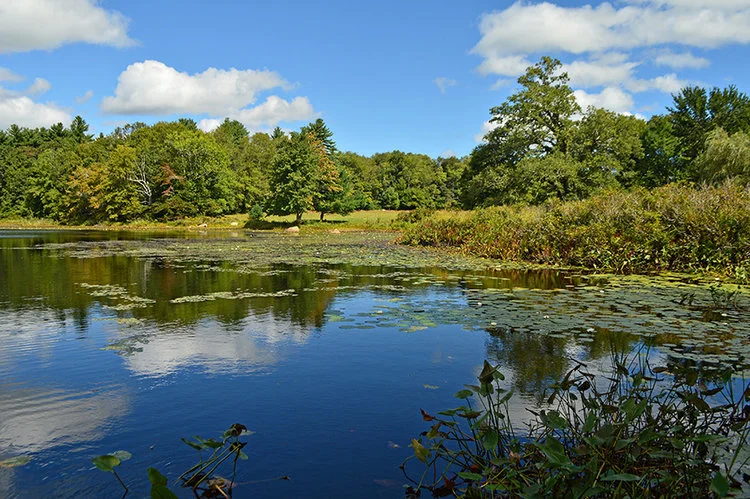
In April, the Buzzards Bay Coalition is expected to open trails at two newly protected properties at Tinkhamtown Woodlands, in Mattapoisett, above, and New Boston Road in Fairhaven, growing the Mattapoisett River Reserve to 530 acres of publicly accessible forests, wetlands and cranberry bogs for hiking, paddling, fishing, hunting and wildlife watching.
-- Buzzards Bay Coalition photo
By ecoRI News staff
See ecori.org
The Massachusetts towns of Fairhaven, Marion, Mattapoisett and Rochester, working in partnership with the Buzzards Bay Coalition, permanently protected from development 1,468 acres of forests and wetlands in the Mattapoisett River valley between 2001 and 2016 — an average of 98 acres annually — to safeguard public drinking-water supplies.
The Mattapoisett River Valley, which spans from Snipatuit Pond in Rochester to Mattapoisett Harbor, is one of the most important water resources in southeastern Massachusetts, according to the Buzzards Bay Coalition (BBC). The underground aquifer supplies drinking water to more than 24,000 residents.
A recently released report details how the Mattapoisett River supports outdoor recreation, a historically active river herring run, and a number of rare and threatened plant and animal species.
Conserving land is one of the most important ways to protect water for drinking, swimming and fishing. Forests, streams and wetlands work together to shield water supplies from harmful pollution. Preserving this land not only safeguards clean drinking water, but it also protects clean water downstream in Buzzards Bay for people, wildlife and aquatic life, according to BBC’s president.
“Many places in Massachusetts and along the East Coast are actually losing much more than 100 acres of sensitive land to development every year,” Mark Rasmussen said. “In the Mattapoisett River valley, with the strong commitment of these four towns, we’ve been able to reverse the trend and permanently conserve our land and water for generations to come.”
In 2000, the BBC partnered with the Mattapoisett River Valley Water Supply Protection Committee, composed of representatives from the four towns, to conserve land in the river valley to safeguard drinking-water supplies. At that time, just 8 percent of the river valley was permanently protected from development. Today, that number has increased to 17 percent.
“Over the years, the Mattapoisett River Valley Water Protection Advisory Committee has developed a successful partnership of land ownership with the Buzzards Bay Coalition,” said Vincent Furtado, superintendent of the Fairhaven Board of Public Works. “This has resulted in preserving open lands for the survival of our environment, which includes protecting our drinking-water supplies, promoting healthier, active lifestyles, and sustaining habitats for native plants and animal species.”
Of the 1,468 acres that have been conserved, 768 acres (52 percent) are in Rochester, 598 acres (41 percent) are in Mattapoisett, 67 acres (5 percent) are in Fairhaven, and 35 acres (2 percent) are in Marion. Altogether, these land-protection efforts cost $13 million, which was split nearly equally between federal, state and local government grants (53 percent) and private funding sources (47 percent).
Land-protection opportunities in the Mattapoisett River valley are strong because many of the remaining undeveloped land exists in large parcels that have been passed down for generations within local families. Most of the total acreage (898 acres, or 61 percent) was protected through outright fee acquisition, in which landowners sold or donated their land to the towns or the BBC.
The rest of the land (571 acres) was protected with conservation restrictions, which allow private landowners to permanently protect their land while still keeping ownership of it.
GOP would cost-shift massive obligatory medical costs to states
Adapted from an item in Robert Whitcomb's "Digital Diary'' in GoLocal 24
The Congressional Budget Office figures that the Republican healthcare bill would reduce the federal budget deficit by $337 billion through fiscal 2026. I doubt that, but even assuming that it’s true, it doesn’t project how much the bill could cost the states.
A problem is that every state mandates that all sick and/or injured people who show up in inefficient and expensive hospital emergency rooms (which is most of them), and indeed at many other providers, must be treated regardless of ability to pay. There will be a heightened flood of such people at ERs over the next few years if the GOP bill is enacted because many of these folks would no longer have coverage that has let them get preventive treatment as part of a regular clinical relationship with a physician, especially with a primary-care doctor.
Hospitals and other providers and state governments would have to eat much of the cost of caring for the low-income people cast off with the demise of the Affordable Care Act. Unless state governments decide that they’ll just let a lot of poor people die on the street. Now that’s libertarian!
As former Massachusetts Gov. Mitt Romney said in 2006 in explaining his health-insurance plan for the Bay State: “Some of my libertarian friends balk at what looks like an individual mandate {as in the future Affordable Care Act}. But remember, someone must pay for the healthcare that must, by law, be provided: Either the individual pays or the taxpayers pay.’’
As for the alleged evil of “individual mandates,’’ states have long had them for auto insurance, and generally those who want to own a home are compelled to buy property insurance to get mortgages.
In any event, the Republican healthcare plan, among other things, is a great big inefficient cost-shifting to the states.
There are elements of the GOP approach that, in principle, have merit. For instance, the Trump administration wants the states to charge Medicaid patients at least some premiums, require them to pay part of their emergency-room charges (Medicaid patients tend to overuse ER’s) and push recipients to get jobs. These changes might reduce some of the vast amount of waste pervasive in American healthcare. And everyone should be reminded that healthcare is never “free’’; it’s just a question of who’s paying for it. But what percentage of Medicaid folks can meet these demands is unknown. Many of them are already under a lot of economic and other stress.
But beware of circles

"Homage to the Square: Festive,'' by Josef Albers, in the show "Small-Great Objects: Anni and Josef Abers in the Americas,'' at the Yale University Art Gallery, New Haven, Conn., through June 18.
GOP senators vs. demagogues
Adapted from Robert Whitcomb's "Digital Diary'' column in GoLocal 24.com.
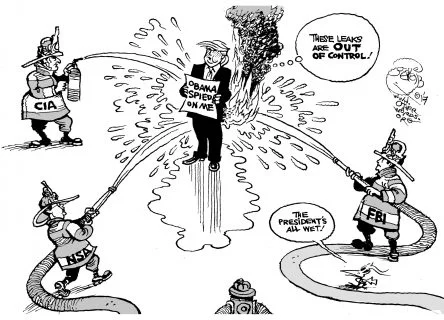
Perhaps it will be a Republican senator who helps bring down the crook who is our president. One honorable and brave young Republican senator who can be expected to keep pushing back against this thug: Sen. Ben Sasse, of Nebraska. Better known GOP Trump skeptics (if that’s the word) include Senators John McCain and Lindsay Graham.
Back in 1954, Sen. Ralph Flanders {R.-Vt.) introduced a successful motion to censure fellow Republican Sen. Joseph McCarthy for his outrageous and lie-laden attacks on individuals that came to be known as “McCarthyism’’. Mr. Flanders felt that McCarthy was distracting America from addressing real and serious threats and were creating division and confusion in the United States to the comfort of our enemies abroad. (Sound familiar?)
Senator Flanders pointed to McCarthy’s "misdirection of our efforts at fighting communism” and his role in “the loss of respect for us in the world at large.’’ Other Republican senators who fought McCarthy included, most notably, Vermont Sen. George Aiken and Maine Sen. Margaret Chase Smith.
William Kristol, editor of the conservative Weekly Standard, recently wrote:
“And then 36 hours later, Saturday morning {on March 4}, we had Donald Trump's latest tweetstorm {alleging that then-President Obama had ordered wiretapping at Trump Tower}. Previous ones had been distasteful and vulgar and unseemly. But this one was different in the depth of its recklessness and irresponsibility. It threatens to unleash real damage on our institutional and constitutional order. Trump's accusing his predecessor of illegally wiretapping him, without presenting any evidence, will make partisan bitterness even more acrid, inflame relations between key institutions of the government, and generally threatens to undermine basic confidence in the rule of law. If Trump's suspicions are true, there are proper ways for him to see to it that they are thoroughly investigated. If the allegations are false, he shouldn't make them. But the whole issue of the Trump campaign, Russia, and the Obama administration now threatens our basic political health in a way we've rarely seen.’’
(Given Donald Trump’s close links with the Putin regime, I wouldn’t be surprised if the FBI (not President Obama) got a judge to authorize spying on Russia-related activities at Trump Tower.)
'Soon!'
Last night beneath the mockery of the moon
I heard the sudden startled whisperings
Of wakened birds settling their restless wings;
The North-east brought his word of gladness, "Soon!"
And all the night with wonder was a-swoon.
A soul had breathed into long-dreaming things;
Some unseen hand hovered above the strings:
Some cosmic chord had set the earth in tune.
And when I rose I saw the Bay arrayed
In her gray robe against the coming heat.
A pulse awoke within the stirring street--
The wattle-gold upon the pavements thrown,
And through the quiet of the colonnade
The smoky perfume of boronia blown.
-- Arthur Henry Adams, " A Spring Sonnet''

David Warsh: Invasion of Iraq was America's 21st Century original sin

U.S. soldiers at the Hands of Victory monument in Baghdad during the invasion of Iraq in 2003.
SOMERVILLE, Mass.
Fourteen years ago today, a U.S.-dominated coalition of forces began bombing Baghdad. The U.S. had demanded that Saddam Hussein leave Iraq within 48 hours. When he didn’t, coalition forces attempted to kill him and his sons in the first hour of their “shock and awe” bombing campaign, beginning the morning of March 19, 2003. George W. Bush went on television that evening to describe the purpose the war to follow: “to disarm Iraq, to free its people, and to defend the world from grave danger.”
The invasion of Iraq was the fulcrum on which much has shifted since. Vladimir Putin’s speech in February 2007 to the Munich Conference on Security Policy dissented sharply from Washington’s vision of a unipolar world and warned against further NATO expansion along Russia’s southern borders.
The “Arab Spring,” beginning in Tunisia in late 2010 (“gripped by the narrative of a young generation peacefully rising up against oppressive authoritarianism to secure a more democratic political system and a brighter economic future,” in one interpretation), swept through Egypt, Libya, Yemen and Syria with profoundly mixed results.
The Islamic State of Iraq and Syria (ISIS) found its footing in the villages and towns along upper Euphrates and Tigris rivers, accelerating the European refugee crisis and contributing to Britain’s vote to leave the European Union. The fall of a friendly government in Kiev in 2013 led to Russia’s annexation of Crimea and civil war in Ukraine. The financial crisis of 2008-09 proceeded separately, contributing greatly to the strain.
The disaster in Iraq is well understood. The best book I know on the war itself is Overreach: Delusions of Regime Change in Iraq (Harvard, 2014), by Michael MacDonald. The broader context is well covered in America’s War for the Greater Middle East: A Military History (Random House, 2016), by Andrew Bacevich. Rise of the Vulcans: The History of Bush’s War Cabinet (Viking, 2004), by James Mann, traces its origins to the experience of America’s defeat in Vietnam.
Yet like a repressed bad dream, the decision to invade Iraq is routinely overlooked as a landmark event. George W. recanted only in joking. Solidarity with his brother helped cost Jeb Bush a primary campaign he was expected to win. Hillary Clinton’s slippery views on Iraq counted against her in the recent election and almost certainly cost her the 2008 Democratic nomination. And Donald Trump, skewered when he claimed he had opposed the war before it started, has scarcely mentioned it since.
As for the newspapers, the editorial board of The Wall Street Journal still thinks that the war was a great idea. The Washington Post has renounced its zest for the war only a little. Even The New York Times has trouble remembering the role its coverage played in fomenting the war. Economicprincipals.com, my Web site, still burns with shame.
The U.S. made various mistakes in the 1990s, when it stood alone as the as the world’s dominant power, but there is a sense in which invasion of Iraq was the 21st Century's original sin, costing credibility around the world – never mind the lives of 5,000 of its soldiers, those of at least half a million Iraqis, and some $3 trillion so far. Until the U.S. comes to terms with its miscalculation, it can expect to misunderstand and be misunderstood
The aftermath of the war is central to today’s controversy with Russia. And with Secretary of State Rex Tillerson warning of a much harder line against North Korea, it could hardly be more relevant. Let March 19 become a national day of reflection.
David Warsh, a longtime columnist on economic, political and media affairs, is proprietor of economicprincipals.com, where this first ran.
Llewellyn King: Look around the world for what works best in health-care systems
''Nothing is ever done until everyone is convinced that it ought to be done, and has been convinced for so long that it is now time to do something else. ''
— F.M. Cornford
There are no simple solutions to complex problems — unless they’ve become so complex that only a simple solution will do. Welcome to health care and insurance in all of their complexity.
Engineers like to say that if a new machine of structure has too many parts, it’s not ready. Not a bad idea to keep in mind when creating a societal structure like health care. One should know where one wants to go; knowing what one doesn’t want isn’t a starting point.
I submit that the goal of health policy, stripped of its advocates, denigrators and rentiers, should be to get everyone insured for the minimum amount of money and best care result. Simple, eh?
Some aspects:
There ought to be enough money for the United States to have universal health care, not a patchwork — a crazy quilt with holes and weak seams. We spend 19 percent of our GDP on health care, but Germany and the Netherlands spend just under 12 percent of theirs on hybrid public/private, comprehensive systems.
Insurance is a probability game, ergo it’s not unreasonable to ask the able-bodied to pay for the sick.
Mandates are not alien to us. We are mandated to pay taxes, drive with licenses and even wear clothes.
The more people covered by insurance, the lower the cost to all.
There seems to be no good explanation in the public record as to why medicine is so expensive in the United States — so much more expensive than elsewhere on earth, under wildly different systems.
The United States is the only country that leans on employers to provide health insurance to employees and to administer the policy and deal with issues that arrive with disputes.
The cost of the service patients receive is opaque once a third-party payer is responsible: the insurer. The basis of a hospital charge is hidden from the patients and policymakers. The patient has little idea what a procedure costs and who benefits from the expenditure, including doctors who own imaging companies, testing labs and even operating theaters. At the time of delivery, as Norman Macrae noted in The Economist years ago, neither the doctor nor the patients has an interest in the cost.
Hospitals are burdened with emergency rooms that can’t refuse the uninsured and hide this cost by overcharging elsewhere.
For more than 30 years I operated a publishing business and provided health care for my employees. It cost. It cost in time. It cost in premiums. It cost in employee well-being because as the premiums (well before Obamacare) rose by 15 percent to 25 percent, I was forced to shop for providers — which meant, in many cases, new doctors for my employees every year.
After salaries, health care was the big expenditure. I thought I was in the publishing business, but I was also, reluctantly, in the health care business.
I was keen that people have the security that goes with not having to be frightened of getting sick or falling off a bicycle. Some of my employees were on a spouse’s policy as well as mine and didn’t tell me. One man, a printer, said he didn’t like to fill in forms, so he, his wife and three children just told the hospital emergency room that the family had no money. He wanted me to give him what I was paying the insurer so he could spend it.
None of the proposals now before Congress, nor those codified in Obamacare, address the fact that as a nation we backed into health care and created complex set of stakeholders — some of whom should leave the field.
For someone who has wrestled with health care as a provider, as in other things, I believe that if the purpose is not defined, you’ll get the wrong result no matter how hard you try.
The big questions Congress should be asking of the House Republican health care plan, backed by President Donald Trump, are: Will it save money? Will everyone be covered adequately? From my point of view, Congress is proposing to replace a monster with a monstrosity.
That’s no prescription for a healthy nation, free from fear of accident or illness. Time to grab a clean sheet of paper and start again, maybe check on what works around the world, if that isn’t too damaging to our self-esteem.
Llewellyn King (llewellynking1@gmail.com) is host and executive producer of White House Chronicle, on PBS, and a veteran publisher, columnist and international business consultant. He's a frequent contributor to New England Diary. This piece first ran in Inside Sources.