
Vox clamantis in deserto








'On and on...until..'
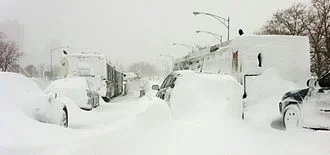
“A small and sinister snow seems to be coming down relentlessly at present. The radio says it is eventually going to be sleet and rain, but I don't think so; I think it is just going to go on and on, coming down, until the whole world...etc. It has that look.”
Edward Gorey, from Floating Worlds: The Letters of Edward Gorey and Peter F. Neumeyer

Chris Powell: What kind of a state would depend on money from casinos and potheads?

At the Connecticut state Capitol the issue is being framed as whether Connecticut should legalize marijuana. But that's not really the issue at all, since marijuana long has been effectively legal in the state for several reasons: because of its common use and the reluctance of courts to punish people for it; because possession of small amounts has been reduced to an infraction; because marijuana production and sales have been legalized for medical purposes; and because the federal government has stopped enforcing its own law against marijuana in those states that don't want it enforced.
The real issue is whether state government should get into the marijuana business -- licensing dealers and taxing sales in the hope of raising as much as $100 million a year to offset state government's financial collapse. Such a scheme would introduce marijuana to many more people, especially minors, who, even if the age for purchase is set at 21, will get it from their older friends, just as minors now get alcohol.
As has happened with legalization in Colorado, many more students will come to school stoned or get stoned there. Intoxicated driving will increase, even if much of the increase will result from Connecticut's refusal to prosecute first offenses. And since Connecticut's criminal sanctions against marijuana have largely disappeared already, legalization won't give the state much financial relief on the criminal-justice side of the budget.
There's another problem with licensing and taxing: It would constitute nullification of federal drug law. Nothing obliges Connecticut's criminal statutes to match the federal government's, but licensing and taxing, profiting from federal crimes, is secession -- and unless federal drug law was changed, the federal government could smash Connecticut's marijuana infrastructure at any time. In any case the half-century of President Nixon's "war on drugs" has shown that drug criminalization is futile and may have only worsened drug addiction while maiming millions of lives with prison sentences.
The drug problem needs to be medicalized, which, while increasing the availability of drugs, will also increase treatment and eliminate most crime and imprisonment expense. But the General Assembly isn't considering medicalization. Instead the legislature is giving the impression that the state's salvation lies in taxing potheads and more casino gambling. Even if that could close its budget deficit, what kind of state would this be?
xxx
The big argument for the Connecticut General Assembly's approval of Gov. Dannel Malloy's renomination of Justice Richard Palmer to the state Supreme Court was that judicial independence required it. This was nonsense, a rationale for accepting whatever appellate judges do to rewrite constitutions. The freedom of judges to decide particular cases within established frameworks of the law is one thing. The freedom of judges to rewrite not just the law but constitutions themselves is another, which is what Palmer did in the Supreme Court's decisions on same-sex marriage and capital punishment.
His decision invalidating capital punishment was dishonest, opportunistically misconstruing the legislature's revision of the capital punishment law, which precluded death sentences for future crimes while sustaining pending sentences. Palmer maintained that the legislation signified that the public had turned against capital punishment though the new law was written as it was precisely because the public very much wanted the pending death sentences enforced. Public officials in Connecticut have certain insulation but none is completely above deliberative democracy. Governors and judges can be impeached, legislators expelled, and judges denied reappointment. The legislators who voted against reappointing Justice Palmer had good cause consistent with good constitutional practice.
Chris Powell is managing editor of the Journal Inquirer, in Manchester, Conn.
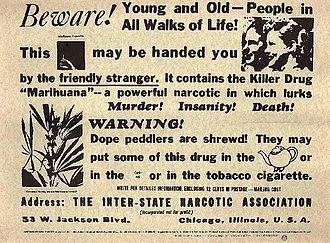
Anti-marijuana-use poster from 1935.
And none of them happy

"Three Men in a Gallery,'' by Kathy Dixon, in the show "Shore Shore Photographers,'' at the South Shore Art Center, Cohasset, Mass., through April 30.
Looking at Brazil and the Southern Cone after a wild year
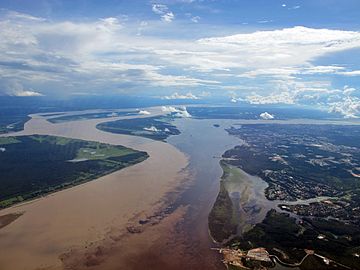
Over Brazil's Amazonia.
March 14, 2017
To members and friends of the Providence Committee on Foreign Relations (thepcfr.org; pcfremail@gmail.com).
Distinguished Brazilian political economistand commentator Evodio Kaltenecker (whom some of you may remember from a few years ago) willspeak on Thursday, March 16, about the challenges and opportunities facing that huge nation (the world's fifth biggest, both in population and area) as well as conditions in South America’s Southern Cone – Uruguay, Argentina and Chile.
Brazil, of course, has had a difficult time in the past couple of years, with economic depression, political upheaval, Zika and a fraught Olympics.
The official title of Mr. Kaltenecker's talk:
"Brazil: 2018 and beyond and the pro-market wave in Latin America''.
Modernist chowder

Today we take New England clam chowder as something traditional that makes our roots as American cooking very solid, with a lot of foundation. But the first person who decided to mix potatoes and clams and bacon and cream, in his own way 100 to 200 years ago, was a modernist.
-- Jose Andres (Spanish-American chef)
Late-winter dusk

--Photo by Charles Pinning
Rolling down Angell Street at dusk on College Hill, Providence.
Gray matter

"One on One'' (off Coast Guard Beach, Eastham, Mass.), by Bobby Baker. Copyright Bobby Baker Fine Art Photography.
The road from Rio
March 12, 2017
To members and friends of the Providence Committee on Foreign Relations (thepcfr.org; pcfremail@gmail.com).
New England’s bizarre climate – the worst part of the winter comes near its end this year!
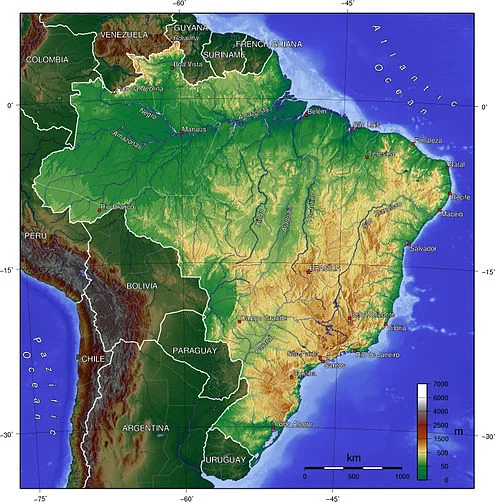
Distinguished Brazilian political economist and commentator Evodio Kaltenecker will speak on Thursday, March 16, about the challenges and opportunities for that huge nation as well as conditions in South America’s Southern Cone – Uruguay, Argentina and Chile. The recent past has been very tumultuous in Brazil particularly. Will the instability continue?
The title of his talk:
Brazil: 2018 and beyond and the pro-market wave in Latin America.

At least they don't look unfriendly

"The Silent Ones'' (acrylic on canvas), by Michael Shores, in his show "Cloud Creatures and Other Delusions,'' at Galatea Fine Art, Boston, April 1-30.
He says that many of his paintings were "inspired by a visit to a sacred ancient place in the American Southwest where "I experienced an epiphany of biomorphic forms in sandstone....Perhaps a visit to another planet might be the closest feeling. Being there completely convinced me of the existence of an alien life form that existed million of year before man.''
Retrofitting Art Deco buildings ain't cheap

The United Shoe Machinery Building, on Federal Street in Boston's financial district.
Adapted from Robert Whitcomb "Digital Diary,'' in GoLocal24.com
Providence’s Industrial Trust Building (aka the Superman Building) might be best used for design studios for Providence’s big art and design community on the first few floors over the ground floor (which could have restaurants and shops), and then apartments and condos and then a restaurant near the top. If none of these soon become economically plausible, then tear the damn thing down; it’s starting to fall apart. The building is probably too clunky and outdated (with its step-backs) to lurea big company.
Of course, if Providence were as rich as Boston, there would be enough money around to retrofit the mini-skyscraper as well as was done at the great art deco United Shoe Machinery Building in downtown Boston.
He needed that

"The way a crow
Shook down on me
The dust of snow
From a hemlock tree
Has given my heart
A change of mood
And saved some part
Of a day I had rued.''
-- Robert Frost, "Dust of Snow''
Frank Carini: The horrific effects of plastic pollution

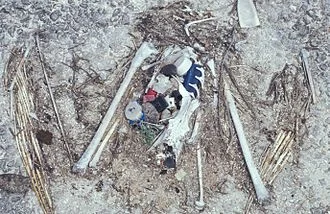
The remains of this Laysan albatross chick on Midway Island in the Pacific show the plastic it ingested before death, including a bottle cap and lighter.
The amount of plastic choking the planet, most notably the world’s oceans, is unfathomable. The evidence of this unrelenting assault overwhelming. The scale of this toxic pollution horrifying.
Consider:
It’s estimated that there are 5.25 trillion pieces of plastic debris in the ocean, from 269,000 tons afloat on the surface to some 4 billion plastic microfibers per square kilometer in the deep sea.
Plastic bags break up into smaller pieces, but their footprint never vanishes. If they do break down, it’s into polymers and toxic chemicals. Some 500 billion single-use plastic bags are used annually worldwide. If you joined them end to end, these petroleum pouches would circumnavigate the globe 4,200 times. Only a minuscule fraction are recycled or reused.
Twenty-five billion Styrofoam cups are thrown out annually in the United States alone.
A single tube of facial scrub can contain more than 330,000 plastic microbeads. A single microbead can be a million times more toxic than the water around it.
Nearly 3 million plastic bottles, every hour of every day, are used in the United States. Less than 30 percent are recycled.
More than 300 million plastic straws are used every day in the United States. Straws are too small to be easily recycled, so they typically become trash. Plastic straws are one of the top beach polluters worldwide.
Eight million tons of plastic are dumped into the world’s oceans every year.
About 100,000 marine creatures die every year from plastic entanglement.
About a million sea birds are killed every year by plastic. A record 276 pieces of plastic where found in one dead bird. It was 90 days old.
At least two-thirds of the world’s fish stocks are suffering from plastic ingestion.
A 2016 study warns that there will be more waste plastic, by weight, in the ocean than fish by 2050, unless humans clean up their act.
“We’ve plasticized the entire biosphere, including our bodies,” said Marcus Eriksen, research director and co-founder of the 5 Gyres Institute. “The impact of plastic is widespread, and it’s destroying the oceans.”
Eriksen was one of four guests who spoke March 4 at Brown University during a panel discussion titled “The Plastic Ocean.” The discussion also featured photographer Chris Jordan, Georgia State University professor Pam Longobardi and author Carl Safina.
In January, ecoRI News hosted a screening of A Plastic Ocean at the Cable Car Cinema, in Providence. Both events highlighted a serious problem.
Plastics production has increased twenty-fold since 1964, according to last year’s The New Plastics Economy: Rethinking the future of plastics study. Production is expected to double again in the next 20 years, and almost quadruple by 2050.
The world’s plastic problem was first identified in the 1970s. In 1987, a law was eventually passed to restrict the dumping of plastics into the ocean. The Marine Plastic Pollution Research and Control Act went into effect Dec. 31, 1988, making it illegal for any U.S. vessel or land-based operation to dispose of plastics in the ocean.
However, this act and other laws like it, such as the Microbead-Free Waters Act of 2015, can’t compete with mass consumption and throwaway societies.
In 2000, Eriksen traveled to Midway Atoll — a 2.4-square-mile island roughly equidistant between North America and Asia — where he found hundreds of dead Laysan albatross with plastic-filled stomachs. The visit narrowed Eriksen’s environmental focus, and led to the creation of his Los Angeles-based nonprofit that empowers action against the global health crisis of plastic pollution through science, art, education and adventure.
More than 600 animal species are impacted by plastic, through ingestion or entanglement, both of which can sicken or kill them, according to the 5 Gyres Institute. Birds, fish, turtles, dolphins, sharks and whales can be poisoned or trapped by plastic waste.
“There’s pieces of plastic out there with shark bites, turtle bites,” said Eriksen, noting that smaller pieces of plastic can be found everywhere in the world’s oceans. “The world is covered by microplastic particles. The fact we can find plastic in the middle of the ocean is a tragedy of the commons.”
Photographer Chris Jordan followed Eriksen to Midway Atoll. He has visited the far-flung island in the North Pacific Ocean several times. His photographs have vividly captured the destruction caused by plastic. The experience was soul-crushing.
Jordan, the first speaker at the recent panel discussion, introduced himself this way: “I’m the guy who took the horrible photos of the birds with plastic in their stomachs.”
As the Seattle-based photographer shot pictures and videos of plastic-ridden bird carcasses, he found himself sobbing. “Being with dying birds and seeing their suffering ... I felt the grief,” he said. “I never knew how much I cared about these animals.”
“We could be living in such a different way,” Jordan said. “There’s nothing standing in the way of radical change in global behavior. Science is telling us that we need this change.”
Pam Longobardi with some of the plastic she has collected from beaches around the world during the past 10 years. She makes art with some of it, to raise awareness of the world’s plastic problem, archives some of it and recycles as much of it as she can. (Drifters Project)
In 2006, after discovering mountains of plastic on remote Hawaiian shores, Pam Longobardi founded the Drifters Project. During the past decade, the nonprofit has removed tens of thousands of pounds of debris, mostly plastic, from the natural environment and reused the material as communicative social sculpture, to create awareness of the problem.
“The ocean ecosystem is full of life ... and it’s in trouble,” Longobardi told those gathered in the Brown University auditorium. “The ocean is vomiting plastic because it’s full.”
She called plastic a crime against nature, and noted that all this pollution is creating an environmental and racial crisis.
“Plastic comes back to haunt us,” she said. “It’s the ghost of our consumption.”
Longobardi has led “forensic beach cleanings” around the globe, from emptying plastic-filled caves on Kefalonia, an island in the Ionian Sea, west of mainland Greece, to scrubbing beaches in Hawaii. She’s currently running a project in Lesbos, a Greek island in the northern Aegean Sea off the coast of Turkey.
Change is possible, and the four speakers noted that, despite the best efforts of lobbying groups such as the American Chemistry Council, a tipping point is fast approaching.
For instance, applying circular economy principles to global plastic packaging flows could transform the plastics economy and drastically reduce negative externalities such as leakage into oceans, according to the 2016 report by the World Economic Forum and Ellen MacArthur Foundation.
“Why are we packing yogurt that lasts three weeks into containers that last forever?” Eriksen asked.
Individual behaviors are also changing.
“When I see a piece of plastic, I pick it up,” Longobardi said. “I know it won’t be consumed by a bird or animal.”
Frank Carini is editor of ecoRI News, where this first ran.
Jim Hightower: Hypocrite House speaker should spare us his lectures on morality of entitlements
Via OtherWords.org
For nearly half a century now, America’s middle-class working families have been pummeled by corporate greedmeisters and their political henchmen.
Indeed, during the recession, the typical median-income family has lost 40 percent of their wealth. Haven’t they been punished enough?
No, says U.S. House Speaker Paul Ryan.
Along with other top Republican leaders of Congress, he intends to slash the Social Security money that middle-class and low-income workers depend on for their retirement, and he ultimately aims to kill it altogether.
Dependence on such public “entitlements,” he preaches, weakens our nation’s morality.
Entitlements? Social Security isn’t a welfare program — regular working people pay a 12-percent tax on every dime of their wages into this public pension fund year after year. They earn their retirement.
Morality? Social Security embodies America’s core moral value of fairness and our society’s commitment to the common good. And it works: Before it was enacted, half of all Americans spent their “golden years” in poverty.
Social Security has saved the great majority of us from old-age penury. Where is the morality in stealing away this earned retirement — and the modicum of dignity that comes with it — from millions?
Besides, a sermon on the morality of entitlements should never come from a congress critter’s mouth.
Ryan himself wallows in a mud pit of congressional entitlements that working stiffs couldn’t imagine getting: A $223,500 annual paycheck, a free limousine and chauffeur, a maximum-coverage health plan, a tax-paid PR agent, a lavish expense account, free travel — and, of course, a platinum-level congressional retirement program funded by the very taxpayers whose Social Security he’s out to kill.
Yet Ryan wonders why Congress’ public approval rating is plummeting toward single digits.
Jim Hightower is a radio commentator, writer, and public speaker. He’s also the editor of the populist newsletter, The Hightower Lowdown.
It's been a lot worse
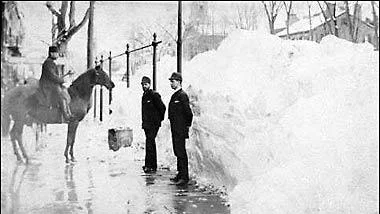
A scene in Middletown, Conn., just after the Blizzard of '88, still considered by many to be southern New England's most fabled such storm, dumped more than 50 inches in some places on March 11-14, 1888.
"March is frequently a wintry month in New England. Not until the close of the month do the chances of a twelve-inch snowstorm or a morning of zero cold diminish to a minimal percentage possibility. One needs only recall the rugged month of March, 1956, when six storm systems crossed the region, and back-to-back snowstorms on March 17-18 and 20-21 paralyzed the Boston area.''
--From The Country Journal New England Weather Book, by David Ludlum
My siblings and I liked the March 1956 storms' drama on the Massachusetts coast, which included the wreck of the freighter Etrusco on the shores of Scituate and, of course, a few days without school. My parents, however, were bitter about the inconvenience and disillusioned by Mother Nature's arrogance and deception. The storms followed what had been generally a very mild and easy (aka "open'') winter.
-- Robert Whitcomb
Finally, 'Open Space Master Plan' for fabled Newport

The U.S. Naval War College, in Newport.
The Newport Open Space Partnership is very close to making public its “Open Space Master Plan,” which the Newport Daily News says is the “first citywide open space planning effort since [legendary landscape architect} Frederick Law Olmsted Jr. published “Proposed Improvements for Newport,’’ in 1913. ‘’ Amazing that with all the changes in the City by the Sea in the past century that it has taken this long!
“It’s a high-quality planning document,” Scott Wheeler, the city’s arborist and supervisor of buildings, ground and parks, told the paper. “It will be invaluable as a helpful guide to much of what we do. It has already helped us.” Good news for one of the most interesting, colorful and complicated cities in America and one that despite its small size, is well known around the world. Mr,. Olmsted, famed designer of New York's Central Park, would have been pleased.

Migration and our sense of place

"Migration,'' by Adrienne der Marderosian, in the show "Up/Rooted,'' at the Brookline (Mass.) Art Center, March 17-April 21.
The gallery says that the show "explores origin, displacement and the influence of the past on the future...and how culture and identity relate to our sense of place.'' The show includes 59 artists working in painting, mixed media, photography, charcoal, glass, monoprint and more.
Happy travel news
Kudos to the Raimondo administration and others involved in bringing Norwegian Airlines to T.F. Green Airport! The Federal Aviation Administration and others have long wanted Green to offer regular international flights, to, among other things, reduce congestion at Boston’s Logan International Airport. Certainly southeastern New England has the population density to support a major international airport.
The extension of the main runway to 8,700 feet due to be completed at year’s end should draw more international airlines since the longer runway means very long-haul airlines can use it. Rhode Island, Massachusetts and Connecticut business should study how they can best benefit from Green’s expanded role in international travel.
xxx
In other happy travel news:
Gov. Charlie Baker is now looking again at closing the broken, one-mile link in the Northeast rail corridor between South and North stations in downtown Boston that prevents connectivity between commuter rail systems and interrupts Amtrak service. I hope that he sees this as a priority. Closing the link would ultimately help most New Englanders. This was a dream of former Gov. Michael Dukakis, but fiscal and political pressures blocked the way.
Timothy J. Babineau, M.D.: Study what works well in U.S. healthcare and build on it
American healthcare is expensive. Too expensive. On this, there is little debate. In 2001 the median U.S. household spent 6.4 percent of its income on healthcare; by 2016, the same household spent 15.6 percent of its income on healthcare. That bigger share of the pie leaves less for other essential purchases such as food, education and housing.
The same phenomenon exists at the national level, with spending on education, the environment and social programs getting squeezed. Recent estimates from the Centers for Medicare and Medicaid Services (CMS) have the American healthcare tab coming in at $3.6 trillion for 2016 and projected to continue to soar through 2025. Despite broad agreement that rising healthcare costs are unsustainable, the root causes of the rates of increase and the best ways to combat them remain the subject of some debate and confusion.
Numbers matter. The 80/20 rule—known to healthcare actuaries as the Pareto principle, posits that 80 percent of all medical spending is incurred by only 20 percent of the population. Whether a population is defined as a company, a county, or a country, most healthcare spending is for care of a small minority of individuals. Moreover, the bulk of that spending arises from either largely unavoidable or unpredictable single events (such as trauma or sudden-onset acute illnesses); such chronic conditions such as diabetes; complex episodes of care for such illnesss as cancer, and care delivered at the end of life.
A critical (but often overlooked) point is the fact that as much as 40 percent of spending during chronic and complex episodes is avoidable if providers and systems adhere to established standards of care. Reining in runaway healthcare spending must involve better management of high-cost episodes of chronic and complex care.
A key buzzword in today’s debate is “population health”. Confusion occurs when the term is interpreted as a strategy for controlling healthcare costs when it is applied across our entire population as opposed to the sickest 10 percent or 20 Percent. Wellness initiatives, early detection, the avoidance of emergency room visits, and disease prevention have undeniable value, and should all be pursued, but they will not (by themselves) sufficiently reduce healthcare spending by enough to make the system “affordable”.
As the Baby Boomers swell the ranks of Medicare beneficiaries, the inevitability of illness is the only certainty in an otherwise uncertain world. To be successful, programs, payment systemsand policies to curb healthcare spending must focus on improving the efficiency and effectiveness of care delivered to the sickest subset of the population. This is best accomplished within a completely integrated healthcare-delivery system.
American hospitals and healthcare systems are among the best in the world. Rather than asserting that “American healthcare is broken” and in need of rebuilding from scratch, a better strategy may be to look at what works well within our system and ask how we can build on those strengths while facing the escalating costs head on. Hospital systems are in the health care business, and we should not be reluctant to say so. No matter what wellness and prevention programs we collectively offer, inevitably a small subset of the population will still get very sick, and it is a core mission of health systems—working in close partnership with our primary and specialty providers—to take the very best and most efficient care of them when that happens.
Irrespective of what happens with the Affordable Care Act (ACA), as leaders in health care, we must redouble our efforts to eliminate unnecessary variations and wasteful spending in the clinical care we deliver to patients.
Rather than debate the actual percentage that is “wasteful spending” (now commonly referenced at around 30 percent) we would be better served by continuing the hard work of identifying and eliminating areas within our own systems where needless variations in care add cost without improving outcomes. As Lifespan, the system I lead, continues to evolve into a comprehensive, high-value, integrated healthcare system, we are doing just that.
Timothy J. Babineau, M.D., is president and chief executive of Providence-based Lifespan, a large hospital system, and a professor of surgery at the Warren Alpert Medical School of Brown University.
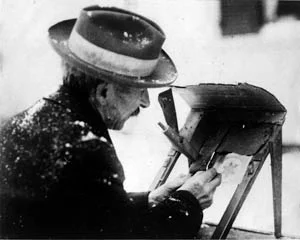
'A masterpiece of design'

Photos by Wilson Bentley, circa 1902.
Wilson "Snowflake" Bentley
Photographer, (1865-1931)
Mr. Bentley, of Jericho, Vt., was one of the first photographers to closely study and photograph snowflakes. See his picture below.
"...But always, from the very beginning, it was
snowflakes that fascinated me most. The farm
folks, up in this north country, dread the winter;
but I was supremely happy, from the day
of the first snowfall-which usually came in
November-until the last one, which sometimes
came as late as May."
"Under the microscope, I found that snowflakes
were miracles of beauty; and it seemed a shame
that this beauty should not be seen and
appreciated by others. Every crystal was
a masterpiece of design and no one design was
ever repeated. When a snowflake melted, that
design was forever lost. Just that much beauty
was gone, without leaving any record behind."
He died of pneumonia at his farm on Dec. 23, 1931, after walking home six miles in a blizzard.
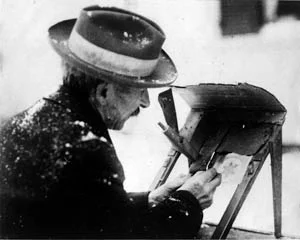
Mr. Bentley at work.