
Vox clamantis in deserto







In an unresolved season

"Resolutions'' (oil on canvas), by Julia Purinton, at Alpers Fine Art, Andover, Mass.
James P. Freeman: With the Trump vaudeville show, it's back to 'Laugh-In'
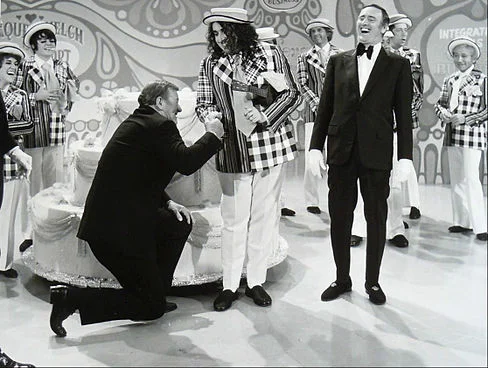
John Wayne and Tiny Tim helped Laugh-In celebrate its 100th episode in 1971. Co-host Dan Rowan yucks it up in his tuxedo.
“… let’s go to the party!”
— Dan Rowan
Without a trace of transgression, Time recently described Donald Trump and his nascent administration as “a vaudeville presidency.” The other week, with absurd appearances by several of the president’s principal architects, the Conservative Political Action Conference (CPAC) unwittingly staged this politically charged vaudeville act, replete with comedy, contortion, and commotion that, at times, resembled the television program Rowan & Martin’s Laugh-In that ran in the late 1960s and early 1970s.
“Groovy!”
Hosted by comedians Dan Rowan and Dick Martin, the unique variety show was, says tv.com, “a fast-moving barrage of jokes, one-liners, running skits, musical numbers as well as making fun of social and political issues” of the period. And so was, CPAC 2017.
Writing for The New York Times Magazine in 1968, Joan Barthel observed that “whatever else it is — and at one time or another Laugh-In is hilarious, brash, flat, peppery, irreverent, satirical, repetitious, risqué, topical and in borderline taste — it is primarily and always fast, fast, fast! And in this it is contemporary. It’s attuned to the times. It’s hectic, electric …”
And so is the Trump administration, which, in its first month has proven to be a series of recurring, improvisational sketches, careening with disorder. Hence, the surreal Laugh-In connection.
“You bet your sweet bippy!”
In the television program, “guests” at the “Cocktail Party” would mill around with drinks in hand or dance to music that would suddenly halt when a party-goer would face the camera to deliver a one-liner or a quick joke. (Today’s party stops and starts again after President Trump transmits on Twitter his version of one-liners. (Remember the infamous tweet about the “so-called judge”?)
CPAC was, without a hint of hysteria, hijacked by a few of its guests vicariously reprising several popular segments of Laugh-In: “Mod, Mod World,” (Russian sabotage?); “Laugh-in Looks at the News” (fake news?); and the “Joke Wall” (the great Wall of Mexico?). With life imitating art, these cameo appearances made this year’s CPAC disturbingly memorable. And laughable.
Kellyanne Conway, counselor to the president, a few weeks ago on Meet the Press said that the White House press secretary used “alternative facts.” (Of which Rolling Stone rightly said, “the Trump presidency had its first laugh line.”) Telling attendees on Feb.23 in anticipation of Trump’s appearance the next day of the conference — stop the music! — “Well, I think by tomorrow this will be TPAC.”
But what was lost among the intermittent laughter was this stunning punchline: “Every great movement,” Conway said, “ends up being a little bit sclerotic and dusty after a time.” That line was directed at Reagan conservatives. Just as Laugh-In had obliterated conventional variety show boundaries, Trump World is eschewing traditional conservatism, simultaneously ransacking it and redefining it. Even as Conway formally announces the end of the Reagan Revolution, President Trump cleverly says his victory was a “win for conservative values.”
“Verrrry interesting!”
Apparently, Vice President Mike Pence was never let in on the punchline. After finishing his introductory remarks to CPAC with the jab, “all kidding aside,” Pence delivered this bizarre, if not ridiculous comparison: “From the outset, our president [Trump] reminded me of somebody else. A man who inspired me to actually join the cause of conservatism nearly 40 years ago. President Ronald Reagan.” Later, Pence quoted Scripture. Stop the music, again!
And then there was the question-and-answer session with the dynamic duo, Steve Bannon, White House chief strategist, and Reince Priebus, White House chief of staff. Trying to convey a patina of unity and order to this “fine-tuned machine,” Priebus said, “the truth of the matter is … President Trump brought together the party and the conservative movement.” And Priebus also compared Trump to Reagan saying the former also sought “peace through strength.”
Gannon (who led the crusading “alt-right movement” while at Breitbart, used to host his own counterprogramming conference to CPAC, called the “Uninvited”), straight faced, said, “The reason why Reince and I are good partners is that we can disagree.” Hilarious.
Laugh-In fashioned its aesthetic from the counterculture of the 1960s (“sit-ins,” “love-ins,” and “teach-ins”), reasons britannica.com. The show “tapped into the zeitgeist in a way no other show had, appealing to both flower children and middle-class Americans.” And Bannon, a counterculture conservative, likewise believes that “the power of this movement” will appeal to a broad spectrum of people too. Or will it?
One board member of the American Conservative Union (CPAC’s host) told The Daily Beast that, “‘The craziest elements of the [party] have managed to get every single thing they wanted over the past year … This is the shape our movement is in today.’”
“And that’s the truth!”
But first, a few words from our president, who openly mocked CPAC in his monologue-cum-speech Feb. 24 by declaring, “You finally have a president.” (Read President Reagan’s elegant 1981 CPAC speech, and his 1987 CPAC speech in which he imagined the future of conservative values; “a vision that works.”) Trump in his stand-up said, “We’re going to put the regulation industry out of work and out of business. And, by the way, I want regulation.” On his Cabinet: “I assume we’re setting records for that. That’s the only thing good about it, is we’re setting records. I love setting records.”
Recalling his first CPAC speech years before, with “very little notes, and even less preparation,” Trump quipped, “So, when you have practically no notes and no preparation, and you leave and everybody was thrilled, I said, ‘I think I like this business’.”
During the 1968 presidential campaign, candidate Richard Nixon taped a six second clip for “Laugh-In,” reprising one of its signature gag lines. Nixon won the election and Dick Martin jokingly confessed, “A lot of people have accused us.” After CPAC 2017, Reagan conservatives are the butt of the joke and target of that gag line:
“Sock it to me!”
James P. Freeman, an occasional contributor to New England Diary, is a writer and financial-services professional. He’s a former columnist for The Cape Cod Times. This piece first ran in the New Boston Post.

Llewellyn King: Guilt-stricken meat eater; review of train stations; our beaches are better

'They treat us like equals''
NOTEBOOK
Italian Veal Caper
Let me be out front about my hypocrisy when it comes to eating animals. I’m a shameless carnivore, but I hate to think of the herds of cattle, pigs and sheep that I've eaten.
In my heart, I’m a vegetarian, but my stomach has an hereditary attachment to the hunters who preceded me. So I eat meat and wish I didn’t.
The best I can do to atone for this sin is to avoid bacon, not because I don’t love it; I do, but I think, along with Winston Churchill, that pigs are pretty terrific creatures. Of course, I do gobble the odd pork roast and chop; so my hypocrisy flourishes.
In case you’ve forgotten, this is what Churchill had to say about pigs, “I like pigs. Dogs look up to us. Cats look down on us. Pigs treat us as equals.”
Well, all of this is by way of a gastronomic enquiry: Why is there so little veal on the menus of Italian restaurants, which abound in New England? Rhode Island's numerous Italian restaurants just give a nod to veal, once the staple meat of the fine Italian table, north and south.
Now, I find chicken has replaced veal on Italian restaurant menus. Such standards as veal franchese, veal saltimbocca and veal marsala are mostly made with chicken.
Osso buco (braised veal shank) has almost disappeared from restaurant menus. You can't make it with chicken. My wife, Linda Gasparello, makes delicious osso buco. But buying the veal shanks for a recent dinner party involved perseverance.
Are we saving the calf and sacrificing the chicken? Looks that way. Eat up and leave the agonizing to me.
Train Trials: Amtrak Stations That Are OK, Great and Awful

In the main room of the Providence train station. On the floor is carved the lovely phrase from Robert Louis Stevenson: "For my part, I travel not to go anywhere, but to go. I travel for travel's sake. The great affair is to move.''
As readers may know, I’m the fat man in the bow tie, so often seen on the Amtrak train between Providence and Washington, D.C. I take the Northeast Regional in times of low economic activity, as it's now for me, and the Acela when economic activity is robust.
The train is really pretty good or, at least, agreeable. But the stations are something else.
Starting at the head of the line, Boston's South Station has lots of places to eat, but few to sit and wait for your train.
Providence's Amtrak station is a train-rider's joy. A small rotunda with a wonderful sandwich bar – with possibly the best sandwiches in the state – Cafe La France
Going swiftly to my next alighting point: New York's Penn Station. It's just scary, with too much third-rate retailing, too many people squeezed together under a ceiling that’s too low. It's filthy, unfriendly, probably unsafe and everything that train travel used not to be. Even a Zaro's Bakery outlet can't redeem it.
Union Station in Washington, D.C., is an architectural masterpiece and the main hall has been fabulously restored. However, Amtrak, which operates the facility, which also serves commuter trains into Maryland and Virginia, seems to care more about rental income than people. There's too much retailing near the train gates, too little use of the glorious main hall. Worse, passengers waiting for trains have to hunt for the few broken chairs in the station.
It’s a pleasure to get on train just to sit down. I hasten say that Union Station isn't as awful or threatening as Penn Station, but it could use some passenger-friendly improvements.
California Beaches Versus New England Beaches

Recently, I found myself again in one of those arguments that won’t be settled and won’t go away: Where are the best beaches? This argument usually boils down to a contest between California and southern New England.
Let me be partisan: Our beaches are best.
The reason has nothing to do with the tonnage of sand per bather. Rather, it's our secret weapon: the Gulf Stream, which in the summer and early fall sends water that can get well up into the 70s to the southern New England coast, most noticeably into Buzzards Bay. It means that in summer, there's no beach that isn't bather-accessible. You can go in the water.
I've done some pretty thorough research on the western shores of the country and they do have great sand, surf and sunsets -- maybe the best -- but the water is cold. I once ran naked into the Malibu surf to impress an actress: It didn’t work and I froze. In fact, you have to go as far south as San Diego before the water is swimmable.
Sunsets and sand are nice, but you do want to run into the water? We win.
Llewellyn King (llewellynking1@gmail.com), a frequent contributor to New England Diary, is executive producer and host of White House Chronicle, on PBS. He’s also a veteran publisher, editor, columnist and international business consultant
'We are all old-timers'
After a hearty New England breakfast,
I weigh two hundred pounds
this morning.
 Cock of the walk,
I strut in my turtle-necked French sailor's jersey
before the metal shaving mirrors,
and see the shaky future grow familiar
in the pinched, indigenous faces
of these thoroughbred mental cases,
twice my age and half my weight.

We are all old-timers,
each of us holds a locked razor.
-- Robert Lowell, from "Walking in the Blue,'' inspired by Lowell's stay in McLean Hospital, the famous psychiatric institution in Belmont, Mass.
And now he's our capo di tutti capi
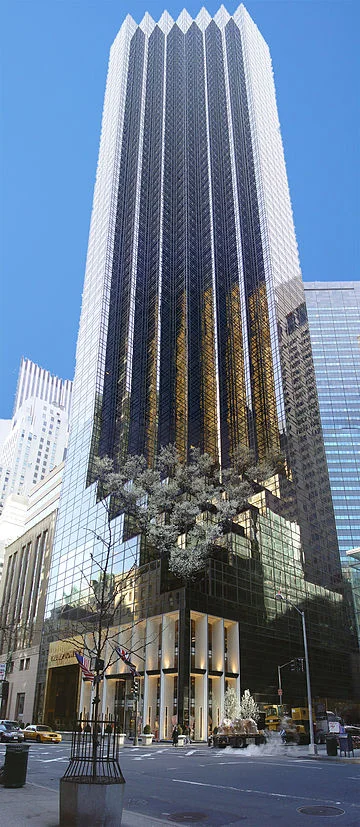
Grandiose Trump Tower, in midtown Manhattan, base of the Trump Organization and presenting a hugely difficult and expensive (for the taxpayers) security challenge.
Adapted from Robert Whitcomb's "Digital Diary'' column on GoLocal24.com:
Many Americans, the great majority of whom remain surprisingly ignorant of Donald Trump’s business career, have been taken aback by the volatile, seat-of-the-pants way he acts as president. But that’s how he runs the Trump Organization (runs, not ran: whatever the bad ethics involved he is still effectively running the Trump Organization, and indeed seeking to make lots of money for it in his new gig in the Oval Office). I’m also impressed by how much this man, who has so successfully avoided paying federal income taxes, is, with his jet-setting family, costing the taxpayers around $10 million a month in travel expenses – 10 times the rate of President Obama and his family. Mr. Trump is on track to be by far our most expensive president.
The president’s company was never publicly owned. Rather it is a secretive family enterprise centered on the intensely narcissistic if sometimes paternalistic Donald Trump, with power radiating out from him through family members and retainers. It recalls a Mafia operation (and the Trump Organization is not entirely unfamiliar with mobsters). Compared to a public company, the Trump Organization has had relatively few constraints on how it operates and has been able to operate with remarkable opaqueness.
Given Mr. Trump’s history, age and character, it seems very unlikely that he’ll change his operating style in any major way. Rather, he will tend to run the White House as he runs his company – very arbitrarily. He must tell himself: “Hey, it got me this far!’’ Let us hope that some of the grown-ups in the Cabinet can moderate his worst impulses.
So do something now

The Coolidge homestead in Plymouth, Vt.
"We cannot do everything at once, but we can do something at once."
-- Calvin Coolidge (1872-1933).
The 30th U.S. president was born in Plymouth, Vt., but spent most of his life in Northampton, Massachusetts, a state that he served as governor.
'Pompous joy'
"March is the month of expectation,
The things we do not know,
The Persons of Prognostication
Are coming now.
We try to sham becoming firmness,
But pompous joy
Betrays us, as his first betrothal
Betrays a boy."
-- Emily Dickinson, "XLVIII''
Todd McLeish: It's a busy time at the Mystic Aquarium's Seal Rescue Clinic

via ecoRI News (ecori.org)
MYSTIC, Conn.
The Seal Rescue Clinic at Mystic Aquarium is a modest, outdoor, fenced area where seals, sea turtles and other marine animals rescued from nearby beaches are cared for until they are ready to be released back into the wild. And in winter, it’s a busy place.
Last week, swimming in a 12-foot-diameter tank containing 3,200 gallons of water, was a young harbor seal found malnourished on a Long Island beach in December. A few steps away in one of five 700-gallon intensive care tanks was a newly arrived gray seal pup recovered from a beach in Maine, and another gray seal pup — this one stranded on Fisher’s Island, N.Y. — rested in a smaller tank.
Inside an adjacent tent, food and medications were being prepared by staff and interns to ensure that the animals recover as quickly as possible.
“January to April is our busy season for responding to live animals,” said Janelle Schuh, who directs the clinic and the aquarium’s Animal Rescue Program. “That’s when we see gray seals pupping off our shoreline and when harp seals and hooded seals are migrating into our area.”
Aquarium staff and about 250 trained volunteers respond to some 150 reports of sick, stranded and dead marine mammals in southern New England and Fisher’s Island, N.Y., annually — about 70 percent of which come from Rhode Island.
When it’s deemed necessary to rescue an animal, it’s herded into a mobile kennel and delivered to the Seal Rescue Clinic for round-the-clock care. When necessary, veterinarians may conduct surgeries and other procedures in the aquarium’s new veterinary hospital, which opened in December.
The clinic also rehabilitates animals recovered by organizations elsewhere in the Northeast that don’t have their own clinics, including a manatee found on Cape Cod last fall that was eventually flown to Florida by the Coast Guard.
Last year was the aquarium’s busiest year for rehabilitating seals. About 30 animals were rescued and brought to Mystic — half of them harbor seal pups recovered in the summer in Maine — and 25 of them were nursed back to health and released at Blue Shutters Beach in Charlestown. Most were young seals struggling with malnourishment, dehydration and traumatic wounds such as shark bites. Other animals were suffering from human interactions, such as fishing-gear entanglements or boat-propeller wounds.
How long the animals remain at the aquarium depends on their age and the severity of their malady.
“This time of year, we often turn around a dehydrated harp seal in a month, gray seal pups in two or three months, and days-old harbor seal pups are usually here four or five months,” Schuh said. “They’re sometimes here for over a year if they have bad injuries.”
She said the number of stranded animals isn’t increasing, but it’s unlikely that it will decrease enough to put her out of a job.
“There’s always going to be a need,” she said. “Marine mammal populations are increasing significantly, especially seal populations, and there will always be human interactions as the number of animals increases.”
While few seals have been rescued from disease in recent years, an outbreak of the avian flu virus in harbor seals in 2011 resulted in ongoing research projects that require aquarium staff to collect biological samples from every animal that comes into the clinic.
According to Schuh, one of the benefits of the Animal Rescue Program is the public education that results from the rescue, rehabilitation and release of the animals. The public learns first-hand how their actions, such as the irresponsible disposal of plastics, can affect marine creatures.
Those who observe a seal or other marine mammal or sea turtle on a beach are encouraged to report it to the Mystic Aquarium Animal Rescue Program at 1-800-572-5955, ext. 107. The aquarium advises the public to give the animal plenty of space, don’t touch it, keep pets away, and be observant for obvious signs of injury, general body condition and any identification tags.
“It’s human nature to do what we can to help an animal in need,” Schuh said. “That’s the philosophy we take here. If we see an animal in need, we’re going to help it and take care of it regardless of what’s happening to the population in the wild. In some cases, they’re too far gone to help, but we can still ease their suffering. It’s the least we can do.”
Todd McLeish runs a wildlife blog and is a contributor to ecoRI News..

'Dawn chorus'

Male blackbird emoting.
The birds were singing very loudly this morning, in what ornithologists and others call the "dawn chorus.'' Given how cold it was this morning -- indeed, one of the coldest mornings of this generally very mild winter -- this might sound surprising, but the birds are reacting to the bright March sun, not the temperature. The dawn chorus is loudest in the spring. The noise is related to the birds trying to lure a mate, defend a breeding territory or call in the flock of members of the same species in the same neighborhood. Sounds very human....
I've long wished that New Year's Day came on March 1 instead of Jan. 1 because about now is when things start growing again in southern New England, at first slowly and with much hesitation but by late April, explosively. On Jan. 1, on the other hand, you can't look forward to different weather or visible outdoor biological change for weeks.
Lots of crocuses and snow drops came up and bloomed in the past week or two with the extraordinarily warm weather and now they're in frozen ground. But they're tough and they'll look good again by the the middle of this week when it gets into the fifties. Life is resilient, especially in New England, with the wild weather swings that go with being at the crossroads of such different climate zones.
A few folks around here say they heard some spring peepers (a kind of tiny frog) this past week -- very early in the season indeed. They'll be silent for a couple of days but I wouldn't be surprised if they're heard again in just a few days.

Salt thicker than snow.
Is it really necessary to put salt on the roads that's thicker than the snow it is supposed to melt? That's what they do in Pawtucket, R.I., which must be a triumph for the cause of water pollution and vegetation killing. And what a waste.
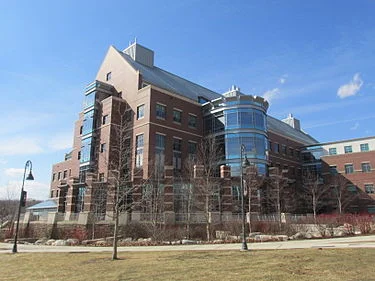
Elsa Nunez: 'Dreamers' are at heart of the American Dream
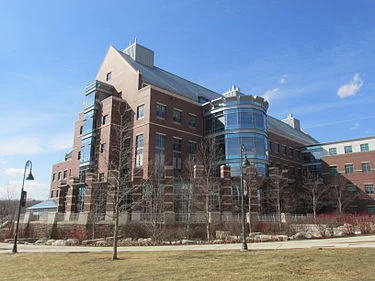
Science Building at Eastern Connecticut State University, in Willimantic.
WILLIMANTIC, Conn.
The recent controversy surrounding a proposed ban on immigration from seven Middle East countries recalls similar times in our history. More than 130 years ago, Chinese immigration was restricted. In 1924, Japanese immigrants were effectively barred from entering the U.S., and Mexicans living here during the Depression were the subject of repatriation, even those who were U.S. citizens. Other restrictions on immigration have marked our history, based on the domestic and global politics of the times.
The latest policy pronouncements reaffirm the need for comprehensive immigration reform in this country. It is time for Congress to decide how to balance securing our borders with the need for a path to citizenship for the 11 million undocumented people already in the U.S.
While we wait to see what Congress does, 1.8 million young people deserve better. Known as “Dreamers,” this entire generation of talented, dedicated students was born abroad but raised in this country without documented legal status. Since 2012, more than 740,000 Dreamers have been given Deferred Action for Childhood Arrivals (DACA) status, allowing them to receive a renewable two-year period of deferred action from deportation and eligibility for a work permit.
DACA students came to this country as children, they have grown up here, been schooled here, and dream of having productive, engaged lives here as American citizens. They think of themselves as Americans. They are exactly like the children of immigrants arriving in our country throughout most of our nation’s history, and today, they are like the children sitting next to them in school, except for the matter of permanent legal status.
Even with DACA status, these young people still face an uphill battle to achieve the promise of a college education. In 16 states, DACA students are either prevented from attending their in-state public college or university, or are forced to pay prohibitively expensive out-of-state tuition to attend their home-state public institutions. “Locked out” states include Alaska, Arkansas, Georgia, Idaho, Indiana, Iowa, Louisiana, Mississippi, Missouri, North Carolina, North Dakota, Pennsylvania, South Carolina, South Dakota, West Virginia and Wisconsin.
TheDream.US, a national foundation created by former Washington Post publisher Donald Graham and his wife, Amanda Bennett, has established the Opportunity Scholarship program to support upwards of 500 Dreamers over the next few years. Opportunity Scholars receive sufficient scholarship funds to fully pay for their tuition, fees, room and board.
In fall 2016, Eastern Connecticut State University was one of two institutions nationally—Delaware State University is the other—to enroll the very first cohort of Opportunity Scholars. In addition to 42 eligible Dreamers from the 16 locked-out states, the Dream.US foundation is also supporting five DACA students from Connecticut to attend Eastern. No public funds are being used to support Eastern’s Dreamers, and no in-state students are being denied admission because of the program.
Our 42 out-of-state Dreamers come from eight locked out states—Georgia, Idaho, Wisconsin, North Carolina, South Carolina, Pennsylvania, Missouri and Indiana—and from 13 different countries, ranging from Brazil to India, Ecuador and Zimbabwe. Applications are already being accepted for fall 2017, and Eastern will likely enroll another 75 Opportunity Scholars.
How are our Opportunity Scholars doing in this first year at Eastern? All 42 out-of-state Opportunity Scholars—as well as all five from Connecticut—have successfully weathered their first semester on campus and are back for the spring. The median GPA of our out-of-state Dreamers is an impressive 3.58! They are already becoming campus leaders—as members of the Honors Program, as resident assistants and as senators on the Student Government Association. The key has been to treat them with respect—they aren’t singled out nor housed in a single dormitory or made to feel different from their peers on campus. They receive the same personal attention for which our close-knit, public liberal arts campus is known.
When I speak to our Opportunity Scholars—and I make an effort to seek them out individually whenever possible—I am struck by their gratitude and their determination to succeed. These young people—like the native-born citizens they sit next to in class—are our nation’s future leaders, doctors, lawyers, accountants, teachers and business leaders. Their talents, work ethic and diversity bode well for our economy and society.
As much as this success story at Eastern is uplifting, the broader issue of the future of Dreamers in our country is a test of this nation’s moral fiber. Everyone in this country—except Native Americans—has ancestors who originally came from other lands to create the rich diversity we have today in the U.S. Like other members of American society, motivated, high-achieving immigrant students, no matter their nation of origin, should also have access to education—the key to social mobility and economic security in the U.S. That must be our commitment to them, knowing that what we get in return—a rich diversity of culture, religion, race and political thought—is the core strength of our democracy.
It is not by accident that our nation is the world’s melting pot, brimming with people of all nationalities and backgrounds. The U.S.—the greatest experiment in democracy the world has ever known—has enjoyed a moral standing throughout the world because it serves as a beacon of hope to all who long for freedom and opportunity. Acknowledging the right of today’s Dreamers to pursue a college education will reaffirm this moral high ground. Returning them to home nations that they cannot remember would be a disservice to these young people, would prevent them from making a contribution to our society, and would diminish our moral standing around the globe.
At Eastern, we will continue to enroll, support and advocate for the outstanding Opportunity Scholars who have come to us to earn their college degree. We urge all educators—all Americans!—to lobby our congressional leaders to do the right thing—extend the American Dream to a deserving generation of Dreamers while pursuing a viable long-term solution to the immigration issue.
Elsa Nunez is president of Eastern Connecticut State University. This piece first ran on the Web site of the New England Board of Higher Education (nebhe.org).
Just don't plug it in

"Untitled" (lead, mixed-media installation), by Marilu Swett, at Boston Sculptors Gallery.
Land of Pilgrims and motels
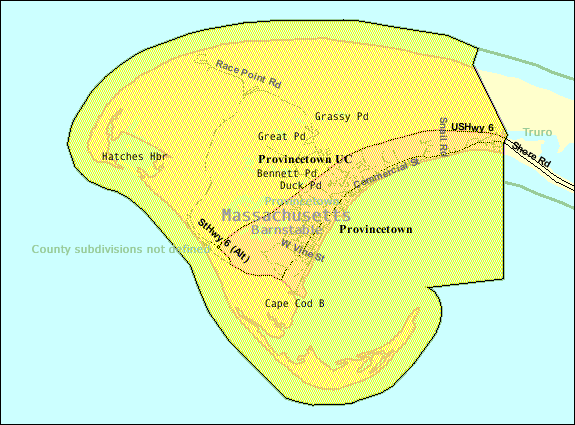
‘’I think of the Pilgrims whenever I walk to these emerald-green marshes at the end of town (Provincetown}….If I have a drink in me, I begin to laugh, because across from the plaque to the Pilgrims {whose first stop in America was at what was to become Provincetown}, not fifty yards away, there where the United States began, stands the entrance to a huge motel….Its asphalt parking is as large as a football field. Pay homage to the Pilgrims.’’
-- From Norman Mailer’s novel Tough Guys Don’t Dance
PCFR dinner on March 8 about the condition and the future of the oceans

To members and friends of the Providence Committee on Foreign Relations (thepcfr.org; pcfremail@gmail.com).
Our next guest will be Dr. Stephen Coan, on Wednesday, March 8.
Dr. Coan is president and chief executive officer of Sea Research Foundation, Inc., a 501c3 non-profit organization which operates Mystic Aquarium, Institute for Exploration and Immersion Learning. He is also chief executive officer of The JASON Project, an internationally acclaimed science program for classroom students, also managed by Sea Research Foundation in partnership with the National Geographic Society.
He’ll talk about the condition and future of the oceans in a time of global warming and other environmental challenges, especially the manmade ones.
Sam Pizzigati: Taxpayers heavily subsidize heavily endowed colleges that serve the rich elite
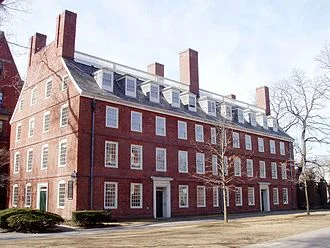
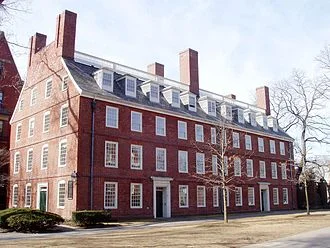
Massachusetts Hall (1720) Harvard's oldest building. Harvard's endowment is about $35 billion.
Via OtherWords.org
Most of us know folks who owe everything they have in life to education. That explains, I suspect, why we nod in agreement whenever we hear somebody describe education as the ultimate antidote to inequality.
Education certainly can serve as a brake on our widening divides. But education, if structured the wrong way, can also reinforce inequality — and perpetuate privilege.
We saw this unfortunate dynamic at work most blatantly back in the days of legal school segregation. “Separate but equal” kept children of color distinctly unequal.
Legally segregated schools no longer scar our nation. But our educational systems are still, in many different ways, perpetuating privilege. And the most powerful perpetuating of all may be taking place at the tippy top of America’s educational order, on the campuses of our nation’s most prestigious elite universities.
We tend to view these elite schools {many of them in New England} — such places as Harvard, Yale, MIT, Dartmouth, Brown and Princeton — as national treasures. One thing’s for sure: These private universities certainly sit atop treasures. They all boast endow In 2012, Harvard, Yale Princeton and five other elite schools had endowments worth a combined $112 billion. For this enormous nest egg, elite private schools owe the American people a debt of gratitude. Without us, their endowments wouldn’t be anywhere near as large.
Elite universities, keep in mind, get the bulk of their contributions from wealthy alumni. These alumni — thanks to the generosity of the American taxpaying public — get to deduct charitable contributions off their taxes. This generous tax break gives the wealthy a mighty incentive to donate to dear old ivy. The more they give, the more they can deduct.
With this tax break in place, elite universities get to accumulate vast endowments, and the phenomenally rich get to pay taxes at bargain basement rates — and stay phenomenally rich.
But these same endowments are also creating fabulous wealth — for the money managers and hedge fund kingpins that universities hire to invest their endowment dollars. These money manipulators rake off enormous fees, often many millions of dollars a year.
What about us, the general public? What’s our return on investment for the hefty tax breaks we extend to wealthy people for their college contributions?
University PR staffers have a ready answer. Elite private universities, they assure us, are serving the public interest. Those billion-dollar endowments, these flacks note, fund scholarships that enable students from families of modest means to get the finest educations available anywhere in the world.
Elite universities, the claim goes, are broadening opportunity.
But not by much, a new landmark study makes clear. The academics behind this new research — economists from Stanford, Berkeley, and Brown — examined data for over 30 million students who attended college in the United States between 1999 and 2013. They found that students from lower-income families make up a shockingly paltry proportion of the enrollments at elite private universities.
In fact, 38 elite institutions have more students from families making over $650,000 a year — our top 1 percent — than from the under-$65,000 ranks of the low- and middle-income families who make up America’s entire bottom 60 percent.
We do have colleges in the United States, the researchers also found, that do a good job reaching large numbers of lower-income students and helping them succeed. The vast majority of these colleges happen to be public institutions — places like the City University of New York.
These public schools aren’t sitting on billion-dollar endowments subsidized by tax breaks for mega millionaires. These colleges depend on our tax dollars for their support. What do you think? Maybe they should get more of those tax dollars — and mega millionaires less.
Sam Pizzigati, an Institute for Policy Studies associate fellow, co-edits Inequality.org. His latest book is The Rich Don’t Always Win.
But won't get you through the winter

"Logjam'' (maple, wisteria, bittersweet, willow, cedar, wood dyes and oil paint), by Susan Lyman, at Boston Sculptors Gallery.
Candy store of tax breaks to lure companies

-- Photo by Brian Snelson
Adapted from Robert Whitcomb's "Digital Diary'' column in GoLocal24.com
Economic development by deal continues apace in Rhode Island. The latest example that we know of: State officials have been considering whether to award up to $4.1 million in state tax credits to Agoda Company, a Singapore-based online travel agency that’s part of Priceline, in return for opening an office in downtown Providence. The quid pro quo is said to be the creation of up to 200 jobs in the Ocean State.
Of course, these tax credits must be made up by businesses and individuals who are not getting such goodies. As I have often notedbefore, the argument is that the state’s promotional position gains by its bringing in high-profile companies, which will then presumably get others get excited about moving to the paradise on Earth that is Rhode Island. But measuring the economic benefits of subsidizing individual companies to move to a jurisdiction is, to say the least, an uncertain science. And corporate promises about the number of jobs to be created have the transience of snow in March in New England. That is not to say that all or most states in varying degrees don’t do "economic development' by deal.
Perhaps this is technologically impossible, but it would be nice if some computer genius would figure out a way to compare the macro-economic benefits of only changes that would affect most everyone in the state – such as better schools, better roads, lower or at least simpler taxes and clearer and fewer regulations -- with the effects of subsidizing individual companies to come. Implementing broad changes that gradually make a state more attractive to a wide range of businesses isn’t as sexy and doesn’t grab the headlines of snaring one company (and often for only a few years) but it would seem to make more sense.
And let’s not forget that Rhode Island has splendid comparative advantages in location (oneof the best in the world), in such long-recognized sectors as design and boatbuilding and insome famed educational institutions. These qualities are very saleable, especially if the broad-based improvements noted above were made. Too often, it seems that paying a company to come to the state is the first approach to economic development.
Former Rhode Island Gov. and Sen. Lincoln Chafee told WPRO; “I’ve traditionally been opposed to what I call the candy store. I’d rather treat all the companies in Rhode Island equally, rather than pick favorites, and shovel the candy at them, as I call it: taxpayer dollars.”
This race to lure famous companies can also be seen as a race to to the bottom.
This may be politically impossible, but he has the right idea. (His naïve and/or wishful-thinking remarks about how to deal with Russia deserve comment some other time.)
Then you live in New England

“If you've worn shorts and a parka at the same time, you live in New England.''
“If you have switched from 'heat’ to 'A/C' the same day and back again, you live in New England.''
“If you carry jumpers in your car and your wife knows how to use them, you live in New England.''
“If driving is better in the winter because the potholes are filled with snow, you live in New England.''
“If you find 10 degrees 'a little chilly', you live in New England.''
‘’If there's a Dunkin' Donuts on every corner, you live in New England.''
-- Jeff Foxworthy

Chris Powell: With casinos now everywhere, who needs Indian casinos?

-- Photo by Ralf Roletschek
MANCHESTER, Conn.
Casino gambling could make an argument in Connecticut a few decades ago when itcould prey on more people from out of state than on the state's own residents. That is no longer the case, with casinos opening in neighboring states andthroughout the Northeast and with one soon to open in Massachusetts just overthe border in Springfield.
Indeed, the "interceptor" casino now being proposed by Connecticut's twocasino-operating Indian tribes would prey exclusively on the state's ownresidents, diverting some of them from heading north on Interstate 91 to thecasino planned by MGM Resorts.
With the "interceptor" casino the tribes would preserve the monopoly stategovernment has given them on casinos in Connecticut. The tribes would pay newgambling royalties to the state and millions in property taxes to East Windsor, whose town government is supportive and where the tribes have secured land alongthe highway.
The tribes say the "interceptor" casino will reduce the gambling revenueConnecticut loses to Springfield and preserve hundreds of jobs in the state. More likely the casino will create a few hundred jobs and relocate hundreds morefrom the two Indian casinos in southeastern Connecticut as gambling trafficturns north.
There are a couple of problems with this plan. The first is that the pathologies of the increased gambling will be borneentirely by Connecticut itself -- the addiction, the theft and theconcentration of wealth, its transfer from the public to the government and thetribes and the weakening of nearby businesses.
The second is that if casino gambling is to become pervasive, and not a specialthing in special places -- first Las Vegas, then Atlantic City, thensoutheastern Connecticut, then Indian reservations throughout the country, andsoon nearly everywhere -- why should Connecticut let any group monopolize it? That is, for casino purposes, who needs Indians anymore? (Really, who ever did?)
As New London Day columnist David Collins writes, last week the general counselof MGM Resorts, Uri Clinton, told a General Assembly committee that his companywill pay Massachusetts and Springfield far more for its casino rights thanConnecticut's Indian tribes are paying state government. That is, stategovernment continues to sell itself short for the benefit of the tribes.
The MGM Resorts executive also noted that if it really wants to compete withcasinos in other states, Connecticut is forfeiting its most lucrativeopportunity, which is not near the Massachusetts line but in Fairfield County, since a casino in Bridgeport, rejected years ago, might draw heavily from theNew York metropolitan area.
Indeed, instead of opening a mere "interceptor" casino near Massachusetts, whynot open a full-fledged casino, entertainment, and sports venue in thenorth-central part of the state?
After all, Connecticut just happens to have a bankrupt capital city whosedowntown is adjacent to both a big arena whose expensive renovations stategovernment can't afford and a new minor-league baseball stadium the city can'tafford. If such a venue could be competently operated, it might overshadow MGM'soperation in Springfield and push some of the burden of gambling's pathologiesback out of state.
Instead of increasing gambling, it would be far better for state government toeconomize by questioning the premises of its most expensive, mistaken, andfailing policies -- government labor contracting, welfare and child protection, and education. But that would require more political courage than Connecticut has musteredsince the Civil War. If it can't bring itself to stand up to a few rent-seekingIndians, state government will never stand up to anyone else.
Chris Powell is managing editor of the Journal Inquirer, in Manchester, Conn.