Vox clamantis in deserto





'A charlatan's successful selling of his fabulousness'
Adapted from a recent item in Robert Whitcomb's "Digital Diary,'' in GoLocal24.com
"To argue with a man who has renounced the use of reason is like administering medicine to the dead."
-- Thomas Jefferson, letter to the Danbury Baptists (1802)
Donald Trump Jr. in 2008: "Russians make up a pretty disproportionate cross-section of a lot of our assets. ... We see a lot of money pouring in from Russia." Loans, perhaps?
“The larger the mob, the harder the test. In small areas, before small electorates, a first-rate man occasionally fights his way through, carrying even the mob with him by the force of his personality. But when the field is nationwide, and the fight must be waged chiefly at second and third hand, the force of personality cannot so readily make itself felt, then all the odds are on the man who is, intrinsically, the most devious and mediocre — the man who can most adeptly disperse the notions that his mind is a virtual vacuum.
“The Presidency tends, year by year, to go to such men. As democracy is perfected, the office represents, more and more closely, the inner soul of the people. We move toward a lofty ideal. On some great and glorious day the plain folks of the land will reach their heart’s desire at last, and the White House will be adorned by a downright moron.
-- H.L. Mencken, in The Baltimore Sun, July 26, 1920
Democratic republics are doomed by the inevitable decay and corruption of civic culture. For a while, enough of the electorate is willing to learn real facts, study the issues, reflect on the lessons of history and bestir themselves enough to take a few minutes to vote to usually prevent deeply corrupt and incompetent people from achieving high office.
But as time goes by, a growing proportion of the citizenry loses its civic enthusiasm as the education system ceases to teach them how their political and governmental institutions work and to remind them how precious and fragile those institutions are. Meanwhile, society’s leaders become increasingly corrupted by self-interest, usually economic, and expend most of their political energies on strengthening the (mostly hereditary) plutocracy that nurtures them. (Read The Sunday New York Times’s wedding section for the zoology of the plutocracy.)
The rise of the bread-and-circus-and-cute-kitten machines of the Internet and cable television accelerates this decline, encouraging citizens to stay within self-referential and escapist echo chambers where lie-based but comfortingly simple and engaging stories are told by employees of the powerful and facts are treated as irritating distractions.
Most people have always preferred well-told stories, including ones based on lies, over facts and reason anyway. And now the electronic media give them such tailored stories 24/7.
To think that most citizens operate on the basis of reason, as opposed to wishful thinking and fear and other visceral emotions, is naïve. And they want a leader who can convince them that he/she will take care of them and make all the hard decisions in the public square for them.
For a while – and the U.S. has had quite a run -- the ruling class in an officially democratic republic is proud to be considered relatively thoughtful, selfless and civic-minded. But corrupted by addiction to money and power, the proportion of such people in our leadership groups inevitably declines. The rise of the 24/7 electronic media demagoguery machine accelerates this byintentionally distributing falsehoods, devaluing public probity and sowing confusion. As bad money drives out good, so bad (fraudulent) information tends to drive out accurate information.
In the end, democracies end and dictatorships return; the latter is the natural default. Nothing lasts. You can see this around the world now, where frustrated citizens in democracies are increasingly looking to tough men to address their nations’ problems, if need be with extra-legal means.
The conservative columnist George Will wrote during the election campaign:
“The beginning of conservative wisdom is recognition that there is an end to everything: Nothing lasts. If Trump wins, the GOP ends as a vehicle for conservatism.’’
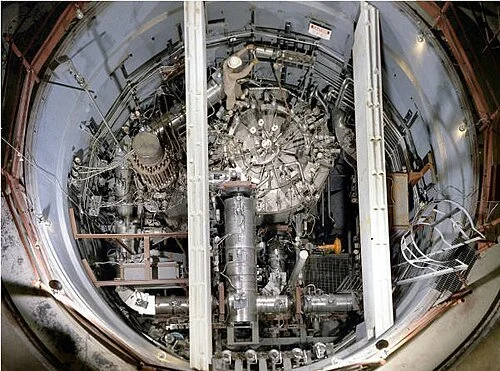
“Pessimism need not breed fatalism or passivity. It can define an agenda of regeneration, but only by being clear-eyed about the extent of {civic} degeneration, which a charlatan's successful selling of his fabulousness exemplifies.’’

Artist as anthropologist
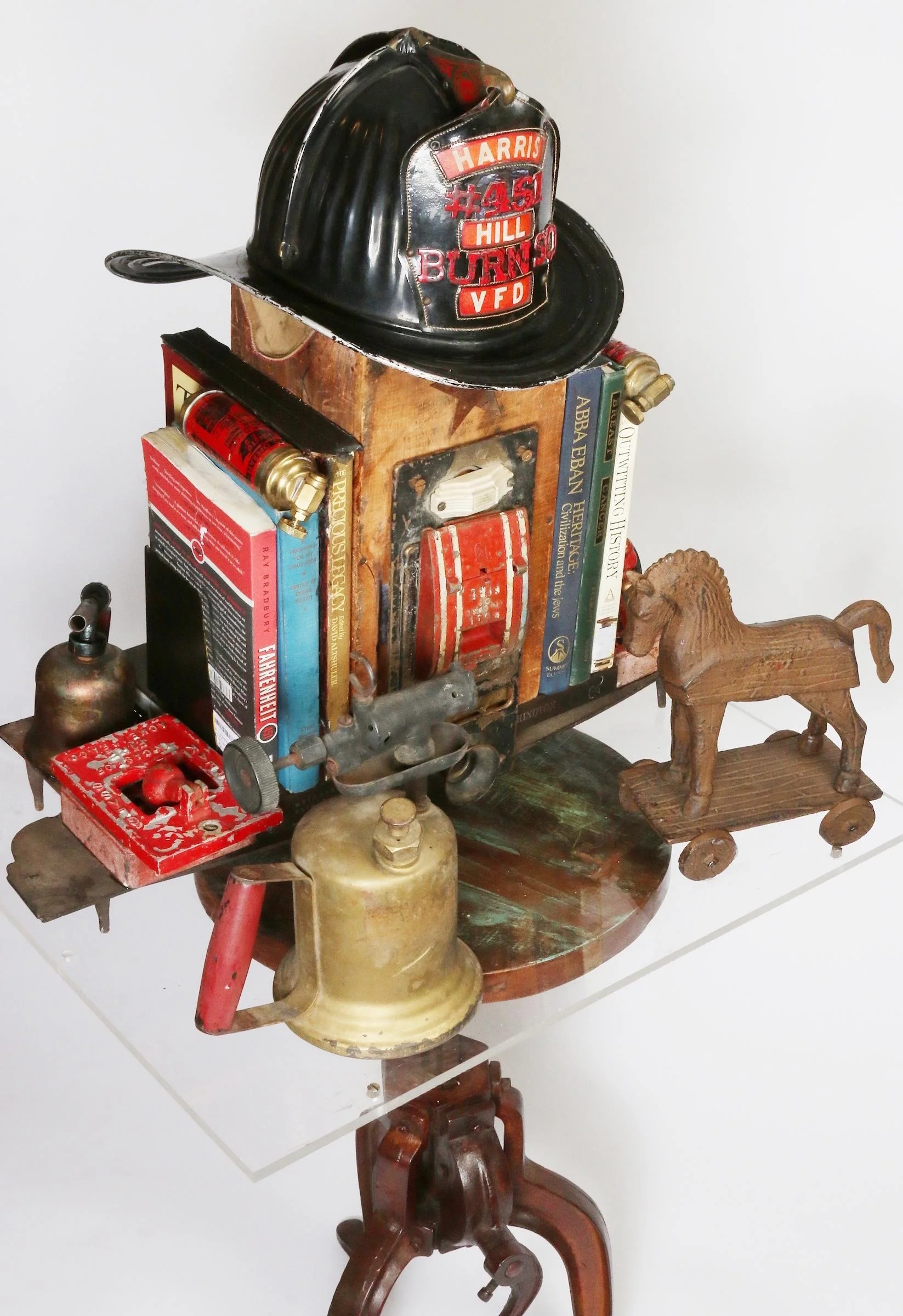
"Fahrenheit 451 Revisited: Conceptual Construction of Found Objects,'' by Ruth T. Segaloff, at Galatea Fine Art, Boston, Feb. 1-26.
She writes:
“’Precious Legacies’ is a retrospective across time and generations. These artworks focus on three questions: ‘Who Am I?,’ ‘Where Did I Come From?’ and ‘Why Am I Here?’ George Santayana explained why this is important: ‘ Those who cannot remember the past are condemned to repeat it.’ Never has this danger been so close at hand.
“Thanks to my parents, I realized at a young age that objects hold our stories andour stories matter. I’ve been collecting things ever since, and I incorporate many into my art: family memorabilia and knickknacks from desk drawers and estates; baby shoes from antiques shops or gifts; wisdom written on coffee mugs and refrigerator magnets. The Modern Artist as anthropologist. Baby shoes over 70 years old are displayed in Holocaust museums across the world. They provide silent testimony that these shoes belonged to real children who most likely didn’t survive to adulthood.
‘’’Fahrenheit 451 Revisited’ incorporates many themes of the show. It is based on Ray Bradbury’s 60-year-old science fiction novel of that name, referring to the temperature at which paper burns. A demagogue declares books illegal and that owning them invites harsh punishment. In this climate of suspicion, family and neighbors betray each other. Firemen become burn squads instead of firefighters, wielding blow torches, not water hoses. Dissidents safely hide and each memorizes a favorite book, then shares it with the others. Thus they keep alive the history of civilization, culture and values, all the qualities that make us decent human beings.
‘’The Trojan Horse pull toy updates this story. It’s a cautionary tale, especially for us today, because what appeared to be a gift was actually a weapon of mass destruction. ‘’
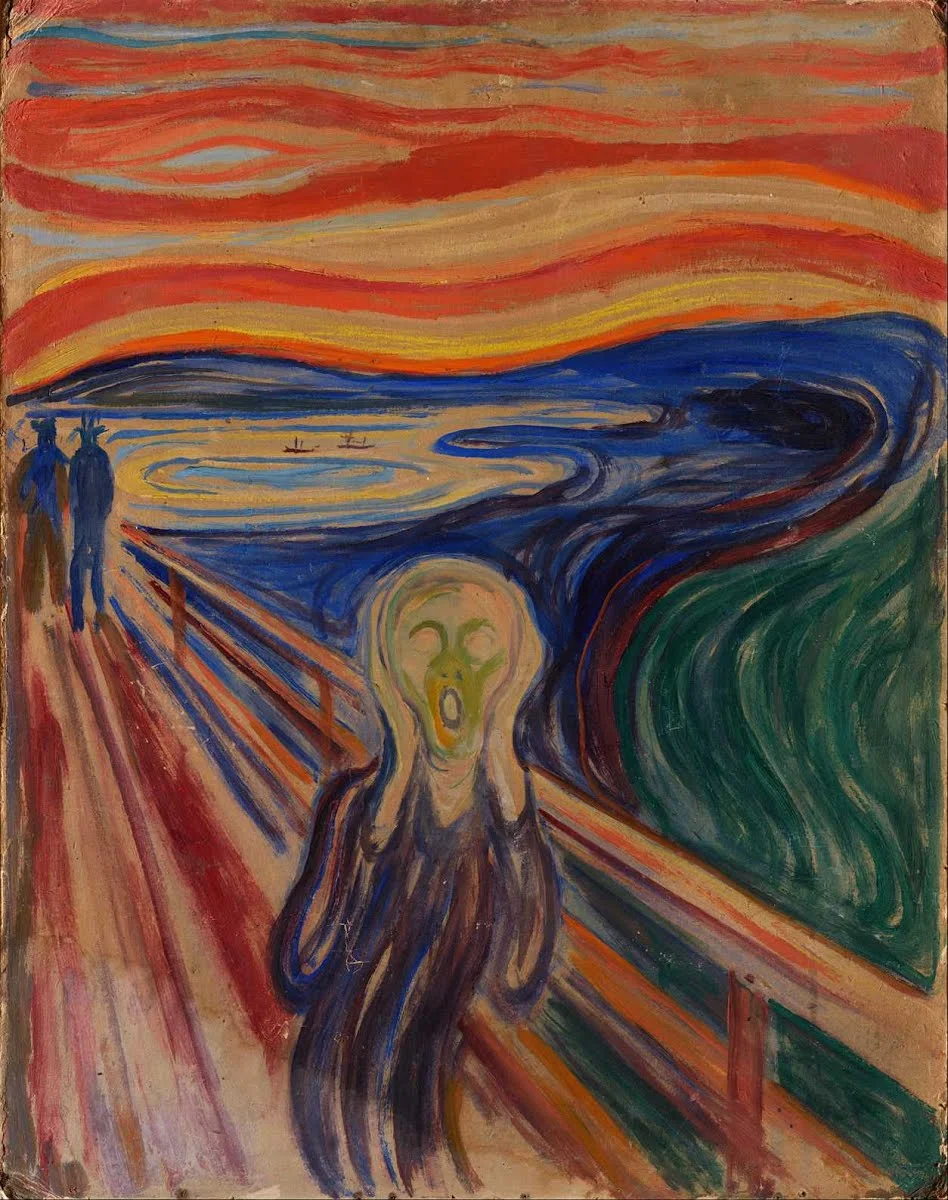
Llewellyn King: America's, and the world's, 'quaking hour' starts with Trump's threateningTweets
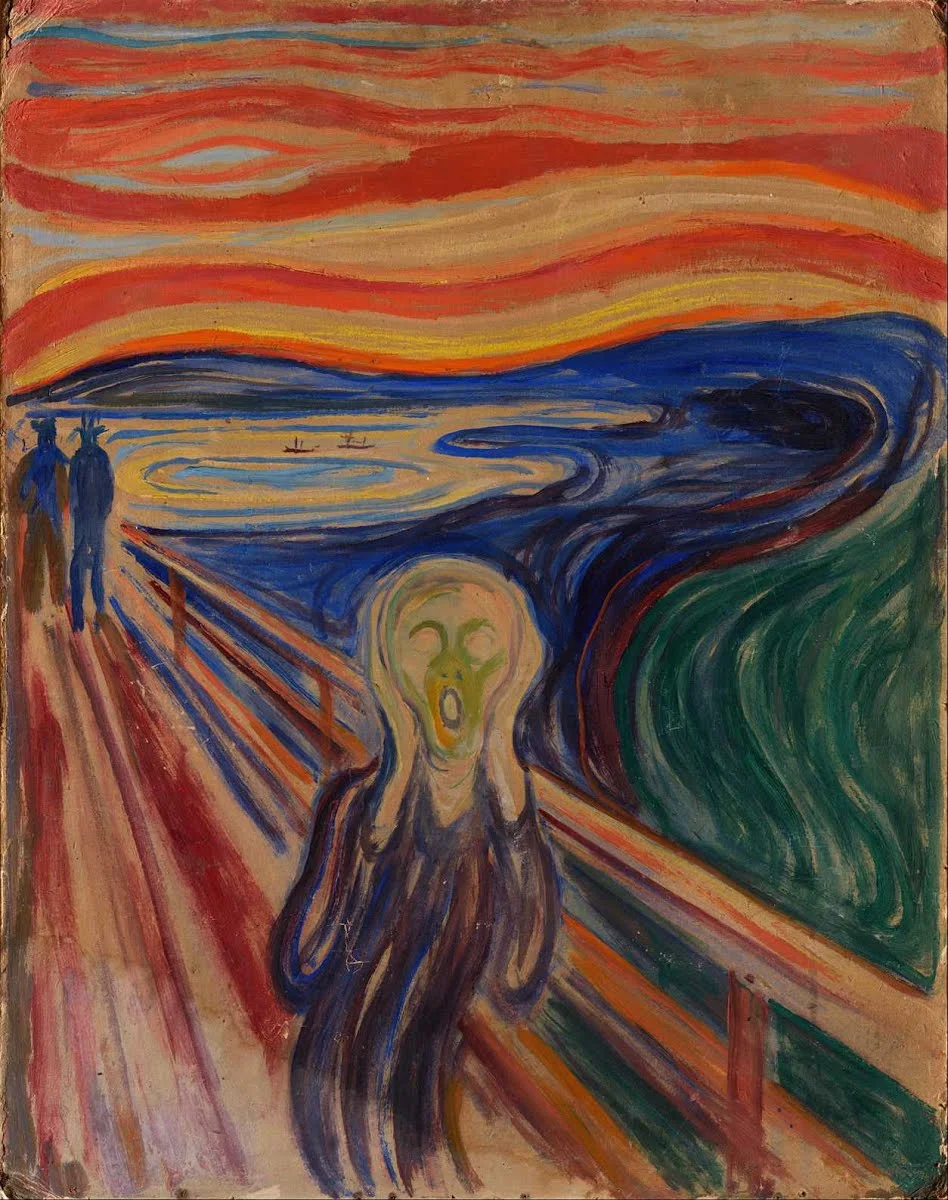
"The Scream,'' by Edvard Munch.
One can only imagine what it is like to be a Republican member of Congress in the Age of Trump. What should be a time of harmonious playing, with both houses secure with a GOP majority and a Republican about to assume the presidency, instead is one of jarring orchestration.
The problem is the score written by President-elect Donald Trump. It is discordant and inspires fear among them.
Senate Republicans are not afraid of their leader, Mitch McConnell, and their House counterparts do not quake when their leader, Paul Ryan, speaks. But when it comes to the president-elect, there is unspoken fear.
Republicans are not waking to the bright morning of governance, but rather to the “quaking hour” when they find out what Trump did to them overnight by Twitter or some other unplanned communication.
Did Trump ridicule one of them personally, attack a collective Republican action (like the attempt to close the Office of Congressional Ethics) or take aim against a heretofore Republican orthodoxy (like free trade)?
Has he promoted the interest of Russia over the well-grounded suspicions that Republicans on Capitol Hill have of Russia in everything, from hacking to aggression in Syria and Ukraine?
Has he offended 27 European countries in the European Union by supporting Britain’s plans to exit?
Has he, perchance, committed the United States to military action on the Korean Peninsula without consulting Congress or our reliable allies in South Korea. Does he know that the South Korean capital, Seoul, lies just 35 miles from the heavily fortified border with North Korea?
There is surely more to come that will cause heartburn with breakfast.
Not all Republicans are climate deniers, even though they may not have liked Democratic prescriptions. Most Republicans are free-traders, and the North American Free Trade Agreement was passed with Republican support. Are they going to be asked to throw in their lot with dismantling it? And what might they get in NAFTA Mark II?
The known points of stress between the Republicans and their leader-elect are now joined -- almost nightly -- by random pronouncements with huge policy implications.
Trump is exempt from the normal disciplines of politics. He is comfortable with his paranoia, therefore all criticism is the work of “enemies” or fools. He seems to have no icons, no heroes, and no respect for the institutions of U.S. governance or the history that underlies them -- hence giving the back of his hand to the intelligence agencies over Russian hacking.
If Trump does not like the message, he trashes the messenger.
This must sit badly but privately with congressional Republicans. They have fought hard over long years to protect the CIA, the NSA and the rest of the intelligence apparatus from being hobbled by the Democrats. So Trump’s cavalier dismissal of their findings must rankle, if not darn right alarm. The links between the intelligence community and leading Republicans are strong and enduring.
Trump will get his honeymoon. Republicans on Capitol Hill will support and explain and excuse the new president. But, in time, there will be a breaking point; a time when the music will change, when Republicans will speak up again for conservative orthodoxy and the going will get rough for Trump.
Tweeting is not governing, and the presidency is not reality television -- particularly when you are threatening to upend the world order on midnight caprice.
Beware the quaking hour. It breaks with the first keystroke of the morning, when the GOP finds out what its leader might have done to it and its verities overnight. It breaks for the person who has spoken up and has been ridiculed, singled out as weak.
This is not what was expected from a party winning both houses of Congress and the White House. It is a new dimension in American politics. And the quaking is not just for Republicans.
Llewellyn King is executive producer and host of White House Chronicle, on PBS. His e-mail is llewellynking1@gmail.com.
Raising tuna at URI

These yellowfin tuna are schooling in the ocean. Other yellowfin tuna are schooling in a giant tank at URI's School of Oceanography. It's exciting to watch.
Expanded from an item in Robert Whitcomb's Dec. 31 '"Digital Diary'' column in GoLocal24.com
Thank God for scallops. These shellfish have been a boon for New England fishermen– an offset to the tendency of fishermen to fish to near-extinction finfish, such as as cod, off New England to meet the world’s rapidly growing appetite for seafood.
But there may soon be big reinforcements for New England's fishing sector and they start on land. Experts in a facility on the campus of the University of Rhode Island School of Oceanography are raising yellowfin tuna in an exciting and potentially very lucrative aquaculture experiment. I recently had a tour of the URI Bay Campus facility, which has a giant tank where this is taking place. To see the tuna school in the tank is, well, neat.
If this experiment works, it could mean a lot of money for URI and for businesses, based, let us hope, in New England. Most of the aquaculture in southern New England has been with shellfish; there's been some salmon aquaculture in Maine. It’s nice to see more diversification.

At least the roof is still there

"Shine On'' (photo on aluminum), by Rebecca Skinner, in the current "Divergent Thinking'' show at Fountain Street Fine Art, Framingham, Mass.
David Warsh: The gapping Clinton-Obama differences on policy toward an aggressive Russia
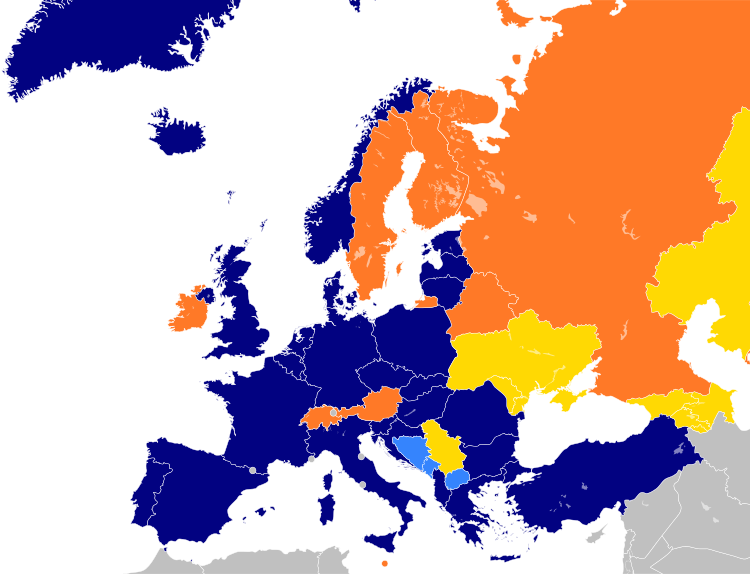
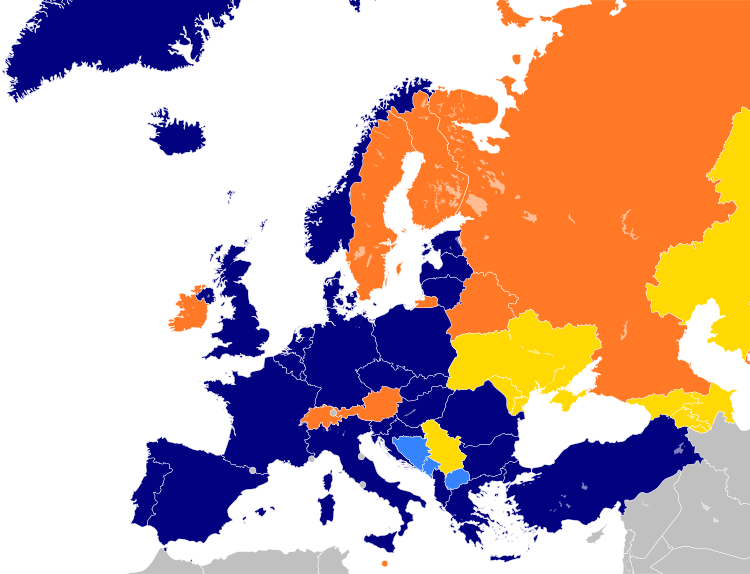
Blue nations are in NATO.
Given the high degree of partisan divide following the U.S. election, a discomfiting fact is that Donald Trump is likely to espouse many responsible positions in his role as president, even if he can’t make the case for them himself. This confusing state of affairs has not become obvious yet. But it is inevitable, and we will get used to it. A case in point is the current confusion about Russia.
Trump campaigned throughout the last year and a half on a promise to roll back the Viktor Yanukovych’s pro-Putin government in Ukraine in 2014. He never mentioned the much larger issue that lies behind it, the enlargement of the North Atlantic Treaty Organization to Russia’s southern borders, but that is likely what he meant.
In contrast, Hillary Rodham Clinton was equally clear throughout that she intended to increase the pressure on the Russian Federation. She now blames Putin (and FBI Director James Comey) for her loss.
As it happens, Mark Landler, White House correspondent of The New York Times, earlier this year gave us a very good account of her foreign policy views. Alter Egos: Hillary Clinton, Barack Obama, and the Twilight Struggle over American Power (Random House 2016) was written when Clinton was concerned to burnish her credentials as a hawk in anticipation of the general election.
The climax of the book is worth quoting at length. It comes in September 2014, when Obama invites a dozen foreign-policy experts to a dinner at the White House that has been “planned down to the minute”: an hour of discussion on the Islamic State; another on Russia, and, in particular, the proposal to supply Javelin antitank missiles to Ukrainian troops then fighting the Russian army. Mr. Landler writes:
“As the second hour began, Obama threw down a startling gauntlet.
“’Will somebody tell me, What’s the American stake in Ukraine?’ he asked his guests.
“Strobe Talbott [Deputy Secretary of State for seven years under President Clinton], who spent much of his professional life studying the Soviet threat during the Cold War, was slack-jawed. Preserving the territorial integrity of states liberated from the Soviet Union was an article in faith in Washington, at least for those of Clinton’s generation, who had watched the Soviets invade Hungary in 1956. Talbott argued that the West couldn’t simply stand by while Russia had its way with one of its neighbors. Stephen Hadley, who had been George W. Bush’s national adviser, echoed him. ‘Well, I see it somewhat differently than you do,’ Obama replied. ‘My concern is it will be a provocation and it’ll trigger a Russian escalation that we’re not prepared to match.’ That was a legitimate concern, Talbott granted, but not a reason to give Russia a free pass. ‘Having known Hillary for a long time,’ he told me [Landler wrote],’ I’m pretty sure she would have seen the invasion of Ukraine in a different way, mainly as a threat to the peace of Europe.”’
‘’A year and a day after that dinner, Talbott’s assumption was borne out. Standing on a stage of the Brookings Institution, of which he is president, Talbott introduced Clinton for the first major foreign policy speech of her 2016 presidential campaign. During a question-and-answer period afterward, she was asked how the West could put more pressure on Vladimir Putin. The United States, Clinton said, needed to dial up the sanctions and bring other pressure to bear. Though she didn’t specify it that day, her aides said that would include providing defensive weapons to the Ukrainians…
‘’Clinton wasn’t just talking about guns and butter. Washington, she said, urgently needed a new mindset to deal with an adversary that was going to plague the United States for years to come. It wasn’t so much new as back to the future: The White House would have to recruit old Soviet specialists –‘and I’m looking right at you, Strobe Talbott,’ she said – to dust off their playbooks and devise new policies for fighting Russian aggression. Like the Soviets, the Russians planned ‘to stymie and confront and to undermine American power whenever and wherever they can.”’
On this and many other issues, Landler writes, Obama and Clinton were the product of the experiences of their very different childhoods. She grew up in a middle-class suburb of Chicago, the daughter of a conservative Methodist businessman. Obama grew up in Hawaii, the son of a single mother who moved with him to Indonesia in fourth grade. That, and his “Kenyan roots,” created “a carapace of suspicion,” Landler writes. “Clinton viewed her country from the inside out; Obama from the outside in.” Maybe so, but Trump, who is mentioned twice, fleetingly, in the book, is president-elect.
Obama’s own instincts have served him well enough in foreign policy – in Iraq, Afghanistan and Syria. But the two secretaries of state he appointed, both of them frustrated presidential candidates, have gone on pursuing the agenda of an enlarged NATO military alliance as devised by Bill Clinton, which they inherited intact from George W. Bush. This is, of course, the deepest source of Russia’s grievance at the United States –Russian leaders thought they had received assurances from James Baker, secretary of state to George H. W. Bush, that there would be no expansion east if Germany was permitted to re-unite under the NATO banner. But the enlargement of the alliance that began in 1997 with Poland, Hungary and the Czech Republic admitted to membership, that precipitated a short war in Georgia in 2008, and another in Ukraine in 2014, is still going forward, zombie-like, in the present day.
NATO enlargement never became an issue in the presidential campaign. In a 10-part “Blueprint for Donald Trump to Fix Relations with Russia,” national security expert Graham Allison, former dean of Harvard University’s Kennedy School of Government, goes as far as he dares. “NATO is the greatest alliance in history and played an essential role in America’s Cold War victory. But today it stands in need of substantial reform.” Its expansion is not mentioned.
Leaders of the United States are henceforth going to have to become accustomed once again to living in a multi-polar world. That won’t be easy to explain, but Trump is going to have to try. Here is Graham Allison again, this time on the likelihood of war with China, from his article last year in The Atlantic, “The Thucydides Trap” (soon to be a book). He is reflecting on the vision of China’s role in the world that President Xi Jinping presented to a meeting of its political and military leadership in 2014:
“The display of self-confidence bordered on hubris. Xi began by offering an essentially Hegelian conception of the major historical trends toward multi-polarity (i.e. not U.S. unipolarity) and the transformation of the international system (i.e., not the current U.S.-led system). In his words, a rejuvenated Chinese nation will build a ‘new type of international relations through a ‘protracted’ struggle over the nature of the international order. In the end, he assured his audience that ‘the growing trend toward a multipolar world will not change.’’’
The nerve of those guys!
Obama is preparing to give a farewell address in Chicago on Jan. 10. Here’s hoping the explainer-in-chief leads with foreign affairs. As good an overall job as he has done in the the past eight years, he still has a lot of explaining to do.
David Warsh, a longtime economic historian and business journalist, in proprietor of economicprincipals.com, where this first ran.
Quite enough people
.From Robert Whitcomb's Dec. 29 "Digital Diary'' column in GoLocal24.com.
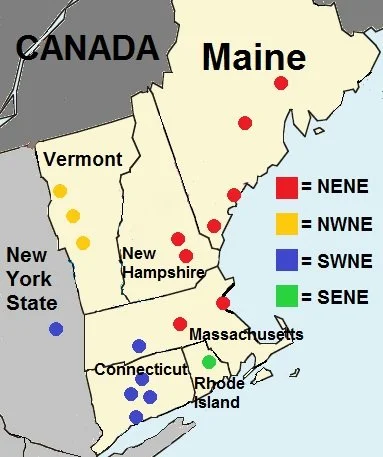
SomeNew Englandpublic-sector economic-development officials and business leaders say that they’re worried about slow population growth in New England; in Connecticut the population has actually slipped a bit in recent years. Well, we can always use more highly trained people to staff the many sophisticated enterprises in our region, and we need more young adults, but I have heard these tales of woe about New England’s sluggish population growth –among the lowest of any states in America – for decades and yet New England continues to be among the the richest parts of the U.S.
And it’s hard to argue that the world needs more people! Indeed, the swelling human population is destroying the planet’s eco-system at an accelerating rate. One of the nice things about New England is that it has less of the new sprawl and mess of the rapidly growing South, most of which remains the poorest part of the country and whose sparse social services are heavily subsidized by the richer, better run and more humane Northeast.
Rhode Island, for its part, is likely to lose a congressional seat because of its sluggish population growth. That’s just as well. The state would be better off merged with Massachusetts anyway.
Can respond via:
rwhitcomb4@cox.net

An open winter?

"Beaver Pond'' (oil on panel), by Sue Charles, at Alpers Fine Art, Andover, Mass.
That is, a beaver pond in an "open winter,'' with little snow. It has been open in most of southern New England so far this winter. Will we get clobbered soon? Or maybe we'll get most of our snow in March, as happened in 1956, after a very open winter until then? In any case, innumerable surprises lie ahead.
Meanwhile, "live every day as if it's your last, and someday you'll be right'' -- a line from the great movie Breaker Morant, set in the Second Boer War.

A time to repurpose

"Accumulations #4'' (mostly shredded household mail), by Jaynie Crimmins, in the group show "Reclaim Reprocess.'' at Flinn Gallery, Greenwich, Conn., through Jan. 18. The show brings together five contemporary artists' works "using discarded byproducts to repurpose materials and bring light to today's consumer culture and environmental waste,'' says the gallery.
This morning was still, clear and mild for this time of year in southeastern New England. Birds were singing as if it's April. Perfect conditions for walking your dog along deserted streets and clarifying your thoughts about what to do in this new year. That might include throwing away stuff that has outlived its usefulness or, as above, "repurposing'' it, or, for that matter, repurposing your entire life.
-- Robert Whitcomb
Response to:
rwhitcomb4@cox.net
Commuter rail for skiiers

This winter picture of (mighty?) Mt. Wachusett makes it seem considerably more impressive than it actually is: only 2,006 feet high. But this monadnock (a geological term for a single mountain on a relatively flat landscape -- named after southern New Hampshire's famed Mt. Monadnock) is impressive for its neighborhood.
Adapted from Robert Whitcomb's Dec. 22 "Digital Diary'' column in GoLocal24.com.
A special ski train now provides service to and from Boston’s North Station to Wachusett Mountain Ski Area, in Princeton, Mass., for a round-trip fare of $23; children under 12 ride free. The ticket includes a free shuttle from the recently opened Wachusett Station, in Fitchburg, to the mountain. What a nice idea: Bringing commuter rail service to skiing.
The trains have ski and snowboard racks. For more information, please see this page of the MBTA Web site:
http://www.mbta.com/riding_the_t/whats_new/?id=14107
More trains to more places in our tight little region, please. But at least New England has far more train service than most of this car-dependent country.

Jill Richardson: Fasten your seat belt: 2017 may be led by a man with Narcissistic Personality Disorder

Via OtherWords.org
If you thought 2016 was bad, I have bad news: Buckle up.
Hopefully 2017 won’t bring the deaths of more beloved celebrities, and I doubt we’ll see the killing of any more famous gorillas.
But one element that made 2016 terrible isn’t going anywhere. It’s actually getting worse.
You can call it the Trump phenomenon, polarization among Americans, or whatever you want to call it. From my vantage point, Trump’s transition team is making some troubling decisions that are going to reverberate well into next year, and the ones to come after it.
Even before the man’s in office, Trumpocracy is already beyond my worst nightmares. It’s so awful that it’s hard to even keep track of everything I need to be angry about. But here’s my best attempt.
First, there’s the strange personal behavior of the man himself.
Already some psychiatrists have raised alarm that he exhibits traits seen in people with Narcissistic Personality Disorder. (See picture below.) They cannot ethically diagnose him without examining him, but they’ve called for him to be evaluated. One area of concern to them is his thin skin and impulsiveness. Instead of paying attention to the tragedy in Aleppo, for example, he took to Twitter to attack a comedy show and a magazine that gave his restaurant a lousy review.
Second, he isn’t bothered by facts, or perhaps cannot tell the difference between truth and lies. When the FBI and CIA agreed that Russia interfered with our election, he refused to believe them.
But meanwhile he claims that millions of people voted against him illegally, which got a “pants on fire” rating from Politifact.
Perhaps if he’d attended those boring intelligence briefings, he’d have the facts about Russian hacking, but he claims he’s too smart to bother with those.
This is a security threat. The Russians didn’t just hack the Democrats — according to more recent reports, they hacked the Republicans, too. They have leverage against Trump’s own party. Trump needs to know about information that could possibly be used against him, or against our country.
Third, there are his conflicts of interest. Since Trump has so far refused to put his assets in a blind trust, there’s the risk that Trump will use the presidency to enrich himself and his family.
Instead, he’s placed his children at the helm of his business empire, even as he also includes them in official government business. That’s not OK.
Previous presidents went to great lengths to avoid even the appearance of conflicts of interest. Trump doesn’t care. He’ll continue to do as he pleases up to the point of breaking the law, and perhaps beyond it if he thinks he can get away with it.
After all, he knows his Republican Congress probably won’t impeach him, no matter what he does.
Fourth, there are his appointments. They run the gamut from white supremacists to anti-environment extremists. He so often places someone who wishes to destroy an agency in charge of that very agency that Saturday Night Live joked he picked Walter White, the meth dealer from TV’s Breaking Bad, to lead the Drug Enforcement Administration.
As we enter 2017, I’m not among the crowd cheering the end of 2016. Whatever comes next, it’s not going to be good. Let’s prepare to fight our way through this thing
Jill Richardson is a columnist for OtherWords.org.

"Narcissus, '' by Caravaggio, shows the Greek mythological youth looking at his own reflection.

Will these deals raise economic 'animal spirits'

“The Proposition,’’ by William-Adolphe Bougureau (1825-1905).
From Robert Whitcomb's Dec. 22 "Digital Diary'' column in GoLocal24.com.
I admire the very hard and patient labor of Rhode Island Gov. Gina Raimondo and her colleagues (presumably working with Providence Mayor Jorge Elorza’s administration) to bring some highly respected companies and quite a few jobs to Rhode Island.
The biggest recent employee hauls, all slated for Providence, will be hundreds of jobs (to start) coming to Wexford Science & Technology’s project in the 195 relocation area; 300 at Virgin Pulse (maybe in the Providence Journal Building); 100 at General Electric, and 75 at Johnson & Johnson. The hope is that those well-paid employees will be just the beginning of thousands of well-paying ones arriving over the next couple of years. (City and state official are apparently still working to bring in some Pay Pal operations, too.
We’ll see.
It was gratifying that J&J cited the presence of Brown and RISD as a reason for the project. The state hasn’t gotten nearly enough leverage from its higher-education establishments, or from its proximity to(and lower costs than) the brainiac center of Greater Boston.
A lovely change from the 38 Studios approach.
Of course, the new arrivals will each get millions of dollars in “tax incentives’’ to come to Rhode Island -- incentives that everyone else must pay for. Such incentives are the rule in every state to varying degrees. Two big recent examples – Indiana (pressed by Donald Trump) bribing the Carrier Corp. to not send 800 jobs to Mexico and Massachusetts giving many millions of dollars in goodies to General Electric to move its headquarters to Boston’s waterfront.
Companies that have loyally stayed in their states and paid taxes there without special favors must be irritated. But life is indeed unfair – and probably getting more so. The rich get richer and the poor get…. Get used to it, especially over the next four years.
The idea behind the legal bribery is that not only will these big, rich companies bring in new jobs in themselves but they’ll give many local vendors a lot of work and thus incentives to hire more people. That means not only vendors already in the area but also new ones coming in to serve the big shots. The old “multiplier effect’’.
And just by having such prestigious enterprises in Rhode Island as the ones lured by the Raimondo administration, it is argued, will boost the “animal spirits’’ of local and other business people and investors about Rhode Island. The hope is that such optimism/local pride will then help create, or lead to the import of, more enterprises, in a virtuous circle.
Will this work enough in all too cynical and negative Rhode Island to turn around the state for the long term? Who knows for sure, but I give a lot of credit to Ms. Raimondo and her staff for their labors while being denounced from all sides by those who provide few if any practical alternatives.
Seeds of hope

"There are two seasonal diversions that can ease the bite of any winter. One is the January thaw. The other is the seed catalogues."
-- Hal Borland
Retired still a hero
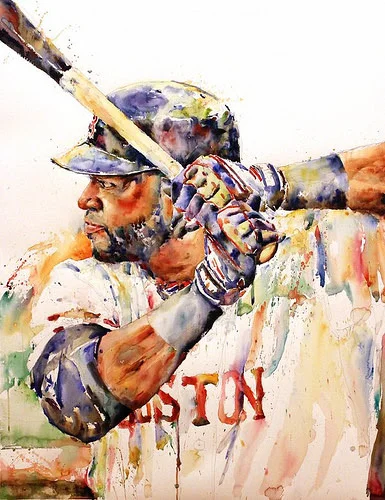
"Big Papi'' (David Ortiz) (watercolor), by Richard Sullivan, in "New Members Show 2017'' at Copley Society of Art, Boston, Jan. 12-Feb 9.
Llewellyn King: 2016's big lies, myths and narratives
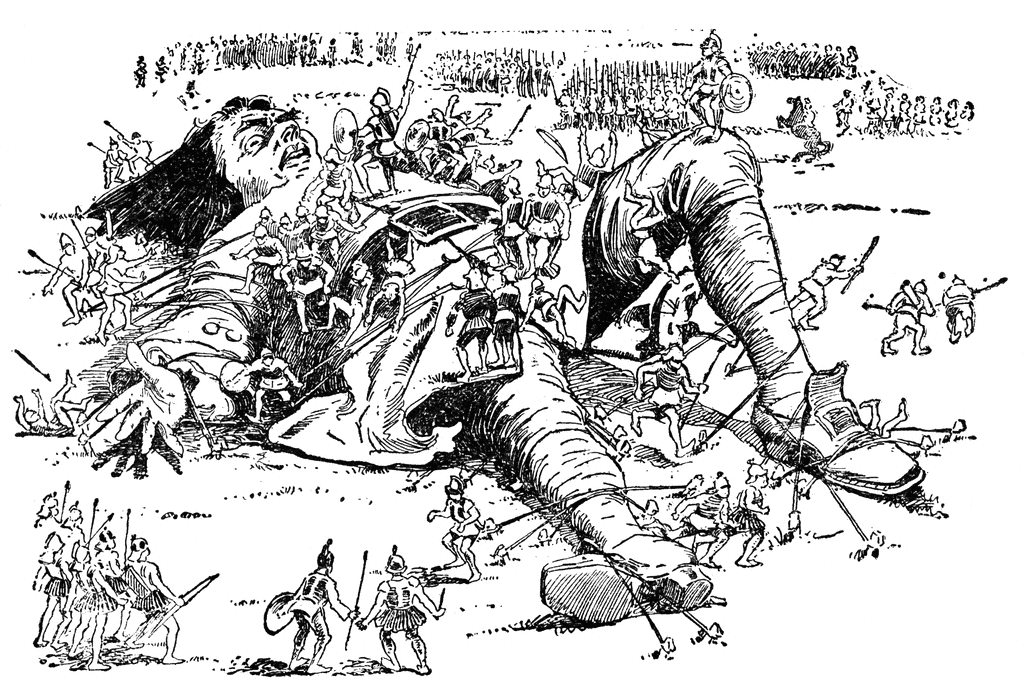
Gulliver tied down by the Lilliputians.
So what then were the big ideas of 2016?
The great, world-changing actions are the decision of Britain to leave the European Union – Brexit -- and the election of Donald Trump as president of the United States. Both pointed to electorates that had had it with the status quo and the elites who run things.
The victors in these elections relied on and triumphed with a simple strategy: a propaganda coup. They told the electorate that things were worse than they actually were.
Start with Britain. Those who campaigned to take Britain out of Europe took an ancient, maybe primal, desire of an island people to remain unattached and exploited it with cunning, disinformation and suspect numbers.
Britons were, this narrative claimed, suffering under the yoke of European bureaucrats. Yet if you ask people in Britain -- let us remember that this was primarily an English and (less so) Welsh issue and not a Scottish or Northern Ireland one -- to tell you how they have been hurt by the European Union, they cannot tell you.
Britain is one of the most successful nations in Europe and inmany ways the most influential. From architecture to banking to theater, Britain leads the way. Now that is to be ended for small-nation status and mythology about sovereignty.
The nation that has given so much to the world has voted to be insignificant and poorer, all because of leaders telling them that they were oppressed by Europe in unquantifiable ways.
A further mystery: Why have American conservatives, almost en masse, applauded Britain’s decision to embrace irrelevance?
During his presidential campaign, Trump used the same argument as those who wanted Britain to vote to roll back history: Things are awful and getting worse. This postulated that the government has fallen into the hands of people who cannot administer, and that the United States has crushing unemployment.
When it came to foreign relations and trade, Trump averred that our negotiators are feckless pushovers, always ready to cave. Not so. Around the world, we are respected for our powers of negotiation and the depth of expertise we bring to the table.
The Hobbesian Trumpian view of things contrasts with unambiguous facts: The nation's economy has been growing, unemployment is below 5 percent and there are shortages in many blue-collar fields, and manufacturing is growing.
Like the Leave campaign in the United Kingdom, Trump has emphasized the role of regulation in holding back economic expansion. This is the Gulliver’s Travels vision of the economy; that there is an economic giant yearning to be free and to lift economic growth when the pesky regulations that keep him tied up are ditched.
Well, perhaps some. The historical picture of deregulation is mixed.
Deregulation of oil and natural gas -- particularly with gas – led to an increase in supply even before the hydraulic fracturing (fracking) boom.
While airline deregulation resulted in many more cheaper -- and more unpleasant -- flights, it also left many small cities with fewer and more expensive ones.
Electric utility industry deregulation has been a mess, resulting in weaker companies, stranded investment and no consumer dividend.
Drug regulation needs streamlining but remains essential.
Banks howl at regulations and go off the rails when they are slackened, as with the savings and loan scandal and the mortgage debacle. Maybe when greed is a profession, regulators are needed.
Regulation is not across-the-board deleterious. Relaxing some will help some national goals, like building more pipelines to move the hydrocarbon bounty to market. But keeping pipelines safe is a regulatory necessity.
The Trump administration will come to power burdened with weight of expectations that it has ignited.
This was the year where shaded facts, political myth and old-fashioned lies dominated the discourse.
Expectations levitated in 2016 will fall to earth in 2017 -- softly one hopes. As for the big idea? It has not yet been Tweeted to us.
Llewellyn King is executive producer and host of White House Chronicle, on PBS. His e-mail isllewellynking1@gmail.com.
App will tell you if you're drunk
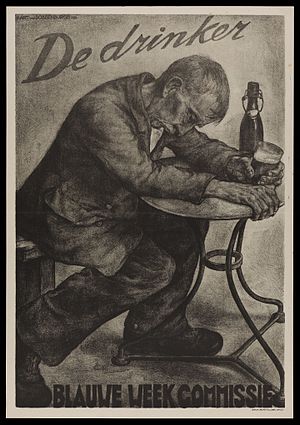
The Worcester Telegram reports:
“Brainiacs at Worcester Polytechnic Institute have developed a first-of-its-kind smartphone app that can tell its user if he or she has had too much alcohol to drink without the use of blood, breath or sobriety tests.
“WPI associate professor of computer science Emmanuel Agu conceived of the app idea, which predicts a person's blood alcohol content with 90 percent accuracy, on average, and will actually ‘buzz when you're buzzed."’
“Dubbed AlcoGait, the app runs in the background on the user's smartphone, continuously analyzing the person's walking pattern, or gait, for anomalies. Users can track their intoxication level to decide when to stop drinking, and the app will send a text message and make the phone buzz when the user's gait indicates he or she has likely exceeded the legal limit.’’
We all hope that this device will be on the market by New Year’s Eve next year.
Robert Whitcomb: Reporting in pre-glitz Boston
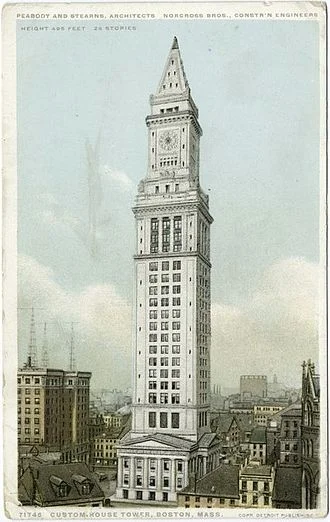
Soon after I had graduated from college, in June 1970, a friend suggested that I try to get a job at the Boston Herald Traveler (RIP), an old Yankee establishment newspaper that also had a lucrative TV and radio station. I applied, but first, the city editor, the always unflappable and wry Bob Kierstead, said that I should report and write a research project -- a little book -- for the paper to prove I could report. The book, on Boston politics, history and demographics, was meant to help the paper’s reporters cover the next mayoral and other local elections.
Mr. Kierstead found the little book useful enough to hire me a reporter. I wish that I could find what I wrote and compare the reporting in it with the very different (much glitzier and more Manhattanish) Boston of today. Back then, Boston had a down-at-the-heels quality that evoked the Thirties, or even Dickens’s London.
Then began a crazy year of covering all kinds of stuff – from train derailments, murders, industrial-strength arson, potheads lost in the White Mountains, race and student riots, the start of Boston’s busing/desegregation crisis and the opening of Walt Disney World. It was one of my most vivid periods and showed me what I could do on deadline and often in considerable chaos on the road.
I thought that it would be just an occupational side trip, whence I would return to school to perhaps get a doctorate in history or start a small business. But I found I had a talent for quickly if roughly understanding people, places and situations and concisely writing down fast what I had so quickly learned. What’s more, back then, I liked to travel (much more than now). Journalism spoke to these things. A college history major, I looked on my work as writing current history. Or, as the late editor of The Washington Post, Ben Bradlee, put it, “history on the run.’’
But I knew I couldn’t stay at the Herald Traveler because it was likely soon to lose its FCC license for its very profitable TV station, which, with its sister radio station, had been subsidizing the newspaper. The case went up to the U.S. Supreme Court, where the owners lost for good; the paper's assets were sold shortly thereafter to Hearst, for whose sensationalist Boston tabloid, the Record American, I had worked in a summer job as an editorial assistant/gofer.
So I applied to the Columbia University Graduate School of Journalism, was admitted, got an economics fellowship and off I went, at the end of the summer of 1971, to New York. This was just after the Pentagon Papers were printed and Nixon took America off the gold standard. The latter led me to interview for the Herald Traveler a covey of famous economists, most notably Milton Friedman and John Kenneth Galbraith, shortly before I left for Manhattan.
It was fun to have such access to celebrities.
And it was a relief to leave the stuffy walkup apartment I was renting on the Cambridge-Somerville line from the brother of a former girlfriend.
Robert Whitcomb is editor of New England Diary.

Chris Powell: Of nullification in stoned America; don't fish for immigrants from the Middle East

Under legislation proposed by Connecticut state Senate Majority Leader Martin Looney, the Nutmeg State would legalize and tax marijuana.
Of course, marijuana is barelyillegal in the state now, possession of a half ounce or less having been reducedin 2011 to a mere infraction liable to a small fine, while charges of possessinglarger amounts are eligible for resolution through probation. Indeed, marijuanause in Connecticut has become so common that police, prosecutors, and courtsreally don't want to bother with it anymore, though sale and cultivation of thedrug remain felonies, at least technically.
Looney, a Democrat from New Haven, is a big-government liberal and his mainobjective with the marijuana bill seems to be taxation, as he advocates themarijuana-business system recently adopted in Colorado, which is raising morethan $100 million a year for state and local government there. That kind ofmoney could finance golden parachutes for a few more failed football coaches atthe University of Connecticut.
But legal marijuana is giving Colorado more than tax money. It is also producinga huge increase in students coming to school stoned, since, as with liquor andcigarettes, limiting sales to adults doesn't keep young adults from procuringstuff for those under 18.
With legal marijuana Colorado also has built a state-sanctioned and closelyregulated industry on the violation of federal drug law, which still classifiesmarijuana with the most powerful of the illegal drugs.
While President Obama, violating his constitutional obligation to execute the law faithfully, has toldhis Justice Department to suspend marijuana-law enforcement in states that don'twant it, a different president could take his obligations more seriously.
Nothing obliges Connecticut to criminalize any drugs; the state is free todecriminalize marijuana and anything else and leave the issue to the federalgovernment, which maybe someday will wise up and simply medicalize the wholedrug problem, the "war on drugs" having long been only a fantastically costlyemployment program for police, prosecutors, criminal-defense lawyers, prisonguards, parole and probation officers, and social workers.
But basing a retail industry and tax system on the violation of federal law goesfar beyond mere decriminalization and becomes nullification -- the sort of thing that New Haven has been doing for years by issuing identification cards to illegalaliens to facilitate their violation of federal immigration law --"state'srights" stuff that impairs national unity, stuff that liberals used to deplore whenconservatives did it to thwart the Constitution and federal civil-rights laws.
In coming months states governed by conservatives may note the success ofliberal nullification in Colorado, Connecticut and elsewhere and implore thenew president, who is suspected of having conservative if not reactionaryinstincts, to ignore laws that he doesn't like, starting with abortionrights. The next step will be secession, though in light of how much liberals andconservatives have come to hate each other lately, maybe this time the country willagree to divide peacefully.
xxx
FISH ELSEWHERE FOR IMMIGRANTS: The mass murder committed at the Christmas marketin Berlin by a Tunisian immigrant is not quite the vindication claimed byPresident-elect Trump for banning immigration by Muslims per se.
For government to restrict people according to their religion isplainly unconstitutional. But the atrocity in Berlin is a reminder of the civil war raging in Islambetween modernity and medievalism, a cultural war as much as a religious war, and a reminder that immigration law must protect the United States againstcountries with benighted cultures.
The United States can fish for immigrants in ponds with or without alligators. It can have all the Latin Americans and Asians it wants, or lots of MiddleEastern religious crazies, fascists, and terrorists. The country needn't repeatEurope's deadly mistake.
Chris Powell is managing editor of the Journal Inquirer, in Manchester, Conn., and an essayist.
Allan Klepper: Down with Uptalk
Though not my intention to preach,
A most annoying pattern of speech
Is uptalk; an upward inflection,
Takes voice in a questioning direction.
It’s high rising terminals in the U.K.,
In California, how Valley Girls say,
Or Aussie question intonation for sure,
Or just by the excessively insecure.
Many speech pathologists agree,
Uptalk lacks in authority!
Not in U.S. Exec. Boardrooms as yet:
When millennials take over – you bet!
-- Allan Klepper