
Vox clamantis in deserto







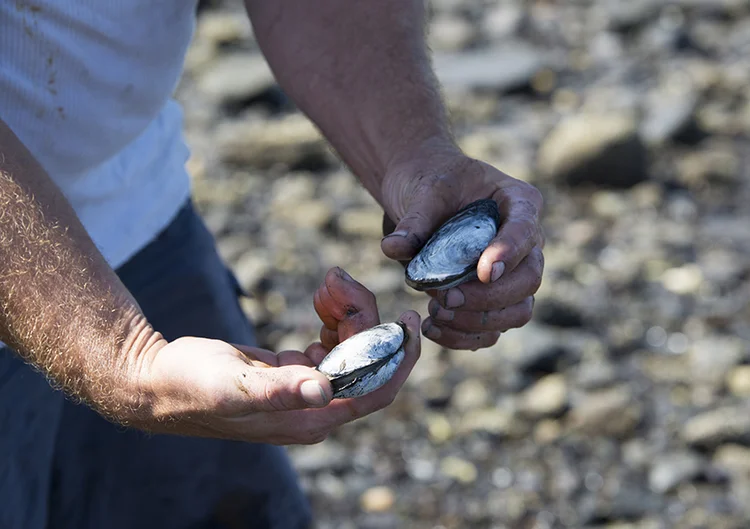
Bleached out clams
By FRANK CARINI, for ecoRI news (ecori.org)
NORTH KINGSTOWN, R.I. — Dan Briggs is afraid he’s losing his job. That explains his angry posts to social media this summer. His venting, however, isn’t doing anything to solve the problem, but at least his boss doesn’t mind.
For the past 20 years, the South Kingstown resident has run a one-man commercial operation that sells streamers — dug by hand, with help from a short rake — from tidal areas throughout Narragansett Bay. The soft-shell clams he’s digging up now — far fewer than he was a dozen years ago — often don’t look right, at least when it comes to the color of their shells. He stopped eating his own catch several years ago.
“I know this is bad advertising for my business, but I want the bay cleaned up,” said Briggs, who comes from a long line of quahoggers and diggers. “I just want a cleaner bay, a better protected bay, so I can keep my job and sell high-quality shellfish. But we don’t care about cleaning up spots; we just cover our asses and close them to shellfishing.”
ecoRI News recently spent a Saturday morning with the frustrated fisherman. We meet him at Bissel Cove, which, according to the Environmental Protection Agency, was an impaired waterbody in 2014, 2012 and 2010 when it came to shellfish consumption. Rhode Island’s 2014 list of impaired waters also noted that Bissel Cove didn't support the consumption of shellfish, because of the presence of fecal coliform.
Briggs took us to two spots that he said once supported plenty of steamers. Today, both locations — Fox Island, a short boat ride from the shore of Bissel Cove, and the western shore of Jamestown — are largely graveyards for bleached clam shells.
Our guide blames the discoloration of the shells — and his dying livelihood — on the amount of chlorine being used at wastewater treatment plants to kill pathogens. He doesn’t buy the argument that the ultraviolet systems used at these facilities to remove chlorine before the treated effluent is released into Narragansett Bay is adequately addressing the accumulation of this element in the Ocean State’s most important natural resource. His eyes, and years of shellfishing experience, tell him something is wrong.
“We can’t continue to treat the bay like everyone’s private leach field,” Briggs said. “We’re dumping too much chlorine into the bay.”
The use of chlorine is reducing the amount of bacteria in Narragansett Bay, but Briggs believes the buildup of this element is having unintended and overlooked consequences. “Do you want to eat a bleached-out white clam?” he asked.
Chlorine at concentrations to bleach shells would be toxic to bivalves, according to scientists and researchers ecoRI News contacted after our late-July visit with Briggs. It's doubtful, they said, that that much chlorine was being released into Narragansett Bay, because of dechlorination procedures being conducted at wastewater treatment facilities to comply with the Clean Water Act.
Michael Rice, Ph.D., professor of fisheries and aquaculture in the Department of Fisheries, Animal & Veterinary Science at the University of Rhode Island, said the bleaching phenomenon in many species of clams can be caused by acidic bottom conditions, mostly in coves, brought about by summer decomposition of organic material that builds up during colder months.
"Microbial decomposition converts the organic sediments to carbon dioxide that causes local areas of low pH (acidic conditions) that erode the outer layers of the shells leaving chalky white surfaces," he wrote in an e-mail to ecoRI News. "Quahogs coming out of Greenwich Cove look like this often. The bad side of this is that steamers are less tolerant of these types of conditions than the quahogs that have a thicker shell."
Marta Gomez-Chiarri, Ph.D., chairwoman of URI's Department of Fisheries, Animal & Veterinary Science, said biogeochemical reactions may lead to conditions in sediments that can lead to the bleaching of shells.
"Of course, these are all hypothesis, and I don’t know of anybody that has tested them rigorously or done any measurements in the field to check if chlorine is present in areas where the bleaching occurs," she wrote in an e-mail. "This is a great question for researchers, and something that fishermen (not only clam diggers, but also lobstermen) have been interested in having scientists study."
Briggs, a longtime shellfisherman, often finds more dead shells than live steamers after flipping a section of a tidal area.
On the Jamestown, R.I., shore, Briggs flipped a dozen or so spots, typically finding more dead shells than live steamers. On one flip, he counted 14 dead and just three alive. The shells of both featured a lot of white. He noted that the percentage of dead steamers to live ones is disturbing.
“There’s nothing but dead shell here,” Briggs said. “No babies tells me there’s nothing here. Something is killing them.”
Ribbon worms alone can’t be held responsible, but David Gregg, Ph.D., executive director of the Rhode Island Natural History Survey, said research shows steamers are being affected by green crabs.
On the banks of Fox Island a little later, nearly a dozen more flips with his short rake exposed an even bleaker picture. Briggs uncovered only a handful of live steamers, but plenty of whitewashed dead shells. He said the same picture exists in once-fertile spots around the Jamestown and Newport bridges and along Prudence Island.
“Chlorine is killing them,” Briggs said. “There must be other ways to treat our sewage than dump it in the bay. I’m not a scientist, but there must be a better way to collect and treat our sewage.”
Chlorine is widely used as a disinfectant for sewage treatment plant effluent and to treat combined sewer overflow discharges. Chlorine can cause environmental harm at low levels, and is especially harmful to organisms that live in water. It combines with inorganic material in water to form chloride salts, and with organic material in water to form chlorinated organic chemicals.
The impact of chlorine use in wastewater treatment facilities on shellfish health, however, is largely unknown, as little research has been conducted, anywhere.
"I’m sure chlorine in effluent does bad things but bleaching steamers white isn’t one of them," Gregg wrote in an e-mail.
He also noted that chalky shells "are more likely a symptom of ocean acidification caused by too much carbon dioxide in the air from burning fossil fuels." Gregg said he couldn't confirm that Narragansett Bay is more acidic now than before, but noted that chalky shells "is what I would think it could look like."
Briggs is one of the last remaining shellfishermen dry digging for steamers in Narragansett Bay tidal areas. His income dropped by $15,000 last year, despite working 300 days in 2015. A typical day means flipping some 200 square feet of coastline. He’s having a harder time filling his tall white buckets with steamers, which he currently sells for $4.50 a pound wholesale.
Briggs said state and local officials can’t just blame the disappearance of steamers — and other marine species — on overdigging or overfishing.
“We’re polluting the bay with chlorine and poop,” he said. “All the regulations, all the paperwork, are on us. We just can’t hide all this sludge in the bay. I love my job. That’s why I’m complaining.”

For a good time, vote for me
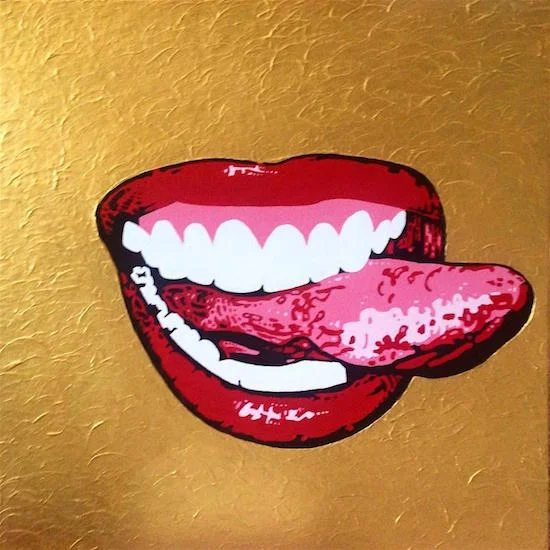
"Miley's Lips'' (acrylic on campus), by Joe Kitsch, is his show ''#Lose Your Head,'' at Galatea Fine Art, Boston, Sept. 1-28. The gallery notes say his work presents "art on the lighter side of our crazy times derived from the Internet and popular culture.''
Don Pesci: In Fairfield, Trump shouts what others whisper
The Trump rally in the heart of still wealthy Connecticut -- Sacred Heart University in Fairfield, in Connecticut’s uber-rich “Gold Coast” – was hot in both the literal and metaphorical sense.
Five thousand supporters of Donald Trump braving the heat, 100 degrees and climbing, were packed like sardines at the university awaiting the saving word. Trump rallies are political Chautauqua events. What’s a Chautauqua rally without steaming hot crowds, eh? A flop, that’s what.
It is Trump, not the recently defanged Vermont socialist Bernie Sanders, who evokes a William Jennings Bryan excitement in crowds. Dismissed from the Democratic race following an amusingly uneventful Democratic National Convention, Mr. Sanders on cue sheepishly endorsed Hillary Clinton – the Bonnie of the Bonnie and Clyde Clinton Foundation and ambled off. His will be a pleasant exile: Salon will move on; the phone will not ring.
The national media, chronically unable to step in front of its own prejudices, hasn’t quite figured Trump out yet.
Mr. Trump connects with the political “everyman” – the unwashed masses who have not yet succumbed to the irresistible editorials of Eastern Seaboard progressives -- adopting his thought patterns and speech codes that need it be said, are not the thought patterns and speech codes of 99 percent of the editorial boards of major newspapers in the dis-United States. Mr. Trump’s opposite is not, as has been supposed, the boring pin-striped Republican of yore, but the universally disdained “mainstream media” and, of course, incumbent establishment politicians, both Republican and Democrat, who have made a ruin of domestic and foreign policy. Lately, Mr. Trump has identified President Obama as the founder of ISIS, scattering the wits of the usual political TV commentators.
When Mr. Trump paused several times in his stock stump sermon to castigate the establishment media – “Honestly, I’m not running against Crooked Hillary. I’m running against the crooked media” – electric applause rumbled through the crowd. The anti-media rhetoric was red meat thrown to lions.
But what really resonated was the notion that inherent and creaky incumbent power structures are by definition the cause and not the solution to our problems. This is a flag stolen from the iron grip of the journalistic ancien regime.
One “white male” in the crowd was carrying a sign announcing he was an “intelligent college graduate,” – take that New York Times! -- a disappointment no doubt to those who insist Mr. Trump’s support comes from redneck rubes clinging to their Christian God and guns. Another celebrant, Mitch Beck, a 54-year-old executive recruiter from Monroe, summed up the long “winter of our discontent” with remarkable precision: “If Bush [the younger] put the economy in the grave, Obama put the dirt on top of it. I hope Trump has a shovel,” presumably to dig the rest of us out from under the rubble.
The furry and primitive notion of Mr. Trump is that he represents some sort of viral reaction – but to what and for what no one knows. Comparisons with the recently exiled Mr. Sanders persist: Mr. Trump is a populist of rare vintage; he is a herculean outsider come to clean the Augean Stables in Washington DC; like all Caesars, he likes walls; he is either the spear-point of some unknowable advance in human nature, or an imbecile. He stirs ancient prejudices in the governing class. He is a political Pan piping a new tune. He is a future full of frankencense and myrrh. He is Attila at the gates.
Mr. Trump’s overreached: Mr. Obama is not literally the founder of ISIS. But what about Gilbert Chagoury, aLebanese billionaire who contributed $1 billion to the Clinton Foundation? He found that his business endeavors in Nigeria were being hampered by the U.S. State Department’s designation of Islamic terrorist organization Boko Haram as a terrorist organization. The designation, some think, may have been delayed following Mr. Chagoury’s generous contribution. At best, the politically toxic contribution points to an invitation to corruption that lies at the center of the Clinton Foundation, a private slush fund connecting former Secretary of State Clinton with her own campaign fundraising.
Trump supporters are not imbecilic: They understand perfectly well the difference between a wedding invitation and a wedding, but they also understand that a wedding invitation is a strong indicator that a wedding is at hand.
Mr. Trump speaks their language and shouts in the public arena what politicians whisper in closets – which is why he has a larger and more attentive audience than the editorial board of The New York Times.
Don Pesci is a Vernon, Conn.-based political writer.

The most dangerous ones

"Some Artists Are Models Too,'' by Robert Henry, in his show opening Aug. 19 at Berta Walker Gallery, Provincetown.
Brexit expert to lead off Providence Committee on Foreign Relations season
To members and friends of the Providence Committee on Foreign Relations (thepcfr.org; pcfremail@gmail.com):
Herewith is part of the PCFR’s annual Summer Letter. Please note that there are a few updates below.
We are heading into our 89th season, which is a pretty impressive number.
One of our members says that the PCFR dinner meetings are “the best party in town.’’ That’s a competitive field, of course, but we think that we can accurately say that attendees have a very good time, while learning a bit more about the world.
Our 2015-2016 season speakers included:
Evan Matthews, director of the Port of Davisville, on international shipping changes, particularly in the context of the expansion of the Panama Canal.
Greg Lindsay, writer, futurist and expert on cities around the world and their relationship to airports.
Hedrick Smith, PBS documentary maker, former star foreign correspondent.
David Alward, Canadian general consul.
Allan Cytryn, international cybersecurity expert.
Andrew Michta, U.S, Naval War College expert on Russia and NATO.
Rima Salah, High U.N. humanitarian-relief official.
Eduardo Mestre, Cuban-American civic leader and international banker.
Paul Glader, author, former Wall Street Journal foreign correspondent and expert on Germany.
Scott Shane, New York Times correspondent, book author and expert on terrorism.
Mark Blyth, our first speaker, whom some of you have heard on NPR commenting on Brexit, will talk on Wednesday, Sept. 14, about Europe after Brexit.
Mark Blyth is Eastman Professor of Political Economy andProfessor of Political Science and International and Public Affairs at Brown.
He is an internationally celebrated political economist whose research focuses upon how uncertainty and randomness affect complex systems, particularly economic systems, and why people continue to believe stupid economic ideas despite buckets of evidence to the contrary. He is the author of several books, including Great Transformations: Economic Ideas and Institutional Change in the Twentieth Century (Cambridge: Cambridge University Press 2002, Austerity: The History of a Dangerous Idea (Oxford University Press 2013, and The Future of the Euro (with Matthias Matthijs) (Oxford University Press 2015).
Coming fast after that will be:
Prof. Morris Rossabi, probably the world’s greatest expert on Central Asia and particularly Mongolia: a democracy stuck between the police states of Russia and China, Sept. 21. How does this faraway country do it? He’ll be speaking to us soon after returning from Mongolia and other points in Asia.
Then:
Former U.S. Ambassador to Slovakia Tod Sedgwick, on thetense situation in Central Europe, Oct. 5.
Meanwhile, the World Affairs Council of Rhode Island and the PCFR are preparing a forum for Oct. 20 at the Hope Club on the foreign-policy visions and challenges of the U.S. presidential candidates. Stay tuned.
Naval War College Prof. James Holmes on the geopolitics of global warming, Nov. 15.
German General Consul Ralf Horlemann on the role of Germany in an E.U. without the U.K and with an aggressive Russia pressing in from the east, Dec. 14.
International epidemiologist Rand Stoneburner, M.D., on Zika and other burgeoning threats to world health, Jan. 18.
Indian Admiral Nirmal Verma, on military and geopolitical issues in South and Southeast Asia, Feb. 15.
Dr. Stephen Coen, director of the Mystic Aquarium, on the condition of the oceans, March 8.
Brazilian political economist and commentator Evodio Kaltenecker on April 5 to talk about the crises facing that huge nation.
James E. Griffin, an expert on ocean fishing and other aspects of the global food sector, will speak to us on Wednesday, May 17.
Joining us on Wednesday, June 14, will be Laura Freid, CEO of the Silk Road Project, founded and chaired by famed cellist Yo-Yo Ma in 1998, promoting collaboration among artists and institutions and studying the ebb and flow of ideas across nations and time. The project was first inspired by the cultural traditions of the historical Silk Road.
Meanwhile, we’re trying to keep some flexibility to respond to events. Everything in human affairs is tentative. ”We make plans and God laughs….’’
We are talking with our friend Michael Soussan to come to speak about the U.N., diplomacy, Iraq and his book Backstabbing for Beginners, now being made into a major movie and with an international travel expert (to give us business- and pleasure-travel advice) in world that sometimes seems to be imploding.
Suggestions and contacts are always appreciated!
Save this jewel of a landscape
Excerpted and revised from an item in Robert Whitcomb's Aug. 11 Digital Diary column in GoLocal24.
Many readers may know the exquisite landscape around Allens Pond, in South Dartmouth, Mass. The mix of very fertile farmland, marsh, river, pond, beautiful beaches on Buzzards Bay and lovely modest old houses is one of the treasures of our region, There are vineyards nearby that recall the Bordeaux region of France. But, as in any such areas close to cities, there are always intense development pressures. In this case, challenges include a proposal for a 38-lot subdivision.
A coalition of groups, led by the Buzzards Bay Coalition (savebuzzardsbay.org) and the Dartmouth Natural Resources Trust (dnrt.org), are trying to raise money and jump through a complicated series of legal and financial hoops to preserve one of the few stretches ofrural coastal landscape in the Northeast megalopolis. Good luck to them!
-- Robert Whitcomb
Llewellyn King: How to get around Washington's arrogant gatekeepers
There must be a special place in hell for the gatekeepers -- with a special circle for the Washington gatekeepers. These nonentities man the gates in Washington and, by design or simple obduracy, pervert the purposes of government.
They also fuel the lobbying industry. The name of that game is “access” and it is sold openly. If you have worked on Capitol Hill, or in a Cabinet secretary’s office, bingo! You have access.
Chances are the general public, journalists or others who need to speak to the principals, whether elected or appointed, will not get a look in because of the gatekeepers: those busybodies who take it upon themselves to affect things by blocking messages or meetings.
In Washington at present, the gatekeepers have more power than I have seen in 50 years. You have the constitutional right to petition your elected and appointed officials. But that right is abrogated if you cannot get through the door.
That is where the lobbyists come in; they can get through the door and influence the principals.
None of this is new, but there is a new dimension. Time was when you could get into federal buildings and walk around. That meant you had a chance of literally bumping into people you might want to buttonhole. Now surly guards demand appointments and IDs. A chance encounter with an assistant secretary is no longer in the cards.
There are channels that are harder for the new face to navigate than for those who have access. As most of us do not have this means of entry, we must settle for not being heard or getting routine rejection from the staffer manning the gate.
I have never known a time when the bureaucracy was so indifferent to the public when it comes to access. If a reporter does not cover a particular department regularly, your request for an interview will be sidelined or ignored. And if you represent a publication that does not have the weight of The New York Times or The Wall Street Journal, you will be dismissed.
Friends of mine work who for a charity dealing with a terrible and under-reported disease, Myalgic Encephalomyelitis, have found the gatekeepers not only unhelpful but obstructionist at the Department of Health and Human Services and one of its agencies, the National Institutes of Health.
When I managed reporters in Washington, I urged them to find ingenious ways around the gatekeepers, such as riding back and forth on the subway that carries members from the Capitol to their office buildings. Eventually, you would have a word with a congressman. And, surprise, surprise, he or she would be happy to oblige, unaware of the barriers erected around them by their gatekeepers. I have known senators who would sit in their offices hoping to see a new face, while their staffers turned them away.
Unfortunately, the phenomenon of out-of-control gatekeeping is not confined to the government and Congress. It is now rampant throughout society.
But it is the isolation of government from the people that is damaging and pernicious. It is that which creates and feeds the wrongs of lobbying and establishes the power of the elites.
Officialdom knows that saying “no” has more power than saying “yes.” The gatekeepers, who decide who should be heard and who should be denied, have always been with us. Witness the courts of Europe.
To get around the Washington gatekeepers, here are some extreme measures:
· Get a home address for the person you want to talk to -- there are many services that will sell you armfuls of personal information, including home address and telephone numbers.
· Join the person's church -- public piety is in.
· Go wild on social media -- shame the person.
You could, I suppose, try sending a drone with a message through the window of the unfortunate one you have been denied access to. But I would not advise that, just yet.
Llewellyn King ( lewellynking1@kingpublishing.com), based in Rhode Island and Washington, D,C., is executive producer and host of White House Chronicle, on PBS, and a longtime publisher, columnist and international business consultant. This piece first ran on InsideSources.
Overseer’s note: I can testify to the fact that it is much more difficult now to talk to government officials in Washington than when I worked there from time to time in the ‘80s and ‘70s --- Robert Whitcomb.
Almost over
"Whilst August yet wears her golden crown,
Ripening fields lush - bright with promise;
Summer waxes long, then wanes, quietly passing
Her fading green glory on to riotous Autumn."
- - Michelle L. Thieme, "August's Crown''
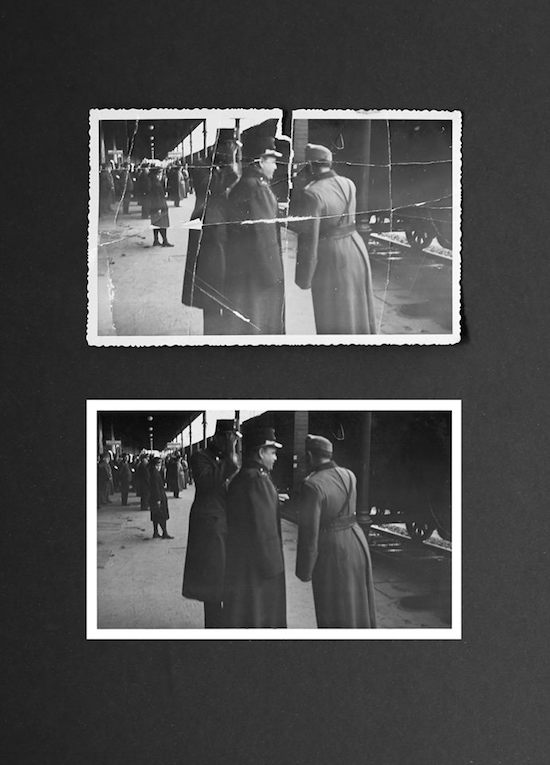
Closely watched trains
"Restored Memories,'' by Zolt Asta, at Galatea Fine Art, Boston, in September.
These pictures are eerie and evocative of Europe's 20th Century totalitarian horrors. Some evil actors in the world now, particularly Putin, ISIS, Assad, China and North Korea, arouse some existential fears that we had thought would not be around again for a long time.
Mr. Asta is a Hungarian. He writes, not about the images here but in general about his work:
“My aim is to investigate the role of the human soul in today's technocratic society. During the renaissance period the centre of the universe was located in people, but now as it seems its place was taken by the instruments of the consumer society. I wonder how could the human presence disappear? It still manifest but in a more hidden and coded way. I depict these coded and hidden situations by using various media. I juxtapose the sterile and remote world with lyric and often romantic human contexts. I tend to use sacral motives since I believe the human soul is sacral in essence.’’
And cleaner and safer than Rio
See this amusing photo essay in The Boston Globe about "The Farmer Olympics.'' Just hit this link.

Port out, starboard home

"Offshore'' (oil on canvas mounted to panel), by Tim Wilson, in the "Install 8'' group show at Corey Daniels Gallery, Wells, Maine, through Sept. 10. The gallery says his "familiar style of deconstructed figures and compelling landscapes mingle with less articulated forms and an exploration of new surfaces and techniques.''
Tim Faulkner: Nature is a lousy 'bridge fuel'
By TIM FAULKNER, for ecoRI News (ecori.org)
A new report concludes what has long been suspected about natural gas: Leaks of methane during the extraction and transportation process eliminate any climate benefits from the supposed low-carbon fuel.
“These findings should lead policymakers to reject natural gas as a ‘bridge fuel’ and instead to redouble America’s efforts to repower with truly clean energy from the sun, the wind and other sources of renewable energy,” according to the report “Natural Gas and Global Warming” compiled by the environmental advocacy groups Environment America and the Toxics Action Center.
Their research analyzed studies of both fracking and traditional extraction of natural gas from mining sites across the country. Aircraft-based sampling across Colorado's Front Range found a 4.1 percent leakage rate. Production sites in southwestern Pennsylvania had a 7 percent leakage rate, according to the report.
The report also questions previous studies of leakage by the Environmental Protection Agency and the University of Texas for underestimating natural-gas leakage. The 22-page report also calls into doubt the claim that natural gas is a “bridge fuel” to renewable energy, by producing less carbon than oil and coal. Both Rhode Island Gov. Gina Raimondo and Massachusetts Gov. Charlie Baker support natural gas a bridge fuel.
Although natural gas emits less carbon dioxide when burned, it generates higher carbon emissions than traditional fossil fuels when the full life cycle of natural gas is considered. Leaks during extraction, storage and transportation of natural gas release greenhouse-gas emissions that equal some 250 new coal-fired power plants, according to the report.
Methane, the primary gas in natural gas, is a potent greenhouse gas, and the report emphasizes the near-term impacts of methane leaks that can occur from 29 different activities and equipment that natural gas goes through during its life as a fuel.
“Temperature increases over the next few decades have the potential to push the climate past ‘tipping points’ — such as the release of methane deposits in the ocean or Arctic permafrost — that could further trigger warming,” according to the report.
Environment America suggests that the rapid growth of the wind and solar industries presents an opportunity for a rapid shift away from natural gas. The advocacy group points to the wave of new natural-gas infrastructure projects as a threat to a low-carbon energy future.
“New fracked gas infrastructure proposed across the region threatens our climate future, our health and our neighborhoods,” Ben Weilerstein, of the Toxics Action Center, said during a July 27 press conference outside the Rhode Island Statehouse.
The event was one of seven held recently across southern New England to protest natural-gas pipeline and infrastructure projects. At another press event on July 27, this one in Massachusetts at the New Bedford Harbor Walk, Sylvia Broude, executive director of Toxics Action Center, said, “For years, communities on the frontlines of proposed pipelines, power plants, compressor stations and LNG terminals have been told by the fossil-fuel lobby and politicians that gas is a low-carbon bridge to a clean energy future. Today, it’s clearer than ever that this is not the case. New fracked-gas infrastructure proposed across the region threatens our climate future, our health, and our neighborhoods. It’s time to double down on clean local renewable-energy sources right here in New England."
In Rhode Island, new fossil-fuel projects include a natural-gas power plant and the expansion of a pipeline compressor station, both in Burrillville, and a liquefied natural gas (LNG) processing facility on the Providence waterfront. Rehoboth, Mass., is being asked to host a new compressor station. A new LNG storage facility is proposed for Acushnet, Mass.
“These new fracked-gas proposals on the South Coast are nothing more than a money-making scheme for the fossil-fuel industry,” said Rachel Mulroy, an organizer with the Fall River, Mass.-based Coalition for Social Justice and a board member for South Coast Neighbors United, which formed out of concerns about Spectra Energy’s LNG proposal in Acushnet.

Functional but creepy

-- Photo and information by Thomas Hook
Mr. Hook notes that "Insects are everywhere. The exact number is unknown but there are at least a million separate species.''
So he joined a a Facebook group called Insects of Connecticut.
This spring and summer, while gardening, cleaning house, driving, or whatever, he has noticed a number of interesting types that have enhanced his appreciation for these six-legged creatures.
So, camera in hand, he goes on the hunt in his yard, on the edge of steep woodland in Southbury, Conn.
This female Pelecinad wasp crossed his path one day. She is not one that will likely sting us.
She uses her long slender abdomen to thrust into the soil in search of grubs. When finding one, she lays an egg on it and when the egg hatches, the larva penetrates the body of the defenseless grub and eats it from the inside out.
While this is gruesome, it explains why this wasp has evolved into her current shape -- very functional but still a little bit creepy.
Meanwhile, we wonder how many species of insects global warming will send us in New England.
David Warsh: Putin, doping at the Olympics and history
When a co-founder of the Russian Anti-Doping Agency died unexpectedly, in February, a couple of months after the world anti-doping authority accused Russia of widespread state-sponsored cheating and corruption, it didn’t make the news. When his 52-year-old successor died two weeks later, of a heart attack, after cross -country skiing, it did.
When the agency’s former laboratory chief fled Russia for Los Angeles in May, it made the front page of The New York Times. Grigory Rodchenkov described an elaborate state-run doping program at the Sochi Winter Olympic Games, in which at least 15 Russian medal-winners participated. Anti-doping experts and members of a Russian intelligence service worked nights, passing supposedly tamper-proof bottles of urine back and forth through a hand-sized hole in the wall, in order for samples to be ready for testing the next day.
No sensible person doubts that the Russian government has been cheating on its doping tests – or that ultimate responsibility lies with Sports Minister Vitaly Mutko, a Vladimir Putin ally since the early ’90s, and with Putin himself.
What was there to be gained? Medals, obviously. In the Winter Games in Vancouver, in 2010, Russia won 3 gold medals and 15 altogether. Four years later, as the host in Sochi, Russia dominated the games, winning 13 gold medals and 33 overall. The comeback served to burnish the narrative of turnaround under Putin, at least for domestic consumption
But what about larger question, of Russia going forward as member of the community of nations? What does the doping scandal tell us about what Putin is trying to accomplish? To glimpse the outlines of a satisfying answer to that question, you have to take a longer view – much longer. You have to start with the Cold War, and with the former Soviet Union.
. xxx
Next year will mark the hundredth anniversary of the Bolshevik Revolution. Get ready for an avalanche of commemoration. For a concise statement of what that was all about, it’s hard to beat the opening sentences of Jonathan Haslam’s Russia’s Cold War: From the October Revolution to the Fall of the Wall (Yale, 2011):
“On the grand scale of history, the Cold War stemmed directly from a thoroughgoing revolt against Western values established since the Enlightenment, a wholesale rejection of an entire way of life and its economic underpinnings increasingly dominant since the seventeenth century, and the substitution of something new and entirely alien in term of culture and experience. That revolt began with the October Revolution in 1917.’’
A longtime professor of history at Cambridge University, Haslam today is serving a six-year term as the George F. Kennan Professor at the Institute for Advanced Study, in Princeton. Russia’s Cold War is utterly absorbing, as helpful as anything I have seen for understanding the course of developments after World War II, thanks to the simple expedient of tracking the course of the Soviet experiment largely through Russian eyes.
For our purposes, let’s fast forward to 1980, when the Summer Olympics were held in Moscow, and the U.S. stayed away, in protest of the Soviet invasion of Afghanistan. Barely noticed at the time was China’s return to the Olympics after an absence of 24 years, four years after the death of Mao Zedong. The Chinese skipped the Moscow session that year, but sent 24 athletes to the winter games, at Lake Placid.
By 1980, the Soviet Union was already in crisis, Haslam notes. Soviet growth, which averaged 3.4 percent from 1961 to 1975, had slowed to 1.1 percent a year from 1976-1990, even as population was increasing 14 percent. Oil and gas exports had soared during the 1970s, but the proceeds had been spent on the military-industrial complex, Third World aid and agricultural imports instead invested of new enterprises. Grain imports had tripled since 1973. Now energy prices had peaked. Real oil prices would fall 90 percent during the decade.
By 1983, Ronald Reagan and European NATO allies, especially France, were turning up the pressure. The Soviets were technologically weak; Reagan proposed the Strategic Defense Initiative, or “Star Wars” defense, as it became known. Arms limitation talks were called off. Espionage became more brutal on both sides. The next four years or so, as described by former Washington Post reporter David Hoffman in The Dead Hand: The Untold Story of the Cold War Arms Race and Its Dangerous Legacy (Doubleday, 2009), were genuinely scary. After the Reykjavik summit, in October 1986, at which Mikhail Gorbachev surprised everyone by proposing a 50 percent cut in strategic weapons in exchange for the West agreeing to not deploy SDI weapons, tensions slowly abated
Haslam:
“[W]hether one likes to admit it or not, the Carter-Reagan build-up in counterforce systems, the anticommunist zeal within Reagan’s administration, and the obsession with space-based defense played a key role in the unraveling of Soviet security policy across the board… Thatcher’s endless berating of Gorbachev, untiring pressure from Kohl, and the hard line of the Bush administration when faced with requests for financial aid all played their part in forcing the Soviet leadership to reconsider past policy and move to ever more radical change so as to enable perestroika to advance at home.’’
Let’s skip over the decline of Gorbachev and the rise of Boris Yeltsin, fascinating though that story is, described in Autopsy on an Empire: The American Ambassador’s Account of the Collapse of the Soviet Union (Random House, 1995), by Jack Matlock. Let’s skip over, too, the wild and wooly ’90s, which are well-covered in Yeltsin: A Life (Basic Books, 2008), by Timothy Colton. This is a Sunday morning column, after all. And as for China’s explosive growth after 1978, let’s simply mention Ezra Vogel’s Deng Xiaoping and the Transformation of China (Harvard, 2011), with its matter-of-fact account of Deng’s suppression of student demonstrations in the “Beijing Spring” of 1989.
Thus we arrive at 1999, when, for reasons that are made clear in The New Tsar: The Rise and Reign of Vladimir Putin (Knopf, 2015), by Steven Lee Myers, Yeltsin, having maneuvered Putin into office as prime minister, resigned abruptly in his favor on the last day of 1999. Myers has written a remarkably good book. I am going to skip over most of that, too.
. xxx
On the eve of taking over, Putin produced a blueprint to accompany his 2000 campaign for the presidency. In fact, “Russia at the Turn of the Millennium’’ had been prepared by German Gref, another member of the circle that had launched his career back when St. Petersburg was still known as Leningrad, but Putin had carefully read and annotated the document and it was fundamentally his. Posted on the government Web site on Dec. 28, it was a new kind of campaign document, at least for Russia.
The dramatic turn in global development of the previous 20 or 30 years had caught the Soviet Union mostly unaware, Putin wrote. The Russian empire had been powerful, but it hadn’t been rich. Its GDP had halved in the ’90s; its GNP was a tenth of that of the U.S. and a fifth of China. For the first time in centuries, Russia was in danger of slipping into the second or even third rank of nations.
The reason why was not in question. Putin:
“For three-quarters of the twentieth century Russia was dominated by the attempt to implement communist doctrine. It would be a mistake not to recognize, and even more to deny the unquestionable achievements of those times. But it would be an even bigger mistake not to realize the outrageous price our country and its people had to pay for the social experiment…. The experience of the 1990s vividly demonstrates that our country’s genuine renewal without excessive costs cannot be achieved by merely experimenting with abstract models and schemes taken from foreign textbooks. The mechanical copying of other nations’ experience will not guarantee success either.’’
Elsewhere:
“Russia is completing the first, transition stage of economic and political reforms. Despites problems and mistakes, we have entered the main highway of human development. World experience convincingly shows that only this path offers the possibility of dynamic economic growth and higher living standards. There is no alternative.…’’
And:
“Russia was and will remain a great power…. It will not happen soon, if ever, that Russia will become the second edition of, say, the U.S. or Britain in which liberal values have deep historic roots. Our state and its institutions and structures have always played an exceptionally important role in the life of the country and its people. For Russians a strong state is not an anomaly to be discarded. Quite the contrary, they see it as the source and guarantee of order, and the initiator and main driving force of change.’’ (The document wasn’t originally posted in English; this is from a translation by Richard Sakwa, of University of Kent.)
Myers divides the saga of Putin’s life into five parts: his youth and service as a young officer in the KGB, perhaps the least corrupt and best-informed agency in the dying empire; his rise to power in the ’90s as a member of the circle that gathered around reform Leningrad Mayor Anatoly Sobchak, a law professor, and Putin’s subsequent move to Moscow as a mid-level appointee in the second Yeltsin administration; his first eight years as Russian president, 2000-2008; Putin’s service as “prime minister” under President Dimitri Medvedev when law prevented him from running for re-election; and his return to the top job in 2012. Medvedev and Putin announced a few weeks before the election that they would again switch places. Not everyone was surprised: a few months earlier after Medvedev had created a storm in Russian government circles when he failed to order a veto of a U.N. resolution that preceded the U.S.-led NATO bombing that overthrew the Qaddafi regime.
Myers sees “no clear purpose” in Putin’s return in 2012, other than “the exercise of power for its own sake.” The Russian president had restored neither the Soviet Union nor the czarist empire over the course of a dozen years, Myers writes. Instead Putin had created “a new Russia, with the characteristics and instincts of both. Brief and fragile in the ’90s, democracy has vanished. Putin had made himself the indispensable leader. He would not encounter much opposition if he chose to run for re-election in 2018. He would be only 72 years old after leaving office in 2024.’’
I am more inclined to take Putin at his word. The expansion of NATO membership that began with Bill Clinton over Yeltsin’s objections, and which continued under George W. Bush and Barack Obama, seems to me one of the central themes in understanding the course of events in Russia since 1992. Putin gave a clear account of Russian objections in a speech in Munich in February 2007, and warned against further expansion. In August 2008 Medvedev waged and won a short war with neighboring Georgia after the would-be NATO member sought to annex South Ossetia. Then came the events in Ukraine in 2014, when Russia seized Crimea from Ukraine after a change of government in Kiev. Putin defended his right to do so in a vigorous speech, “The Spring Snaps Back.” Sanctions followed; the Russian economy has since tumbled into recession. The events in Ukraine represented a “fundamental break,” Myers writes. Putin no longer cared how the West would respond.
. xxx
So where does Olympic cheating fit in? I don’t know the Russian psyche well enough to expound with any conviction on the intricate system of relevancies surrounding the issue. Why Russians Like Vladimir Putin, by state-funded Russia Today television commentator Peter Lavelle, is probably representative of what many ordinary Russians say to themselves. What ordinary Russians think about the deaths of anti-doping officials – or runaway oligarchs, journalists, and turncoat spies – is not part of his story.
I do know that, like all the rest of us — all other thinking citizens, not just those of us in the West – Putin has been pondering the outcomes of a series of epic natural experiments performed over the last hundred years. The attempt to radically transform human nature under communism failed. Markets work, and the combination of international trade and technical change make most people richer, though inevitably some are made worse off. During the ’80s, U.S. and NATO spending contributed to the Soviet collapse. China after 1978 retained its apparatus of political control and boomed; Russia after 1989 abandoned its apparatus of control and fared much less well.
Finally, as columnist Michael Powell just reminded us yesterday in The New York Times, Putin knows that the U.S. had a considerable Olympic doping scandal of its own during its strenuous contest for supremacy with the Soviet Union, especially after the 1984 Los Angeles Olympics amid Ronald Reagan’s “Morning in America” re-election campaign. Under a headline that began, “Lest We Forget …,” Powell wrote:
“For much of the 1980s and 1990s, the United States had a pervasive doping problem in Olympic Sports that was enabled by the USOC {U.S. Olympic Committee}. Test results disappeared, doped-up athletes ran and jumped and swam their way to medals, and complicit coaches prospered. Our Olympic leaders and corporate sponsors and many of us in the news media placed hands over eyes and blocked ears at talk of American doping.
“So the doping scandal probably doesn’t tell us very much about Putin’s larger designs and ambition. It may gain him something domestically; internationally, IT probably doesn’t cost him very much. The Western press doesn’t like him very much, anyway. See David Remnick, "Trump and Putin: A Love Story,'' if you doubt it. Remnick is a distinguished journalist, author of Lenin’s Tomb: The Last Days of the Soviet Empire (Random House 1993) and Resurrection: The Struggle for a New Russia (Random House 1997). Since 1998, he has edited The New Yorker. But, having been a correspondent in Moscow for four years, he is also a charter member of what I have called “the Generation of ’91” – idealists in government and policy circles caught up in the fervent hope that Russia would become more like the US. It already has. It may become yet more so.’’
Perhaps that is the moral of the doping scandal. Both nations cheated in hopes whipping up patriotism, in the throes of risky attempts to improve their positions. In the U.S., the government never was directly involved, and no one was killed, though guilty officials were promoted to senior positions. In Russia not everyone was involved: 271 athletes were cleared to compete, 118 fewer than had been entered. Unattractive as the Russian approach may have been over the decades to American values, in general the Russians have increasingly, slowly, come to play by shared rules.
David Warsh is a long-time financial journalist and economic historian and proprietor of economicprincipals.com, where this first ran.
Hot, lazy and full
"August creates as she slumbers, replete and satisfied."
-- Joseph Wood Krutch

Not great at pastoral care

'The Minister's Black Veil,'' by Varujan Boghosian, in his show at the Berta Walker Gallery Wellfleet (Mass.) through Aug. 21.
Llewellyn King: Vietnam wants to be U.S conduit to North Korea
Can Vietnam talk some sense into North Korea, and in so doing make itself the go-to country in Asia for diplomatic fixes? There are those in Hanoi, and quite a few scattered across the foreign policy establishment, who think so.
Vietnamese President Tran Dai Quang believes so, and would like to be the intermediary between the United States and North Korea.
Back-channel talks — if they can be called that — have begun. Influential American academics have met with leaders in Vietnam and President Quang has been involved. An idea, however inchoate, is in the air in Hanoi – and the government would very much like to see the concept grow.
For Hanoi, being useful to both Washington and Pyongyang, would help Vietnam gain international stature, as well as accelerate its importance in the region.
Globally, Asian scholars and diplomats are hoping to see strong initiatives, particularly from the United States, to affect the seeming intractability of a number of issues in Southeast Asia, which include North Korea’s adventurism and China’s continued expansion in the South China Sea. An additional irritant is China’s damming of the Mekong River, starving Vietnam, Laos and Cambodia of water.
No one involved believes that a communications channel will cause Kim Jong-un, the North Korean leader, to abandon his war games with rocket and missile tests. But they do believe that when and if there is a need to have some kind of opening to North Korea, and to speak to its obtuse leadership, Vietnam is uniquely well-placed facilitate a conversation.
Vietnam, like North Korea, has fought the United States. It also knows what it is like to be dependent on China for its survival, as North Korea is and as North Vietnam was. It also knows what it is like when that kind of lifeline of dependence goes wrong. Vietnam fought a war with China in 1979, with intermittent clashes until 1990.
Hanoi’s hopes to become a bigger player in the Asia diplomatic firmament extend beyond helping the United States with Pyongyang. It would like to be a bigger player in general in Asian diplomacy and use its unique history with the United States and with China to make it a valuable go-between with other countries including Myanmar and even Iran.
“Vietnam feels it has come of age among nations and wants to play a role in offering its good offices to the United States and other world powers,” says a Vietnamese academic, who lives in the United States and is involved in these early diplomatic moves. He says Vietnam, after the fall of Saigon in 1973 and the abrogation of the peace treaty in 1975, and the United States have come a long way and enjoy very good relations. Polls show the United States is favorably regarded by 78 percent of the Vietnamese population of nearly 100 million. President Obama visited a thrilled Vietnam in May. Eight percent of the foreign students studying in the United States are from Vietnam.
But all is not completely rosy. The foreign policy establishment in Washington, as well as a plethora of civil rights groups, worries about human rights in Vietnam, its authoritarian ways and the treatment of dissidents.
Particularly vexing to those who would like to see Vietnam become a kind of Asian Switzerland, friendly to all and skilled at bringing disputatious parties together, is the treatment of journalists, bloggers and others who are imprisoned when they run afoul of the Vietnamese leadership’s sensitivities. Press freedom is high on the list of reforms the West in general would like to see if Vietnam is to realize the role which it seeks.
For its part, Vietnam would like to see the United States take a stronger stand against China’s virtual annexation of the South China Sea and to pass the Trans-Pacific Partnership agreement. Here, there are real fears that the hostile political climate in the United States will do damage to its relations with Southeast Asia at a critical time.
Still, Vietnam wants ever-closer relations the United States and a bigger diplomatic role in Asia. The feelers are out.
Llewellyn King is a long-time publisher, editor and columnist and host of White House Chronicle, on PBS. This column originated on Inside Sources.
On the edge of space
"One summer night, out on a flat headland, all but surrounded by the waters of the bay, the horizons were remote and distant rims on the edge of space."
-- Rachel Carson
James P. Freeman: 1966 was a very good year for Frank Sinatra
“To do is to be – John Stuart Mill
To be is to do – Jean-Paul Sartre
Do be do be do – Frank Sinatra”
--Graffiti, Cambridge University Library, 1966
It was in the Mad Men era, before things got really weird, excessive and decadent.
People dressed up for airline travel. Mini-skirts were all the rage while gentlemen still adorned stingy-brimmed fedoras. Batman, Star Trek and How the Grinch Stole Christmas all made their television debuts in living color but Vietnam was beamed into living rooms nightly in black and white. The U.S. Supreme Court affirmed “Miranda Rights’’ and LSD was made illegal. Project Gemini was exploring new frontiers in outer space and, for the first time in 400 years, the leaders of the Catholic and Anglican churches exchanged fraternal greetings, on earth, in Rome.
As a counter to Berkeley’s counter-culture, Ronald Reagan was elected governor of California. The average home cost $14,200 and a gallon of gas cost just 32 cents. Mercury Record Company introduced the music cassette to the U.S. market and fans burned vinyl records in reaction to reading that John Lennon said the Beatles were “more popular than Jesus.” The Jimi Hendrix Experience recorded “Hey Joe.” And a 50-year-old, with a style and swagger all his own, won the Grammy Award for Best Vocal Performance, Male, for “It Was a Very Good Year.” The man was Frank Sinatra and the year was 1966.
This was the environment Sinatra was operating in 50 years ago. He was enjoying success again in the mid-sixties -- in music and movies, having returned from the brink of extinction in the early 1950s. But 1966 was different. There was a definitive creative tension in popular music that year, where the contemporary electric sounds --the cacophony -- were colliding with the more traditional acoustic sounds -- the symphony. In his astute cultural observation, author Jon Savage in 1966: The Year the Decade Exploded concludes, the year began in “pop” and ended in “rock.”
“It was the year,” Savage writes, “in which the ever lasting and transient pop moment would burst forth in its most articulate, instinctive and radical way.” The 7-inch single outsold the long-player for the last time. “After 1966, nothing in pop would ever be the same.”
The pace of change and the drive for even greater expression in popular culture, in general -- and music, in particular -- could render someone hopelessly dated and irrelevant rather quickly, if they did not act. Fear of being left behind competed with a desire to be current. Sinatra, too, must have sensed something in the air, that tension.
The year before, in 1965, Sinatra’s music (especially on the album September of My Years, which, incidentally, won Album of the Year at the 1966 Grammy Awards, and on “It Was a Very Good Year,” the single that yielded Sinatra the above Grammy for Best Vocal Performance, Male) was tinged with reflection and tortured with resignation, surely as a consequence of hitting middle age.
His first release of 1966 was in March, with Moonlight Sinatra. Recorded in late 1965, it was familiar territory, romantic and ruminative; another in a series of concept albums, playing off of Beethoven’s “Moonlight Sonata” theme. It was new but not innovative.
In his famous April 1966 Esquire magazine essay, “Frank Sinatra Has a Cold,” written mostly in 1965, Gay Talese noted that the entertainer “survives as a national phenomenon, one of the few prewar products to withstand the test of time.” But he still craved relevance, not just survival.
In 1966, Sinatra -- beyond The Voice but not yet The Chairman of the Board -- wanted to be cutting-edge, yet retain his classic style. Personally and professionally he reflected perfectly the “tumult” and “urgency” of the year Savage wrote about: Sharp-edged and sharply dressed, he held the freakish, Technicolor of bohemian hippiedom in absolute disdain. But he married Mia Farrow, then sporting a modern Twiggy-like hairdo, just 21 years old. And musically, as then-young music producer, Jimmy Bowen, said, “he wanted Top 40 radio… he wanted hits.” Where The Beatles were happening. As he had done over a decade beforehand, he would have to radically retool his sound. That would require adding a new instrument to the repertoire to introduce new tones and colors. Something hip.
The Vox Continental organ (and later the Hammond B3) was a staple in many of the mid-sixties hits in popular music. Transistor-based, it was able to replicate a “reedy, eerie” sound, but also looked and sounded futuristic. It was the signature sound on the Animals’ “House of the Rising Sun,” and used by the likes of The Beatles, The Dave Clark Five, The Monkees, and, later, The Doors -- all hit makers.
Recorded on April 11, 1966 and distributed hastily via plane and courier (fearing a version by Jack Jones would hit the airwaves before his version), Sinatra’s “Strangers in the Night,” (a product of producer Bowen and engineer Ernie Freeman) became a massive success, reaching number one in the United Kingdom (June 4) and the United States (July 2). It would be the last Sinatra song to hit the top of the Billboard charts and features a “surprisingly quixotic scat” coda: “dooby-dooby-do.” A new, but immortal, Sinatraism.
Despite the achievement, as Will Friedwald notes in his extraordinary book, Sinatra! The Song is You, “the rest of the Strangers [In the Night] album had been originally earmarked for another project; Sinatra and Reprise annexed the material under the ‘Strangers’ banner out of a quick need for an album to complement his mega-hit single.”
Ironically, the singer initially hated “Strangers.” Even with a melodic hook and moody hesitancy the sound came from familiar territory. The remaining collection, wrote Friedwald, was a “set so beautifully done it almost seemed as if Sinatra were apologizing for the original track.” And that’s where things got interesting.
Paired with long-time arranger Nelson Riddle (largely responsible for creating the classic Sinatra soundtrack, as defined by the test of time), it was Riddle who, according to an iTunes review of the album, “wanted to modernize Sinatra within believable limits.” Irrepressibly, “The Popular Sinatra,” announced the back cover to the LP, “Sings for Moderns.” In a kind of throw down, Stan Cornyn’s liner notes warn that Sinatra, “defies fad. He Stayeth.”
Two tracks, sequenced behind “Strangers,” heralded the new Sinatra sound, the organ-infused “Summer Wind” and “All or Nothing at All.” They were among “the last fully realized, top-drawer examples of the Sinatra-Riddle collaboration.”
The “Summer Wind” was the “greatest triumph” of the collaboration in its ‘60s phase, concludes Friedwald. The song employs two orchestras – the organ and the big band – that “become a countermelody and background riff to Sinatra’s exposition of the central melody.” Riddle constructed a stunningly catchy “leitmotif to represent the breeze,” where the organ lifts into a crescendo and softly fades away, the protagonist’s “fickle friend.” If anything, the organ adds a contemporary texture to the track. It reached number 25 in the charts on Oct. 1, 1966, but retains a remarkable staying power, a favorite of fans even today.
“All or Nothing at All,” a Sinatra ballad first recorded in 1939, was given a complete reworking; an up-tempo, jazz-inspired swinging swirl, the organ is even more emphatic. Riddle’s liberal use of it, combined with a more pop-oriented rhythm section, presents a modern, sophisticated masterpiece -- where the singer is at his most commanding, confident and in control, in years. Here, the organ and orchestra “don’t play at the same time but trade phrases back and forth like two warring big bands in a Savoy Ballroom battle.” It is arguably the quintessential post-modern Sinatra tune. So utterly cool, it never approaches parody status, a dreadful hallmark of some of Sinatra’s later work.
Released on May 30, Strangers in the Night would remain on the charts for 43 weeks and would be Sinatra’s last number one album, and, incredibly, his last with Riddle and his orchestra. Clocking in at 27 minutes and 10 seconds, a complex compression of old and new, the album would revitalize him. Indeed, Sinatra was back, standing tall, a hit maker again.
Keeping the momentum going, in July Sinatra at the Sands was released as a double album, featuring live performances of the 1966 incarnation of the brash, Rat Pack leader. Taken from a series of shows recorded at the hotel’s Copa Room, in January and February of that year, it contains none of the year’s new material. Remarkably, it does not even anticipate the new sound or direction. Playful and cascading with attitude as wide as America, it does, however, showcase Quincy Jones’ fine traditional arrangements and Count Basie’s solid orchestra.
That’s Life, released on November 18, did further the exercise in experimentation, reaching number 6 on the album charts. The single, “That’s Life”, is propelled, right from the opening bars, by a rhythmic and melodic organ, more rooted in the blues, than jazz, and way up in the final mix. Gritty and a bit more raucous than its predecessors, the song peaked at number 4 on the charts, fittingly, on Dec, 24. After “Strangers,” it would be the second in a trilogy (the third being 1969’s “My Way,” which reached number 27 on the charts that year) of songs most closely identified as “ballad-rock” or “contem-pop” during the1960s Reprise era. As Friedwald writes, this formula became the “dominant mode” of future Sinatra singles and albums.
On March 2, 1967, Sinatra’s efforts from the previous year were fully recognized. The song “Strangers in the Night” won Grammy’s in four different categories, including Record of the Year and Best Vocal Performance, Male. Sinatra at the Sands won Stan Cornyn the award for Best Album Notes. And, in an exquisite twist of fate, Strangers did not win Best Album honors. Instead, exhibiting a bizarre sense of humor, Grammy voters awarded Sinatra: A Man and His Music (an album issued in 1965, too late for inclusion in the 1966 Grammy nominations) that distinction.
Five years before a self-imposed “retirement,” and two decades before becoming a caricatured figure, Frank Sinatra was at the height of his artistic and commercial appeal in 1966. You can almost still see him, impeccable, with a lit cigarette and tumbler of whiskey, as he might have described that year in his own unique vernacular: “Oh, it was a gas.”
James P. Freeman is a New England-based writer and a former columnist with The Cape Cod Times
Chris Powell: Too much even for Cole Porter?
Until a few weeks ago the Connecticut Department of Children and Families was using its Internet site to propagandize children about sex and politics by publicizing a list of purported definitions of sexual terms.
The definitions held that every form of sexual expression and conduct is normal except one and that anyone who questions anything sexual is an enemy of the people. The one purportedly sexual deviancy admitted by the list was interest in guns. "Someone who has an unnatural romantic relation with firearms or affection for or love of firearms" was termed an "ammosexual."
"Binary sex" was defined as "a traditional and outdated view of sex, limiting possibilities to 'female' or 'male.'" The supposedly proper outlook was reflected by the term "gender gifted" -- "a person whose capacity for gender expression exceeds the binary." Such people, according to the list, might better be described with a new gender-neutral pronoun, not by "he" or "she" but rather "ze."
Even a few ordinary words were redefined and sharply narrowed in their meaning by the list. "Advocate" became "a person who works to end intolerance, educate others, and support social equity for a group," while "ally" became "any non-lesbian, gay, bisexual, or transgender person who supports the rights of LGBT people."
The list forbade use of a few sexual terms as disrespectful even as it advocated a disrespectful term of its own: "gayby," the baby of a same-sex couple, as if babies need to be classified according to the gender of their parents. (What are the children of "gender-gifted" parents to be called? Thankfully the list didn't say.)
It's good that the country has become more libertarian about entirely personal matters. No one really needs to care much that, for example, some men want to dress as women and some women want to dress as men. But whose bathrooms they use is another matter.
For it is one thing to tell children that much of gender is a social construct, that sexuality can be fluid and mysterious, that gender dysphoria is a phenomenon deserving scientific study, and that it may be best to be kind to people and refrain from unnecessary judgments. It is something else to tell children that social norms have no legitimacy, that people must be politically correct, and that the only perverts are people who support the Second Amendment.
Even the songwriter Cole Porter, who, in a repressive era, still managed to enjoy plenty of extravagance, including sexual extravagance, recognized lyrically, in this song “Anything Goes,’’ the necessity of a little social order.
In olden days a glimpse of stocking
Was looked on as something shocking.
But now, God knows --
Anything goes. ...
The world has gone mad today
And good's bad today
And black's white today
And day's night today
And that gent today
You gave a cent today
Once had several chateaux.
The sexual-definitions page on the DCF internet site was disclosed by an internet site, the Daily Caller, whose report was publicized by the Connecticut Capitol Report Internet site, whereupon the department recognized the content's inappropriateness for children or at least its political indefensibility and removed it.
A DCF spokesman told the Journal Inquirer that the department had no idea where the definitions came from or who was responsible for conferring the department's endorsement on them and that it would be impossible to find out. This only raised suspicion that the department didn't want to know and that, as its troublesome record suggests, its attitude remains that even with children anything goes.
Chris Powell, an essayist on cultural and political topics, is also managing editor of the Journal Inquirer, in Manchester, Conn.