
Vox clamantis in deserto







New Hampshire blue

"Canoers'' (oil on canvas), by Kim Case, at the Patricia Ladd Carega Gallery, Center Sandwich, N.H.
'Catching in open screens'
"A break in the heat
away from the front
no thunder, no lightning,
just rain, warm rain
falling near dusk
falling on eager ground
steaming blacktop
hungry plants
thirsty
turning toward the clouds
cooling, soothing rain
splashing in sudden puddles
catching in open screens
that certain smell
of summer rain."
-- Raymond A. Foss, ''Summer Rain''
If only they would
“To my knowledge, nobody has fallen into the lagoon yet,” said Susan Abell, director of communications at the Friends of the {Boston} Public Garden.
— regarding Pokémon players wandering around America like zombies from The Night of the Living Dead, as reported in the current issue of The Boston Guardian.

Body heat and global warming

"Burn Baby Burn'' (oil on canvas), by Mia Cross, in the show "Heat,'' at the Bromfield Gallery, Boston, Aug. 3 through Aug. 28. This juried show features 17 New England artists who explore the theme in relation to climate, sex and politics.
David Warsh: Trump, Rodrik and the clash of global integration, national sovereignty and democracy
David Brooks, of The New York Times, wrote the single best piece I read last week on the Republican convention: “Death of the Party.” Like him, I was riveted by Donald Trump’s acceptance speech. The scene seemed straight out of one of those dystopian Batman movies of the 1980s, ’90s, and ’00s, an outlandish character, sailing under false colors, bullying and threatening, preying on fears, selling Gotham a bill of goods, preparing chaos.
By the time the nominee bellowed, “I am your voice” to the hall of delegates, he seemed simply the latest in a long line of improbable adversaries: the Joker, the Penguin, the Riddler, Mr. Freeze, Poison Ivy, Ra’s al Ghul, the Scarecrow, Bane, Mr. Trump.
But then Batman movies depend on the Caped Crusader, the Dark Knight, to answer the Bat signal, expose the fraud, counter the villains’ plans, and save the city.
Batman in this case is Dani Rodrik, 58, of Harvard University’s Kennedy School of Government. He is likely to be the next economist to enter the pantheon of those who went to school in the ’70s whom much of the public knows today” Jeffrey Sachs, Paul Krugman, Larry Summers, Ben Bernanke.
His father, a Turkish manufacturer of ballpoint pens, was happy to finance his son’s education in the United States: Harvard College, ’79, before graduate school at Princeton University, where his adviser was Avinash Dixit. Rodrik’s first job was at the Kennedy School, in 1985. He taught for four years at Columbia University, 1992-96, then returned to the Kennedy School.
In 2013 Rodrik ascended to one of the pinnacles of the profession, replacing Nobel laureate Eric Maskin as the economist on the faculty of the Institute for Advanced Study in Princeton, N.J .He returned to the worldly bustle of the Kennedy School after only two years. Something of an explanation of the journey is to be found in Economics Rules: The Rights and Wrongs of the Dismal Science (Norton, 2015). Maskin, too, returned to Harvard and teaching after a few years; the Institute has no graduate students, only fellows.
In 1997, Rodrik published a monograph that boldly asked, “Has Globalization Gone Too Far?’’ (Institute for International Economics). He argued that trade was creating deep divisions between those who possessed the skills to thrive in global markets and those who lacked them. Redistribution to the losers of the gains from trade were almost wholly lacking, and globalization seemed to have permanently altered the norms surrounding domestic production in nations all around the world. There was bound to be a backlash.
In “Rebel with a Cause,” in the International Monetary Fund’s Finance and Development magazine, he told economist Prakesh Loungani that Harvard Prof. Andrei Shleifer, then advising the Russian government on privatization, would josh him whenever they met, “How is the revolution going?”
It was Shleifer who, as, editor of the Journal of Economic Perspectives, published Rodrik’s 2000 article “How Far Will International Economic Integration Go?” in which he broached what has since come to be known as “the globalization trilemma.”
Democracy, national sovereignty, and global integration were mutually irreconcilable, Rodrik argued, because of the political strains that inevitably would emerge. Nations could have any two of the three possibilities, but could never have all three at once at least not in strong forms.
In 2000, Rodrik predicted that the nation-state eventually would disappear; that global federalism would take its place. By the time The Globalization Paradox: Democracy and the Future of the World Economy appeared (Norton, 2013), he was no longer quite as sure.
By then, though, Rodrik had ceased to be a gadfly critic, and was well on the way to becoming the foremost policy authority on the political economy of global trade. Just ahead lay Brexit and the insurgent candidacy of Donald Trump. As Loungani writes in “Rebel,” the revolution was over and Rodrik had won.
Here, too, as in the movies, there is a foil, not a Robin-like sidekick, but a philosopher, Harvard Law Prof. Roberto Mangabiera Unger, a native Brazilian whose influence extends around the world to politicians on the Left. Rodrik and Unger taught a Harvard course on trade together for many years.
Unger habitually argued that economics had lost the capacity for grand narrative; Rodrik countered that small-scale theorizing about cause and effect was good enough, at least for now. The prolific Unger produced a book, Free Trade Reimagined: The World Division of Labor and the Method of Economics (Princeton, 2007), a demanding survey of the intellectual underpinnings of contemporary views on trade. The Globalization Paradox and Economics Rules followed in due course. For an introduction to the peripatetic Unger, read about the luncheon that ensued when John Paul Rathbone, of the Financial Times, came calling.
You have to go back to a sunnier time, the ’60s, and a memorable network television series, to find a more congenial Batman to serve as a stand-in for Rodrik as a crime-fighter. That series thrived, the Wikipedia entry says, by presenting relatively simplistic moral lessons aimed mainly at the young, including championing the importance of using seat belts, doing homework, eating vegetables and drinking milk, wrapped up in the story of one caper after another in which some villain tries to take over Gotham City. Today, it’s probably remembered best by those who saw it for its campy tone, especially Robin’s non-stop exclamations of astonishment at each new twist of the plot.
Rodrik isn’t exactly fighting with Trump, the way that Batman fights with those villains. He is, by his own account, recasting the globalization narrative, replacing the familiar triumphalist version with a more nuanced account, including the ill-effects of integration that gave rise to the Trump and Bernie Sanders campaigns, and those of H. Ross Perot and Pat Buchanan before them. (Meanwhile, Rodrik is interpreting events in Turkey as well.)
The Trump campaign supports no intellectual edifice whatsoever. For all its flaws, it is up to the Clinton campaign to begin translating into political terms the deeper understanding globalization – its costs as well as its benefits – that Rodrik, Unger, and many others have been working out.
Holy Hoodwink, Batman! Let’s get to work!
David Warsh is proprietor of economicprincipals.com, where this first ran, and a longtime economic historian and financial columnist.
Oil-spill settlement helps fund shellfish-restoration projects around Buzzards Bay
By ecoRI News staff
BOURNE, Mass. — Buzzards Bay recreational fishermen may soon have access to improved scallop, oyster and quahog populations in town waters for recreational harvests, thanks to settlement funding being used by the Massachusetts Division of Marine Fisheries and The Nature Conservancy to restore natural resources injured by a 2003 oil spill near the bay’s entrance.
In April 2003, the Bouchard Transportation Co. Barge #120 spilled about 98,000 gallons of fuel oil into Buzzards Bay. The oil spread along more than 90 miles of shoreline and affected wildlife, shellfish beds, recreational activities and habitat. Eight years later, natural resource agencies secured a $6 million settlement to restore wildlife, shoreline and aquatic resources and lost recreational uses.
With the settlement money, the Buzzards Bay/Bouchard B-120 Trustee Council — the U.S. Fish & Wildlife Service, National Oceanic and Atmospheric Administration (NOAA), and state agencies from Massachusetts and Rhode Island — has funded 26 projects. Nature Conservancy bay scallop and oyster restoration projects and Massachusetts Division of Marine Fisheries quahog and oyster restoration work are among the recently funded projects. These restoration efforts are targeting recreational shellfisheries within the impacted Buzzards Bay communities.
“Recreational shellfisheries were tragically affected by the Bouchard spill, with some municipal harvesting areas closed for six months or longer during the peak harvest season due to the oiling,” said John Bullard, regional administrator for NOAA Fisheries Greater Atlantic Region.
The two settlement-funded conservancy shellfish projects are underway. In early June, the conservancy, in collaboration with Bourne municipal shellfish officials, deployed 7,500 caged adult bay scallops in town waters. The goal is to create a spawner sanctuary as an effective way of restoring sustainable bay scallop populations and supporting seasonal recreational shellfishing.
“Bay scallops are a historically and culturally significant species,” said Steve Kirk, the conservancy’s Massachusetts coastal restoration ecologist. “While populations have always fluctuated, we want to bring them back by creating spawner areas to ultimately boost the wild population.”
In collaboration with the town of Fairhaven, the conservancy is using additional settlement money to restore a one-acre oyster bed in Nasketucket Bay.
The Buzzards Bay Coalition is supporting the scallop and oyster restoration work by securing project volunteers and hosting outdoor educational opportunities focused on this shellfish restoration work.
Also funded by the settlement are projects led by the Massachusetts Division of Marine Fisheries, including multiyear hard clam (quahog) relay and oyster restoration projects. This work involves moving adult quahog stock from an area closed to shellfishing in the Taunton River to designated transplant sites in the waters of Bourne, Dartmouth, Gosnold, Marion, Mattapoisett, New Bedford, Wareham and Westport.
Upwellers for nursery grow-out will be installed and juvenile quahogs will be outplanted in Dartmouth, Wareham and Fairhaven. Outplanting of single field-plant-sized oysters will also take place in Bourne, Marion and Wareham.
The goals of the Division of Marine Fisheries-led projects are to increase overall municipal quahog populations and enhance recreational shellfisheries.
“Boosting the local quahog stocks for local recreational fishermen will be a tangible benefit to those impacted by the spill,” said Division of Marine Fisheries director David Pierce. “Once the transplanted clams are certified clean and held for at least one spawning season after a minimum of six months from relocation, fishermen will have access to this crop. We hope there will be increased quahog reproduction from these transplants, resulting in increased and sustainable harvests from their progeny in the future.''

You won't need a reservation

"Destination in Sight'' (acrylic/oil on paper mounted on board), by Susan Blatt, at the New England Collective VII'' show at Galatea Fine Art, Boston, Aug. 3-28.

To remember them when they're extinct
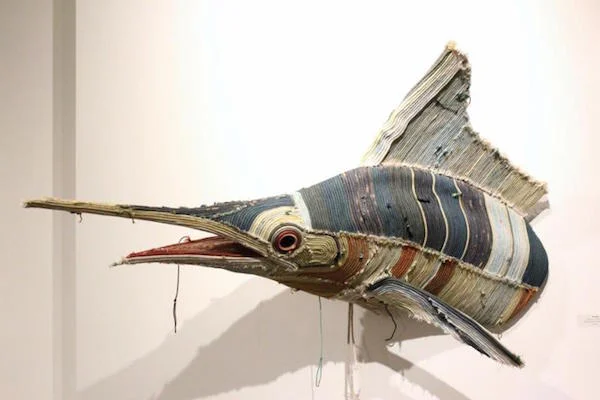
"Roger's Zoo Marlin'' (hand-dyed, retired longline fishing gear/enamel/taxidermy form), by Gin Stone, in the "The England Collective VII ''show at Galatea Fine Art, Boston, Aug. 3-28.

William Morgan: 'On Cape Cod' celebrates 'ebullience of the summer Cape'
On Cape Cod, Photographs and text by Don Krohn; 175 pp.; David R. Godine, Publisher; $29.95.
If you cannot get to the Cape this summer – you refuse to fight the traffic, you can't afford the exorbitant rentals, the old family cottage has been sold, leveled, and replaced by a hedge fund manager's McMansion – then some time with Don Krohn's new book, On Cape Cod, will slake a little of your thirst for beaches and cranberry bogs.
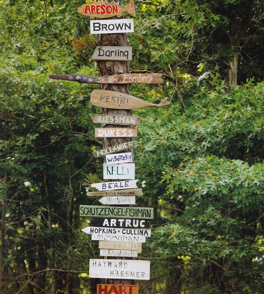
Signs, Truro
All the pictures were taken in the summer. "They depict the ebullience of the summer Cape that is so easy to love," notes Australian writer and Vineyard resident Geraldine Brooks in her introduction. "A primary-colored place illuminated by tumbles of beach roses and impossibly blue hydrangeas, glossy-painted dinghies and buoys, bright beach umbrellas an suntanned faces."
Krohn, the Brandeis- and Harvard-educated founder of Main Street Books in Orleans, offers up exceptionally handsome images of standard Cape fare: antiques shops, ice cream stands, shingled houses, jam jars and abundant flora and fauna. Some of his shots are abstract compositions, and most are artistically strong.

Four Girls Swimming, Old Silver Beach, Falmouth
One senses that this book is actually three: the photos, plus a couple of extended essays. The "Photographer's Note" is a wonderful 12-page exegesis on history, craft, art and life.
"Fortnight in the Dunes" is a thrice-longer journal of time spent in an artist's shack outside of Provincetown. These simple shelters have been getaways and creative sojourns for the likes of Eugene O'Neill, Jack Kerouac, Jackson Pollock, William de Kooning, Tennessee Williams, and Norman Mailer. Krohn's particular cottage was built in 1940 by Russian surrealist painter Boris Margo and his wife Jan Gelb as a summer retreat.

View from inside Boris's Shack, Provincetown
Krohn writes: "We gathered some sea lettuce which had been tossed upon the beach in abundance in the recent ocean churn, rinsed it numerous times at the pump to remove the sand, and enjoyed it for lunch tossed with olive oil and, of course, sea salt."
Willam Morgan is an architectural historian, essayist and photographer. He is the author of, among other books, The Cape Cod Cottage (Princeton Architectural Press).
Robert Whitcomb: Open woods; the aim is merely fame; Art Deco challenge
A version of this first ran in the Digital Diary feature on GoLocalProv.com.
The other week, as I drove through miles of woodsin inland southern New England where caterpillars had consumed the leaves of so many trees, I thanked God that no one has suggested spraying to kill the creatures. You hear enough about massive spraying campaigns to kill mosquitoes carrying the Zika virus.
The trouble with these campaigns is that they kill a lot more than the targeted culprits. They kill, for example, bees, which we need for pollination of our crops, as well as birds, fish and many other creatures.
The trees will come back without chemical bombing. For now, we can enjoy the eerie sight of midsummer woods looking like November’s.
xxx
In picking Indiana Gov. Mike Pence as his running mate, Donald Trump has shown yet again that he really doesn’t have any “policies.’’ His only real apparent interest is maintaining himself as a “winner’’ and Mr. Pence might help.
Mr. Pence’s support for “free-trade’’ agreements that have helped kill jobs and lower wages in the U.S.; his backing for open immigration (which also cuts U.S. wages), and his evangelical Christian views don’t jibe with Mr. Trump’s rhetoric or behavior.
Mr. Trump has two main issues: Crack down on “free trade’’ and on immigration. On the latter, he wants to kick out 11 million illegals, build a “wall’’ on the Mexican border and make it tough for Muslims to enter America. Operational details to come.
Maybe.
The governor has also been a loyal servant of the Koch Brothers and other very rich people. For a time, Mr. Trump made vague populist noises about the need to reduce the power of Wall Street big shots and Washington lobbyists but that has gone away as he realizes the Republican reality. The public has less and less patience with details anyway, and citizens rarely remember what a candidate said a few months back.
Judging by how he has conducted his business and much of his personal life, The Donald would rank high up on most metrics of, to be polite, ‘’amorality’’.
But that matters little in the Reality TV and Twitter age, even to the Boy Scouty Mr. Pence, who has decided to try to ride the Trumpmobile back to Washington, where he was an ineffective, if pleasant, congressman promoting the usual collection of Tea Party and supply-side nostrums that, although having been tried for much of the past few decades, do not seem to have ushered in a golden age for the middle class.
Anyway, the aim is fame. Isuspect that Donald Trump originally ran for president simply to keep himself and his businesses in the news. He may have been surprised that his incoherent, virtually detail-freebut entertainingly demagogic primary campaign did as well as it did. And this pathological liar and con man will get a lot of votes in November from people who won’t admit their choice to their neighbors. As for Mike Pence, he knows that there’s a good chance that a vice president can become president.
xxx
People tend not to like Hillary Clinton because she has told some self-protective lies; because she has a reputation for extreme secretiveness; because she seems to feel herself privileged to make her own rules (but not as much as Donald Trump), and because she and her husband have made a fortune by mingling/cross-self-promoting government work, “nonprofit’’ work and for-profit work (especially by being paid vast sums to speak to companies and other special-interest groups). And, as unfair as it is, a lot of people find her voice grating.
Not surprisingly, she generally avoids press conferences. But she could do herself a big favor by holding a long press conference in which she takes any questions. She could, for example, elaborate more on why she used a private server to conduct top-secret discussions by email and also explain the mysterious workings of the Clinton Foundation. Such a forum might help lance the boil of public distrust, if not dislike.
xxx
David Sweetser, whose High Rock Development owns the Industrial Trust Building, in downtown Providence, is smart to have arranged for public tours of the Art Deco skyscraper to be offered over the next couple of months to, he hopes, get people excited/intrigued enough to rent there (or buy the whole place).
It’s a gorgeous structure, although, of course, fading. The model in New England of how to retrofit such a stepped-back Art Deco building is the gold-topped United Shoe Machinery Building, on Federal Street in downtown Boston, which is now fixed up and full. But it’s usually a lot cheaper to tear down an old building and put in a cheap utilitarian replacement than to save it. And there’s much more money in Boston than in Providence. But hang in there, Mr. Sweetser!
Robert Whitcomb is the overseer of New England Diary.
Llewellyn King: Murdoch created the formula with which Ailes built Fox News
In the beginning, there was Rupert Murdoch. He created the formula.
Then he met Roger Ailes and installed him as head of what would become America’s most successful cable news channel, Fox News Channel, also known as Fox News.
And so the formula of conservatism and sex, pioneered on a newspaper in Britain, came to television and the rest, as they say, is history.
In 1969 Murdoch bought an ailing British newspaper called The Sun. He bought it from the Daily Mirror Group, then the publishers of the most successful tabloid in Britain, The Daily Mirror, and its sibling The Sunday Mirror (where I once worked). The Daily Mirror was firmly left-wing and The Sun, if anything, more so. It had started life as The Daily Herald and was owned collectively by the trade union movement.
The new owners, who used an old formula — the working class as exploited, downtrodden and hopelessly dependent on the largesse of their employers — failed to attract or excite readers.
Murdoch, fresh from Australia (although he had worked earlier as an editor in London), looked around and saw something quite different. He saw a new worker, who owned a car, took vacations in Spain (thanks to jet travel), and did not feel oppressed.
The British workers — especially working men — had thrown off the past and were now much more like the workers of Australia and the United States. It was also a period of sexual freedom.
These workers would be Murdoch’s target.
Overnight, without warning, he turned The Sun from far-left whining to triumphant far-right throatiness. Murdoch had realized that the working man had become a man of property.
As for sex, Murdoch would go further. British tabloids had always published “cheesecake” — pictures of busty, young women in bikinis. Murdoch took off the tops: Every day, on Page Three, he published a photo of an English rose blooming in a bikini bottom. It was bold and it was brave and it worked.
The Sun, with its new brawny politics of nationalism, anti-European attitude, right-wing enthusiasm and topless beauties, was a triumph. It began a meteoric rise, almost entirely at the expense of the forelock-tugging Daily Mirror.
The formula was born: right-wing nativism and sex.
When Murdoch came to the United States, he found the society was less louche and he could not put nudity into his newspapers. Also, there was a tradition of editorial duality: Although the politics of newspapers was not concealed, readers wanted to think that the news was impartial. Murdoch bought newspapers in San Antonio, New York, Boston and Chicago, and he started a weekly supermarket tabloid.
None succeeded and gradually Murdoch sold off these properties, except for The New York Post. Murdoch’s daughter, Elisabeth, told me that he was the first to admit that he had misunderstood the U.S. market. That is probably why when he bought The Wall Street Journal in 2007, he was careful to respect that property and to change it incrementally — for the better.
But the formula was not dead. When Ailes applied it to television, it worked all over again. Except this time, the result was even more spectacular in political power and profit.
Fox News is the voice of raucous conservatism, all served up with sex appeal.
Ailes clearly has had a fascination with beautiful, blond women reading the news — and other channels are going that way.
Ailes has done more than apply the formula: He has applied it with brio. He has given the news pace. It moves along and little inventions, like “Around the World in 80 Seconds,” are part of that energizing.
I visited with Ailes when Fox News was just beginning its ascent. He was thrilled with the fact that it had just drawn slightly ahead of CNN Headline News. I do not think he realized then how potent the formula would be and what heights his creation would reach.
Llewellyn King is host of White House Chronicle on PBS. Based in Rhode Island and Washington, D.C., he is a longtime publisher, editor, columnist and international business consultant. This originated on InsideSources.
Jim Hightower: Banks like Goldman Sachs don't commit crimes, their bankers do
Hey, stop complaining that our government coddles Wall Street’s big, money-grubbing banks.
Sure, they went belly-up and crashed our economy with their greed. And, yes, Washington bailed them out, while ignoring the plight of workaday people who lost jobs, homes, businesses, wealth, and hope.
But come on, buckos. Haven’t you noticed that the Feds are now socking the banksters with huge penalties for their wrongdoings?
Wall Street powerhouse Goldman Sachs, for example, was recently punched in its corporate gut with a jaw-dropping $5 billion punishment for its illegal schemes. It’s hard to comprehend that much money, so think of it like this: If you paid out $100,000 every day, it would take you nearly 28 years to pay off just $1 billion.
So imagine having to pull five big Bs out of your wallet. That should make even the most arrogant and avaricious high-finance flim-flammer think twice before risking such scams.
So these negotiated settlements between the Feds and the big banks will effectively deter repeats of the 2008 Wall Street debacle, right?
Actually, no.
Notice that the $5 billion punishment is applied to Goldman Sachs, not to the “Goldman Sackers.” The bank’s shareholders have to cough up the penalty, rather than the executives who did the bad deeds.
Remember, banks don’t commit crimes — bankers do. Yet Goldman CEO Lloyd Blankfein just awarded himself a $23 million paycheck for his work last year. That work essentially amounted to negotiating a deal with the government to make shareholders pay for the bankers’ wrongdoings — while he and other top executives keep their jobs and keep pocketing millions.
What a great example for young financial executives. With no punishment, the next generation of banksters can view Blankfein’s story as a model for Wall Street success, rather than a deterrent to corruption.
Jim Hightower is a radio commentator, writer and editor of the Hightower Lowdown.
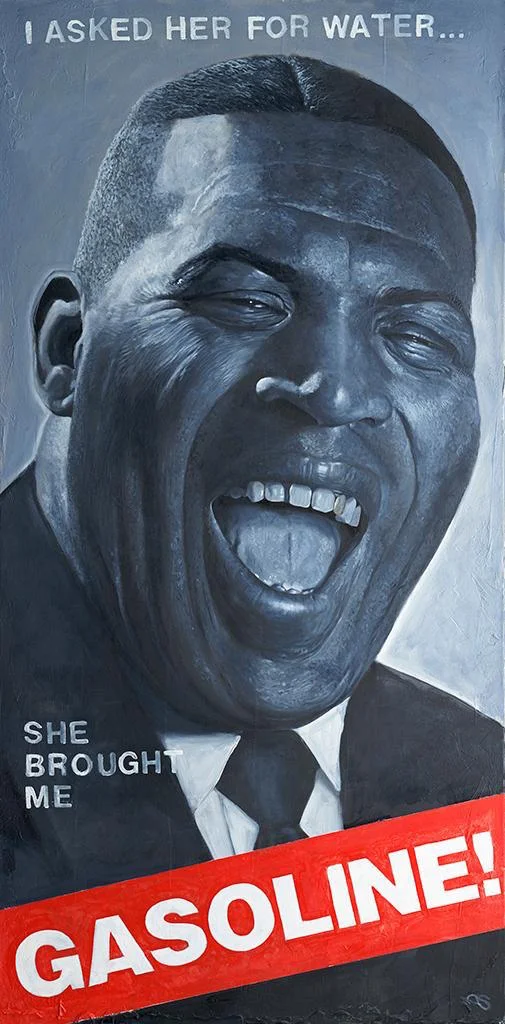
Some like it hot
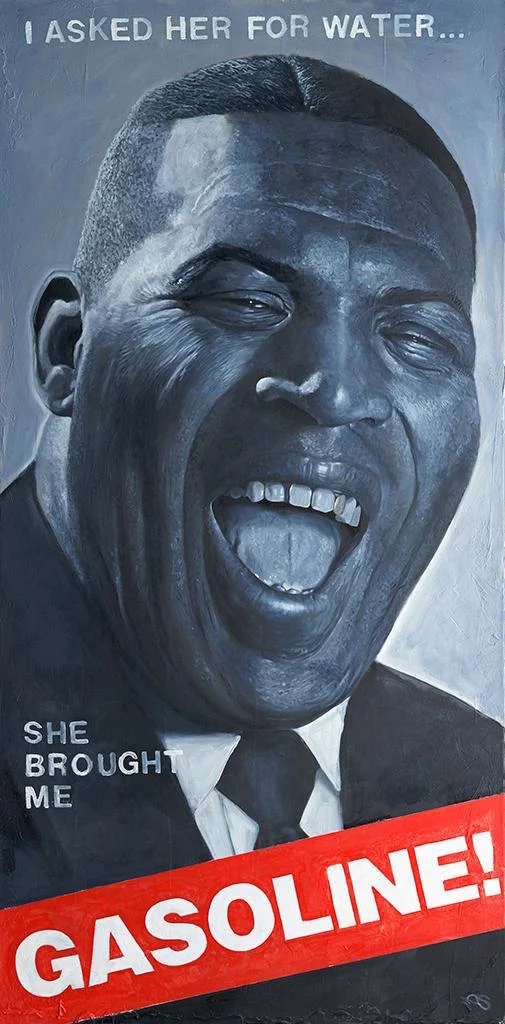
"Gasoline'' (oil on canvas), by Dale Stephanos, in the show "The New England Collective VII,'' Aug. 3-28, at Galatea Fine Art, Boston. This has indeed been a banner year for pouring gasoline on hot issues.
Chris Powell: Politically correct vandalism at Yale
Liberals, the old saying goes, are too broad-minded to take their own side in an argument, and Yale University in New Haven prides itself on defining liberalism, or at least the political correctness into which liberalism has devolved.
So Yale has asked the New Haven state's attorney's office not to prosecute a black cafeteria worker for the university who, finding it intolerable, smashed a stained-glass window at Calhoun College, one of Yale's dorms, that depicted two black slaves carrying baskets of cotton. The shards fell on a passerby and the vandal was charged with criminal mischief and reckless endangerment. He confessed and resigned, though now he wants his job back and promises to behave.
Yale long had defended the cotton-picking window as a mere historical illustration rather than an endorsement of slavery, though it has been getting harder to understand the university's persistence in honoring John C. Calhoun, a Yale graduate from South Carolina two centuries ago. While Calhoun held many national offices -- in Congress, the Cabine and the vice presidency under two presidents -- he was not one of the country's founders and he is most remembered for advocating slavery and state nullification of federal law.
Maybe Calhoun's advocacy of nullification is what Yale still finds attractive about him, since the university has made itself the headquarters of the movement to nullify federal immigration law, having induced New Haven to proclaim itself a "sanctuary city" and issue city identification cards to illegal aliens.
After the cafeteria worker's arrest the politically correct brigades who essentially run New Haven and patrol it around the clock for improper thought and expression rushed to his defense. They said the window was "racist" and deserved to be smashed and that Yale should rehire the smasher.
So the incident raises an issue more important than an employee's duty to his employer: freedom of expression. That is, Yale may be insensitive in merely depicting slavery; the university may be crazy in glorifying it and may even hold racist views. But doesn't the university still have the right to put into its windows whatever illustrations it wants and to honor whomever it wants?
The PC brigades say no. They contend that smashing windows is not just acceptable but necessary if a window bothers you enough.
Of course the perpetrators of Kristallnacht, another outburst of window breaking, felt the same way. Suppressing contrary opinion and enforcing orthodoxy, they were the politically correct of their time. No one stood up to them until it was too late.
But at least they were rebuked eventually, perhaps best by a judge of the 2nd U.S. Court of Appeals in New York, the great Learned Hand.
"Liberty," Hand declared to an audience of more than a million people in Central Park in 1944, "lies in the hearts of men and women. When it dies there, no constitution, no law, no court can even do much to help it. While it lies there it needs no constitution, no law, no court to save it.
"And what is this liberty that must lie in the hearts of men and women? It is not the ruthless, the unbridled will. It is not freedom to do as one likes. That is the denial of liberty, and leads straight to its overthrow. A society in which men recognize no check upon their freedom soon becomes a society where freedom is the possession of only a savage few, as we have learned to our sorrow. ... The spirit of liberty is the spirit that is not too sure it is right."
If Hand tried giving such a speech at Yale today he'd be shouted down, as others who are politically incorrect have been shouted down lately, and not merely because he went to Harvard but because attending Yale these days seems to confer the certainty that one is right, even in breaking windows.
Chris Powell, an essayist on politics and culture, is managing editor of the Journal Inquirer, in Manchester, Conn.

Backyard bathing beauty

Photos by Thomas Hook, taken in Southbury, Conn.
I have always loved the little lush worlds of backyard ponds, especially with frogs residing there. (See photo below.) There's so much life in such small places, and it's all so alluring on a hot day. The trick is to keep the raccoons from eating the frogs.
This tiny pond is at the bottom of a steep wooded hill, whose springs feed the pond.
-- Robert Whitcomb

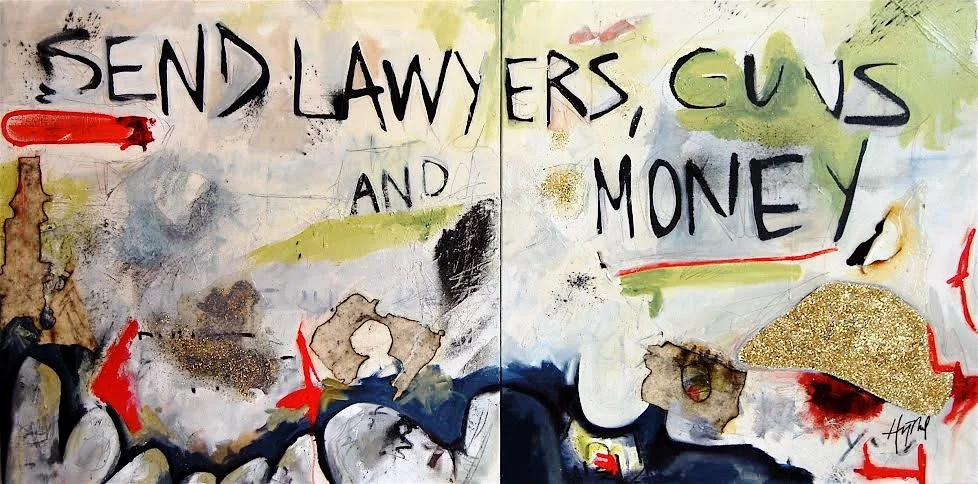
And we'll triumph
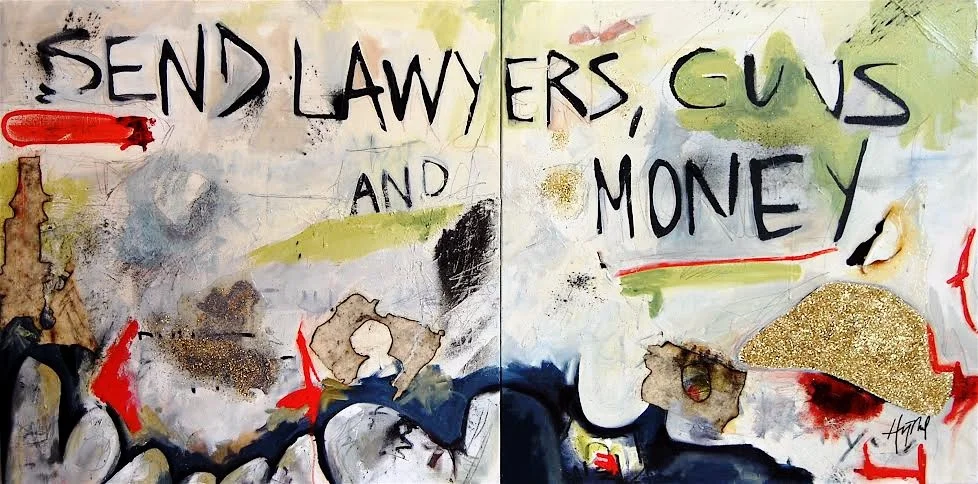
"Send Lawyers, Guns and Money - Warren Zevon" (oil, charcoal, graphite, pastel, collage and glitter on canvas), by Hilary Tait Norod, showing at Christopher's Restaurant, Cambridge, Mass.
Chuck Collins: The American Dream has moved to Canada
Via Otherwords.org
Does your family aspire to the American Dream of a decent paying job, a few weeks of paid vacation, a home of your own, and the hope of retiring before you die?
Maybe try Canada.
Our country has historically prided itself on being a socially mobile society, where your ability is more important than the race or class you’re born into. Indeed, during the three decades after World War II, social mobility increased — particularly for the white working class.
That mobility became part of our self-identity, especially when juxtaposed with the old “caste societies” of Europe and their static class systems. Today, however, that story has been turned on its head.
If you forgot to be born into a wealthy family, you’re better off today living in Northern Europe or Canada, where social safety nets and investments in early childhood education have paid big dividends for ordinary citizens. In fact, Canada now has three times the social mobility of the U.S.
Young people in the U.S. face huge inequalities of opportunity, in large part based on the wealth — or lack of wealth — of their parents. Researchers call this the “intergenerational transmission of advantage,” referring to the dozens of ways that affluent families boost their children’s prospects starting at birth.
Affluent families make investments that give their kids a leg up through childhood enrichment activities, including travel, music lessons, museum visits, and summer camp.
As they grow older, wealthier kids have better access to college guidance, test preparation, financial literacy skills, and debt-free or low-debt educations.
Then, as they enter the workforce, wealthy young adults have access to their parents’ social networks and are able to take unpaid internships to help them develop job skills. Meanwhile, children in families unable to make these investments fall further behind.
Combined with the 2008 economic meltdown and budget cuts in public programs that foster opportunity for middle- and low-income families, we’re witnessing accelerating advantages for the affluent and compounding disadvantages for everyone else. And once inequalities open up, research says, they rarely decrease over time.
The U.S. could rise to this challenge, as we did in the years after World War II and in the 1960s, by resolving to make robust public investments in policies that include everyone.
But in our increasingly plutocratic political system, the very wealthy — who have oversized political influence along with oversized bank accounts — have less stake in expanding opportunities for the rest of us, as their own children and grandchildren advance through privatized systems.
We can’t stop well-off families from passing advantages to their children, but we can give everyone else a fair shot.
High-quality early childhood education, universal access to healthcare and nutrition, resources for those with learning disabilities and special needs, and tuition-free higher education for first-generation college students are key initiatives that would help level the playing field.
We could make this possible by taxing wealth. Revenue from a steeply progressive estate or inheritance tax could capitalize an education opportunity trust fund.
If we don’t take action, the United States will further drift toward a caste society fractured along class lines, where opportunity, occupation, and social status are determined by inherited advantage.
By then, our presidential race won’t be the only thing tempting people to move to Canada.
Chuck Collins is a senior scholar at the Institute for Policy Studies and a co-editor of inequality.org. His forthcoming book is Born on Third Base.
Linda Gasparello: A Mass. man in full
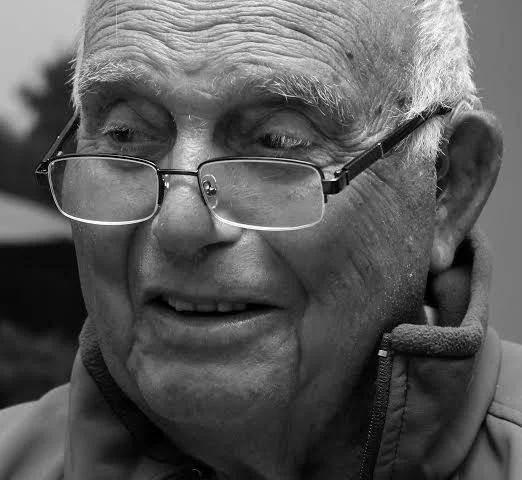
Ralph Marcy Gasparello
This is about my father, Ralph Marcy Gasparello, who died on July 11, aged 88. He was a stalwart resident of Hingham, Mass. Indeed, he often boasted about his status as “maybe the longest resident” of the town.
He had many opportunities to leave Hingham, especially after the death of his wife, Joan, in 2005. But he loved the town and their elm tree-canopied house -- which he largely built -- and where he raised four daughters and a son.
He and his wife were players in that championship season of residents who moved to Hingham in the early 1950s, and contributed to the desirability that it has today as a South Shore town. The young married couple supported the town's planning, enlarging its schools and raising the educational standards (particularly Wilder Memorial Nursery School and South Elementary School), and the building of the new Hingham Public Library.
He was a Massachusetts man through and through. He grew up in and around Boston, but mostly in Malden. He attended Boston Latin and other schools before graduating from Malden High School, in 1945. He was president of his high school class, and captain of its football team.
His athleticism won him a place on the football team of Cornell University, where he attended its famed school of hotel administration on an ROTC scholarship, and graduated in 1951, after completing his Army service. He married Cornell alumna Joan Rita Circola, of Brooklyn, N.Y., in 1952 at the university's Our Lady Chapel. They moved to Hingham in 1953.
He had a natural talent for public speaking, which caught the attention of his professors at the hotel school. While he was recruited by the Armstrong Cork Co. upon graduation, a speech that he gave on self-employment in a business class at Cornell sold him on that path in life.
When he and his wife moved to Hingham in 1953, he was working as a meat broker in Boston, having learned the business from a family member. He had a knack for sales because he liked to talk and listen to people: a skill honed during his days as a bartender at Cornell's Statler Club, where he learned to make his signature Negroni cocktail.
He stayed in the meat-brokerage business for more than three decades, until Iowa Beef Processors irrevocably changed the playbook for meat brokers in Boston in the 1980s.
A love for travel and languages – he spoke restaurant menu-level French, Italian and Spanish, which he and his wife studied at night for years at Hingham High School – led him to form an association for senior travel planners in 1985. He, his wife and his son, Ralph Jr., ran the National Association for Senior Travel Planners, and built it to 50,000 members before its dissolution, in 2001.
Through the association, he and his wife traveled widely. They enjoyed the business, and he especially enjoyed his public speaking – and even singing – opportunities during their Senior Travel Days shows. After his wife's death, he continued speaking in public – to those who attended the book lectures that he sponsored at the Hingham Public Library in memory of his wife, and to UBS investors forums.
His message to these and any audience -- of one or many -- was always positive. As he once said, quoting actress Audrey Hepburn, “Nothing is impossible, the word itself says 'I'm possible.'”
He had wide interests, including an abiding one in his college alma mater. He and his wife were active participants in the Cornell Club of Boston and Cape Cod. For years, they interviewed prospective students from the South Shore.
His appreciation of music was passionate and all-genre – from Big Band to bluegrass to salsa and classical. It never dimmed, even though his hearing did in his final decade.
He was a natural athlete and could do anything with a ball, and watch any sport. He could cane chairs, which was his way of passing long New England winters. “I like to be busy,” he used to say.
He was a reader and relished discussions of domestic and foreign affairs. He wrote poetry.
He was an accomplished cook, especially Italian food, and loved to “get dirt under his nails” (as did his father) in the gardens in his homes in Hingham and on Nantucket Island.
He was Big Ralph to his family and friends. He was tall in stature and big in his love of life and this world. He had a big heart, which finally failed and took him from us.
He is survived by three daughters and a son, Linda Gasparello, of West Warwick, R.I., Lisa Holt, of Newburyport, Mass., Nina Moore, of San Francisco, and Ralph Jr., of Merrick, N.Y., their spouses and seven grandchildren -- who called him Pops -- and other relatives. His daughter Paula Jordan, of Belton, Texas, died in 2012.
A private family memorial ceremony will he held on Nantucket Island.
Linda Gasparello is co-host of White House Chronicle, on PBS.

A face in the cloud

Featured sculpture by Carolyn Wirth in her show "Seeing Past Faces,'' through Aug. 20 at the Fruitlands Museum, Harvard, Mass., where she is artist-in-residence. The gallery notes say that she "blends images of her subject and photographs of herself in order to create an entirely unique facial structure.''
David Warsh: Robert Bartley's malign ghost at the GOP convention
There is no point in asking Donald Trump about his economists. It hasn’t been that been that kind of a campaign. In May the businessman reached out to Stephen Moore, of the Heritage Foundation, and CNBC television host Lawrence Kudlow, to help cut the $10 trillion cost of the tax cuts that he had proposed. Last week Moore and lawyer-turned-restaurateur Andy Puzder gave Trump a qualified endorsement in The Wall Street Journal: “A Trump Economy Beats Clinton’s.” Mark Skousen made the libertarian case against Trump here last spring.
If there is one man beside Trump himself whose spirit will inhabit the hall in Cleveland, at least metaphorically, it is Robert L. Bartley – not because Bartley himself approved of Trump – who knows if he did? – but because, as editor of the editorial page of The Wall Street Journal, Bartley spearheaded the creation of the say-anything, stop-at-nothing rules that ultimately led to Trump’s success in gaining the Republican Party’s nomination.
Bartley died in 2003. After taking over the editorial page in 1972, he became the most influential administrator of the rules of American public debate in the last third of the 20th Century. In that position, Bartley began the populist revolt that has since found its apotheosis in Trump.
Most influential journalistic umpire of an age? How do you back a claim like that? Mainly by comparison, naturally -- in this case to the career of the most influential journalist of the middle third of the 20th Century, Walter Lippmann. As it happens, thanks to Craufurd Goodwin, of Duke University, dean of U.S. historians of economics we have a first-rate biography of Lippmann that concentrates on his role as a defender of market economics (Walter Lippmann, Public Economist (Harvard, 2014), as opposed to Ronald Steel’s Walter Lippmann and the American Century (1980).
Lippmann was the child of well-to-do German-Jewish parents, attended Harvard College, worked for Woodrow Wilson during World War I, was on friendly terms from then on with Franklin Roosevelt, John Maynard Keynes and Felix Frankfurter. Bartley was the son of a professor of veterinary medicine, attended Iowa State University, and, as editor of the WSJ (as the editorial page editor was and still is called), became a friend of Robert Mundell, of Columbia University; Albert Wohlstetter, of RAND Corp.; Edward Teller, of the University of California, at Berkeley; and President Ronald Reagan.
Bartley was 34 when he was appointed to the job. He had voted for Lyndon Johnson over Barry Goldwater in 1964, but by the time that he spent a year in Washington, in 1971, he had become conservative, and, according to former WSJ reporter Robert Novak, by then a syndicated columnist, he was ostracized by liberal reporters there as a right-wing “kook.” Upon becoming editor he built a staff that eventually totaled fifty writers and editors, creating a universe of conservative opinion parallel to the news side of the paper. Among those he hired was Jude Wanniski, a flamboyant reporter for The National Observer, a weekly newspaper published in those days by Dow Jones.
In a level-headed appreciation in Slate, in 2003, Jack Shafer described an experience that was widely shared during the 1970s:
“[W]hat attracted me to the page when I first started reading it in 1973, fishing it out of a trash can each night as I cleaned an office building, was Bartley’s allegiance to the classical liberal values of free markets and free speech. Back then, Bartley was a minority of one among editorial-page editors in hewing to those views, tilting against the neo-Swedish worldview of The Washington Post, New York Times, and Los Angeles Times editorial pages. So if Bartley overstated his case from time to time by shouting until his vocal chords hemorrhaged and his readers lost their hearing, well, that was OK by me.
“As a small-government libertarian, I never subscribed to the Journal edit page’s supply-side orthodoxy as formulated by Jude Wanniski, which didn’t seem to care about the growth of government as long as taxes got cut. Today, nearly everybody recognizes that the marginal tax rate of 70 percent when Ronald Reagan took office was at least twice as high as it should be. Cutting it down to 28 percent proved to be both a utilitarian and an individual boon. As economist Bruce Bartlett notes, the world took notice of the American tax revolution, and many nations followed our example to excellent effect. But back in the ’70s, when Galbraithism and Heilbronerism ruled, Bartley and his scriveners were the true intellectual radicals.
Wanniski introduced Bartley to a pair of refugees from the University of Chicago, Arthur Laffer and Mundell. By 1975, Mundell was teaching international economics at Columbia. Wanniski described a “Mundell-Laffer hypothesis,” as revolutionary and mysterious as the prescriptions of Keynes 40 years before, all the more so for being confided in a series of restaurant lunches instead of conveyed as formal models in technical papers. The ideas eventually were encoded as WSJ editorials and dubbed ‘supply-side’ economics: massive tax cuts that would pay for themselves by spurring growth.’’
Reagan won the presidency in 1980, and Bartley won a Pulitzer Prize for editorial writing. The editorial page had become immensely powerful, and has remained so. Bartley told an interviewer in 1981, about the time Wanniski was fired for train-station-electioneering for a supply-side insurgent candidate, “Jude had a tremendous influence over the tone and direction of the page. He taught me the power of the outrageous.” Wanniski struck out on his own as a political consultant but remained close to the page. By 1982, Vermont Royster, Bartley’s processor as editor, had joined the critics. Novak later quoted him: “‘When I was writing editorials,’ said Royster, ‘I was always a little bit conscious of the possibility that I might be wrong. Bartley . . . is not conscious of the possibility that he is wrong.’ Yet Bartley’s page “exerted more influence than Royster’s ever attempted,” wrote Novak.
By the end of the 1980s, Bartley had won. George H. W. Bush had succeeded Reagan as president, but the WSJ editorial page refused to take yes for an answer. Bartley vigorously opposed Bush’s decision to seek modest tax increases to pay for war in the Persian Gulf to expel Iraq from Kuwait. And when Bill Clinton defeated Bush, in 1992, the editorial page began a series of attacks on Clinton and his wife that ultimately sought to overturn election results with an impeachment trial.
I can pinpoint the day the page lost me altogether. It was March 18, 1993, with a famous editorial, whose title, “No Guardrails,” has since become a WSJ battle cry. A physician who performed abortions in Florida had been ambushed and killed by a protester in Florida. The editorialist, Daniel Henninger, wrote:
“[T]here really was a time in the United States when life seemed more settled, when emotions, both private and public, didn’t seem to run so continuously at breakneck speed, splattering one ungodly tragedy after another across the evening news. How did this happen to the United States? How, in T.S. Eliot’s phrase, did so many become undone?
“We think it is possible to identify the date when the U.S., or more precisely when many people within it, began to tip off the emotional tracks. A lot of people won’t like this date, because it makes their political culture culpable for what has happened. The date is August 1968, when the Democratic National Convention found itself sharing Chicago with the street fighters of the anti-Vietnam War movement.
“The real blame here does not lie with the mobs who fought bloody battles with the hysterical Chicago police. The larger responsibility falls on the intellectuals –university professors, politicians and journalistic commentators – who said then that the acts committed by the protesters were justified or explainable. That was the beginning. After Chicago, the justifications never really stopped. America had a new culture, for political action and personal living.
“With great rhetorical firepower, books, magazines, opinion columns and editorials defended each succeeding act of defiance – against the war, against university presidents, against corporate practices, against behavior codes, against dress codes, against virtually all agents of established authority.’’
There was something downright creepy about that editorial – like the moment in The Shining when a leering Jack Nicholson, peering over her shoulder, says to his wife, who has just discovered that his manuscript, on which he has been working obsessively, is repetitive nonsense, “How do you like it so far?” Any relatively disinterested observer who lived through the 1970s, ’80s, and ’90s knew the extent to which those years had involved a calming down from the ’60s, of the restoration of rules of civility in the political realm, a process of equilibration.
From the short-lived administration of Gerald Ford to the zero-based budgeting and deregulation under Jimmy Carter, from disinflation under Paul Volcker to tax simplification and Social Security stabilization under Ronald Reagan, the signal events of those years constituted a retreat from the excesses of the ‘60s and a celebration of traditional values of order, credibility, ambition, and achievement. The one sphere in which pressure had continued from the Left was expansion of civil rights — of women, minorities, immigrants, gays, and specifically the rights of women to obtain abortions. Which was, of course, exactly what the writer had in mind.
Shafer described the scorched-earth policies of those years:
“As many of Bartley’s ideas gained ascendancy, his page became shriller, unable to give Clinton proper credit for getting control of spending. There’s a thin line between hard-hitting opinion journalism and character assassination, a line that Bartley frequently erased. Instead of serving as a sophisticated and credible spokespage for classical liberalism—like The Economist—his page descended all too often into the dishonesty and hackery one associates with politicians.’’
By 2001, Bartley was ill. He stepped down and began writing an occasional column. The 9/11 destruction of the World Trade Center temporarily forced the WSJ from its offices around the corner. The editorial page soon began a relentless campaign for the invasion of Afghanistan and Iraq. Bartley died in December 2003, a week after receiving the Presidential Medal of Freedom.
I hope that Bartley will find as wise and good-natured a biographer as did Lippmann in Goodwin. The rise of paleo-conservatives has been the subject of at least one good book, George Nash’s The Conservative Intellectual Movement in America since 1945 (1976), and is soon to have another, a long-awaited biography of William F. Buckley, by Sam Tanenhaus. Peter Steinfels and Jacob Heilbrunn, have chronicled the rise of the neoconservatives: The Neoconservatives: The Men who are Changing America’s Politics (1979) and They Knew They Were Right: The Rise of the Neocons (2008). Populist conservatives were the subject of Peddling Prosperity: Economic Sense and Nonsense in the Age of Diminished Expectations (1994), by Paul Krugman. If paleo-con Buckley’s National Review provided the starting place for the careers of George Will and Garry Wills; if neo-con Irving Kristol’s influence extended to Allan Bloom, Francis Fukuyama, and Dinesh d’Souza (and influenced the views of broadcast journalists such as John McLaughlin, Rush Limbaugh, and Glen Beck); then Bartley can be said to have furthered the careers of Wanniski, Michael Novak, George Gilder and Amity Shlaes. There’s plenty of material to work with there.
Is it fair to blame the chaos surrounding this year’s Republican nomination on Bob Bartley? Clearly I think so. No one in my lifetime systematically removed more of those guardrails, the norms governing good-faith political and economic discourse, than he. Trump is the downside of 40 years of WSJ ed page comment too often just like his: outrageous, sulfurous, and, all too often, half-baked. Bartley is dead; long live Bartley: in his absence, the page was completely unable to steer the nomination toward a more viable candidate this year. The best that can be said is that its editorialists helped keep it away from Sen. Ted Cruz.
Paul Gigot, who succeeded Bartley in 2001, has steered a steady course, admitting more diverse opinion to its op-ed pages, coping with increasing disunity among the -cons mainly by proliferating columnists. Lee Lescaze, whom the WSJ hired from The Washington Post in 1989 and who founded its Weekend section, laid the foundation for a humane and sophisticated new wing of the paper before he died, in 1996.
Rupert Murdoch bought the paper from Dow Jones heirs in 2007. His sons, James and Lachlan, have their work cut out for them. Sometime in the next few years they must replace Gigot, 61, with an editor capable of restoring credible focus to a page that has become alternately ideological and diffuse. The decision of The New York Times in March to replace Andrew Rosenthal with James Bennett, hired back from The Atlantic, can only increase the pressure.
Two great heroes of the Republican Party in living memory were Dwight Eisenhower and Ronald Reagan. To lionize Reagan is not enough. Until the similarities of roles of both are understood, the Republican Party is not going to regain the White House.
David Warsh is proprietor of economicprincipals.com and a longtime financial journalist and economic historian. He, like the overseer of New England Diary, Robert Whitcomb, worked for The Wall Street Journal in the 1970s.