
Vox clamantis in deserto






Summer dreams
"And pomp, and feast, and revelry,
With mask, and antique pageantry,
Such sights as youthful poets dream
On summer eves by haunted stream."
- - John Milton, ''Allegro'' (1631)

The wet stuff

Work by Gillian Frazier in the show with Priscilla Levesque called "Reflections,'' at The Loading Dock Gallery, Lowell, Mass., through July 31.
Llewellyn King: Technology is more powerful than politicians
Dear Candidates:
Even as you strain to tell us the wondrous things that will come about if you are elected in November, may I tell you some wondrous things that are happening anyway?
My contention here is twofold: First, not everything that changes our lives is political. Second, not all technological change has to do with the Internet.
In the same vein, not all progress will come out of the established agencies of private change, such as Amazon, Apple, Google and Tesla.
Of all things, an electric utility has moved into the world of innovation. It is the Southern Co., under the dynamic chairmanship of Tom Fanning.
Southern is on the cutting edge of utility technologies, including carbon capture and storage, and advanced coal combustion. It is also building two state-of-the-art nuclear plants in Georgia.
Fanning believes that the remit of the electric utility runs beyond the flow of electrons. Hence, one of Southern’s newest and most revolutionary undertakings: the vertical, urban farm.
According to Fanning, the idea is to go to blighted city areas where there is a shortage of fresh produce — the kind produced by truck farms — and convert old industrial and office buildings into urban farms. “We’re taking vacant, commercial buildings and creating farms that are vertical. There, produce can be grown more efficiently with our light and water systems. One of the best things is that you don’t need to use pesticides,” he told me.
Other things that are coming down the pike include the capture of carbon after combustion in power plants, steel mills and cement plants. What was a crazy scheme is almost a reality: So, be careful before you join the lynch mob of fossil-fuel haters.
Then there is the revolution in manufacturing. Now, with additive manufacturing, we can build up goods rather than cutting them to shape: no more wasted glass, plastic or steel. Houses, bridges, even guns have been printed.
It ain’t gonna be your father’s factory. So if your plan is to bring back the factories of the Industrial Revolution, better think some more. The new factories will be smaller, more dispersed and, in many cases, may be in or near workers’ homes.
And before you lay into cutting government, be sure you do not cut out vital organs like the Department of Energy’s Lawrence Livermore, Los Alamos, Oak Ridge and Sandia national laboratories that maintain our nuclear weapons and have harnessed things like the seismic technologies that have changed energy supply and kept us as the world’s leader in physics.
These labs are the muscles in the strong arm of American technology. Never forget that the Internet was invented by an arm of the Department of Defense. So do not malign government science and research.
Spare our technology, please, and do not get policy from the old tapes or old demagogues. The world is changing a lot faster than the talking points. If you are to lead it, you ought to understand that what was needed 10 years ago is not needed now, and technology will shape the future as much or more than you think you will, if elected.
Llewellyn King is executive producer and host of White House Chronicle, on PBS. He is a longtime publisher, editor, columnist and international business executive who is now based in Rhode Island and Washington, D.C. This piece first ran on InsideSources.com.
Seth Handy: Paper's censorship vs. the facts of renewable energy
It is sad and ironic that the opportunity for good legislation on the interconnection of renewable energy to Rhode Island’s electricity-distribution system was squandered by utility lobbying and The Providence Journal’s one-sided coverage of one developer’s (Wind Energy Development LLC) alleged undue influence (“Favor to wind-project developer could cost electric rate payers,” June 12; “Republicans want provision that aids R.I. wind-power developer removed,” June 13; “{House Speaker Nicholas} Mattiello removes provision to benefit big donor, cost rate payers,” June 14; and “Wind power favor yanked” and the editorial “No favor to R.I. ratepayers,’’ both on June 15). I was quoted in one article and write to correct the record.
I sent this column to The Journal's editorial-page editor, Edward Achorn, but he declined to run it.
Interconnection legislation is needed and good for the people of Rhode Island. I explained that to the reporter but he neglected to report it. Our utility, National Grid, administers interconnection to protect its interest in the existing energy system, to the detriment of a new-energy economy that greatly benefits Rhode Island. The utility has a history of inflating interconnection costs and delaying interconnection to an extent that many good projects cannot withstand and others are severely overburdened.
The assertion that this bill was to benefit one developer is wrong; interconnection obstructs many good projects. Sadly, too many developers are scared to speak out, because the utility still controls too much of the fate of their projects. National Grid’s abuse of its discretion on interconnection was especially obvious in response to the proposed large Coventry wind project. National Grid refused to interconnect some turbines and sought to charge Wind Energy Development $13 million as part of the process of replacing much of Coventry’s antiquated poles and wires.
But interconnection problems are rampant in Rhode Island and across America. When our “regulated utility” is inadequately regulated, as it has been on interconnection, it is the General Assembly’s duty to protect Rhode Island’s interests through legislation. The interconnection bill put necessary parameters on utility control over interconnection. It was supported by the state Office of Energy Resources and passed the House of Representatives twice by nearly unanimous vote because it is good policy.
National Grid is not a benign steward of ratepayer interests; it is a corporation based in England. When its shareholders’ interests conflict with those of our ratepayers, it favors its shareholders. That is why, for instance, National Grid reported $8 million in annual profits for operating Rhode Island’s municipal streetlights all made while it refused to authorize conversion to more efficient LED fixtures that have much lower maintenance costs.
National Grid’s conflicting interest on local renewables was evident in its proposal to charge Wind Energy Development an access fee to use the distribution system that was put forth without even considering the General Assembly’s order that it first weigh the economic benefits of local generation. Unanimous opposition led National Grid to withdraw that access fee just before the state Public Utilities Commission hearing.
Studies consistently show that local renewables benefit all ratepayers by reducing the costs of energy, capacity, transmission, distribution, line-loss, operating risk, environmental, and other known and measurable costs of our energy system. A national expert presented this information at the State House on March 24, 2016; you can watch it on Capitol TV. The Journal’s reporting that an interconnection policy that fairly allocates responsibility for system upgrades benefitting all customers would cost us all and unduly subsidize renewables ignored that ratepayers already pay National Grid to maintain and improve its distribution system. Most importantly, it overlooks the savings that renewables produce for our energy system. The reporter that interviewed me chose to ignore all that.
National Grid spent at least $84,000 on lobbying this legislative session. Their reporting of their lobbying is unclear and it is hard to track their legislative contributions apparently made through their lobbyist’s Political Action Committee (PAC), “Advocacy Political Action.” Those of us regularly pushing for good energy legislation face the utility’s resistance, not so much in the hearings but late in the session from back rooms of the State House.
Last year, this interconnection law that unanimously passed the House was victim to the Senate’s early adjournment. This year, after very supportive hearings and near unanimous approval from the House, National Grid worked to strip it through the Senate. I deplore the impact of money in politics, but the U.S. Supreme Court’s free speech cases, like Citizens United, protect such spending to sway government action. For The Journal to deride influence sought by a renewable- energy developer awkwardly overlooks the massive influence such developers are up against. National Grid spends huge sums of ratepayer dollars on advertising, much of which is in The Journal. Such well-funded speech evidently earns greater protection.
At the end of this legislative session, strategic and poorly reported last-minute flame-throwing beat down a good bill. The utility still holds its strings on interconnection. Now that the dust has settled we can reflect on that. Much may be vested in our existing energy system, but our people are not well served by its exceptionally high cost, insecurity and other bad impacts. To change that, we need to correct the mechanics under which alternatives are delivered. Those of us who are passionate about Rhode Island’s energy future remain confident that justice ultimately will be served through policies that promote the public good, despite all the financial interests that obstruct them.
Seth Handy is a lawyer in Providence.
Chris Powell: Politically incorrect crime data; illegals get preference; plutocrat Pequots
Cellphone video from around the country continues to suggest that white police officers can be too quick to confront and shoot black men. But whenever there is such cellphone video, nobody wants to wait for due process of law to determine exactly what happened. It's always "no justice, no peace" immediately, even as justice requires a little time.
Immediate justice constitutes lynching, which is as wrong when it is demanded today by black mobs as it was in the last century when it was perpetrated by white mobs.
A report issued last month by Central Connecticut State University, concluding that police in the state use their stun guns more often against Hispanics and blacks than against whites, is not helpful in pursuing justice. It seems meant mainly to intimidate officers out of doing their jobs with racial minorities.
Of course to some extent racial prejudice and racial fear will always figure in police work. Such prejudice and fear may be the most likely explanations for why black people are shot to death by white officers in confrontations that begin over trivia like a broken taillight or the sale of CDs in front of a convenience store.
But crime itself is correlated with race and poverty. For example, that the great majority of Connecticut's prison population is black and Hispanic is not mainly the result of racist cops, prosecutors, judges and juries; it results mainly from the concentration of crime and poverty among certain racial and ethnic groups.
So maybe Connecticut needs a study quantifying the racial disproportions in crime. But since its data would be politically incorrect, the state probably has no institution of higher education capable of the work.
xxx
ILLEGAL ALIENS GET PREFERENCE. Expanding its campaign to nullify federal immigration law and devalue citizenship, state government will place at Eastern Connecticut State University 46 students from other states who are living in the country illegally.
The university won't pay for the students; a national scholarship fund for illegal aliens will cover their expenses. Most of the students are living in states that either prohibit the admission of illegal aliens to their own public colleges or charge them higher nonresident rates. But admitting the illegals to Eastern will reduce admissions for Connecticut's own legal residents and for U.S. citizens generally.
Since the plight of the illegal alien students is largely the responsibility of their parents, they deserve some sympathy. But what compels state government to give them such preference? Only the political correctness that seems to be the highest principle of the current state administration.
xxx
THEY LOOK LIKE PLUTOCRATS. Hardly a day passes when Republican presidential candidate Donald Trump doesn't say something insulting, mistaken, or stupid. So why last week did Connecticut's Mashantucket Pequot tribe bother denouncing him for his remark about the tribe in 1993?
Trump, a casino developer competing with the Pequots, told a congressional hearing, "They don't look like Indians to me."
The Pequots want to construe this as a slur on their ancestry. But Trump was actually challenging the casino privileges the Pequots had gained from the government. For while the federal law authorizing casinos on Indian reservations was presented as economic development for long-oppressed people consigned to Western wastelands, no modern Pequot had ever encountered such disadvantages.
No, the tribe was reconstituted to exploit the casino privilege meant for the oppressed. The people reconstituting the tribe were fully part of the broader community of southeastern Connecticut and had been living in raised ranches and working at Electric Boat like everybody else. Now, because of ethnic patronage and privilege, they're rich, and it's not necessary to support Trump to resent it.
Chris Powell, a Connecticut-based essayist on cultural and political topics, is managing editor of the Journal Inquirer, in Manchester, Conn.

New England's ancient dairy delirium

"Milk Made'' (mixed media), by Peter Thibeault, at Patricia Ladd Carega Gallery, Center Sandwich, N.H.
Sophie Lampard Dennis: The sad decline of face-to-face encounters
Via the New England Board of Higher Education (nebhe.org)
Remember the faculty lounge? When I began at my current institution back in 1999, there was one in every building—sometimes two! This public space—complete with industrial furniture, coffee pots smoldering on burners, and a mini-fridge with sticky notes all over it reminding people to clean out their stinky sandwiches—was higher education’s version of the office water cooler.
Faculty and staff connected, people in different departments shared ideas, jokes and snacks, and mainly people let off a bit of steam while taking a much-needed mental break during the day—often while they also made photocopies (remember those?). Many a problem or conundrum was vented, birthday cards signed (and cake shared), and aha moments with students were exulted over in the faculty lounge. NPR stories were re-told. Most importantly, this simple, open and welcoming space engendered a sense of community. I miss it.
Lately, I have been lamenting the increasing loss of face-to-face interaction. The prevailing attitude of taking care of business without having to actually get together has taken hold across all realms of society. Despite the also-growing trend toward “open workspaces,” there seems to be less and less contact with other human beings as a matter of course in life these days. “No need to meet; we can take care of that with email” has become a consistent mantra- and my nemesis—even as I imagine with dread the numbers of “reply all” to come.
Recently, “I’ll set up a Google Docs account and we can use that to upload information rather than getting together” has taken hold. I am beginning to wonder whether I should, perhaps, begin sending my avatar to teach, thereby staying in my office for the entire working day. Or more to the millennial point—perhaps a class conducted entirely in Facebook Messenger? Class attendance would probably be greatly increased!
The “mail room” where the painted wood faculty mailboxes hang on the wall in alphabetical order—seems mostly a tribute now to a time long gone wherein actual business took place in this room and people converged, if briefly. Now, those mailboxes only occasionally hold a paper phone bill—and surely, these could be generated electronically. The room is no longer a help for those looking for human contact. Even the bulletin board in this room (for those millennials reading this article, that’s a location for actual paper announcements to be posted using thumb-tacks), which at one time held a plethora of messy communications, has been left in the dust as the electronic version has prevailed (so neat! So tidy! No trees killed!).
Campus projects over the years have caused the old lounges, one-by-one, to be converted into other types of spaces. As student programming has expanded and entered the 21st Century, so has the need, for example, for enhanced labs for computer gaming courses as well as for offerings in video production and electronic music. Computers have taken hold where, once, faculty congregated. So here I am, in the comfort of my own lonely office, on a hallway of offices, in a building of offices, with nowhere to wander to. Am I more productive? Maybe. I eat my lunch at my standing desk (don’t get me started about what happened to a common lunchtime!) as I grade papers, while simultaneously receiving and responding to all mail, as well as perusing the electronic faculty bulletin and checking Google Docs for new uploads from my current task force or committee.
The actual faces of my colleagues and friends as seen at one time in person, have now been replaced by a “profile picture”—a tiny square with a face in it- which pops up with their email. At least when I have something funny to share with a colleague, or an aha moment with students to report (I haven’t figured out how to share cake this way yet)—there is an emoji for that: ☺ .
Sophie Lampard Dennis is associate professor of education at Landmark College, in Putney, Vt.


Cute kitsch or deeply depraved?

Henry Houghton, of the central Massachusetts town of Athol, advertised in the May and June 1949 issues of Popular Mechanics, apparently trying to establish a photography business.
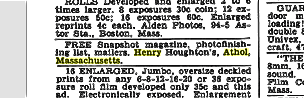
This is the only record that Internet research could turn up on Houghton. But 67 years later, four of his snapshots turned up at the Walden Street Antiques, in Concord, Mass., at $1 apiece in a bin with other mostly unidentified family photos. Each of the prints is stamped on the reverse with an official looking "Henry Houghton's Athol, Mass.," along with the date, in this case, August 1950.

The doll Dorothy is photographed here at Long Lake, a park in Littleton, Mass. Was Houghton on assignment, or was he just having fun, creating a little tableau?

In this and two other images, Dorothy is propped up with a Shmoo. The creation of L'il Abner cartoonist Al Capp, the Shmoo first appeared in Aug. 31, 1948, becoming a sensation in Dogpatch and around the world over the next few months; the spin-off toy Shmoo, like Dorothy, lasted longer.
Unusual critters, to say the least, Shmoon (yes, that's the plural) reproduced asexually, were always smiling and were happy to let you eat them. After dining on their flesh one could use their pelts for leather, but since they produced both milk and butter, it would be a mistake to kill off a Shmoo. In the cartoon strip, contented Shmoon have love hearts drawn are around their heads.
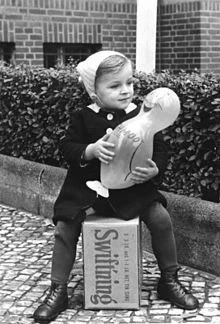
Of course, it's almost impossible to make out the Schmoo in the faded old photo above. Below see picture of a West Berlin child holding a Schmoo and sitting on a Care package in October 1948, during the Soviet blockade and the Western Allies' airlift to relieve the city.

As adorable as a Shmoo is, there is something creepy about this one's friendship with Dorothy – or rather, while Shmoon are harmless, the doll appears somewhat supernatural. What were Henry Houghton's pictures meant to convey? Was he attempting a story for a child or children? Intentional or not, Dorothy is as menacing and as disturbing as a character by that other New Englander, Stephen King.
William Morgan, a Providence-based architectural historian and essayist, taught the history of photography at Princeton University.
Ethan Allen returns to warn Vermont
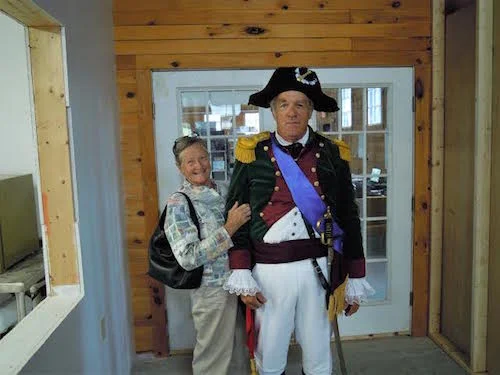
Josh Fitzhugh’s version of a speech that might have been given by Vermont founder Ethan Allen at a July 10 gubernatorial-candidate forum and picnic at the Vermont Granite Museum, in Barre. Mr. Fitzhugh is the chairman of the Washington County (Vt.) Republican Committee.
My fellow Vermonters! The Almighty has given me an unprecedented Opportunity after 225 years to revisit the haunts of my Youth, to see what has become of my own special Green Mountain State, and to share with you my Thoughts regarding the same, with no Shame or Fear but only a Desire to arrive at the Truth using Reason which is the only Oracle of Man!
Ever since I arrived to a state of manhood, and acquainted myself with the general history of mankind, I have felt a sincere passion for Liberty. Many times have I hazarded my life for you, as in my attack on Montreal and my barbarous captivity by the British. You know that when I lived, with a small band of fearless countrymen, I stormed and took Ticonderoga, a stony symbol of Oppression and Tyranny, “in the name of the Great Jehovah and the Continental Congress.” ( I might also have said, “Come out of there, you goddamn old rat!”)
The Green Mountain Boys later defeated the British warlord Burgoyne at Bennington. For many years I wrote, spoke and fought against New York authorities who wished to Deprive us of Property secured by the New Hampshire grants, even to the extent of sentencing us to Death in absentia for our Actions and Beliefs.
There were a number of Depraved and mean spirited Rascals, who would probably have assisted that designing government of Land clenchers to divide and enslave us, had not the Integrity and Heroism of the Green Mountain Boys prevented it.
Since New‐Hampshire had forsaken us, and New York tyrannized us as much as they possibly could or dare, we were left a people between heaven and hell, as free as is possible to conceive as any people to be; and in this condition we formed a government upon the true principles of Liberty and Natural Right.
So what do I see in Vermont today? I see a Beautiful land, as gorgeous as I recall, with as striking views of the Green and Adirondack mountains as ever I witnessed in my youth. I find people warm and friendly but sadly uninspired by the true Passions of our existence, a perpetual quest for Liberty and Personal Achievement. I see well-worked farms and hard-working farmers, and a strong commitment to our militia and armed forces. I see a people less controlled by clerics and more believing, as I am, in the law of nature.
Most proudly I see a state which still exists, independent of New York. But sadly, I also see a government which in many ways resembles the Schemers and Land‐Jockeys who worked so feverishly to deprive us of our Possessions and Liberties some two and a quarter centuries ago
You ask for examples. I see towering industrial windmills placed on Pristine mountaintops, because lobbyists have secured tax breaks and incentives in back room deals. I see contractors unable to choose how they wish to employ their help. I see local schools controlled by state know‐it‐alls. I see one’s very health determined not by one’s lifestyle and family and the will of God, but by the State itself. I see taxes imposed not to fund a critical social need but rather to redistribute income amongst the population. I see a high proportion of families under the regular supervision of state social workers, and I see rows of empty storefronts in some of our biggest cities.
When I lived, except for debts caused by war, government expenses were miniscule. Today, nearly 50 percent of all human enterprise in this state is attributable to government. Taxes and fees are imposed on nearly every human product and activity, from beehives to ginseng, mutual funds to fuel oil. State expenses are increasing twice the rate of income growth. I did not fight to create a “land of endless taxation!”
Our legislature was composed of farmers and small merchants, busy people who found time in winter to discuss and resolve the important issues of the day. Now I see that your solons are nearly full time and no issue seems too small to address. Where is the faith in the people and their families to solve these problems themselves? Above all, I see a state in which Freedom is defined as the ability to Ask for Permission rather than a Right to Act and Do, and where the political leaders routinely hand back our tax money and expect a thank you in return. Our leaders may not seek, but in fact are getting, a permanent dependency from their citizens. My wife, Fanny, doesn’t like me to say it, but I call it the “Mother May I” syndrome, after the children’s game:
“Mother Vermont, may I put a shed on this property? Yes you may, dear Ethan, if you pay us a fee and it satisfies our extensive rules.
“Mother Washington, will you give me some money for a new business? Why yes, Ethan, if we like your business, and you swear an oath to satisfy these 30 conditions.
“Mother Vermont, may I buy a gun from my neighbor? Today, yes, Ethan, but given your reputation, probably not for long.”
A dependent people are an impoverished people. A dependent people are those waiting for, indeed expecting, some kind of a handout. A dependent people are a people who believe that because they live, they are entitled to happiness. By my Beetle of Immortality, Happiness is not guaranteed in life!
You have this strange game where people try to throw a ball through a basket. A player in this game, LeBron James, said it well when he talked about his home in the Western Reserve. There he said, “Nothing is given; everything is earned. You work for what you have.” That is the Vermont I left and the Vermont I love!!
Tyranny, my friends, does not always come at the end of a gun, nor does it always come quickly. You can lose freedom slowly law by law, tax by tax. When I lived, hard currency was scare but we were free to build our lives and fortune in this new land. The opportunity to innovate and profit inspired all of us. Now it seems life is a network of credits and debits so complicated that even your vaulted computers can’t keep them straight, and the word Profit is treated like blasphemy.
We fought the New York patroons, the British lords and the Loyalist sympathizers because law was being used as a tool to cheat us out of the country we had made vastly valuable by labor and expense of our Fortunes. And if my life meant anything, it is that faced with such insatiable, avaricious, overbearing, inhuman, and barbarous intentions, you are not bound to be an accessory to your own ruin and destruction, but may act in accord with the law of Nature and Self Preservation.
Now don't assume I am against all government. Anyone who is acquainted with mankind, and things, must know that it would be impracticable to manage the Political Matters of this country without the assistance of civil government. People without it are like a ship in the Sea without a helm or mariner, tossed with impetuous waves. As the poet Alexander Pope wrote, “Go, teach Eternal Wisdom how to rule / then drop into thyself, and be a fool.”
You ask what can be done. I came here today because I feel these good people speaking today can help get Vermont back on track. I know they care for this state and understand the values that created her. I have previously, upon mature deliberation, expatiated on the good effects which cannot fail of redounding to the inhabitants, in so extensive a frontier country as, from the blessings of a well established civil government; and think it worth my trouble to communicate my sentiments and reflections to the public, with a view of encouraging the good and virtuous inhabitants of this State, to persevere and be happy in the further confirming and establishing the same.
In closing let me repeat something I wrote in my letter to Congress urging acceptance of Vermont as a state in the new Union. “A confederation of the state of Vermont with the other free and independent states cannot fail of being attended with salutary consequences to the confederacy at large, for ages yet to come. What a nursery of hardy soldiers may in future be nourished and supported in this fertile country (which is one hundred and fifty miles in length, and near sixty in breadth), stimulated with the spirit of liberty, having a perfect detestation and abhorrence of arbitrary power, from the exertions whereof they have suffered so much evil.”
I said then, and say now, that Vermonters will instill the principles of liberty and social virtue in their children, which will be perpetuated to future generations. The climate and interior remove from the sea coast will naturally be productive of a laborious life, by which means they will be in great measure exempted from luxury and self indulgence, and be a valuable support to the rising empire of the new world.
Hear ye, Hear ye. What was true then is still true today! Good luck and may I see you again some time!

Robert Whitcomb; Time for some reinstitutionalization

A version of this first ran in GoLocalProv.com, in Robert Whitcomb’s weekly Digital Diary column.
Read the June 23 Boston Globe article “The Desperate and the Dead: Families in Fear,’’ about how tough it is to treat (and keep off the streets) dangerous mentally ill people. To me, it’s part of a wider problem caused by the closing of most state mental hospitals and the decline of institutionalization. And the story shows how hard it is for many families of mentally ill adults to obtain clinical information about their sick relatives and be allowed to work closely with healthcare providers.
We obviously need to reopen many mental hospitals (whose closing was a false economy), to make it easier to institutionalize more of the most severely ill people and to enact “The Helping Families in Mental Health Crisis Act,’’ long sponsored by Pennsylvania Congressman Tim Murphy, a clinical psychologist. The bill would amend the Health Insurance Portability and Accountability Act (HIPAA) to ease clinical-information sharing between providers and the families of adult mentally ill people. It can be a matter of life and death.
As Mr. Murphy notes: “More than 11 million Americans have severe schizophrenia, bipolar disorder and major depression yet millions are going without treatment as families struggle to find care for loved ones….Sadly, patients end up in the criminal justice system or on the streets because services are not available.’’
Of course, many state mental hospitals were snake pits in the old days. New ones must be run much better. Meanwhile, people of a certain age may remember a remarkably stupid argument for closing mental hospitals: That new drugs then, such as thorazine, for schizophrenics, or lithium, for bi-polar disorder, would make almost all mental hospitals unnecessary. But why would mentally ill people take their psychotropic drugs with the regularity, say, of someone with heart disease taking his statins? They are, after all, mentally ill.
xxx
When does police officers’ zeal for chasing people whom they suspect of nefarious acts become irresponsible, adrenaline-fueled showing off of their well-armed power? I thought of that the other week while driving in Providence.
All of a sudden, in heavy, rush-hour traffic, an unmarked police car (we figured out) started moving very fast and erratically across four lanes of traffic, confusing and scaring the drivers of the other vehicles, who had no idea how to get out of the way of the seemingly crazed driver of the cop car, who wasn’t using his siren.
Then I read a story in the June 28 Providence Journal headlined “Coventry couple accuse Providence police of excessive force following chase with unmarked vehicles’’ in 2013. Robert Gadoury and Alisa Chamberlain allege in a lawsuit that the police stopped them in their car without probable cause, made them the victims of excessive force and battery and forced Ms. Chamberlain to undergo an inappropriately invasive search.
The couple say that plainclothes narcotics unit officers in two unmarked Providence Police Department cars chased and cornered them, initially without flashing lights or sirens. Mr. Gadoury said he had feared that the drivers of what he learned later were police vehicles were trying to carjack the couple, which is why he fled.
Apparently the officers (erroneously) suspected that the couple had something to do with a young man on a bicycle in the neighborhood suspected of selling drugs. And The Journal reported, Mr. Gadoury had “faced some drug charges,’’ which may have popped out when the police checked the couple’s license plate. Eventually, the police turned on strobe lights as they moved in on the scared couple.
The lawsuit alleges that after officers pulled Mr. Gadoury from the car, one of them, Matthew Jennette, kicked in his teeth after Mr. Gadoury told the officers that he thought that the couple was being carjacked. Under the circumstances, probably a rational fear.
At the very least, the case raises questions about how well the Providence police are trained to control their adrenaline rushes and power drives when they are exercising their potentially lethal authority. Law enforcement can be difficult and dangerous but that doesn’t obviate the need for self-discipline and an awareness of public safety at all times.
xxx
Crazed Army veteran Micah Johnson might have been able to murder five Dallas police officers if American law and a powerful gun culture hadn’t made it so astonishingly easy for him to obtain military-style weapons meant to kill as many people as fast as possible…
xxx
The Obama administration’s decision not to more forcefully help the moderate foes of Syrian dictator/mass murderer Bashar Assad has let a catastrophic situation to develop that has fueled the perverts known as the Islamic State, given Russian dictator/ Assad ally Vladimir Putin an opportunity to make his nation a major military power in the Mideast and strengthened the Shiite dictatorship of Iran, also allied with Assad.
All this has helped cause the immigration crisis in the European Union, the vote in the United Kingdom to quit the E.U. and the rise of right-wing populist movements in Europe. (The more refugees that Putin’s bombing in Syria helps send to the West, the happier he is.)
What to do? First, the U.S. must lead much more strongly than it has a campaign to destroy ISIS at its heart. That means seizing ISIS’s “capital,’’ Raqqa, Syria, as soon as possible. That ISIS has the structure and ambitions of a government encourages its members to carry out their outrages. Sen. John McCain was quite right when he said last weekend: “What we need to do is to go to Raqqa and kill them.’’
But there can be no peace in Syria as long as Bashar Assad remains in power.
xxx
New England students should know aboutthe New England Regional Student Program, which lets New Englanders enroll at out-of-state public colleges and universities in the region at a discount from the usual out-of-state tuitions. The New England Board of Higher Education elaborates: “Students are eligible for the RSP Tuition Break when they enroll in an approved major that is not offered by the public colleges and universities in their home-state.’’
More such collaborations among the states in our compact region, please!
xxx
I recently read a lovely novel called Emily, Alone, about an elderly widow in Pittsburgh as she goes day to day, trying to maintain her independence, with sadness, joy, humor, impatience, whimsy and fatalism in the shrinking world of the old. What particularly struck a chord was howshe found that memories of her early life in near-poverty in a small Pennsylvania town sharpened with age. Toward the end of the book, she drives there to look around and ruminate.
“In my end is my beginning,” T. S. Eliot wrote in Four Quartets.
xxx
The other day in Newport I saw (in the spectacular Redwood Library) part of a TV documentary being filmed about Oliver Hazard Perry, the Rhode Islander who led the U.S. victory in the Battle of Lake Erie in the War of 1812. He’s the guy who said: “We have met the enemy and they are ours.’’
The Jane Pickens Theater, in Newport, would be the perfect place for the documentary’s premiere.
Robert Whitcomb is overseer of New England Diary.

And we're already sick of it?
Summer has set in with its usual severity.
-- Samuel Taylor Coleridge

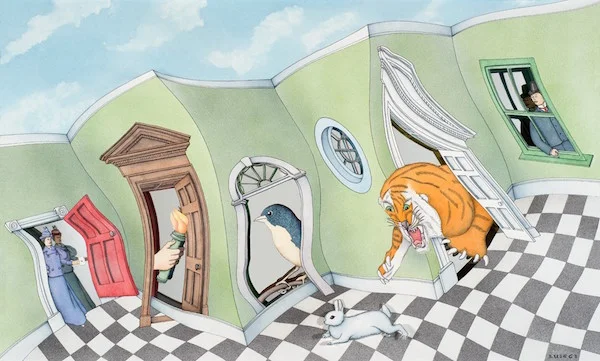
Real-estate agent's nightmare
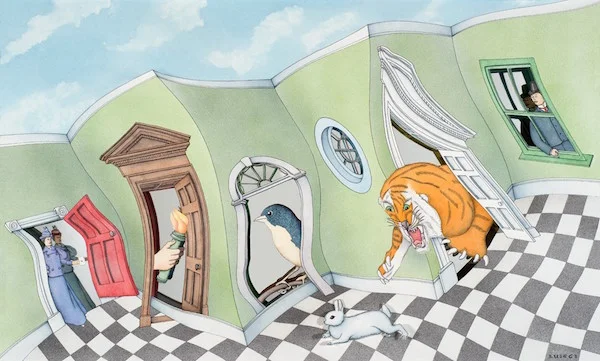
"Seeing Glass'' (watercolor, pen & ink) cut paper and mirror) by Mark Luiggi, in the summer show "Melt'' at the Brickbottom Artists Association, Somerville, Mass. July 14-Aug. 20.
Mirror, mirror on the wall
"Suppose you were an idiot, and suppose you were a member of Congress; but I repeat myself. ''
--- Mark Twain
This famous quote should be extended to people who could have voted but did not in the 2016 primaries -- about 70 percent of eligible citizens didn't take the few minutes needed to exercise their central democratic right.
Their sloth paved the way for what we got as the major-party putative nominees: An ethically compromised Democrat who shamelessly panders to whatever group is in front of her and, worse, a demagogic, pathologically narcissistic con man Republican who admires murderous dictators.
Americans should stop whining about the presidential choices and what Congress does and look in the mirror. If they don't like -- especially today -- that it's easy to go to Walmart and buy a military-style rifle designed to kill as many people as possible in the shortest period of time they could bestir themselves to go vote for a congressional candidate not in thrall to the National Rifle Association and the gun makers and who might vote for the sort of gun controls in force during the Eisenhower administration.
But many, perhaps most, of the complainers won't because America's civic culture is in full decadence mode.
--- Robert Whitcomb

Beach rites

"Ariel (red)'' (screenprint), by Alex Katz, in the show "Waterways IV,'' July 13-Sept. 10, at Heather Gaudio Fine Art, New Canaan, Conn.
Jill Richardson: And now naming rights in our National Parks!
Via otherwords.org
Imagine painstakingly making up your way up the cables of Yosemite National Park’s famous Half Dome peak — only to see swooshes and slogans encouraging you to “Just Do It.”
“Welcome to Half Dome,” a gleaming banner greets you, “sponsored by Nike.”
Unfortunately, it’s a possibility. As the coverage swells over Barack and Michelle Obama’s recent visit to Yosemite and Carlsbad Caverns, Americans are learning that National Parks will now start selling naming rights.
The parks are facing a hefty budget shortfall, so they’re turning to corporations — who are apparently more generous with cash than the current Congress.
Truly, this is a bummer.
We go to National Parks to escape the commercialism of modern life. Nothing is more spectacular than enjoying the beauty of a waterfall or the sunset over the mountains, or the magnificence of grizzly bears, wolves, and bison that one rarely sees outside of a National Park.
What’s more, we don’t have to buy this majesty because we, the American people, already own it. There’s no need to consider what to buy or how much it costs when enjoying the splendor of a National Park. For one thing, it’s worth more than money, and for another, it’s already yours.
But instead of properly funding our parks, the government will now auction off naming rights to the highest corporate bidders, thus cheapening the experience of the millions of Americans who visit the parks each year.
So Coca-Cola, which already wraps itself in the flag to peddle diabetes-inducing sodas, can now place its branding on the most iconic American destinations.
For now, there are limits to which assets businesses can name, and where they can use their slogans. But the next time there’s a shortfall, what else can we expect?
Maybe Angel’s Landing in Zion, brought to you by Victoria’s Secret Dream Angels bras? Or how about Apple, which named its latest operating system for the mountain El Capitan in Yosemite, buying naming rights for the actual El Capitan?
What about re-naming Utah’s Arches National Park for Dr. Scholl’s Arch Support shoe inserts? Or worse, for the Golden Arches of McDonald’s?
The only bright spot I can think of is that Pepsi changed the name of its lemon-lime soda to Mist Twist, so it’s unlikely that the soda Sierra Mist will be the sponsor of actual Sierra mist. Although I suppose that wouldn’t stop them from sponsoring Yosemite’s Mist Trail.
This is a bigger issue than just seeing a corporate logo or two on your next visit to a National Park. This is about how we, as a people, agree to pay for running our nation.
You’ve heard the phrase “you get what you pay for.” Well, we are.
After more than three decades of anti-tax rhetoric and a lot of blustering by members of Congress about stopping the old “tax and spend” ways, they’re cutting back on what makes us American.
Think about how you run your budget. You don’t just buy the cheapest car or the cheapest food, or get the cheapest haircut. You don’t decide to go without a medical procedure or avoid buying clothes just because they cost money.
You weigh costs against value. You buy what you need. Sometimes it makes sense to spend a little more for better quality. And you certainly wouldn’t avoid expenses related to your core values just to save a buck.
So should we as a nation. We should invest in our national parks, and we should invest in other areas too.
Let’s treat our National Parks like the treasures that they are — not as albatrosses to cut costs on by selling naming rights to the highest bidder.
Jill Richardson, an OtherWords.org contributor, is the author of Recipe for America: Why Our Food System Is Broken and What We Can Do to Fix It.
Welcome to the allergy room

"Fritz's Barn'' (oil on canvas), by Tom Pirozzoli, at the Patricia Ladd Carega Gallery, Center Sandwich, N.H.
Llewellyn King: The deluded Trump backers in my old N.E. mill town
In the neighborhood where I live in Rhode Island, Donald Trump is a hero. It is a solid, mostly white, community of working-class people.
They are fiercely patriotic, as the many veterans memorials that dot the landscape testify, as well as the solemnity with which they celebrate Memorial Day.
They are religious. Being mostly of Italian and Portuguese descent, they are practicing Catholics. Plaster Madonnas sit on many lawns.
These people -- these good, hard-working God-fearing Americans -- usually vote Democratic in a state that is more unionized than most. There are deep labor movement roots, and a history of struggle between the mill owners and the workers in the days when New England was home to the textile trade.
But sharing the small, neat lawns with Madonnas are blue Trump campaign signs.
These people are a near mirror-image of the working people in the north of England who voted for Britain to the leave the European Union. They are also working class or, as we have abandoned that term, middle-class people who saw their textile industry implode.
In Rhode Island, these exemplary people clearly are falling for the false music of Pied Piper Donald Trump. His wild, anti-trade siren song appeals here, invoking the time when New England was a manufacturing hub and China was place that you read about in National Geographic.
Their twins in the blighted North of England followed another piper with another myth: the former mayor of London and showman, Boris Johnson. He preached freedom from Europe: a halcyon dream of Britain free of entangling regulation from the European administrative capital, Brussels.
Now Johnson’s bluff has been called, and it is dawning on the good people of the North of England (think of it as England’s Rust Belt) that their well-being -- such as it has been -- has been largely as a result of the European Union. The North, much less prosperous than the South, where London holds hegemony, depends on European Union investments and grants. Now free of Europe, they are free to be poor.
In Rhode Island, after years in the post-industrial doldrums, a zephyr of new hope is just rising, and it has attracted part of General Electric Co.’s digital division. It will sit alongside another global mainstay of the U.S. economy, Textron, based in Rhode Island.
So even as Rhode Island is beginning a new chapter, its citizens are flirting with drinking the Kool-Aid being peddled by Trump.
Johnson and others, mostly Conservatives, peddled the myth that Britain was being hogtied by Europe and was yearning to be free and trade with the world – a sharp contrast to the Fortress America that Trump is peddling, but appealing to workers who, on both sides of the Atlantic, want a fairer shake.
Johnson says: Europe has hindered us and is undermining our national sovereignty. Trump says: The world is stealing from us. Both are political myths: dangerous, toxic myths. Both share a common lack of coherence, as is now so evident in Britain.
The sin of Johnson against the British people is that the campaign was based on lies, and there was no plan for how to proceed after victory: a well-known political trap (see G. W. Bush and Iraq).
No one I know believes that after Trump presumably gets the Republican nomination in Cleveland he will go on to win. But neither did I know anyone in Britain who thought that the country would fall for the wiles of devious leaders who play on patriotism and frustration for their own ends: glorification and power.
The blue Trump signs outside the modest houses proudly owned on my street may not get Trump elected, but -- and here is the danger -- they may draw his putative opponent, Hillary Clinton, toward the same trade poison that he is advocating. She already has backpedaled shamelessly on the Trans-Pacific Partnership, which she helped negotiate, and who knows what anti-trade deals she will strike with the unions?
When politics is informed by myth not policy, democracies are in danger of hurting themselves. We do not need a special relationship with Britain founded on mutual folly.
Llewellyn King (llewellynking2@gmail.com) is executive producer and host of White House Chronicle on PBS. He is also a longtime publisher, editor and international business consultant.

Life was beginning over again with the summer
“And so with the sunshine and the great bursts of leaves growing on the trees, just as things grow in fast movies, I had that familiar conviction that life was beginning over again with the summer.”
― F. Scott Fitzgerald







Drunk on delusion
"Summer is the time when one sheds one's tensions with one's clothes, and the right kind of day is jeweled balm for the battered spirit. A few of those days and you can become drunk with the belief that all's right with the world."
- Ada Louise Huxtable