
Vox clamantis in deserto





Llewellyn King: Invasive, relentless coverage has driven good people from politics
Being in public life is now like being on trial day in and day out without knowing what evidence the prosecution has or when it will bring it forward. In fact, being in public life has become God awful and no talented person ought to want to do it.

There is a line of reasoning in political circles which says that Barack Obama created the phenomenon of Donald Trump.
I aver that Donald Trump is a creation of the post-Watergate media. Collectively we have made running for office so absolutely awful, so fraught for families and careers that only two types of office seekers have the fortitude for public life: the grotesques, who are outside of the norms of the political culture, and the shopworn.
Both are on display as we trudge toward November wondering how in a country of so much talent so little of it has been on the ballot in this primary season.
The rot, I submit, began with Watergate when publishers and editors came to believe that the mission of the media was not only to scrutinize the policy views of elected officials but also to rip down the bedroom door, peer into the piggy bank and examine every word in print or on tape that a candidate has uttered since high school, whether in jest or earnest.
We confused personal rectitude -- or rectitude according to the norms of public morality of the day -- with sagacity, statesmanship and talent to lead. In the days before Watergate, Jack Kennedy could do with impunity what got Bill Clinton impeached.
Now that Watergate is 44 years behind us, its legacies are many, but two stand out. The first is that journalists in large numbers were suddenly attracted to covering politics in a way that fewer had been previously. The late Arnaud de Borchgrave, who covered 18 wars, noted disapprovingly that young journalists nowadays aspire to cover politics when they used to aspire to be foreign correspondents.
Even in these days of restrained budgets, Capitol Hill, and to a lesser extent the White House, is flooded with journalists, from the national media to the smallest newsletter. Politics is big news and that is good for business. As the incredibly successful Politico editors like to say, “flood the zone.”
But Congress is a deliberative body and moves slowly, so the news maw is fed with gossip. When the secrets of the budget are not clear or hard to get at, there is always the personal conduct of those working on the budget. If a member of Congress goes out to lunch with someone, anyone, a family member, it will be reported somewhere.
Being in public life is now like being on trial day in and day out without knowing what evidence the prosecution has or when it will bring it forward. In fact, being in public life has become God awful and no talented person ought to want to do it.
No wonder no one holding public office wants to stray from the talking points. A few stray words can bring you down, unless you are so outlandish that you have nothing say but stray words in lieu of coherent ones, like Donald Trump.
Watergate washed away unwritten rules under which what political figures did after hours was not fair game. I once saved a Cabinet member from a situation with two “ladies” who did not have his best interests at stake. Everyone knew why a certain congressman liked to travel to Mexico -- and it was not for tacos. Publicly, it was debated whether the statesman Sen. Daniel Patrick Moynihan drank too much and no less a person than that public scold, George Will, defended the New York senator by concluding that the great man drank just enough.
Olin “Tiger” Teague, a revered chairman of the House Science Committee, served drinks to his guests at 11 a.m. --and if you wanted an audience, you enjoyed a glass of bourbon with the Texas congressman. Today, you are lucky to get a plastic bottle of water during a Capitol Hill visit.
A Capitol Hill secretary of my acquaintance was proud of the number of congressmen she had bedded, including some in the leadership.
The post-Watergate, unwritten rules of scrutiny, which imply that in private conduct there are clues to public greatness, rather than bringing a new morality to politics, only frightened off the talented, the effective and the patriotic and created a space for the outrageous and the shopworn. Look to Donald Trump and Hillary Clinton and wonder no longer how we got that unappetizing choice to lead the nation.Ll
Llewellyn King (llewellynking2@gmail.com), executive producer and host of White House Chronicle, on PBS, is also a longtime publisher, editor, columnist and international business consultant. This first ran in InsideSources.
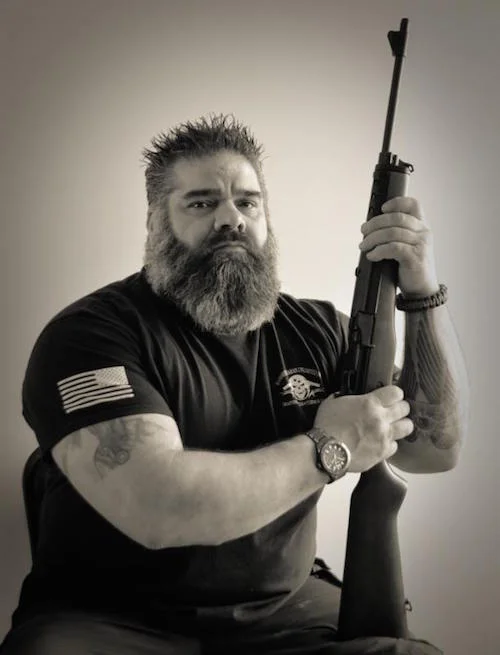
Loaded and ready for the election
"Chris,'' by Ed Friedman, in his show "Focus on: The Gun Culture,'' at Galatea Fine Art, Boston, June 1-26.
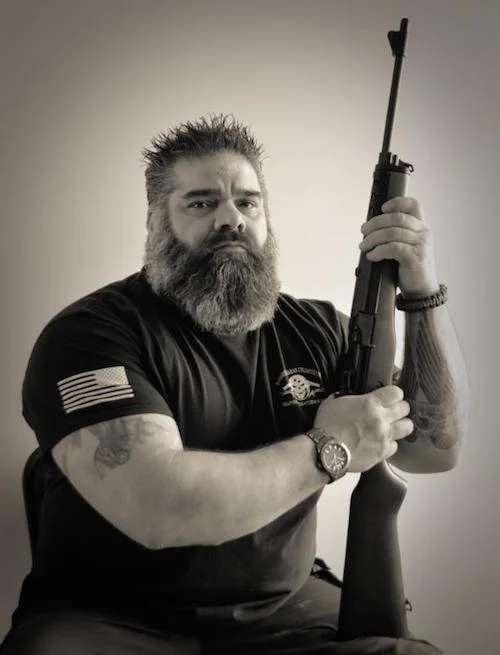
"Chris,'' by Ed Friedman, in his show "Focus on: The Gun Culture,'' at Galatea Fine Art, Boston, June 1-26.
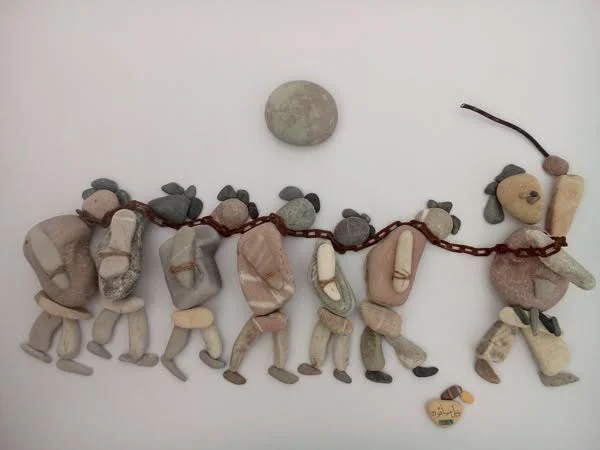
A boy's art amidst refugee anguish
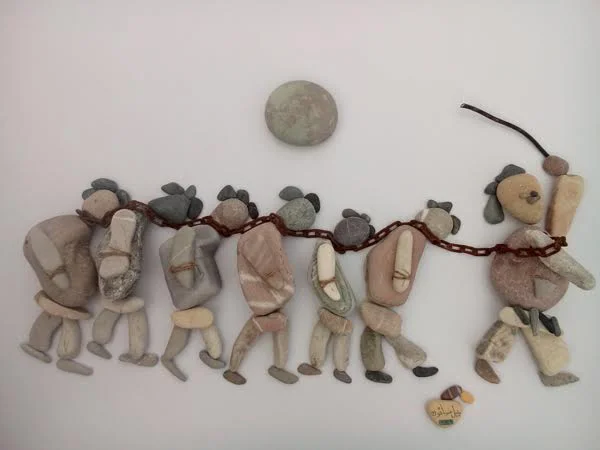
One in a series of art works using stones done by a Syrian boy in a refugee camp. It was forwarded to us by my friend and fellow Providence Committee on Foreign Relations (thepcfr.org) member Reza Mahdavi, a Cambridge, Mass.-based international businessman. -- Robert Whitcomb

To offset the green
"Longing for Blue,'' by Lauren Pollaro, in the show "Color and Construct,'' at Mitchell Giddings Fine Arts, Brattleboro, Vt., through May 29.

"Longing for Blue,'' by Lauren Pollaro, in the show "Color and Construct,'' at Mitchell Giddings Fine Arts, Brattleboro, Vt., through May 29.
Don Pesci: Learning how to make frescoes at Enders Island
Enders Island is la few miles from Mystic Seaport. on Long Island Sound. In the first week of May, I spent a rainy eight days there laboring, with some success, to produce three mural frescoes under the guiding hand of Chady Elias, a masterful religious artist who is the Vice President & Dean of Administration at Sacred Art Institute Enders Island and the Adjunct Professor of Sacred Art at Holy Apostles College & Seminary in Cromwell, Conn.
About the rain: I cannot help mentioning a morning prayer delivered by Sister Eugenia, a Master Catechist, after a sumptuous breakfast before we set out for the studio. It contained the usual appreciation and gratitude for all things large and small, with a slight knock “even though the weather has been not to our liking.”
When someone – was it me? – pointed out that this was a proper Biblical way of addressing the God of mercy and justice (See Job, 7:11), the sister pointed out with a slight Irish lilt in her voice, “Well, I’m Irish.” Such mild reproofs are to be expected of Irish lasses: Roses mingle with thorns.
And she was Irish, full of green thoughts, prone to laughter and seated comfortably on years of study and learning. A certified Spiritual Director and a member of Spiritual Directors International, Sister Eugenia has degrees in Education, Music, Religious Studies, Spirituality Theology and Scripture. She left Ireland when she was eighteen, but Ireland, as we know, never leaves the Irish. She has taken Ireland with her to several states – agnostic California among them -- loves children, has dedicated her life to the service of God and man, quotes Wordsworth at length from memory, and composes, on the spot and with flawless fervor, prayers that tickle the ears of angels.
Frescoes can be intimidating. Through our eight days, Chady leads us by baby steps – first a watercolor of the subject, then a painting on dry plaster, and finally a portable fresco mural on a wet surface. How, one may ask, is it possible to paint on a wet surface? Ah, but with God, who leads the senses to beauty and form, all things are possible. Every bit of Michelangelo’s art in the Sistine Chapel is fresco, a process that involves simultaneous multiple steps: plotting the image, preparing the surface with a combination of lime, sand and plaster, waiting patiently for the moment when the surface will accept dry pigments dissolved in lime-water, kissing the surface softly with a brush plunged in color.
One thinks of Michelangelo, suffering under the mild lash of a pope, carving forms on the ceiling of the Sistine Chapel with brushes the size of brooms, wondering, like Job, when the horror will end so that he might return to his first love -- sculpture.
As they say in the fairy tales: There are things twain; one you must do, the other you must not do. A fresco is a form to be seen from afar. And so, on the final stretch, you must see the projected painting from a distance, plastering in large blocks of color that change hue as the fresco dries. Chady puts it this way: NO DETAIL! The final strokes will be lines, bordering off the colors, the way stained glass is presented from a distance when a raking sun floods the forms with the light of creation.
After eight days of spiritual comradeship and hard work, I came home with three frescoes thinking, oddly enough, of the sea wall surrounding Enders Island and of Sister Eugenia’s yet unanswered prayer. During a violent storm, part of the sea wall collapsed. She was assured by the Army Corp of Engineers they would repair the wall. In years and years following that assurance, large boulders necessary for the repair were collected on the island. She prays, she waits, full of a fugitive hope. The boulders lie untouched by the Army Corps of Engineers. There may be somewhere in Connecticut a politician attuned to God’s whisperings, so quiet they seem to be faint commands tucked in whirlwinds. Heaven needs earth to move Heaven.
Following its connection with Holy Apostles College & Seminary, St. Michael’s has become an internationally renowned religious Art Institute. It is a jewel in the heart of Connecticut that has drawn artists and aspiring artists the world over. It’s time now to shout for joy, time to ring the bells – time to fix that wall. Do it for Sister Eugenia, do it for Art, do it for God. But do it.
Don Pesci (donpesci@att.net) is a writer who lives in Vernon. Conn.
RIP, Providence's Sal Laterra: Part of a quiet immigrant family's success story
Sal Laterra, for nearly 50 years a familiar presence at Paramount Cleansers, on Union Street, in Providence, died unexpectedly at Massachusetts General Hospital on May 3. He had celebrated his 90th birthday on the preceding Wednesday.
Born in Providence on April; 27, 1926, he was a son of Joseph and Elisabetta (Autiello) Laterra, immigrants, respectively, from Sicily andsouthern mainland Italy. He attended Mount Pleasant High School, but left school when he was 17 to join the Marines in World War II began. As a member of the Third Marine Division, he participated in the freeing of Guam from the Japanese, and his unit was in China awaiting orders to invade Japan when the atomic bombs were dropped.
Proud Marine though he was, he happily returned home to Providence and soon joined his father in the dry-cleaning and tailoring business that Joseph Laterra had opened 20 years earlier at the suggestion of then Providence Journal editor and later publisher/editor Sevellon Brown. For the next 40 years, Sal Laterra would be a familiar presence on Union Street, cleaning and tailoring clothes for Providence mayors and Rhode Island governors, Brown and RISD professors and Providence Journal reporters and editors.
At the end of each day, by pre-arrangement, he would hurry out into Union Street with a smile and a wave, with an armful of clothes that had been tailored or cleaned, and hand them out quickly to patrons who slowed down in their cars. At the death of his father, in 1987, he inherited the shop and it continued in business until his own retirement, in 1995. By then his son, John, was well embarked on his career as a neurologist at Johns Hopkins Hospital, in Baltimore (he was named one of the nation’s top neuro-oncologists by Newsweek earlier this year), and his daughter, Elizabeth, was in a post with the National Security Agency. He was ready, he said, to spend more time with his wife, Alda (Pontarelli) Laterra, and in the garden he had planted beside his Naples Avenue, Providence, house. He had bought the lot, he said, not only so that he and his family could enjoy it, but for the enjoyment of neighbors who had lots too small to have gardens. Having grown up in a six-story Providence tenement with no land around it, he said, he knew how you could long for a garden.
Always an outdoorsman, he also hoped to spend more time bicycling, skiing and mountain climbing. He was always proud of having skiied France’s Chamonix glacier and climbed Maine’s Mount Katahdin, and peaks in the White Mountains with the late Providence Journal art critic Bradford F. Swan and the late Journal photographer Andtrew Dickerman. In retirement, he bicycled with enthusiasm, joining the Narragansett Bay Wheelmen. In 1985, when he was 58, he had been featured on the Sunday Journal’s Health and Fitness insert as a prime example of a healthy Rhode Island outdoorsman. (It was not the first time that he had been featured on a Sunday Journal supplement cover. In 1967, his picture had been on the Rhode Islander cover when Paramount Cleansers itself was the subject of a story on the tailoring business.)
Although his wife died soon after his retirement, he continued to tend the garden they had both so enjoyed, and to travel as they had traveled together. He revisited the China he had known as a young Marine, and went on in Asia to visit Thailand and Vietnam. He also went to Australia and New Zealand, Mexico, Argentina and Chile, France, Germany, Switzerland, Spain, Portugal, the Azores, Italy, Sicily, Turkey, England and Scotland, and crossed both the United States and Canada by train. On his travels, he perfected his photography -- a talent that he had helped develop in the Providence Journal darkroom. As a memorial to his wife, he established a children’s book fund at the Providence Community Library on Academy Avenue.
He is survived by his daughter, Elizabeth Hobbins of Laurel, Md., his son, John Laterra, M.D., Ph.D., of Baltimore, and three grandchildren, Catherine Hobbins of Columbia, Md.; Sarah Yusko of Westminster, Colo., and Anne Laterra of Atlanta and a brother, Joseph Laterra of Wickford. He was predeceased by his wife and two sisters, Adeline McGuirk and Lucy Pettinato.
A memorial service will be held at a time to be announced.
-- Phyllis Meras
Robert Whitcomb: Mr. Brooks finally discovers that the natives are restless
In an April 29 column by The New York Times’s David Brooks headlined “If Not Trump, What?’’ he writes that to understand Donald Trump’s GOP popularity (and by implication Bernie Sanders’s among Millennials):
“{I]t’s necessary to go out into the pain. I was surprised by Trump’s success because I’ve slipped into a bad pattern, spending large chunks of my life in the bourgeois strata — in professional circles with people with similar status and demographics to my own. It takes an act of will to rip yourself out of that and go where you feel least comfortable….’’
“….Up until now, America’s story has been some version of the rags-to-riches story, the lone individual who rises from the bottom through pluck and work. But that story isn’t working for people anymore, especially for people who think the system is rigged.’’
How little effort much of the elite have made to know the plus-90 percent of the nation who aren’t. You’d think that big-time journalists would try to talk more to “everyday Americans,’ at least for show. But media celebs such as Mr. Brooks are addicted to the money, privilege and ego-gratification that go with spending most of their time with the rich and/or powerful. Meanwhile, many business/economics journalists have been fired to help maintain media outlets’ profit margins. So rigorous, data-driven coverage of socio-economic changes has declined in the media that American most look at in favor of, well, nonstop coverage of Mr. Trump’s latest insults. (I’m a former business editor.)
Mr. Brooks, et al., now seem to fear that massive social unrest is coming unless members ofthe “middle class’’ think that they will get a better deal. (Of course, many low- and middle-income people could help their situations by, for example, avoiding having kids out of wedlock and other disorderly behavior linked to poverty. They could also vote.)
The nub of the problem:
Government data show that American economic productivity in 1945 -1973 rose 96 percent and inflation-adjusted pay 94 percent; in 1973-2014 productivity grew 72.2 percent and inflation-adjusted pay 9.2 percent, with almost all of the growth in 1995-2002.
This suggests that the folks owning and/or running companies have become much less willing to share. At the same time, tax laws remain very skewed in favor of investment income over earned income. This keeps reinforcing a plutocracy based on inherited capital and privilege. The Sunday New York Times weddings section displays this crowd in all its glory.
Meanwhile, the elite’s disinclination to share has slowed economic growth by constraining most Americans’ purchasing power.
The very rich have increasingly sequestered themselves from the poor and the middle class through, among other things, jet travel, globalization, the Internet and gated communities. Thus they’re less likely to see and be embarrassed by extreme divergences of wealth. Ever more large local enterprises are owned by far-away companies and/or individuals rather than by people in the communities where the companies operate. The local employees are mere numbers on a screen rather than people whom senior executives and major shareholders might awkwardly encounter on the street.
In some of the burgs where my family have lived over the past century, such as Brockton, Mass., when it was a shoe-making capital, and Duluth, Minn., an iron-ore and grain shipping port, my relatives who were executives, factory managers and the like would encounter a wide range of the population daily, from rich to poor. Now, the descendants of these folks who have not yet drunk away the old money made in these places tend to spend six months and a day enjoying tax avoidance in Florida , and those who own and/or run largeenterprises with operations in places like Duluth and Brockton may never visit them at all.
Out of sight, out of mind.
But now there’s the glint of pitchforks in the sun. It’s too bad that the leading spokesmen for the new “populism’’ are con man Donald Trump (see: www.trumpthemovie.com) and a naïf like Bernie Sanders, who doesn’t understand the need to always encourage entrepreneurialism to raise living standards. As for the Clintons, all too often they act like establishment grifters.
Anyway, we need capitalism, but adjustments are long overdue.
Robert Whitcomb (rwhitcomb51@gmail.com), a former Providence Journal editorial page editor, a former International Herald Tribune finance editor and a former Wall Street Journal editor, oversees New England Diary and is a partner at Cambridge Management Group and president of Guard Dog Media, based in Boston.
Josh Hoxie: Forget Panama: Delaware will suffice for hiding money from tax authorities
The first thing you notice on the cab ride from the airport to downtown Panama City is the skyscrapers. They’re architecturally beautiful, but jumbled together as if there was no plan or consideration for how they might look next to one another.
What you might not notice is that they’re nearly all empty.
Panama, a small Central American country with just 4 million people, has dominated the news in recent weeks.
For that you can thank the Panama Papers — a massive leak of private documents from the Panamanian law firm Mossack Fonseca, which serves well-heeled companies and individuals all over the world. The leaks exposed a vast global system of shady offshore tax shelters and the global elites that benefit from them.
A few months before Panama landed on the front pages of nearly every newspaper in the world, I visited the country and got a look at those empty buildings firsthand.
Unlike many travelers, I wasn’t in Panama City to launder my ill-gotten cash or to hide my profits from meddling tax collectors (not least because I have neither). I was in search of beautiful beaches and perfect waves, both of which the country is well known for.
It was striking, however, that the most attractive resource the country advertises to the global elite is a hands-off business and tax climate seemingly designed for exploitation.
According to my cab driver (and Reuters), drug cartels are responsible for much of the building boom in Panama City.
For cash-laden criminals unable to drop their funds in a checking account, investing in a Panamanian commercial building makes a lot of sense. They carry excess cash into the country by hand and convert it into an appreciating asset that can remain empty for years. Never mind that many Panamanians live in rickety shacks and dire poverty.
Many who take advantage of Panama’s lax business climate never have to step foot in the country. Named in the Panama Papers were 12 current or former world leaders, 128 other public officials and politicians, and hundreds of other elites — from well known celebrities to enigmatic businessmen — from over 200 countries.
They each in some way used Mossack Fonseca to create hard-to-trace shell companies to hide their assets. Those companies helped their owners evade taxes, public scrutiny, legal action, or all three.
Iceland’s prime minister, Sigmundur Gunnlaugsson, was forced to step down in the face of massive public protests after he was named in the leak. British Prime Minister David Cameron, Russian leader Vladimir Putin, and famous soccer player Lionel Messi have faced significant public scrutiny as well.
Notably, few American names have been listed to date. That could change in revelations to come, but it also might not. States like Delaware offer very similar hands-off approaches to regulation that individuals and companies can exploit to hide their business dealings without going overseas.
One single address in Wilmington, for example — 1209 North Orange Street — is listed as the headquarters for 285,000 separate businesses exploiting Delaware’s lax laws. Indeed, both Hillary Clinton and Donald Trump have firms registered in that two-story office building.
In fact, the Tax Justice Network ranks the United States third in the world for financial secrecy, behind only Switzerland and Hong Kong. Panama is No.13.
As the saying goes, behind every great fortune is a great crime. And the Panama Papers provide the tools to begin prosecuting some of the more egregious crimes of tax evasion and corporate irresponsibility. Many countries have already begun to take action on this front, the United States included.
Perhaps more importantly, the leak provides an impetus for much-needed public pressure to fix our rules so they work for everyone — not just the tax-dodging elites and their shady shell corporations.
Josh Hoxie directs the Project on Opportunity and Taxation at the Institute for Policy Studies (IPS-dc.org). Distributed by OtherWords.org.
Bankers' bacchanal

"Piggy Bankers/The Great Recession of 2008'' (porcelain, wood, white gold leaf, gold leaf, bone, brass balls (!)), by Mara Superior, in the show "The Face of Politics: In/Tolerance,'' at the Fuller Art Museum, Brockton, Mass., through Aug. 21.
Negative capability
"Hoe while it is spring, and enjoy the best anticipations.
It is not much matter if things do not turn out well."
-- Charles Dudley Warner
Cities around airports and underwater, backstabbers, Panama Canal helps Quonset
May 5, 2016
To members and friends of the Providence Committee on Foreign Relations (thepcfr.org; pcfremail@gmail.com):
Our next meeting comes on Wednesday, May 11, with the internationally known expert on cities, transportation and workplaces around the world, journalist, urbanist and futurist Greg Lindsay. (He’s also a former Jeopardy champion.)
Look at:
http://www.amazon.com/Aerotropolis-Way-Well-Live-Next/dp/0374100195/ref=sr_1_1?ie=UTF8&s=books&qid=1279805811&sr=8-1
As this Amazon summary of that book, co-written by Mr. Lindsay and John D. Kasarda, put it:
“This brilliant and eye-opening look at the new phenomenon called the aerotropolis gives us a glimpse of the way we will live in the near future―and the way we will do business too.
“Not so long ago, airports were built near cities, and roads connected one to the other. This pattern―the city in the center, the airport on the periphery―shaped life in the twentieth century, from the central city to exurban sprawl. Today, the ubiquity of jet travel, round-the-clock workdays, overnight shipping, and global business networks has turned the pattern inside out. Soon the airport will be at the center and the city will be built around it, the better to keep workers, suppliers, executives, and goods in touch with the global market. This is the aerotropolis: a combination of giant airport, planned city, shipping facility, and business hub.’’
Mr. Lindsay is also a contributing writer for Fast Company, author of the forthcoming book Engineering Serendipity, a senior fellow of the New Cities Foundation — where he leads the Connected Mobility Initiative — a non-resident senior fellow of The Atlantic Council’s Strategic Foresight Initiative, a visiting scholar at New York University’s Rudin Center for Transportation Policy & Management, and a senior fellow of the World Policy Institute.
Heprovocatively notes, on a topic of particular interest to coastal New Englanders: “Rising sea levels is no longer the twenty-second century’s problem; it’s ours. Will we be forced to abandon coastal megacities? Will we manage to wall them off, or float them? The answer is probably ‘all of the above,’with the wealthiest districts of the wealthiest cities deploying some mix of technological and infrastructural fixes while the rest are submerged.
As usual, the dinner will be at the Hope Club, 6 Benevolent St., Providence. Drinks start at about 6, dinner by 7, then the talk and a Q&A and the evening ends by 9.
Please let us know whether you will join usby replying to pcfremail@gmail.com or, in a crunch, calling (401) 523-3957.
Thanks very much to those who have already let us know!
The Hope Club needs good estimates no later than the day before a PCFR dinner.
Dues and dinner cost information may be found at: thepcfr.org. Other membership information may be found there, too. (A member asked if (the modest) duesand dinner fees for this nonprofit educational and civic membership organization aredeductible for business purposes. In some cases. Ask your tax adviser.)
On Tuesday, June 7, Michael Soussan, former UN whistleblower; acclaimed author; widely published journalist; NYU writing professor, and women's rights advocate, will speak. His satirical memoir about global corruption, Backstabbing for Beginners: My Crash Course In International Diplomacy (Nation Books / Perseus) is being adapted for a feature film, starring Ben Kingsley and Josh Hutcherson
He will speak about the subject of his next book TRUTH TO POWER: how great minds changed the world. A brief history of thought leadership.
Evan Matthews, a key thought leader at the North Atlantic Ports Association and director of the Port of Davisville, has very kindly offered to talk to us on Wednesday, June 22, on changes in world shipping, including the widening of the Panama Canal and other changes of huge interest to New England ports, especially Quonset/Davisville.
: @ThePCFR
Charles Chieppo: Every state should have gubernatorial line-item veto power
The recovery from the Great Recession has largely been a half-hearted one, and few see the economy improving dramatically in the near future. These realities present challenges for state and local governments that will likely require a range of responses, but giving governors the line-item veto should be seen as low-hanging fruit for the six states that don't have it.
Those states are Indiana, Nevada, New Hampshire, North Carolina, Rhode Island and Vermont, and there is a movement afoot in at least one of them to do something about it. Three bills pending in the Rhode Island legislature would put the issue before the Ocean State's voters this November.
Former gubernatorial candidate Ken Block, founder of the state's Moderate Party, has created a Web site, lineitemveto.org, that has gathered more 900 signatures for a letter urging the state's leaders to support the change.
There's good reason to consider the idea. The long-term fiscal forecast is far from rosy for states and their local governments. A decade ago, the concern was rising healthcare costs. Then came a number of municipal bankruptcies fueled in part by the costs of long underfunded pension systems. Next came a rule from the Government Accounting Standards Board that required governments to report liabilities associated with postemployment benefits such as retiree health care.
More recently, the focus has been on the need for costly improvements to infrastructure at a time when the sluggish recovery has produced slow revenue growth. It's not as though the lineitem veto, which allows governors to delete items or parts of items in an appropriations bill without rejecting it entirely, will solve these problems for the six states that don't allow it after all, plenty of states that do have it struggle with their finances but it's one of the tools that will be needed if governments are to survive the fiscal challenges to come.
Like most things in politics, the full impact of the tool can't be measured in dollars and cents. The threat of the line-item veto can shape debates and make it harder for legislators to lard up popular bills with pork. A line-item veto could be overridden by lawmakers, but not without shining a light on provisions they might not want the public to pay a lot of attention to.
The temptation for public officials to duck responsibility for dealing with hard problems and let successors wrestle with them is always going to be great. But state and local leaders who want to deal with problems now face difficult choices. One approach, of course, would be to raise taxes, but voters are rarely happy about that. Another would be for governments to retreat entirely from some areas they now fund.
One could make a realistic argument that the public sector does a number of unnecessary things, but the inconvenient truth is that in a democracy every one of them has a constituency.
In most states, the far more realistic approach will be a combination of raising revenues and finding savings. The line item veto may be an imperfect tool for accomplishing the latter, but it's one that all states ought to have at hand.
Charles Chieppo (Charlie_Chieppo@hks.harvard.edu) a research fellow at the Ash Center at Harvard''s Kennedy Center. This piece first ran on govering.com.
Nature imitating art on Amtrak
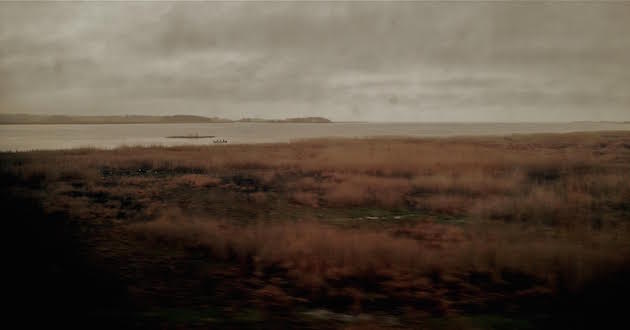
Commentary and photo by William Morgan
Travel today is mostly a chore. But one pleasure of taking Amtrak's Northeast Regional between Boston and New York is the trip along the shore of Long Island Sound.
Between Westerly, R.I., and New Haven, Conn. -- going through Stonington, Mystic, Old Lyme, Saybrook, Clinton, Madison and Guilford -– there is an aqueous landscape of estuaries, rivers and marshes.
Despite efforts to despoil our natural habitat, this watery stretch between Interstate 95 and the Sound cannot support much more than the train tracks and summertime sailboats.
An iPhone shot taken at 65 miles an hour, in the rain, should be nothing to write home about. Yet, this glimpse of coast around Clinton evoked New England landscape painters of 150 years ago, such as Worthington Whittredge, Martin Johnston Heade, and Fitz Hugh Lane. Like them, we are still inspired.
The feathered bastards
"Every year, back comes Spring, with nasty little birds yapping their fool heads off and the ground all mucked up with plants."
-- Dorothy Parker
Not an acceptable circus act

"Dream Drawing With Stallions'' (mixed media on paper), by Nancy Ellen Craig (1927-2015), in the show "Renaissance Dream Paintings,'' at Berta Walker Gallery, Provincetown, May 6-July 5.
Pearl Macek: N.E. ocean fishermen worry about sector's sustainability
Via ecoRI News (ecori.org)
PROVIDENCE
Fishermen, scientists and interested citizens gathered in mid-April at Rhode Island College for a panel discussion about whether commercial ocean fishing is, or can be, sustainable.
The panel consisted of six speakers who discussed the current state of fish populations within U.S. waters, climate change and its impact on fish stocks, and the current rules and regulations imposed on commercial fishermen. The discussion was often heated, and it was obvious that the fishermen, both on the panel and in the audience, weren’t happy with current catch quotas and monitoring regulations.
Panelist John Bullard, the Northeast regional administrator of the National Oceanic and Atmospheric Administration (NOAA), said commercial fishing is “definitely sustainable.” But fishermen David Goethel and Mark Phillips, also on the panel, believe the more important question to explore is whether fishing communities are sustainable. Both fishermen said catch quotas and the crippling expenses fishermen have to face both to run their boats and pay catch monitors are making fishing as a way of life all but impossible.
“The smell of fish is gone, replaced by burnt coffee,” Phillips said about the traditional fishing docks of New England.
NOAA regulates the fishing industry, and both Phillips and Goethel are involved in a lawsuit against the federal agency regarding the costs incurred by New England fishermen who now have to pay monitors about $700 a day to be on their boats.
Traditionally, the monitoring system was federally funded, but commercial fishermen now have to pay the monitors’ wages, a burden that many fishermen believe will push them toward bankruptcy. The lawsuit was filed last December in federal district court in Concord, N.H.
The audience clapped almost every time Phillips and Goethel spoke about the need for less regulation and more freedom to continue the tradition of small-scale commercial fishing. Phillips bemoaned the fact that U.S. fishermen are only allowed to fish one-third of Georges Bank, one of the most valuable fishing grounds off North America and easily accessible by New England fishermen.
He said fish stocks follow a natural cycle completely independent of fishing, and that every 15 to 20 years a fish population crashes and then rebounds. Phillips also said that when fishermen aren’t allowed to harvest a particular fish stock, the population often times dies off because of disease caused, at least in part, by overpopulation. He claimed there are more fish in the Atlantic Ocean than there were 20 to 30 years ago.
NOAA recently released its annual report to Congress on the status of U.S. fisheries and the numbers are fairly promising: the number of stocks listed as subject to overfishing or overfished remain near an all-time low, with only 9 percent of stocks subject to overfishing and 16 percent of stocks being overfished. Overfishing occurs when more fish are caught then the population can replace; overfished means the current population is 35 percent or below the estimated original population. A fish population can become overfished for reasons outside of fishing, such as disease, natural mortality and changes in environmental conditions.
The topic of climate change also came up frequently in the conversation.
“Climate change is a big problem we have to face,” said Jake Kritzer, director of the Fishery Solutions Center team at the Environmental Defense Fund, a nonprofit environmental advocacy group. He noted that a reduction in salinity and nutrients in ocean waters has caused a decrease in the production of plankton.
“Every fishery management plan has to take climate change into consideration,” Bullard said. He also spoke about whole species of fish and marine crustaceans moving further north as New England’s coastal waters get warmer. In recent years, Maine lobstermen have experienced a glut of lobster, which drove prices down to the point that fishermen refused to harvest them until prices increased.
“Fisherman should be advocates,” said Graham Forrester, a professor in the Department of Natural Resources Science at the University of Rhode Island, as he tried to be a unifying voice on a panel that was bitterly divided between fishermen and scientists. “We are struggling in the scientific community to understand these problems.”
At the beginning of the discussion, each member of the audience was given an electronic remote control with which they could answer if they thought fishing was sustainable. At the beginning of the discussion, 69 percent of the audience said yes; by the end of the discussion, that number increased to 78 percent.
In the panelists’ closing remarks Bullard extended a metaphorical olive branch to the fishermen both on the panel and in the audience by saying that regulating the fishing industry needed to be improved, because fishermen have the “hardest job in the world” and “we are making their place of business a hostile environment.”
Pearl Macek is a contributing writer for ecoRI News.
'So Eden sank to grief'
"Nature's first green is gold,
Her hardest hue to hold.
Her early leaf's a flower;
But only so an hour.
Then leaf subsides to leaf.
So Eden sank to grief,
So dawn goes down to day.
Nothing gold can stay."
-- Robert Frost, ''Nothing Gold Can Stay''
Chris Powell: A desperate America needs you to sign a petition for a big new political party.
MANCHESTER, Conn.
How has this happened? How have the two major political parties contrived to give their presidential nominations to candidates who, according to opinion polls, are both heartily disapproved by a majority of voters generally even as they command majority support in their own parties?
Must the next president be a megalomaniac and serially bankrupt buffoon leading a pack of hateful brownshirts, or a clumsily pandering, posturing grifter leading a pack of parasites?
No presidential election in modern times has offered as much opportunity for a third-party challenge. John Anderson took almost 7 percent of the vote in 1980 and Ross Perot almost 20 percent of the vote in 1992 against candidates whom the public did not find half as repulsive as Donald Trump and Hillary Clinton.
Is there no one in public life in this country whose approval rating exceeds his or her disapproval rating — no one who, while perhaps little known at the moment, might earn the country’s respect rather than its contempt in a few months?
Of course since elections are usually exercises in building consensus, campaigns can be a slog toward mediocrity. Disappointed with the result of the 1924 presidential election, the social critic H.L. Mencken renounced democracy itself.
“Democracy,” Mencken wrote, “is that system of government under which the people, having 35,717,342 native-born adult white men to choose from, including many who are handsome and thousands who are wise, pick out a Coolidge to be head of the state. It is as if a hungry man, set before a banquet prepared by master cooks and covering a table an acre in area, should turn his back upon the feast and stay his stomach by catching and eating flies.”
And Coolidge didn’t turn out so badly, as Mencken had to admit when he wrote the former president’s obituary in 1933: “He had no ideas and he was not a nuisance.”
But Donald Trump in charge of the nuclear arsenal? Hillary Clinton —futures trader extraordinaire, tool of Goldman Sachs, destroyer of universal medical insurance, dissembler of Benghazi, compromiser of classified documents — in charge of anything?
Now will someone please start circulating the petitions?
Chris Powell is managing editor of the Journal Inquirer, in Manchester, Conn.
A target of art

"X Marks the Spot'' (mixed media collage) by Sophiya Khwaja, in her show "Machinations,'' through June 25, at Cade Tompkins Projects, Providence. This Pakistani artist, now based in Dubai, will give a talk and participate in a panel discussion at the gallery 3-5 p.m., April 30 at the gallery, at 198 Hope St., Providence.
Saturday, April 30, 2016
3-5pm
Talk 4pm
Exhibition Dates
April 30 - June 25, 2016
'Last year is dead'
"The trees are coming into leaf
Like something almost being said;
The recent buds relax and spread,
Their greenness is a kind of grief.
Is it that they are born again
And we grow old? No, they die too,
Their yearly trick of looking new
Is written down in rings of grain.
Yet still the unresting castles thresh
In fullgrown thickness every May.
Last year is dead, they seem to say,
Begin afresh, afresh, afresh."
- Philip Larkin, "The Trees''