
Vox clamantis in deserto





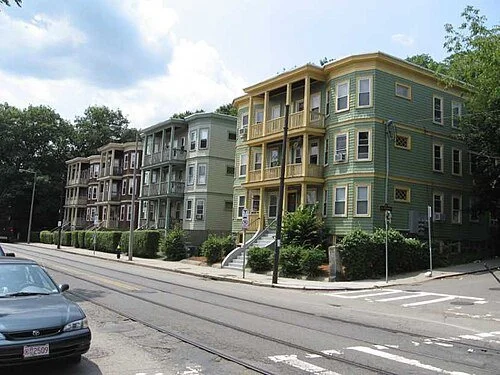
Spring spoilsport
"So Spring comes merry towards me here, but earns
No answering smile from me, whose life is twin'd
With the dead boughs that winter still must bind,
And whom today the Spring no more concerns.
Behold, this crocus is a withering flame;
This snowdrop, snow; this apple-blossom's part
To breed the fruit that breeds the serpent's art.
Nay, for these Spring-flowers, turn thy face from them,
Nor stay till on the year's last lily-stem
The white cup shrivels round the golden heart."
-- Dante Gabriel Rossetti, "Barren Spring''
Isaiah J. Poole: Give 'tax and spend' a chance
via otherwords.org
This time of year, a whole lot of Americans are feeling taxed enough already.
But the astonishing momentum of Bernie Sanders’s presidential candidacy reveals something else: Millions of taxpayers are willing to entertain the idea that some of us aren’t taxed enough, and that it’s hurting the rest of us.
Sanders has propelled his race against Hillary Clinton on a platform that would ramp up government investment — in infrastructure, education, health care, research and social services — while boosting taxes on the wealthiest Americans and big business to cover the cost.
Clinton’s own vision is less ambitious, but it’s also a far cry from “the era of big government is over” days of her husband’s administration.
The old conservative epithet against “tax-and-spend liberals” hasn’t completely lost its sting, says Jacob Hacker, a political-science professor at Yale University who pushed the idea of a public option for health insurance during the Affordable Care Act debate. But “we are moving toward the point where we can have an active discussion” about why “you need an activist government to secure prosperity.”
Hacker’s latest book, with Paul Pierson of the University of California at Berkeley, is American Amnesia: How the War on Government Led Us to Forget What Made America Prosper.
Hacker and Pierson argue that it was “the strong thumb” of a largely progressive-oriented government, in tandem with “the nimble fingers of the market,” that created the broad prosperity of the post-World War II era. Conservative ideologues and corporate leaders then severed that partnership.
Anti-government activism replaced the virtuous cycle of shared prosperity that existed into the 1970s with a new cycle that’s reached its depths in today’s radical Republican-run Congress: Make government unworkable. Attack government as unworkable. Win over angry voters. Repeat.
But in today’s mad politics, growing numbers of voters seem to have gotten wise to the routine and how it’s been rigged against them. Some are gravitating toward Donald Trump, as Hacker puts it, out of “the need to put a strong man who you know is not with the program in Washington in charge.”
Sanders has the opposite vision. He’s looking to spark a people-powered reordering of what government can do, with the biggest wealth-holders paying the share of taxes that they did when America’s thriving middle class and thriving corporate sector were, together, the envy of the world.
That vision is embodied in "The People's Budget.'' a document produced by the Congressional Progressive Caucus as an alternative to the House Republican budget.
It’s based on the premise that America can break out of its slow-growth economic malaise through a $1 trillion infrastructure spending plan that would create more than 3 million jobs, increased spending on green-energy research and development, and universal access to quality education from preschool through college.
“There are two messages that come out of the progressive budget,” Hacker said. One is that “we can actually increase investment if we don’t cut taxes further on the wealthy.” The other is that “if we got tougher with the modern robber barons in the healthcare and finance and energy industries, we could actually achieve substantial savings without cutting necessary spending.”
Unfortunately, The People’s Budget won’t get close to a majority vote in Congress — and that’s if it gets a vote at all in the dysfunctional Republican House.
Yet together with the debate provoked by the Sanders campaign, Hacker says, it shows that now “we have a little bit more of an opening for the kind of conversation we should’ve had 20 or 30 years ago, when we were trashing government and abandoning all of these long-term investments that are essential to our prosperity.”
Isaiah J. Poole is the online communications director at Campaign for America’s Future (OurFuture.org).
Beware the giant carp

"From the Canoe'' (oil on canvas), by Anne Ireland, at Alpers Fine Art, Andover, Mass.
And not be ashamed of it
In the spring, at the end of the day, you should smell like dirt.
-- Margaret Atwood, "Unearthing Suite''
Chris Powell: Of minimum wages, gender shifting and hypocritcal trading with China
Woody Allen's movie Bananas has a scene depicting the power madness that afflicts a Latin American revolutionary leader upon his seizure of office. El Supremo gathers his people to proclaim that henceforth the country's official language will be Swedish, that underwear will be changed every half hour and worn on the outside "so we can check," and that all children under 16 years old now are 16 years old.
Modern political liberalism increasingly evokes that scene with its belief that there are no practicalities that power cannot overcome and that merely proclaiming something makes it so.
For the great liberal causes of the moment seem to be, first, raising the minimum wage and, second, giving men who want to be women and women who want to be men the right to use the washrooms of their choice.
California and New York already are increasing their minimum wages to $15 per hour. Connecticut soon may follow. And some states, including Connecticut, have construed the sexual identity clamor as a matter of civil rights. Connecticut Gov. Dan Malloy has gone so far as to prohibit official state government travel to states that maintain ordinary sexual-identity rules, as if those rules, followed for centuries -- followed until very recently even by Connecticut itself -- were actually outrages of oppression. (Who knew?)
Economists are divided on whether minimum wages are beneficial, whether their redistribution of income is positive on the whole or whether income gains for lower-paid workers are offset by automation and declines in employment. Indeed, signing California's minimum-wage bill the other day, Gov. Jerry Brown said the minimum wage makes no economic sense, just political sense.
If the rationale for a minimum wage is accepted, the wage should be increased from time to time to match inflation, and the minimum wage has eroded badly in that respect. But then no business can survive without linking wages to productivity, and proclaiming a minimum wage of $15 per hour or any amount does not suddenly guarantee that the work done by everyone employed at minimum wage will produce that much value to an employer, or that an employer paying minimum wage will be able to recover his higher wage costs by raising prices.
And while current minimum wages surely are not sufficient to support families, as advocates of raising the minimum wage complain, many jobs don't produce enough to match what families consume. So why should the minimum wage necessarily be high enough to support a family? And what size family?
As for whether men can be women and women can be men simply by their own assertion, even the worst reactionaries and most fervent religious fundamentalists these days probably would not advocate oppression of people with sexual identity issues. The lives of such people may be hard enough already.
But has modesty, the rationale for separate-sex washrooms, really been so oppressive all this time? Certainly it never intended to be oppressive, unlike racial, ethnic, and religious discrimination. Separate-sex washrooms did not impair anyone's full inclusion in society. Maybe men who identify as women and women who identify as men would be more comfortable with the right to use the washroom of their choice, without regard to traditional rules, but what of the right of everyone else to modesty?
Anyway, like the minimum wage, the washroom issue is arguable. So a governor who, like Connecticut's, has managed to do business with totalitarian China only makes himself ridiculous with his politically correct indignation about washrooms in North Carolina and Mississippi.
Chris Powell is managing editor of the Journal Inquirer, in Manchester, Conn.
Posted in Chris Powell on Monday, April 11
You couldn't have slept with all the racket
"Everything is blooming most recklessly; if it were voices instead of colors, there would be an unbelievable shrieking into the heart of the night."
- Rainer Maria Rilke, from "Letters of Rainer Maria Rilke''
Let me rest up a bit first
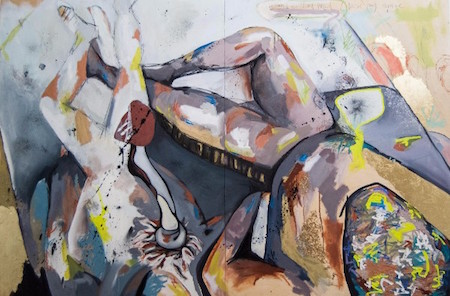
"Come and Rest Your Bones With Me" (oil, charcoal, graphite, mica and golf leaf on panel), by Hilary Tait Norod, in her show "Are You Crazy With Me,'' at Jerome Street Studios, Medford, Mass.
'Nor pity the flowers'
"O Day after day we can't help growing older.
Year after year spring can't help seeming younger.
Come let's enjoy our winecup today,
Nor pity the flowers fallen."
- Wang Wei, "On Parting With Spring''
Llewellyn King: The body language of this presidential campaign
WEST WARWICK, R.I.
Whenever I go out to dinner lately, along with the first sip of wine, I’m served a pre-appetizer: a short, dispiriting conversation about the politics of the moment, complete with a special kind of head-shaking and eye-rolling that has been perfected for this election season.
First the diner’s head is lowered slightly and shaken slowly from side to side. Then the eyes are raised, as though in supplication by a puppy that has done something wrong but doesn’t know what: What did we do to deserve this?
Donald Trump elicits the most severe reaction. People quickly agree that he is not only unsuitable for high office but quite possibly bonkers, stark-raving mad, round the twist — whatever you call the unbalanced in colloquial speech.
Next comes the Ted Cruz shudder. After the shaking of the head over Trump comes a nervous, whole-body response to the mention of Cruz. It begins in the shoulders and migrates down to the pelvis while the head is stationary, having been stilled after shaking at the thought of Trump. Nobody suggests that Cruz is bonkers but quite the opposite, the extreme opposite. In whispers, the Cruz shudderers say “he is clever” and, ominously, “he has an agenda.” Cruz, it is intimated, is in touch with forces beyond he grave, and on the wrong side of that.
John Kasich doesn’t make the grade for dinner gyrations. With a little shake of the head and shrug of the shoulder, he is dismissed.
On to the Big Sigh.
The Big Sigh is reserved for discussion of Hillary Clinton. It is preceded by the “don’t make me laugh” expulsion of breath over Bernie Sanders. Devout liberals keep Sanders alive in conversation for a few moments, saying that they like his views on healthcare or taxing the rich. But he is gone with the first full exhalation.
The real sighing is for Hillary, the choice of last resort. People declare that they will vote for her then elaborate her failings. One is told, “she is overly ambitious,” “she is a terrible manager,” “she has baggage,” “she looks worn out,” and “she has to explain Libya.”
Clearly, she has locked up the hold-your-nose vote.
Look, I haven’t just been supping on sushi in Georgetown, although I’m guilty there, or on Dover sole at the Metropolitan Club in Washington, guilty again, but also on mac and cheese at the humble, working-class Harris Grille in Coventry, R.I., and barbecue at Calhoun’s in Knoxville, Tenn.
What amazes is where are the millions who turn out to support Trump so vigorously? Why don’t I run into them, hunt high and low though I may? Are they all sitting at home waiting for a pollster to call so they can give their man further ammo?
Where are the Cruzers? Are they out there testing the fallibility of Obamacare, or demonstrating against world conquest by Planned Parenthood? The rot starts with women’s health and ends with socialized medicine, don’t you understand?
At least one can find the Bernie Sanders legions. They are the young people with the special cellphone posture; who have turned themselves into question marks as they crouch over their devices, looking into the future on their tiny screens.
When they unwind in middle age to look around them, freed of the millennial stoop, will they morph into Republicans? Will there be any Republicans after Trump and Cruz have worked their magic?
What, I wonder, will we be doing at dinner parties after the Republican National Convention in Cleveland? Will we be doing the Trump headshake and confused eye or the Cruz full-body shudder?
After the Democratic National Convention in Philadelphia, the Big Sigh is predictable at dinner tables across the nation.
In November, after electing President Unsuitable, we will all be holding our heads in a kind mute astonishment.
Llewellyn King (lking@kingpublishing.com) is a longtime publisher, columnist and international business consultant. He is host and executive producer of White House Chronicle, on PBS. Mr. King is based in Rhode Island and Washington, D.C.\Ll
This first ran on InsideSources.
Pope's fatuous push on refugees
So Pope Francis wants the most humane place in the world -- the West, and especially Western Europe -- to help many more refugees without suggesting that, for example, Russia, with its vast space, help, which it does not at all. Yet again, let the West do everything!
The most generous people in the world are asked to do more while the Pope fails to denounce the cause of the refugee problem -- Islamic fascism, worsened by the Putin gangster regime's help for mass-murderer Bashar Assad, the Syrian dictator and pal of Russian thug-in chief Vladimir Putin.
And it's easy for the Pope, who doesn't have to deal with the complications of absorbing millions of immigrants with non-Western backgrounds (and some with anti-Western ideas) into Europe to make glib pronouncements about letting them all in.
The Pope is fatuous.
-- Robert Whitcomb
Cities expert Greg Lindsay next at Providence Committee on Foreign Relations
April 16, 2016
To members and friends of the Providence Committee on Foreign Relations (thepcfr.org; pcfremail@gmail.com)
Hedrick Smith gave us a stirring talk on April 12 as he vividly described his view of an America paralyzed by extreme income inequality and political deadlock, and proposed ways to right the ship of state. The PBS Frontline star and Pulitzer Prize-winning former New York Times foreign correspondent noted that America’s domestic crises inevitably limit its ability to operate effectively abroad.
Next, on Wednesday May 11, comes the internationally known expert on cities, transportation and workplaces around the world, journalist, urbanist and futurist Greg Lindsay.
Look at:
http://www.amazon.com/Aerotropolis-Way-Well-Live-Next/dp/0374100195/ref=sr_1_1?ie=UTF8&s=books&qid=1279805811&sr=8-1
As this Amazon summary of that book, co-written by Mr. Lindsay and John D. Kasarda, put it:
“This brilliant and eye-opening look at the new phenomenon called the aerotropolis gives us a glimpse of the way we will live in the near future―and the way we will do business too.
“Not so long ago, airports were built near cities, and roads connected one to the other. This pattern―the city in the center, the airport on the periphery―shaped life in the twentieth century, from the central city to exurban sprawl. Today, the ubiquity of jet travel, round-the-clock workdays, overnight shipping, and global business networks has turned the pattern inside out. Soon the airport will be at the center and the city will be built around it, the better to keep workers, suppliers, executives, and goods in touch with the global market. This is the aerotropolis: a combination of giant airport, planned city, shipping facility, and business hub.’’
Mr. Lindsay is also a contributing writer for Fast Company, author of the forthcoming book Engineering Serendipity, a senior fellow of the New Cities Foundation — where he leads the Connected Mobility Initiative — a non-resident senior fellow of The Atlantic Council’s Strategic Foresight Initiative, a visiting scholar at New York University’s Rudin Center for Transportation Policy & Management, and a senior fellow of the World Policy Institute.
Heprovocatively notes, on a topic of particular interest to coastal New Englanders: “Rising sea levels is no longer the twenty-second century’s problem; it’s ours. Will we be forced to abandon coastal megacities? Will we manage to wall them off, or float them? The answer is probably ‘all of the above,’with the wealthiest districts of the wealthiest cities deploying some mix of technological and infrastructural fixes while the rest are submerged.
As usual, the dinner will be at the Hope Club, 6 Benevolent St., Providence. Drinks start at about 6, dinner by 7, then the talk and a Q&A and the evening ends by 9.
Please let us know whether you will join us April 12 by replying to pcfremail@gmail.com or, in a crunch, calling (401) 523-3957.
Thanks very much to those who have already let us know!
The Hope Club needs good estimates no later than the day before a PCFR dinner.
Dues and dinner cost information may be found at: thepcfr.org. Other membership information may be found there, too. (A member asked if (the modest) duesand dinner fees for this nonprofit educational and civic membership organization aredeductible for business purposes. In some cases. Ask your tax adviser.)
On Tuesday, June 7, Michael Soussan, former UN whistleblower; acclaimed author; widely published journalist; NYU writing professor, and women's rights advocate, will speak. His satirical memoir about global corruption, Backstabbing for Beginners: My Crash Course In International Diplomacy (Nation Books / Perseus) is being adapted for a feature film, starring Ben Kingsley and Josh Hutcherson
He will speak about the subject of his next book TRUTH TO POWER: how great minds changed the world. A brief history of thought leadership.
Evan Matthews, a key thought leader at the North Atlantic Ports Association and director of the Port of Davisville, has very kindly offered to talk to us on Wednesday, June 22, on changes in world shipping, including the widening of the Panama Canal and other changes of huge interest to New England ports, especially Quonset/Davisville.
We plan to getexperts on the Zika virus, chaotic Brazil, the geopolitical effects of global warming and ocean fishing in the next season. Expert on Central Asia Morris Rossabi, former Ambassador to Slovakia Tod Sedgwick, German General Consul Ralf Horlemann and the Silk Road Project’s Laura Freid will be among those speaking in that season, which starts soon after Labor Day.
Suggestions are appreciated.
We look forward to seeing you.
: @ThePCFR
Ci
Leaving behind 'dissipation without pleasure'
"On the approach of spring, I withdraw without reluctance from the noisy and extensive scene of crowds without company, and dissipation without pleasure."
-- Edward Gibbon
What cool pads

"Amidst Lotus VII'' (oil on panel), by Linda Perlman Karlsberg, in the "Closer Look'' group show at Dedee Shattuck Gallery, Wesport, Mass., from May 7.
My parents' last house, before everything fell apart, was on a pond where in coves at each end grew beautiful flowering lily pads in water that was tan from nearby cranberry-bog sand heavy in iron and from decayed oak leaves and pine needles. The water, swimmable and loaded with bass, put out a smell somewhere between rank and pleasantly aromatic, depending on the weather.
But below the pads often lurked a huge snapping turtle ready to grab a frog or small bird. Adjacent beauty and terror.
-- Robert Whitcomb
Civic slobs and gender 'self-identifiers'
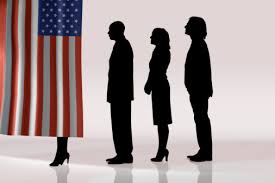
A couple of questions that have been occurring to me the last few weeks:
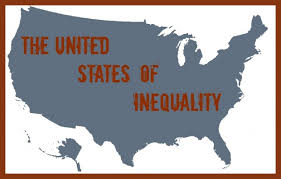
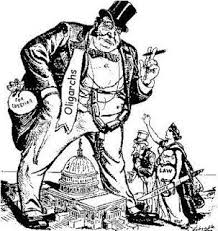
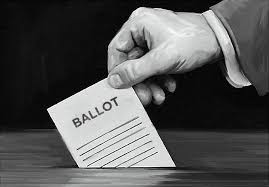
Why do so many people who complain about what they call unfair income inequality and the vast political power of the rich fail to vote? "The 99%'' could, one would think, vote in large enough numbers to easily offset the efforts of "the 1%'' to protect their power and their bank accounts in Panama or wherever.
The answer is that most Americans are civic slobs who don't bother to take 15 minutes to vote. They get the country they deserve.
The other question is why someone who opposes a "civil-rights'' law to mandate that anyone can "self-identify'' in either gender at any time and barge into a public bathroom formerly assigned to one (biologically provable) sex is "bigoted''. We've gone way off the rails.
--- Robert Whitcomb

Don Pesci: Confused public in Conn. and across America prey for political Babbitry

VERNON, Conn.
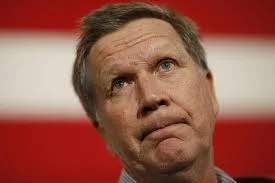
Connecticut’s presidential primary is coming up April 26, and the jockeying has begun. Governor of Ohio John Kasich, who has managed to corral a slender 145 delegates in a primary that a little over a year ago boasted 17 Republican presidential candidates, recently made his appearance in Connecticut and was warmly received by some legislators and editorial writers.
Mr. Kasich seems to be, at least here in the Northeast, the preferred candidate of what Trumpeters disdainfully call “the establishment,” meaning safe Republican politicians and, one supposes, Connecticut’s left-of-center media. In preparation for the arrival of Donald Trump, the Nutmeg Media – which has never understood or approved of the conservative movement – pulled out its critical party hats.
There may not be many surprises in the Connecticut primary mash-up. The delegate vote in Connecticut likely will be split between the three Republican contenders. As of April 10, the national breakdown is as follows: Cruz 545, Kasich 145 and Trump 742. Possibly Mr. Trump will leave Connecticut with a majority of delegates in his pocket.
The Boston Globe recently printed a “satirical” front page containing pre-fab stories covering a future Trump presidency. Screaming headlines on the mock front page included: “Deportations to Begin: President Trump Calls for Tripling of ICE forces, Riots Continue” – “Markets Sink as Trade War Looms” – “US Soldiers Refuse Orders to Kill ISIS Families” – “New Libel Laws Target ‘Absolute Scum’ in Press” – and so on. You get the idea.
Americans, Mr. Trump may hope, view satire as satire, and The Globe -- which, along with other left-of-center papers, has presided approvingly over the Democratic hegemon in the Northeast -- is The Globe.
The matchless scorn of the Trumpeters is directed at thoughtless professional dunderheads, the left-of-center media, moderate Republicans who twiddled their thumbs as the prosperous Hartford of Mark Twain became the murder capital of New England, and other impedimenta to the coming Age of Trump. Their scorn is well deserved. Barry Goldwater said during his own presidential campaign “If you lop off New England and California, you’ve got a pretty good country.” For the past half century, New England and California have been proving him right. All this and more has come to a boil under Mr. Trump’s flag.
Criticism of Mr. Trump in Connecticut will ramp-up as the state primary approaches. Conservatives view Mr. Trump as a flawed leader of a continuing conservative revolution because a) he’s not a conservative, and b) he’s not a Republican, both attributes that have satisfied the political predilections of people who think parties are dispensable. Mr. Trump has big mouth, a thin skin, a glass jaw, and he’s far too big for his political britches.
One of his most ardent followers here in Connecticut has said in so many words: “Screw the Republican Party. We don’t need it. We have Trump,” which is on a par with saying “We don’t need water taps; we have water” or “We should go to war with the army we’ve got, minus weapons.”
There are only two ways to build a party: You can form it around a set of ideas or you can personalize it, build it around a magnetic personality. After one of the bloodiest centuries in the modern period, one would think the world would have grown weary of strongman government. Who needs a strongman president? We already have one in the current Napoleon. Our constitutional and formative ideas have already been set by all the non-loudmouth intellectual giants who have preceded Mr. Trump.
We need a restoration, not a revolution. And if that restoration must be brought about by fierce rebel patriots, we want to be sure they are on the side of the angels. Mr. Trump, many believe, does not and will not pass this test.
Following the Democratic national convention, Hillary Clinton almost certainly will emerge as the designated Party driver. Republicans will choose between Cruz and Mr. Trump at their national convention. One of them will prevail. In the northeast, Mr. Kasich will receive a sufficient number of delegates to keep his pretensions alive until the convention, at which point he will become a power broker of sorts.
Neither this writer nor anyone else knows who the Republican Convention nominee will be.
Republicans have two relatively seasoned candidates, Cruz and Kasich, and a greenhorn in Mr. Trump. Most polls show Mr. Trump losing to Hillary Clinton. Mr. Trump hasn’t any political experience, and he has successfully, so far, been beating experienced Republicans with their experience. Facing Mrs. Clinton, a formidable candidate with several Damoclean swords dangling over her head, Mr. Trump may regret his lack of experience. It does, on occasion, come in handy.
On the whole, this has been the queerest election in a lifetime of queer elections. Republicans seem to be on the point of nominating a man, Mr. Trump, who is neither a reliable conservative nor a reliable Republican. On the Democratic side, an aging socialist, Bernie Sanders, is racking up more votes than Mrs. Clinton among young people who have not yet been pushed out of the socialist college cocoon into the wicked world.
Moderates everywhere have disappeared. The general populace is confused and, as such, has become prey to dangerous political Babbitry. The Supreme Court has been revaluating the values of the U.S. Constitution for several decades. The Congress has been ceding its constitutional power to a run-away subversive president. The Middle East lies prostrate under the drawn sword of Islam. Newspapers have been replaced by twittering banshees. And – worst of all – God, who once showered blessing upon America from sea to shining sea, appears to be hibernating, not that anyone can blame Him.
Not good.
Don Pesci is a political writer.

Power shirts

A little thing I've been noticing for more than 20 years:
When men in Washington want to tell the world that they're now big shots, they stop wearing button-down shirts, replacing them with starchy-looking and usually blindingly white ones with cufflinks. For some reason, they think that this sartorial shift makes them more powerful, or at least makes them look more important.
The upwardly mobile Washington media talking heads move to mimic this politician-and-K-Street-lobbyist dress code, with the idea that we'll then take them and their usually erroneous predictions more seriously. Take a look at the news and "public-affairs'' shows on The Tube.
-- Robert Whitcomb
Richard Freeland: Integrating the liberals arts and professional/vocational education
Via The New England Journal of Higher Education (see nebhe.org)
My talk is about experiential education and liberal learning. This topic has been on my mind ever since I graduated from a liberal arts college many years ago and began my first real job, whereupon I discovered—to my surprise and at some cost to my ego—how much I did not know about putting my ideas to effective use in the world beyond academia. But in addition to my personal interests, the relationship between liberal learning and effective action has become increasingly important for educators in the U.S. over the past several decades, although we are far from anything like consensus on this matter among liberal arts educators. I have chosen this topic for this conference for chief academic officers, because I believe the academic leaders of our colleges and universities have a critically important role to play in what I call the “necessary revolution in liberal education.”
Experiential education, of course, has its roots in occupational and professional education, which in turn, grew from the tradition of apprenticeships. Within the professional context, experiential education has taken many forms, from clinical work in health and medical education, to practice teaching for future educators, to cooperative education in engineering and business. In all these fields, the value of experiential education is obvious: The purpose of occupational and professional studies is to prepare students to work in non-academic settings. Common sense tells us that classroom study can take students only so far in equipping them to perform surgery or build a bridge or manage a sixth-grade classroom.
Employers confirm this obvious point. College graduates whose programs include some form of experiential education are far readier for the workplace than those whose preparation is limited to classroom study.
Liberal education, in contrast to professional studies, has its roots in the education of gentlemen and historically had almost nothing to do with preparing students for useful activity of any sort. Indeed, one of the foundational texts of liberal learning, Cardinal Newman’s famous essay on “the idea of a university,” is in some respects an attack on practical education, arguing at eloquent length that “knowledge is its own reward” and that the goal of a university education is to “raise the intellectual tone of society … and refine the intercourse of private life.”
As liberal education developed in the U.S., however, it did come to be seen as foundational for advanced professional studies in a wide variety of fields, but champions of the liberal arts continued to draw a bright line between liberal learning and preparation for the workplace. I remember the contempt that faculty at my undergraduate college conveyed toward any suggestion that our education had anything to do with preparing for an actual job. This attitude is still, I think, quite common among faculty in the liberal arts and sciences.
Intellectual qualities outside academy
There is, however, a problem with the way we've been characterizing liberal education, a problem that becomes evident the moment you read the mission statement of virtually any liberal arts college. Such statements almost never stress purely intellectual qualities in the manner of Cardinal Newman. Such statements almost always insist that the college is focused on developing the capacity to act effectively in the world after college, both in the workplace and in civic life. The proposition offered by champions of traditional liberal education, therefore, is that a curriculum focused entirely on nurturing intellectual qualities in classroom settings is also the best possible preparation for effective action outside the walls of the academy.
I will be the first to acknowledge the truth in this proposition. It is surely the case that intellectual skills associated with the liberal arts and sciences—critical thinking, quantitative reasoning, effective communications, a generalized adaptability—are vitally important for effective practice, especially in a world where the demands of the workplace are constantly changing. I would also argue that the intellectual context provided by liberal education—an understanding of different perspectives, an appreciation of history, a grasp of psychology and social structure, an awareness of ethical traditions—is also tremendously helpful in informing wise decisions in the nonacademic world.
Granting all of that, I would still argue that the argument that liberal learning in the traditional form that I experienced it in the 1960s is the best possible preparation for action in the nonacademic world is deeply flawed and, to the best of my knowledge, unsupported by empirical research. This is a topic to which I will return more explicitly in a few moments.
It is important to note at this point, however, that, despite the history of distance, and even some antagonism, between the traditions of liberal and professional learning, the boundaries between these two halves of the academic walnut have become blurrier in recent years. On the professional side, most accrediting agencies now insist that the programs they certify include a substantial component of liberal education. On the liberal side, most colleges of arts and sciences have adopted programmatic practices that have roots in professional education. Indeed, most now offer some professional majors, or at least courses in applied fields.
Some are using pedagogical practices first developed in professional fields—things like simulations, case studies and group projects focused on problem-solving. In addition, most liberal arts colleges now offer some form of experiential education, typically in the form of internships, or civic engagement opportunities, or service-learning courses—although these experiences often do not carry academic credit and are mostly on the margins of the basic curriculum.
Convergence of liberal and professional education
Why is this convergence of liberal and professional education occurring? I believe the reason is that, in one way or another, students are demanding it. The unchanging reality is that a large percentage of young people in the U.S., including those attending liberal arts colleges or majoring in a liberal arts fields, seek to improve their qualifications for employment and, more broadly, to prepare themselves to act effectively in the world after graduation. Most will not go to graduate school. Most wisely want their undergraduate years to include some attention to practical skills and some experience in the nonacademic world. Colleges—needing to maintain their enrollments—have come to understand this reality.
This coming together of liberal and professional education has brought us to a fascinating moment in the history of undergraduate studies. Historically, we have had two just two main categories: liberal education and professional education, each with distinct goals and traditions. But now a third category seems to be emerging based upon an integration of the two, with experiential education playing an important role. This movement remains fragmented, even inchoate. It does not yet have a name. I once tried to label it “practice oriented education” but that title did not stick. Still the movement is evident in undergraduate institutions all across the country.
The most impressive example of the trend toward combining the strengths of liberal learning and practical studies is the LEAP project of the Association of American Colleges and Universities. The acronym L-E-A-P stands for Liberal Education and America’s Promise. It represents a massive effort by the AAC&U to build a new model of liberal learning that makes sense for our country’s highly democratized system of higher education in the 21st century. The centerpiece of the LEAP initiative is a statement of the goals of liberal education in the form of 15 specific outcomes developed through wide-ranging consultation with faculty and employers. Amazingly, the AAC&U achieved a remarkable degree of agreement in support of the LEAP framework. Colleges and universities all over the country are using it as the basis for their own undergraduate programs of liberal studies.
There are many interesting things about the LEAP construct. I want to focus on its insistence that liberal education include an emphasis on practice. One category of LEAP outcomes, for example is “intellectual and practical skills” and one of the outcomes listed in this category is “teamwork and problem solving.” Another category is “personal and social responsibility” and two of the outcomes listed under this category are “civic engagement” and “ethical reasoning and action.” In addition, an overarching principle of LEAP is an insistence that the knowledge and skills and responsibilities it seeks to nurture must be demonstrated through “application … in new settings and complex problems.”
This emphasis on action, on teamwork, on problem-solving in new settings seems to me to represent a fundamentally different notion of liberal education than the one to which I was treated so many years ago. Nothing in my undergraduate education was about application except insofar as application meant producing a paper. There were exceptions around the edges, like lab work in the sciences or studios in the arts, but at its heart, this education was about the intellect, about cognition, about thinking and analysis and the mastery of challenging material—all hugely important and all essential to effective action in the world, but all one very large step short of actually applying these intellectual qualities and skills to real problems in authentic settings.
The LEAP framework does not make explicit reference to experiential learning. but it doesn't take much imagination to see how the two are linked. Indeed, some years ago I organized a conference at Clark University in Worcester, on the connection between liberal education and effective practice. The conference included educators from liberal arts backgrounds as well as professionals—business executives, lawyers, government officials—who had attended liberal arts colleges. A central focus of the event was the role of experiential education in promoting the capacity to act effectively in the world. Conference attendees—both educators and practitioners—were unanimous in the conclusion that experiential education should play a central role. As the president of Wellesley College put it, noting overwhelming evidence of the benefits of experiential education, “one wonders why everyone doesn’t just do it.”
Making liberal arts experiential
Having agreed without difficulty on the value of experiential education, the Clark conferees quickly turned to the political challenge of getting this kind of experience included in the undergraduate curriculum of a liberal arts college. At this point the Wellesley president acknowledged that she and her dean had spent three years conducting a carefully managed and richly resourced process to persuade her faculty to make experiential education an integral component of the Wellesley curriculum and had failed.
The resistance was too deep, the commitment to established disciplinary norms too powerful, the aversion to learning a whole new pedagogical approach too daunting. After three years of discussion and experimentation, experiential education at Wellesley remained what it had been at the beginning: available in a few courses because of the interest of individual faculty and widely available in the form of non-credit experiences, but mostly disconnected from the curriculum.
This is, in my view, a sad story, amusing perhaps in the predictability of its outcome, but deeply sad in terms of what it says about liberal education today, at least at one of the country’s elite liberal arts institutions. As the Clark conference confirmed, and as the AAC&U LEAP initiative demonstrates, we are at a moment when there is wide agreement that linking undergraduate studies in the liberal arts and sciences with the capacities of effective practice is an important goal. We are also at a moment when there is wide agreement that the capacities of effective practice involve more than the intellectual qualities traditionally associated with the liberal arts and sciences, qualities like self-direction, discipline, perseverance, imagination and the ability to work in groups and across boundaries of difference.
Many institutions are wrestling with the question of how to turn these general ideas into programmatic reality. At Clark, a particularly ambitious and interesting effort along these lines has developed (with strong faculty involvement) a category of goals within its liberal arts curriculum labeled “capacities of effective practice,” which include exactly the kind of non-intellectual qualities I have just mentioned. The evidence that experiential education can play a critical role in developing these qualities in students is, as the Wellesley president noted, overwhelming. It is without question the single most powerful pedagogical device I have encountered not only to nurture essential non-intellectual capacities but also to deepen a student’s intellectual grasp of the ideas they are studying in the classroom.
But, as the Wellesley experience makes clear, it is a hard sell with a liberal arts faculty whose members tend to believe that undergraduate education comes in only two flavors, with liberal education on one side and practical studies on the other. The third category that draws on the strengths of both may exist in fact but not yet in theory. This is what I meant a few moments ago when I spoke of the “necessary revolution in liberal education.” We are an industry that advances by fostering broad agreement, not by executive action. We need to help our faculty colleagues get beyond an instinctive aversion to explicitly practice-oriented components within their overall curricular structures. Chief academic officers, the people gathered in this room, are ideally positioned to lead in this effort.
Push for more
I end this morning with a plea that you take this challenge on in whatever form makes sense when the opportunity arises in your individual institutional settings. Your presence at this conference suggests an openness to the ideas I have been discussing. Engaging this challenge with the faculties you lead, however, will be difficult and risky. The temptation will be to pull back, admit that the resistance is too strong, and settle for marginal gains. We need to push for more. Our students deserve more. I urge you to play a leadership role in what I believe is truly a national movement with historic significance.
I wish I had some formula for advancing this cause that can ensure success, but I do not. The best I can do is summarize a long discussion about this matter at the Clark conference. The academic administrators among the conferees agreed that efforts to directly confront the biases of liberal arts faculty against adding practical experiences to the curriculum were not likely to be effective. The most hopeful approach seemed to have three essential components.
First, we need to engage the faculty in a discussion of goals and outcomes—get them talking not about their disciplines but about how they want the curriculum to empower their students. Such a discussion, just like the typical college catalog, will quickly range beyond purely intellectual outcomes to a discussion of equipping young people to act effectively in the world beyond college.
The second component involves promoting a culture of assessment—fostering an atmosphere of openness to looking at evidence, at research on pedagogical outcomes in relationship to goals. Such an exploration comes naturally to academics and will, I am confident, point toward the power of experiential education as a powerful means to accomplish the goals being sought.
The third component of the process is to provide faculty leaders and volunteers with the space and support to experiment with new pedagogical approaches. That will take time and money but the investment of both is more than worth it.
John Dewey taught us over a century ago that it is impossible to separate deep learning form experience. Liberal education has spent the intervening hundred years ignoring that fundamentally obvious insight. We are now at a moment when we can recover that truth to the great benefit of the next generation as well as the country. I urge you to be part of that effort.
Richard Freeland is a distinguished professor at Northeastern University, where he was president of from 1996 to 2006, He was Massachusetts commissioner of higher education from 2009 until 2015. This piece is drawn from Mr. Freeland's April talk to the WACE Chief Academic Officer Colloquium.

An organic orgy
"It was that period in the vernal quarter when we may suppose the Dryads to be waking for the season. The vegetable world begins to move and swell and the saps to rise, till in the completest silence of lone gardens and trackless plantations, where everything seems helpless and still after the bond and slavery of frost, there are bustlings, strainings, united thrusts, and pulls-all-together, in comparison with which the powerful tugs of cranes and pulleys in a noisy city are but pigmy efforts."
-- Thomas Hardy
'Defintion of space'

"Bellagio-Promise Kept'' (acrylic, charcoal and crayon on canvas), by Jo-Ann Boback, in her show "Marking My Territory,'' at Galatea Fine Art, Boston, May 4-29.
She says that "this work is about definition of space. I don't worry about what is being expressed -- i.e., landscape, emotional memory, etc. Instead my goal is to be sure it is worth experiencing.''
Online dialogue with chief Japanese spokesman postponed to April 18
The event below has been postponed to April 18, at an hour to be announced, from April 14 because of an urgent meeting with Russian diplomatic officials visiting Japan.
Yasuhisa Kawamura, Director-General for Press and Public Diplomacy of the Japanese government, a job that includes being chief spokesman for Japanese Prime Minister Shinzo Abe, will be the featured speaker in a Boston Global Forum(BGF) live online dialogue titled “The Role of Japan in Peace, Security and Development in the World Today.’’ Such a dialogue takes on particular importance now because Japan will host this year’s G7 Summit, to be held on May 26-27.
The event can be seen live at bostonglobalforum.org.
Joining Mr. Kawamura in the discussion will be Michael Dukakis, Chairman of the Boston Global Forum’s Board of Directors and Board ofThinkers, and Prof. Thomas Patterson, a member of the BGF Board of Directors and Board of Thinkers; Bradlee Professor of Government and the Press at Harvard’s Kennedy School of Government, and Acting Director of the Kennedy School’s Shorenstein Center on Media, Politics and Public Policy.
The session is one in the series of online dialogues in the Boston Global Forum’s BGF-G7 Summit Initiative, in which BGF experts have been working with Japanese officials to craft proposals to be considered by the national leaders at the summit.
The Boston Global Forum encourages its members and friends to send questions for the discussants to office@bostonglobalforum.org. Members of the Boston Global Forum’s Special Editorial Board will gather your questions and insights and send them to the speakers.
The talk and listeners’ responses to it will be live-streamed at www.bostonglobalforum.org