
Vox clamantis in deserto




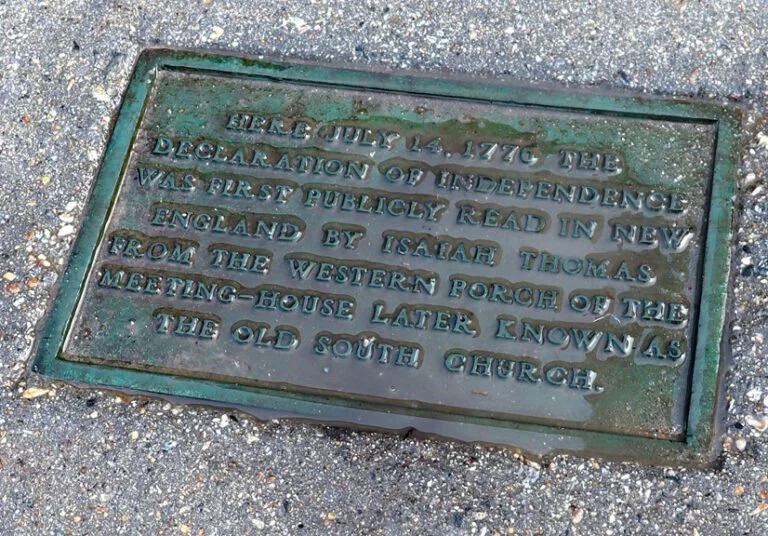



Love 'em all
"To be interested in the changing seasons is a happier state of mind than to be hopelessly in love with spring."
-- George Santayana
When it 'easters out of the dimness'
“There is a fragrance in the air, a certain passage of a song, an old photograph falling out from the pages of a book, the sound of somebody’s voice in the hall that makes your heart leap and fills your eyes with tears. Who can say when or how it will be that something easters up out of the dimness to remind us of a time before we were born and after we will die?”
-- Frederick Buechner
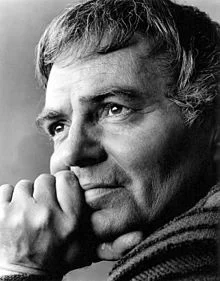
Robert Whitcomb: 'Not a problem to be solved'
Here’s an edited version of the preface I wrote a few weeks ago for the 50th reunion book for my boarding-school class.
To the Class of 1966
‘’And they shall seem to us in that far day
Like unforeseen, fond meetings with old friends’’
-- From the school song (actually more like a hymn)
Now we are well into that ‘’far day’’. It seems paradoxically predictable and startling.
As I sit here, occasionally looking out the window at the trees after a very pretty but inconvenient snow and ice storm, I’m struck again at how much time speeds up even as we wish to slow it for reflection in the autumn of our years. “Where are the snows of yesteryear?’’ and all that.
While the weeks often dragged on when we were at school and February and March particularly seemed to stretch to afar gray horizon, now we know that the lushness of Connecticut in May, and our reunion, will be here in a flash.
Between now and then seems a good space to consider where we’ve been, if not where we’re going. As Orwell wrote: “{I}t can also happen that one’s memories grow sharper after a long lapse of time, because one is looking at the past with fresh eyes and can isolate and, as it were, notice facts which previously existed undifferentiated among a mass of others.’’
We have been privileged to have had a fine education and to have lived in a very dynamic period in modern history, as social change (some good, some not), technology and globalization have brought us daily lives quite different from ours in a school in the early and mid ‘60s.
When we were there, daily school life there, I suspect, wasn’t all that different from what it had been in the ‘30s and ’40s. Yes, television had become pervasive in American life, but with few exceptions, we weren’t allowed to watch it. A memorable and moving exception were the hours after the John F. Kennedy assassination. I can still hear the Navy Hymn on the TV in the common room. And the Sexual Revolution had begun, but we isolated boys weren’t yet in it.
We had the daily rhythms of classes, sports and vespers (with those stirring old Protestant hymns), we wore coats and ties and were at least in public very respectful of the teachers. Little emphasis was placed on food, and “mystery meat,’’ with its greenish tint, was frequent fare. Now there’s fine dining (explaining some of the astronomical tuition?), no vespers and, to say the least, informal clothing rules among the boys and girls in our Gothic revival school. But no smoking for seniors. \
Those of us there for the full four years were ruled in our first year by a kindly but firm, dignified and gray-suited headmaster who had run the show since 1936! That style would soon change with his immediate successor, who felt that he had to get the school more in tempo with the (sometimes chaotic) times.
Of course, we weren’t all friends. And most of us wore a protective adolescent carapace of superficial cynicism. Open displays of sensitivity weren’t encouraged, and weakness was to be hidden. Still, some of us became lifelong friends, with, in some cases the real friendships starting years after we graduated. And certainly the Internet has made reconnecting and maintaining old relationships easier.
Soon, pushed by intensifying awareness of our mortality, many of us will meet again at the school and celebrate both our differences and what we have had in common in the stretch of history we have shared. For many, perhaps most of us, it will be our last meeting.
I suspect that we’ll be surprised again by the solidity of our core personalities. I still remember what my father told me when I asked him after he got back from his 25th college reunion if his classmates had changed. He said: “I was surprised at how much they hadn’t, except for a guy who had been in a Japanese prison camp during the war {World War II}. Before the war he was jokey and relaxed. Now{1964} he is quiet and twitchy.’’
At the reunion, we’ll get more lessons in how our ratio of nature – our fundamental personalities and hard wiring – and nurture/experience has played out over the half century since we left our school.
Thanks to all who have sent biographical sketches. In them, classmates show an impressive range of skills, achievements, successes, failures, triumphs and tragedies in their public and private lives. In other words, we’re roughly like our age cohort in general but I think (as an elderly journalist) with more variety and color than most elderly Baby Boomers.
That’s admittedly in part because the majority of us came from more privileged socio-economic backgrounds than most Americans: Most of us have had more options than most men of our era. As these bios suggest, most in the Class of ’66 didn’t waste those options, and those who did generally had good medical, psychological and/or social reasons. We see a panorama in this book of vastly different jobs, places lived and passions pursued.
Of course, classmates who are either deceased or declined to send in sketches also had engaging stories. We hope to hear about some of them at the reunion and after. Who knows? Perhaps some of them can be put into a book, too.
Kierkegaard famously wrote: “Life can only be understood backwards; but it must be lived forwards.’’ Well, “understanding’’ the past may be as beyond us as is answering such questions as “why is there something instead of nothing?’’
But one thing is clear: Long friendships are central to emotionally and mentally rich lives. We’ll celebrate those friendships at the reunion and some of us may even make some new ones before it’s too late. And for those who can’t make it, please get in touch.
Kierkegaard also said: “Life is not a problem to be solved, but a reality to be
experienced.’’
Robert Whitcomb is overseer of New England Diary.

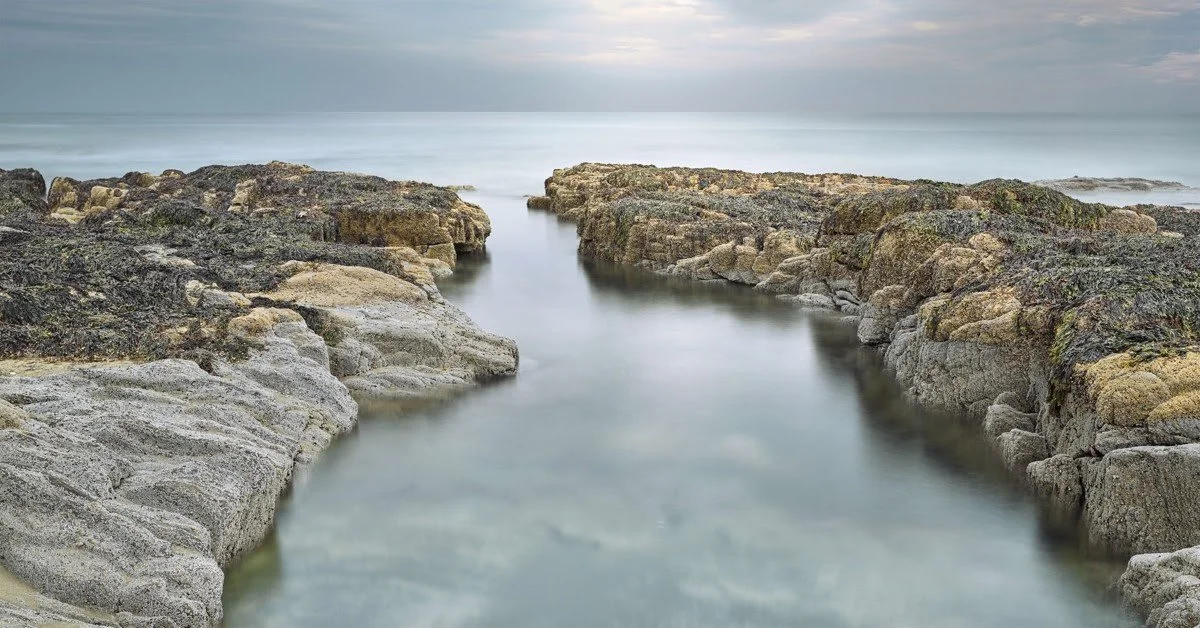
Early spring on the New England coast
"It was cold and windy, scarcely the day
to take a walk on that long beach
Everything was withdrawn as far as possible,
indrawn: the tide far out, the ocean shrunken,
seabirds in ones or twos.
The rackety, icy, offshore wind
numbed our faces on one side;
disrupted the formation
of a lone flight of Canada geese;
and blew back the low, inaudible rollers
in upright, steely mist."
-- Elizabeth Bishop, "The End of March''
Ignorance is bliss
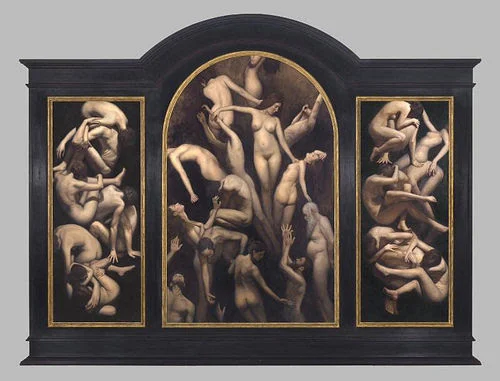
"Know Not Thy Pending Fate,'' by Christina Mastrangelo, at the "New Members' Exhibition'' at the Guild of Boston Artists.
Giles Knight: Wacht auf, America
The race of the Republican Party as we have known it toward oblivion has been orchestrated by a new social order called “Trumpism,” which in spite of the name is not really new but rather consists of old-fashioned nationalism and authoritarianism with a fascist streak.
Donald Trump has become the messiah for many people who feel left out economically and socially by those in power or “the system.” The complain angrily about foreign economic competition, the media, immigration and, of course, the current government in Washington, D.C.
Trump’s bombastic, hate-filled speeches seem to be just the right ticket to usher in a “new America.” Whether the “new America” is the same as “make America great again” we do not know yet, but his actions during this campaign bear a passing resemblance to other fire-breathing demagogues, such as Joe McCarthy, George Wallace, Mussolini and one of the most famous of all, Adolf Hitler, to name a few.
Go back to the 1920’s in a war-shattered Germany when a fellow named Hitler attracted a fanatical following with rousing speeches and programs for making Germany “great’’ again. Nationalism, bigotry and militarism were his main messages.
How did he win over one of the most civilized countries in Europe? Remember that at that time Germany was in bad shape economically. People wanted to believe his oratory and what better way to make them believe than to find scapegoats to blame for their troubles. Taking top ranking on his list were theWestern Allies (the U.S, Britain, France and a few others), a relative lack of living space in the densely populated country, and least understandable, Jews and other people not of “pure Aryan origin.’’
The SA (Stormabteilung or Assault Division) was founded by Hitler in 1921 and was made up of angry, unemployed people, thugs really, who abused and even murdered those speaking out against The Leader.
After Hitler’s arrest by the Weimar government, in 1924, he wrote a book in prison called Mein Kampf (My Struggle), which outlined in detail his idea of a new Germany. He followed the script exactly until his suicide, in 1945. His career resulted in the deaths of tens of millions of people.
By 1925, he also began to be concerned about his ability to control the SA, which had grown large. And so he established the SS (Schutzstaffel or “Protective Echelon’’) as his personal bodyguards.
The SS made the SA look like choirboys in putting down opposition. He appointed his close associate Heinrich Himmler as SS leader in 1929, thereby resulting in a more loyal, tightly organized group reporting directly to him.
Things did not go well for the SA when on June 30, 1934, some of its leaders were killed by Hitler’s people --- “the night of the long knives.”
Then, on Nov. 9-11, 1938 hundreds of communities in Germany experienced wholesale destruction and looting of Jewish stores and businesses -- “Crystal Night” or “Night of the Broken Glass.” By this time most of the newspapers and radio stations were effectively closed down, or taken over by the Nazi regime, ensuring that everyone followed the party line, and the SS, along with the Gestapo, became the chief unit of surveillance and terror in Germany.
The SA was eventually combined with the SS, which, in turn, was incorporated into the German army as the Waffen SS. It grew into a huge force of hundreds of thousands, including such notable units as the Death Head Division, which oversaw concentration camps. All military people and many civilians were forced to sign a loyalty oath to Hitler.
The most fanatical and elite SS Division was the Adolf Hitler Division, which caused havoc in numerous battles against the Allies. Many of these fellows met a timely end during “the Battle of the Bulge,” in December 1944, preferring to die rather than surrender as Allied air power obliterated their armored vehicles.
Hitler’s policy of intimidation illustrates how quickly democracy can be destroyed by someone who controls the masses.
This brings us to “Trumpism” in America. Mr. Trump is not a replica of Adolf Hitler, but he exhibits some disturbingly similar characteristics. The most obvious is his ability to sway masses of people by appealing to their grievances. His animated, dramatic power of delivery puts his followers into almost a fanatic frenzy.
This tactic is typical of most demagogues, and was a major reason for Adolf Hitler’s unexpected success. Recent horrifying video clips of a Trump rally show American college students raising their right hand arms in a Nazi salute in answer to Mr. Trump’s request for a loyalty pledge.
Other characteristics of Mr. Trump are worth noting, including a policy of one man, one rule, a vindictive and hair-trigger personality and a belittling attitude in general, but especially against those who disagree with him. And his many business dealings show enough lawsuits and other disagreements to raise serious questions about his honesty. His vicious rhetoric ensures that he will meet with antagonism globally.
The good thing is that presidents do not run the federal government alone. There are also Congress and the federal courts. However, the president can have great deal of influence on the other two branches of government. Trump’s extraordinary ability to mesmerize parts of the American public could easily be used to bring Congress and the Supreme Court under his brand of rule. True, his views deserve to be heard in a democracy. But does his brand of democracy fall under the letter and spirit of the Constitution in all respects?
When groups follow the siren song of a messiah, social unrest follows, and while history does not repeat itself exactly, it can, as Mark Twain said, rhyme.
Fiery speeches filled with hatred, intolerance and authoritarianism can not help but lead to domestic and global unrest. America is the strongest country. The real danger we face lies within, not outside. We know what happened to Nazi Germany. A fanatical leader persuaded the country to follow him, assisted by intimidation by such groups as the SA and SS.
“Wacht auf” in German means “wake up’’. We should look very closely at “Trumpism” as our election process continues. Every American must ask him or herself: “Do we really want this type of person representing our country, the Constitution and the world’s pillar of democracy?
Giles Knight is a retired international equity mutual fund manager.
Llewellyn King: Muslim immigrants demand that Western nations bow to them

In the aftermath of the Brussels attacks, critics are blaming Belgium for not assimilating immigrants from the Middle East and North Africa.
The fact is that Europe does not do assimilation. Europeans widely practice what might be called “anti-assimilation.” Instead of engagement with their immigrants, they practice a kind of look-the-other-way stance.
Muslim immigrants on the whole do not seek to integrate into European societies, but rather to demand that European societies adopt their ways. In Belgium, which has three official languages, Dutch, French and German, there are constant demands that Arabic become a fourth. Muslims in Britain, and throughout Europe, demand shari'a, or Islamic law, for their communities. Muslims in Europe, and the United States, demand that Eid al-Adha (Feast of the Sacrifice) be accorded the same recognition as a public holiday as Christmas.
Muslim defenders, after the bombings in Brussels, insist that Western countries with large Muslim minorities should do more to integrate them into national life. But this integration mostly means that the host culture should bow to the insurgent one.
In ancient lands, like Britain and France, this is an affront; as though the extraordinary traditions of those countries should be shoved aside to accommodate the cultural demands of an a very antagonistic minority. That is asking too much.
Europe has mostly dealt with the challenge by hoping that new generations born in Europe and subjected to the influence of European education, the arts and media will become little Europeans: little Frenchmen, little Belgians, little Englishmen, versed in European history and imbued with European values. There are such people throughout Europe, from those of Turkish descent in Germany to those of Indian descent in Britain and North African descent in France.
But by and large the Muslim minorities remain separate, unequal and belligerently hostile to the countries that have given them shelter and opportunity. Rather than the generations born in Europe adopting European norms, they have ended in an unfortunate place where they are outcasts by their own inclinations and by the difficulties posed by European societies, which are quietly nationalistic, closed, eyes-averted.
If anything, the separation has grown worse for generations that know no life other than the one they lead in Europe. This is often marginal, lived in ghettos like the banlieues, the suburbs to the north of Paris, the troubled Brussels neighborhood of Molenbeek, or Bradford in the north of England.
The original immigrants could look back to what they had escaped, whether it was war and persecution in Algeria, in the case of those who migrated to France, or the grinding poverty that prevailed in Pakistan, in the British case. People move for safety or for a better life. They do not move because they want a new food or a new religion: They want the old food and the old religion in a better place.
Trouble is that three or four generations on, the immigrant descendants may not feel they are in a better place. They are isolated, largely unemployed and subjected to the preaching of murderous extremists.
Once in Brussels, my wife and I were walking down a side street not far from the Grand Place. My wife, who lived in the Middle East and speaks Arabic, remarked that we had left Europe within a few streets and entered North Africa.
As we passed some young men standing outside a cafe, she heard one say to another in Arabic, “What are they doing here? They don’t belong here.”
When the London suburb of Brixton was becoming a black enclave, favored by West Indian immigrants, I lived nearby. “Don’t go there. Maybe they will leave one day,” my neighbors said when I wanted to go there.
No-go areas are not always that: they also are not-want-to-go areas. Someone has to want assimilation, if that is the answer.
Llewellyn King, host and executive producer of White House Chronicle on PBS, is a iong-time publisher, editor, columnist and international business consultant. This piece originated on InsideSources.
Charles Chieppo: Ex-Bridgewater State University president gave a course in cheating the taxpayers
BOSTON
As we watch a presidential campaign that serves as a cautionary tale for what can happen when people grow sufficiently disillusioned with government, a story out of Massachusetts provides a reminder of why so many voters feel that way.
When Bridgewater State University President Dana Mohler-Faria retired last year after 39 years in state service, he did so with a $183,421 annual pension. But that wasn't what really caught people's attention. It turns out he also received a cash payout of $269,824 for unused sick and vacation time.
When most Massachusetts state employees retire, they can receive payment for up to twice their annual allotment of vacation days and for 20 percent of their accrued sick days. But those rules -- generous as they might seem to private-sector workers, few of whom can cash out unused sick and vacation time -- don't apply to state public higher education officials who aren't covered under a collective-bargaining agreement. They are entitled to the full value of up to 64 days of unused vacation time, about twice what most state employees get. And unlike other state workers, they can roll any additional unused vacation time into the sick-leave bank, 20 percent of which they can collect in a lump sum.
Mohler-Faria, who earned $285,600 in his final year at Bridgewater State and is now paid $100,000 annually as a senior adviser to the university, was eligible to take a total of 61 paid days off in each of the last 15 years. In addition to holidays, they included 15 annual sick days and 30 vacation days. If he took all the time available to him, his schedule would have worked out to an average work week of 3.8 days. As president, Mohler-Faria signed off on his own sick time and vacation schedule.
During his first 10 years at Bridgewater State, Mohler-Faria did use an annual average of 21 sick and vacation days. But over his final six years, he didn't take a single sick day. And although he used just nine vacation days during that period, from 2012 to 2015 alone he took 29 foreign and domestic trips on Bridgewater State's dime, including at least four to his ancestral home of Cape Verde and two to Belize.
While Mohler-Faria's was the biggest payout, during the last five years three other state higher-education officials received cash-outs of more than $200,000 upon retirement. In the wake of the news about Mohler-Faria's payout, Gov. Charlie Baker is reviewing public higher education pay policies.
Let's hope that sunlight proves to be the best disinfectant in this case. Many state governments have moved to curb perks like the ones Mohler-Faria received for most of their retirees.
But whether its higher education or certain quasi-public authorities, there are still too many corners of the public sector that play by different rules. Until the practice of maintaining places where the well-connected can go to reap a windfall is ended, look for the voter revolt to continue.
Charles Chieppo (Charlie_Chieppo@hks.harvard.edu) is a research fellow at the Ash Center at Harvard's Kennedy School. This piece first ran on governing.com.
A sense of place

One of the mixed-media pictures by Stacey Durand at the Museum of Art at the University of New Hampshire.
Much of her work involves exploring the visual environments of New Hampshire towns and cities.
The map in this picture makes us wonder how much of future mapmaking will be hurt by the use of GPS. Will many people in 20 years not know how to read a map? Of course maps can be beautiful -- indeed an art form. It would be very sad if the physical-mapmaking craft fades away.
Medicated America

"Assembly Line'' (oil on canvas), by Tess Barbato, in the show "NOW! New Work, New Artists,'' at ArtsWorcester, through April 16.
'Keep us here'
"Oh, give us pleasure in the flowers in the flowers today;
And give us not to think so far away
As the uncertain harvest; keep us here
All simply in the springing of the year.
Oh, give us pleasure in the orchard white,
Like nothing else by day, like ghosts by night;
And make us happy in the happy bees,
The swarm dilating round the perfect trees."
- Robert Frost, "A Prayer in Spring''
Crime scene?

"Border #15,'' by Elizabeth Ferrill, in the group show "Works on Paper,'' March 30-May 1, at Dedee Shattuck Gallery, Westport, Mass.
Brian J. Zink, M.D.: On those 'preventable' hospital emergency department visits
This previously ran in The Providence Journal and on cmg625.com
Consider this real-life situation: A 65-year-old Rhode Islander has high blood pressure and high cholesterol. Saturday evening after dinner, he develops crushing pain in his chest and nausea. His wife is alarmed and wants to call the rescue to take her husband to the local hospital emergency department (ED). (Note: The term “ER” is widely used, but antiquated given that many EDs now contain over 50 rooms.)
But, as he struggles with the pain, he remembers reading about a report from the Rhode Island Executive Office of Health and Human Services and HealthSource RI claiming that 60 percent of ED visits were preventable, and that for Medicare patients the leading “preventable” ED visit was for chest pain. So, he thinks, “I don’t need to go to the hospital, it’s probably just ingestion.”
Wrong. As the chest pain worsens, a good portion of this man’s heart muscle, deprived of blood and oxygen from a blocked coronary artery, is irreparably damaged. He is left with only half of his normal heart function. Over the next few weeks, his activity level and health declines. He develops heart failure, an irregular heartbeat, and requires frequent hospitalizations and stays in the ICU. He needs a pacemaker. His quality of life is poor and he dies prematurely from heart-related complications.
Let’s look at the health economics of this case. If this gentleman had been seen in the ED with his initial bout of chest pain, his heart attack would have been diagnosed within 10 minutes, and within 90 minutes a stent could have been placed by a cardiologist to open up his blocked artery. He would have near normal heart function and would have been discharged within 48 hours.
With good medical management by his primary-care doctor and cardiologist, he would live a long life, free of cardiac symptoms, and yet he would consume far fewer medical resources than in the above scenario. The total cost of not visiting the ED, in this case, is likely to be more than 10 times higher than an appropriate ED visit with expedient care and follow-up.
The data that HealthSource RI uses appears to assume that if a patient’s presenting complaint did not result in an admission to the hospital, then the visit was preventable. That “Monday-morning-quarterback” approach is fraught with risk. Policy makers should not interfere with or misinform patients’ decision-making about when to seek emergency care for serious symptoms. That approach is also frequently penny-wise and pound foolish. Symptoms that could be a heart attack, a stroke, or a ruptured aneurysm should be evaluated and treated as true emergencies. That is good medical practice, and also financially smart when downstream costs are considered.
The state also assumes that a primary-care physician or clinic is readily available as an alternative to the “unnecessary” ED visit. As many citizens of Rhode Island will attest, trying to get prompt access to primary care, especially after hours or on weekends, is very challenging. And with a serious symptom like chest pain in a 65-year-old, a call to the primary-care office will usually get this appropriate response: “Go to your nearest hospital ED."The cost of emergency care is estimated to represent about 6 percent to 8 percent of total health-care expenditures in the United States. Emergency care is not the place to get a real “bang for the buck” in reducing costs in healthcare. The effect on overall healthcare spending of eliminating every “inappropriate” ED visit would be minimal.
Certainly, some ED visits could be avoided with proper planning, communication and access to alternative care sites. Those of us who work in EDs are actively engaged in innovative approaches that will hopefully lead to more coordinated, efficient, and less expensive medical care.
Better communication with primary-care physicians and patient-centered medical homes, increased case management in the ED, and increased observation services to avoid admissions are all part of ongoing projects. These are more sensible ways to reduce costs than to encourage patients with serious symptoms to avoid emergency care.
Brian J. Zink, M.D., is president of University Emergency Medicine Foundation (UEMF), a Rhode Island group practice.
Next at PCFR: Hedrick Smith, cities, backstabbers and ports
March 23, 2016
To members and friends of the Providence Committee on Foreign Relations (thepcfr.org; pcfremail@gmail.com)
It was gratifying to see such a large crowd on Tuesday, March 22, when the very distinguished Andrew A. Michta, professor of National Security Affairs at the U.S. Naval War College and an adjunct fellow with the Center for Strategic and International Studies (Europe Program), talked to us about resurgent Russia and NATO/E.U. fecklessness.
Big stories internationally now include the bombings in Belgium, the Ziki virus and economy worsening in Brazil; the effects of Obama’s trip to Cuba; the North Korea regime threatening a “pre-exemptive’’ nuclear strike on South Korea; China continuing to militarize the South China Sea; the partial Russian military exit from Syria; the start of the British debate on leaving the European Union; gains by right-wing parties in Germany, and preparations for the G7 Summit in May, to be held in Japan.
Our next speaker comes on Tuesday, April 12, when celebrated author, TV documentary maker and former foreign correspondent Hedrick Smith will join us. He’s the author of The Russians and Who Stole the American Dream?
Thanks very much to those who have already let us know! The Hope Club needs good estimates no later than the day before a PCFR dinner.
Dues and dinner cost information may be found at: thepcfr.org. Other membership information may be found there, too. (A member asked if (the modest) duesand dinner fees for this nonprofit educational and civic membership organization aredeductible for business purposes. Ask your tax adviser.)
On Wednesday May 11, comes the internationally known expert on cities around the world, Greg Lindsay.
Look at:
http://www.amazon.com/Aerotropolis-Way-Well-Live-Next/dp/0374100195/ref=sr_1_1?ie=UTF8&s=books&qid=1279805811&sr=8-1
He is a contributing writer for Fast Company, author of the forthcoming book Engineering Serendipity, and co-author of Aerotropolis: The Way We’ll Live Next. He is also a senior fellow of the New Cities Foundation — where he leads the Connected Mobility Initiative — a non-resident senior fellow of The Atlantic Council’s Strategic Foresight Initiative, a visiting scholar at New York University’s Rudin Center for Transportation Policy & Management, and a senior fellow of the World Policy Institute.
On Tuesday, June 7, Michael Soussan, former UN whistleblower; acclaimed author; widely published journalist; NYU writing professor, and women's rights advocate, will speak. His satirical memoir about global corruption, Backstabbing for Beginners: My Crash Course In International Diplomacy (Nation Books / Perseus) is being adapted for a feature film, starring Ben Kingsley and Josh Hutcherson
He will speak about the subject of his next book TRUTH TO POWER: how great minds changed the world. A brief history of thought leadership.
Evan Matthews, a key thought leader at the North Atlantic Ports Association and director of the Port of Davisville, has very kindly offered to talk to us on Wednesday, June 22, on changes in world shipping, including the widening of the Panama Canal and other changes of huge interest to New England ports.
Suggestions are appreciated.
We look forward to seeing you.
Don Pesci: Useful U.S. idiots for the Castros
When President Obama arrived in Cuba on Palm Sunday along with his retinue, so large that they displaced 12 journalism students from Central Connecticut University, who were dispatched to other quarters 55 miles from Havana to make room for Mr. Obama.
Cuban President (dictator) Raul Castro, still kicking at 85, did not greet the president at the airport. It should be noted before passing on that Communist Cuba under the Castro brothers was never a hospitable place for foreign journalists.
A Cuban acquaintance tells me that the Castro brothers pulled a Queen Elizabeth on the lame-duck president: Some mountains will not go to Mohammed. When Mr. Obama visits England later this year, Queen Elizabeth will not attend his arrival in London; instead, the president and his traveling retinue will be transported to Windsor Castle, where he will be received right royally. Monarchs, even when they are decorative rather than functional, retain the privileges of monarchy.
But the Castro brothers?
The last U.S. president to visit Cuba, we are told, was Calvin Coolidge, in 1928, about 30 years before the Cuban Communist Revolution. That was the revolution roundly condemned and resisted by every U.S. President since Dwight Eisenhower. Mr. Coolidge’s remarks while in Cuba were mercifully brief and to the point: “Thirty years ago Cuba ranked as a foreign possession, torn by revolution and devastated by hostile forces. Such government as existed rested on military force. Today Cuba is her own sovereign. Her people are independent, free, and prosperous, peaceful, and enjoying the advantages of self-government." Mr. Obama, it need not be pointed out, is no Cal Coolidge.
It is not widely known that in 1963, following the disastrous Bay of Pigs invasion of Cuba in 1961 and the ensuing U.S. Soviet Union Missile crisis in 1962, President John Kennedy’s representatives entered into top- secret talks with Fidel Castro’s representatives to arrive at a modus vivendi agreeable to both parties.
Very likely, Mr. Castro was searching for a new patron after Soviet leader Nikita Khrushchev withdrew diplomatically from the hot-headed Mr. Castro, who had implied in private talks with Mr. Khrushchev that he would not be averse to loosing one of Mr. Khrushchev’s nuclear missiles on the United States. Mr. Kennedy was not averse to a rapprochement, but his assassination months later by Lee Harvey Oswald, who, it was thought, had connections both in Cuba and Moscow, terminated any possible rapprochement.
Among American dignitaries traveling to Cuba on this historic occasion was U.S. Rep. Rosa DeLauro of Connecticut, who occupies one of the safest seats in Congress. The lady, therefore, can afford to be adventuresome.
She served in Congress since 1991, a quarter century. Ms. DeLauro, 73, has grown more and more progressive over the years, though she has not proceeded as far left as the Castro brothers, both of whom are unrepentant communists of the Che Guevara type.
Life for dissidents under the Castro brothers has long resembled a Hobbesian universe – “nasty, brutal and short.” Every so often, the Castro tyrants, perhaps to rid themselves of the cost of serving thin soup to so many of their prisoners of conscience, would allow dissidents to escape to Florida. Miami is chock full of communist Cuban ex-pats who flourished under freedom’s skies in America.
Having periodically flushed Cuba of dissidents, the revolution marched forward, communist manifesto in hand. Ms. DeLauro no doubt is familiar with the dreary routine of communist states: the Big Brother neighborhood watch committees, thugs whose business it is to terrify Cubans into compliance with the whims of the Castro brothers, both of whom are exceedingly rich and powerful; the suppression of Ms. DeLauro’s church in Cuba, which is officially atheistic; and chronic poverty among the lower orders – i.e., any Cuban who is determined not to take orders from the Castro Brothers.
The embargo of Cuba began in 1960, following the expropriation and seizure of all U.S. property by the Castro regime; Cuban assets on American soil were frozen, diplomatic ties were severed and a semi-permeable embargo was imposed.
For reasons that are not at all transparent, Mr. Obama decided several months ago to abandon a multi-nation, successful embargo of Iran. Mr. Obama arranged a “deal,” not a treaty, with the terrorists-sponsoring regime of Iran -- which has many times pledged to destroy Israel, a Middle East democracy close to the heart of every Democratic President from Harry Truman forward -- apparently with the approval of the Connecticut seven, the state’s all-Democratic U.S. Congressional Delegation, and never mind that the “deal,” not signed by Iran, bypassed the usual Congressional approval process for treaties.
On a roll, Mr. Obama, no Jack Kennedy, has now opened the purses of credulous American businessmen and women to the Castro brothers. If in the process Mr. Obama, having emptied Guantánamo Bay prison, turns over the property to Fidel and Raúl, one may expect a theatrical quibble from Mr. Blumenthal. Ms. DeLauro’s God alone knows what she will do. Her unconquerable congressional seat is safer than the presidency of Cuba.
Don Pesci is a Vernon, Conn.-based political writer.
'An old untried illusion'
The afternoon is bright,
with spring in the air,
a mild March afternoon,
with the breath of April stirring,
I am alone in the quiet patio
looking for some old untried illusion -
some shadow on the whiteness of the wall
some memory asleep
on the stone rim of the fountain,
perhaps in the air
the light swish of some trailing gown.
- - Antonio Machado (1875-1939)
Selected Poems, #3, Translated by Alan S. Trueblood
Llewellyn King: The sad age, health and realty obsessions of the narcissistic mega rich
Take a moment, if you would, to pity the derided billionaire class. I have been watching them with keen interest on television. And based on my viewing, I can tell you that life at the top is miserable, boring and fraught.
One program features private islands, where the unimaginably rich get away from it all. But part of what the unimaginably rich get away from is the unimaginable loneliness of being stuck in unimaginable isolation. When the hideaway-from-it-all has been furnished in unimaginable opulence, the favored one is off to another home in so-close-to-it-all New York, London, Palm Beach or Aspen. Anywhere you can while away the day with a Bloomberg Terminal.
Why, you ask, do those who want to get away from it all and protect their privacy favor their New York residences over their other five homes? Call it Greta Garbo Syndrome. “I want to be left alone,” she said. Had she not heard of Nebraska?
From this you can deduce that those who are rich beyond counting, but count anyway, do not want to be left alone at all. They long for control — and you do not control much staring at your Impressionist masterpieces on your private island in the Bahamas.
Apparently, the super ridiculously rich yearn to entertain. One television program on buying mega-yachts reveals all. The purchasers are prepared to plunk down around $70 million for what they seem to think is a floating hotel suite. They do not want to know about the yacht’s seaworthiness, crew requirement, propulsion, fuel consumption and range. No, they want to know how much closet space there is in the master stateroom (For what on a boat? Presumably, haute couture gowns and bespoke suits, and handmade deck shoes.)
And they want to know much deck space there is to entertain. Maybe they’re not planning to leave the dock in Ft. Lauderdale, Martha’s Vineyard, or wherever. A mega yacht is not for ocean voyaging. The captain will take the watery penthouse to Monaco or Bali. You will go in the private jet.
Friends, it appears, are a particular problem for those beyond the dreams of avarice. Ever since Lady Astor and her famous dining room that seated 400, it will not do to have fewer than 400 friends. But they have to be the right friends: people famous in the arts or the very top of the media, like Charlie Rose. I hear he is on every list. Ordinary people will not do. If you are rich enough, people will always want to be your friend. Ask Donald Trump.
One billionaire babe told me, “I only lunch with,” and she named another billionaire babe, “Everyone else just wants money.” How perceptive from someone who inherited a great fortune. We assume she is not parting with any of it — especially to some lunch supplicant.
No, the places where the ungodly rich load up on friends is at charity balls. “Darling, we’ve just snapped up a charming little place in the Hamptons. You must copter out.” Translation: Don’t you dare show your face, but tell everyone else about our 16-bedroom, 20-bathroom, beachfront monument to vulgarity.
If you have it all, you want to keep it always. You are obsessed with age. Age means health must come first. Those who have not in their luxurious boredom fallen prey to drugs and booze are in the thralls of life-extension through diet and exercise.
Once in a café on the main street in Aspen, I watched a famous and indecently rich and thin matron inquire of the server, “Are your muffins sweetened with apple juice or sugar?”
“Apple juice, ma’am,” the young man responded.
“I will take one,” she said.
When she left the café, I asked how the young man knew about the muffin’s sweetener.
“I don’t,” he said. “But I know what she wants to hear.”
Trickery is another burden on the ultra rich.
Llewellyn King is a Rhode Island- and Washington, D.C.-based publisher, columnist and executive producer and host of White House Chronicle, on PBS (and a friend of New England Diary's overseer). This column first ran on InsideSources.
Tim Faulkner: Turning a coal plant into a renewable-energy hub
By TIM FAULKNER
SOMERSET, Mass.
The Brayton Point coal-fired power plant has drawn the ire of environmentalists for decades. Now, as it nears its last days, there is an effort to transform the dirtiest of utilities into a renewable-energy oasis.
“Reimagining Brayton Point,” a report by a Cambridge, Mass.-based economics firm and endorsed by three Massachusetts-based environmental groups, envisions changing the 53-year-old facility into a renewable-energy hub and public park. Gone are the smokestacks; in their place are solar arrays, a food-scrap digester and a shipping port that serves offshore wind farms.
The hope is that the concept will deter a possible conversion into a new natural-gas power plant. That prospect seems likely given the high number of natural-gas pipeline and infrastructure expansion projects in southern New England, as well as support for these projects from politicians. The coal-fired power station in Salem, Mass., is currently undergoing a conversion to a natural-gas plant.
Brayton Point burns more than 1.2 million tons of coal annually.
To avoid the same end here, renewable-energy advocates commissioned the 35-page study by Synapse Energy Economics Inc. According to the report, the existing high-voltage transmission infrastructure at Brayton Point can be upgraded to deliver wind energy to the grid. It's estimated $20 million cost is significantly less than the $1.3 billion to convert it to a large-scale natural-gas plant, according to the report.
The switch to a natural-gas plant would increase the likelihood of higher energy costs for consumers, according to the report. As the most dominant fuel for generating electricity in southern New England, natural gas-price spikes could cause costly price swings.
Revenue for the proposed idea could come from generating renewable electricity, payments from offshore wind developers, and other commercial and retail uses.
The project must also raise tax revenue. At its peak, the plant raised $12 million a year in property taxes for Somerset. The money has declined considerably as the facility reduced energy production and nears retirement. In 2014, the owner of Brayton Point announced it would close the plant by June 2017, because of high operating costs, lower costs for other fuels and the facility's need for upgrades. For now, Brayton Point is the last coal-fired power plant in Massachusetts and the largest in New England.
There is debate about how much new electric generation is needed to replace the 1,530-meagwatt power capacity generated by the plant and supplied to the regional power grid. Last year, the 680-megawatt Pilgrim Nuclear Power Station in Plymouth, Mass., announced it was shutting down because of poor market conditions and decreased revenue.
Advocates for a renewable-energy hub say new fossil-fuel plants aren’t necessary and will complicate the state’s greenhouse gas-reduction goals. In addition to supporting solar, wind and anaerobic digestion, the 234-acre Brayton Point site could foster research and development of new energy technologies, such as large-scale battery storage. A portion of the waterfront land could also generate jobs, tax-revenue and public use by building homes, schools, parks, stores and offices.
“The site could be cleaned up, re- zoned, and re-vitalized into a safer, more accessible space for a multitude of non-energy uses,” according to the report.
Town officials have been working with the Massachusetts Clean Energy Center (MassCEC), a state agency that promotes renewable energy, to consider alternatives for the site. Last December, the center released areport on how to close the site and consider new uses for it. The 53-page report says the presence of waste storage sites and fuel spills require remediation of contaminated property before redevelopment can commence. A wetland buffer must also be restored.
The state report says suitable new uses include a 9-megawatt solar array, a 500-kilowatt anaerobic digester, and offshore wind interconnection. Conversion to a 400-500-megawatt natural gas plant also is an option, as one of the three generators at the existing plant already runs on natural gas. The MassCEC report says a new pipeline would be needed to increase natural-gas output. An industrial marine hub is another option. Wind turbines aren't currently allowed for the site.
MassCEC has met with town officials and held three public workshops. The agency says it can further guide a public process to determine the most suitable use for the property on Mount Hope Bay. The final decision, however, is up to the property owner, Houston-based Dynegy Inc. The company has, so far, not announced its intentions for the Brayton Point site after shutting down coal operations.
The Coalition for Clean Air South Coast, Clean Water Action Massachusetts and the don’t fully support the MassCEC report. The groups say a focus on renewable energy creates more jobs and a healthier and more diversified space.
A nation of sheep

One of the paintings in Carolyn Letvin's show "Am I Dreaming,'' at Galatea Fine Art, through March 27. She told the gallery:
"I've been painting Jacob sheep for 14 years. When I began, I had no idea that they would engage me as a visual subject for such a long time! As when I started painting them, I still get a charge from the results of the combination of my hand, the medium and the subject. One of the things that has evolved through the making of them is that I've pretty much eliminated any identifiable background. I think the flat color background accentuates the negative space of the composition. To me, composition is, as with any piece of art, the most important element in the painting. No matter how well the picture is painted, if the composition is lacking, the piece will not be successful.
Sheep are often one of the first images we see in our lives. Think of all the nursery rhymes and children's stories that involve or are about sheep. In my case, one of my very first memories is of painted wooden cut-outs of Little Bo Peep and her sheep that my mother had hanging above my crib. I can envision that room and how the "art" was hung to this day.
E.U., NATO, Russia, cities, backstabbers and ports
March 20, 2016
To members and friends of the Providence Committee on Foreign Relations (thepcfr.org; pcfremail@gmail.com):
This is the last reminder about our next dinner meeting, on Tuesday, March 22, with the very distinguished Andrew A. Michta, professor of National Security Affairs at the U.S. Naval War College and an adjunct fellow with the Center for Strategic and International Studies (Europe Program).
He’ll talk about European politics and security, including NATO and the future of the European Union. He has a special focus on Central Europe and the Baltic States. (We hope he talks about the Russian buildup in the enclave of Kalingrad.)
In 2013–2014, he was a senior fellow focusing on defense programming at the Center for European Policy Analysis in Washington, D.C. In 2011–2013, he was a senior transatlantic fellow at the German Marshall Fund of the United States (GMFUS) and the founding director of the GMFUS Warsaw office.
He is a member of the International Institute for Strategic Studies in London.
He might want to talk about this:
In a deal in which German Chancellor Angela Merkel played a large role, the European Union and Turkey have agreed that new asylum seekers – many from Syria -- who arrive in Greece from Turkey will be returned to Turkey.
See:
Dues and dinner cost information may be found at: thepcfr.org. Other membership information may be found there, too.
On Tuesday, April 12, celebrated author, TV documentary maker and former foreign correspondent Hedrick Smith will join us; he’ll talk about Russia, and the current state of America, too.
On Wednesday May 11, comes the internationally known expert on cities around the world, Greg Lindsay.
Look at:
http://www.amazon.com/Aerotropolis-Way-Well-Live-Next/dp/0374100195/ref=sr_1_1?ie=UTF8&s=books&qid=1279805811&sr=8-1
He is a contributing writer for Fast Company, author of the forthcoming book Engineering Serendipity, and co-author of Aerotropolis: The Way We’ll Live Next. He is also a senior fellow of the New Cities Foundation — where he leads the Connected Mobility Initiative — a non-resident senior fellow of The Atlantic Council’s Strategic Foresight Initiative, a visiting scholar at New York University’s Rudin Center for Transportation Policy & Management, and a senior fellow of the World Policy Institute.
On Tuesday, June 7, Michael Soussan, former UN whistleblower; acclaimed author; widely published journalist; NYU writing professor, and women's rights advocate, will speak. His satirical memoir about global corruption, Backstabbing for Beginners: My Crash Course In International Diplomacy (Nation Books / Perseus) is being adapted for a feature film, starring Ben Kingsley and Josh Hutcherson
He will speak about the subject of his next book TRUTH TO POWER: how great minds changed the world. A brief history of thought leadership.
Evan Matthews, a key thought leader at the North Atlantic Ports Association and director of the Port of Davisville, has very kindly offered to talk to us on Wednesday, June 22, on changes in world shipping, including the widening of the Panama Canal and other changes of huge interest to New England ports.