
Vox clamantis in deserto






Tim Faulkner: Back when farming was sustainable
Via ecoRI News (ecori.org)
BRISTOL, R.I.
Farming in 1790 is a zero-trash dream. There’s no plastic, cardboard or toxic chemicals. Grit is swept into the fireplace. The few crumbs of food that aren't eaten are tossed out a window with the dishwater, where a wild turkey waits to peck at the morsels. Nearly everything is made and used on-site.
This practice of sustainable living is happening at Coggeshall Farm Museum, on Colt Drive, — a working tenant farm that adheres to the late 18th-Century New England standard of living. Farmers, depicted as “living history interpreters,” practice organic agriculture and resiliency, with the tools, crops, livestock and even clothing from the Federalist Era.
Even on a wintry day, when the fields are idle, the 48-acre farm is vibrant. Lambs are born. Cows are fed. In the farmhouse, the hearth is roaring. Cast-iron pots hang over the flames: one for soup, one for hot water, another for candle making.
The soup is made with chicken, leeks, potatoes, carrots and dill — all ingredients from the farm. A Dutch oven is covered in embers to make bread. This spring, the farm will grow grain for the flour.
It’s farming without tractors, running water and refrigeration. Yet, there is a cheese press, a spinning wheel, a root cellar and hearth ovens.
“Small farms are diversified and extremely resilient,” Coggeshall's executive director, Cindy Elder, said.
Coggeshall Farm and farmhouse date back to the mid-to-late 1700s. It was preserved for public use in 1921 and established as a nonprofit in 1973. The farm and museum are open to the public throughout the year for tours, events and workshops.
Here’s a brief look at tenant farming in the Federalist Era:
Owning land
Wealthy local families leased the property to tenant farmers, who paid rent with their farm products. Excess food and goods were sold to save money, in hopes of eventually buying land of their own. Land ownership, for men at least, came with certain rights and privileges, such as voting.
Family values
Like any farm, labor was critical and big families were the best source of workers. Generations of a family often lived together and shared the work.
“Families tended to stick together, because you can’t run a farm with three or four people,” said Emily Liss, one of Coggeshall's full-time farmers. “Back then, kids were your money, kids were your labor force.”
Although work was assigned by gender, such as the women doing the cooking and laundry, running a farm typically relied on whomever was healthy and able.
“All is fair in love, war and farming,” said Liss, who has worked on organic farms in Massachusetts and New York. “The tougher things get, the more equal genders are.”
Resilient animals
Farm animals are versatile. Gulf Coast sheep are low-maintenance and ideal to withstand the elements, while providing wool, meat and field-mowing services. The American milking Devon cow, which was a fixture of East Coast farms at the time, were popular for their meat, milk and labor.
Many of these species are now endangered or threatened, including four varieties of chickens common during the era. Coggeshall Farm is part of a nationwide effort to preserve and propagate these breeds.
Era drawbacks
“Not everything from the past should be glorified, but we learned from their lessons,” Elder said.
The colonists drove out Native Americans, the original stewards of southern New England, upset the ecosystem and exploited natural resources.
Trees became scarce thanks to clear-cutting for farmland. So, firewood was one staple typically not from the farm. Most of the firewood and lumber for this area was collected from forested areas several miles away in Fall River, Mass.
Slavery was big business after the Revolutionary War, and Bristol was one of the main ports in trafficking human beings. Although slaves weren’t common to tenant farmers, the slave trade was fundamentally an accepted institution during the mid-to-late 1700s and treatment of black citizens was abhorrent.
Tim Faulkner is a member of the staff of ecoRI News.
A plaintive and musical no-school announcement
See this bizarre and very musical no-school announcement by the headmaster of Moses Brown School, in Providence.
All that glisters is not gold

"Worn scale at McNulty's Tea & Coffee Co., Inc., established 1895''.
-- Photo by Anders Corr (2016)
Don Pesci: Mother Aetna's unhappy children
VERNON, Conn.
In Mario Puzo’s novel The Godfather, Michael Corleone, plotting to kill a crooked cop, says to his brother Sonny, “It's not personal, Sonny. It's strictly business.”
Ya’ gotta do what ya’gotta do.
If Aetna CEO Mark Bertolini does move Mother Aetna’s home office from Hartford, Conn., to Louisville, Kentucky’s largest city, he can also plead it’s only business. General Electric (GE) recently announced it was moving from Fairfield, Conn., to Boston – just business, nothing personal… please try to understand.
"We've done the analysis," Mr. Bertolini said five years ago, "and, quite frankly, Connecticut falls very, very low on the list as an environment to locate employees …in large part because of the tax structure, the cost of living, which is now approaching, all in, the cost of locating an employee in New York City.”
Such “hits,” to borrow the Mafia term, are not generally shouted from the rooftops. The possibility of dramatic uprootings are conveyed by subtle body language, a frown here, a warning word there, and threats so understated it would take a raw-nerved politician weeks to decode them.
GE CEO Jeff Immelt turned all this on its head. He was shouting from the rooftops just before he shook the dust of Connecticut from his feet and headed to Massachusetts, formerly “Taxachusetts.” Mr. Immelt’s message to Gov. Dannel Malloy and Connecticut’s Democratic-dominated General Assembly was an iron-fisted, unambiguous BANG: Get control of spending, particularly pension obligations; stop taxing the engines of prosperity; and repeal your new Unitary Tax, which will drive large multi-state businesses from Connecticut. When political decision-makers in Connecticut showed themselves hostile to such pleadings, GE decided to leave town – nothing personal.
After GE’s “hit,” Mr. Malloy sniffed, “You win some, you lose some.” Speaker of the House Brendan Sharkey and President Pro Tem of the Senate Martin Looney, having taunted Mr. Immelt as a tax-scofflaw, were not convinced the company had pulled up stakes in Connecticut for reasons given by Mr. Immelt.
It was left to Red Jahncke, president and CEO of The Townsend Group, to point out what ought to have been obvious all along: that the reasons GE decided to leave Connecticut, lucidly stated by Mr. Immelt in his many public rooftop proclamations, and the reasons that GE chose Boston {for its strengths as a high-technology and education center} as its future nesting place were, necessarily, not the same.
How many CEOs of companies in Connecticut and elsewhere were watching Connecticut’s instructive-destructive melodrama from the wings? Was Mr. Bertolini, perhaps, among them? We are back to subtlety. Does the the Kentucky-Bertolini romance portend yet another Immelt-like rupture in Connecticut?
Maybe, thought Senate leader Len Fasano, a Republican Savonarola indelicately bringing up the matter of papal immorality: “Aetna, I believe, is under the same impression that Connecticut is not going to fix its problems. They clearly said, 'We are clearly committed to Louisville, Kentucky.' Then when politics came into play, they said, 'Well, for now, we're in Hartford.' Clearly, they're leaving the state. I would suggest they've already done some clearing out of the state already. This just speaks to a Democratic majority who wants to put blinders on, who doesn't want to see the facts because it doesn't fit their narrative, and want to continue with the status quo. We are in deep trouble in this state. ... We've gotta fix this.”
The possibility of further business flight was dangling like a Damoclean sword over the head of Governor Malloy as he mounted the rostrum to deliver his second State of the State address before Connecticut’s General Assembly. The ladies and gents in the audience were all ears, and when Mr. Malloy proposed that the short session should be devoted strictly to budgetary matters – eschewing the pet projects that legislators often tuck into end-of-session implementer bills to enhance their re-election possibilities – he received the most raucous applause of the afternoon.
It was a fine and timely suggestion. Serious reforms that return any of the three branches of government to their pristine purposes as define in constitutions and statutes will hasten the state’s renewal and give tax-whipped Connecticut citizens fresh reason to believe that politicians generally stand for something more solid and lasting than their re-election campaigns.
Don Pesci (donpesci@att.net) is a writer who lives in Vernon, Conn.

It only looks dead

"Within'' (pastel), by Shirley Koller, in her show "The Wounded Tree Series: Trees in Landscapes,'' at the Providence Art Club, through Feb. 12.
It has always struck us how much of a tree can look dead but yet it keeps on growing.

Voters hiding from the world

The insularity of that minority (i.e., “the base’’) of the electorate that tends to dominate presidential campaigns’ first innings explains much of the current nasty race, especially on the Republican side.
These people seek to protect themselves from the anxiety of hearing a viewpoint they might not like by holing up in echo chambers in which the same fact-thin opinions are repeatedly shouted day after day. The epicenter is the oratorical masturbation known as political talk radio.
You’d think that listeners would get bored and occasionally want to hear something different, but that would make them uncomfortable. Talk radio does not encourage curiosity or research. The point is to soothe listeners by reinforcing their well-entrenched prejudices and satisfy their desirefor simple solutions to their problems – and clear villains.
The majority of talk-radio fans are middle- and lower-middle class white people aggrieved by their downward socio-economic mobility and upset about changing social mores as seen, for example, in gay marriage, and the changing ethnic and religious mix of America. That’s understandable.
But their refusal to listen to all sides in order to become better informed citizens also suggests a disinclination to make the changes, be it training for new work skills or bringing disorderly personal lives under control, necessary to address these tougher times for many Americans. Too many of them are both angry and passive.
That makes them prey to such demagogues as Donald Trump and Ted Cruz. Mr. Trump may be an especially fitting candidate for our times: People who avoid reading and obtain most of their “news’’ from TV and talk radio like him the most.
No wonder (relatively) scandal-free people of great executive and policymaking accomplishment who would have been very plausible presidential candidates in the past – say former New York Republican Gov. George Pataki and former Democratic Sen. Jim Webb -- don’t have a prayer. And such competent chief executives as Ohio Gov. John Kasich, former Florida Gov. Jeb Bush and former Maryland Gov. Martin O’Malley haven’t gotten much traction either.
And it’s hard to see Hillary Clinton, despite her long CV, intelligence, ambition and persistence, as a person of great executive and policymaking success. Bernie Sanders, for his part, is an eccentric fringe high-tax candidate in a nation whose citizens hate taxes. His only executive experience has been as mayor of Burlington, Vt.: pop: 42,000.
(A possible spanner in the works of a Hillary Clinton marchto theDemocratic nomination: indictment stemming from her “top-secret’’ home-server e-mails.)
You’d think that voters would want the nation’s chief executive to be or have been a successful elected executive of a government body. And no, running a business is not the same as running a government body.
Globalization and technology, both of which will continue to eat away at the American middle class, require a panorama of responses, including reducing our plutocracy’s ever-increasing power, more job training and rebuilding the nation’s decayed physical infrastructure to create jobs and make the nation more internationally competitive.
Cheapening labor and technology-based automation, which so far have mostly destroyed the jobs of blue-color workers, are now eating away even at what had been well-paying upper-middle-class jobs. Andsenior business execs show little desire to share more of their gargantuan compensation with underlings.
The candidates generally avoid presenting and emphasizing programmatic details because details don’t do well on TV and talk radio. And so many journalists have been laid off that the surviving ones almost entirely focus on the easiest and more marketable stuff in the campaigns - - the daily insults, faux pas and hour-by-hour opinion polls -– the horse race.
Apparently that’s fine with the people who hide in the silos of talk radio.
Once the candidates of the two major parties are chosen, perhaps more substance will appear as the candidates reach for support from moderate and independent voters. We can hope they’ll then explain with considerabledetail and precision what they’d do and, as important, how they’d do it.
Meanwhile, most of the electorate, the large majority of whom only bother to vote in November, can look into the mirror to see who is most to blame for our predicament.
Robert Whitcomb (rwhitcomb51@gmail) oversees newenglanddiary.com, is a partner at Cambridge Management Group (cmg625.com), a former Providence Journal editorial-page editor and a former International Herald Tribune finance editor,

Morning in Little Compton.
How coldly burns our sun! One would say its rays of light are shards of snow, one imagines the sun lives upon a snow crested peak on this day.....
All photos by Lydia Davison Whitcomb







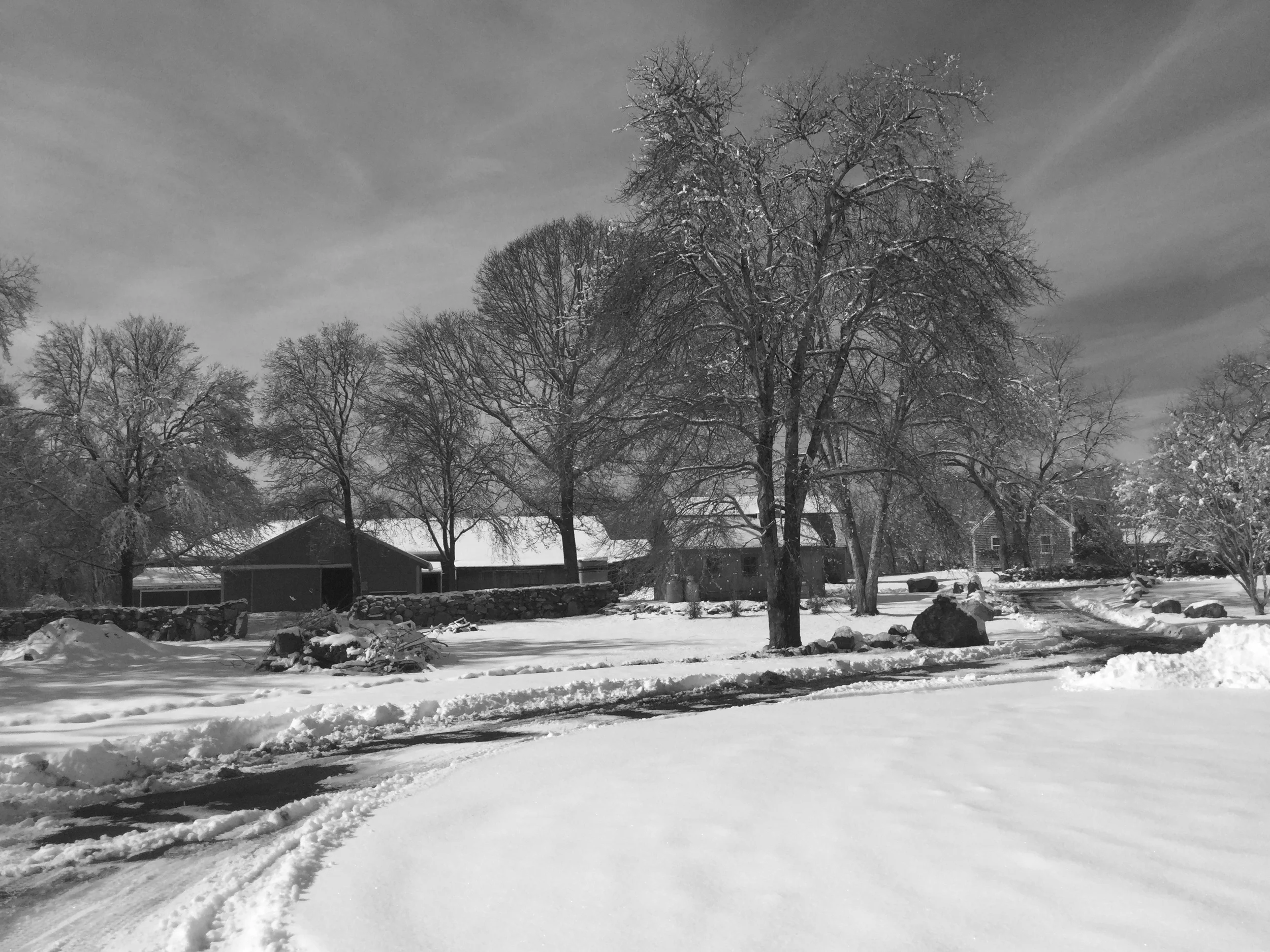

“It is growing cold. Winter is putting footsteps in the meadow. What whiteness boasts that sun that comes into this wood! One would say milk-colored maidens are dancing on the petals of orchids. How coldly burns our sun! One would say its rays of light are shards of snow, one imagines the sun lives upon a snow crested peak on this day. One would say she is a woman who wears a gown of winter frost that blinds the eyes. Helplessness has weakened me. Wandering has wearied my legs.”
― Roman Payne
PCFR dinner on Hydro-Quebec, Trudeau, etc.
Feb. 2, 2016
To members and friends of the Providence Committee on Foreign Relations (thepcfr.org; pcfremail@gmail.com). (We update the Web site frequently with news and commentary. Information on how to join the PCFR is on the site, too.)
Speaking to us next, at our Tuesday, Feb. 16, dinner meeting, will be David Alward, the former premier of New Brunswick and now the consul general of Canada to New England.
He’ll talk about the implications of the recent change in Ottawa under new (rock star?) Prime Minister Justin Trudeau, international security issues, such big trade matters as New England’s purchase of more hydro-electric power from Canada, the U.S.-Canada border and the idea of a common market encompassing Canada, the U.S. and Europe.
When you rush a cataract operation

Song's for Anthony Caesar (charcoal on paper), at the Kingston Gallery, Boston, in show "Phantasmal Espionage Feb. 3-28.

Too cold to be naked

"The trees down the boulevard stand naked in thought,
Their abundant summery wordage silenced, caught
In the grim undertow; naked the trees confront
Implacable winter's long, cross-questioning brunt."
D.H. Lawrence, "Winter in the Boulevard''
Josh Hoxie: No fun for resort workers
via otherwords.org
People with working-class jobs in U.S. beach towns and ski resorts are getting pushed away by exorbitant housing costs.
Think back to your favorite vacation. Wouldn’t it be delightful if that trip never ended?
Imagine moving to that fantastic destination town, finding a job and a house, and living the dream. Even if you had to wait tables or stock store shelves, who needs a desk job when you live in paradise?
That’s how many of us view the lives of the working class in beach towns or mountain resorts — an endless vacation.
If only. Barbara Ehrenreich popped that bubble in her book This Land Is Their Land.
As destination towns get more popular, she explains, more people flock to them. That creates more jobs, but it also causes housing prices to spike, making it nearly impossible for ordinary workers to find a place to live. This scenario is playing out in just about every town in America that people like to visit.
I grew up on sunny Cape Cod, a Massachusetts peninsula known to vacationers as a quaint getaway with sandy beaches and bountiful seafood. What it’s not known for is affordable housing or high-wage, year-round jobs. This leaves businesses scrambling to find enough workers during the year’s busy months and workers struggling to find housing they can afford.
Or take the case of Vail, Colo.. Low-wage workers, who can’t begin to pay the skyrocketing rents around the expensive ski resort, are being forced to move farther and farther away from their jobs, as The New York Times recently reported.
In short, the Cape Cods and Vails of America are turning into hollow versions of their former selves. They’re losing the culture, vibrancy and authenticity that comes from real people living there — not just second home owners commuting in from the cities on weekends and holidays.
Addressing this problem is going to take action on two fronts: raising wages and cutting housing costs. These problems are felt in nearly every burg and burrow across the country. But destination towns have one key advantage — a steady flow of tourist revenue.
The only problem is it’s going into very few hands.
Ski resorts are an excellent example. While some mom and pop resorts are barely getting by, mega-resorts like the one at Vail are profitable enough to pay their executives seven- figure salaries. Yet most of the folks who keep the resorts running — many of whom, like ski patrollers and instructors, do dangerous work — toil for sub-poverty wages.
Now, though, many of these workers are organizing to raise their wages through labor unions and collective bargaining. Ski instructors at Beaver Creek, a resort owned by Vail, recently won collective-bargaining rights, as did ski patrollers at Telluride. These inspiring efforts offer a glimpse at a solution for what ails America’s many hollow paradises.
Reducing housing costs is harder. Wealthy urbanites have more cash to drop on second homes than local workers have to buy their sole residences. That drives up the cost for everyone.
Yet innovative solutions like community land trusts are gaining popularity. These trusts take land out of pricy real estate markets and often enforce year-round residency requirements. That creates a way for communities from Lake Champlain, Vt., shared by Upstate New York and Vermont to theSan Juan Islands in Washington State to ensure housing for low- and moderate-income families.
Vacation towns aren’t immune to the inequality that’s been festering in this country for decades. But if they can invest in a more equitable future for their workers, then maybe living there really will be a little more like paradise.
Josh Hoxie is the director of the Project on Opportunity and Taxation at the Institute for Policy Studies. IPS-dc.org
.
Doodling toward home

"By the Sea'' (mural), by Ben Jundanian, at New Art Center, Newton, Mass., through Feb. 27, created for Uber Boston, 2015.
In this project, Mr. Jundanian "engages with the aesthetics and iconography of maps to create an expansive and highly developed doodle....The piece's bustling roadways, bike paths, railroads and waterways converge on a point in the center of the wall, an indicator of home.''
One thinks of T.S. Eliot's line from his poem "East Coker,'': "In my end is my beginning.''
David Warsh: How a 'milking media' company hurt Flint
The New York Times, The Washington Post, and The Wall Street Journal all agree: the decision to draw drinking water for Flint, Michigan, from its river was an epic failure of government. Where they placed the blame varied widely: Flint’s mayor and the city council; the governor’s office and Michigan’s Emergency Manager Law; the Michigan Departments of Environmental Quality and Health and Human Services; the federal Environmental Protection Agency regional headquarters in Chicago; or the EPA itself.
As Evan Osnos wrote in The New Yorker:
The headwaters of Flint’s crisis are not located in the realm of technical errors; rather, there are harder questions about governance and accountability in some of America’s most vulnerable places. Who controls policy and why? How does the public check those who govern in its name?
Somewhere near those headwaters are the offices of The Flint Journal, a wholly owned subsidiary of Advance Publications, which also owns Condé Nast Publications, which publishes The New Yorker and 20 other magazines, including Vanity Fair, Vogue, W and Wired.
The Journal’s transformation into a four-day-a-week adjunct to a regional Web site, as part of Advance’s retreat from the newspaper business, is an important part of the story.
Advance got its name when Samuel Newhouse bought the Staten Island Advance, in 1922. Newhouse went on acquiring newspapers whenever he could, assembling a chain that included such well-respected dailies as the Newark Star-Ledger, the New Orleans Times-Picayune, the Cleveland Plain Dealer, and the Portland Oregonian. He bought the Condé Nast magazine group in 1959, by legend on the advice of his wife, and, in 1976, added eight prosperous Michigan dailies when Advance bought the Booth chain, headquartered in Grand Rapids.
Newhouse died in 1979; and his sons, Samuel I. “Si” Jr. (b. 1927) and Donald (b. 1930), took over. The magazines lost money for a time in the 1980s and ’90s, but the newspapers’ earnings more than made up for it. The brothers bought Random House from RCA Corp. in 1980 and sold the firm in 1998 to the German publisher Bertelsmann SE & Co. Meanwhile, Donald was gradually moving Advance into cable television. If Charter Communications’ $67 billion bid for Time Warner and Bright House Networks is permitted, Advance, which started Bright House, stands to become one of the largest shareholders in the nation’s second-largest cable company, after Comcast. Forbes in 2014 ranked Advance 44th largest among privately owned companies in the US.
Much changed with the advent of search advertising in 2002, as the traditional semi-monopoly of newspapers on mind-share and many sorts of advertising was shattered. Even before that, Steven Newhouse, a third-generation family leader, had turned enthusiastic about the prospects for digital news. After that, Advance began cutting back on the frequency of print editions of its newspapers and consolidated many of their operations in centralized digital hubs – first in New Orleans, then New Jersey, Michigan, and Oregon.
In 2009, Advance closed the Ann Arbor, Mich., News and replaced it with a Web site, annarbor.com, only to resume printing two days a week, in 2013, while folding the Arbor Web site into a a large site, MLive,com, covering most major cities in southern Michigan, including Flint. Alan Mutter, an influential columnist as “Newsosauer,’’described the Advance strategy as “milking” their newspapers, as opposed to Warren Buffet’s custom of “farming” and Rupert Murdoch’s practice of “feeding” them.
How did the Flint paper do on the story? One metric (from Advance-affiliated Reddit) notes that veteran reporter Ron Fonger contributed 250 stories on the water crisis; MLive lists500 stories by Journal reporters since the crisis began, and offers a timeline of how the story emerged.
I couldn’t find a story explaining why all the surrounding townships in Genesee County had elected to continue to buy their water from Detroit until a new pipeline from Lake Huron could be completed, and only the Flint emergency manager decided to go it alone, without the backing of the city council. Only when Genesee County officials finallyblew the whistle last October, warning citizens of the city not to drink the water, did the local crisis turn into a state-wide scandal, and then a national one. Certainly the MLive effort was nothing like the all-out coverage of Hurricane Katrina for which the Times-Picayune won a Pulitzer Prize in 2006.
But that was before Advance applied the “digital first” treatment to the New Orleans paper. Since then, key staffers have left and the Baton Rouge Advocate has moved of its rival in circulation to become Louisiana’s largest newspaper. (The cities are 80 miles apart along the Mississippi River.)
After James Warren, of the Poynter Institute, a non-profit journalism school, published “How the Media Blew Flint,’’ John Hiner, vice president of content at Michigan's MLive Media Group, who previously was executive editor of the Flint Journal, sent the rejoinder “The Local Media Didn’t Whiff on Flint Coverage’’.
Warren quoted David Poulson of Michigan State University's Knight Center for Environmental Journalism, who gave good marks to the Journal’s Fonger:
I daresay a well-placed FOIA (Freedom of Information Act request) several months ago regarding the Flint situation may have earned some mainstream news publication a Pulitzer nomination. Or perhaps aggressive coverage of local government under the state-appointed financial manager would have caught the issue earlier, or even prevented it from happening. And a well-trained reporter covering local health or the environment and deeply versed in those issues may have really watch-dogged the transition from one water source to another and asked questions about required testing. Or an aggressive news organization may have even invested in independent water testing once questions arose and brought attention, testing and treatment much earlier than when it happened. That didn't happen because, well, they don't exist.
What’s the alternative to Newhouse’s “milking” model? The company could indicate a willingness to sell local newspapers wherever there are willing buyers. A citizens group in New Orleans tried that, but as Warren Buffett dryly noted at the time, “They do not have a history of selling anything.”
Of course it makes a world of difference how it is done. A couple of years ago the New York Times Co. sold The Boston Globe for a pittance to Boston Red Sox owner John Henry, its former business partner. Henry made headlines recently by firing the newspaper’s home-delivery contractor without having a capable alternative vendor in place. You probably won’t read the backstory to that one, either, in The Times.
I have a feeling this watchdog function of the press will regenerate itself, over another 20 years or so, with non-profits, free-lancers, and bloggers taking up the slack. In the Flint case, it was water-quality engineer Marc Edwards, a Virginia Tech professor, who produced the critical tests for lead as a consultant to community activists; Jake Blumgart, a Philadelphia free-lancer, contributed a good piece for Slate. And last week the Michigan Press Association gave its Journalist of the Year Award to Curt Guyette, who covered the Flint story online for the Michigan chapter of the American Civil Liberties Union.
Meanwhile, pay a little closer attention to the behavior of the press lords. It was not just government that failed Flint.
David Warsh, a long-time financial columnist and economic historian, is proprietor of economicprincipals.com, where this first appeared.
Go with the flow

"Poured Enamel, '' by LEAH DURNER, in her show at Heather Gaudio Fine Art, New Canaan, Conn., through Feb. 20.
The gallery touts that "her planned color schemes give way to impromptu spill motion.'' The idea, the gallery says, is to let "the uninhibited mind do great things.''
Winter's three gardens
"From December to March, there are for many of
us three gardens:
the garden outdoors,
the garden of pots and bowls in the house,
and the garden of the mind's eye."
-- Katherine S. White
The writer was an editor at The New Yorker, a celebrated writer on gardens -- especially about her garden in Brooklin, Maine -- the husband of the late celebrated essayist and children's book author E.B. White; the mother of Roger Angell, the still-working writer (especially on baseball and, increasingly in his old age, a superb memoirist) and a beloved Maine boatbuilder, the late Joel White.
Mr. Angell said of his mother: "As an editor, she was maternal and as a mother she was editorial.''

Wear your sunglasses

"Window 60 Autumn,'' by Maira Reinbergs in the "Color Passages'' show at ArtProv gallery, Providence, through Feb. 17.
Of climate change and N.E. floods

-- Photo by UMass Amherst
This photo shows how the Connecticut River spewed sediment into Long Island Sound on Sept. 2, 2011, showing the widespread erosion caused by Tropical Storm Irene.
Via ecoRI News (ecori.org)
AMHERST, Mass.
Lake sediments reveal that erosion from Tropical Storm Irene flooding in 2011 caused the most severe erosion of the historic record, according to a new study.
The recent study reveals that increasing soil moisture is raising flooding, erosion and landslide risks in New England, and found that erosion risks have multiplied four times as a result of climate change.
Led by University of Massachusetts Amherst geologist Brian Yellen, a team of scientists has been using sediment deposits in New England lakes to evaluate erosive destruction of historic floods. When floodwaters reach the quiet conditions of a lake, they drop their sediment and leave a layer at the lake bottom that can be used to reconstruct the erosive conditions of the causal flood, according to the researchers.
In a new paper in the journal Earth Surface Processes and Landforms, Yellen and his team show that the 2011 flood from Tropical Storm Irene in Massachusetts and Vermont caused historically unprecedented erosion in the form of landslides and rivers that jumped banks and destroyed most everything in their paths.
“When considering river floods here in hilly New England, the greatest risk we face is from fast, steep rivers undermining our structures — not from broad areas of inundation, like in the flat Midwest,” Yellen said.
Using chemical clues in the sediment layers, Yellen and his team showed that Irene flooding was uniquely capable of eroding ancient glacial till, riverbank material that has remained unmoved for the past 15-20 thousand years. Previous storms with greater precipitation totals and peak river flows weren’t as erosive, according to Yellen.
So what made Irene so erosive and destructive? It turns out that the 2011 tropical storm arrived on the tail of an anomalously wet period. In Vermont, total precipitation for the month immediately before Irene fell in the 95th percentile.
Increased soil moisture weakened banks and allowed for massive erosion, despite river flows that had been exceeded in the instrumental record.
Most alarming, the study found that rainfall statistics are shifting as a result of climate change. Based on trends in rainfall records, monthly preceding rainfall for Irene was four times more likely in 2011 than in 1911, according to the researchers.
“The jury is out on whether we will see more hurricanes as a result of climate change,” Yellen said. “But what is known with a good deal of confidence is that our region will continue to become wetter. This increasing baseline moisture primes the system for maximum destruction when big rain events occur.”
Stick to your opinion whatever the facts?
John Maynard Keynes's line in a debate: "When the facts change, I change my mind. What do you do, sir?'' is good to remember when politicians and others charge their opponents with inconsistency.
Canadian general consul to speak at PCFR on Feb. 16 on hydropower for N.E., etc.
Jan. 30, 2016
To members and friends of the Providence Committee on Foreign Relations (thepcfr.org; pcfremail@gmail.com). (We update the Web site frequently with news and commentary. Information on how to join the PCFR, including dues (which are very modest) and other organizational stuff may also be found there.)
Here’s our updated schedule for the rest of the year.
Speaking to us next, on Tuesday, Feb. 16, will be David Alward, the former premier of New Brunswick and now the consul general of Canada to New England.
He’ll talk about the implications of the recent change in Ottawa under Justin Trudeau, international security issues, such big trade matters as New England’s purchase of hydro-electric power from Canada and the idea of a common market encompassing Canada, the U.S. and Europe.
The international cities expert Greg Lindsay was to have joined us Feb. 16 but he must go to Scandinavia then. He’ll join us Wednesday, May 11. Some members have asked about when Eric Brenner, the Hapag-Lloyd executive, will reschedule to talk to us about world shipping, including the widening of the Panama Canal and the effects on East Coast ports. The answer: We don’t know yet.
We may also reach out to someone from the Port of Boston and Quonset.
As usual, the Feb. 16 dinner will be at the Hope Club, 6 Benevolent St., Providence. Drinks start at about 6, dinner by 7, then the talk and a Q&A and the evening ends by 9.
Please let us know whether you will join us Feb. 16 by replying to pcfremail@gmail.com or, in a crunch, calling (401) 523-3957. Thanks very much to those who have already let us know. The Hope Club needs good estimates no later than the day before a PCFR dinner.
Dues and dinner cost information may be found at: thepcfr.org. Other membership information may be found there, too.
On Tuesday, March 22, comes the very distinguished Andrew A. Michta, professor of National Security Affairs at the U.S. Naval War College and an adjunct fellow with the Center for Strategic and International Studies (Europe Program).
He’ll talk about European politics and security, including NATO, and has a special focus on Central Europe and the Baltic States.
In 2013–2014, he was a senior fellow focusing on defense programming at the Center for European Policy Analysis in Washington, D.C. In 2011–2013, he was a senior transatlantic fellow at the German Marshall Fund of the United States (GMFUS) and the founding director of the GMFUS Warsaw office.
He is a member of the International Institute for Strategic Studies in London.
Columbia Prof. Morris Rossabi, who had been skedded for March and is one of the world’s greatest experts on Central Asia, is being rescheduled to September or October.
We have asked him to focus on Mongolia, whose ability to become a real democracy stuck between the great expansionist police states of China and Russia, has long fascinated us.
On Tuesday, April 12, celebrated author, TV documentary maker and former foreign correspondent Hedrick Smith is scheduled to join us; he’ll talk about Russia, and the current state of America, too.
On Wednesday May 11, comes the aforementioned internationally known expert on cities around the world, Greg Lindsay.
Look at:
http://www.amazon.com/Aerotropolis-Way-Well-Live-Next/dp/0374100195/ref=sr_1_1?ie=UTF8&s=books&qid=1279805811&sr=8-1
He is a contributing writer for Fast Company, author of the forthcoming book Engineering Serendipity, and co-author of Aerotropolis: The Way We’ll Live Next. He is also a senior fellow of the New Cities Foundation — where he leads the Connected Mobility Initiative — a non-resident senior fellow of The Atlantic Council’s Strategic Foresight Initiative, a visiting scholar at New York University’s Rudin Center for Transportation Policy & Management, and a senior fellow of the World Policy Institute
Theodore Sedgwick, former U.S. ambassador to Slovakia, who had been skedded for May, is rescheduling to September. (We take July and August off.)
On Tuesday, June 7, Michael Soussan, former UN whistleblower; acclaimed author; widely published journalist; NYU writing professor, and women's rights advocate, will speak. His satirical memoir about global corruption, Backstabbing for Beginners: My Crash Course In International Diplomacy (Nation Books / Perseus) is being adapted for a feature film, starring Ben Kingsley and Josh Hutcherson.
He will speak about the subject of his next book TRUTH TO POWER: how great minds changed the world. A brief history of thought leadership.Ca
Suggestions are appreciated.
We look forward to seeing you.