
Vox clamantis in deserto






Scott Wolf/Laurie White: Efficient mass transit can boost local economy
Via ecoRI News
To have a successful mass-transit system you have to correctly answer a simple question: Does it get people where they need to go, when they need to get there, conveniently, safely and affordably?
Right now, Rhode Islanders’ answer to that question is largely “No.” Many people still can’t easily rely on mass transit to get to work, go to school, visit their doctor, go shopping or just see a friend when they’re ready to go. This results in Rhode Island not taking advantage of the economic benefits that an inviting and user-friendly mass transit system offers.
While the Rhode Island Public Transit Authority (RIPTA) has taken steps to maximize passenger mobility with extremely limited resources, achieving and sustaining a robust transit system requires substantial investments in both infrastructure and operations. Among Northeast Corridor states, Rhode Island ranks last in annual per-capita public investment in transit, averaging just $50.53 per person, compared with the regional average of $202.45 per person, according to a 2014 study by the American Association of State Highway and Transportation Officials.
It isn’t as though Rhode Island lacks the public will to upgrade its mass transit. In 2014, Rhode Island voters handily approved a $35 million first-ever transit-only bond to create a multi-modal transit hub at the Providence train station.
And Rhode Island already has many other pieces in place to succeed. Notably small, it’s the second-most urbanized state, with more than 75 percent of its residents living within a 10-minute walk of a transit stop. Still, less than 3 percent of the state's population uses transit regularly.
Having a robust and user-friendly transit system is increasingly seen by the business community as an important component to a vibrant economy. This is demonstrated in part by a sustained trend across the country of companies moving to walkable, transit-accessible locations in and around downtowns, big and small.
The Millennial generation, which will soon dominate the workforce, and about whom we hear a constant lament from businesses that young, skilled labor is leaving the state, prefer using public transit to get around. Together with aging Baby Boomers, they’re driving ridership growth around the country. There's no reason why we can’t leverage strategic investments in transit to make Rhode Island more attractive to millennials and grow our economy in ways that further revitalize our urban and town centers.
The recent “Next Stop: Making Transit Work for Rhode Island” forum in Providence demonstrated how we can achieve a transit system that generates a positive return on investment for Rhode Island’s economy and quality of place. Following a “lessons learned” presentation by officials and transit experts from Minneapolis, Denver and Hartford, Rhode Island officials engaged in a lively discussion about the challenges and opportunities for achieving a transit system that really works for more residents and businesses.
With continued leadership from the governor's office and House and Senate leaders to make public transit a priority this year, we’re confident that Rhode Island can reap the many economic and quality-of-life benefits of a more convenient and effective transit system.
Investing in a smarter transportation system is becoming easier with the recent approval of the new federal transportation act — the FAST Act — that modestly increased federal investment for roads and bridges and also for local mass transit. Also boosted were public and private incentives for transit projects that best deliver on mobility, and economic, environmental and social gains.
Still, Rhode Island must do even more to focus and leverage its limited resources to unleash the many co-benefits of improved mass transit. This includes a serious pursuit of public-private partnerships that have proven to work elsewhere, particularly for transit stations and transit-oriented development.
That simple question — “Does the public transit system take people where they need to go, when they need to go, conveniently, safely and affordably?” — may not yet yield the answer we all want. But by taking steps now to plan and invest wisely, we can get the correct response that Rhode Islanders and the state’s economy are looking for.
Scott Wolf is the executive director of Grow Smart RI, which co-leads the Coalition for Transportation Choices. Laurie White is president of the Greater Providence Chamber of Commerce.
Hartford is another sucker stadium city
Most partially or fully publicly financed professional-sports team stadiums are scams and grand larceny against the public. But owners of these franchises know full well how moronic many politicians and some members of the general public are apt to be about these scams because they're blinded by the "glamour'' of professional sports and want so much to believe in the chimera of "economic development'' from them.
The latest example is the new stadium being built in the desperate sucker city of Hartford.
But such is the triumph of hope over experience, that officials in Providence will probably be open to another proposal by the owners of the Pawtucket Red Sox.
The stadium scams are a bit like the state lotteries -- another income transfer from the not-rich to the very rich. But at least gambling is voluntary, unlike taxpayers paying rich people for stadiums.
Shedding more light on the season
This is about the time of year that you start to notice on early-morning walks the sunlight a little brighter and earlier than only a couple of weeks ago. The toughest weeks of winter -- physically -- are the next four or five weeks but the slowly extending light -- and the sense of accelerating time -- gives one more hope than one had in November, at least for a few minutes after sunrise.
-- Robert Whitcomb

Emily Schwartz Greco: So Trump would 'take their oil'?
Donald Trump’s first presidential campaign ad pledges to “take their oil.” That’s what President (gasp) Trump would do after having “quickly cut the head off the Islamic State,” says the deep-voiced narrator.

Along with political decapitation, there are many disturbing things in the Republican front-runner’s commercials besides these three words. But stop and ponder the questions they raise.
First, the U.S. government lacks state-owned oil companies, the requisite drilling equipment, and a fleet of tankers. How would Trump “take their oil”?
He’d get around this inconvenience wrought by America’s capitalist system by giving ExxonMobil the job, and backing the corporation up with “a ring” of U.S. troops.
“You ever see these guys, how good they are, the great oil companies?” Trump crowed in Iowa in November. “They’ll rebuild that sucker, brand new — it’ll be beautiful.”
(Exxon and its competitors aren’t “great” companies. They’re destroying the planet and are dangerous for investors. But let’s stick with those three words.)
Second, much of the territory the Islamic State controls today lies in oil-poor Syria. If a businessman-turned-president is going to deal with all the hassles that making our nation’s fifth-largest corporation an official agent of foreign policy would entail, why operate there?
Further, Syria faces a crisis so severe that babies are starving and the locals are eating cats and dogs to stay alive. Taking their oil would sow more instability and create more refugees. Doesn’t Trump see how bad snatching oil from the Islamic State’s survivors right after it falls would look?
Whether it’s out of humanitarian concern or propelled by the optics, shouldn’t the immediate post-ISIS U.S. mobilization focus on delivering aid and relief rather than further impoverishing the carpet-bombed populace?
Furthermore, the diplomatic conflict now brewing between Iran and Saudi Arabia may spiral into a regional war. Shouldn’t the Pentagon get out of the way instead of forming a “ring” around invasive oil rigs?
Finally, Uncle Sam can’t take oil that doesn’t lie below federal land without stealing it. How would swiping a commodity that belongs to other people foster stability in the Middle East and dial back the threat of “radical Islamic extremism,” three other wordsTrump likes to chant?
He’s also repeatedly criticized the U.S. government for not “taking” Iraq’s oil during Washington’s occupation, which began 13 years ago amid related oily delusions.
“The bulk of the funds for Iraq’s reconstruction will come from Iraqis,” notably including their oil revenue, former Defense Secretary Donald Rumsfeld wrongly predicted in October 2003.
Ultimately, Washington squandered $60 billion on Iraq’s botched reconstruction. The U.S. government left the country in shambles, vulnerable to the Islamic State’s operatives, and ready to forge military ties with Iran.
Trump’s call for easy fixes and letting post-conflict oil pay the bills coincides with our country’s latest Middle Eastern milestone. The Gulf War officially began with the bombing of Baghdad on January 17, 1991. Happy 25th anniversary, everybody!
While shorter and cheaper than the second Iraq War, that misadventure set the stage for the failures that followed. It dragged on in other ways through years of harsh economic sanctions and intermittent bombing.
The conflict inflicted immeasurable misery upon the Iraqi people with relatively little inconvenience on our part. Since it ended, however, cancers and other chronic diseaseshave sickened and even killed some 200,000 Gulf War veterans.
Isn’t it time to stop pretending that Americans can quickly fix the Middle East’s problems and deluding ourselves about how the profits from taking their oil will pay the tab for our military intervention?
It sure would be nice if the GOP presidential debate moderators were to ask The Donald some of these questions.
Emily Schwartz Greco is the managing editor of OtherWords.org, where this piece originated.
A cold beauty

"The Northern Lights'' (oil on canvas, 1926), by Sydney M. Laurence, in the show "The Art of Winter,'' at the Shelburne Museum, Shelburne, Vt., Jan. 23-May 30.
Don Pesci: GE games Conn. system and leaves
The news was leaked in advance of the formal announcement. Capitol Report, Tom Dudchik’s popular Connecticut aggregation site, announced in a bold red headline -- BOSTON GLOBE: GE MOVING TO BOSTON, BOMBSHELL: GE EXEC CALL BAKER, WALSH. And several sub stories were listed:
FLASHBACK: Looney: 'I think they doth protest too much'...FLASHBACK: Sharkey accuses GE of 'fear-mongering'...FLASHBACK: Aresimowicz tells GE suits 'take a weekend off from the yacht'...
President Pro Tem of the Connecticut state Senate Brendan Sharkey several weeks ago announced that General Electric's much publicized tax complaints were needless whining because “GE pays no taxes.” His complement in the House, Speaker Martin Looney, had added that GE’s CEO Jeff Immelt, like Lady Macbeth “doth protest too much.”
Gov. Dannel Malloy claimed to have had conversations with Mr. Immelt, but he had no comment on GE’s possible move from its large campus in Fairfield. Pressed by reporters just before the newly appointed Chairman of the Democratic Governors Association was due to arrive in Washington, there to receive plaudits from fellow progressive President barrack Obama, Mr. Malloy whined, with a shrug, “GE will do what GE will do.” Upon his return home from his Washington, D.C., petting, Mr. Malloy was told that GE was moving to Boston.
Early tremors had been signaling that earth quake for months; even much dazzled Connecticut reporters were not surprised by the announcement. Mr. Malloy noted, phlegmatically, “You win some, you lose some.”
But of course – If GE pays no taxes, how could Mr. Malloy induce GE to remain in the state by slathering the company with tax abatements?
Days before the leak, it was rumored that Mr. Immelt, perhaps stung by Mr. Looney’s Lady Macbeth reference, was considering deeding the Fairfield campus to Sacred Heart University and so removing the property from Connecticut tax rolls.
No taxes, eh?
The GE move -- along with major Connecticut insurance company consolidations with other major out-of-state companies, the sale of Sikorsky, the out-migration of some United Technology operations, the out-migration of the state’s most promising entrepreneurial talent to other states, Connecticut’s seemingly endless budget deficits and rescissions, and the drip, drip, drip of Connecticut’s prospectivetax revenue to other low tax, low regulatory states – long ago should have convinced Connecticut’s progressive governor and progressives within the Democrat dominated General Assembly that progressivism itself contains the seeds of its own destruction.
The progressive president pro tem of the state Senate admitted as much when he was asked by Dennis House of WFSB’s Face the State whether recurring deficits would be a permanent feature of Connecticut’s budget making. Connecticut’s economy is volatile, Mr. Looney answered “but one other trend that we do have to recognize is that, while unemployment in our state is down and actual employment is up, we are to some extent victimized by the progressivity of our own tax structure. Because of an array of credits and deductions that we have, most people earning under $40,000 a year or so wind up not having income tax liability.
A lot of the jobs that have been created are in the service economy. So, while we are seeing an increase in employment, we are not seeing an increase in tax revenues. But I think that’s why both the governor and the General Assembly are committed to advance the interest of high tech businesses and others that will, in fact, pay high wages, so that people will then be able to support the state.”
The volatility in Connecticut’s economy may be traced to the inability on the part of Mr. Looney’s Democratic cohort in the General Assembly to make meaningful cuts in spending, a hard political road to travel. The easy road is to boost revenue through tax increases and then sooth preferred impacted companies by awarding credits and deductions, a process that shifts the tax load from large to small businesses. Companies play the game, reap temporary benefits and then move on to less punishing quarters elsewhere. GE will not be the last in-state company to game the political system before shaking the dust of Connecticut from its feet.
Fortunately for Connecticut, progressivism is a self-limiting disease. At some point short of bankruptcy, thoughtful governments begin to regulate government rather than the governed. We can only imagine what Connecticut might look like if it had as governor a chief-executive intent on regulating governmental greed and a modest General Assembly pledged to return the state to normalcy.
Don Pesci is a political writer based in Vernon, Conn.
Chris Powell: Not worth it to chase addicts
Three East Hartford, Conn., police officers were lucky to survive their interrupting aheroin addict's injecting himself in a car in a hotel parking lot last week.
Speeding off, the addict, Kevin McNeilly, ran his car into them, prompting an officer to fire hisgun at the addict, hitting the addict's car and a parked car. After a chase inwhich the addict drove with only three tires, chewed up lawns, and crashed intothe gate of an apartment complex, he was apprehended four miles away.
The incident raises several serious questions. The first is the question with all criminal drug law: Was the police actionworth the trouble and particularly the risk to the lives of the officers and thedrivers and pedestrians near the chase?
Why should lives of the bravest public servants and innocent civilians bejeopardized only to prevent some poor soul from jeopardizing his own life?
It would have been far better if the police had let the addict shoot up and thenblocked him from driving away while calling an ambulance for him. It might havebeen better even to have left him alone entirely. For as developments in hiscase were to suggest the next day, drug criminalization is futile.
The second question is about Connecticut's criminal-justice system itself. Striving to create what he calls a "second-chance society," Gov. Dannel Malloy hasbecome Connecticut's first governor to get serious about criminal recidivism, the cycle of crime, imprisonment, release, return to crime, and moreimprisonment, a cycle that traps two-thirds or more of the state's criminaloffenders, most of them fatherless and neglected young men produced by thewelfare system. This cycle ruins lives and causes huge public expense.
The governor's initiatives, which have included reducing criminal penalties forsimple drug possession, are crucial insofar as they mean reducing the law'smanufacture of offenders and rehabilitating offenders, ensuring that upon their release from prison they are educated and physically and mentally healthy enoughfor decent work and have access to housing and health care.
But as many other sensational crimes in Connecticut do, last week's incident inEast Hartford showed that the state long has been something far beyond a"second-chance society."
For at his arraignment in Manchester Superior Court on the day after theincident, the addict not only confessed to buying heroin but was confirmed tohave a record of 32 criminal convictions dating to 1981, including convictionsfor burglary, robbery and larceny, and to be serving probation from aconviction in New Jersey for selling untaxed cigarettes. Most of these offensesseem connected to his drug problem.
Anyone with 32 convictions and a drug problem extending over 34 years is plainlyincorrigible and surely has committed many more crimes than he has beenapprehended for. But Connecticut has no "three strikes" or even "10 strikes" lawand the state's prosecutors and courts ignore incorrigibility for anything shortof murder.
So the guy who ran into the East Hartford officers, like so many other criminals-- some of them addicts, many of them not, many of them murderers, like themurderers of the Petit family in Cheshire, in 2007, and a man with 27 convictionswho was charged in November with a murder in Middlebury -- are allowed to liveessentially as make-work projects for police, prosecutors, public defenders, judges, probation officers, and social workers, being sent to prison for lifeonly after they get around to killing someone.
That's why the third question arising from last week's incident in East Hartfordis: As Connecticut properly strives to create a "second-chance society," will itever do anything about the damage caused by the 32nd-chance society it long has been?
Chris Powell is managing editor of the Journal Inquirer, in Manchester, Conn.
Not wild compared to now

"Down the Rabbit Hole'' (encaustic/mixed media on paper), by CONNIE BIGONY, in the shoe "Fauvistically Speaking,'' at Galatea Fine Art, Boston, Feb. 3-28. Fauvism is the style of Les Fauves ("wild beasts''), the early 20th Century artists who were disturbed by what they saw as the complacency of the Impressionists.
David Warsh: A lyrical look at the rise and fall of U.S. economic growth
SAN FRANCISCO
It was just two years ago that Thomas Piketty directed economists’ attention to rapidly rising degrees of inequality with his weighty tome Capital in the Twenty First Century (Harvard, 2014). We know too much to return to the single-minded preoccupation with distribution exemplified by 19th Century pioneers such as Malthus, Ricardo, and Marx. A series of industrial revolutions has seen to that.
The growth of knowledge has made room on the planet for the lives of billions of persons, and dramatically raised longevity and living standards among them around the world. But what if the rate of improvement has slowed? The first installment in the dystopian film saga The Hunger Games rolled out four years ago.
Piketty is right, of course, that institutions and policies are central to whatever happens next, and that we require a much clearer picture of the distribution of income and wealth to guide social decision-making in the future. That was one of the reasons the Swedes awarded the Nobel Prize in Economics last autumn to Angus Deaton, of Princeton University. As Deaton noted in his prize lecture, “In a world in which you work entirely in averages, if you look at the macro economy, things like inequality and poverty are simply not legible.” Without the details of individual choices, they disappear. “Even if you are only interested in the aggregate economy, distribution clearly matters for aggregate economic activity, and certainly for any serious analysis of well-being.”
Hence the depictions of Deaton working with a microscope, devising comparisons of, for instance, what it means to subsist on dollar a day. It’s a matter of “honest scorekeeping,” he says, among competing measures designed to improve individual well-being.
Some of them work and some don’t. Piketty’s empirical work, with Emmanuel Saez, of the University of California at Berkeley, and Sir Anthony Atkinson, of Nuffield College, Oxford, on the concentration of wealth in 19th- and 20th Century societies has set a high standard. Nicholas Bloom, of Stanford University, made headlines at a session of the meetings of the American Economic Association here with a new study, Firming Up Inequality, extending the analysis to industrial organization. Individuals’ inequality with their coworkers has changed little over the past three decades, he and his co-authors found; it is inequality among firms that is increasing. Workers with good corporate jobs therefore experience little growing inequality.
But as Philippe Aghion, a former Harvard professor who last year bested Piketty in competition for an appointment to a permanent professorship at the College de France, pointed out in a talk at the meetings, it is by no means clear that the potential for growth has been exhausted. Pro-growth policies remain important; they must take account of several different yardsticks of inequality, not just concentrations at the top, but measures of social mobility as well. Innovation is indisputably a source of top income inequality, Aghion said, but it differs from others sources: for example, consider the difference between Steve Jobs, who helped create smart phone, and Carlos Slim, who gained control of the cellular market through political influence, first in Mexico, and then in 18 other countries. Aghion and several coauthors spelled out the argument for fostering innovative growth last summer in an article for Vox EU.
For that reason, it seems to me that the most important development at the meetings was the appearance of another big book, in many ways the perfect complement to Piketty’s treatise. The Rise and Fall of American Growth: The U.S. Standard of Living since the Civil War (Princeton, 2016), by Robert J. Gordon, of Northwestern University, also arrived with a intimidating thud: Rise and Fall weighs in at 762 pages, vs. 685 pages for Capital in the Twenty-first Century. (My enthusiasm for his research program played a minor role in his expanding an article into the book.)
Not that Gordon’s book is heavy-going. It’s just the opposite. A poet of the Sears, Roebuck catalog for his chapter in a 1980 National Bureau of Economic Research volume, The Measurement of Durable Goods Prices, Gordon went on to co-edit a landmark NBER volume, The Economics of New Goods, in 1996. (The book included an essay by William Nordhaus, of Yale University, on the historic costs of lighting a room at night that is as close to a decisive experiment as is to be found in all of economics.) The inspiration for the present book, Gordon writes, dates from a chance encounter in a bed-and-breakfast with Otto Bettmann’s 1974 book, The Good Old Days –They Were Terrible. Bettmann, a German émigré, founded the Bettmann Archive of historically interesting photographs, in 1936. Gordon has boiled down the story to analytic narrative.
He divides the 15 core chapters into two periods, 1870-1940 and 1940-2015, speedup in one era and slowdown in another, hence “one big surge,” the sobriquet by which Gordon’s thesis has been known since it first appeared as a journal article, in 2000. The great inventions of the past could happen only once, he argued then. Wondrous as they are, he says, microprocessors and the packet-switching of the Internet do nor rival the invention of electricity, the internal-combustion engine, or flight. (Many young economists are unconvinced by this last claim.)
Thus chapters in the first period include “The Starting Point: Life and Work in 1870”; “What They Ate and Wore and Where They Bought It”: “The American Home: from Dark and Isolated to Bright and Networked”; ”Motors Overtake Horses and Rail: Inventions and Incremental Improvements”; “From Telegraph to Talkies: Information, Communication, and Entertainment”; “Nasty, Brutish, and Short: Illness and Early Death”; “Working Conditions on the Job and at Home”; “Taking and Mitigating Risks: Consumer Credit, Insurance, and the Government.” (I would have mentioned fewer titles except they convey so clearly the argument of the book.)
Chapters after 1940 include “Fast Food, Synthetic Fibers and Split-level Subdivisions: the Slowing Transformations of Food, Clothing and Housing”; “See the USA in Your Chevrolet or from a Plane Flying High Above”; Entertainment and Communications from Milton Berle to the iPhone”; “Computers and the Internet from the Mainframe to Facebook”; “Antibiotics, CT Scans, and the Evolution of Health and Medicine”; and “Work, Youth and Retirement at Home and on the Job.”
In the business end of the book, Gordon trades his role as historian for that of macroeconomist and growth accountant. He reprises his three key papers, including “Inequality and the Other Headwinds: Long-run American Economic Growth Slows to a Crawl,” the essay that gradually grew into the book.
What are these impediments to growth? The first is rapidly growing inequality itself, which Piketty, Saez, and others have documented. With incomes of the bottom 90 percent of the population growing much more slowly than the top ten percent, there simply won’t be enough spending to fuel the growth of median income at more than barely half its historic rate. Rising costs of education and its declining quality constitute a second headwind; demographic factors, chiefly the retirement of Baby Boomers, are a third; bourgeoning government debt is a fourth. Lesser frictions include globalization, global warming, and industrial pollution.
Through a relentless process of adding-up and subtraction, Gordon concludes that, for decades, “the future growth of real median income per person will be barely positive and far below the rate enjoyed by generations of Americans dating back to the 19th Century.” He adds a brief postscript describing measures that might boost productivity and accelerate somewhat the rate of future growth: a more equitable and efficient tax system; a better education system; less incarceration; drug legalization; more immigration; a federal fiscal reckoning that today seems quite out of reach.
Recently Gordon has been bogged down in debates with techno-optimists, the MIT duo of Erik Brynjolfsson and Andrew McAfee; and Gordon’s Northwestern colleague, Joel Mokyr, a distinguished historian of technology. “Nobody debates the headwinds. Instead they debate technical progress,” Gordon laments.
The meetings, at least, provoked a spirited discussion among a panel of distinguished economic historians: Gregory Clark, of the University of California at Davis; Nicholas Crafts, of the University of Warwick; Benjamin Friedman, of Harvard University;and Noam Yuchtman, of the University of California at Berkeley Haas School of Business, a proxy for James Robinson, of the University of Chicago, who was unable to attend.
The real debate is with the assumptions embedded in various congressionally-mandated forecasts of future growth. What’s the difference between the official 2.2 percent growth in the Budget Data Projections of the Congressional Budget Office and Gordon’s estimate of 0.5 percent? The difference between halcyon days and sustained turmoil. For the present, at least, growth accounting dominates the center ring of policy economics. The taboo on facing up to its implications hangs over the presidential primaries.
Richard Thaler, of the University of Chicago, Booth School of Business, gave the presidential address; president-elect Robert Shiller, of Yale University, organized the meetings. Jeremy Campbell, of Harvard University, gave the Ely Lecture, “Restoring Rational Choice: the Challenge of Consumer Finance.” Bengt Holmström, of the Massachusetts Institute of Technology, gave the Joint AEA/AFA Luncheon Address, “Why Are Money Markets Different?”, with Patrick Bolton, of Columbia University Graduate School of Business presiding. Some 13,300 members of more than 50 Allied Social Science Associations registered for the meetings, a record.
David Warsh, proprietor of economicprincipals.com, is a long-time financial journalist and economic historian (and colleague many years ago of New England Diary’s overseer, Robert Whitcomb, at The Wall Street Journal.
Our well-defined winter sky

Better than TV. (Photo by Kari Amick)
WAREHAM, Mass.
The unseasonably warm weather lately means we have been spending a lot of time talking about whether it feels like winter; But there is one winter thing to complain about: it’s dark.
The sun sets early, and night settles in fast, encouraging everyone to sit tight in their homes. I journeyed into the woods after dark one night and my flashlight caught the twin glints of some creature’s eyes. It spooked me, I’ll admit.
There are other glints in the darkness: on long winter nights, the stars seem brighter than in the rest of the year. Like many things that mark the seasons, this has to do with the Earth’s orientation: in the winter, we in the Northern Hemisphere are facing away from the center of the Milky Way, out toward the galaxy’s hinterlands. In the summer, we see more stars, and all that light makes the individual stars appear dimmer. The darker skies of winter gives the stars we do see more room to shine.
One of the most easily recognizable winter constellations is Orion, easily identified by the three stars that make up Orion’s belt. I was helping fellow MassLIFT-Americorps member Tanya with an orienteering program at one of Wareham’s elementary schools when one of the boys told us he had already learned to navigate. Then he appeared to veer wildly off subject.
“You know the hero guy?” he asked.
The teachers, Tanya and I tossed out bewildered guesses, mostly of the DC or Marvel variety: Thor, Superman, Wolverine.
“No,” the boy said with a frown. “Orion.”
So he hadn’t moved off the subject of orienteering at all: Orion’s belt rises in the east and sets in the west, and can be used for navigation. And Orion was a hero guy, of sorts, or at least a mighty hunter. One version of the Orion myth holds that he was such a skilled hunter that he was hired to kill a plethora of vicious beasts; after succeeding, he vowed to kill every animal on earth. This angered the goddess Gaia, who sent a scorpion to kill Orion. The scorpion succeeded, and Orion was placed amongst the constellations — along with the scorpion, which explains why the constellations Orion and Scorpius never share the sky.
It all seems a bit peculiar, maybe. But everyone has to reckon with the long nights one way or another, and often we are inside telling or listening to stories; sharing them, whether through television or written or spoken word.
So it might not look like winter when you venture outside during the day, and I will set aside questions of climate change to encourage you to enjoy the warmth while it lasts, along our shore, in our salt marshes or cranberry bogs or forests. But some things hold steady from the Greeks through to today, so if early nightfall drives you inside, you can remember: it is winter, after all.
Kari Amick is from the Berkshires, and currently serves as MassLIFT-AmeriCorps community engagement coordinator with the Wareham Land Trust and theBuzzards Bay Coalition. She is writing a regular column for ecoRI News during her stay in southeastern New England.
Creative destruction

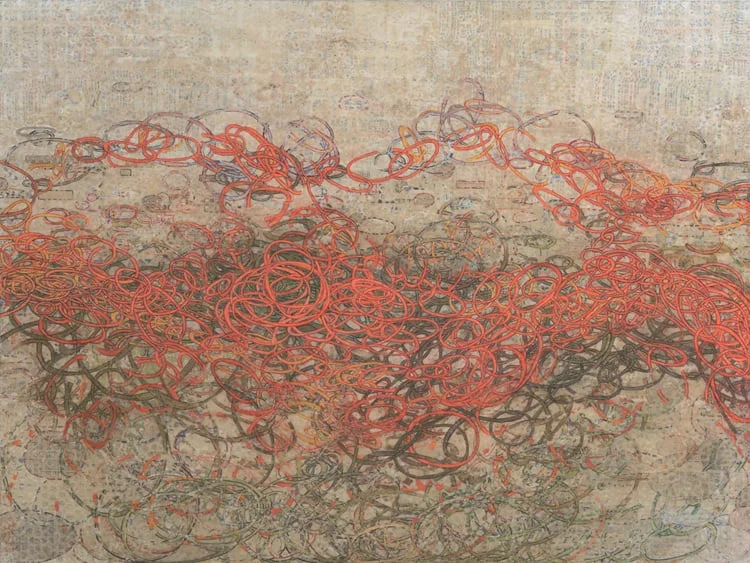
"Trashed - Dyslexic Love'' (oil, graphite, ink on paper), by JANET LAGE, in the 46th Annual Nor'Easter Juried Exhibition, Jan. 9-Feb. 14 at the New Britain (Conn.) Museum of Art.
William Morgan: In tiny Ripley, Maine, a 'no-frills preaching box'
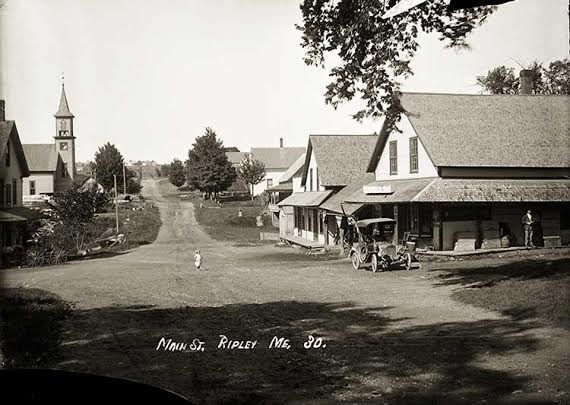
Main Street, Ripley, about 1910. (Courtesy of Penobscot Marine Museum)
Named for Brig. Gen. Eleazar Wheelock Ripley, a long-forgotten War of 1812 hero and later a congressman from Louisiana, this agricultural town in Somerset County has not changed much. Today's population (488) is not a lot more than it was in 1820, shortly after the town was founded. At 655, the population peaked in 1860, just before the Civil War, but was down to around 435 when this photograph was taken, around 1910.
A new Methodist church, built in 1889, joined the Union church (on the left in the photo above). Looking not unlike the ubiquitous one-room schoolhouse found throughout the rural U.S., the Ripley Methodist Church is your basic, no frills multi-denominational Protestant preaching box.

As part of its 75th anniversary, the church issued this commemorative plate, made by the Preston-Hopkinson Co., in Appomattox, Va. This little piece of northern New England history turned up in Savers' knick-knack department in Providence, for a relatively high price of almost $7.

Its owner apparently failed to note that such plates are "For Decorative Use Only," so a trip or two through the dishwasher marred the plate with some sort of ceramic pox.
The Methodist church is still active in its 127th year. But given Ripley's historic trajectory, one can imagine that this 50-year-old plate might have been the only relic of an abandoned church.
-- William Morgan
Mr. Morgan is a much-published architectural historian.
Chris Powell: Worthless educations; yes, exploit working-class fears
From President Obama to Connecticut Gov. Dannel Malloy, elected officials are boasting aboutimprovements in high school graduation rates. But last week even The New York Times acknowledged that it's a fraud. For higher graduation rates are comingmainly at the expense of educational standards, since, while graduation ratesare up, "measures of academic readiness for college or jobs are much lower."
"The most recent evaluation of 12th-graders on a national test of reading andmath found that fewer than 40 percent were ready for college-level work," TheTimes reported. "College remediation and dropout rates remain stubbornly high."
Recent testing of Connecticut high school students and state government’s ownmost recent survey of college freshmen show the same thing: Most students arenot mastering grade-level work but are promoted and awarded high school diplomasanyway, and most freshmen in the state university and community college systemsrequire remedial high school math or English or both.
That's because Connecticut's educational policy now is formally one of socialpromotion. Promotion and graduation require no actual learning. Rather, onlysimple attendance is required. Promotion and graduation are left to thediscretion of local school boards, which have lost the nerve to enforcestandards that measure learning.
Students and parents may be fooled by this dumbing down of education butemployers are not. While students eventually find out, leaving college withdegrees in politically correct fluff like "women's studies" and incurringcrushing student loan debt only to find themselves qualified to be only cashiersand burger flippers, by then it's too late. The education racket has taken theirmoney, and their futures, in the guise of protecting their self-esteem, whichshatters soon enough anyway.
If mere higher graduation rates are the objective, Connecticut should distributehigh school diplomas with birth certificates. Actual education will requireimposing standards and measures of learning -- serious testing -- and riskinghurt feelings earlier.
NO WORKING-CLASS HERO: President Obama complains that presidential candidateDonald Trump is exploiting the fears of the working class, and of course Trumpis. But those fears are entirely valid, since living standards for mostAmericans have been declining for several decades. Somebody should exploit those fears politically.
To some extent the Obama administration has tried to assist the working class. That's how the national medical insurance scheme dubbed "Obamacare" was meant, though increasingly it seems to be failing, driving up costs while leavingpeople with deductibles so high as to make it prohibitive for them to use theirinsurance.
Meanwhile mergers and acquisitions in the economy have exploded, fueled bygovernment’s suppression of interest rates and the preferential access that bigbusiness has to capital. By one estimate mergers and acquisitions in the UnitedStates this year reached a record $2.5 trillion in value. These combinationsdiminish competition and thereby drive costs up and employment down. The ObamaJustice Department's Antitrust Division has slept through them.
FOOL, BRITANNIA: Trump wants to use religion to prohibit certain people fromentering the United States, whose anthem nevertheless identifies it as "the landof the free and the home of the brave."
Responding to a petition protesting Trump, Britain's home secretary, Theresa May, says she might bar the presidential candidate from visiting thatcountry because she has the authority to exclude people who are not "conduciveto the public good." That is, she might keep people out for being controversial. One of the U.K.'s several anthems says: "The muses still with freedom found/ Shall to thy happy coast repair." But soon those muses may be admitted only ifthey sing the right tune.
Chris Powell is managing editor of the Journal Inquirer, in Manchester, Conn.
Philip K. Howard: How to bring parties together to fix infrastructure mess
Fixing America’s decrepit infrastructure shouldn’t be controversial—it enhances competitiveness, creates jobs, and helps the environment. And of course, it protects the public. Repairing unsafe conditions is a critical priority: More than half of fatal vehicle accidents in the United States are due in part to poor road conditions.
After years of dithering, Washington is finally showing a little life for the task. Congress recently passed a $305 billion highway bill to fund basic maintenance for five years. But the highway bill is pretty anemic—it barely covers road-repair costs and does nothing to modernize other infrastructure. The total investment needed through the end of this decade is actually $1.7 trillion, according to the American Society of Civil Engineers. Further, the highway bill does nothing to remove the bureaucratic jungle that makes these projects so slow and costly.
But these two failures—meager funding and endless process—may actually point the way to a potential grand bargain that could transform the U.S. economy: In exchange for Democrats getting rid of nearly endless red tape, Republicans would agree to raise taxes to modernize America’s infrastructure.
Stalled funding. The refusal to modernize infrastructure is motivated by politics, not rational economics. By improving transportation and power efficiencies, new infrastructure will lower costs and enhance U.S. competitiveness—returning $1.44 for every dollar invested, according to Moody’s. That’s one reason why business leaders, led by the U.S. Chamber of Commerce and the National Association of Manufacturers—normally on the same page as congressional Republicans—have been pleading for robust public funding. As an added benefit, 2 million new jobs would be created by an infrastructure-modernization initiative, jump-starting the economy. That’s why labor leaders and economists have joined with the business community to advocate for it.
But these benefits largely accrue to society at large—not to the public entities funding the infrastructure. Because tolls and other user charges, where applied, rarely cover all the capital costs, the federal government often must subsidize public works if the United States wants modern interstate transportation, water, and power systems. As a matter of party ideology, however, Republicans have steadfastly refused to raise the gas tax and other taxes needed to fund infrastructure. This line in the sand was drawn in the 1990s because of the Republican conviction, widely shared by the public, that government is wasteful.
So when the highway trust fund expired this year, Congress found itself in an ideological struggle over how to fix potholes. Unfortunately, Washington’s answer is an inadequate funding plan that is also basically dishonest, resorting to gimmicks like selling oil from the nation’s strategic petroleum reserve at more than $90 per barrel (when the market price is closer to $40).
Red-tape waste. The Republican frustration about government waste is illustrated by the inefficiencies of infrastructure procurement and process. The arduous procedures by which public infrastructure gets approved and built shows that total costs could be cut in half by dramatically simplifying the environmental review and permitting processes—which can often consume a decade or longer. The water-desalination plant in San Diego, for example, which is vital for water-parched California, began its permitting in 2003. It finally opened in December 2015, after 12 years and four legal challenges.
Even projects with little or no environmental impact can take years. The plan to raise the Bayonne Bridge roadway, which spans a strait that connects New Jersey to Staten Island—in order to allow a new generation of post-Panamax ships into Newark Harbor—had virtually no environmental impacts because it used the same foundations and right of way as the existing bridge. Yet the project still required five years and a 20,000-page environmental assessment. Among the requirements was a study of historic buildings within a two-mile radius of the Bayonne—even though the bridge touched no buildings. Once approved, the project was then challenged in the courts based on—you guessed it—inadequate environmental review.
All of this process is expensive. The nonpartisan group Common Good (which I chair) recently published a report on bureaucratic delays, Two Years, Not Ten Years, which found that decade-long review and permitting procedures more than double the effective cost of new infrastructure projects. Delay increases hard costs by at least 5 percent per year. Delay prolongs bottlenecks and inefficiencies, which totals 10 to 15 percent of project costs per year (depending on the infrastructure category). A six-year delay, typical in large projects, increases total costs by more than 100 percent.
Careful process, the theory goes, makes projects better. But the U.S. approval process mainly produces paralysis not prudence. America’s global competitors don’t weigh themselves down with these unnecessary costs. Take Germany: It is a far greener country than the United States, yet it does environmental review in a year not a decade. Germany is able to accomplish both review and permitting in less than two years by creating clear lines of authority: A designated official decides when there has been enough review and resolves disputes among different agencies and concerned groups. The statute of limitations on lawsuits is only one month, compared with two years in the United States—and that two years is only because it was shortened under the new highway bill. Following Germany’s lead, Canada recently changed its permitting process to complete allreviews and other infrastructure decisions within two years, with clear grants of authority to officials to meet deadlines.
Like most laws, America’s infrastructure process has its supporters. Any determined opponent of a project can “game” the procedures to kill or delay projects it doesn’t like. And, just as most Republicans are adamant about not raising taxes, many Democrats are adamant about not relinquishing the effective veto power environmentalists currently wield. After all, who knows when a new Robert Moses might appear to flatten urban neighborhoods?
Spending years arguing about if the project is worthwhile rarely improves the decision.
The tragic flaw in this position, however, is that lengthy environmental review is dramatically harmful to the environment. Prolonging traffic and rail bottlenecks, the Common Good report found, means that billions of tons of carbon are unnecessarily released as officials, environmentalists, and neighbors bicker over project details. America’s archaic power grid—not replaced in part because of permitting uncertainties—wastes electricity equivalent to the output of 200 coal-burning power plants. At this point, the decrepit state of America’s infrastructure means that almost any modernization, on balance, will be good for the environment. Water pipes from 100 years ago leak an estimated 2.1 trillion gallons of water per year. Faulty wastewater systems release 850 billion gallons of waste into surface waters every year. Overall, America’s infrastructure receives a D+ rating from the American Society of Civil Engineers. For every project that is environmentally controversial, such as the Keystone pipeline, there are scores of projects that would easily provide a net benefit to the environment.
In some vital projects, adhering to rigid legal processes could even lead to catastrophe. For example, the proposed new rail tunnel under the Hudson River must be completed before the adjoining tunnel is shut down to repair damage caused by Hurricane Sandy. Any delay in approvals would cut rail capacity to Manhattan from New Jersey in half, with unthinkably bad consequences on traffic, carbon emissions, and the economy.
Environmental review is important, but the tough choices required can usually be understood and aired in a matter of months not years. The trade-offs for the most part are well known: A desalination plant will produce one gallon of briny byproduct for every gallon of clean water; the new rail tunnel under the Hudson River will require dislocating homes and businesses at either end; a new power line will emit electromagnetic energy and mar scenic vistas. But California’s fresh water must come from somewhere, New York needs to eliminate rail bottlenecks, and new power lines will carry clean electricity to cities from distant wind farms. In each case, the relevant questions are whether the new project is worth the costs and, sometimes, whether there’s a practical way to mitigate the effects. Spending years arguing about if the project is worthwhile rarely improves the decision—it only makes projects more expensive while prolonging pollution.
A new bargain. There’s a way to break the logjam caused by a lack of needed funding and an overabundance of process. Conservatives concerned about wasteful government should agree to raise taxes to fund infrastructure if liberals agree to abandon the bureaucratic tangle that causes the waste. This deal will cut critical infrastructure costs in half, enhance America’s environmental footprint, and boost the economy.
Adequate funding will get America moving with safe and efficient infrastructure. And abandoning years of process need not undermine environmental goals or public transparency. The key, as in Germany and Canada, is to allocate authority to make needed decisions within a set time frame. Public input is vital, but it can be accomplished in months. Plus, input is more effective at the beginning of the process, as adjustments can be made before any plan is set in the legal concrete of multi-thousand-page environmental-review statements.
Politically, of course, getting Republicans and Democrats to strike a bargain—more funding for less bureaucracy—won’t be easy. Special interests on both sides have their claws deep into the status quo. It is notoriously difficult to raise taxes, and curbing review timelines can sound like cutting corners. But America can’t move forward on infrastructure built two generations ago. Eliminating traffic jams, electricity outages, airplane delays, and unnecessary tragic accidents will be more than worth the small increase in taxes and a shorter review period.
Congress knows there’s a problem. The new 1,300-page highway bill tiptoes toward streamlining decisions. Unfortunately, these good intentions may actually make matters worse. The bill creates a new 16-agency committee to review projects and defines elaborate procedures on how to set a permitting timetable. But the timetable can be waived, and the new procedures assiduously avoid the one indispensable element for enforcing deadlines: a final decision maker. Indeed, the reluctance to grant anyone the ability to resolve disagreements is almost comical. The director of the Office of Management and Budget is supposedly in charge, but the director’s ultimate grant of authority amounts to no authority all: “If a dispute remains unresolved … the Director … shall … direct the agencies party to the dispute to resolve the dispute.”
But a new bipartisan bargain doesn’t require complicated drafting. It only takes a few words for Congress to approve a gas tax or other taxes to fund infrastructure-modernization programs. And the radical change needed to reduce permitting from ten years to two years will not be made in substantive law—underlying environmental requirements, for example, would remain the same—but rather in authorizing specific officials to make and review decisions. Creating clear lines of authority is much simpler than defining the intricacies of a procedural labyrinth. The law can give the chair of the Council on Environmental Quality responsibility over deciding when there has been enough environmental review, and it can give the OMB director responsibility over resolving disputes among squabbling agencies. They will both be accountable to the president and, if necessary, to the courts. Common Good, at the request of relevant committees in Congress and with the help of two former Environmental Protection Agency general counsels, has already drafted proposed amendments that establish these lines of authority as well as oversight standards for the president and the courts.
The good news is that the political winds are shifting. Hillary Clinton recently proposed a $500 billion infrastructure initiative that included a call to radically streamline permitting and review processes. And Jeb Bush recently called for permits to be granted “within two years instead of ten.” With strong leadership, the nation can get there: If the Democrats cut waste and the Republicans provide funding, Americans will have better rules and better roads.
Philip K. Howard is chairman of Common Good, a regulatory and legal reform organization, a New York-based lawyer and civic leader and the author of several books, including The Death of Common Sense and The Rule of Nobody.
New Year's flowers
I noticed while walking on the path to the front door of a nursing home this morning that pansies had recently been planted and were brazenly blooming in an area with a southwest exposure. In the hard freeze tonight they'll be killed but their presence was a nice reminder of the mild December we've had and that we'll see flowers blooming there again in a few months.
I was at the nursing home to see a physically failing friend who still has his mental faculties. I suspect that he's asking himself how he fits into the cycles of death and birth as he looks out the window at the windy, glittery head of the estuary and wonders whether he will see green trees again in the little park along the water.
-- Robert Whitcomb
Of cheap fares and Christmas card quandaries
There’s been pushback to the Rhode Island Public Transit Authority’s plan to make some low-income elderly and/or disabled people who have been riding for free pay 50 cents a ride.
With those tiny fares, taking public transportation will still be much cheaper for them than owning/driving a car. Further, at least most low-income old people have Social Security and Medicare, unlike younger working-class folks unprotected by AARP lobbyists.
When many people ride for free or at very low fares, it dangerously drains RIPTA’s fiscal ability to provide the frequent and predictable service that could draw many more paying customers; that added revenue could be used to improve the service and, in a virtuous circle, get new riders and revenue. Many riders would happily pay fares more commensurate with the real cost of service if service were better.
The Providence Journal reported that RIPTA “spends about $4.20 per ride on fixed-route buses, and the average fare paid by riders is $1.50….’’ That is absurdly low but helps explain (along with bad labor contracts and inadequate state support) why RIPTA service is so inadequate: It never has enough money to really improve.
Special-interest politics keep undermining sound public policy in Rhode Island, whose dense population would seem readymade for mass transit. The MBTA has plenty of problems, but Greater Boston’s great prosperity can be attributed in part to that system’s dense network and frequent service.
xxx
There are always lessons from holiday seasons, if only to reinforce what you already knew, such as needing to appreciate how much time seems to accelerate as you get older and thus to savor each day as it speeds past. You look up from your morning coffee and it’s Christmas again!
And how fragile we are! Consider the annual casualty list as expressed by Christmas cards that don’t arrive because the senders are dead or too sick or enfeebled by age to write. Or sometimes it’s that the absent senders are newly divorced. Send the latter a “Happy New Year’’ card! (But maybe happiness is overrated: An article in The Lancet, the British medical journal, says that research suggests that unhappy people don’t die earlier than happy ones
Those lazy -- perhaps modern is a better word – e-mail cards: I respect any efforts to keep in touch but something on a screen doesn’t measure up to something tactile. It’s just too easy to push “send’’ to multitudes who get exactly the same message, like an ad. We’re much more grateful getting a physical card with a few words written with a pen by someone mentally and physically trying to maintain or restore a connection with one or a few individuals.
Meanwhile, deciding to whom to send cards can become a rather ruthless exercise. You’ve accumulated a lot of acquaintances but how many are really friends? You’re tempted to start culling the list even faster than death does.
Then you get a surprise card from someone you knew slightly years before but always wished that you knew better. Sending back a card might be a way to start establishing a real friendship, though that’s rare: You’ve moved on too far.
Another funny thing that happens as the Christmases roll by is that not only do you selfishly not want the bother and expense of buying Christmas presents but maybe you don’t want to get them either – it’s just more stuff to store or, at best, “regift.’’ Except, of course, for cash….
A lot of these thoughts are simply about getting older, which speaks to newspaper readers’ demographics. Anyway, if you maintain a clinical curiosity leavened with some humor aging can sometimes be pleasant.
And an observation from this past Yule shopping season: While some small neighborhood shops will keep thriving as people seek convenience, community and quirkiness, Amazon, et al., may soon kill most big department stores. Prepare for a post-retail Providence Place. Textile factory? Dorms?
Robert Whitcomb (rwhitcomb51@gmail.com) is a Providence-based editor and writer and the overseer of New England Diary.

'For reward, for revenge, and for rest'
She’d rather be killing birds,
but instead, she settles beside me
and purrs.
Walking down the road
with fireflies lighting the way –
Christmas in July.
There must be a god somewhere,
for reward, for revenge,
and for rest.
A sure sign that I’m getting old:
people are polite to me.
Old age:
the age of silence
and the age of talking too much.
I’m very lucky:
the only problems I have
can never be solved.
Growing older –
my real fear
is that I will get
what I deserve.
Returning to work after retirement,
trespassing on land you used to own.
One day,
people will become worthy
of the works of art they create.
Is that my smile,
or a river of wrinkles
spreading across my face?
Grateful for having,
ashamed of having,
tired of having,
afraid of losing.
After the concert:
we applaud,
not because we won’t forget it,
but because we will.
Youth passes, thank God.
I’d just make the same mistakes
all over again.
The mind lusts after the flesh,
but the flesh is lost in dreams.
About my wife:
yes, she could have done better,
but she could have done worse.
As the future shrinks,
the past expands
and takes revenge on the present.
After the argument,
the boat springs a leak
but doesn’t quite sink.
I can’t believe these hands are mine –
their knuckles and veins
are so ancient and wise.
The thread snapped –
you could barely hear it –
and people went on with their lives.
The ballet of cars
at a busy intersection –
beauty is everywhere.
Listening to Beethoven
during a thunderstorm –
Beethoven always wins.
The past is an open wound
that never heals.
I can’t forgive
or be forgiven.
Killing ants in the bathroom –
it doesn’t help,
but at least I feel guilty.
Remembering and forgetting –
the two diseases of old age.
Slowly, finally,
my home becomes a home,
my wife becomes a wife.
A single blade of grass
casts a shadow on the fence.
Frank Robinson
James P. Freeman: Mass. in '15: A state of hope and (fiscal) peril
It is right there
Betwixt and between
The orchard bare
And the orchard green
— Robert Frost from “Peril of Hope”
With an eerie prescience, the Jan. 9, 2015, front page of The Boston Globe captured perfectly the mixture of fear and anticipation associated with the hope a new year brings. Two headlines above the fold – “Boston picked to bid for Olympics” and “Baker promises firm fixes, sensitive touch” – would set the tone for 2015 in Greater Boston.
Boston 2024 Partnership, the consortium of business and political interests (so-called “thought leaders”) to bring the 2024 summer Olympic games to The Hub, underestimated Bostonians’ capacity for common sense and overestimated Bostonians’ tolerance for large municipal projects. (Didn’t anyone remind planners of the Big Dig experience?) Residents rightly feared costs would be socialized and any profits would be privatized by special interests. The bid was rescinded in July.
Charlie Baker was sworn in as Massachusetts’ 72nd governor within hours of the Olympic announcement. No politician campaigned on the Olympics but it consumed precious time and energy from more mundane and serious matters, such as the opioid emergency, which rages on unabated (1,256 people – likely more this year – fatally overdosed in Massachusetts in 2014). Alarmingly, more people die in Massachusetts from overdoses than from car crashes.
Boston broke the record for snowiest winter on record, with 108.6 inches. But the MBTA was broken long before 2015 from decades of incompetent government oversight. With melting irony, man could not make the trains run during the blizzards but a train actually ran without a man this December in Braintree, due to “operator error.” Baker must restore the entire system to ensure a second term.
The New England Patriots earned their fourth Super Bowl championship in February, amidst the faux-scandal of Deflategate (which is now being taught as a class at University of New Hampshire). A federal judge determined that the NFL went too far in suspending quarterback Tom Brady. In May, some suggested that Salem State University went too far in paying him $170,000 for a one hour “lecture.” But don’t tell that to the local media, which cover the team by way of sports jingoism, not journalism.
It took a jury in April nearly 26 minutes just to read the “guilty” verdict on all 30 counts against unrepentant terrorist Dzhokhar Tsarnaev, in the Boston Marathon bombing trial.
Irish rockers U2, who lived through the terror of “The Troubles,” charmed the town with four sold-out concerts this summer, as “#BostonStrong” was featured prominently on a massive vidi-wall during their encores.
Pedro Martinez was inducted into the Baseball Hall of Fame and David Ortiz announced this post season he would retire in 2016. Their recognition and retirement mark the perilous end of an era of Boston baseball dominance. Perhaps no other players were better catalysts of hope for a despondent Red Sox Nation before 2004.
Two films about Boston’s ugly underbelly proved to be, in many respects, largely for Boston; another cathartic exercise in order to exorcise criminality. “Spotlight” chronicled the unspeakable and unimaginable clergy sex abuse cover up, and “Black Mass” showcased Whitey Bulger. Each affirmed that evil can reside both in men of the cloth and the cleaver.
After nearly a century, Cambridge-based Converse unveiled the long-awaited Chuck Taylor II sneakers.
After 20 years since the first charter school was opened in Massachusetts, with some municipalities having reached their quotas, many want a reset, a Charter 2.0.
Atty. Gen. Maura Healey, prodigal progressive, concluded that more regulation (of course) would be best for Boston-based fantasy sports league website DraftKings (and FanDuel). But former Gov. Deval Patrick, promiscuous progressive, discovered free enterprise by joining the investment firm Bain Capital.
In November, the financial news Web site 247wallst.com ranked Massachusetts as the best place to live among the 50 states. General Electric thinks so, as it imagines what a world headquarters might look like in Boston as it contemplates relocation from Connecticut for lower taxes and closer proximity to the area’s innovation ecosystem.
This autumn, the Oxford Dictionaries determined that its word of the year was, in fact, not a word, but a pictograph. The “Face with Tears of Joy” emoji according to Oxford lexicographers, “best reflected the ethos, mood and preoccupation of 2015.”
In retrospect, then, Frost got it partially right. Time — and 2015 — might best be defined as an alloy of peril and hope.
James P. Freeman is a New England-based writer and a former Cape Cod Times columnist. This comes via the courtesy of The New Boston Post.
For some of his previous columns, read:
- See more at: http://newbostonpost.com/2015/12/30/the-year-2015-and-the-peril-of-hope/#sthash.VrgyiQQu.dpuf