
Vox clamantis in deserto






Don Pesci: Murderer Putin evokes Trump's admiration
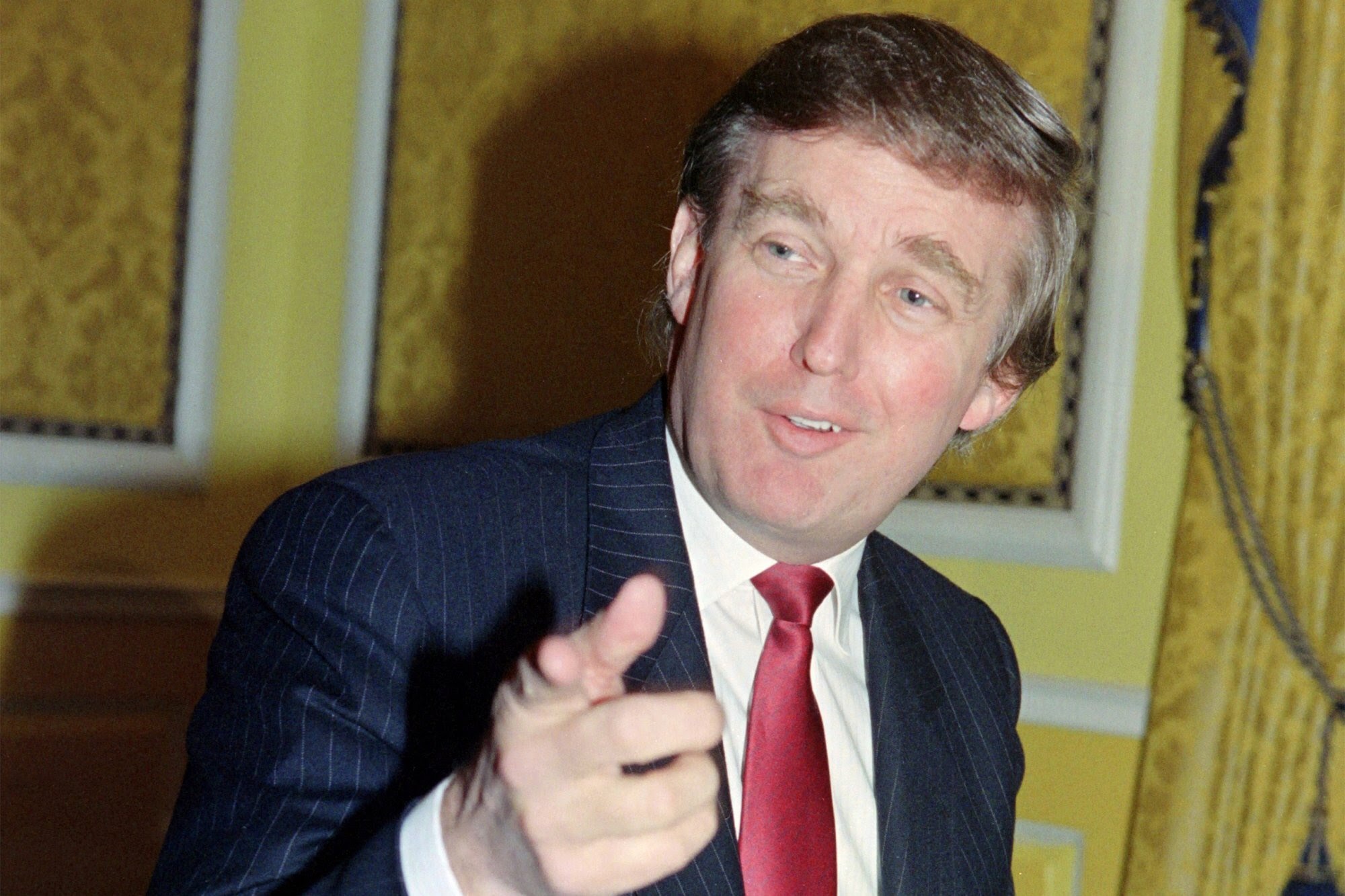
VERNON, Conn.
Progressives, who sometimes have great difficulty making proper distinctions between populism and progressivism, may want to take a gander at populism Trump style, which appears to be a toxic combination of demagoguery laced with ineffable stupidity.
Here is the sad tale according to Charles Cooke of National Review:
“US presidential hopeful Donald Trump has said it is a 'great honor' to receive a compliment from Russian President Vladimir Putin. The property tycoon hailed Mr. Putin as a man 'highly respected within his own country and beyond.' It comes after Mr. Putin said Mr. Trump was a 'very colorful, talented person' during his annual news conference...
“Just a few hours ago, Trump confessed exactly that. He was not caught in a 'gotcha.' He was not misquoted. He was not led down the garden path by the ‘liberal or ‘mainstream’ or ‘pro-Obama’ media. Rather, he said, as plain as day, that he has ‘always felt fine about Putin’; he called him ‘strong’ and a ‘powerful leader’; and he suggested that he should be respected for his ‘popularity within his country.’ Nothing could pry him from this reverence. When it was pointed out to him that Putin is a man who ‘kills journalists, political opponents, and invades countries,’ Trump said flatly, ‘At least he’s a leader,’ which I can only imagine sounds an awful lot better in the original German. Then, for good measure, he took aim at the American system: ‘Unlike,’ he added, ‘what we have in this country.’”
It fell to Joe Scarborough of Morning Joe to point out to Mr. Trump that his amorata, President Vladimir Putin, formerly a KGB agent, the butcher of Ukraine and bosom pal of Bashar al-Assad, whose father was also a butcher of Syria, is “also a person that kills journalists, political opponents, and invades countries.”
Mr. Scarborough asked his guest, whether he thought “that would be a concern.”
Trump: “He’s running his country and at least he’s a leader. You know, unlike what we have in this country.”
Scarborough: “But again, he kills journalists that don’t agree with him.”
Trump: “Well, I think our country does plenty of killing also, Joe. There’s a lot of stupidity going on in the world right now, Joe. A lot of killing going on and a lot of stupidity and that’s the way it is.”
Mr. Trump is probably the only politician in the United States, though he has confessed he is new to the political game, who can survive an all-night rhetorical binge and emerge in the morning raring to meet the press. There is no mare’s nest of his own making from which he will not try, so far successfully, to extricate himself – for, see you, Mr. Trump is a populist, and populists who are popular receive from the media fewer yanks on the hangman’s noose than do, say, brothers of presidents running for president or articulate conservatives.
Mr. Trump likes Mr. Putin because the ex-KGB agent is popular in Russia; Mr. Trump, should he succeed to the presidency, hopes to be popular in Russia, though for different reasons of course; and, no, Mr. Trump was not suggesting that Mr. Putin was stupid, a sliver of the vast stupidity in the world, or even affected by the stupidity, a sort of mental flu, that appears to be making the rounds among Republican presidential aspirants, all of whom are much stupider and far less rich than Mr. Trump.
Mr. Trump’s sad suspicions about Republicans, not to mention the other dark corners of our stupid Republic, may be confirmed should he be nominated by the Republican convention as their bell-weather -- because Mr. Trump is not a Republican or a conservative. And he may have more in common with Mr. Putin than he or anyone else knows.
Don Pesci is a Vernon, Conn.-based political writer.
New England's chilly mountains

"You Don't Say'' (oil on panel), by JULIA PURINTON, at Alpers Fine Art, Andover, Mass.
Late but sometime before March

"Pond, through forest'' (oil on panel), by ROY PERKINSON, at Fountain Street Fine Art, Framingham.
The future of world shipping
The next guest speaker of the Providence Committee on Foreign Relations (thepcfr.org) comes Tuesday, Jan. 12, for when we have scheduled Eric Brenner, a high official of Hapag-Lloyd, the huge international shipping company, to talk about the effects of the widening of the Panama Canal and other changes in world shipping – including, presumably, the happy economic effects on the ports of Quonset, Providence, New Haven, Bridgeport, Boston and Portland.
Perhaps he’ll also talk about how a proposed North American-European trade community might boost the volume of shipping.
For Tuesday, Feb. 16, we have scheduled Greg Lindsay. Mr. Lindsay is an internationally known urbanist who speaks often about globalization, innovation and the future of cities. Here’s a sampling of his work:

He is a contributing writer for Fast Company, author of the forthcoming book Engineering Serendipity, and co-author of Aerotropolis: The Way We’ll Live Next. He is also a senior fellow of the New Cities Foundation — where he leads the Connected Mobility Initiative — a non-resident senior fellow of The Atlantic Council’s Strategic Foresight Initiative, a visiting scholar at New York University’s Rudin Center for Transportation Policy & Management, and a senior fellow of the World Policy Institute.
On Tuesday March 15, we’ll haveMorris Rossabi, one of the world’s greatest experts on Central Asia. He’s a professor at Columbia University
Among his many other honors and posts, he became chairman of the Arts and Culture Board of the Open Society Institute.
We have asked him to focus on Mongolia, whose ability to become a real democracy stuck between the great expansionist police states of China and Russia, has long fascinated me.
In mid-April, celebrated author, TV documentary maker and former foreign correspondent Hedrick Smith will join us; he’ll talk about Russia, and the current state of America, too. We’ll nail down the exact date soon. Thanks to PCFR member Llewellyn King for suggesting this.
Tod Sedgwick, former U.S. ambassador to Slovakia, will join us in May 18 to talk about the future of Central Europe. He’s another friend of Mr. King.
On Tuesday, June 7, Michael Soussan, former UN whistleblower; acclaimed author; widely published journalist; NYU writing professor, and women's rights advocate, will speak. His satirical memoir about global corruption, Backstabbing for Beginners: My Crash Course In International Diplomacy (Nation Books / Perseus) is being adapted for a feature film, starring Ben Kingsley and Josh Hutcherson.
Mr. Soussan will speak about the subject of his next book TRUTH TO POWER: how great minds changed the world. A brief history of thought leadership.
We may also have an expert from Bhutan, mostly because that tiny country includes happiness in its measurement of national prosperity, andan official of the Yo-Yo Ma’s Silk Road Project. All is not grim on the planet.
A reminder that general and specific information is available on thepcfr.org
Chris Powell: Protect decent procedure to protect our rights

The Kaaba, in Mecca, Islam's holiest site.
MANCHESTER, Conn.
Republican presidential aspirant Donald Trump says he wants to prohibit Muslims from entering the United States until the government "can figure out what isgoing on." But everybody knows what is going on and President Obama explained itwell enough earlier this month in a national address.
That is, a war is being waged within Islam by a totalitarian death cult. Inancient times there were wars within Judaism and in medieval times wars withinChristianity. In such wars God is perceived mainly as license for any atrocity. Islam's war continues today in part because that religion is so much youngerthan the others, but the world's interest in it is overwhelming, what withnearly a quarter of the world's population at least nominally Islamic, most ofthat population in the developing world.
The war for Islam has put the United States at the center of a world-historicalmoment.
If the country heeds Trump and demonizes all Muslims and if it tolerates theharassment and attacks against Muslims who are legally and inoffensively in thecountry, citizens, taxpayers, military service members -- attacks that havehappened even in Connecticut -- it will discredit modernity and vindicate thetotalitarian death cult. But if the United States claims Muslims as a fully legitimate part of ademocratic society under a secular government, the totalitarian death cult willbe repudiated and Muslims everywhere will be invited to choose against it.
No one may speak with more authority about this than Malala Yousafzai, thePakistani teenager who has taken a bullet in the war for Islam on account of heradvocacy of education for Muslim girls and equality for Muslim women and whoreceived the Nobel Peace Prize last year.
The more that people speak against Islam and all Muslims, Yousafzai said theother day, the more terrorists are created, and the more that all Muslims arecondemned for the actions of a few, the more will go into terrorism.
Indeed, exploiting fears politically rather than protecting the country againstterrorism, Trump and others are refusing to distinguish between good guys andbad guys and thereby are telling the good guys that there is no point in being good guys -- that they’ll be treated as bad guys anywayand that there will be no treating Muslims as individuals in the United States.
This is fascism, the betrayal of all American principle. But the fascist impulse isn't threatening only on the political right and withRepublicans. It is just as threatening on the political left and with Democrats. Stifling political disagreement, it now dominates college campuses from Amherstto Yale to Missouri to California, and even Connecticut Gov. Malloy has begun to dabblein it.
In the name of deterring terrorism, the governor would use the federalgovernment’s secret, grossly erroneous, and unappealable terrorism watch list toimpair the constitutional right of people in Connecticut to bear arms. Thegovernor’s objective is less to deter terrorism than it is part of the politicalleft’s objective to prohibit gun possession generally. If a couple of namessounding like terrorists could be found in the phone book, he'd use that.
The governor charges that people who object to his plan as a violation of dueprocess of law don't mind if terrorists get guns. That resembles what was saidduring the Red scares of the 1920s and 1950s: that if you defend the rights ofcommunists or people suspected of being communists, you're a commie yourself. But you're not.
For as Supreme Court Justice Felix Frankfurter wrote, thehistory of American freedom is the history of procedure. Decent procedure mustbe protected at all costs.
Chris Powell is managing editor of the Journal Inquirer in Manchester, Conn.
Parrish's luminosity
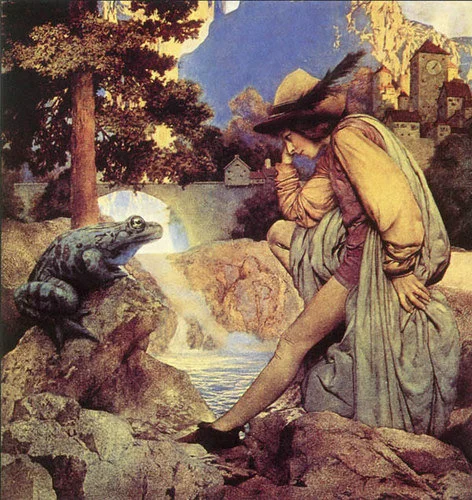
"Frog Prince,'' by MAXFIELD PARRISH, at the show "The Power of Print,'' at the Currier Museum of Art, Manchester, N.H., through Jan. 10. Mr Parrish did much of his work in New England at the artists' colony in Cornish, N.H.
Fishing-gear entanglement imperils endangered whales
WOODS HOLE, Mass.
Entanglement in fishing gear is the leading cause of death for North Atlantic right whales — one of the most endangered of all the large whale species. Their migratory routes take them through some of the busiest commercial fishing areas along the East Coast.
Entangled whales can tow fishing gear for tens to hundreds of miles over months or even years, before either being freed, shedding the gear on their own or succumbing to their injuries.
In a paper published Dec. 9 in Marine Mammal Science, a research team led by the Woods Hole Oceanographic Institution (WHOI) has quantified the amount of drag on entangled whales that is created by towing fishing gear, such as rope, buoys, and lobster and crab traps. The study provides relevant data for evaluating the risks and benefits of whale disentanglements.
“We know that entanglement can change a whale’s diving and swimming behavior and depletes their energy,” said Julie van der Hoop, lead author of the paper and a Ph.D. candidate in the MIT-WHOI Joint Program in Oceanography. “But the big thing we have never really known is what it must be like for animals to tow the gear. Is it like wearing an empty backpack or is that backpack overloaded with heavy books? Does removing part of the gear improve chances of survival? These are some of the questions that we were looking to answer with this research.”
Working with colleagues from the Center for Coastal Studies and NOAA Fisheries, van der Hoop used a tensiometer to measure the drag forces on various types of fishing gear collected from past right whale entanglements. The team tested 16 sets of gear — five sets that included floats or buoys, one that included a two-brick lobster trap and 10 that were line only — towing them behind the WHOI vessel R/V Tioga across a range of speeds and depths.
The team found considerable variation in drag created by the different sets of gear, with the presence of floats and buoys having a significant effect on the overall drag created for the entangled animal.
“Some entanglements have very low drag, for example, if a whale is towing 10 meters of rope, which is basically the length of the whale itself,” van der Hoop said. “The weighted lobster trap created the most with three times the amount of natural drag on a whale’s body. That’s a huge increase in what is normal to these animals.”
On average, the team found that entanglement increases the total body drag to 1.5 times that of a non-entangled whale. It also calculated the additional energy costs to the animal.
“Entangled animals have to spend twice as much energy to swim at the same speed,” said van der Hoop, based on results from a separate study.
“This study significantly improves our understanding of the energetic cost of large whale entanglement drag forces,” said Michael Moore, a co-author and van der Hoop’s advisor. “These persistent entanglement cases can be a very serious barrier to whales attempting to grow, migrate and reproduce. The study also reinforces current disentanglement efforts to minimize entangling gear if it cannot be removed entirely.”
The tests also allowed researchers to establish a relationship between drag and gear length, which will help in estimating the amount of drag on an entangled whale when it’s first spotted. By reducing trailing line length by 75 percent, drag on the animal can be decreased by 85 percent, according to the study.
This research is an expansion on an individual case study in 2013 of a two-year-old female North Atlantic right whale called Eg 3911 — or Bayla — which was first sighted emaciated and entangled in fishing gear on Christmas Day 2010 off the coast of Jacksonville, Fla., by an aerial survey team.
Using a small, suction-cupped device called a Dtag to monitor the animal, van der Hoop, Moore and colleagues from the Georgia Department of Natural Resources, the Florida Fish and Wildlife Conservation Commission and NOAA Fisheries showed how fishing lines impacted an entangled whale.
Though disentanglement efforts by a rescue team eventually led to the removal of almost all of the gear after several attempts, Bayla didn't survive. Her injuries were too severe to overcome. An aerial survey in February 2011 observed her dead at sea. A necropsy showed that effects of the chronic entanglement were the cause of death.
“We know that entanglement does more than just kill whales, and we know North Atlantic right whales aren’t as healthy as right whales in the Southern Hemisphere,” said co-author Peter Corkeron, of NOAA Northeast Fisheries Science Center. “This work is a step towards quantifying just how entanglement is contributing to North Atlantic right whales’ health problems.”
David Warsh: The new geography of jobs

Consider a handful of apparently disparate facts.
In “Wrapping It Up in a Person,” researchers last week reported in Science magazine on the first strong measurements of the impact of government-funded research on the economy – evidence designed to counter congressional suspicions of lollygagging in programs funded by, among others, the National Science Foundation. Almost 40 percent of Ph.D. recipients whose work was funded by federal and nonfederal programs took jobs in industry, disproportionate numbers of them in high-tech and high-wage establishments. (The rest took jobs in education or government.)
And while the graduates whose experience was studied spread across the nation, there was evidence of geographic clustering around the universities where their doctorates had been obtained, in this case, Indiana, Iowa, Michigan, Minnesota, Ohio State, Purdue, Penn State and Wisconsin universities. It was the physicist J. Robert Oppenheimer who observed that the best way to send knowledge out into the world was to wrap it up in a person.
Meanwhile, Boston made a short list of cities to which General Electric Co. is considering relocating its corporate headquarters – 500 or so high-paying jobs. New York and Providence are other possibilities. The 125-year-old technology company, with annual sales of around $150 billion, made headlines last summer when it announced it was considering pulling out of suburban Fairfield, Conn., where it has been since 1974, after the Connecticut legislature passed a package of hefty tax increases.

GE apparently crossed off its list Cincinnati, Dallas and, perhaps, Atlanta after state Congressional delegations lined up against the Export-Import Bank. Negotiations with legislative leaders in Hartford began immediately; GE may yet decide to remain in Fairfield. What makes a good headquarters city? A lively and diverse community, scientific and financial; neighborhood housing nearby; a short haul to a good airport; and, of course, supportive state and local government.
And in New York, activist investors led by Nelson Peltz, of Trian Partners, last week prepared to merge DuPont Co. and Dow Chemical, planning to reorganize the competing giants in order to spin them out as three companies, thus unsettling two other comfortable corporate abodes of long standing, Midland, Michigan, and Wilmington, Delaware.
What these phenomena have in common is that all are evidence of the forces reshaping both the distribution of income and the landscape itself. These accelerating trends are described to good effect by economist Enrico Moretti, of the University of California at Berkeley, in The New Geography of Jobs (Houghton Mifflin, 2012).
For all the hype about the death of distance, Moretti says, cities remain the most important generators of wealth, much as journalist and author Jane Jacobs first forcefully asserted they were more than 50 years ago in The Death and Life of Great American Cities. Telecommuting remains rare, important interactions still occur mainly face-too-face, and most of what we learn that is valuable comes from the people we know, not from textbooks or the Web. Moretti writes:
At the same times that goods and information travel at faster and faster speeds to all corners of the globe we are witnessing an inverse gravitational pull towards certain key urban centers. Globalization and localization seem to be two sides of the same coin.
To put it mildly, there is a good deal we do not know about the two-sided processes of globalization and localization. Therefore there was special interest in what Princeton’s Angus Deaton had to say in his Nobel Economics Prize lecture in Stockholm last week.
Had the award for measurement economics been made seven or eight years ago, it might have gone in a very different direction – to the great refinements in growth and national income accounting of the KLEMS program, for example. The award this year to Deaton signaled something new – what the committee called a “microeconometric revolution” in the analysis of consumption, inequality and poverty around the world also marked an apparent shift in attention to issues of distribution from the sources of growth.
It was Deaton, the committee observed, who had written two textbooks and a monograph designed to bring closer together the analysis of individual and aggregate outcomes. Typically, he pointed out that the supposed increase in global poverty first reported in 2005 stemmed mainly from the fact that rapidly growing India had been dropped from the set of countries forming the basis for the global poverty line, even though India had a relatively low measure of poverty compared to poorer countries. “In effect,” Deaton wrote, “India and the world have become poorer because India had become richer” because of the aggregation.
And it was Deaton who, with his economist wife Anne Case, also of Princeton, identified the soaring death rate among middle-aged U.S. whites, driven mainly by overdoses of prescription drugs and suicides, amidst rapidly falling morbidity rates in the same age groups in other industrial countries, and in the U.S. Hispanic population as well. It was a triumph of dis-aggregated analysis, published weeks after the Nobel award was announced.
Perhaps more than ever, it seems, there is much to be learned by taking things apart and seeking to put them back together again. The difference between the aggregates of early macroeconomics and the more sophisticated models and better data of the present day is the advent virtually limitless computing power. Theory is still important, but measurement is riding high.
David Warsh is proprietor of economicprincipals.com and a long-time economic historian and financial journalist.

"Scott City'' (encaustic, oil and archival inkjet prints on wood panel), by PAIGE BERG RIZVI

"Scott City'' (encaustic, oil and archival inkjet prints on wood panel), by PAIGE BERG RIZVI
"Scott City'' (encaustic, oil and archival inkjet prints on wood panel), by PAIGE BERG RIZVI, in the "Terrain Show'' at Fountain Street Fine Art through Jan. 10.

"Winter Light'' (oil on panel), by SUSAN CHARLES

"Winter Light'' (oil on panel), by SUSAN CHARLES
"Winter Light'' (oil on panel), by SUSAN CHARLES, at Alpers Fine Art, Andover, Mass.
John Kiriakou: The Red Cup controversy and X-Mass in America

I happened to be visiting the first-ever Starbucks in Seattle a few weeks ago when a mini-controversy erupted: There were no Christmas trees or snowflakes on this season’s holiday Starbucks coffee cups.
The horror!
Facebook exploded with comments, as did Twitter. Even Republican presidential candidate Donald Trump bloviated from the campaign trail that “maybe we should boycott Starbucks.” Referring to the Starbucks in his own Trump Tower in New York, the candidate added, “That’s the end of that lease.”
Conservative pundits immediately deemed the minimalist Starbucks cup design a “war on Christmas.”
For the life of me, I couldn’t understand what the controversy was about. This was a corporate entity that had decided to use plain red coffee cups instead of ones festooned with holiday icons. Big deal.
But the more I read into the story, the more I realized that Americans — and especially conservative Christian Americans — have a very parochial view of Christmas. For most people in this country, Christmas means a decorated tree, snow, and Christmas carols.
Those are nice traditions, but none of them has anything to do with the birth of Jesus Christ. They’re what modern American culture has turned Christmas into.
The Christmas tree, for example, is hardly ancient: It was popularized in Germany in the 16th century. It wasn’t adopted in the United States until the late 18th century — and even then, only among the upper classes. It’s not at all a part of the story of Jesus’ birth. Indeed, the Vatican itself didn’t even put up a Christmas tree until 1982.
Furthermore, in many cultures with longer Christian traditions than North America and Western Europe, the Christmas tree plays no role whatsoever. In Greece, the tradition favors a Christmas boat, a wooden structure around which Saint Basil the Greatplaces presents for children. Other cultures use a large, decorated shoe.
As a Greek-American with family roots in the sunny Mediterranean, I also never understood the significance of a “white Christmas.” Even as a kid I was aware that it rarely snowed in Bethlehem in December — or, frankly, in much of the world.
So if you’re dreaming of a white Christmas, dream on. And don’t get upset if your coffee cup doesn’t have snowflakes on it.
Even many Christmas carols, including some of the most popular ones, have no connection to the birth of Jesus. Personally, I reject anything with a mention of reindeer, for example. I doubt any of those polar caribou were milling about the Middle Eastern manger where Jesus was born.
And to be honest, we don’t have any real idea of when Jesus was born anyway. The church didn’t adopt the date of December 25 until the 4th century. Many scholars believe that date was chosen to placate Roman citizens who already were celebrating the “Festival of the Unconquered Sun.”
So with so much confusion and tradition not based on fact, can we lighten up on Starbucks?
John Kiriakou is an associate fellow at the Institute for Policy Studies and the winner of the 2015 PEN Center USA First Amendment award. This column is distributed by OtherWords.org.
Robert Whitcomb: How to Speed Up Infrastructure Repair
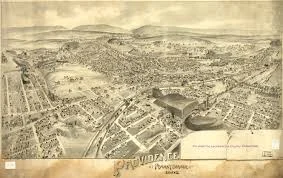
An irritated citizenry has blocked a bid by the Pawtucket Red Sox, employing very few people and with a mostly seasonal business, to grab valuable public land and erect, with lots of public money, a stadium in downtown Providence, on Route 195- relocation land. The plan would have involved massive tax breaks for the rich PawSox folks that would have been offset by mostly poorer people’s taxes.
The public is belatedly becoming more skeptical about subsidizing individual businesses. (Now if only they were more skeptical about casinos’ “economic- development’’ claims. Look at the research.)
Perhaps Lifespan will sell its Victory Plating tract to the PawSox. And maybe a for-profit (Tenet?) or “nonprofit’’ (Partners?) hospital chain will buy Lifespan, which faces many challenges. Capitalism churns on!
In any event, the stadium experience is a reminder that we must improve our physical infrastructure, in downtown Providence and around America.
Improved infrastructure will be key to a very promising proposal by a team comprising Baltimore’s Wexford Science & Technology and Boston’s CV Properties LLC for a life-sciences park on some Route 195-relocation acres. This could mean a total of hundreds of well-paying, year-round jobs in Providence at many companies. Tax incentives for this idea have merit. (I’d also rather fill the land slated for a park in the 195 area with other job-and-tax-producing businesses, but that’s politically incorrect.)
The proximity of the Alpert Medical School at Brown University, the Brown School of Public Health, hospitals and a nursing school is a big lure. Also attractive is that Providence costs are lower than in such bio-tech centers as Boston-Cambridge and that the site is on the East Coast’s main street (Route 95, Amtrak and an easy-to-access airport).
Rhode Island’s decrepit bridges and roads are not a lure. Governor Raimondo’s proposal for tolls on trucks (which do 90 percent of the damage to our roads and bridges) to help pay for their repair, and in some cases replacement, should have been enacted last spring. It’s an emergency.
It takes far too long to fix infrastructure, be it transportation, electricity, water supply or other key things. The main impediment is red tape, of which the U.S. has more than other developed nations. That’s why their infrastructure is in much better shape than ours.
Common Good sent me a report detailing the vast cost of the delays in fixing our infrastructure and giving proposals on what to do. It has received bi-partisan applause. But will officials act?
The study focuses on federal regulation, but has much resonance for state policies, too. And, of course, many big projects, including the Route 195-relocation one, heavily involve state and federal laws and regulations.
Among the report’s suggestions:
* Solicit public comment on projects before (my emphasis) formal plans are announced as well as through the review process to cut down on the need to revise so much at the end, but keep windy public meetings to a minimum.
* Designate one (my emphasis) environmental official to determine the scope and adequacy of an environmental review in order to slice away at the extreme layering of the review process. Keep the reports at fewer than 300 pages. The review “should focus on material issues of impact and possible alternatives, not endless details.’’ Most importantly, “Net overall (my emphasis) impact should be the most important finding.’’
* Require all claims challenging a project to be brought within 90 days of issuing federal permits.
* Replace multiple permitting with a “one-stop shop.’’ We desperately need to consolidate the approval process.
Amidst the migrants flooding Europe will be a few ISIS types. That there are far too many migrants for border officials to do thorough background checks on is scary.
Fall’s earlier nightfalls remind us of speeding time. When you’re young, three decades seem close to infinity, now it seems yesterday and tomorrow. I grew up in a house built in 1930, but it seemed ancient. (My four siblings and I did a lot of damage!) Yet in 1960, when I was 13, the full onset of the Depression was only 30 years before. The telescoping of time.

Textiles printed using large, engraved metal plates produced finely detailed scenes.

Printed at Bromley Hall, England, 1774-1811
Textiles printed using large, engraved metal plates produced finely detailed scenes. Blue threads in this fabric’s edge indicate that it was made for export to America or other British colonies. This was printed at Bromley Hall, England, 1774-1811

Charles Chieppo: What Do the States Really Owe?

When it comes to getting your arms around just how much states really owe, there is no shortage of moving parts. There's bonded debt, and then there are liabilities for pensions and for other post-employment benefits such as retiree health care.
Dig deeper and you find that states set different periods over which they aim to pay down liabilities and that they assume differing rates of return on investments. Some states use fixed annual payments, but many use a gradually increasing schedule that results in payments being backloaded.
A new report from J.P. Morgan performs an important service by showing how states would stack up if all of these major variables were standardized. The study's author, Michael Cembalest, assumes a 6 percent rate of return on investments, level annual payments and a 30-year term for paying down liabilities.
Despite nearly $1.5 trillion in debts and unfunded retirement obligations, the study finds that, overall, state liabilities don't amount to the kind of national crisis that has often been portrayed. That is, unless you live in one of the states that face some very difficult choices because their debt and retirement costs are at or above a quarter of state revenues.
Cembalest finds that states with a liability-to-revenue ratio of 15 percent or less are in pretty good shape, and 36 states fall into that category. But eight states are in trouble. Given all the attention its pension problems have garnered, it's no surprise that Illinois is the worst, but wealthy Connecticut isn't far behind. Five of the eight (Delaware, Hawaii, Illinois, Kentucky and New Jersey) would have to more than double their annual payments to get their debt and retirement liabilities under control. The other two states on the watch list are Massachusetts and West Virginia.
The 6 percent rate of return Cembalest assumes on state investments is below historical averages, but it represents a much safer strategy than the 7.5-8 percent that most states assume. Such rosy assumptions result in gaping budget holes during tough economic times when states are least able to plug them.
While it might seem to make sense to increase annual retirement-liability payments each year on the assumption that inflation increases payrolls over time, too high a rate of annual escalation results in backloaded contributions that can understate long-term liabilities.
Perhaps as a result of the attention devoted to public-pension costs in recent years, 29 states made their full annual required contribution (ARC) to their pension funds in 2012. But the cost of other post-employment benefits (OPEB) is an even larger burden than pension liabilities in Hawaii and Delaware, and it is equal to pensions in Connecticut, New Jersey and West Virginia.
Despite the magnitude of the problem, just seven states made their full ARC toward paying down OPEB liabilities that year. Montana and Nebraska contributed nothing.
If the J.P. Morgan report is correct, most states have dodged a bullet. But to avoid a future crisis, they must do a better job of both calculating and addressing long-term liabilities. Massachusetts, for example, uses a debt affordability analysis calibrated to ensure that debt-service costs don't exceed 8 percent of budgeted revenue in any future year.
In addition, state taxpayers can no longer shoulder the entire downside risk for pensions. As I have argued before, they should transition to a system under which employees have a choice between defined-contribution and cash-balance plans.
The majority of states that face manageable debt and retirement liabilities can rightfully breathe a sigh of relief. But unless they get more conscientious about long-term liabilities, they won't be so lucky in the future.

Charles Chieppo: New convention center math

Rarely is state government’s dysfunction on display more than in the waning days of a legislative session. This time around, exhibit A is the rush to approve a $1.1 billion expansion of the Boston Convention and Exhibition Center (BCEC) despite enough red flags to fill the quarter-mile-long building.
Apparently the $620 million the Massachusetts Convention Center Authority claims the BCEC and the Hynes Convention Centers pumped into the local economy last year makes it easy to set aside doubts. But a closer look at how the MCCA arrives at that estimate makes you realize why there are no real numbers in the convention industry.
Convention centers are designed to attract people from outside the area who wouldn’t otherwise spend money here. But one thing the industry doesn’t want you do know is that about half of convention attendees — whether in Boston or elsewhere — are generally locals who’d be spending their dollars at a nearby mall if they weren’t eating in a Seaport District restaurant. It’s no accident that the number of hotel room nights generated by the BCEC and the Hynes is less than the number of people who attend events at the facilities; many of the attendees sleep in their own beds at night.
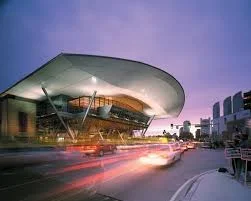
Yet when Pioneer Institute obtained a description of the methodology by which the MCCA derives its economic impact number, we discovered that it includes a “dollars saved” category and assumes “the in-state attendee would have attended the event regardless of location.” Believe it or not, the MCCA actually pretends that every local attendee at a BCEC or Hynes convention would still have gone if it were held in Las Vegas or Orlando, and the authority includes the savings as part of its “economic impact.”
Did that $620 million number just lose a zero?
The economic impact follies are just the latest in a line of troubling revelations about the expansion proposal. First came word that, contrary to MCCA claims, taxpayers would indeed pay a price for expansion. Receipts from taxes that flow into the Convention Center Fund and support the authority could revert to the commonwealth’s general fund once BCEC bonds are paid off in 2034. Expansion of the facility would keep that money flowing to the MCCA until about 2050, siphoning off at least $5 billion from state coffers.
Next we learned that the expansion bill doesn’t require the MCCA to go back to the Legislature if it wants to take more money from the Convention Center Fund. The waiver is akin to a blank check when it comes to the hefty public subsidy that will be needed for the 1,200 to 1,500 room headquarters hotel that is part of the expansion plan.
Finally we learned that the legislation exempts the project from state procurement and public disclosure laws. That means we might never find out how large a subsidy that new hotel will require.
Thankfully, as the Herald recently reported, Senate Bonding Committee Chair Brian Joyce (D-Milton) thinks the BCEC expansion question requires more thought and deliberation. Let’s hope this is one time when lawmakers won’t pass a bill to find out what’s in it.
Charles Chieppo is a senior fellow at Pioneer Institute. He is a former vice chair of the Massachusetts Convention Center Authority.
Chris Powell: Why not elect UConn's president and board instead?
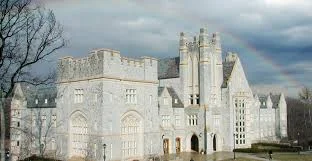
Now that the likely Republican nominee, Tom Foley, has assured state employees that he would follow Governor Malloy's generous policies toward them, there's not much point in having an election for governor. The state employees have already won it by forfeit. But since the University of Connecticut has just decided to push its annual budget up to $1.2 billion, an increase of nearly 5 percent, and to raise tuition by more than 4 percent, it would be good if the state could have an election for the university's president and Board of Trustees.
Yes, as UConn officials complain, state government's direct financial support for the university has been declining and as a result tuition increases are as much a decision by the governor and General Assembly as by the university itself.
But behind the political cover of its champion basketball teams UConn long has been building an empire about which there are many compelling questions.
Salaries at UConn are sometimes so spectacular as to be scandalous, from the president's own, $500,000, to the salaries of various UConn employees who get inconvenient notice from time to time, like the police chief, music department dean, and vice president for publicity who lately have been paid nearly a quarter million dollars, far more than the governor is paid for taking nominal responsibility for the whole of state government.
While in raising its budget the university boasted that it is improving its ratio of teachers to students, it did not detail how many of those teachers will be actually teaching rather than pursuing UConn's longtime objective to become “a great research university,” wherein professors get to do whatever they want and needn't bother with mere undergraduates, whose instruction can be left to graduate assistants, some from abroad with impenetrable accents. The university long has been vague about just how much teaching is being done by exactly whom.
Then there's the UConn Foundation, which lately has been keeping two presidents on its payroll, the outgoing one making $484,000 per year as a sort of retirement gift and the new one enjoying a salary that has not been disclosed, apparently because it would risk more criticism.
In addition, the foundation recently spent $660,000 so the university's president could have not only a mansion in Storrs but also a mansion in Hartford from which she and the university might more easily continue to overawe the governor and state legislators.
That Connecticut knows even this much about the UConn Foundation is only by its permission. The foundation has been exempted from the state's Freedom of Information Act on the grounds that donors might be less generous if the public could find out what they are giving -- information that would involve what they are [ITALICS] getting [END ITALICS] in exchange for their donations, like the dismissal of the university's athletic director three years ago, which happened not long after it was demanded by a big donor who was sore that the athletic director wouldn't heed his advice about the football team.
Two months ago the Senate chairman of the General Assembly's Higher Education Committee, Stephen T. Cassano, D-Manchester, acknowledged UConn's haughtiness, remarking, "We have just as much chance of sitting with the Soviet Union as we do with UConn." Cassano expressed concern about the impending tuition increase and said the university needed to communicate more with the legislature.
But nothing came from that; it was only Cassano's obligatory posturing when he was pressed for comment. He called no hearings. Meanwhile the governor lets UConn do whatever it wants and legislators generally are content if they can have their pictures taken with the basketball players. No one in authority puts any critical question to the university and there's little danger that it will have to answer to anyone soon.
-----
Chris Powell is managing editor of the Journal Inquirer in Manchester, Conn.
Don Pesci: The Rock Cats Shuffle
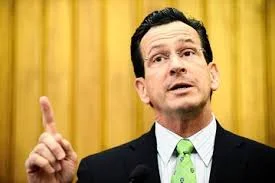
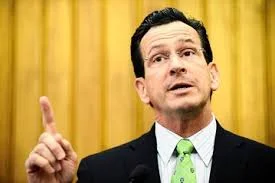
Governor Daniel Malloy
Facing what is certain to be a hard fought gubernatorial campaign, Governor Dannel Malloy vowed that he would not intervene (read: invest state tax money in) a pre-arranged deal between officials in Hartford and the owners of the New Britain Rock Cats to reposition the baseball team in Hartford.
Chris Powell, managing Editor of the Journal Inquirer and the paper’s chief political columnist, noted wryly that any such “investment” on the part of Mr. Malloy would be redundant, since state taxpayers already provide Hartford, as well as other large non-self-sustaining cities in Connecticut, with sufficient funds that more than offset any expenses involved in relocating and housing the team.

The Malloy administration certainly has sufficient experience in providing tax funds to a number of companies in Connecticut that have moved from one town in the state to another, but this time, perhaps because of the proximity of an election, Mr. Malloy has turned his face to the wall. He had already gone on record as promising no new taxes, no union giveaways and no reductions in services. Any tax money doled out to Hartford, a one-party Democratic basket case, to facilitate the Rock Cats’ move from New Britain to Hartford would, considering the campaign pledges made by Mr. Malloy, have been politically awkward.
The crowd that turned out at the Town Meeting in Hartford to oppose the Rock Cats shuffle was not concerned with the political futures of those One Party Town politicians who brokered the deal months before it was announced as a fait accompli by Hartford Mayor Pedro Segarra. Opposition to the back- room deal was vigorous – and poetic.
Hartford resident Chris Brown stepped before the microphone and said:
In a starling announcement on the sunny fourth of June, From left field came a surprise that afternoon. With dicey-looking figures and mathematical wiggle room, We saw the latest road map to efficient fiscal doom. The numbers are inflated, optimistic fuzzy math, With details twice as blurry as a fuzzy photograph. If the goal’s creating jobs, I propose a better path. Make jobs of things we use in Hartford every day, Like my wondrous local library, underfunded, overfilled, Like repairing the streets and sidewalks that are crumbling away … These lower cost investments in the things you might find dull Will be longer term solutions to our economic lull. They are all more shovel-ready than a steaming load of bull.
Mr. Brown’s poetry recital was interrupted twice by raucous applause. People in the audience were resisting the move for two reasons: 1) They felt that the priorities of the city fathers, all Democrats, were woefully misplaced. Hartford’s real needs would not be met by the relocation to the city of a baseball team; and 2) Those who arranged the deal months earlier had not consulted them concerning the move.
"People talk a lot about the declining faith in government," said Joshua King, who lives on Broad Street. "This is why. This is it."
"When the mayor came on, one of his biggest words was transparency," said Evelyn Richardson of Enfield Street. "How do you hold 18 months of [secret] meetings and call that transparency?"
Mayor Pedro Segarra issued a response through a spokeswoman: "We have understood from the beginning that this project would require public discussion, participation and dialogue. Just like tonight, there will be many opportunities to learn more about how this revitalization will be an asset to the community for years to come."
Mr. Brown touched most of these points in his poem: Public discussion should precede, not follow, major decisions. Without pre-discussion the “government of the people by the people and for the people” is thrown to the three winds. Mr. Segarra wears his arrogance well. To say in the face of such heated resistance “there will be many opportunities to learn more about how this revitalization will be an asset to the community for years to come" is to say – the only role the public may play in matters of this kind is to hear and accept supinely the decisions that have been made for you by your betters.
This is the usual posture of most political leaders in one-party political operations -- countries, states, towns or, for that matter, families ruled by stiff-necked autocrats.
The real problem with Hartford is that it is suffering all the ills of a one party autocracy. Always and everywhere in history, the autocrat, the patron, the Jefe, is interested chiefly in maintaining his status through the abject obedience of his subjects, who receive benefits dispensed by the one party operation without their participation or consultation. Real democracy upsets his carefully constructed apple cart.
Jefe knows best.
Don Pesci is a writer who lives in Vernon E-mail: donpesci@att.net

And in a flammable place
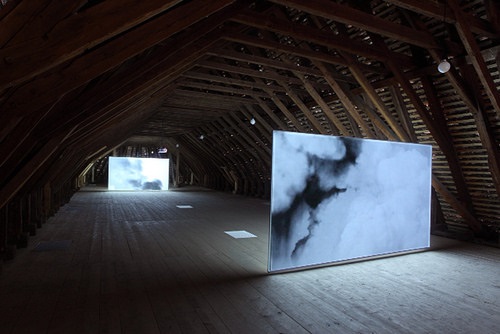
"Smoke'' (installation view, two-channel video, looped), by LISA OPPENHEIM
"Smoke'' (installation view, two-channel video, looped), by LISA OPPENHEIM, in the "Film as Medium and Metaphor'' show at the Massachusetts Museum of Contemporary Art, North Adams, Mass.
“The Rule of Nobody: Saving America From Dead Laws and Broken Government,” is a well-named collection of proposed new amendments to the U.S. Constitution that he calls the “Bill of Responsibilities.”
In the appendix of Philip K. Howard’s new book,
“The Rule of Nobody: Saving America From Dead Laws and Broken Government,” is a well-named collection of proposed new amendments to the U.S. Constitution that he calls the “Bill of Responsibilities.”
I over-summarize them here; read the book. Mr. Howard is an engaging writer, using stories (some grimly funny) to get across his strong prescriptions.
Mr. Howard proposes amendments to: “sunset” old laws and regulations; give the president power to far more effectively manage the executive branch — including line-item vetoes and expanded discretion to hire and fire and reorganize operations, all subject to being overridden by a majority of each house of Congress — and widen judges’ power to dismiss unreasonable lawsuits.
Finally, he recommends an amendment to create a “Council of Citizens” as an advisory body to make recommendations on how to make government more responsive to the public’s needs. This reminds me of the Hoover commissions on government reorganization of the late 1940s and the ’50s, named after Herbert Hoover, who chaired them. The composition of this council would be very federalist, with members chosen “by and from a Nominating Council composed of two nominees by each governor of a state.” The idea is to push along the ideas represented by the other new amendments. This is intriguing but the nomination process could get caught in political sludge.
The phrase “Bill of Responsibilities” gets to the heart of what Mr. Howard is saying throughout his book: that we have become so tangled up in laws and regulations that it’s often impossible to exercise authority and take responsibility — the avoidance of which, I would add, is attractive to many people, just as long as they continue to have the perks of their positions. As a result, it’s tougher and tougher to get things done, at the local, state and federal levels, whether it is fixing a bridge, creating a health-care system whose benefits are commensurate with its vast cost, or firing an incompetent bureaucrat.
Admiral Chester Nimitz said during World War II, “When in command, command.” President Truman said of the prospect of Dwight Eisenhower as president: “He’ll sit here, and he’ll say ‘Do this! Do that!’ And nothing will happen. Poor Ike. It won’t be a bit like the Army. He’ll find it very frustrating.” Well, Eisenhower turned out to be a pretty effective president but Truman was fairly accurate: It has always been hard to make government work, and in many ways it’s harder now than 60 years ago because of the accretion of laws and regulations, many of which should have been eliminated or streamlined long ago. A law or a regulation cannot cover every eventuality, Mr. Howard writes: You need judgment and common sense. Fewer laws and more decisions, please!
The problems that Philip Howard tackles remind me of the growing dominance of process over content (or maybe call it substance). You see this in daily life with the increasing time demanded to keep up with endlessly updated computer programs (planned obsolescence!), and the hours needed to fill out tax returns and insurance forms.
Meanwhile, the European Court of Justice has issued an advisory judgment that European Union residents have the right in certain circumstances to make search engines remove links to personal information that people think damages them. It’s “the right to be forgotten,” a cousin of Americans’ famous, if informal, “right to be left alone.”
This will be very difficult to enforce, given the vast complexity of the Web. But I like the idea of taking down the arrogance of Google, et al., a few notches. You don’t have to be much of a “public figure” to be the object of scurrilous inaccurate attacks on the Internet for which the likes of Google wrongly take no responsibility. In the Digital Age your good name can be instantly destroyed on the screen.
The court supported exceptions for “public figures,” especially politicians. But that’s very tricky: Almost anyone can become a “public figure” on the Internet. And is it fair to exclude politicians, etc., from such protection from attacks? Whatever, the European case at least raises the issue of responsibility for content, which the search-engine companies, most notably Google, have tended to avoid while raking in billions of dollars.
***
A college “commencement” is a strange term because it seems much more of an ending, as emphasized by the dirge-like “Pomp and Circumstance.” Sadder is that so many colleges, supposedly refuges of the free exchange of ideas, surrender to demands for censorship by “activists” to block commencement speeches by people (usually with comparatively “conservative” views) whose opinions they don’t like. Cowardly college chiefs fail to take responsibility for protecting one of their central missions.
Robert Whitcomb (rwhitcomb51@gmail.com), a former editor of these pages, is an editor, writer, management consultant at Cambridge Management Group (cmg625.com). and a fellow at Pell Center for International Relations and Public Policy.
Crows' business model; river town
Crows, which are highly intelligent, if often associated with death, have a very effective business model as scavengers. Indeed, being a good scavenger of things and ideas seems essential for thelong-term success of most of us. (A successful investor is a particularly good scavenger -- an outstanding opportunist.)

"Two Crows,'' by JAMES REED, in his show at Gallery19, in Essex, Conn., through June 3o.
Crows, which are highly intelligent, if often associated with death, have a very effective business model as scavengers. Indeed, being a good scavenger of things and ideas seems essential for the long-term success of most of us. (A successful investor is a particularly good scavenger -- an outstanding opportunist.)
When I was a kid living on thepre-environmentalist coast, seagulls were protected because they cleaned up the garbage left in the open. They did a particularly fine job on the remnants of beach picnics. Crows do the same thing and swiftly consume roadkill, too.
Essex, by the way, is a beautiful town on the Connecticut River, one of several beautiful communities in its area. New England is not famous for its big rivers, of which the Connecticut is the only one, and doesn't have many of what you would call "river towns'' in, say, a Midwestern or Southern sense.
But the Connecticut looks pretty big in the southern Nutmeg State and Essex is definitely a river town, with all that implies about water-borne transportation, commerce and culture in general.