







A_map_of_New_England,_being_the_first_that_ever_was_here_cut_..._places_(2675732378).jpg

Vox clamantis in deserto

Commentary Robert Whitcomb Commentary Robert Whitcomb

PCFR speakers from far and wide

  Speakers at the 2014-15 season of the Providence Committee on Foreign Relations (thepcfr.org) were:

Anders Corr, a geopolitical analyst and former Defense Department official in Afghanistan, on Chinese expansionism.

Richard George, former high National Security Agency official, on international cyber-security.

Prof. Evodio Kalteneker, on the Brazilian economy and politics.

Professor and journalist Janet Steele on democratic Indonesia.

Jennifer Yanco, a public-health expert and a director of the West Africa Research Association, on the Ebola crisis.

Australian Consul Gen. Nick Minchin, on his nation’s relations with Asia and the U.S.

Delphine Halgand, a high official of the Paris-based Reporters Without Borders, on threats to free speech and journalism. (She spoke a few days after the Charlie Hebdo massacre.)

Amir Afkhami, M.D., a psychiatrist, on dealing with mental illness in war zones, particularly the Mideast.

Military historian and retired Army Colonel Andrew Bacevich on why America should stop fighting wars in the Mideast.

Famed Canadian journalist Diane Francis on why the U.S. and Canada should consider merging.

International landscape architect Thomas Paine on making cities more humane, especially in China.

Admiral Robert Girrier, deputy chief of the U.S. Pacific Fleet, on countering Chinese expansion in the South China Sea.

Gary Hicks, deputy chief of mission in Libya at the time of the Benghazi attack and now at the Center for Strategic and International Studies on lessons for the U.S. in Libya and the future of international trade.

The new season looks exciting too. (And maybe even useful for investing decisions.)

We’re still penciling in speakers and dates, but we can say that Cuban-American businessman and civic leader Eduardo Mestre will speak on Sept. 30 about the reopening of diplomatic relations between the U.S. and the land of his birth.

Mr. Mestre is a member of the boards of the International Rescue Committee and the Cuba Study Group.

He’s also a senior adviser at Evercore and was previously vice chairman of Citigroup Global Markets and chairman of its Investment Banking Division. Before then, he headed investment banking at Salomon Smith Barney and its predecessor firms from 1995-2001 and was co-head of Salomon Brothers' mergers and acquisitions department in 1989-1995.

Skedded for Oct. 22 is Scott Shane, the New York Times reporter who wrote the new book Objective Troy, about  Anwar al-Awlaki, “the once-celebrated American imam who called for moderation after 9/11, but a man who ultimately directed his outsized talents to the mass murder of his fellow citizens’’ and was eventually killed by an American drone. Among other things, he’ll discuss the moral issues raised by the increasing use of drones.

Some of the people we have on the drafting board for the rest of the season:

A U.N. expert on international refugee crises; a journalist or diplomat who will discuss the Greek crisis; a member of the Federal Reserve Board who will discuss international financial-system challenges; a Japanese journalist to talk about that nation’s increasingly muscular regional posture; an expert on international shipping in light of the widening of the Panama Canal; a status report on Mexico; a Chinese philanthropist; a member of the Ukrainian Congress Committee; (we have been trying for some time to get a Russian official or journalist to give Moscow’s side of the war in eastern Ukraine), and the director of the Aga Khan University Media School to talk about training journalists in the Developing World

All subject to change. We frequently repeat Prime Minister Harold Macmillan’s purported response when he was asked what he most feared:

“Events, my dear boy, events.’’

Members should feel free to chime in with suggestions.

Also, we’ll strive to frequently update the PCFR Website with supplemental news and commentary on international matters that may be of interest.

Please consult www.thepcfr.org or message pcfremail@gmail.com for questions about the PCFR.

Enjoy the rest of the summer!

Robert Whitcomb, chairman

pcfremail@gmail.com


Read More
Commentary Robert Whitcomb Commentary Robert Whitcomb

Sort of a sex scandal

Read More
Commentary Robert Whitcomb Commentary Robert Whitcomb

What about Pataki?

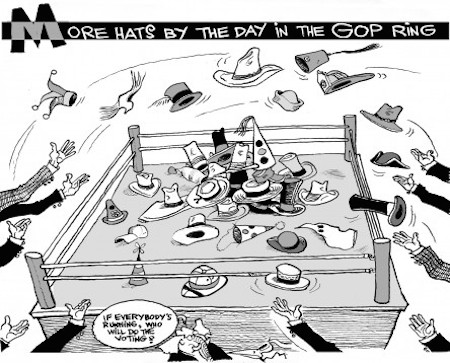
gop Cartoon from OtherWords.org

Why don't more people pay attention to a person you'd think would be a major GOP presidential hopeful  -- former  three-term New York Gov. George Pataki, a very successful chief executive of a very big state?

He's running for president, but  New Jersey's Chris Christie, a not very successful governor, gets about 95 percent of the attention from those who think that  a Northeast Republican could actually win the nomination of a party now mostly run from the South.

--- Robert Whitcomb


Read More
Commentary Robert Whitcomb Commentary Robert Whitcomb

Jill Richardson: Luxury vacation with no conveniences

When you read this, I’ll probably be out in the wilderness on a 220-mile hike along the John Muir Trail. Embarking on this journey through California’s breathtaking Yosemite, Kings Canyon and Sequoia National Parks reminded me of a conversation I had in Mexico five years ago.

I’m a relative newbie to hiking and backpacking — I didn’t grow up outdoorsy. Traveling to a rural part of Chiapas in 2010 to research indigenous farming techniques took me outside my comfort zone and helped me find a new hobby.

I went with friends I trusted, and they were comfortable with our accommodations. My discomfort started the first time I asked for the restroom and somebody told me to go behind a tree.

Wait, you mean there’s no — what?

About a week later, I noted to my fellow travelers that living among peasant farmers felt an awful lot like camping. Only camping is something Americans do for recreation for short periods of time (and with fancy gear).

In this part of Mexico, this was how people spent their entire lives — except without down sleeping bags or portable espresso makers. The closest thing many Americans can imagine to that is Survivor, the old reality TV show.

Imagine if the hiking boot were on the other foot. How about a reality show for rural Mexicans in which competitors commuted to work in heavy traffic and then sat at a desk for eight hours looking at spreadsheets, interrupted only by staff meetings?

My time in Mexico didn’t immediately lead me to take up camping, but it helped me grow a little more comfortable going without modern “necessities” like toilets or hot showers.

It was ultimately my love of North American nature that got me to take up camping. You can see a lot of magnificent beauty on short day hikes, but some natural wonders require days of backpacking to get there — and there’s no Holiday Inn on the trail.

So I’m giving up my beloved indoor plumbing and extra-firm mattress to enjoy what a 25-day hike through California’s Sierra Nevada mountains can offer. I’m spending nearly a month close to nature, without many modern conveniences. For fun.

You know what? The hot showers I take in my bathroom are fantastic, but not as good as bathing in a rain forest’s river like the people I met in Mexico do every day.

And beds are utterly fantastic — but I don’t get to see the stars very often when there’s a roof over my head. My friends in rural parts of Kenya, the Philippines, and Bolivia see them every night.

Between doing cardio in a gym and walking on trails, there’s no contest. The gym has no stream running alongside the treadmill, and even the best smelling gym can’t compare with the fragrance of a pine forest.

My comparison of life in rural Mexico to camping initially elicited sympathy for my Mexican hosts because of all the material comforts we have and they lack. Now, I’m heading out to temporarily seek a life more like theirs for a few weeks.

For everything Americans gain from our modern conveniences, perhaps we’ve lost a few too many old-fashioned pleasures. Like walking along tree-lined trails. Or observing wildflowers as they bloom throughout the warmer months. And looking up in awe at the stars every night.

Our national and state parks afford these pleasures to anyone who can get there and spare the time. The 25 days I’m taking to do this hike is an enormous luxury that many Americans will never enjoy. The wonders of nature should be accessible to all, not a luxury for the privileged few.


Jill Richardson is the author of Recipe for America: Why Our Food System Is Broken and What We Can Do to Fix It.  This originated at OtherWords.org.

Read More
Commentary Robert Whitcomb Commentary Robert Whitcomb

Upholding the dignity of the beach

Batherkatz "Bather'' (oil on linen), by ALEX KATZ, in the show "Alex Katz in the 1950s,''  at the Colby College Museum of Art, Waterville, Maine, through Oct. 18.

Read More
Commentary Robert Whitcomb Commentary Robert Whitcomb

Maybe more jailing, less crime?

I was amused to hear the talking heads on the radio  today say, in connection with President Obama's visit to a prison, that we should stop the incarceration emphasis of the last three decades because crime rates have fallen so low. Might they not think that many logical listeners would think that there just might be a link between a higher jail rate and a lower crime rate? Or  does the lower crime rate mostly stem from the aging of the population?

-- Robert Whitcomb

Read More
Commentary Robert Whitcomb Commentary Robert Whitcomb

'Infusion 2015' of salsa and fashion

  This was just sent to us:

"Prepare for your next resort get-away by viewing the hottest looks of the season and immerse yourself in a night of fashion, cocktails, music and a mixture of Latin-inspired entertainment by the dance professionals of Salsa con Soul. Following the runway show will be 4 hours of social mingling and dancing.

''INFUSION 2015 is the first fully infused showcase of fashion and the resort experience. It’s about bringing together the looks of resort fashion and the flare of the resort destination experience. For the first time in Rhode Island, both industries, communities and aficionados of Fashion and Salsa unite to host an event in the city of Providence to engage, showcase and celebrate, the talents, brands and people of its scene. On Saturday July 18th, many will witness for the first time a total INFUSION experience that involves two highly talented fashion designers as well as the skillful dance professionals of Salsa con Soul. Resort runway meets resort salsa 7pm-2am at Aurora Providence.''

Read More
Commentary Robert Whitcomb Commentary Robert Whitcomb

Lines of memory

  Prey


"Fibonacci's Workshop'' (watercolor), by BARBARA ERNST PREY, in the show "Re/Viewing the American Landscape,'' at Blue Water Fine Arts, in Port Clyde, Maine, July 20-Aug. 31.

The gallery says this is an  example of using color to create "a jarring balance.''

"Each wash within this painting has subtly changed the nature of the piece until the depth and balance are achieved, making the painting as much a reflection of the space changing over time as well as the artist's memory.''


Read More
Commentary Robert Whitcomb Commentary Robert Whitcomb

Llewellyn King: Alternative energy threatens electric grid

On Feb. 3, 1960 in Cape Town, British Prime Minister Harold Macmillan shook up what was still the British Empire in Africa by telling the Parliament of South Africa that “the wind of change is blowing through this continent.”

His remarks weren’t well received by those who that thought that it was premature, and that Britain would rule much of Africa for generations. The British ruling class in Africa – the established order — was shaken.

But Macmillan’s speech was, in fact, a tacit recognition of the inevitable. It was the signaling of a brave new world in which Britain would grant independence to countries from Nigeria to Botswana and Kenya to Malawi. Britain would not attempt to hold the Empire together. His speech was seminal, in that Britain had signaled that things would never ever be the same.

To me, the appearance of investor and entrepreneur Elon Musk at the Edison Electric Institute’s annual convention in New Orleans was a “wind of change” moment for the august electric utility. It was a signal that the industry was coming to terms, or trying to come to terms, with new forces that are challenging it as a business proposition in a way that it hasn’t been challenged in a history of more than 100 years.

But whereas Britain could swallow its pride and start a withdrawal from its former possessions, the electric industry faces quite a different challenge: How can it serve its customers and honor its compact with them when people like Musk, who is the non-executive chairman of the aggressive company SolarCity, and a passionate advocate of solar electricity, and Google are moving into the electric space?

At EEI’s annual convention, Musk didn’t tell his audience what he thought would happen to the utilities as their best customers opted to leave the grid, or to rely on it only in emergencies, while insisting that they should be allowed to sell their own excess generation back to the grid. Musk also didn’t venture an opinion on the future of the grid — and his interlocutor, Ted Craver, chairman and CEO of Rosemead, Calif.-based Edison International, didn’t press him.

Instead Musk talked glowingly about the electrification of transportation, implying — but not saying outright — that the electric pie would grow with new technologies like his Tesla Motors’ electric car.

The CEOs of EEI’s board were ready for the press by the time they held a briefing a day after Musk’s opening appearance. They spoke of “meeting the challenges as we have always met the challenges” and of “evolving” with the new realities. Gone from recent EEI annual meetings was CEO talk of their business model being “broken.”

The great dark cloud hanging over the industry is that of social justice. As the move to renewables becomes a flood, enthusiastically endorsed by such disparate groups as the Tea Party and environmentalists, the Christian right and morally superior homeowners, and companies like SolarCity and First Solar, the poor may have difficulty keeping their heads above water.

The grid, a lifeline of U.S. social cohesion, remains at threat. Utilities are jumping into the solar business, but they have yet to reveal how selling or leasing rooftop units — as the Southern Company is about to do in Georgia — is going to save the grid, or how the poor and city dwellers are going to be saved from having to pay more and more for the grid while suburban fat cats enjoy their sense that they’re saving the planet.

My sense is that in 10 years, things will look worse than they do today; that an ill wind of change will have reduced some utilities to the pitiful state of Amtrak — a transportation necessity that has gobbled up public money but hasn’t restored the glory days of rail travel.

People like myself — I live in an apartment building — have reason to fear the coming solar electric world, for we will be left out in the cold. The sun will not be shining on those of us who still need the grid. It needs to be defended.

Llewellyn King (lking@kingpublishing.com) is host of  White House Chronicle, on PBS, and a longtime publisher, editor, writer and international business consultant. This column was previously published in Public Utilities Fortnightly.

Read More
Commentary Robert Whitcomb Commentary Robert Whitcomb

Lose the lawns

Drought-stricken California is starting to make developers reduce the area devoted to lawns, which are huge water-guzzlers. You'd think from looking at Southern California's heavily lawned landscape that it is as wet as New England rather than a desert made green by water from hundreds of miles away in the High Sierra. Lawns, even in usually damp New England, are huge wasters of water, and a major contributor of pollution from the fertilizers and pesticides  that folks dump on them, often to excess.

Ground cover or just trees are a much better use of the land, though I  still appreciate the beauty of a very green lawn. I have fond memories of lying on them on  hot, pre-air-conditioned nights watching the fireflies. But we give lawns far too much space.

I wish that my parents had planted over their lawns on the Massachusetts coast with something that didn't require my spending many hours a month cutting them -- my earliest  steady "summer job.''

Back then,  in the  '50s and early '60s,  we never worried about using too much water or about pouring on the (pre-Silent Spring) pesticides and fertilizer.

-- Robert Whitcomb

Read More
Commentary Robert Whitcomb Commentary Robert Whitcomb

'and our little life is rounded with a sleep'

power  

"Floating'' (oil on canvas), by SKY POWER, in the group show "Mystical Landscapes,'' at the Berta Walker Gallery, Provincetown, Mass., July 27-Aug. 9.

Read More
Commentary Robert Whitcomb Commentary Robert Whitcomb

Chris Powell: Of a Confederate flag and a corrupt former mayor

MANCHESTER, Conn. For a few days last month Connecticut’s Democratic state headquarters tried to make a scandal out of the Confederate flag being flown by a member of the Republican State Central Committee at his home in Berlin.

The man maintained that he flew the flag as a protest against political correctness, not as support of racial oppression. But Senate Republican Minority Leader Len Fasano, Danbury Mayor Mark Boughton, and Trumbull First Selectman Tim Herbst, among other leading Republicans, quickly condemned the gesture.

It was a tempest in a teacup, or a thimble, really, since a single member of the state committee of a political party that holds no statewide or congressional offices is of little consequence. The issue was just an excuse for Democratic headquarters to proclaim that since it had located a nutty Republican, all Republicans in Connecticut are nutty -- as if the state has no nutty Democrats.

Infinitely more remarkable is the silence surrounding former Bridgeport Mayor Joseph Ganim's candidacy for mayor again despite his extensive corruption in office, for which he served seven years in federal prison before his release in 2010.

Of course Bridgeport Mayor Bill Finch, facing Ganim in the Democratic primary in September, argues that his challenger's corruption should disqualify him. But all other leading Democrats in the state seem to be silent about Ganim. Thus the Democratic Party is suggesting that a bitter old crank's flying the Confederate flag is more of a disgrace to his party and more of a threat to society than someone who took bribes and kickbacks while presiding over the state's largest city and who may get the chance to do it again.

Last week, in a distressing irony, the ex-convict candidate was endorsed by Bridgeport's police union, apparently in the expectation that as mayor again Ganim would go easier on city employees than the incumbent.

Gov. Dan Malloy could quickly resolve the Bridgeport issue in favor of integrity in government by announcing that his administration would not cooperate with a Ganim administration and that if Bridgeport holds so little respect for itself and the state, it will be on its own. The governor's "second-chance society" initiative to rehabilitate nonviolent offenders, welcome as it is, doesn't rationalize degrading public office.

xxx

A Connecticut Superior Court judge is being criticized for declining to issue a protective order to a woman whose boyfriend later threw their baby to his death from the Arrigoni Bridge, in Middletown. At a hearing the judge concluded that the evidence presented to him didn't support the request -- that the evidence showed that the couple's relationship was "chaotic" but not imminently threatening.

Maybe the judge was wrong about the evidence, but at least he reviewed it, while no one bothered to review it before criticizing him. Rather, the advocates of women against their crazy boyfriends and husbands simply presumed, as they always do, that a woman's accusation should be considered valid without any inquiry at all.

Lately these advocates have been making this argument in regard to guns owned by men against whom wives or girlfriends seek a protective order -- that such men should be required to surrender their guns before any hearing and finding, that simple accusation means guilt, and that ordinary due process of law is dispensable.

In the recent hysteria over gun crimes, even the governor and many state legislators, while sworn to uphold our constitutions, have also supported discarding due process.

But Connecticut can have due process and public safety in the normal way -- with formal criminal accusation, arrest, and speedy trials. Until Connecticut provides speedy trials in domestic cases, the state will be left with these calls for "Alice in Wonderland" justice: sentence first, verdict afterwards.

Chris Powell is managing editor of the Journal Inquirer in Manchester, Conn.

Read More
Commentary Robert Whitcomb Commentary Robert Whitcomb

Video: John Oliver on sports-stadium corruption by the rich

Read More
Commentary Robert Whitcomb Commentary Robert Whitcomb

Forming a government

  rodriguez_birthofanation

"Birth of a Nation''  (detail) (installation with toddler T-shirt, digital print and fishing line), by BRYAN RODRIGUEZ,  in the group show "Wildlife Sanctuary,'' at the Samson Gallery, Boston, through Aug. 22.


Read More
Commentary Robert Whitcomb Commentary Robert Whitcomb

In defense of (and fear of) Chinese censorship

  Read how growing up in a police state affects a young person's understanding of freedom of speech -- and lack thereof -- as we see in this piece in The Journal of Political Risk. In this case, it's Grace Zhang, a Chinese student studying at Adelphi University, in New York, defending censorship.

Most Americans would find her argument preposterous. But then, this Shanghai  native will have to return to China some day. It just wouldn't do to irritate the authorities.

Here's the first paragraph of her piece:

"There has been a great deal of attention, domestic and abroad, surrounding China’s education minister, Yuan Guiren, and his January 2015 speech in Beijing.[i]In his speech, Yuan touched on the controversial topic of minimizing the usage of Western ideals in textbooks and classroom discussion in higher education. He called for limited use of Western textbooks, effectively blocking the way of Western values entering the classroom and forbidding the criticism of Communist Party’s leadership and negative attitude from teachers that will affect students. To Western countries, this speech may be difficult to understand and may also easily trigger criticism because Yuan’s opinions go explicitly against the liberal education that Western higher education has stood for centuries. I, however, am of the opinion that if one only reads the words of the speech without any consideration of China’s difference in political systems from Western countries, it is very easy for readers to think that China is blocking the way of liberal education in their universities, but the actual purpose behind this speech, is Yuan’s advocating for Chinese national interest.''

Read More
Commentary Robert Whitcomb Commentary Robert Whitcomb

G.W. Bush's $100,000 fee from nonprofit for wounded vets

Read More
Commentary Robert Whitcomb Commentary Robert Whitcomb

Making a 'Blue Plan' for Long Island Sound

Via ecoRI News Connecticut has caught up with its neighbors in Massachusetts and Rhode Island and recently enacted a program of marine spatial planning for Long Island Sound.

After years of background work by a coalition of environmental groups, academics and Connecticut Department of Energy and Environmental Protection (DEEP) staff, “An Act Concerning a Long Island Sound Blue Plan and Resource and Use Inventory” (HB 6839) was signed by Gov. Dannel Malloy June 19 and went into effect July 1.

This “Blue Plan” establishes a process by which Connecticut will develop an inventory of Long Island Sound’s natural resources and uses and, ultimately, a spatial plan to guide future use of its waters and submerged lands. Currently, Connecticut’s Coastal Management Program (CMP) protects coastal resources and guides shoreline development. The development of a Blue Plan for Long Island Sound will supplement the CMP’s existing authority in the deeper offshore reaches of the sound.

The Blue Plan is intended to prioritize the protection of natural resources and uses, such as fishing, aquaculture and navigation, from future conflicting or incompatible activities and it won't create new regulatory restrictions for them.

Under the plan, an inventory of Long Island Sound’s natural resources and uses must be completed by a Long Island Sound Inventory and Science subcommittee that will be convened by the University of Connecticut.

The inventory will be based on the best available information and data on the sound’s plants, animals, habitats and ecologically significant areas in nearshore and offshore waters and their substrates — surfaces where marine organisms grow. This inventory must also include the human uses of the sound’s waters and substrates, such as boating and fishing, waterfowl hunting, shellfishing, aquaculture, shipping corridors, and energy facilities and interests including electric power lines, natural-gas pipelines and telecommunication crossings.

Once the resource and use inventory is complete, that information will be used to develop the Blue Plan, a spatial plan that will help avoid user conflicts by identifying and protecting special, sensitive and unique estuarine and marine life and habitats. The plan will foster sustainable uses of Long Island Sound that will make the most of economic opportunity without significantly harming the sound’s ecology or natural beauty, according to the DEEP.

The Blue Plan will also remain “fluid,” adapting as necessary to ever-evolving knowledge and understanding of the marine environment, recognizing current issues such as climate-change impacts and sea level-rise adaptation while anticipating and addressing future issues.

Another significant benefit of the Blue Plan, according to state officials, will be the identification of appropriate locations and performance standards for activities, uses and facilities that are regulated by permit programs, developing measures that will guide the siting of those uses in ways that are consistent.

Development and implementation of the Blue Plan must also be coordinated with the state of New York, and with local, regional and federal planning entities and agencies including the Connecticut-New York Bi-State Marine Spatial Planning Working Group, the Long Island Sound Study and the National Ocean Policy’s Northeast Regional Planning Body.

The plan will not “zone” Long Island Sound. There is no need to specify uses or “use zones” over every part of the water surface, according to state officials. However, the plan could establish priority use areas such as utility corridors or shellfish beds. The plan could also identify critical areas that may need greater protection and management of uses.

A version of this story originally ran in the July 2015 edition Sound Outlook, the Connecticut Department of Energy & Environmental Protection’s e-newsletter.

Read More
Commentary Robert Whitcomb Commentary Robert Whitcomb

When will U.S. strike back against China?

When will America  retaliate against China for its relentless cyber-attacks to steal the personal information of tens of millions of Americans (for blackmail and other nefarious purposes) and its non-stop theft of U.S. patented and copyrighted intellectual property? Our passivity in the face of a new kind of  highly aggressive war by the Chinese police state/kleptocacy against America is making things worse and worse for us.


We are at war.

Read More
Commentary Robert Whitcomb Commentary Robert Whitcomb

But not organic

Brent "Primal Garden" (paint rags, foam, acrylic and mixed media), by SARAH MEYERS BRENT, in her show at Kingston Gallery, Boston, through Aug. 2.

It's the drip effect. Jackson Pollock would have liked it.

Read More
Commentary Robert Whitcomb Commentary Robert Whitcomb

Chris Powell: Of 'rats' and foreign and local flights in Conn.

While freedom of information prevailed with some big stuff during this year's sessions of the Connecticut General Assembly, legislators still snuck secrecy into bills here and there, and of course did it secretly as well. At least two such incidents involved the budget "implementer" bill, which was passed in the legislature's special session.

The "implementer" is supposed to do no more than implement decisions already made by budget legislation, whose provisions have faced public hearing and discussion. But the "implementer" often is used to enact policies that have received no scrutiny at all. Since legislators are given little time to review the "implementer" before a vote is called, unscrutinized provisions -- in legislative jargon, "rats" -- sometimes become law.

That was the case with an "implementer" provision to exempt the Public Utilities Regulatory Authority from the state Freedom of Information Act. Authority members said they didn't want their communications with each other between meetings to be subject to disclosure, as if utility regulation isn't the public's business.

The authority's objection might have been challenged at a public hearing. But there was no hearing and no legislator questioned the secrecy provision as the "implementer" was rushed through.

Another "rat" to defeat open government, a provision to nullify legislation subjecting state-financed "charter" schools to freedom-of-information law, was inserted into an early draft of the "implementer" but was noticed, complained about, and removed.

Still more anti-FOI language was belatedly inserted, without a hearing, into a bill requiring municipal school systems to report their special-education expenses to the state. The bill passed but, for other reasons, Governor Malloy vetoed it.

House Speaker Brendan Sharkey and state Senate President Martin Looney, whose offices are responsible for the "implementer" bill, should investigate where the "rats" came from and demand accountability. The speaker and Senate president also should arrange repeal of the provision exempting the utility regulators from the FOI law, sending the idea back through the normal legislative process.

With its last-minute secret writing and rewriting of the state budget legislation this year, the legislature made itself ridiculous. Public deliberation would have avoided that. The legislature's sneakiness risks making it contemptible.

xxx 

Connecticut may not fully appreciate its main airport, Bradley International, in Windsor Locks. While Bradley is small, it offers much convenience -- 29 daily direct flights, many of them reaching air traffic hubs: Charlotte, Chicago, Dallas, Denver, Detroit, Minneapolis, Newark, Philadelphia, Washington, Toronto and Montreal.

But Toronto, Montreal, and Cancun, Mexico, are the only destinations that make Bradley international, and while those cities have excellent connections, the Air Canada flights between Toronto, Montreal, and Bradley use small twin-propeller planes that may make some people nervous, while Cancun is far out of the way.

So spurred, by Governor Malloy, the Connecticut Airport Authority is aiming to recruit an airline to operate direct flights from Bradley to Europe. Ireland's Aer Lingus is the leading prospect and would take Bradley passengers to Dublin, which has excellent connections to the continent.

A direct flight to Europe is a nice idea but probably not realistic, since state government might have to subsidize it with $5 million, with no assurance that it ever would become self-sustaining.

But being less ambitious could still be a big improvement -- that is, starting service between Bradley and Logan International in Boston and Kennedy International in New York, and increasing flights from Bradley to Newark and Philadelphia. Many Connecticut residents fly to Europe from Boston and New York, and getting to the airports there involves hours of surface travel far less convenient than a flight from Bradley would be.

Chris Powell is managing editor of the Journal Inquirer in Manchester, Conn.


Read More