





A_map_of_New_England,_being_the_first_that_ever_was_here_cut_..._places_(2675732378).jpg

Vox clamantis in deserto

Commentary Robert Whitcomb Commentary Robert Whitcomb

College fraternities should rethink values

  Emily Esfahani Smith has written a wonderful piece about the long history of, and current  controversies facing, American college fraternities in The New Criterion, where she used to be the managing editor.  Ms. Smith, who was a member of college sorority, says at the end of the piece:

"Rather than giving fraternities new rules that they will surely break, college administrators and faculty members might encourage them to rethink their values and ideals. The problem with Greek life today is not Greek life itself; it is that the masculine ideal the fraternities currently celebrate is depraved. If that ideal changes, perhaps the culture of the fraternities would change too.''

Read More
Commentary Robert Whitcomb Commentary Robert Whitcomb

Oil spill on the bay

Motherwell "Provincetown Bay'' (oil on canvas), by ROBERT MOTHERWELL, in the show "Robert Motherwell: A Centennial Celebration'' at the Provincetown Art Association and Museum through May 31.

Read More
Commentary Robert Whitcomb Commentary Robert Whitcomb

Rhode Island an easy mark

  This very interesting piece from GoLocalProv suggests that experience has shown wheeler-dealers that Rhode Island is an easy mark.

"The City of Boston tax records show the ownership team that owns the Boston Red Sox pays millions annually to the city in property taxes for 103-year-old Fenway Park and they pay hundreds of thousands more for three other parcels of land.

"The same ownership group is leading the effort to move the Pawtucket Red Sox to Providence and asking for tens of millions in state subsidies, and looking in Providence to avoid paying property taxes for decades.''


Read More
Commentary Robert Whitcomb Commentary Robert Whitcomb

'Cities with Heart' author on 'White House Chronicle'

This came from  our old friend Tom Paine, a distinguished international landscape architect based in Boston. He recently spoke at a meeting of the Providence Committee on Foreign Relations (thepcfr.org)
"I was recently invited to appear on the PBS show White House Chronicle to talk about the importance of parks and greenspace in urban life around the world, and  about my book Cities with Heart. This half-hour PBS program first airs this Sunday, May 31.
White House Chronicle has been around for 18 years and is broadcast  on  more than 200 stations nationwide -- a mixture of PBS,  public-access and commercial stations (many of which air the program more than once a week). The commercial stations include those on the AMGTV Network. The show also airs worldwide on Voice of America Television.

In Washington, D.C., the episode will air at 9 a.m. on WETA, Channel 26; then at 11:30 a.m. and 6:30 p.m. on WHUT, Channel 32. (WHUT, Howard University Television, is the PBS originating station for the program.)

In New England, the episode will air at 11:30 a.m. on Rhode Island PBS, Digital 36.1/ Cox 08 /1008HD/Verizon FiOS (RI) 08 / 508HD / (MA) 18 / 518 HD Full Channel 08/Comcast in southern Massachusetts.
Read More
Commentary Robert Whitcomb Commentary Robert Whitcomb

Pataki a fine candidate, but for....

  Former New York Gov. George Pataki, who was very successful in his three terms running the Empire State, is running for  the 2016 Republican presidential nomination -- finally.

This amiable and very smart politician and administrator might be a fine president, but his nomination seems impossible in the current version of the Republican Party.

Too bad.

Read More
Commentary Robert Whitcomb Commentary Robert Whitcomb

Pacific Fleet admiral speaking tonight at PCFR

Admiral Robert Girrier, deputy chief of the U.S. Pacific Fleet, will be our speaker tonight at the Providence Committee on Foreign Relations (thepcfr.org) monthly dinner.  We're pretty sure that he'll talk about how to counter Chinese expansionism in the South China Sea.

Read More
Commentary Robert Whitcomb Commentary Robert Whitcomb

Frank Carini: The selfish slobs of Brown University


slobs

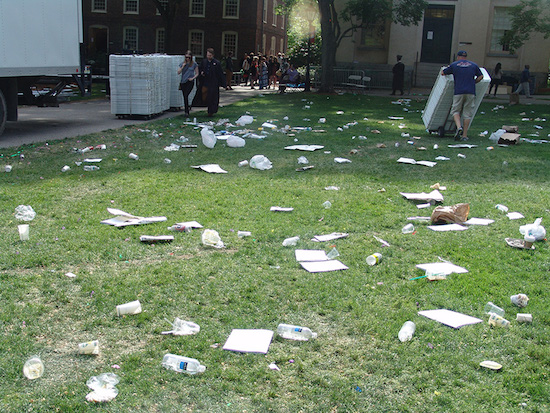
Photo  and article by FRANK CARINI, ecoRI News

The trashy scene above recently left behind after the Brown University Class of 2015 graduated perfectly exemplified growing U.S. selfishness.

Kindergartners leave a cafeteria with more grace than the  elite who exited the Main Green by dumping their lunch trays on the ground. It’s sickening how little we think of others and the places we share that it’s considered acceptable to leave behind an easily-avoidable mess for someone else to clean.

After celebrating the accomplishments of young men and women, the  elitists who attended the May 24 graduation left the university lawn littered with half-drunk plastic water bottles, newspapers, commencement programs, half-empty coffee carafes, pieces of lightly bitten fruit and other barely touched foods, and, of course, all things plastic.

The elitists  ignored the many bins, barrels and totes  that Brown University had thoughtfully placed throughout the area to collect trash and recyclables. Plastic crunched underfoot and litter was inadvertently kicked as graduates and their guests slowly left. The workers responsible for folding the chairs and removing the rest of the commencement infrastructure were left to navigate the debris.

It would be nice to think that the  elite kindly left their unwanted food for hungry squirrels, but, sadly, they just thought someone else should pick up their mess. The littering elite couldn’t even be bothered to freshen the trampled lawn with the water they left locked in jettisoned plastic bottles.

There’s little wonder the U.S. recycling rate is a lackluster 35 percent, our composting rate considerably less, consumption is soaring, apathy increasing and our collective concern negligible. Wasted food makes up the largest percentage of all material buried in our landfills. We throw away up to 40 percent of our sustenance, according to the Environmental Protection Agency (EPA).

In fact, the average American wastes 10 times as much food as the average Joe in Southeast Asia — up 50 percent from Americans in the 1970s.

Of the more than 150 million mobile devices we discard annually — many still in fine working order but no longer socially fashionable — only about 12 percent are recycled.

A mobile phone contains about 40 elements, including heavy metals and persistent organic pollutants such as flame-retardants, PVC, lead, cadmium, chromium, mercury, bromine, tin and antimony. Such chemicals have been linked to birth defects, impaired learning, liver toxicity, premature births and early puberty.

Our response to this problem has become the American Way. For instance, the United States is the only industrialized country that hasn’t ratified the Basel Convention, an international treaty that makes it illegal to export toxic e-waste. The convention’s main goal is to protect human health and the environment from hazards posed by trans-boundary movements of hazardous waste.

Since 1990, U.S. greenhouse-gas emissions have increased by about 6 percent, according to the EPA, and we have been one of the largest, if not the largest, emitter of climate-changing emissions for decades. Our response has been to blame China and India for now polluting as much as we do.

Unfortunately, thinking of others and the environment aren’t ideals that get you elected or make you rich and powerful. The trickle-down effect of our expanding self-indulgence was on full display last Sunday at Brown University. The mess is likely unseen in the background of countless selfies.

It has become increasingly OK to leave our trash at college graduations, on airplanes, in movie theaters, at ballparks, in public parks and at the beach. Someone else will pick up mess ... or birds will choke on plastic bottle caps mistaken for food ... or donations will eventually be made to the Great Pacific Garbage Patch.

Since we can’t even be bothered to properly dispose of trash and recyclables at an event that celebrates society’s potential, what sacrifices are we truly willing to make to ensure a prosperous and healthy future for others?

Frank Carini is the editor of ecoRI News.

 

Read More
Commentary Robert Whitcomb Commentary Robert Whitcomb

'Stillness and Motion'

buck2 "The Buck and Kick'' (oil stick on paper, mounted on board), by ANDREW NIXON, in his "Stillness and Motion'' show, at the Dedee Shattuck Gallery, Wesport, Mass., June 3-June 28.

Read More
Commentary Robert Whitcomb Commentary Robert Whitcomb

'Keyhole and key'

hur  

From  "Finally Wear the Piano,'' an exhibition of large-scale paintings by Korean artist JUNG HUR, at the Corey Daniels Gallery,  Wells, Maine, May 30-June 30.

The gallery says that  in the show, Mr. Hur explores how objects take form, acquire a name, and become iconic symbols that can then be appropriated for other things, such as a logo, and influence other areas of cultural currency and eventually, ... land on a T-shirt. "I am interested in how many steps does it take to finally wear the piano and what does that process look like."

For this current work, Mr. Hur has developed his own version of the ubiquitous yin-yang symbol. "My symbol is a keyhole and key. It implies a visual lens, a door to pass through and different perspectives. It implies the relationship between looking and the process of perspective."

Read More
Commentary Robert Whitcomb Commentary Robert Whitcomb

Chris Powell: 'High-stakes tests' for high-stakes life

MANCHESTER, Conn. Connecticut's biggest teachers union, the Connecticut Education Association, is increasing its clamor against what it calls "high-stakes" testing of students and against the "Smarter Balanced" test in use by the state Education Department.

The union has complained that the test has technical problems. The union’s bigger objection is that there is too much standardized testing and that test preparation distracts from learning. But the union's definition of "high-stakes" testing shows that improving learning is not its objective at all.

As the union's executive director, Mark Waxenberg, explains it, a test is "high stakes" if its results can be compared and construed to mean that a student, teacher, or school is not proficient or, worse, is a failure, or if its results can jeopardize a school's funding.

By that definition any standardized test whose results are made public is a "high-stakes" test and the union can accept only tests whose results are secret. That is, the union's objective is, predictably enough, to deprive the public and its elected representatives of any independent measures of student, teacher, and school performance, making public only unstandardized and uncomparable measures provided by teachers and school administrators. In the CEA's system, all students and teachers, as in Lake Woebegon, will be above average.

As a practical matter there is no "high-stakes" testing in Connecticut's schools -- no testing whose results have serious consequences, none that determines student advancement from grade to grade and graduation from high school, none that figures in teacher evaluation, and none that determines school funding.

Instead, Connecticut's schools practice the social promotion of students. Nearly every student who shows up is given a high school diploma even if he has learned little.

While Gov. Dan Malloy once thought that student performance should be a factor in teacher evaluations, criticism from teacher unions caused him to back off. With its clamor against "high-stakes" testing -- that is, against any testing from which the public might draw meaningful conclusions -- the union seeks mainly to keep student performance out of teacher evaluations.

As for test results and school funding, the union has nothing to worry about. For state government's thinking long has been that the worse a school performs, the more funding it should get, on the mistaken premise that the main problem of education is schools rather than the growing neglect of children by their parents.

While the CEA's dissembling is tedious, teachers can't be blamed for not wanting to be judged by the performance of their students on tests when students themselves are not judged. Instead teachers can and must be blamed for not protesting the abandonment of academic standards, the results of which the CEA now strives to conceal lest they reflect unfairly on teachers.

For while there is no "high-stakes" testing of students in Connecticut, the stakes for the state itself could not be higher: Will we have an educated, self-sufficient, and civic-minded population or an increasingly ignorant proletariat unable to compete economically with the rest of the world, dependent on government income supports, and recognizing no obligation to sustain democratic institutions?

The costly consequences of Connecticut's abandonment of education standards are easy to see if hard to look at -- the failure of most students to master high school work before graduating and the growing number of unqualified students admitted to the state university system, which has institutionalized remediation. Connecticut now pays for 16 years of education but gets less than 12.

"High-stakes" testing in school is nothing to be disparaged. To the contrary, it will be crucial as long as life itself is for high stakes.

Chris Powell is managing editor of the Journal Inquirer, in Manchester.


Read More
Commentary Robert Whitcomb Commentary Robert Whitcomb

So ugly that we'd miss it

prudential  

From dartblog.com, run by Joseph Asch:

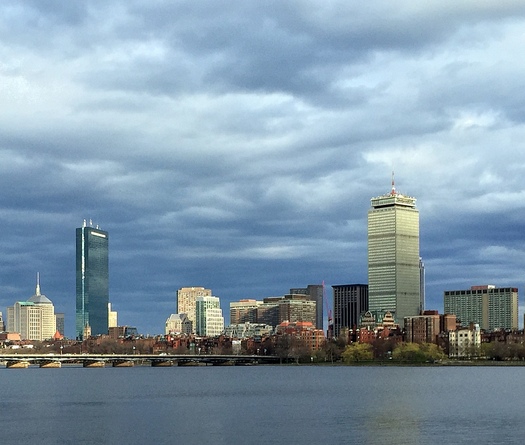
{Boston's} Prudential Center looks as good as it’s ever going to get in this iPhone 6 shot in angled evening light, but it doesn’t hold up to the John Hancock Tower, Henry N. Cobb’s 1976 creation (he was working at I.M. Pei’s firm). The two buildings offer a sharp contrast, don’t you think? Squat brutalist power facing sleek elegance. To my mind and eye, the Hancock building wins every time.

Addendum: Wikipedia summarizes the reception that the Pru received from architectural critics:

When it was built, the Prudential Tower received mostly positive architectural reviews. The New York Times called it “the showcase of the New Boston [representing] the agony and the ecstasy of a city striving to rise above the sordidness of its recent past”. But Ada Louise Huxtable called it “a flashy 52-story glass and aluminum tower … part of an over-scaled megalomaniac group shockingly unrelated to the city’s size, standards, or style. It is a slick developer’s model dropped into an urban renewal slot in Anycity, U.S.A.—a textbook example of urban character assassination.” Architect Donlyn Lyndon called it “an energetically ugly, square shaft that offends the Boston skyline more than any other structure”. In 1990, Boston Globe architecture critic Robert Campbell commented: “The Prudential Center has been the symbol of bad design in Boston for so long that we’d probably miss it if it disappeared.”

The individual critics have it right. 

Read More
Commentary Robert Whitcomb Commentary Robert Whitcomb

Boston's Children's Hospital buying metro NYC physician group

Read More
Commentary Robert Whitcomb Commentary Robert Whitcomb

Avoid sleeping or sex there

frances "Our Bedroom, Westminster St. '' (screen prints, masonite, wood  and foamcore), by KEVIN FRANCES, in the "You Are Here'' show at New Art Center, Newtonville, Mass., next Jan. 15-Feb. 20.

The gallery says the show will present "place as physical, geographical, liminal or psychological spaces. Each artist will interpret the subjective phrase 'you are here' commonly found on directory maps to present place through the scope of their practice.''


Read More
Commentary Robert Whitcomb Commentary Robert Whitcomb

Birdland at Maine gallery

  Farrar

"White Pullet'' (encaustic), by HELENE FARRAR,  in the show "Little by Little, Bird by Bird,'' at Monkitree gallery, in Gardiner, Maine.

The show includes bird-inspired art by nine Maine artists.

Ms. Farrar says she came to crafting birds when her dying mother made hamburger  available to attract, and watch the beauty of,  a flock of birds. (Not so beautiful for the  steer killed to make the hamburger.)

"As they swooped down for their dinner, their flying and fluttering forms forced a moment of quiet and observation in an otherwise intense and painful period in my life. Birds from that point on became something else  -- a witness to life's events and cycles, portraits, commentaries on life and relationships, and a general slice of humor.''

The gallery says that whether "they symbolize peace or freedom, flight or ambition, birds are the sole focus of the artists in this exhibition.''

Has she seen The Birds, the Alfred Hitchcock movie?


Read More
Commentary Robert Whitcomb Commentary Robert Whitcomb

Robert Whitcomb: Oregon points to better Medicaid

  Unsurprisingly, Rhode Island Gov. Gina Raimondo is getting pushback from interest groups against her goal of “reinventing Medicaid’’ – the federal-state program for the poor. The Ocean State’s Medicaid costs are America’s second-highest per enrollee (Alaska is first) and 60 percent higher than the national average.

Many in the nursing-home and hospital industries will fight the governor’s effort to cut costs even if it can be shown that her plan can simultaneously improve care. After all, the current version of Medicaid has been very lucrative for many in those businesses. The Affordable Care Act has brought them even more money.

As we watch her plan unfold, let’s be very skeptical when we hear lobbyists for the healthcare industry and unions asserting that reform would hurt patients. Lobbyists are adept at getting the public to conflate the economic welfare of a sector’s executives, other employees and owners with its customers’. Ambrose Bierce called politics “a strife of interests masquerading as a contest of principles.’’ Often true!

So “nonprofit’’ Lifespan, the state’s largest hospital system, has just hired eight lobbyists to work the General Assembly to defend its interests. (And beware healthcare executives’ citing their businesses’ “nonprofit’’ status. Many of these enterprises take their profit in huge executive compensation.) Some unions are also on the warpath. They worry that reform to reduce the overcharging, waste and duplication pervasive in U.S. health care might reduce the number of jobs.

But economic and demographic reality (including an aging population, widening income inequality and employers’ eliminating their workers’ group insurance) make Medicaid “reinvention’’ mandatory as more patients flood in.

Oregon provides a model of how to do it.

There, in an initiative led by former Gov. John Kitzhaber,  M.D., an emergency-room physician, the state has both improved care and controlled costs. It did so by creating 16 regional coordinated-care organizations (CCO’s). The state doesn’t pay for each service performed but gives each CCO a “global budget’’ of Medicaid funds to spend. The emphasis is on having a range of providers work with each other to create holistic treatment plans for patients that include the social determinants of health (such as access to transportation and housing quality) as well as patients’ presenting symptoms.

Oregon’s “fee for value’’ approach rewards providers for meeting performance metrics for quality and efficiency and punishes them for poor outcomes and increased costs.

Oregon CCO’s have great flexibility in spending Medicaid money. For example, they could use it to buy patients air conditioners, which may make it less likely that they’ll show up in the E.R. And Oregon CCO’s pay much attention to how behavioral and mental problems can lead to the more obviously physical manifestations of illness. After all, many in our health-care “system’’ “self-medicate’’ through smoking, drinking, drugs, eating unhealthy food and lack of exercise. You see many of these people again and again in the E.R. –wheezing from smoking and obese.

In Rhode Island, 7 percent of Medicaid beneficiaries account for two-thirds of the spending; many of these “frequent fliers’’ have mental and behavioral health problems best addressed through Oregon-style coordinated care.

Unlike the Oregon approach, the “fee for service’’ system that’s still dominant in U.S. health care encourages hospitals and clinicians to order as many expensive procedures as possible, prescribe the most expensive pills and do other things to maximize profit – and send the bills to the taxpayers, the private insurers and the patients.

But “evidence-based medicine’’ -- as opposed to “reputation-based medicine’’’ -- has helped to show that doing more procedures does not necessarily translate into better outcomes; indeed overtreatment can be lethal. I recommend Dr. H. Gilbert Welch’s book “Less Medicine/More Health’’.

Meanwhile, Oregon points the way:

Among the Oregon Medicaid reform’s achievements: a 5.7 percent drop in inpatient costs; a 21 percent drop in E.R. use (which is always very expensive), and an 11.1 percent drop in maternity costs, largely because of hospitals not performing elective early deliveries before 39 weeks of pregnancy. Thus Oregon officials assert that the state can reach its goal of saving $11 billion in Medicaid costs over 10 years.

Rhode Island can achieve similar successes.

Robert Whitcomb (rwhitcomb51@gmail.com), overseer of New England Diary, is a Providence-based editor and writer and a partner  in Cambridge Management Group (cmg625.com), a national healthcare-sector consultancy. He's also a Fellow of the Pell Center for International Relations and Public Policy.

Read More
Commentary Robert Whitcomb Commentary Robert Whitcomb

Olympic-level zig-zagging

slope  

Read More
Commentary Robert Whitcomb Commentary Robert Whitcomb

Frank Carini: Protect our forage fish

By FRANK CARINI for ecoRI News, of which he is the editor. Forage fish play a vital role in any marine ecosystem, but their importance is largely overlooked when it comes to fisheries management. In the ocean waters the coast of New England, for example, menhaden and Atlantic herring provide food for such recreationally and commercially important species  as striped bass, bluefish and cod.

These fish also are food for tuna, salmon, sharks, dolphins, seabirds and other animals that are integral to healthy marine ecosystems. Fishermen use squid as bait in lobster and crab traps. Juvenile menhaden, as they filter water, help remove nitrogen.

“Forage fish are worth more in the water than out,” Greg Wells, speaking for the Pew Charitable Trusts’ U.S. Oceans Environmental Group, told those who attended the March 24 Southern New England Recreational Fishing Symposium in Warwick, R.I. “If we don’t leave prey fish in ecosystems for predators and fishing, there are consequences to other wildlife, and this has an impact on eco-tourism businesses.”

Wells spoke about the importance of implementing ecosystem-based fisheries management plans, saying such an approach focuses on an entire ecosystem and includes the significant impacts made by humans.

“Decisions are based on understanding how an ecosystem works to make sure it maintains its health and productivity,” Wells said. “We need to be focusing on systems rather than single populations and stocks. Fisheries need to be managed with a cautious approach. We must be able to adapt to changing ocean conditions and fish populations.”

When it comes to most forage fish, however, very few regional or federal management plans even exist for species such as shad and river herring. As these fish are removed in bulk by trawlers, lost in bycatch and their populations redistributed by a changing climate, economical, environmental and societal impacts are created.

Demand, largely industrial, for these nutrient-rich species, which are mostly used to make fertilizer and cosmetics and to feed livestock and farmed fish, is increasing worldwide. Lost in the runaway consumption of this biomass is the importance these little fish play in supporting a variety of businesses, from commercial and recreational fishing to seafood restaurants and coastal tourism.

To improve the conservation of forage fish, the Pew Charitable Trusts and others concerned about the long-term survival of these species believe fishery managers need to set science-based limits on how many forage fish can be caught annually to ensure abundant food sources for other wildlife, including managed fish species, and that a national definition of what species qualify as forage fish for management purposes needs to be created.

“This has been a hot issue for a number of years,” said Kevin Friedland, a fisheries oceanographer with the National Oceanic and Atmospheric Administration (NOAA) who spoke at the late-March symposium in Warwick. “It’s a complex mix of services that forage fish provide. Herring and menhaden are important species in how the ecosystem works.”

What exactly is a forage fish? According to Friedland, it’s a broad group of fish defined by a complex equation that includes stomach-content analysis. They are typically small, schooling species that eat microscopic plants (phytoplankton) and animals (zooplankton) drifting near the ocean surface.

“We’re just beginning to understand the role and importance of forage fish,” he said. “Forage fish are a big part of the total production of an ecosystem.”

In 2012, the Lenfest Forage Fish Task Force, a panel of 13 internationally known marine scientists, found that harvesting of forage fish at levels previously thought to be sustainable could have major adverse effects on some marine ecosystems.

A task force study has recommended cutting forage fish catch rates by half in many ecosystems and doubling the minimum required amount left in the water. These measures would help to maximize the benefits of forage fish as food for more highly valued species, according to the 120-page study.

The protection of forage fish, however, has an impact beyond simply feeding larger fish. For instance, a 2011 study of several ecosystems found that seabird populations decreased when the amount of forage fish fell below a third of the maximum historical level.

When some 1,600 starving sea lion pups washed up on California’s shores in 2013, researchers concluded that their mothers likely abandoned them because there weren’t enough forage fish, such as Pacific sardines, to support both generations.

The severe decline in the sardine population also was a threat to other marine life along the California coast and the fisheries that depend on that diversity. In response, the Pacific Fishery Management Council reduced sardine fishing levels by nearly two-thirds from 2013-14.

The council also has taken other steps in forage fish management, providing a model for its counterparts nationwide, according to Wells. In 2013, the council approved its first fishery ecosystem plan, which spells out how to take a broad approach to managing marine resources. The plan’s first management initiative called for developing a sound understanding of the potential impact of new fishing on forage species.

Most of the nation’s other fishery management councils, including the New England Fishery Management Council, haven’t adopted practices to better manage forage fish populations.

Earlier this month, however, recreational fishermen, charter boat captains, conservationists and birders up and down the East Coast received a bit of good news about the long-term management of Atlantic menhaden.

The Atlantic States Marine Fisheries Commission decided to take an ecosystem-based approach to managing this forage fish species that is so vital to the local marine food web.

The commission’s Atlantic Menhaden Management Board has committed to “moving forward with the development of an amendment to establish ecological based reference points that reflect Atlantic menhaden’s role as a forage species. The amendment will also consider changes to the current state‐by‐state allocation scheme.”

Lee Crocket, U.S. oceans director for The Pew Charitable Trusts, wrote that the May 6 commission’s decision “is a major shift from the old way of setting catch limits — focusing on a single species — and gives the commission a better way to consider the health of the broader ocean ecosystem.”

“Big schools of fatty, oily menhaden are crucial for marine wildlife such as whales, striped bass, ospreys, and eagles, so much so that they’ve earned the moniker ‘the most important fish in the sea,’” he wrote. “But menhaden also are the most heavily fished species on the East Coast. Just one company (Houston-based Omega Protein Corp.) nets nearly 290 million pounds of them a year to grind into fish meal and oil.”

Read More
Commentary Robert Whitcomb Commentary Robert Whitcomb

Don't climb

schull  

"Birch Saplings'' (sculpture), by ALANNA SCHULL  in the MFA Thesis Show at the the University of Massachusetts at Dartmouth's gallery in New Bedford. Photo by Hank Gaitlin.


Read More
Commentary Robert Whitcomb Commentary Robert Whitcomb

Llewellyn King: Way up high with the 'Globotrash'

You and I live in houses, apartments, coops and condos and apartments. The super-rich -- or is it the mega-rich or the ultra-rich? -- live in residences. Well, they own them and sometimes they take up residence in one of their homes, so maybe the name is appropriate. In real estate speak, if it costs north of $5 million, it is a “residence.”

I get this not from the Oxford English Dictionary, but from the advertisements in The New York Times for living space in New York City. The city is one of a few places where the incalculably rich want to have a residence. And they shell out big bucks -- bucks beyond the dreams of common avarice -- to get a pad there.

Other cities where the rich feel at home are London, Monaco and Dubai. There is God Almighty-expensive real estate in Hong Kong and Mumbai (the world's most expensive), but not all the new billionaires want to live there. They want the best of the West.

The real estate rush comes from the new billionaires. Whereas it was once the super-rich of Europe, known as Eurotrash, who sought the marble and concierge life in Manhattan towers, it is now the unfathomably rich from China, India and Russia who have ushered in a new Gilded Age with more wealth than the Americans of the Gilded Age before World War I ever could have dreamed as they journeyed between Fifth or Park avenues and Newport, R.I.

Call them “Globotrash” -- and watch them push up prices for everyone, as real estate moguls buy old buildings in Manhattan and demolish them to build luxury towers that rise higher than 90 floors.

Central London has gone, as far as ordinary Londoners are concerned. They have to commute further and further to work in the neighborhoods where they once lived. New York City is not much better:  The Globotrash push out the middle class and the poor.

The skyline of Manhattan tells this new Gilded Age story: booming construction of spindly glass towers, so thin they seem even higher than their very real height.

Look in awe at 432 Park Ave., the luxury condo that stands at 1,396 feet, slightly taller than One World Trade Center. Or the stunning new “residence,” One57: It rises to 90 floors with prices from a paltry $6 million for a one-bedroom to a penthouse for a god at $94 million. Now, we are talking “residence.”

The principal selling point for these pieces of fanciful engineering is that you get a view of Central Park. It is all, apparently about, privacy and views. Well, Central Park is nice to look at, but it is not one of the wonders of the world.

As for privacy, wait a minute. While you might want to take in the views of Manhattan as you soak in one of the grand bathrooms' Carrara marble tubs, and then emerge in the buff to get another look at the views, for which you have paid so extravagantly, you had better watch out. I hear the paparazzi are getting camera-equipped drones. You see the park, and their cameras see you.

One57 has some of the best blue-veined marble ever quarried in Italy. In fact, there is so much of it in the building that an imaginative lawyer might be able to claim that it is a territorial extension of Italy. A part of Italy on Manhattan Island, Mamma mia!

And as the Globotrash are not known for their kitchen skills, it will be up to the imagination of New York City again to get another iconic Italian product, pizza, up there.

Llewellyn King (lking@kingpublishing.com) is  executive producer and host of  White House Chronicle,  on PBS. 

Read More
Commentary Robert Whitcomb Commentary Robert Whitcomb

Home art

  Veverka

"Junk Drawer Pencil Brooch'' (pencils and sterling silver), by DONNA VEVERKA, in the show "The Homework Project,'' at Laconia Gallery, Boston, through June 20.

The show includes eight artists who have studios within their homes who use the objects that surround us in daily life as inspiration, source and raw material.

Read More