









A_map_of_New_England,_being_the_first_that_ever_was_here_cut_..._places_(2675732378).jpg

Vox clamantis in deserto

Commentary Robert Whitcomb Commentary Robert Whitcomb

Charity begins at home

I admire the hard work of company PR departments that manage to promote, say, a $1 million corporate grant to a local charity as a gigantic piece of generosity even as the CEO of said company -- one (usually) man -- pays himself tens of millions a year. -- Robert Whitcomb

Read More
Commentary Robert Whitcomb Commentary Robert Whitcomb

April as it should be

It's a  wet, warm morning,  finally the way it should be in April in southern New England. -- Robert Whitcomb

Read More
Commentary Robert Whitcomb Commentary Robert Whitcomb

Your basic Stonington (Conn. or Maine)?

  shrestha

"Stonington House on the Ledge'' (oil) by NIVA SHRESTHA, in her show "New Work,'' at Galatea Fine Art, Boston, May 1-31.

She says:

"Architectures of small New England towns have been the main subject in my work for the last three years. From stairs to poles, boats to houses, every line and shape in the townscape are intertwined to create either the most dynamic movements or the quietest stillness. Thus I paint on site in these townscapes where wonderful and playful compositions are naturally formed.''


Read More
Commentary Robert Whitcomb Commentary Robert Whitcomb

David Warsh: Looking for a 'Jewish lunch' at Harvard

  SOMERVILLE, Mass.

What propelled Massachusetts Institute of Technology economics to the top of the heap? As Bloomberg Businessweek memorably illustrated in 2012, most of the leadership arrayed against the financial crisis was educated to the task at MIT, starting with Ben Bernanke, of the Federal Reserve Board; Mervyn King, of the Bank of England, and Mario Draghi, of the European Central Bank.

That they and innumerable other talented youngsters chose MIT and turned out so well owed to the presence of two strong generations of research faculty at MIT, led  in the 1970s and ’80s by Rudiger Dornbusch, Stanley Fischer, and Olivier Blanchard, and, in the ’50s and ‘60s, by Paul Samuelson, Robert Solow and Franco Modigliani.

Samuelson started it all when he bolted Harvard University in the fall of 1940 to start a program in the engineering school at the industrial end of Cambridge.

What made MIT so receptive in the first place?  Was it that the engineers were substantially unburdened by longstanding Brahmin anti-Semitism, as E. Roy Weintraub argues in MIT and the Transformation of American Economics?

Or that the technologically-oriented institute was more receptive to new ideas, such as the mathematically-based “operationalizing” revolution, of which Samuelson was exemplar-in-chief, a case made in the same volume by Roger Backhouse, of the University of Birmingham?

The answer is probably both.  The very founding of MIT, in 1861, enabled by the land-grant college Morrill Act, had itself been undertaken in a spirit of breakaway.  First to quit Harvard for Tech was the chemist Charles W. Eliot, in 1865. (Harvard quickly hired him back to be its president.)

Harvard-trained  prodigy Norbert Wiener moved to MIT in 1920 after Harvard’s  mathematics department failed to appoint him; linguist Noam Chomsky left Harvard’s Society of Fellows for MIT in 1955. Historian of science Thomas Kuhn wound up at MIT, too, after a long detour via Berkeley and Princeton.

But the Harvard situation today is very different. Often overlooked is a second exodus that played an important part in bringing change about.

Turmoil at the University of at California at Berkeley, which later came to be known as the Free Speech Movement, had led a number of Berkeley professors to accept offers from Harvard: economists David Landes, Henry Rosovsky and Harvey Leibenstein; and sociologist Seymour Martin Lipset among them.

The story, in the stylized fashion in which it has often been told, is that,  one of the four one day said, “You know, I kind of miss the Jewish lunch” [that they had in Berkeley].

A second said, “Why don’t we start one here?”

“How are you going to find out who’s Jewish?”

“We can’t. Some have changed their names,” said a third. Whereupon Henry Rosovsky said, “Give me the faculty list. I can figure it out.”

A month later, luncheon invitations arrived in homes of faculty members who had previously made no point of identifying one way or another.  And a month after that, a group larger than the original four gathered at the first Jewish lunch at Harvard.  The Jewish lunch has been going on ever since.

Rosovsky, 88, former dean of the Faculty of Arts and Sciences, and the second Jew to serve as a member of Harvard’s governing corporation (historian John Morton Blum, less open about it his Jewishness, was the first)  is the sole surviving member of the original group. Last week  I asked him about it.

“It was not the way things were done at Harvard. The people here were a little surprised by our chutzpah to have this kind of open Jewish lunch, reflecting, I think, the sense that the Jews were here a little bit on sufferance, I don’t think that feeling existed at Berkeley. Nobody was worried there about somebody sending an invitation to the wrong person.

“It’s a subtle thing. We left graduate school at [Harvard] for Berkeley in 1956. I wouldn’t say that Harvard was anti-Semitic, but just as in the ’30s, Berkeley was happy to take the [European] refugees, where Harvard had difficulty with this, there were notions [at Harvard] of public behavior, of what was fitting. Berkeley was a public university, nobody thought twice about their lunch.”

Rosovsky’s wife, Nitza, an author who prepared an extensive scholarly exhibition on  "The Jewish Experience at Harvard and Radcliffe'' for the university’s 350th anniversary, in 1986, remembered that there were surprising cases. Merle Fainsod, the famous scholar of Soviet politics who grew up in McKee’s Rocks, Pa., asked  her one night at dinner if she knew his nephew, Yigael Yadin? “Apparently this was the first time he ever said in public that he was Jewish.” Yadin was a young archaeologist who served as head of operations of the Israeli Defense Forces during its 1948 war and later translated the Dead Sea Scrolls.

Rosovsky’s exhibition catalog tells the story in a strong narrative.  Perhaps a dozen Jews  graduated in Harvard’s first 250 years. But as a professor, then as president of the university, A. Lawrence Lowell watched the proportion of Jewish undergraduates rise from 7 percent of freshmen in 1900 to 21.5 in 1922.  Jews constituted 27 percent of college transfers, 15 percent of special students, 9 percent of Arts and Sciences graduate students, and 16 percent of the Medical School.  Harvard was deemed to have a “Jewish problem,” which was addressed by a system of quotas lasting into the 1950s.

The most outspoken anti-Semite in the Harvard Economics Department at the time that Samuelson left was Harold Burbank. Burbank died in 1951. Some 20  years later, it fell to Rosovsky, in his capacity as chairman of the economics department, to dispose of the contents of his Cambridge house. It turned out that Burbank had left everything to Harvard – enough to ultimately endow a couple of professorships.

So it was  was Rosovsky, by then the faculty dean, who persuaded Robert Fogel – a Jew and a former Communist married to an African-American woman, who he hired away from the University of Chicago – to become the first Harold Hitchings Burbank Professor of Political Economy. “He was the only one who didn’t know the history,” said Rosovsky. Fogel went on to share a Nobel prize in economics.

It is the hardest struggles that command the greatest part of our attention. But between Montgomery, Ala.,  in 1955-56, when the Civil Rights Movement for African-Americans really got going, and the Stonewall Inn riot, in New York, in 1969,  when homosexuals' rights started to get a lot of attention, a great many groups graduated to “whiteness,” as Daniel Rodgers puts it in Age of Fracture – including Jews, Irish Catholics. and, of course, women.

Whatever it was that MIT started, Harvard and all other major universities soon enough accelerated – in economics as well as the dismantling of stereotypes of race and gender. By the time that comparative literature professor Ruth Wisse asserted that anti-Semitism had brought down former Harvard President Lawrence Summers, virtually no one took her seriously.

David Warsh, a longtime economic historian and financial journalist, is proprietor of economicprincipals.com.

.

Read More
Commentary Robert Whitcomb Commentary Robert Whitcomb

Avoid rejection, give it a try

escoto  

"Can't Make Love to the Telephone'' (silver shade instant film), by COREY ESCOTO, represented by Samson Gallery, Boston.

Read More
Commentary Robert Whitcomb Commentary Robert Whitcomb

'It might as well be spring'

Lori "Leaving Dennis at Dusk'' (oil on canvas), by C.J. LORI, in the show "Leaving,'' at Galatea Fine Art, Boston, May 1-31.

I can't remember for a long time a landscape so beaten down by a brutal winter as this year's -- flattened shrubs, broken tree branches, etc.  Of course, we bring our own sense of being beaten down to it.

Still, as the grass turns green  on south-facing slopes,  the crocuses fade and the tulips push up,  it seems that when full spring arrives this year, it will be  particularly lush.  I vividly remember the spring of 1961, after a bad  winter, though not as bad as they one we just went through. (There were only three huge storms in the  winter of 1960-61. One was the famous Kennedy Inauguration Snowstorm.)

It seemed as if the big elm, maples and oak trees would never leaf out, and then, in about two days in the first week of May, there was a green explosion in the western Boston suburb where I found myself living. The next few weeks were so breezy, warm, lush and deliciously melancholic that it was virtually impossible to focus on such June horrors as final exams.

On some days, there were blizzards of  dogwood petals. As a line from the Rodgers and Hammerstein song "It Might as Well Be Spring'' had it: "I feel so gay in a melancholy way that it might as well be spring.''

That was written for a 1945 move called State Fair, and the word "gay'' merely meant happy, though Cole Porter, himself gay,  used the word in a different way in a 1941 song called "Farming''. He was making fun of the many celebrities buying country places in such places as Fairfield and Litchfield counties, in Connecticut, upper Westchester County, N.Y., and New Hope, Pa.

His line goes:

Don't inquire of Georgie Raft Why his cow has never calfed, Georgie's bull is beautiful, but he's gay!

George Raft was a gangster-movie star of the time.

Ah, the great  evolutionary glories of the English language!

--- Robert Whitcomb


Read More
Commentary Robert Whitcomb Commentary Robert Whitcomb

Man and mutations

  Morrison

"Mutation: Specimen''  (textiles) by LAURA MORRISON, in the "Lush Life'' show at the Lamont Gallery, in Exeter, N.H.

The gallery notes say: "The artwork in this exhibition explores the natural world and the effect that humans have on it, encouraging us to cultivate our imagination and consider our own ecological footprint by expressing the beauty and fragility of our world.''

Read More
Commentary Robert Whitcomb Commentary Robert Whitcomb

Chris Powell: Make police wear video cameras

State government's obsession with racial disproportions in traffic stops by police is starting to seem meant to distract from far more serious issues of criminal justice.

Yes, some traffic stops are racially motivated, with some white police officers excessively suspicious of people “driving while black.” But then crime itself in Connecticut is far more disproportionate racially than traffic stops are, with members of minority groups constituting about three-quarters of the state's prison population. Even if all cops were perfect people, racial disproportions in traffic stops would have to be expected.

Traffic-stop data mean little without the details of each stop, including interviews with the motorists stopped, and in any case nearly everyone stopped is sent on his way with or without a ticket, so the incident is only a minor inconvenience. Data about stops will not deter police misconduct, especially not misconduct far worse than a prejudicial stop — misconduct such as the horrifying incidents lately captured on cellphone video in New York City and South Carolina. In New York City a crazed officer berated a motorist who had done nothing wrong. In South Carolina it  is allegedly murder.

The police reforms that Connecticut needs have nothing to do with traffic stops. Officers should be required to wear video cameras recording their work, and police departments should be required to make their arrest records fully public, as they were before an unfortunate decision by the Connecticut Supreme Court last year. The General Assembly should act on both reforms soon.

* * *

Eight years ago Connecticut's Judicial Department generally and its Supreme Court particularly were marred by scandal resulting from excessive secrecy and political maneuvering over a freedom-of-information case. The scandal revealed that the court system had become an old men's clique, hostile to inquiry.

As a result the chief justice retired in disgrace and was sanctioned by the Judicial Review Council, a perfectly good nominee to succeed him had to be withdrawn because of the chief justice's secret maneuvering in his favor, and then-Gov. Jodi Rell nominated and the General Assembly appointed as chief justice an Appellate Court judge who had been outside the fray, Chase T. Rogers.

Rogers has accomplished great change in the Judicial Department's operations, replacing secrecy and resentment of questions with openness and accountability, even though the department remains largely exempt from the state's freedom-of-information law. The department has changed its rules to increase public access at all levels. More important is that, under pressure from the chief justice, the department's attitude has changed.

Under Rogers the department increasingly recognizes that justice in a democracy is everybody's business, that due process of law is our cherished heritage as citizens, and that it can endure only if the public understands it and has faith in it.

Gov. Dan Malloy has renominated Rogers for another eight years as chief justice and the General Assembly should reappoint her with appreciation for her having made the courts more accountable and more deserving of trust.

* * *

In the hope of gaining more attention from presidential candidates, Connecticut's Republican Party is considering replacing its presidential primary with caucuses in the state's 36 Senate districts and holding them early to compete with other early states.

While this might win Connecticut a bit more attention from the candidates, it would mainly just disenfranchise all but the most ideological or self-interested Republicans, requiring them to travel more to vote and then to sit through a long meeting first.

Primary voters don't need to go through such trouble to become informed. If they are voting at all it is because they have already been paying attention. The party's objective should be to facilitate participation, and that means a primary, not caucuses.

Chris Powell is managing editor of the Journal Inquirer, in Manchester, Conn.
Read More
Commentary Robert Whitcomb Commentary Robert Whitcomb

Robert Whitcomb: Where we can win; childlessness; water wars

  The metastasizing Mideast chaos and violence have shown yet again the limitations of American power there. We’re backing and opposing groups in a fluctuating toxic religious, ethnic, tribal and national stew and frequently contradicting ourselves as we do.

Some neo-cons want us to go in with massive military intervention. We tried that. Now consider that the Sunni fanatics called ISIS use American weaponry captured from the Iraqi “army’’ to attack “Iraq’’ -- whatever that is -- an ally of longtime U.S. enemy Iran, which has joined in the melee against ISIS, even as Sunni Saudi Arabia fights its long-time foe and fellow dictatorship Shiite Iran in Yemen. And in Libya and Syria, the civil wars go on and on in permutations and combinations.

The U.S. must occasionally act quickly in the Mideast to rescue its compatriots and to protect the region’s only real democracy – Israel. But after all this time, we should know that the Mideast has so much confusion, fanaticism and corruption that a heavier U.S. role won’t make things better. The best we can do is to marginalize the region as much as possible, such as by reducing the importance of Mideast fossil fuel by turning more to renewable energy in America and Europe, while, yes, fracking for more gas and oil.

We must focus more on Europe, where a scary situation is much clearer. Our Mideast projects have dangerously diverted resources from countering the far greater threat to our interests posed by Vladimir Putin’s mobster Russian regime.

Now that it has seized Crimea from Ukraine and occupied a big slice of the eastern part of that large democracy, Putin’s fascist police state is firing off yet more threats to “protect’’ ethnic Russians in what he calls “The Russian World’’ (i.e., the old Soviet Empire) from bogus “persecution’’ by the majority population in the Baltic States and Poland -- NATO members and democracies. Latvia is coming under particularly hard Russian pressure now. Hitler used the same strategy against Czechoslovakia with the Sudeten Germans. It’s past time to re-energize NATO to thwart Russian aggressio

xxx

Regarding an April 4 New York Times story headlined “No Kids for Me, Thanks’’:

My mysterious father used to say ruefully that “your friends you can pick, your family you’re stuck with.’’ He had five children.

From observing my childless friends, I’d say that contrary to an old social cliché, they are generally happier than those who have children – so far. A simple reason: They have more money, time and freedom to do what they want.

Arthur Stone, a professor of psychiatry at Stony Brook University who’s co-authored a study comparing childless adults’ happiness and those with kids told CNN: “They {parents} have higher highs. They have more joy in their lives, but also they have more stress and negative emotions as well.’’

CNN said he found “little difference" between “the life satisfaction of parents and people without kids, once other factors -- such as income, education, religion and health -- were factored out.’’ Yes, but how do you ‘’factor out’’ income? Paying for children causes a lot of anxiety.

People tend to be more self-absorbed these days, and so less enthusiastic about sacrificing so much for, say, children. But this presents a problem that some childless Baby Boomers are already experiencing: Who will take care of them when they get really old? If they think that younger friends will feel as compelled to squire them through old age as their children, they’re in Fantasyland.

xxx 

The California dream of always-green lawns in McMansion developments in the desert is being revised as drought deepens. (Probably global warming.) The land of Silicon Valley, Cal Tech and Hollywood has more than enough intellectual firepower to address the conservation challenge. (“Dehydrated water – just add water’’?) However, don’t expect many new L.A. Basin golf courses. Californians will see more cactus and less lawn. Meanwhile, places with lots of fresh water -- e.g., New England and the Pacific Northwest – may now be in a better competitive position.

Regarding Golden State water-wars, see the movie “Chinatown’’.


Robert Whitcomb  (rwhitcomb51@gmail.com) oversees New England Diary. He's a partner at Cambridge Management Group (cmg625.com), a healthcare-sector consultancy, a  Fellow at the Pell Center for International Relations and Public Policy, a former finance editor of the International Herald Tribune, a former editorial-page editor and a vice president at The Providence Journal and a former editor at The Wall Street Journal. 


Read More
Commentary Robert Whitcomb Commentary Robert Whitcomb

The glory of the rag trade

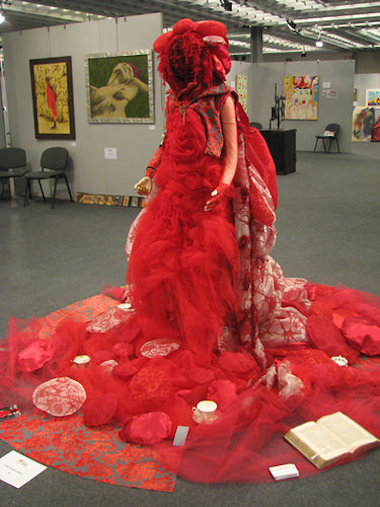
Talbot-Kelly "Open Sesame,'' by SAMANTHA TALBOT-KELLY, in the "Gathering Threads'' show at the Brattleboro Museum & Art Center, Brattleboro, Vt., through May 3. 

The museum says the show "pushes the boundaries of traditional textile techniques into innovative hybrid forms. The exhibit affords you a chance to explore myriad ways in which fiber can be exploited for its vast emotional and symbolic potential.''

Read More
Commentary Robert Whitcomb Commentary Robert Whitcomb

Jim Hightower: Lobbyists are also the congressional staff

Being a Congress critter isn’t the cushy job  that many people assume. After all, they must draft laws, organize hearings, write speeches, round up votes, and do all sorts of other things.

Oh, wait… my mistake. Members have staff to do all that, including telling the esteemed legislators how to vote.

Few people realize that congressional staffers have gained far-reaching control over legislation. While the mass media has ignored this power shift, which further removes the people from the making of our laws, corporate lobbyists have long understood it and assiduously wooed staff members with flattery and gifts.

But then it dawned on lobbyists that instead of wooing staff, they should simply become the staff. So when Republicans took charge of the Senate in January, K Street lobbyists moved right into the Capitol Hill offices of the new corporate-hugging majority.

What a sight to see Tom Chapman, a former top lobbyist for US Airways, now sittingatop the legal staff of the Senate aviation panel that oversees — guess who? — US Airways.

And there’s Joel Leftwich, who pushed furiously to water down nutrition standards for school lunches as a senior lobbyist for Pepsico. Now he can do it directly as the new staff director for the Senate Agriculture Committee, which will re-write the school lunch funding law this year.

What a coincidence.

How about mega-lobbyist Mark Isakowitz, whose specialty is punching loopholes in the Wall Street reform law? As new chief of staff for Sen. Rob Portman, Mark is now punching from the inside. And he’s already slipped a special regulatory exemption into law on behalf of big derivative traders like GE and the Koch brothers.

If you voted Republican last fall, is this the change you wanted?

 Congress critter isn’t the cushy job many people assume. After all, they must draft laws, organize hearings, write speeches, round up votes, and do all sorts of other things.

Oh, wait… my mistake. Members have staff to do all that, including telling the esteemed legislators how to vote.

Few people realize that congressional staffers have gained far-reaching control over legislation. While the mass media has ignored this power shift, which further removes the people from the making of our laws, corporate lobbyists have long understood it and assiduously wooed staff members with flattery and gifts.

But then it dawned on lobbyists that instead of wooing staff, they should simply become the staff. So when Republicans took charge of the Senate in January, K Street lobbyists moved right into the Capitol Hill offices of the new corporate-hugging majority.

What a sight to see Tom Chapman, a former top lobbyist for US Airways, now sittingatop the legal staff of the Senate aviation panel that oversees — guess who? — US Airways.

And there’s Joel Leftwich, who pushed furiously to water down nutrition standards for school lunches as a senior lobbyist for Pepsico. Now he can do it directly as the new staff director for the Senate Agriculture Committee, which will re-write the school lunch funding law this year.

What a coincidence.

How about mega-lobbyist Mark Isakowitz, whose specialty is punching loopholes in the Wall Street reform law? As new chief of staff for Sen. Rob Portman, Mark is now punching from the inside. And he’s already slipped a special regulatory exemption into law on behalf of big derivative traders like GE and the Koch brothers.

If you voted Republican last fall, is this the change you wanted?

Jim Hightower is a columnist for OtherWords.org, where this originated.


Read More
Commentary Robert Whitcomb Commentary Robert Whitcomb

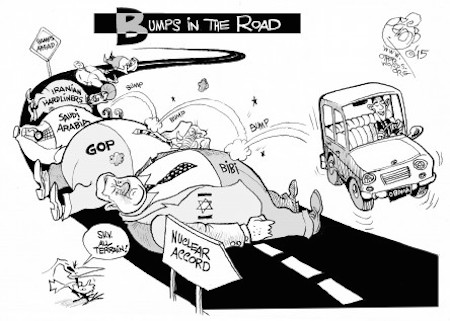
Time to repave

irantoon

Read More
Commentary Robert Whitcomb Commentary Robert Whitcomb

Earth to earth, trash to art

  Huey

"Landfill Tulipiere''  (medium-fire clay and gaze), by LINDA HUEY, in the show "Ceramic Inspiration,'' at ArtProv Gallery, Providence, through May 22.

The gallery says  she  looks at ''the balance between growth and decay''.


Read More
Commentary Robert Whitcomb Commentary Robert Whitcomb

''Experience' is simply the name we give our mistakes'

  Mawikere

"I'm Sorry'' (photos), by KAREN MAWIKERE, at the "BA & BFA Exhibition and MFA Thesis Exhibit'' now at the Museum of Art at the University of New Hampshire, in Durham.

Her photos, say the museum, "express her experience with both anxiety and depression.''

That reminds me of 40 years ago, before the new psychotropic drugs took over, of a high-end psychiatrist in Cambridge, Mass. (no, not mine) repeatedly corrected a friend of mine, who went on to some fame in work, when the patient said he was "depressed.''

"No, no, no,'' replied the shrink. "You're anxious!''

Which might have made him more of both for a while.

-- Robert Whitcomb

Read More
Commentary Robert Whitcomb Commentary Robert Whitcomb

Emily Schwartz Greco: Slow solons won't stop wind-energy growth

The gaggle of workers in Montana’s Carbon County hacking at the barely thawed ground in late December were on a mission: Secure Mud Springs Wind Ranch’s eligibility for a green-energy incentive.

Why were they racing to catch a tax credit in that sparsely inhabited land? Congress.

While ambling across its latest do-nothing finish line, lawmakers approved a bill that extended five-dozen tax breaks. The last-minute move retroactively restored the Production Tax Credit, the wind industry’s primary source for federal support, with a catch: Only projects underway by the year’s end would qualify.

When President  Obama signed the legislation on Dec.  19, Washington had officially extended the wind incentive for the 10th time since 1992 in the least helpful way possible.

In this industrial Cinderella fairytale, Washington fleetingly granted some wind entrepreneurs their wish. Flipping the switch on for two weeks barely gave Mud Springs crews enough time to cut the 1,500 feet of access road and do the turbine prep work required to meet Washington’s evolving definition of getting started, the Billings Gazette reported.

Yet extinguishing this tax credit won’t stop the wind business. Thanks mainly to the increasingly cheap power it generates, it’s flourishing.

Wind generates over 4.5 percent of the nation’s electricity today, enough to power 18 million homes. By 2020, this energy source’s share of the total power market could more than double to 10 percent. By 2030, wind may fuel one out of every five kilowatts consumed in America, the Obama administration predicts.

In contrast to the main federal tax credit supporting solar power and offshore wind, which gives people and companies a break based on the quantity of money they spend, the Production Tax Credit ties tax breaks for wind farm operators to how much power they generate. Uncle Sam issues a 2.3-cent tax credit for each kilowatt-hour produced for 10 years once qualifying energy projects go live.

As you might expect, plenty of conservatives favor this arrangement because it rewards performance. With the wind energy credit dead once again, will the Republican-led Congress revive it for the 11th time in 2015?

That’s up in the air.

Lawmakers have rebuffed Obama’s efforts to make this energy incentive permanent. A bid to renew the tax credit failed by a slim margin earlier this year in the Senate. Votes fell largely along party lines, with some notable exceptions: Democrat Joe Manchin, of West Virginia, rejected it, while Republicans Mark Kirk, of Illinois, Chuck Grassley, of Iowa, and Susan Collins, of Maine, supported the measure.

Several Republicans who hail from America’s wind-belt states voted no, including Steve Daines of Montana.

Yet with the arrival of GOP rising stars like freshmen Joni Ernst, of Iowa, and Cory Gardner, of Colorado, who have supported an extension in the past, the industry hasn’t lost hope.

“We are optimistic that Congress will extend the tax credit this year,” said David Ward, the American Wind Energy Association’s spokesman.

Building wind farms takes about two years, so lapses like the one the industry now faces trigger delayed reactions. The pace of wind capacity growth will plunge to 6.5 percent in 2016 from a projected 16 percent this year, according to the U.S. Energy Information Administration.

Congress, not market forces, fuels this boom-and-bust cycle.

That 16 percent growth is a big deal in today’s electricity market. It represents nearly half of the more than 20 gigawatts of power being added in 2015 to the nation’s collective grid. Wind is currently the leading source of the national grid’s new capacity, sailing past natural gas.

Meanwhile, coal-fired power plant shutdowns will unplug 13 gigawatts.

The wind industry now employs more than 50,000 American workers. It’s reducing pollution that causes cancer, seeds climate chaos, and increases asthma. How can there be any debate over whether Congress should sustain this successful tax credit?

Maybe those Montana construction workers should come to Washington to talk sense to Senator Daines. When it comes to renewing the tax credit for wind energy, he’s blowing it.

Emily Schwartz Greco is the managing editor of OtherWords, a non-profit national editorial service run by the Institute for Policy Studies. OtherWords.org.

Read More
Commentary Robert Whitcomb Commentary Robert Whitcomb

'Merger of the Century'

Diane Francis, a famed Canadian editor, writer and book author, will talk tonight at a Providence Committee on Foreign Relations (thepcfr.org) dinner about her book "Merger of the Century,'' which says that the U.S. and Canada should merge. Who would get the better of that deal?

Read More
Commentary Robert Whitcomb Commentary Robert Whitcomb

Willliam Morgan: The Doughboys of Tiverton

  dough

Commentary and photos by WILLIAM MORGAN

Despite  2014-2018 marking  the centenary of World War I, there do not seem to be a lot of celebrations planned. No groups of war re-enactors and their camp followers are rushing to spend several years in the mud to recreate the Battle of the Somme or Passchendaele.

Yet, it was American "Doughboys,''  arriving in France who turned stalemate into victory (and  into reparations that laid the foundation for the next great war, but that is another story).

Forgetting the isolationist sentiment that kept the United States out of the war for so long, many towns, such as Tiverton, R.I.,  erected statues to our heroes.

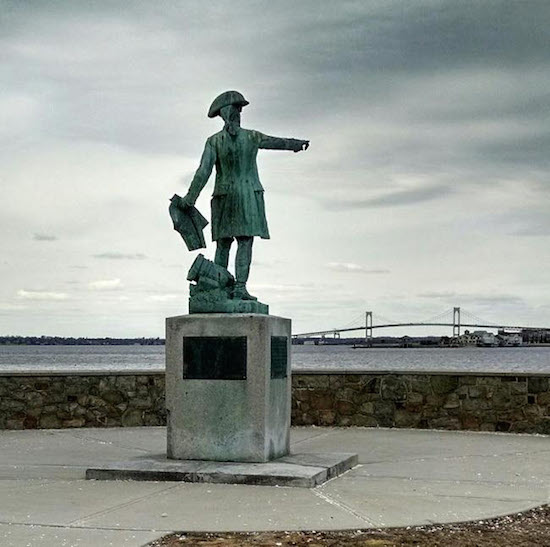
The Tiverton soldier appears to be defending the long-closed bridge across the Sakonnet River. As war memorials go, this bronze by Lewis J. White and cast by the Gorham Foundry is merely serviceable, neither exceptional nor dramatic.

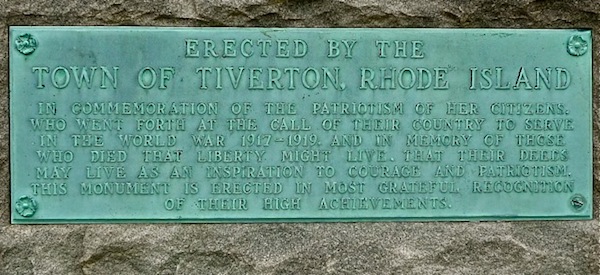
Nevertheless, it still offers a story. The Roll of Honor lists over 150 names. Could Tiverton have sent so many soldiers and sailors to rescue Belgium and France from the Hun? Of those, over a dozen deaths were noted with little stars.

There are a number of Irish (Brophy, Flanagan, O'Connell), French (Beaulieu, Herveux, Lavault), Portuguese (Medeiros, Souza, Raposa). But what surprises is how a hundred years ago the majority of names were old New England ones–Bradshaw, Stafford, Holden. Four nurses are remembered as well, including Emma Frost and Mary Tabor Manchester.

William Morgan is an author and architectural historian.

plaque


Read More
Commentary Robert Whitcomb Commentary Robert Whitcomb

Barret Stern: 'Love is the Highest Law'

  In May 2013, Vlad Tornovy, 22, paid the ultimate price for being openly gay in Russia. After having his genitals slashed, his face bashed in with a rock, and two and a half beer bottles forced into his anal cavity, he mercifully died. This sort of terrible event has become common in Russia, where rampant homophobia can make lethal to speak about LGBT people as equals. Discrimination and violence against homosexuals are condoned, even encouraged, by the Russian government.

Among a series of laws passed by the Russian  parliament in 2013 is one that "prohibits propaganda of non-traditional sexual relations  directed at minors”. The law’s text is so vague that any public pronouncement of feelings between same-sex partners can constitute an infraction. Another law banned the adoption of orphans by same-sex partners. As for couples who have already adopted children, they will soon lose their parental rights.

The documentary Love is the Highest Law looks at three human destinies, linked not only by the persecution of homosexuals in Russia, but also two historic changes in the summer of 2013 in the United States: the overturning of the federal anti-gay-marriage Defense of Marriage Act and the end of the similar Proposition 8, in California.

The movie tells the story of Vadim, of Georgian background, who was born and raised in Moscow, where he developed the dream of becoming an actor. His dearest wish is fulfilled when he starts his studies for a master of fine arts in acting degree at the New York Film Academy. There, he meets Jonathan, who, fully accepting his sexual orientation, at 14 decided to leave his home in conservative Oklahoma to become an actor in Los Angeles. The two fall in love, and Vadim, despite the psychological damage from his Russian past, finally finds the strength to admit his sexuality to both himself and his family.

This is a story about courage, doubt and culture-shock. It shows two people and two countries separated by the deep ocean. It is also about love, which overcomes some of the obstacles. The movie celebrates the main characters’ irresistible desire to share their lives, set goals and fulfill their dreams.

Sandro, a famous designer from Russia, is the third principal character. As a star of Project Runway, Sandro escaped the persecution he faced in Russia and found political asylum in New York. But there, watching archived materials full of violence and harassment in Russia, including by the police, painfully brings back to him events from his past.

Both Sandro and Vadim are still distraught about having to leave Russia. While the United States offers them the security they so desperately lacked in Russia, their move to the America does not end their lifelong struggles. Fame and money seem transient. And Sandro's experience shows the psychological damage he faces daily in his parallel acceptance by strangers and rejection by those whose love and support he needs most.

The film includes the exclusive commentary of famous members of the LGBT community, such as Gilbert Baker, an artist and a civil-rights activist who designed the Rainbow Flag in 1978, and Aaron Morris, the legal director of Immigration Equality, a pro-bono asylum project that provides technical assistance and mentoring on LGBT immigration issues to lawyers around America.

This documentary is intended to change hearts and minds. It encourages people to speak frankly about their feelings and life events amidst radically opposed changes in gay rights and equality in Russia and the United States.

Barret Stern is the pseudonym of a Russian rights activist.

Read More
Commentary Robert Whitcomb Commentary Robert Whitcomb

Charles Pinning: Easter memories of Molly

roch  

 Statue of Rochambeau in  Newport.

When my father changed jobs, he and my mother moved hundreds of miles away. I was 15 and stayed behind, boarding at St. George’s School in Middletown, R.I., where I had been a day student.

I had a girlfriend a couple miles away, in  Newport, whom I would visit on weekends. We would walk along the harbor at King Park, near where she lived with her mother. Close by the water’s edge we often lingered around the statue of Jean-Baptiste Donatien de Vimeur, Comte de Rochambeau, commander of the French forces so instrumental in helping the former colonists win the Revolutionary War.

“You are so lucky to have lived in Paris,” I told Molly. I had never been out of the U.S. before.

Molly had no immediate response, which was not unusual for her. In fact, it was something that I’d grown very much to like.

Molly had long dark hair, long legs, freckles and was partial to miniskirts. She had almond-shaped, hazel eyes that she outlined in mascara that gave her a deep and pensive look, but her sudden, toothy Irish smile could transform her whole face into bright sunshine.

Our time together always flew by. We wrote each other love letters and poems and sent them via U.S. Mail, so quaint by today’s standards.

“My parents split up when we came back here from Paris,” she said.

“I know,” I replied, and squeezed her hand.

On a Saturday in February, I went over to her house for dinner. Her mother, brother and sister were there. Vietnamese skirmishes and body counts were on the television news, as they were every night. I vowed that I would never go.

“Why, that would be unpatriotic,” said her mother. The year was 1967, and many adults in the United States still felt that way.

“But look at them getting shot at!” I said, gesturing to the TV. “Why would I want to get killed for nothing?”

“I would hardly call it for nothing,” said her brother.

“Really?” I asked. “Then could you please tell me why Americans are getting killed there?”

“Have you ever heard of communism?” said Molly’s sister.

“Yes. And do you think if a teeny, faraway country like Vietnam becomes communist it’s going to hurt us?”

“Could you please stop?” Molly asked me.

“What? Stop using my brain?”

“No. Start.”

“I beg your pardon?”

“When are you planning on getting a haircut?” asked her mother beneath her helmet of perfectly coiffed hair.

“No time soon,” I replied sullenly.

Easter was almost upon us but Molly mentioned nothing about it. I assumed that I’d be joining her family for dinner and brought it up.

“That won’t be happening,” she said.

“Why?”

“You’re persona non grata. My family doesn’t like you.”

“Because of last week?” I asked

“You were angry and upsetting.”

“I wasn’t angry. I was passionate! There is a difference!”

“And they saw us arguing.”

“We weren’t arguing. We had a few words. Doesn’t everyone do that from time to time?”

“Not in front of other people.”

“Am I to be crucified for it? How do you feel about not spending Easter together?” Molly lowered her eyes and shrugged.

“Sad.”

On Easter Sunday, I didn’t want to be seen alone around school, so I walked to half-town and bought a blueberry muffin and walked the rest of the way into Newport, winding up at the statue of the Comte de Rochambeau.

Unwrapping my muffin I saw something in the water. It was a white seal looking at me with dark, glossy eyes that were curious and compassionate. I started crying, missing my family and Molly.

The seal watched me and I heard in my head my mother’s voice: “Don’t be mad at Molly. She’s in an awkward position. It’s Easter, and I want you to be happy. Why not write a story about this? You’ll feel better.”

I grumbled and finished my muffin. Even at 15 I was a bit of a curmudgeon. Now, decades later, I’ve finally written the story and I do feel better. Somewhat. And I do still like a muffin, and thinking about Molly.

Charles Pinning is a Providence-based novelist who still procrastinates but plans on getting better.

Read More
Commentary Robert Whitcomb Commentary Robert Whitcomb

Shakespearean visions

oberon

“My Oberon, what visions have I seen!”

                                             [A Midsummer Night’s Dream, IV, i]

One of Massachusetts photographer Russell duPont's works from his ''Shakespeare Series.''

Read More