
Vox clamantis in deserto






Resinous reverie

"Cape Pines'' (print) by ANN GUILIANI, in the show "Printmaking: the Image Conceived and Transformed,'' at the South Shore Art Center, Cohasset, Mass., Sept. 12 through Oct. 19 in the show "Printmaking: the Image Conceived and Transformed,'' at the South Shore Art Center, Cohasset, Mass., Sept. 12 through Oct. 19.
The smell of the pines as one drove south from Boston and into Plymouth on the approach to the Cape on little, two-way Route 3A is a fond memory of those whose childhoods antedate the Interstate Highway System. And the farm stands along the way, from Marshfield south.

Bends in the pond
 At the Millbrook Gallery and Sculpture Garden, in Concord, N.H. , in its "17th Annual Outdoor Sculpture Exhibit,'' through Oct. 26.
Fruit of the vines

"Sky Vines" (oil), by JAMIE YOUNG, in her show at Dedee Shattuck Gallery, in Westport, Mass., through Aug. 24.
The gallery notes say that "Young seeks to capture the feeling of a place and the quality of light rather than creating a formal representational landscape painting, embedded in her images of flora are observations of climate change. Her works are energized and gestural, representing the passion with which she captures the beauty of her surroundings. She is particularly attracted to wild vines enveloping leafy trees, bows dipping into rippling rivers, and sunlight shimmering on foliage.''
Watergate and the Washingtonian
After a day of work at the news desk of The Wall Street Journal in Lower Manhattan hearing about Richard Nixon's pending resignation, I climbed the stairs from the platform at the Montague Street subway station, in Brooklyn Heights, and saw at the newsstand at the top the huge block letters on the first edition (still wet) of The New York Times: "Nixon Resigns''.
Unlike the fresh, cool air this morning, the air that evening was warm, fetid, and sticky as I walked to my apartment in Cobble Hill, through one of the few pro-Palestinian neighborhoods in New York City. (This meant that the neighborhood had some good Mideast restaurants that did wonderful things with apricots.)
The Watergate drama, or melodrama, about which I had been writing, and editing others' writing on, for more than two years was mostly over. But we still had to be subjected to the controversy over President Ford's pardon of Nixon.
Then a few weeks later I was in the WSJ's Washington Bureau (with its lovely oriental rugs) filling in as a copy editor of Washington-based stories, of which Nelson A. Rockefeller's nomination to be vice president was the biggest. Those were hot, humid but energizing weeks, topped off with drinks in the tropical air on the terrace at the top of the Washingtonian Hotel, which seemed as exotic as a bar in a Graham Greene novel.
-- Robert Whitcomb
Peter Baker: Restore the prey of cod to restore cod

(See this excerpt from a Portuguese documentary about cod fishing.)
A recent study illustrates what has happened to New England’s once plentiful Atlantic cod population, and the findings highlight the big role that little fish play in our marine ecosystems and economy. It’s no secret that New England’s cod are in trouble. Overfishing has so severely depleted the population that federal officials declared a fishery disaster and Congress appropriated more than $30 million in aid. But even as the bottom fell out of cod stocks, many fishermen insisted the fish were still plentiful in their nets and disputed the science supporting tighter catch limits. Why did fishermen see a bounty while scientists in fact called it a bust? Researchers at the National Oceanic and Atmospheric Administration’s Northeast Fisheries Science Center say a change in the forage fish, or small prey species, the cod were eating offers an explanation. In an article published in May in the Canadian Journal of Fisheries and Aquatic Science, the authors say that around 2006 the dominant prey for cod switched from Atlantic herring to sand lance — small, eel-like fish that burrow in the sediment of the seafloor. Sand lance were abundant in an area known as Stellwagen Bank, and so cod, too, congregated there. Soon, cod fishermen focused so much effort on the bank that some 45 percent of the cod caught in a year came from just a 100-square-mile area in the region. But scientific surveys assessing the cod population over more than 20,000 square miles in the Gulf of Maine continued to show that the larger population was seriously depleted. Clearly, the abundance in one small region didn’t accurately reflect the overall status of cod. The authors say they hope that the findings can “help fishery managers, scientists and the industry understand and resolve apparent conflicts between assessment results and the experiences of the fishing industry.” While this study helps to explain the recent past, it also holds important lessons for the future of fishing. The switch in cod diet from herring to sand lance held major implications for one of the region’s most important fish. Over the years, through intensive fishing for prey species such as Atlantic herring and menhaden, plus the depletion of other historically important prey such as river herring and shad, the “menu” of forage fish available to cod and other predators has changed. We need a management system that better monitors and responds to the ways prey and predators interact. Such a system is available, and it’s called ecosystem-based fisheries management. Scientists have long known that simply measuring and managing one fish species at a time is insufficient. So they’ve put decades of work into developing the ecosystem-based approach to provide a much more accurate and useful picture of what’s occurring in the water. A good ecosystem-based fisheries management program would take the needs of predator species into account and let managers restore the abundance of prey, causing a resurgence of fish stocks and, ultimately, providing greater opportunity for the fishermen who depend on them.
Peter Baker directs the Pew Charitable Trusts’ U.S. ocean conservation efforts in the Northeast and Mid-Atlantic. This piece originally appeared on ecori.org.
Not New England
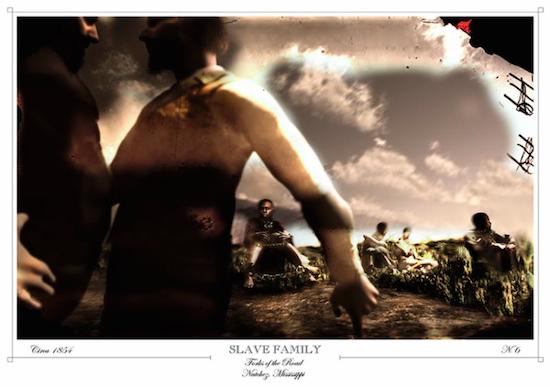
"Slave Family—Forks of the Road, Natchez, Mississippi'' (montage), by STEPHEN GOLDING, at Galatea Fine Art, Boston, in the "NE Collective V Juried Show'', through Aug. 30.

Emily Schwartz Greco/William A. Collins: Good news for public is bad news for Wall St.
NORWALK, Conn.
For the first time since 1997, the U.S. economy just added at least 200,000 jobs per month for six months running. GDP grew at a 4 percent annual clip between April and June. The percentage of Americans who describe the economy as “good” has climbed to the highest level of President Obama’s presidency.
Who wouldn’t rejoice over these happy milestones on the bumpy road to a real recovery?
Wall Street. On July 31, within hours of the release of a bunch of sunny indicators, stocks sank more than they had on any day since early February. The decline wiped out all gains the S&P 500 stock index had racked up over the month.
Global instability contributed to the sharp drop, but so did investors’ fretting over indications that workers are finally getting higher wages and more benefits.
And why exactly does Wall Street tank on news portending economic gains for most Americans? Don’t people with extra money in their pockets boost the economy when they spend more freely? Isn’t it something worth celebrating?
Not in an economy that caters to the rich.
You see, there are practical implications of the chasm between rich and poor for the conduct of commerce. For several years, retailers have increasingly doted on the affluent, the most alluring segment of the $10 trillion consumer spending market.
Consider how U.S. households differ. The richest 20 percent of Americans now pocket more than half of the nation’s income. The typical income for this kind of family tops $150,000, triple the norm for all of us. Together, these “high-value customers” (to borrow a phrase from LuxuryDaily.com) account for about 40 percent of all U.S. spending.
And the cost of real luxury has gotten a divorce from reality. A quilted Chanel handbag can set you back $4,900. An ultra-thin Piaget Altiplano watch could siphon 95 grand from your wallet.
There’s still some money made from selling cheap stuff to the poor and working class. That’s why the four biggest U.S. retailers are big-box behemoths Wal-Mart, Costco, and Target, along with the Kroger supermarket chain. Even the very bottom of the food chain, the people whose households eke by on $30,000 or less a year, account for a stagnant yet sizable $1 trillion bare-bones consumption market.
For them, dollar stores can be a bigger draw than the big boxes. They’re in a bind and so are the companies relying on their purchases.
“Customers are under pressure,” Dollar Tree Chief Executive Bob Sasser told The Wall Street Journal. “Unfortunately, that’s one reason why the space continues to grow.”
In a telling sign of today’s increasingly unequal times, Dollar Tree is merging with Family Dollar Stores. The No. 2 and No. 3 companies in this cut-throat market want to team up to compete with their No. 1 competitor, Dollar General. Together, they’ll fend off bids by Wal-Mart and its ilk to gobble up some of their territory with new smaller-box establishments.
Clearly, times are tough for retailers opting to sell stuff to the rest of us. But they’ve got it figured out for the most part and Wall Street worships predictability.
Think of all the economic models and assumptions that would be shattered if the drive toward wealth concentration were to take a detour toward shared prosperity.
Of course, financial experts won’t say these things out loud. Instead, they’ll mutter about inflation and freak out over signs that labor markets are growing tighter. Are those really big concerns in light of this protracted war on consumers?
If you would like to know more about how and why the rich are getting so much richer while the poor become steadily poorer (and you enjoy very long reads), check out Thomas Piketty’s 700-page masterpiece. In his wildly successful book Capital in the Twenty-first Century, the French economist has finally organized and footnoted every lost battle in this tale of class warfare.
Winning the debate, of course, isn’t enough. Until more U.S. political and business leaders decide they’ve had enough, this nation will become less of a democracy governed by the people and more of a plutocracy ruled by the rich.
Emily Schwartz Greco is the managing editor of OtherWords, a non-profit national editorial service run by the Institute for Policy Studies. OtherWords columnist William A. Collins is a former Connecticut state representative and a former mayor of Norwalk, Conn. This piece originated at OtherWords.org.
Laud Taveras for helping to protect Providence's working waterfront
All hail Providence Mayor Angel Taveras for signing an amendment to the city's zoning ordinance to protect Providence's working waterfront and port from being ruined by developers' plans for condos and restaurants. The port and industrial uses of the waterfront are what actually increase the region's wealth, not speculative, property-flipping condo and other real-estate developers and low-paying "hospitality industry'' jobs, many of which are highly seasonal. The area desperately needs the steady and well-paying "blue-collar elite'' jobs provided by a working waterfront and port.
We have enough restaurants. We need a real economy.
Charles Chieppo/Mary Z. Connaughton: More corruption comin' up!
BOSTON As we learned during the recent trial about the Massachusetts Probation Department’s job-rigging scheme, there’s a difference between patronage and cooking the books. Patronage is legal; cooking the books to foster patronage and political favoritism will land you in prison.
It’s ironic that only five days after former Massachusetts Probation Commissioner John O’Brien and others were convicted, Gov. Deval Patrick signed legislation to expand the Boston Convention and Exhibition Center in a boondoggle designed to feed the Massachusetts Convention Center Authority’s patronage empire and premised on layers of fictional numbers.
On the merits, the $1 billion expansion simply doesn’t make sense. This sums it up: There was a little over 36 million square feet of exhibition space in the United States in 1989. By 2011, that number had nearly doubled to 70.5 million. In the midst of this decades-long convention-space explosion, demand has remained flat at best.
Lest you think that Boston is immune from the trend, the BCEC — touted to be so full that it had to be expanded — is generating less than half the hotel room nights that had been predicted in the 1997 feasibility study on which the decision to build it was based. Before being cannibalized by the BCEC, even the much-smaller Hynes Convention Center had years in which it generated more.
A small group of consultants show up in city after city to prop up the declining convention industry. They made the same claims in such cities as Sacramento, St. Louis and Myrtle Beach, S.C., which got the same or even worse results than were achieved here. Learn from their mistakes? In a 2005 legal deposition, Charles H. Johnson, who conducted the 1997 BCEC study, said, “Once the deal is done, if we’re not engaged, we … give them our report, our final invoice, and wish them good luck.”
But all that can be overlooked to feed the convention center authority’s patronage empire and reward political friends. None of the 80 percent of Massachusetts construction workers who don’t belong to a union will be working on the BCEC expansion, because the legislation includes a union-only project labor agreement.
Security guards also got a piece of the pie: The expansion bill extended the commonwealth’s prevailing wage law to include them.
From the beginning, BCEC expansion has been a case study in government at its worst: A group heavy with tourism industry sycophants was assembled to explore the feasibility of expansion. When they gathered each month, the choir was preached to by convention cheerleaders. After they predictably endorsed expansion, a case made by using unrealistic projections about the convention center authority’s finances and hotel-tax receipts was blessed by state officials disinterested in the substance.
Is it any wonder that the result will be to enhance the ability of politically connected players to dole out jobs and favors to the detriment of the taxpaying public? Time will tell whether it’s all just patronage or it rises to the level of cooking the books.
Charles Chieppo is senior fellow and Mary Z. Connaughton director of finance and administration at the Pioneer Institute, a Boston-based think tank.
Seal of approval

"Chatham Seal'' (Chatham, Mass.,) photo by BOBBY BAKER (copyright Bobby Baker Photography).
Why do people like seals so much? Presumably because they look so much like dogs.
Their 2 major food groups: Nicotine and alcohol

''Beer and Cigarette'' (oil on plexy), by MICHAEL DOYLE, at Patricia Ladd Carega Gallery, in Center Sandwich, N.H.
It wasn't that long ago that millions of workers daily repaired after their shifts to smoky joints like the one that this picture recalls. These places were very close to offices or factories. Indeed, the bars were often scientifically located specifically to serve this or that local big company.
Employees could chain-smoke simply by breathing in the air of the bar. For hours, they'd drink and do supplemental smoking. Then, especially if it were late in the week, repeat the process all over again the next day. Now folks can't smoke in bars, which reduces the desire for drink, which reduces the desire to smoke. (The big exception: The giant bars known as casinos, where state taxing authorities, and income-and-sales-tax-hating citizens, want the cross-promotional addictions of booze, cigarettes and gambling to keep pumping up state budgets from states' draw on casino revenues.)
For that matter, plenty of people went to bars on their "lunch break,'' and unless they were falling down drunk when they returned to the offices or factory, it was tolerated -- indeed, expected. Executives did it, too, albeit more likely ordering cocktails and bottles of wine than what their lackeys bought, which was mostly (bad) beer.
About half the news desk staff at the old Boston Herald Traveler, where I worked, would go next door to a joint called Foley's and toss back a few at their "lunch,'' which came at mid-evening. (It was a morning paper so the paper was mostly produced between about 6 p.m. and 2 a.m.).
The daily heavy-drinking habit, along with relentless deadlines, rapidly aged the editors. Many of those who I thought were around 60 were in fact about 40. But many were addicted to the daily adrenaline of deadines and breaking news (much of which was suffused with false urgency).
All in all, a lousy way to live, but we all got stories about at least mild depravity out of it. Some of us even still remember them.
--- Robert Whitcomb
Killing mosquitoes -- and lobsters
http://www.ecori.org/connecticut-news/2014/7/29/spraying-for-mosquitoes-a-risky-proposition.html No surprise here: Spraying to kill mosquitoes is bad for other life -- in this case lobsters.
The delights of temporary depopulation
Aug. 5, 2014
A mild and humid early morning. Shafts of sunlight glow through the haze. The streets are bordered, and in some stretches topped, by a great lushness, except that some leaves in the trees are starting to wilt and fall off because of summer fatigue. I wonder how late most of the leaves will stay on their trees this fall, which some forecasters say will be warmer than average. Indian summer until well into December?
The best thing about walking in the early morning, besides the freshness of the air, is the absence of people -- that near-constant source of trouble and weariness. If only we could all live from time to time in a cabin at Walden Pond, of course with such nearby friends as the Emersons to mooch off .
Oasis in Greenwich

"Ascending the Surface'' (oil on canvas), by SAMANTHA FRENCH, in the "Just Add Water'' show at C. Parker Gallery, in Greenwich, Conn., through Aug. 30.
David Warsh: They want a 'Fourth Revolution' in the West
BOSTON
When he was 18, before entering college, John Micklethwait toured the U.S. for a year with a friend, traveling on Greyhound buses. When they arrived in San Francisco, they spent a memorable evening with expat British businessman Antony Fisher, founder of London’s Institute of Economic Affairs, and his downstairs neighbor, Milton Friedman.
They talked about the possibilities now that Margaret Thatcher had become prime minister and Ronald Reagan president of the United States. The conversation made a deep impression on Mickelthwait. Then it was back to Magdalen College, Oxford, and an eventual career in journalism.
Today his companion is a major general, but Micklethwait commands many more battalions as editor-in-chief, since 2006, of The Economist. His new book is The Fourth Revolution: The Global Race to Reinvent the State, written with longtime collaborator Adrian Wooldridge, management editor of the magazine. They argue that the West should complete the revolution of the ’80s that Friedman started.
It won’t be easy, the authors acknowledge. Both the welfare state and democracy itself must be reined in, the former by redefining and reducing expectations of it; the latter by consensually imposing a series of self-denying limits: global budget caps, monetary targets, earmarked taxes, co-payments, borrowing ceilings, sunset provisions and the like.
The successful construction and adoption of such a fiscal constitution would amount to a “Fourth Revolution” in the nature of government in the West, they say. Previous revolutions they associate with three philosophers who at intervals wrote influentially on the role of the state. This catechism, a familiar device from their magazine, is designed to buttress the case for what they hope will happen next.
Thus, Thomas Hobbes described the fundamental purpose of the nation-state as the creation of law and order, thus the overwhelming force necessary to maintain the nation-state known ever since, at least to Hobbesians, as “Leviathan.” John Stuart Mill, who lived in a more prosperous time, imagined the state as a kind of “night watchman,” dedicated to free trade, social rights (of women in particular), and education. And Fabian Society socialist Beatrice Webb conjured a ”welfatre state” in the 20th century in which government influence extended into every sphere of production and consumption.
The authors are then off on a round of breathless reporting: to California, which they say illustrates everything that is wrong with modern democratic government, until, miraculously, under Gov. Jerry Brown, the state begins to straighten itself out; to Singapore, to see Lee Kuan Yew, founding father of a new model of national development, adopted in some ways by China, “that is in many ways leaner and more efficient than the decadent Western model”; to Sweden, where a wave of privatizations has reduced government spending in 20 years from 67 percent of GDP to 49 percent.
Along the way, we meet many of the usual suspects. Clayton Christensen, of the Harvard Business School, is “perhaps the world’s most respected writer on innovation,” who thinks that the public sector will be upset by what he calls “mutants” -- new organisms that may spin out from unexpected directions. (Their esteem is not universally shared.) Peter Theil, a prominent venture capitalist, laments that technology has so far failed to change the public sector.
Devi Shetty, an entrepreneur, “whom American surgeons may one day remember the same way that American engineers think of Kiichiro Toyoda,” has a production line of 40 cardiologists who perform 600 operations a week in Bangalore.
There is a peroration in the book:
"The Fourth Revolution is about many things. It is about harnessing the power of technology to provide better services. It is about finding clever ideas from every corner of the world. It is about getting rid of outdated labor practices. But at its heart it is about reviving the power of two great liberal ideas. It is about reviving the spirit of liberty by putting more emphasis on individual rights and less on social rights. And it is about reviving the spirit of democracy by lightening the burden of the state.''
One indication that history may not be tending in this direction is that the subject of climate change comes up nowhere in the book. This is odd because the weekly Economist does such a good job of reporting on the growing scientific consensus that global warming is becoming a serious problem.
Another contraindication is to be found in the authors’ proposal to “leapfrog over the muddle of Obamacare,” borrowing equally from “Old Europe and New Asia.” Why not combine a European-style single-payer health care system, featuring an independent medical board to evaluate the cost-effectiveness of medicines, devices and procedures, with means tests and a Singapore-style stream of earmarked taxes pay for it. That might strike Tea Party fundamentalists as socialism, they write, but it is precisely the kind of transparency-inducing global cap that they advocate in other connections, including Social Security.
It is not fair to place so much weight, as the authors do, on Milton Friedman’s shoulders. The Chicago economist, who was 94 when he died, in 2006, was a deeply consequential 20th Century figure whose role is not yet well understood. He may be fruitfully compared to John Maynard Keynes. Both men were authors of clarion wake-up calls. Keynes argued that government had a role in stabilization policy that it must not shirk; Friedman, that there are many economic ways to address a problem (including, presumably, the threat of global warming). Neither man was much concerned in his day with the finer points of economic analysis, but each commanded the attention and, ultimately, the agreement of his age. Other theorists, notably James Buchanan and Friedrich Hayek, have been more concerned with the idea of fiscal constitution.
At one point in their roundup, the authors quote Michael Bloomberg, the billionaire financial analytics entrepreneur who served three successful terms as mayor of New York City before returning to civilian life. Among other things,he oversees Bloomberg BusinessWeek, which he bought while he was mayor. Running a city is different from running a business, Bloomberg says.
''People are motivated by different things and you face a much more intrusive press. You cannot pay good staff a lot of money…. In business you experiment and you back the projects that win. The healthy bits get the money, and the unhealthy bits wither. In government the unhealthy bits get all the attention because they have the fiercest defenders.''
Doubtless so. But that doesn’t mean that governmental processes are not being improved, mainly along the lines advocated by Micklethwait and Wooldridge. Perhaps it is familiarity with the details that makes Bloomberg BusinessWeek so consistently interesting when it arrives along with The Economist each week. Hardly a week passes that I don’t compare the one to the other. In coverage of the Fourth Revolution, most weeks I think that the Americans are getting ahead.
xxx
A 14-page article, The Biden Agenda: Reckoning with Ukraine and Iraq, and keeping an eye on 2016, by Evan Osnos, in the current issue of The New Yorker, signals the vice-president’s willingness to contest the Democratic presidential nomination with former Secretary of State Hillary Rodham Clinton. For both the politician and the journalist it is an impressive outing (Osnos, recently returned from China, is author of Age of Ambition: Chasing Fortune, Truth and Fraith in the New China). The article would seem to promise a spirited campaign.
David Warsh, an economic historian and a longtime financial journalist, is proprietor of economic principals.com.
Charles Pinning: In '63, encountering a music legend to be
Deep in the summer of 1963, my world consisted of two things: baseball and cars. I lived in Newport. When I was 11 years old and wasn’t playing for my Little League team, I’d wend my way up to Vernon Playground, often stopping at my friend Buddy’s house to snag him. After several hours playing pick-up ball under the blazing sun, we’d backtrack down Bliss Road and head into Koozy’s (Kuznit’s), our neighborhood corner store, for sodas and packs of baseball cards with bubble gum. If the Newport Folk or Jazz Festival was on, we’d head up to Broadway to watch the cars rolling into town. Between the Newport Hospital Nursing School and Rhode Island Avenue, there was a stone wall that rose up six feet above the sidewalk, shaded by two enormous beech trees. Buddy and I climbed the steps to the front lawn of the house and planted ourselves on the wall, our legs dangling over so we could get a good view of the cars coming down Broadway into downtown Newport. “Porsche,” intoned Buddy, making the first identification. The idea was to see how early you could tell what kind of car it was coming. “Jag, XK 120,” I jumped in. “Sting Ray ... Sunbeam Alpine.” “Healey 3000 ... Citroën.” Because of the music festivals in Newport, you got a sudden influx of foreign cars, filled with kool kats, hep cats, berets, long hair, depending on whether it was the Jazz or Folk Festival. We first spied the big-finned Cadillac as it passed DeCotis’s Barbershop, steam billowing out from under the hood, and it pulled over right below us. It had New York plates and the driver, a solid, middle-age man with glasses, stepped out and popped the hood. A skinny, college-age guy with curly hair that was almost fluffed up into a pompadour got out of the backseat. He looked up at us and then leaned against the wall, watching the steam rise out of the engine compartment. The man in front of the hood called to us: “You boys know where there’s a service station?” “Yep. You just passed a Mobil station up there,” I said pointing. “Right before that barbershop.” The man told the skinny guy that he was going up there. The skinny guy said, “OK. I’ll wait here.” Then a woman, about the skinny guy’s age, with long dark hair, got out of the back of the car. She looked up at us and said, “Hi.” She had pretty eyes and a nice smile. The skinny guy looked up at Buddy and said, “Kid, can I have a sip of your soda. I’m dying a thirst.” Buddy hesitated then said OK, and handed down the bottle of RC. The guy took a couple of good slugs and handed it back. “That was good,” he said. “Thanks.” The woman looked at me with her big brown eyes, so I handed her my bottle and she took a swig. The skinny guy took out a pack of cigarettes and asked us if we wanted one. We glanced at each other and said, sure. The skinny guy shook the pack and out popped a couple of Lucky Strikes. Buddy took a drag and started coughing. I held my smoke in my cheeks. The skinny guy went to the car and pulled a guitar case out of the backseat. He and the woman came up and sat down next to us on the wall. “You guys like folk music?” he asked. “It’s OK” I said. “But I prefer rock ’n’ roll.” “No kidding? Electric guitar?” he asked, and looked hard at me with his blue eyes as if he was actually thinking about what I’d said. Then he began playing a song. His guitar playing was good, but his voice was just terrible! Buddy and I looked at each other as he screeched, “The answer my friend, is blowin’ in the wind, the answer is blowin’ in the wind .... ” But when the woman chimed in, she had a voice like an angel, high and pure. Then he played “This Land is Your Land,” and we had fun singing that together. When the older guy got back with a jug of water for the radiator, the skinny guy put his guitar away and thanked us for sharing our sodas. So did the woman and she got back in the car. Before the skinny guy got in, he turned to us. “Hey, what are your names?” he asked. I told him, “I’m Chuck and that’s Buddy.” “Well, OK, Chuck and Buddy. I’m Bob, and I guess that’s about it. Good luck.” With a blast of the Caddy’s horn they pulled away and Buddy and I went back to our car spotting, making jokes about what a horrible singer Bob was. Of course, our estimation of him was destined to change over the next few years. Charles Pinning, an occasional contributor, is the author of the Rhode Island-based novel “Irreplaceable.” While he is a fiction writer, he insists that the above story is true.
Animal to vegetable

"Leaf'' (hand-stiched human hair), by JENINE SHEREOS, in the show "Jenine Shereos and Ada Solomon'' at Solstice Art Gallery & Studio, in Wellfleet, Mass., through Sept. 20.
James P. Freeman: What is a 'living wage'?
Like the mysterious appearance of black swans and blue moons, it was bound to happen sooner or later. The Cape Cod Times recently endorsed a position held by conservative Massachusetts state rep. Randy Hunt, who agreed to an increase in the state minimum wage that became law last month. Supporters of a mandated increase in wages (which will rise to $11 an hour in the commonwealth by 2017) might reconsider their positions given today’s fragile economy and future projections of the deleterious effects of such action locally and nationally.
Hunt (R.-Sandwich) shall be forgiven for choosing, in his words, “the lesser of two evils:” one, a pesky ballot initiative—always a wildcard for passage--in this November’s elections, that called for a swift increase of $10.50 an hour and automatic increases indexed to inflation (think of the recent gasoline tax, pegged similarly in perpetuity); or two, a higher per-hour figure with a definitive cap not tied to a gyrating Consumer Price Index, to be implemented in stages. He chose the latter.
His compromise may make sense given the coercive supreme Democrat majorities in the legislature that would have thwarted more reasonable Republican proposals but it is still bad public policy. It also does little to counter assertions that Republicans are insensitive about the working poor. More so, it is just as bad as President Obama’s $10.10 federal minimum-wage proposal.
In 1938, at the end of progressivism’s first wave and during Franklin D. Roosevelt’s second term, Congress enacted a federal minimum wage. Every president since, except Ford, Reagan and Obama, has signed into law increases, the most recent being George W. Bush in 2007; the last increase set in 2009. Last autumn, The Huffington Post reported that “progressive economists” believe that if today’s wage kept with the rate of inflation it would now be above $10 an hour.
Today’s debate centers on what Roosevelt indeed described as a “living wage.” Arguments abound on the role of government creating arbitrary and artificial adjustments. What should or should not be a floor? Given today’s prettifying pulse of progressivism, why not a ceiling? In the interests of fairness and compassion, why let market conditions dictate such figures?
So public-policy experts now speak of a living wage that would remove workers from poverty. Therefore, the $10.10 figure supposedly will not only lift the working poor out of poverty, but will presumably allow for continued receipt and reliance on benefits so generously distributed in today’s welfare state.
There is a fundamental flaw in this line of reasoning.
To be elevated to a lower-middle-class income bracket, a $10.10 minimum wage presupposes an hourly worker working 40 hours a week for 52 weeks a year. According to federal statistics, however, full-time hourly laborers work an average of 34.5 hours a week; 70 percent of all minimum-wage employees work fewer than 35 hours a week. Even government statisticians must concede that working every single week is wildly ambitious for purposes of actuarial calculations.
Despite having over $2 trillion in cash reserves, corporate America is unwilling to pay wages for what was once universally defined as a 40-hour week, let alone overtime. Government’s role should be to create conditions—incentives--favorable for increasing salaries. But the government continues to create uncertainty with its tax policy, regulatory overreach and, more recently, disrupting coverage and costs for healthcare (watch Massachusetts mandate paid sick-leave for small and medium-sized businesses).
What’s next, establishing a law forcing businesses to comply with a 40-hour work week?
In 2007, David Neumark and William Wascher cleared the din above the noise with a study published for National Bureau of Economic Research. Their research determined: “A sizable majority of the studies surveyed… give a relatively consistent indication of negative employment effects of minimum wages.”
The nonpartisan Congressional Budget Office estimates that raising the federal minimum wage from its current $7.25 per hour rate to the president’s preferred wage will remove only 900,000 people (or 2 percent) out of poverty from the 45 million believed in poverty. Middle-income jobs from the last recession were replaced largely with low-wage jobs.
Of greater concern should be this potentially unintended consequence of government meddling: increased income of the poorest of workers will likely make them ineligible for the full amount of benefits, such as food and energy assistance. Not to mention higher payroll taxes. Such a twist may in fact negate extra hourly pay to the point of making the very increase negligibly beneficial, all to the detriment of domestic and state economies.
A new paradox exists today: jobless rates are generally declining -- as have labor- participation rates--while benefits to Americans are increasing. James P. Freeman, formerly in the financial-services industry, is a Cape Cod-based writer.