
Vox clamantis in deserto


Our polarities with other animals

"Nothin for You Here" (acrylic on canvas), by JANE O'HARA, in the "Beasts of Burden'' sh0w at Harvard Allston Educational Portal through May 5.
Artscope reports: "Both the individual and collaborative efforts within the exhibition speak to the polarities of the human-{other}animal relationship, covering every length of the spectrum from deep love and respect to a palpable sense of anxiety, guilt and even outrage regarding crimes perpetrated against the defenseless species.

Putin's energy lesson for Europe; new green media empire
The Russian seizure of the Crimea is an example of how reliance on fossil fuel makes people captive of dictators. At this point, other than spouting mostly empty rhetoric, it appears that the Europeans can/will do little or nothing to halt Putin's expansionism, which will not stop with Crimea. The main reason is that they're afraid that he will cut off their gas.
The more that the Europeans and others have their own locally created renewable energy, the less their policies will be captive of such dictators as Putin.
Meanwhile, I note that Peter Arpin, Edward Catucci and their colleague at Renewable Now have created a nifty multi-media operation devoted to sustainability and renewable energy.
Ike, LBJ and GWB also didn't act
March 7, 2014
Milder today, with even a touch of the sweet melancholy of spring. I think that when spring (that you can feel) really arrives, maybe next month, there will be an usually exuberant explosion of green. And maybe a particularly hot summer. The meteos predict much warmer weather starting later this year as El Nino gets cooking. Good, this year's heating bill have just about bankrupted us.
First, a reminder that Eisenhower did not do a thing when the Russians invaded Hungary in 1956 and killed about 30,000 people; Johnson didn't do anything when the Russians invaded Czechoslovakia in 1968, and George W. Bush didn't do anything when Russia invaded and stole part of Georgia.
Fascist Russian dictator Putin still occupies Crimea and it looks at this point that not much will be done about it, at least in the short term. The Europeans fear that Putin will turn off their gas supplies; they have also essentially disarmed. This shows yet again how being dependent on fossil fuel from dictators is a dangerous thing. The more local, renewable energy you can get, the safer you are.
Will Obama continue to look and act weak in the face of this thug? Or now that he has learned that sweet talk doesn't work with tyrants, maybe all of a sudden get tough, as happened when the scales feel from Jimmy Carter's eyes about the Soviets in 1979, when they invaded Afghanistan (helping to elect Ronald Reagan in 1980)?
Obama's retaliation so far is a joke -- suspending some visas and freezing some assets of people who weren't really in charge of the invasion of Crimea. In fact, this was all done at the order of Putin. It is the assets of Putin and the people around him, including the economic oligarchs of the astonishingly corrupt current version of the Russian Empire, that need to be frozen.
By the way, one reason that Putin decided to seize Crimea is that the Soviet/Russian port there has been used to constantly resupply with armaments his fellow dictator Bashar Assad and other thugs around the world.
But reminder in all this: Eisenhower did not do a thing when the Russians invaded Hungary in 1956 and killed about 30,000 people and Johnson didn't do anything when the Russians invaded Czechoslovakia in 1968.
rwhitcomb51@gmail.com
We'll stick with hate then
 "A Love Like This" (archival inkjet print), by CORINNE SPENCER, at Samson gallery, Boston, through August. She says "the artist forces the viewer to feel uncomfortable as she imposes bodily distress upon herself.''
Interesting business model.
Memento mori, et al.
 "Enduring Ephemera Series: Installation #2'' (detail, mixed media, plant/animal material, hair), by ERICA WESSMANN, in her "Memento'' show at Fountain Street Fine Art, Framingham, Mass., through March 30.
Prepare for industrial agriculture in maple-syrup business
The big story in The Boston Globe today is:
"Experiments at the University of Vermont’s Proctor Maple Research Center show that maple sap — the raw material that sugar makers boil into syrup — can be efficiently vacuumed from the decapitated trunks of saplings, sharply increasing syrup production. That’s a radical departure from the centuries-old practice of inserting a small tap a few feet above the base of a mature tree, relying on the force of gravity and internal pressure to draw off the sap.''
There's goes the romance of March-thaw maple-sugaring, albeit there will be a windfall for industrial agriculture in the North Country. The baby maples would be grown in tight rows, like corn or Christmas trees.
Respond via rwhitcomb51@gmail.com
On my mother's trail
"Satellite From the Afterlife (detail from acrylic on canvas), by DAVID KINSEY, in his show "In Loving Memory of My Mother, Kathy Wooden Kinsey,'' which presents "an epic trail'' of "moments of time that occur in one's life.'' The show will be at Bromfield Gallery, Boston, March 5-3o.
rwhitcomb51@gmail.com
Bourbon and burgers
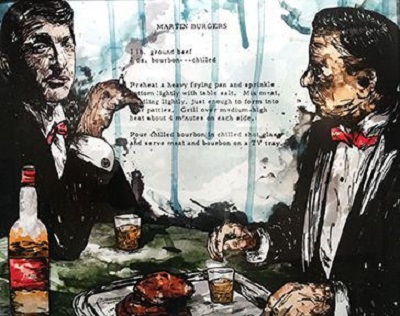 "Burgers,'' by DREW GUNDLACH, at Wedeman Gallery, Newton, Mass., through March 14.
Ukraine and the Sudetenland
March 2, 2014
Gray but at least not very cold morning. A little bit of drizzle. A couple of layers of rock salt and sand on the roads. Some of the ground around the trees unfrozen. Stored-up heat from yesterday's sunlight?
Lots of potholes on the roads. Will Providence's mayor, Angel Taveras, fill enough of them fast enough to avoid lethally damaging his run for governor? How many broken axles can he take?
Happy to hear that we won't get the snowstorm that had been promised for tonight and tomorrow. But heard little birdsong this morning. No bright sun to get the feathered bastards excited.
In some years, plenty of crocuses out by now in sunny spots. But on this year's tundra, we will have to wait, I would guess, until the end of next week. Perhaps the big rainstorm that some meteos see coming up the coast at the of end of this week will unfreeze the ground enough to speed things along.
Meanwhile, about five more degrees this morning and the worms will be wiggling in the compost bin.
Russian dictator and former KGB official Vlad Putin is doing to Ukraine what Hitler did to Czechoslovakia: Using the excuse of "rescuing'' his "compatriots'' (if that's what Russian-speaking Ukrainians are) to try to bring a whole democratic country to heel.
In Hitler's case, he used the bogus "plight'' of ethnic/linguistic Germans living in the Sudetenland strip of democratic Czechoslovakia as an excuse to take over that country after it was betrayed by France and Britain as then-isolationist America looked on.
Now we have further proof that Putin's occasionally murderous regime is also an imperialist and fascist one. We had plenty of proof already.
Will the European Union do anything? Has the Europeans' relentless military disarmament emboldened the Russian dictator to follow Hitler, Mussolini and Stalin and create a new empire, or rather reconstitute the Soviet one in the form of a fascist and xenophobic one?
As when the Russians invaded Hungary in 1956 (when Republican Eisenhower was U.S. president) and Czechoslovakia in 1968 (when Democrat and Vietnam-distracted Lyndon Johnson was president) to impose its will, so apparently it is doing now in Ukraine.
Of course, whatever the rhetoric, the West can do little in the short term to stop the Russians, though it would be nice to think that we could ship the Ukrainians some arms. But then, other than risk World War III, we could do little immediately in '56 and '68, despite the demands of conservative Republicans that we "roll back the Iron Curtain.''
But the Russian economy, whose only really successful part is oil and gas exports, is very vulnerable to long-term economic sanctions -- if the Europeans can summon up more courage and persistence that they have shown lately.
The first thing powerful thing we can do is to start freezing Russian assets in the U.S. (much of them produced from criminal activities anyway) and revoke the visas of Russian officials and businesspersons. Hit the Putin regime very hard in the pocketbook.
And let's hope that we not only take strong measures to thwart cyber-attacks on the Ukrainians, the Western Europeans and us during Russia's invasion of Ukraine but also go on the offensive to do everything possible to make Putin's invasion painful to his regime, which presides over what is in many ways a very fragile, if geographically vast, nation.
Of course, with Putin pal and Moscow resident Edward Snowden probably continuing to feed U.S. systems information to the Kremlin that will be more difficult than it would have been a couple of years ago. (Why oh why has Snowden, who took his information first to the Chinese communist dictatorship and then to the fascist one in the Kremlin been presented as some sort of a hero? )
But America, as an innovative and open society, has far more creativity than does the profoundly corrupt and paranoid Russia ruled by Putin. In the end, we can outsmart it.
respond via rwhitcomb51@gmail.
Our weather narcissism
By ROBERT WHITCOMB
Inevitably, some politicians and entertainers (e.g., Rush Limbaugh) are having great fun with the cold and snowy winter in the East and Midwest, saying that this shows that “global warming” is a fraud.
But they are extrapolating from immediate experience and anecdote, not science. I suspect that most of these people know better, but, hey, they’re in show biz.
Actually, January, for instance, which the news media lamented for its cold, snow and ice, has been rather severe in the eastern U.S. because of a huge dip in the jet stream that has brought cold (though not unprecedented cold) to the Upper Midwest and the Northeast while out West, including Alaska, it’s generally been very warm and dry for this time of year. Northeasterners and Midwesterners have endured temperatures 10, 15 or more degrees below normal; Alaska and California have been 10-15 degrees above. And the National Oceanic and Atmospheric Administration reports that January was, on a global basis, the fourth-warmest on record.
That the Northeast is so densely populated and that much of the national news media are based in New York and Washington mean that the idea that this winter is particularly bad has particularly strong currency. It recalls E.B. White’s funny 1954 essay “In the Eye of Edna,” in which he noted that the nation lost interest in Hurricane Edna after it moved beyond Boston’s radio and TV stations to wallop White’s comparatively remote Mid-Coast region of Maine.
Then there are such relatively new weather-news outlets as the Weather Channel and Accuweather. These commercial outlets will die if they fail to constantly dramatize such old weather phenomena as “The Polar Vortex” — a low-pressure area in upper latitudes that now is presented almost as a new and lethal threat to civilization. Weather events that would have seemed par for the course of a season a half century ago are now characterized as world-historical events.
Changes in the route of the jet stream from time to time bring cold air deep into the eastern part of the United States while the other side of the country becomes much warmer than usual as the jet stream brings in mild, Pacific air from the southwest. The jet stream’s position, of course, can vary widely but it can sometimes get stuck, meaning warm, “open” winters for us some years and cold ones in others. The general trend, though, is for milder winters. The trouble is that we confuse events in our areas that are part of weather’s natural variability with global climate change.
The confusion of one’s particular circumstances with the wider reality reminds me of the heartening rise in recent years of “evidence-based medicine” as opposed to the more traditional “expert-based medicine.” I am simplifying, but evidence-based medicine relies much less on individual physicians’ experience, values and judgment and much more on cold, hard data derived from rigorous collection and analysis of information from broad populations. As with medicine, so with climate, follow the data.
Anyway, New Englanders have suffered through another week of below-normal weather and are heartily sick of it. That the population is aging and that old people, in particular, find winters wearisome may reinforce the winter fatigue of younger people, too.
In some winters, snow drops and crocuses would be popping out of south-facing slopes about now. It looks as if we’ll have to wait a while for them this year. Still, a gradual change in the mix of morning bird song and that there’s bare ground around the base of trees where there was snow a week or two ago reminds us that the sun is getting stronger by the day: Some birds are coming north again and there’s more solar energy for the trees to absorb. And on one of our recent, and for this winter, rare mild days, I found the worms wiggling enthusiastically in our compost bin, whose contents seem to have been frozen solid a couple of days before. Worms: A reminder of the cycles of death and life.
***
The Feb. 23 New York Times business section story “Loss Leader on the Half Shell: A national binge on oysters is transforming an industry (and restaurants’ economics)” was heartening for a coastal New Englander. It implied that our estuary-rich region could benefit a lot from much expanded shellfish aquaculture. Unlike, say, casinos, which are a net subtraction from a region’s economy, or local businesses that recycle money that’s already here, aquaculture, because it has exportable physical products and brings people here from far away to buy them in our eateries as local specialties, increases our region’s wealth.
And the business, with its demands for clean water, prods us to keep our coastal environment cleaner.
Robert Whitcomb (rwhitcomb51@gmail.com), a former Providence Journal editorial-page editor, is a Providence-based writer and editor and the overseer of www.newenglanddiary.com. He is also a director of Cambridge Management Group (cmg625.com).
The NSA enlarges some fingerprints

"Black & White #3 (Chine-colle relief print), by BRYAN NASH GIILL, in his very wide ranging "The Process of Discovery'' show , at Heather Gaudio Fine Art, New Canaan, Conn., through March 22.
Birches and elms
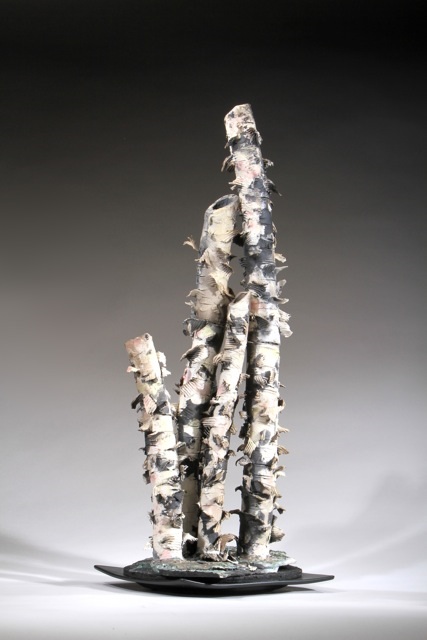
"Birch Trees #1,'' (raku ceramic), by NANCY CAHAN, at Alpers Fine Art, Andover, Mass.
Because of innumerable paintings, photos and such poems as Robert Frost's "Birches'', the birch tree is deeply associated with ideas about the New England countryside (and canoes), as are elms with the region's streets. But climate change might dramatically reduce the number of such trees, and confine them to New England's most northern sections.
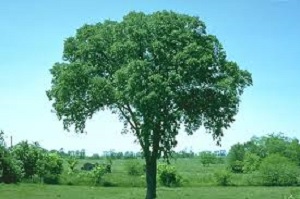
Meanwhile, recent botanical research has led to the development of fungal-disease-resistant American elms (see one below), which Dutch elm disease seemed to utterly doom only a couple of decades ago. We all look forward to the return of these graceful , hourglass-shaped trees to the commons and street sides of New England towns where they were so common 60 years ago. I'm sad I won't be around to see them as tall as I remember the trees, now long dead, as a boy.
I recall Memorial Day parades under the elms and think of their iconic position in New England whenever I hear the Eugene O'Neill play "Desire Under the Elms'' mentioned.
Slow-cooked art

"Standard and Microwave'' (assemblage), by CAROL McMAHON (photo credit: Stewart Clements), in the "Un-Mapping the Air'' show at 83 Spring venue, Watertown, Mass., through April 10.
Work-art balance
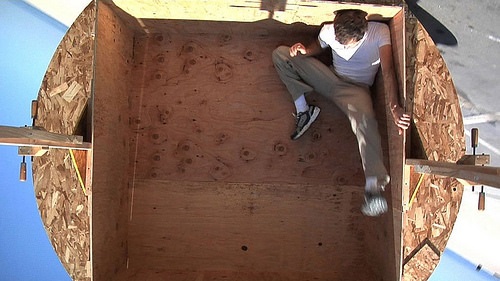 Film still from "Balance Study, Heel Toe,'' by Jacob Tonski, at the University of Massachusetts at Lowell gallery through March 21. Mr. Tonski explores "dynamic balance through video, life-size objects and kinetic metaphors,'' says the gallery.
Conn. vs. Fla. may be equal contest
 By CHRIS POWELL
MANCHESTER, Conn.
With snowstorms seeming to arrive every few days, little room left for stacking
the snow, road-salt supplies nearly exhausted, state and municipal snow-removal
budgets in deficit, and the Connecticut General Assembly reconvening, many people in
Connecticut feel that they have had enough of the state.
It's little consolation to them that Connecticut may have the best snowplowing
operation in the country, with the state's major roads almost always kept
passable throughout even the heaviest snowstorms. For besides the extra snow,
Connecticut's economy and standard of living are still declining, which may be
the cause of most of the surliness here; the snow just makes people feel their
resentments more keenly.
As a result many of them look south enviously, especially to subtropical
Florida, to which many Connecticut residents already have fled, either
permanently or just for the winter. Indeed, when the University of Connecticut's
basketball teams play colleges in Florida, the crowd often seems to favor the
visitors.
But while it may be harder to appreciate Connecticut after shoveling snow or
falling on ice, Florida has its own climate disadvantages. In the late summer
and early fall Florida can be crossed by as many hurricanes as Connecticut suffers
snowstorms in the winter, and the resulting property damage in Florida is far
greater than that inflicted by snowstorms in Connecticut, just as
weather-related electricity outages in Florida can last longer.
Because of bad weather a few weeks ago it took three days and several flight
reschedulings for a recently retired couple from Connecticut to escape the state
by air for their new winter home in South Florida, one of those tightly
regulated condominium complexes that forbid admission to anyone under 55. The
couple had hardly begun breathing the state-income-tax-free air when a line of
thunderstorms stalled overhead for 24 hours and dumped 14 inches of rain on
them, flooding their new neighborhood, closing its roads, and incapacitating
sewer lines and toilets for a couple of days.
It wasn't a snowstorm; it was worse.
Not long after the couple got dried out and settled, some university researchers
reported that alligators, which which infest South Florida, not only swim stealthily
but also climb trees, in part for better surveillance of their prey.
Told of the study, the new arrivals from Connecticut refused to be
concerned. While they had not yet read their condo association's many rules,
they figured that, in addition to excluding people younger than 55, there was
probably one against alligators climbing trees on the property and eating the
residents.
They shouldn't count on it. Annoying as Connecticut's snow has been, at least it
also has gotten in the way of the state's own many predators, both those with
four legs and those with two. There's never much crime in bad weather.
* * *
Two executives of the Metropolitan Transit Authority came to Hartford last week
so Gov Dan Malloy could reprimand them in front of the television cameras about
the MTA's mismanagement of the Metro-North Commuter Railroad, whose many recent
disasters have impaired service from New Haven to Grand Central Station in New
York. The MTA executives duly promised improvements soon.
But while the governor got to look tough, he really didn't increase
Connecticut's leverage with the MTA, a New York state agency paid by Connecticut
to operate the state's rail lines into New York. To gain such leverage
Connecticut needs a plan, just as Metro-North needs a plan to improve rail
service.
Connecticut's plan might include demanding representation on the MTA's board,
the renegotiation of Connecticut's contract with the MTA, and a study of how
Connecticut could take over the management of its rail lines into New York.
Until Connecticut has a rail-service-improvement plan that goes beyond scolding
MTA officials on television, the MTA may assume that it can take its time about
improving service here.
Chris Powell is managing editor of the Journal Inquirer in Manchester, Conn.
Please respond to www.newenglanddiary.com via rwhitcomb51@gmail.com.
By CHRIS POWELL

MANCHESTER, Conn.

With snowstorms seeming to arrive every few days, little room left for stacking
the snow, road-salt supplies nearly exhausted, state and municipal snow-removal
budgets in deficit, and the Connecticut General Assembly reconvening, many people in
Connecticut feel that they have had enough of the state.

It's little consolation to them that Connecticut may have the best snowplowing
operation in the country, with the state's major roads almost always kept
passable throughout even the heaviest snowstorms. For besides the extra snow,
Connecticut's economy and standard of living are still declining, which may be
the cause of most of the surliness here; the snow just makes people feel their
resentments more keenly.

As a result many of them look south enviously, especially to subtropical
Florida, to which many Connecticut residents already have fled, either
permanently or just for the winter. Indeed, when the University of Connecticut's
basketball teams play colleges in Florida, the crowd often seems to favor the
visitors.

But while it may be harder to appreciate Connecticut after shoveling snow or
falling on ice, Florida has its own climate disadvantages. In the late summer
and  early fall Florida can be crossed by as many hurricanes as Connecticut suffers
snowstorms in the winter, and the resulting property damage in Florida is far
greater than that inflicted by snowstorms in Connecticut, just as
weather-related electricity outages in Florida can last longer.

Because of bad weather a few weeks ago it took three days and several flight
reschedulings for a recently retired couple from Connecticut to escape the state
by air for their new winter home in South Florida, one of those tightly
regulated condominium complexes that forbid admission to anyone under 55. The
couple had hardly begun breathing the state-income-tax-free air when a line of
thunderstorms stalled overhead for 24 hours and dumped 14 inches of rain on
them, flooding their new neighborhood, closing its roads, and incapacitating
sewer lines and toilets for a couple of days.

It wasn't a snowstorm; it was  worse.

Not long after the couple got dried out and settled, some university researchers
reported that alligators, which which infest South Florida, not only swim stealthily
but also climb trees, in part for better surveillance of their prey.

Told of the study, the new arrivals from Connecticut refused to be
concerned. While they had not yet read their condo association's many rules,
they figured that, in addition to excluding people younger than 55, there was
probably one against alligators climbing trees on the property and eating the
residents.

They shouldn't count on it. Annoying as Connecticut's snow has been, at least it
also has gotten in the way of the state's own many predators, both those with
four legs and those with two. There's never much crime in bad weather.

* * *

Two executives of the Metropolitan Transit Authority came to Hartford last week
so Gov Dan Malloy could reprimand them in front of the television cameras about
the MTA's mismanagement of the Metro-North Commuter Railroad, whose many recent
disasters have impaired service from New Haven to Grand Central Station in New
York. The MTA executives duly promised improvements soon.

But while the governor got to look tough, he really didn't increase
Connecticut's leverage with the MTA, a New York state agency paid by Connecticut
to operate the state's rail lines into New York. To gain such leverage
Connecticut needs a plan, just as Metro-North needs a plan to improve rail
service.

Connecticut's plan might include demanding representation on the MTA's board,
the renegotiation of Connecticut's contract with the MTA, and a study of how
Connecticut could take over the management of its rail lines into New York.

Until Connecticut has a rail-service-improvement plan that goes beyond scolding
MTA officials on television, the MTA may assume that it can take its time about
improving service here.

Chris Powell is managing editor of the Journal Inquirer in Manchester, Conn.

Please respond to www.newenglanddiary.com via rwhitcomb51@gmail.com.
White out wildlife

On Monhegan
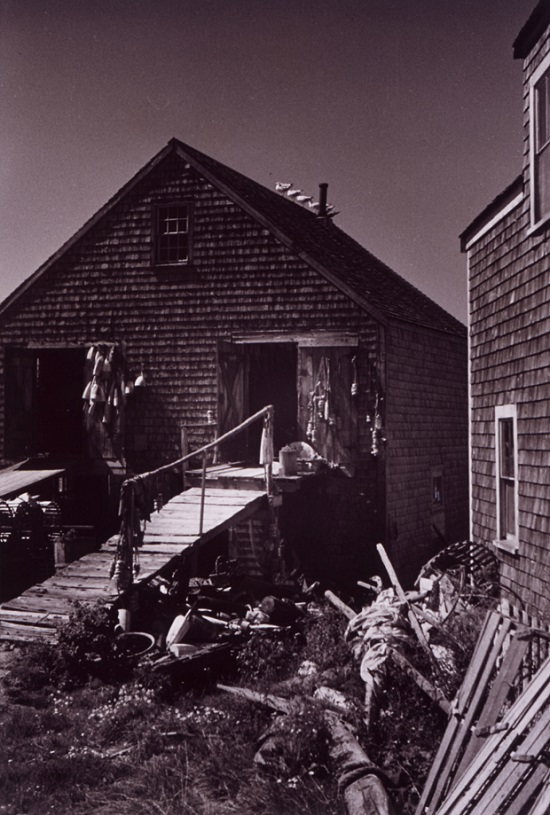
"Untitled'' (gelatin silver print, 1936), by GEORGE DANIELL, in the show " Picturing Monhegan Island,'' March 1--Aug. 3, at the Portland Museum of Art. (Picture is a gift of George Daniell and the Aucocisco Gallery, 2001.6.23 © George Daniell Archive, Dwayne and Gina DeJoy.)
The show showcases about 20 photos and drawings that Daniell created on the famous artists' haunt of  Monhegan Island, far off the coast of Maine, in the summer of 1936.
The stark beauty of the island, and the sadness of Depression-era America, come out in these beautiful pictures.