
Vox clamantis in deserto



Post-war pride

"Community Tree'' (gouache on paper), by STEVAN DOHANOS, for the cover of the Dec. 4, 1948 Saturday Evening Post. Copyright 2013 National Museum of American Illustration, Newport, R.I. Photo courtesy Archives of the American Illustrators Gallery.
What's in the names of some old N.E. companies?
How some famous old New England companies got their names.
Diner rises after Irene
A typical small New England town diner goes on as Wilmington, Vt.'s informal community center after being repaired after devastating flooding by Tropical Storm Irene. Those high carbohydrate and animal-fat breakfasts may not make your body thrive, but your soul and social life get much sustenance.
These diners can be very friendly places but the staff and customers know when to leave people alone, too. Take the Windsor Diner, in Windsor, Vt. The great celebrity recluse J.D. Salinger, who lived just across the river in Cornish, N.H., frequently patronized the place; everyone left him alone.
The anguish of 'The Organization Man'
See Paul Zahl's wonderful take on Sloan Wilson and his "The Man in the Gray Flannel Suit'' (1955), that memorable but frequently misdescribed novel about what William H. Whyte called the corporate "Organization Man''.
The Reverend Mr. Zahl (he is an Episcopal minister) headlined his posting "Post Traumatic Stress Disorder in Suburbia''.
The hero of the novel, the polite and quiet Tom Rath, is a daily Westport-New York commuter on the infamous New Haven Railroad (now the infamous Metro North) in shock from what happened to him in World War II.
Of class and charity
By ROBERT WHITCOMB
Philanthropic contributions by very rich people get a lot of attention. An example around here is Thomas Ryan, a former head of CVS who recently gave $15 million to the University of Rhode Island for a brain-science center to be named after his parents.
Besides the satisfactions of giving per se and the plaudits of the general public, gifts are sometimes meant to show other rich people how successful the givers are. This explains why so much new money rushes into already very rich “nonprofit” institutions, such as Ivy League colleges and big art museums. Wouldn’t giving a pile to, say, a community college serving poor people do more for society than adding yet more to Harvard’s $31 billion endowment?
And this is not the age of the anonymous contribution. Of course, nonprofits, besides appealing to altruism and ego, know that publicizing the names of the donors may encourage an arms race of giving by other rich people.
Anyway, URI alumnus Ryan commendably gave to a local and grossly underfunded public institution. A few years back, the arena at URI was named after him as a result of gifts by him and CVS. In his last 14 months as CEO, he made $124 million, reported Dow Jones. Of course, if the very rich paid a tad more in taxes, then public institutions could more often build such public facilities out of public money and not always be selling “naming opportunities.”
Large public companies’ senior execs have rarely been romantic altruists. But there’s no doubt that they have adjusted their missions, and sense of civic duty, in the past 30 or so years via tax and other legal changes engineered by their lobbyists.
Most of these companies used to consider themselves as having a fairly wide range of stakeholders — not just senior executives and other big shareholders but nonexecutive employees and the communities within which the companies operated. The idea was that the long-term success of the companies would depend on addressing the welfare of all constituencies.
Now the aim above all is to maximize and speed compensation for senior execs, on which, because of lobbyists’ success in creating tax dodges, many pay remarkably little tax, considering their wealth. Investment gains via stock options, etc., are much tax-favored over wages. (The quickest way to maximize their personal profits is to lay off and/or cut the compensation of lower-level employees.) This explains in part, along with globalization, computerization, automation and the loss of local ownership in many places — laying off your neighbors is tough — explains some of the woes of the middle class the past 30 years or so.
Then there’s American feudalism. The Walton family has a fortune of about $100 billion. They have so much money, in part, because their company pays their employees so little. Some Walmart stores have food drives for impoverished Walmart employees.
The holders of current and future dynastic wealth arrange through tricky trusts (including the creative use of charities) and other perfectly legal mechanisms to pay remarkably little or no estate or gift taxes and thus help ensure the self-perpetuation of power and wealth for their heirs. Readers should read about the wonders of “donor-advised funds” for charities — also a cash cow for financial firms because of the fees — and “charitable lead annuity trusts,” used to boost dynastic wealth by avoiding taxes.
The usual structure for these things is the "foundation,'' which can sometimes be more of creature for perpetuating private dynastic wealth and power than a device for good works.
Some more reasons that the government is broke.
Among other benefits, this dynastic wealth gives favored families access to the fanciest schools with the best-connected faculty and students, which, in turn, reinforces the vast advantage that the lucky heirs already have. Thus there’s less social mobility in America than in most of its developed world competitors.
The public might want to at least consider whether society would be better off if the very rich shared a tad more of their wealth further upstream rather than through the charities they create to do good works, glorify their names and/or avoid paying taxes that pay for public services such as URI.
***
A good thing about this sometimes gray, sometimes golden time of the year is that you don’t have to weed for a while and it cleans out the mosquitoes. No wonder farmers tend to like November and December. They get a rest. Too bad the holidays have to ruin it.
***
Everyone understandably bemoans Rhode Island’s jobless rate of 9.2 percent. But bear in mind that the state’s tininess and industrial history skew those numbers. If you spun off eastern Connecticut, parts of Berkshire County, Mass., or upstate New York into separate states, they’d have similar rates. Still, Rhode Island should have done a lot more to capitalize on its location, ports and fabulous design community.
Robert Whitcomb (rwhitcomb4@cox.net; rwhitcomb51@gmail.com; newenglanddiary.com) is a former editor of The Providence Journal's Commentary pages, where this column started, and a Providence-based editor and writer.
No Zamboni in sight
 "The Skating Pond'' (tempera on board, C. 1950), by JOHN CLYMER, done as a New England Mutual Life Insurance Co. advertisement. Copyright 2013 National Museum of American Illustration, Newport, R.I. Photo of painting courtesy of the American Illustrators Gallery, New York City.

"Beach Boys' (oil), by AMANDA HERZOG, in the South Shore Art Center's (in Cohasset, Mass.) "COOL'' show, which is meant to remind us of summer's light and warmth as we enter the darkest time of the year ( the holiday shopping season?).
Partners president links health care and higher ed
Gary Gottlieb, the president of Massachusetts behemoth Partners HealthCare, recently discussed the similarities of the challenges facing higher education and health care.
He called higher education and health care the civil-rights issues of our time.
He spoke at the "Summit on Cost of Higher Education'' run by the New England Board of Higher Education (www.nebhe.org) and the Davis Educational Foundation.
This story and video originated on NEBHE's Web site.

Philip K. Howard: Infrastructure repairs drown in regulatory molasses
To our readers: This column also ran in a pre-renovation version of New England Diary a few weeks ago. As we seek to import the pre-renovation archives, we will rerun particularly important files, such as Philip Howard's piece here.
-- Robert Whitcomb
By PHILIP K. HOWARD
NEW YORK
President Obama went on the stump this summer to promote his "Fix It First" initiative, calling for public appropriations to shore up America's fraying infrastructure. But funding is not the challenge. The main reason crumbling roads, decrepit bridges, antiquated power lines, leaky water mains and muddy harbors don't get fixed is interminable regulatory review.
Infrastructure approvals can take upward of a decade or longer, according to the Regional Plan Association. The environmental review statement for dredging the Savannah River took 14 years to complete. Even projects with little or no environmental impact can take years.
Raising the roadway of the Bayonne Bridge at the mouth of the Port of Newark, for example, requires no new foundations or right of way, and would not require approvals at all except that it spans navigable water. Raising the roadway would allow a new generation of efficient large ships into the port. But the project is now approaching its fifth year of legal process, bogged down in environmental litigation.
Mr. Obama also pitched infrastructure improvements in 2009 while he was promoting his $830 billion stimulus. The bill passed but nothing much happened because, as the administration learned, there is almost no such thing as a "shovel-ready project." So the stimulus money was largely diverted to shoring up state budgets.
Building new infrastructure would enhance U.S. global competitiveness, improve our environmental footprint and, according to McKinsey studies, generate almost two million jobs. But it is impossible to modernize America's physical infrastructure until we modernize our legal infrastructure. Regulatory review is supposed to serve a free society, not paralyze it.
Other developed countries have found a way. Canada requires full environmental review, with state and local input, but it has recently put a maximum of two years on major projects. Germany allocates decision-making authority to a particular state or federal agency: Getting approval for a large electrical platform in the North Sea, built this year, took 20 months; approval for the City Tunnel in Leipzig, scheduled to open next year, took 18 months. Neither country waits for years for a final decision to emerge out of endless red tape.
In America, by contrast, official responsibility is a kind of free-for-all among multiple federal, state and local agencies, with courts called upon to sort it out after everyone else has dropped of exhaustion. The effect is not just delay, but decisions skewed toward the squeaky wheels instead of the common good. This is not how democracy is supposed to work.
America is missing the key element of regulatory finality: No one is in charge of deciding when there has been enough review. Avoiding endless process requires changing the regulatory structure in two ways:
Environmental review today is done by a "lead agency"—such as the Coast Guard in the case of the Bayonne Bridge—that is usually a proponent of a project, and therefore not to be trusted to draw the line. Because it is under legal scrutiny and pressure to prove it took a "hard look," the lead agency's approach has mutated into a process of no pebble left unturned, followed by lawsuits that flyspeck documents that are often thousands of pages long.
What's needed is an independent agency to decide how much environmental review is sufficient. An alteration project like the Bayonne Bridge should probably have an environmental review of a few dozen pages and not, as in that case, more than 5,000 pages. If there were an independent agency with the power to say when enough is enough, then there would be a deliberate decision, not a multiyear ooze of irrelevant facts. Its decision on the scope of review can still be legally challenged as not complying with the basic principles of environmental law. But the challenge should come after, say, one year of review, not 10.
It is also important to change the Balkanized approvals process for other regulations and licenses. These approvals are now spread among federal, state and local agencies like a parody of bureaucracy, with little coordination and frequent duplication of environmental and other requirements. The Cape Wind project off the coast of Massachusetts, now in its 12th year of scrutiny, required review by 17 different agencies. The Gateway West power line, to carry electricity from Wyoming wind farms to the Pacific Northwest, requires the approval of each county in Idaho that the line will traverse. The approval process, begun in 2007, is expected to be complete by 2015. This is paralysis by federalism.
The solution is to create what other countries call "one-stop approvals." Giving one agency the authority to cut through the knot of multiple agencies (including those at state and local levels) will dramatically accelerate approvals.
This is how "greener" countries in Europe make decisions. In Germany, local projects are decided by a local agency (even if there's a national element), and national projects by a national agency (even though there are local concerns). One-stop approval is already in place in the U.S. New interstate gas pipelines are under the exclusive jurisdiction of the Federal Energy Regulatory Commission.
Special interests—especially groups that like the power of being able to stop anything—will foster fears of officials abusing the public trust. Giving people responsibility does not require trust, however. I don't trust anyone. But I can live with a system of democratic responsibility and judicial oversight. What our country can't live with is spinning our wheels in perpetual review. America needs to get moving again.
Philip K. Howard, a lawyer, is chairman of the nonpartisan reform group Common Good. His new book, "The Rule of Nobody," will be published in April by W.W. Norton. He is also the author of, among other works, "The Death of Common Sense''.
Soon to be single occupancy
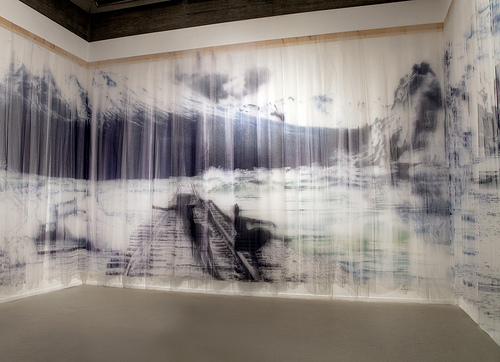 "One View of the Veil Suite,'' by IZHAR PATKIN (ink on tulle curtains) at his show "Izhar Patkin: The Wandering Veil,'' at MASS MoCA, North Adams, Mass., starting Dec. 7. He was inspired by the writings of the late Kashmiri-American poet Agha Shahis Ali on "themes of love, loss and exile,'' as the gallery says.
Cape Sad
 "The Perfect Tree,'' by MARIELUISE HUTCHINSON, in the "Small Works'' show at the Cahoon Museum of American Art, in Cotuit, Mass. (on Cape Cod) through Dec. 22. Green and white work well together. But usually it is brown and gray on the Cape in the winter, as the salt air and relatively mild temperatures assure that the ground is usually bare there in the winter, but with near-constant wind because of the presence or nearness of storms coming up from the southwest. Rather grim, except for the light traffic compared to the summer.
The keg, a joint and hoping for a high number
Read about Denis O'Neill's memoir about being at college (Dartmouth) in 1969 when the last lottery for the military draft was held. Animal House meets geopolitics meets the hippies meets Scott Fitzgerald meets the State Police. The book is called Whiplash: When the Vietnam War Rolled a Hand Grenade Into the Animal House. My number was 361. My friend Steve Perry's was seven. He was killed a few weeks after arriving in uniform in the Republic of Vietnam.
Community-based collage

Handmade collage paper on bristol board by student named David in the "Catalyst: Work from Community-Based Arts Centers'' at Lamont Gallery, at Phillips Exeter Academy, in Exeter, N.H.
See news and comment on health-care sector
See the "News'' section of Cambridge Management Group's Web site, www.cmg625.com for news and comment on health care.
Might a nonprofit buy Providence Journal?
Word that A.H. Belo will sell the storied Providence Journal has New England journalists atwitter (so to speak) about whether a big for-profit media chain will buy it or whether a civic-minded nonprofit organization of affluent people with southeastern New England ties will try to acquire it to keep this public watchdog barking loud enough to restrain local scoundrels. There are a few papers around America set up as nonprofits. And Harper's Magazine is a nonprofit foundation -- (501(c)3 in the Internal Revenue Code.
Generally beautiful Brown
There are architectural disasters on the Brown Universiy campus, such as the hideous science skycraper, the crumbly-looking Rockefeller Library and the brutalist List Art Gallery, but all in all, the campus is one of the most beautiful urban campuses anywhere, with buildings from Colonial days through most of the styles since then, including a bunch of recent "starchitects''. See my friend William Morgan's take on it.
Bright light, big city

"Yellow Cyclinder, New York'' (digital c-print), by MICHAEL EASTMAN, in his "Urban Luminosity''show at Heather Gaudio Fine Art, New Canaan, Conn., through Jan. 25.
Dartmouth Rhodes Scholars, from Canada
Canadians get to win Rhodes Scholarships, too, as these two Dartmouth College seniors just showed.
Grab as much as you can!
GoLocal Providence has just done a story on state and localgovernment pay in Rhode Island. In a nation where greed is running so rampant in the upper echelons of the private sector, perhaps that those in public sector follow suit is no surprise.
Consider this from GoLocal:
#1 Vincent J. D'Ambra
Department: Fire
Position: Fire Rescue Captain
Total Compensation: $218,145.27
Pay
Base: $68,762.44
Longevity: $7,290.03
Overtime: $116,356.94
Detail: $0.00
Benefits (City Contributions)
Medical: $14,789.32
Dental: $1,299.74
Pension: $9,646.80
Note on Detail Pay: Details are normally funded by the private parties that require it. But some detail pay is funded directly by the city. Payroll data provided by the city Law Department does not distinguish between the two.