
Vox clamantis in deserto






No Zamboni in sight
 "The Skating Pond'' (tempera on board, C. 1950), by JOHN CLYMER, done as a New England Mutual Life Insurance Co. advertisement. Copyright 2013 National Museum of American Illustration, Newport, R.I. Photo of painting courtesy of the American Illustrators Gallery, New York City.

"Beach Boys' (oil), by AMANDA HERZOG, in the South Shore Art Center's (in Cohasset, Mass.) "COOL'' show, which is meant to remind us of summer's light and warmth as we enter the darkest time of the year ( the holiday shopping season?).
Partners president links health care and higher ed
Gary Gottlieb, the president of Massachusetts behemoth Partners HealthCare, recently discussed the similarities of the challenges facing higher education and health care.
He called higher education and health care the civil-rights issues of our time.
He spoke at the "Summit on Cost of Higher Education'' run by the New England Board of Higher Education (www.nebhe.org) and the Davis Educational Foundation.
This story and video originated on NEBHE's Web site.

Philip K. Howard: Infrastructure repairs drown in regulatory molasses
To our readers: This column also ran in a pre-renovation version of New England Diary a few weeks ago. As we seek to import the pre-renovation archives, we will rerun particularly important files, such as Philip Howard's piece here.
-- Robert Whitcomb
By PHILIP K. HOWARD
NEW YORK
President Obama went on the stump this summer to promote his "Fix It First" initiative, calling for public appropriations to shore up America's fraying infrastructure. But funding is not the challenge. The main reason crumbling roads, decrepit bridges, antiquated power lines, leaky water mains and muddy harbors don't get fixed is interminable regulatory review.
Infrastructure approvals can take upward of a decade or longer, according to the Regional Plan Association. The environmental review statement for dredging the Savannah River took 14 years to complete. Even projects with little or no environmental impact can take years.
Raising the roadway of the Bayonne Bridge at the mouth of the Port of Newark, for example, requires no new foundations or right of way, and would not require approvals at all except that it spans navigable water. Raising the roadway would allow a new generation of efficient large ships into the port. But the project is now approaching its fifth year of legal process, bogged down in environmental litigation.
Mr. Obama also pitched infrastructure improvements in 2009 while he was promoting his $830 billion stimulus. The bill passed but nothing much happened because, as the administration learned, there is almost no such thing as a "shovel-ready project." So the stimulus money was largely diverted to shoring up state budgets.
Building new infrastructure would enhance U.S. global competitiveness, improve our environmental footprint and, according to McKinsey studies, generate almost two million jobs. But it is impossible to modernize America's physical infrastructure until we modernize our legal infrastructure. Regulatory review is supposed to serve a free society, not paralyze it.
Other developed countries have found a way. Canada requires full environmental review, with state and local input, but it has recently put a maximum of two years on major projects. Germany allocates decision-making authority to a particular state or federal agency: Getting approval for a large electrical platform in the North Sea, built this year, took 20 months; approval for the City Tunnel in Leipzig, scheduled to open next year, took 18 months. Neither country waits for years for a final decision to emerge out of endless red tape.
In America, by contrast, official responsibility is a kind of free-for-all among multiple federal, state and local agencies, with courts called upon to sort it out after everyone else has dropped of exhaustion. The effect is not just delay, but decisions skewed toward the squeaky wheels instead of the common good. This is not how democracy is supposed to work.
America is missing the key element of regulatory finality: No one is in charge of deciding when there has been enough review. Avoiding endless process requires changing the regulatory structure in two ways:
Environmental review today is done by a "lead agency"—such as the Coast Guard in the case of the Bayonne Bridge—that is usually a proponent of a project, and therefore not to be trusted to draw the line. Because it is under legal scrutiny and pressure to prove it took a "hard look," the lead agency's approach has mutated into a process of no pebble left unturned, followed by lawsuits that flyspeck documents that are often thousands of pages long.
What's needed is an independent agency to decide how much environmental review is sufficient. An alteration project like the Bayonne Bridge should probably have an environmental review of a few dozen pages and not, as in that case, more than 5,000 pages. If there were an independent agency with the power to say when enough is enough, then there would be a deliberate decision, not a multiyear ooze of irrelevant facts. Its decision on the scope of review can still be legally challenged as not complying with the basic principles of environmental law. But the challenge should come after, say, one year of review, not 10.
It is also important to change the Balkanized approvals process for other regulations and licenses. These approvals are now spread among federal, state and local agencies like a parody of bureaucracy, with little coordination and frequent duplication of environmental and other requirements. The Cape Wind project off the coast of Massachusetts, now in its 12th year of scrutiny, required review by 17 different agencies. The Gateway West power line, to carry electricity from Wyoming wind farms to the Pacific Northwest, requires the approval of each county in Idaho that the line will traverse. The approval process, begun in 2007, is expected to be complete by 2015. This is paralysis by federalism.
The solution is to create what other countries call "one-stop approvals." Giving one agency the authority to cut through the knot of multiple agencies (including those at state and local levels) will dramatically accelerate approvals.
This is how "greener" countries in Europe make decisions. In Germany, local projects are decided by a local agency (even if there's a national element), and national projects by a national agency (even though there are local concerns). One-stop approval is already in place in the U.S. New interstate gas pipelines are under the exclusive jurisdiction of the Federal Energy Regulatory Commission.
Special interests—especially groups that like the power of being able to stop anything—will foster fears of officials abusing the public trust. Giving people responsibility does not require trust, however. I don't trust anyone. But I can live with a system of democratic responsibility and judicial oversight. What our country can't live with is spinning our wheels in perpetual review. America needs to get moving again.
Philip K. Howard, a lawyer, is chairman of the nonpartisan reform group Common Good. His new book, "The Rule of Nobody," will be published in April by W.W. Norton. He is also the author of, among other works, "The Death of Common Sense''.
Soon to be single occupancy
 "One View of the Veil Suite,'' by IZHAR PATKIN (ink on tulle curtains) at his show "Izhar Patkin: The Wandering Veil,'' at MASS MoCA, North Adams, Mass., starting Dec. 7. He was inspired by the writings of the late Kashmiri-American poet Agha Shahis Ali on "themes of love, loss and exile,'' as the gallery says.
Cape Sad
 "The Perfect Tree,'' by MARIELUISE HUTCHINSON, in the "Small Works'' show at the Cahoon Museum of American Art, in Cotuit, Mass. (on Cape Cod) through Dec. 22. Green and white work well together. But usually it is brown and gray on the Cape in the winter, as the salt air and relatively mild temperatures assure that the ground is usually bare there in the winter, but with near-constant wind because of the presence or nearness of storms coming up from the southwest. Rather grim, except for the light traffic compared to the summer.
The keg, a joint and hoping for a high number
Read about Denis O'Neill's memoir about being at college (Dartmouth) in 1969 when the last lottery for the military draft was held. Animal House meets geopolitics meets the hippies meets Scott Fitzgerald meets the State Police. The book is called Whiplash: When the Vietnam War Rolled a Hand Grenade Into the Animal House. My number was 361. My friend Steve Perry's was seven. He was killed a few weeks after arriving in uniform in the Republic of Vietnam.
Community-based collage

Handmade collage paper on bristol board by student named David in the "Catalyst: Work from Community-Based Arts Centers'' at Lamont Gallery, at Phillips Exeter Academy, in Exeter, N.H.
See news and comment on health-care sector
See the "News'' section of Cambridge Management Group's Web site, www.cmg625.com for news and comment on health care.
Might a nonprofit buy Providence Journal?
Word that A.H. Belo will sell the storied Providence Journal has New England journalists atwitter (so to speak) about whether a big for-profit media chain will buy it or whether a civic-minded nonprofit organization of affluent people with southeastern New England ties will try to acquire it to keep this public watchdog barking loud enough to restrain local scoundrels. There are a few papers around America set up as nonprofits. And Harper's Magazine is a nonprofit foundation -- (501(c)3 in the Internal Revenue Code.
Generally beautiful Brown
There are architectural disasters on the Brown Universiy campus, such as the hideous science skycraper, the crumbly-looking Rockefeller Library and the brutalist List Art Gallery, but all in all, the campus is one of the most beautiful urban campuses anywhere, with buildings from Colonial days through most of the styles since then, including a bunch of recent "starchitects''. See my friend William Morgan's take on it.
Bright light, big city

"Yellow Cyclinder, New York'' (digital c-print), by MICHAEL EASTMAN, in his "Urban Luminosity''show at Heather Gaudio Fine Art, New Canaan, Conn., through Jan. 25.
Dartmouth Rhodes Scholars, from Canada
Canadians get to win Rhodes Scholarships, too, as these two Dartmouth College seniors just showed.
Grab as much as you can!
GoLocal Providence has just done a story on state and localgovernment pay in Rhode Island. In a nation where greed is running so rampant in the upper echelons of the private sector, perhaps that those in public sector follow suit is no surprise.
Consider this from GoLocal:
#1 Vincent J. D'Ambra
Department: Fire
Position: Fire Rescue Captain
Total Compensation: $218,145.27
Pay
Base: $68,762.44
Longevity: $7,290.03
Overtime: $116,356.94
Detail: $0.00
Benefits (City Contributions)
Medical: $14,789.32
Dental: $1,299.74
Pension: $9,646.80
Note on Detail Pay: Details are normally funded by the private parties that require it. But some detail pay is funded directly by the city. Payroll data provided by the city Law Department does not distinguish between the two.
The way he wanted life to look

Norman Rockwell (1894-1978), “The Bridge Game,” 1948, oil on canvas, published by Saturday Evening Post, May 15, 1948 cover Image Courtesy of National Museum of American Illustration, Newport, RI., cover image © SEPS: www.curtispublishing.com.
There’s another picture below.(Rerunning this posting from the pre-renovation version of New England Diary a few weeks ago.)
The New York Times seems to be on a Norman Rockwell kick, with a long review of a new book out about him and a travel piece about Arlington, Vt., where he lived for a long time.
That was before he moved to Stockbridge, Mass, in the Berkshires, to, among other things, be closer to Austen Riggs, the mental hospital identified with many celebrity patients.
As Deborah Solomon (who also wrote the travel story) writes in “American Mirror: The Art and Life of Norman Rockwell,” his life was far more complex and darker than most of his beautiful art. That he was a troubled man (who ain’t?) is not news, but Ms. Solomon puts it together very well indeed.
He was apparently conflicted about homosexual longings, had three troubled marriages and was a lifelong hypochondriac. The Thoreau line about “the mass of men lead lives of quiet desperation” comes to mind. Still, he obviously found much comfort and joy in his studio. Do too many writers these days make too much of sexual conflicts? Maybe a highly creative person’s biggest trauma is the difficulty of finding meaning in a seemingly chaotic world, a torturous search for ultimate meaning.
Some of this reminds me of the strange story of Robert Frost, whose public image as a sort of quaint, folksy, friendly rural poet was so false. In fact, Frost, a kind of Modernist, used his New England settings to explore existential quandaries; and he could be a very nasty man.
Many of his poems were dark, dark, dark. Take a look at his poem design “Design”.
But, in part because his folksy image got him many lucrative lecture gigs, he played along with it, to a point (while winking).
But then, behind almost family’s door is conflict and mental illness of varying seriousness. In some way, maybe imaginative repression and diversion, Rockwell got great popular art done despite, or because of, his problems, through vast technical skill, knowledge of other masters’ work and a rich visual imagination.
The Rockwell renaissance also reminds me of how much many of us miss the golden age of magazines, such as The Saturday Evening Post, for which Rockwell did so much work. The weekly arrival of pubs such as The Post and Life magazine was a joy that I, anyway, have never found with TV, the Internet and newspapers (with the possible exception of the beautiful old New York Herald Tribune).
That is probably ungrateful, since newspapers paid for most of my upkeep for almost 44 years.
Speaking of the past, I was pleasantly surprised to see that John Wilmerding, my art-history professor of almost a half century ago at Dartmouth, was the reviewer of Ms. Solomon’s fine new book. Mr, Wilmerding, an heir to great Havemeyer sugar fortune in New York, also has one of America’s greatest collections of American art, much of which he is giving away.
The best places to see Rockwell work are the National Museum of American Illustration, in Newport, and, the Norman Rockwell Museum, in Stockbridge.
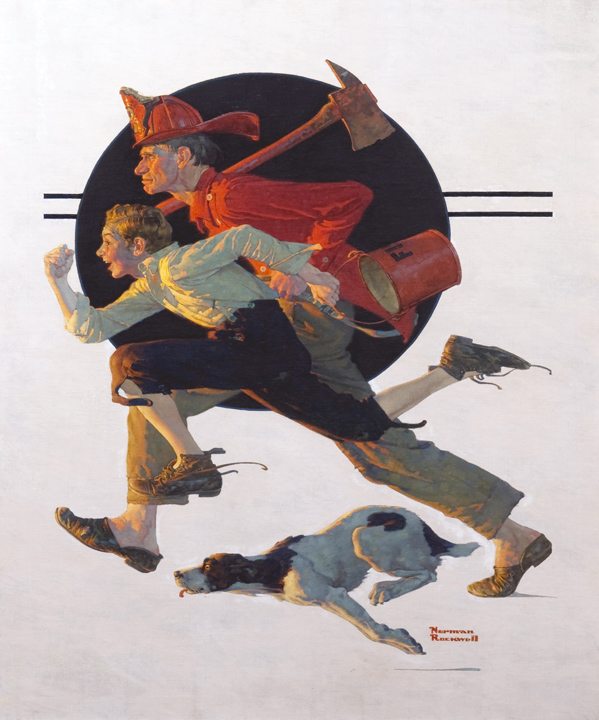
Norman Rockwell (1894-1978), ”Volunteer Fireman,” 1931, oil on canvas, published by Saturday Evening Post, March 28, 1931 cover image Courtesy of National Museum of American Illustration, Newport, RI. Saturday Evening Post cover image © SEPS: www.curtispublishing.com
Chris Powell: Stop corporate welfare -- just extend gas lines
By CHRIS POWELL
MANCHESTER, Conn.
All the bluster about restoring economic growth in Connecticut won’t accomplish a fraction of what the Malloy administration accomplished the other day. The Public Utilities Regulatory Authority approved the administration’s plan to extend natural gas pipelines throughout the state so that as many as 280,000 homes and businesses might gain access to the cheaper and cleaner fuel over the next 10 years.
The cost of building the pipelines will be recovered by natural-gas companies mostly through surcharges on new business and residential customers. They’re not likely to complain, since gaining access to gas and converting from oil or electric power should save them far more money starting almost immediately.
Of course heating oil dealers are furious about state government’s facilitating gas, a competitor. But Connecticut is more reliant on home-heating oil than any state, much of that oil comes from abroad and thus is a drain on the national and state economies and a risk to national security, domestically produced gas is increasingly available, and the public interest in competitive energy sources is overwhelming.
Besides, state government facilitated the heating oil industry and the electricity industry when it built the roads used by oil trucks and utility poles. Insofar as the roads preceded the gas mains, the heating oil industry got its state subsidy first.
The less money it spends on foreign oil, the more prosperous Connecticut will become -- especially since businesses here complain that their biggest burden is not supposedly high taxes or excessive regulation but the cost of energy.
Indeed, Connecticut might be far better off if the state government did nothing for economic development except to build gas mains. Construction jobs would be created right away and financed from energy savings, those savings would keep many millions of dollars in the state, and businesses and households would be more prosperous.
By contrast, it’s hard to see how Connecticut will benefit from the Malloy administration’s distributing hundreds of millions of dollars in cash and discounted loans to companies for doing no more than promising to stay in Connecticut a while longer.
Even as the administration finalized its natural gas plan the other day, Governor Malloy was awarding $15 million to Pitney Bowes for staying in Stamford and planning to increase its employment by 200 over five years, or $75,000 per job, employment the company surely was planning anyway. Of course every company in Connecticut isn’t getting $75,000 from state government for every new hire, so this policy is grossly unfair and turns economic development into mere political patronage. It’s being called corporate welfare.
The administration seems cynically sensitive to such complaints, since, as the Connecticut Mirror recently reported, even as administration agents working for the Democratic Party are extorting political donations from state government contractors and employees of state-regulated companies all over the place, no donations of any size have been recorded from companies receiving those economic development grants.
While state law forbids state contractors from donating directly to the campaigns of candidates for state office, contractors can donate to a political party’s general committee and the committee can use the money to advance its candidates. This money laundering is what Connecticut Democrats call campaign finance reform. It is public campaign financing for just one party, the party in power. The Mirror found that Connecticut’s Democratic Party is leading the Republican Party in such fundraising by 10 to 1.
Are the Democrats targeting state government contractors and companies that are particularly vulnerable to regulation? A spokesman for the party replies, "We don’t discuss our fundraising strategy" -- which is what Connecticut Democrats may call transparency.
Chris Powell is managing editor of the Journal Inquirer in Manchester, Conn.

David Warsh: Deconstructing the Great Panic of 2008
By DAVID WARSH
BOSTON
Lost decades, secular stagnation -- gloomy growth prospects are in the news. To understand the outlook, better first be clear about the recent past. The nature of what happened in September five years ago is now widely understood within expert circles. There was a full-fledged systemic banking panic, the first since the bank runs of the early1930s. But this account hasn’t yet gained widespread recognition among the public. There are several reasons.
For one thing, the main event came as a surprise even to those at the Federal Reserve and Treasury Departments who battled to end it. Others required more time to figure out how desperate had been the peril.
For another, the narrative of what had happened in financial markets was eclipsed by the presidential campaign and obscured by the rhetoric that came afterwards.
Finally, the agency that did the most to save the day, the Federal Reserve Board, had no natural constituency to tout its success in saving the day except the press, which was itself pretty severely disrupted at the time.
The standard account of the financial crisis is that subprime lending did it. Originate-to-distribute, shadow banking, the repeal of Glass-Steagall, credit default swaps, Fannie and Freddie, savings glut, lax oversight, greedy bankers, blah blah blah. An enormous amount of premium journalistic shoe leather went into detailing each part of the story. And all of it was pieced together in considerable detail (though with little verve) in the final report of the Financial Crisis Inquiry Commission in 2011.
The 25-page dissent that Republican members Keith Hennessey, Douglas Holtz-Eakin and Bill Thomas appended provided a lucid and terse synopsis of the stages of the crisis that is the best reading in the book.
But even their account omitted the cardinal fact that the Bush administration was still hoping for a soft landing in the summer of 2008. Nearly everyone understood there had been a bubble in house prices, and that subprime lending was a particular problem, but the sum that all subprime mortgages outstanding in 2007 was $1 trillion, less than the market as a whole occasionally lost on a bad day, whereas the evaporation of more than $8 trillion of paper wealth in the dot-com crash a few years earlier was followed by a relatively short and mild recession.
What made September 2008 so shocking was the unanticipated panic that followed the failure of the investment banking firm of Lehman Brothers. Ordinary bank runs – the kind of things you used to see in Frank Capra films such as "American Madness" and “It’s a Wonderful Life”– had been eliminated altogether after 1933 by the creation of federal deposit insurance.
Instead, this was a stampede of money-market wholesalers, with credit intermediaries running on other credit intermediaries in a system that had become so complicated and little understood after 40 years of unbridled growth that a new name had to be coined for its unfamiliar regions: the shadow banking system – an analysis thoroughly laid out by Gary Gorton, of Yale University’s School of Management, in "Slapped by the Invisible Hand'' (Oxford, 2010).
Rather than relying on government deposit insurance, which was designed to protect individual depositors, big institutional depositors had evolved a system employing collateral – the contracts known as sale and repurchase agreements, or repo – to protect the money they had lent to other firms. And it was the run on repo that threatened to melt down the global financial system. Bernanke told the Financial Crisis Inquiry Commission:
As a scholar of the Great Depression, I honestly believe that September and October of 2008 was the worst financial crisis in global history, including the Great Depression. If you look at the firms that came under pressure in that period… only one… was not of serious risk of failure…. So out of the thirteen, thirteen of the most important financial institutions in the United State, twelve were at risk of failure within a week or two.
Had those firms begun to spiral into bankruptcy, we would have entered a decade substantially worse than the 1930s.
Instead, the emergency was understood immediately and staunched by the Fed in its traditional role of lender of last resort and by the Treasury Department under the authority Congress granted in the form of the Troubled Asset Relief Program (though the latter aid required some confusing sleight- of-hand to be put to work).
By the end of the first full week in by October, when central bankers and finance ministers meeting in Washington issued a communique declaring that no systemically important institution would be allowed to fail, the rescue was more or less complete.
Only in November and December did the best economic departments begin to piece together what had happened.
When Barack Obama was elected, he had every reason to exaggerate the difficulty he faced – beginning with quickly glossing over his predecessor’s success in dealing with the crisis in favor of dwelling on his earlier miscalculations. It’s in the nature of politics, after all, to blame the guy who went before; that’s how you get elected. Political narrative divides the world into convenient four- and eight-year segments and assumes the world begins anew with each.
So when in September Obama hired Lawrence Summers, of Harvard University, to be his principal economic strategist, squeezing out the group that had counselled him during most of the campaign, principally Austan Goolsbee, of the University of Chicago, he implicitly embraced the political narrative and cast aside the economic chronicle. The Clinton administration, in which Summers had served for eight years, eventually as Treasury secretary, thereafter would be cast is the best possible light; the Bush administration in the worst; and key economic events, such as the financial deregulation that accelerated under Clinton, and the effective response to panic that took place under Bush, were subordinated to the crisis at hand, which had to do with restoring confidence.
The deep recession and the weakened banking system that Obama and his team inherited was serious business. At the beginning of 2008, Bush chief economist Edward Lazear had forecast that unemployment wouldn’t rise above 5 percent in a mild recession. It hit 6.6 percent on the eve of the election, its highest level in 14 years. By then panic had all but halted global order-taking for a hair-raising month or two, as industrial companies waited for assurance that the banking system would not collapse.
Thus having spent most of 2008 in a mild recession, shedding around 200,000 jobs a month, the economy started serious hemorrhaging in September, losing 700,000 jobs a month in the fourth quarter of 2008 and the first quarter of 2009. After Obama’s inauguration, attention turned to stimulus and the contentious debate over the American Recovery and Reinvestment Act. Summers’s team proposed an $800 billion stimulus and predicted that it would limit unemployment to 8 percent. Instead, joblessness topped out at 10.1 percent in October 2009. But at least the recovery began in June
What might have been different if Obama had chosen to tell a different story? To simply say what had happened in the months before he took office?
Had the administration settled on a narrative of the panic and its ill effects, and compared it to the panic of 1907, the subsequent story might have been very different. In 1907, a single man, J.P. Morgan, was able to organize his fellow financiers to take a series of steps, including limiting withdrawals, after the panic spread around the country, though not soon enough to avoid turning a mild recession into a major depression that lasted more than a year. The experience led, after five years of study and lobbying, to the creation of the Federal Reserve System.
If Obama had given the Fed credit for its performance in 2008, and stressed the bipartisan leadership that quickly emerged in the emergency, the emphasis on cooperation might have continued. If he had lobbied for “compensatory spending” (the term preferred in Chicago) instead of “stimulus,” the congressional debate might have been less acrimonious. And had he acknowledged the wholly unexpected nature of the threat that had been turn aside, instead of asserting a degree of mastery of the situation that his advisers did not possess, his administration might have gained more patience from the electorate in Ccngressional elections of 2010. Instead, the administration settled on the metaphor of the Great Depression and invited comparisons to the New Deal at every turn – except for one. Unlike Franklin Delano Roosevelt, Obama made no memorable speeches explaining events as he went along.
Not long after he left the White House, Summers explained his thinking in a conversation with Martin Wolf, of the Financial Times, before a meeting of the Institute for New Economic Thinking at Bretton Woods. N.H. He described the economic doctrines he had found useful in seeking to restore broad-based economic growth, in saving the auto companies from bankruptcy and considering the possibility of restructuring the banks (the government owned substantial positions in several of them through TARP when Obama took over). But there was no discussion of the nature of the shock the economy had received the autumn before he took office, and though he mentioned prominently Walter Bagehot, Hyman Minsky and Charles P. Kindleberger, all classic scholars of bank runs, the word panic never came up.
On the other hand, the parallel to the Panic of 1907 surfaced last month in a pointed speech by Bernanke himself to a research conference of the International Monetary Fund. The two crises shared many aspects, Bernanke noted: a weakening economy, an identifiable trigger, recent changes in the banking system that were little-understood and still less well-regulated, sharp declines in interbank lending as a cascade of asset “fire sales” began. And the same tools that the Fed employed to combat the crises in 2008 were those that Morgan had wielded in some degree a hundred years before – generous lending to troubled banks (liquidity provision, in banker-speak), balance-sheet strengthening (TARP-aid), and public disclosure of the condition of financial firms (stress tests). But Bernanke was once again eclipsed by Summers, who on the same program praised the Fed’s depression-prevention but announced that he had become concerned with “secular stagnation.”
The best what-the-profession-thinks post-mortem we have as yet is the result of a day-long conference last summer at the National Bureau of Economic Research. The conference observed the hundredth anniversary of the founding of the Fed. An all-star cast turned out, including former Fed chairman Paul Volcker and Bernanke (though neither historian of the Fed Allan Meltzer, of Carnegie Mellon University, or Fed critic John Taylor, of Stanford University, was invited). Gorton, of Yale, with Andrew Metrick, also of Yale, wrote on the Fed as regulator and lender of last resort. Julio Rotemberg, of Harvard Business School, wrote on the goals of monetary policy. Ricardo Reis, of Columbia University, wrote on central bank independence. It is not clear who made the decision to close the meeting, but the press was excluded from this remarkable event. The papers appear in the current issue of the Journal of Economic Perspectives.
It won’t be easy to tone down the extreme political partisanship of the years between 1992 and 2009 in order to provide a more persuasive narrative of the crisis and its implications for the future – for instance, to get people to understand that George W. Bush was one of the heroes of the crisis. Despite the cavalier behavior of the first six years of his presidency, his last two years in office were pretty good – especially the appointment of Bernanke and Treasury Secretary Henry Paulson. Bush clearly shares credit with Obama for a splendid instance of cooperation in the autumn of 2008. (Bush, Obama and John McCain met in the White House on Sept. 25, at the insistence of Sen. John McCain, in the interval before the House of Representatives relented and agreed to pass the TARP bill. Obama dominated the conversation, Bush was impressed, and, by most accounts, McCain made a fool of himself.)
The fifth anniversary retrospectives that appeared in the press in September were disappointing. Only Bloomberg BusinessWeek made a start, with its documentary “Hank,” referring to Paulson. The better story, however, should be called “Ben.” Perhaps the next station on the way to a better understanding will be the appearance of Timothy Geithner’s book, with Michael Grunwald, of Time magazine, currently scheduled to appear in May. There is a long way to go before this story enters the history books and the economics texts.
David Warsh is proprietor of www.economicprincipals.com, economic historian and along-time financial journalist. He was also a long-ago colleague of Robert Whitcomb.
 #block-56148f14e4b09c917e19b525 {
}
#block-56148f14e4b09c917e19b525 .sqs-html-content {
}
#block-56148f14e4b09c917e19b525 {
mix-blend-mode: var(--tweak-text-block-blend
);
border-radius: var(--tweak-text-block-radius);
}
#block-56148f14e4b09c917e19b525 {
}
#block-56148f14e4b09c917e19b525 .sqs-html-content {
}
#block-56148f14e4b09c917e19b525 {
mix-blend-mode: var(--tweak-text-block-blend
);
border-radius: var(--tweak-text-block-radius);
}