
Vox clamantis in deserto


Our strange inter-species collaboration
 From the "Just for Grins'' series (oil, heavy gesso on canvas) of GAY FREEBORN at the Patricia Ladd Carega Gallery, in Center Sandwich, N.H.
The relationship, and especially the deep bonds of affection between dogs -- those smelly, sometimes affectionate, sometimes vicious descendents of wolves -- and people, in all their complexity, never ceases to amaze me. We are both pack animals and it's astonishing how much the two packs have merged.
The "Grins'' series seems to celebrate people and their dogs in the summer, where even in New Hampshire it's possible to swim outdoors.
Snobs and art lovers
 "Memories of Caesar's Forum,'' by GEORGE NICK, in his "George Nick: Paintings and Legacy'' show at the St. Botolph Club, in Boston's Back Bay, through June 26.
The St. Botolph Club is one of those cultural centers -- in the case of the St. Botolph mostly for visual art (of which it has quite a permanent collection) -- spawned by the new industrial and trading money of the late 19th Century, mostly in the Northeast.
Members prided themselves on promoting an educational and civic mission instead of simply enjoying establishments where the elite could eat and drink with the comforting sense of being in the cocoon of the financially and socially very comfortable, with no Jews, Catholics or Blacks, please.
Such ethnic and religious limitations (at some clubs enforced without anything in writing) have since mostly been dropped in these buildings, though there's still a disproportionate share of the descendents of the old Yankee mercantile aristocracy among the membership. Yes, the Brahmins.
That is not to say that they didn't offer plenty of food and drink, too; they still do. Indeed, evidence of alcoholism has been far from absent over the years in these brick piles, especially since enthusiastic drinking could be taken as a sign of collegiality, within limits, of course.
I remember once being asked by a friend to drop by the St. Botolph on a very quiet Sunday morning and the front door was opened by member who had been staying there during the time of his divorce. Divorces were considerably more complicated and time-consuming then; at least something has gotten simpler. (Presumably the staff had the morning off.)
The member wore a very long, Mandarin-looking silk bathrobe (or would you call it a dressing gown?) and a glass of brandy in his hands. Who could expect any less in "the Athens of America''? This member was not alcoholic, by the way. He was just trying to settle his stomach.
Botolph, by the way, is derived from the name of a 7th Century Saxon saint living in England. The place name "Boston'' is said to come from it.
A reminder of the Anglophilia that permeated these clubs.
Whatever you want
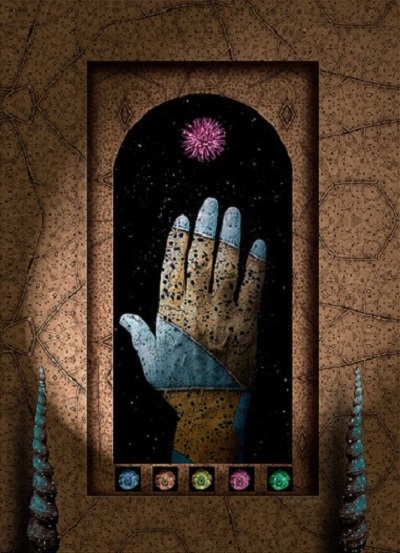
"Acceptance'', by HARVEY GOLDMAN, at Dedee Shattuck Gallery, in hios "Apophenia'' show, through June 1.
The exhibition showcases works from Mr. Goldman's digital series, "along with examples of early ceramic pieces, which have inspired his digital surface textures,'' says the gallery.
The faces of art
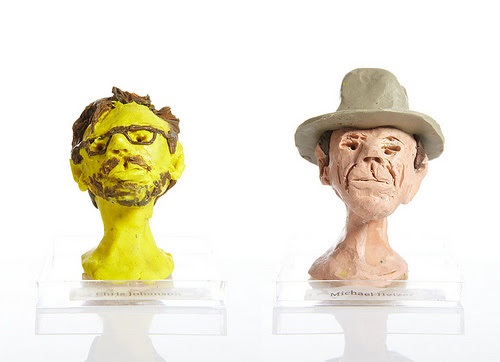 Work by BILL LIEBESKIND, in his show "We Make Art: 1,001 Artist Portraits'', at the Cape Cod Museum of Art, in Dennis, Mass., through June 14.
This artist has fashioned 1,001 heads of artists (including alive and long dead) from modeling clay. Incredibly, it took him only two years. Not surprisingly, he also makes comic books.
This project is educational in a number of ways. One is that it's way for people to see what famous artists whose faces are little known actually looked like. (The faces of only a few famed artists are well known, such as those of Andy Warhol and Salvador Dali.)
That might help viewers understand their personalities a bit more.
The museum's blurb says that, in addition to his art about fellow artists, he is "inspired by current events, such as the destruction of the World Trade Center and the dismantling of the Berlin Wall. Liebeskind attempts to make sense of the chaos in the world by using such powerful imagery in his work.''
Don't we all try to make sense of the world's chaos -- until, usually later in life, we give up trying?
'Mastery of the human condition'
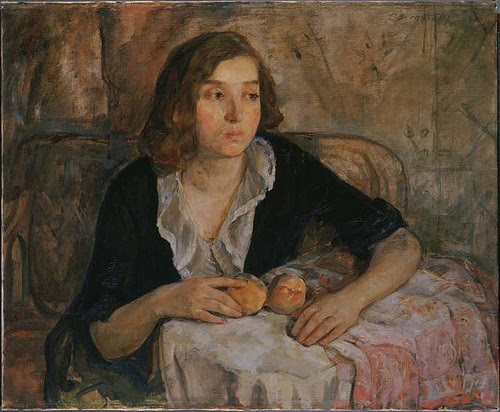 Girlhood'', by the late THERESA BERNSTEIN, in the show "Theresa Bernstein: A Century in Art'', at the Heftler Gallery, Beverly, Mass., through July 11.
The show is meant to acquaint viewers with "her mastery of the human condition.''
As often is the case in these days of identity politics, Ms. Bernstein's relative obscurity is blamed on her being a woman and so not being given adequate respect and publicity. I don't know about that, but she certainly was a fine painter.
]
Norman Rockwell's world and ours
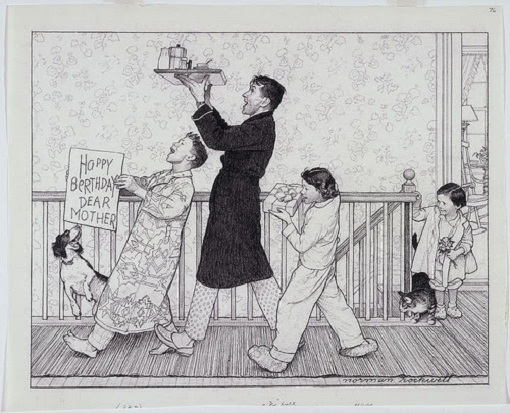 "Mother's Birthday'' (conte crayon drawing), by NORMAN ROCKWELL, at the Springfield (Mass.) Museum, through Jan. 4, 2015 in the show "Norman Rockwell's World: Reinterpreting the American Tradition in the 21st Century''. (Picture is a gift of MassMutual.)
This image was one of 21 drawings that MassMutual (the Springfield-based insurance company) hired Rockwell to do in the '50s and '60s that celebrated such traditional "American themes as hard work that appealed to corporate America,'' says the Springfield Museum blurb for the show. (Note that the father needs a shave!)
"So with today's fluid definitions of family, love and success and our fast-paced self-motivation, how do we make the work of Rockwell and the themes he so passionately believed in relevant to the world as we know it? That's what makes this exhibition so enlightening: comparing and contrasting the important themes of today with the depictions of family, work and leisure given to us by Rockwell himself.''
Ads these days tend to be much edgier and hipper than back then. But Rockwell, despite his rural image, was a very sophisticated man, well attuned to the culture around him, albeit sometimes in flight from it, too. And, I think, he had a rather tragic view of life that led him to paint the world that he wanted rather than the messy one he lived in.
How might he have adjusted his illustration approach today so that his work would remain salable, long after the heyday of print mass-media illustration in which he thrived in the early and mid 20th Century? I suppose he would have learned Photoshop....
Would his celebration of "traditional family values'' appeal to Silicon Valley start-up people?
In any event, his work now is more popular than ever, in what might reflect our escapism from our present attention-deficit-disordered, too fast and too ironical world, and our admiration for Rockwell's superb craft and professionalism. Ah, if only we of a certain age who remember seeing these images for the first time on paper (in magazines) had only appreciated back then how special they were, and that they would last.
Wet oblivion
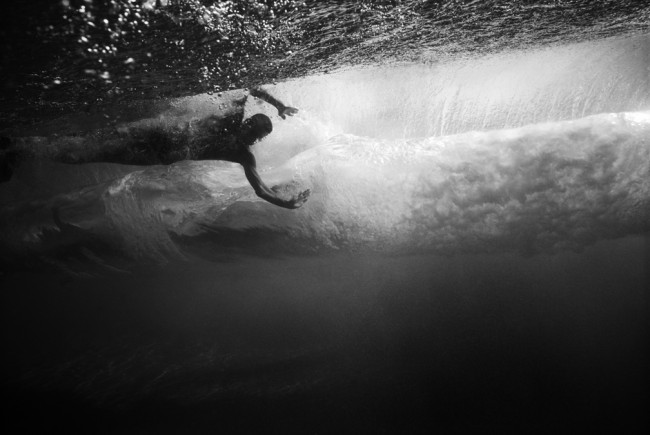 From "Waterways'' show at Heather Gaudio Fine Art, New Canaan, Conn., June 5-Sept 6.
Prelude to pollution
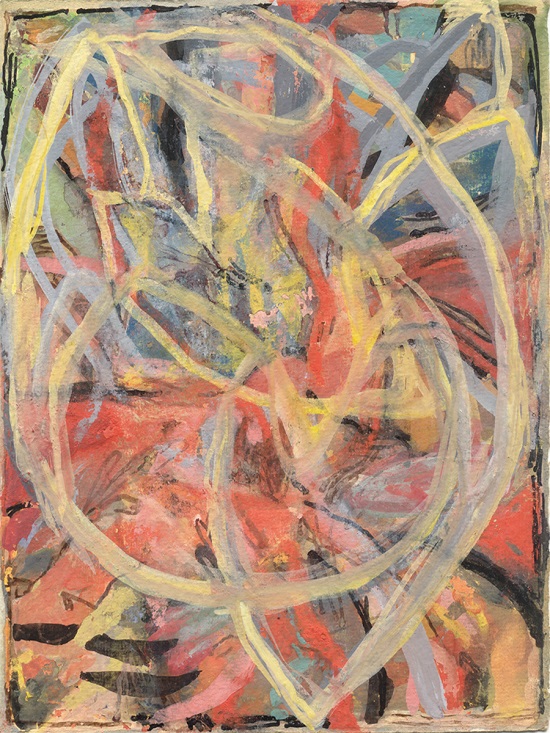 'Prelude,'' by PAT COOMEY THORNTON, AT Dedee Shattuck Gallery, Westport, Mass.
In New York City. You can feel/smell the edge of summer crud pushing at the freshness of spring. More homeless on the street. They're usually old; everyone else seems about 25. Is the new mayor tough enough to keep this city under control?
Summer horror

"Are We There Yet?'' , by Evelyn Dunbar, at the Alden Studio Gallery, at the Art Complex Museum, Duxbury, Mass.
Maine food can't be main course for most
The Portland Museum of Art and the Maine Organic Farmers and Gardeners Association are promoting such activities as a Sunday, May 18, program, from 2 p.m. to 5 p.m. called "Healthy Soil, Healthy Foods'' to pump up agriculture in the Pine Tree State. All well and good, just as long as Mainers do not think that they can survive on Maine food alone. Midwest, Southern and California agriculture will rule for many years to come.
Amusement park bad dream
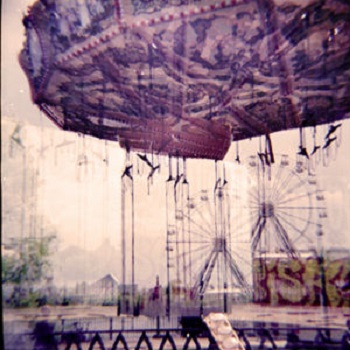
"Swing Low'', by SHARON O'CALLOGAN SHERO, at Brickbottom Gallery, Somerville, Mass.




Soothing to see if not smell
 "Shimmer'' (pastel), by LIZ HAYWOOD-SULLIVAN, at the Art Complex Museum, in Duxbury, Mass.
New England's salt marshes are soothing to look at, if not necessarily to smell, especially in the summer. In any cases they clean coastal waters and act as vast protein factories because of the fish and shellfish they nurture.
Paul F.M. Zahl: Movie offers guide to Harvard Black Mass

"Order and chaos'' (mixed media), by LYNDA CUTRELL, at Galatea Fine Art, Boston, June 1-29.
By PAUL F.M. ZAHL
As a Harvard grad and an Episcopal minister, I am dismayed by the prospect of the university's sanctioning a Black Mass for tonight (May 12), within Memorial Hall.
But what I really want to megaphone to all concerned is this: Wake up, Harvard (not to mention the Satanic Temple of New York City), and watch more horror movies!
You could all spare yourselves a lot of trouble if you watched more horror movies. Specifically, you need to see that unregarded but rich Hammer horror film from the early 1970s, entitled Dracula A.D. 1972. For those who care, and this writer cares very much, Hammer Studios in England produced dozens of luridly wonderful horror movies from the late '50s through the early '70s. These immortalized such U.K. character actors as Peter Cushing and Christopher Lee.
Fans of these movies tend to regard the instantly dated Dracula A.D. 1972 as the nadir of Hammer's output. But in light of what's slated to happen today in Cambridge, Mass., it's risen to the top of my list.
This is because Dracula A.D. 1972 anticipates in detail a scenario that has already unfolded. To wit, the villain in the movie, whose made-up name in the story is 'Johnny Alucard' (the surname, of course, is ''Dracula'' backwards), looks, dresses and talks like the spokesman for the Satanic Temple of New York City. Secondly, he keeps telling his gullible young friends in the movie to ''Keep cool, birds'' -- the script is deliriously filled with faux-Flower Child and Swinging London colloquialisms. "This happening I'm asking you to jive to is just a stunt. Just a bit of fun, mates."
To their acute misfortune, members of "Johnny Alucard's''' circle believe him when he says: "This is just a re-enactment."
The movie's staging of the Black Mass itself is extremely well done. The director, Alan Gibson, is sure-footed in the blocking and the angles; and during the Mass, which takes place in a ruined Memorial-Hall-type building, a deconsecrated church damaged during the Blitz, in World War II, the movie gets serious. The elements of a real Black Mass are all there, just as they will be, presumably, this evening in Cambridge within the once hallowed walls of the university's memorial to its Civil War dead. The parallels between now and this absurd but tight English movie are breathtaking.
Finally, the church comes into it. But not priest, not bishops, not archbishop.. Rather, old-fashioned religion comes in to Dracula A.D. 1972 through the person of an aging physician named ''Lorrimer Van Helsing". (Who ever thought of that first name? The writer should have been knighted on the spot!)
Anyway, ''Lorrimer Van Helsing'' strides into the movie, an old man poignantly concerned about the well-being of his impressionable niece. (His niece has come under the spell of ''Johnny Alucard".) Fortunately for her, her uncle intervenes, with cross and stake, and Jessica van Helsing is saved.
This is a classic instance, which occurs often in English horror and sci-fi movies, in which wise members of the older generation are the only ones who know enough to save clueless members of the younger one. (Usually, the character actor Andre Morell played these roles, though John Mills did once, too.)
I wish that Harvard University officials would go straight to Barnes and Noble, and buy their very reasonably priced copy of Dracula A.D. 1972. It's in all the stores as I write. (Target, too.)
A personal note in conclusion: Three times during my ministry in the Episcopal Church, I was forced to get up close and personal with Satanists. Somehow they succeeded in inveigling members of our parish youth group in Westchester County, N.Y., to take part in a Black Mass.
They "staged" this on the grounds of a country club up on the Hudson. Two of the young participants -- and I had to clean up the bones of living animals that had been sacrificed during the service (and had to change the locks on the parish sacristy because Communion wafers were being stolen) -- were scarred indelibly by what they were lured into doing. I never of them smile again.
I also got to know a languid old trust fund Satanist, who lived in London and had the most beautiful personalized Satanic stationery.
Harvard, wake up! Buy this movie and watch it. And it may not be quite as campy as it first appears.
The Rev. Paul F.M. Zahl is an Episcopal minister and a theologian.
Addendum by Robert Whitcomb: So will we see the Prophet Mohammed in drag in the next Hasty Pudding Show at Harvard, or indeed portrayed in any public way on Harvard's campus as less than perfect? Or course not -- and not because of any particular respect by a mostly secularized Harvard community but because of the physical fear of offending followers of a religion a few of whose adherents are famously violent.
Fear is a key ingredient of hypocrisy.
From Siberia to Suriname

"Maynard Spring'' (oil on canvas), by GEORGE NICK, at the Art Complex Museum, Duxbury.
It's always a bit of a shocker: A few weeks ago all was brown, gray, black and white, and now, after a couple of warm, wet days, southern New England turns into jungle-like lushness.
'Beacons of hope'
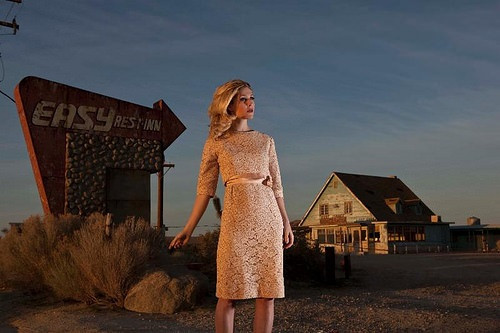
"Lori X, Lancaster, California,'' by B.J. & Richeille Formento, in the "Circumstance: American Beauty on Bruised Knees'' show at the Robert Klein Gallery at Ars Libri, in Boston.
Mr. Formento is the photographer and Ms. Formento, his wife, is the stylist in this show, meant to show the changing face of the American Dream through pictures of "women who became beacons of hope against the dark and slated backdrops of their lives.''
Jumping into summer
 "No Strings Attached'' (oil on canvas), by CAROL O'MALIA, at the Art Complex Museum, in Duxbury, Mass.
A peak of realism and terror

A painting of Mt. Katahdin, Maine's greatest mountain, from photo-realist Richard Estes's "Realism'' show, opening May 22 at the Portland Museum of Art.
Looking at that gorgeous peak, I think of black flies and beer on a fishing trip to Baxter State Park 45 years ago. And, some years later, hiking Katahdin's scary "Knife Edge,'' with near-sheer cliffs on each side.
On a climbing trip to Katahdin about a decade ago, I noticed how variably physical fear can manifest itself. While I found walking along the "Knife Edge'' nearly terrifying (although every few minutes mitigated by clouds scudding in below us, thus helpfully making it impossible to see just how big the drop was) one of my companions, who had done extensive climbing in the Alps and other high mountains, seemed to display no anxiety.
And yet when the next day we rented a small plane (and its wisecracking Mainiac bush pilot) and flew over the gorgeous peak, our companion seemed terrified.
Coronary and traffic congestion
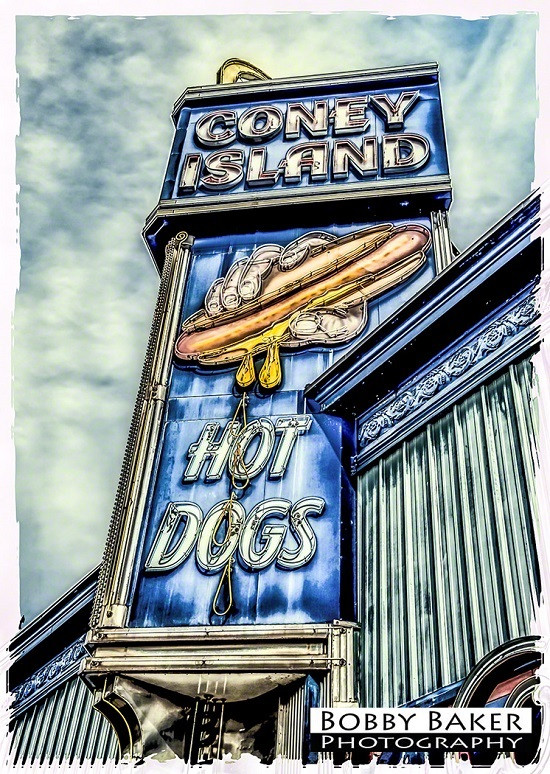
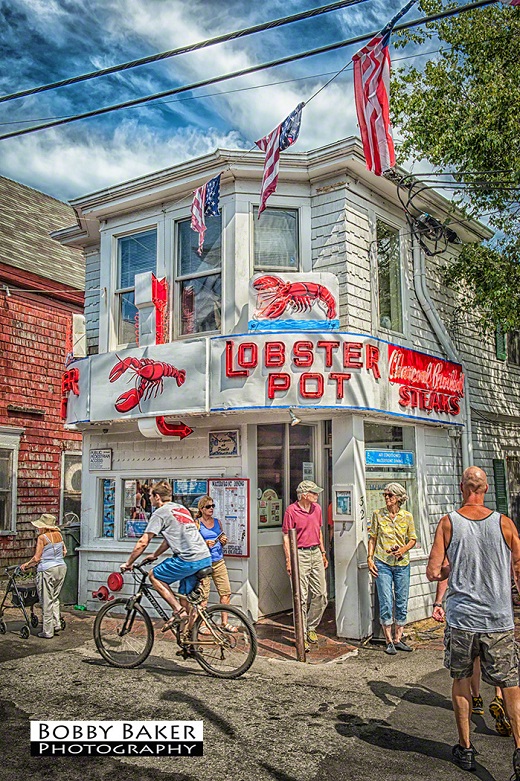
Photo copyright BOBBY BAKER, who travels New England in search of memorable shots.
This one, of a joint in gritty downtown Worcester, is very evocative to me. Friends and I used to stop there on road trips to Vermont and fill up on food that the American Heart Association would urge us all to avoid whenever possible. It is utter junk, but delicious. The confused and congested traffic circulation of downtown Worcester, "New England's Pittsburgh,'' was a frustration that was difficult to avoid but Coney Island made it considerably more tolerable.
From Worcester, we'd proceed northwest through assorted villages and mill towns, some of which looked little changed (except for the cars) from photos taken 100 years ago. If a year or more had elapsed since our last trip through the areas, we'd notice that some big wooden store or old stagecoach hotel on a common had burned down in the interval.