
Vox clamantis in deserto

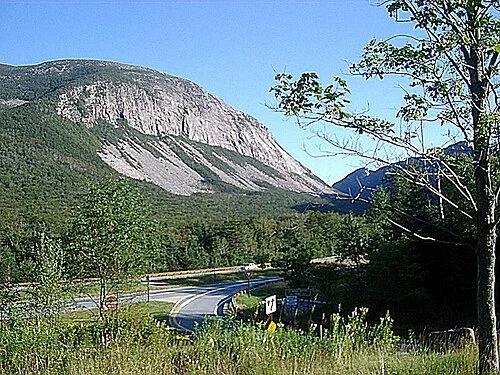
For those in peril on the sea

"Chapel on the Hill'' (oil on panel), by NAN HASS FELDMAN, at Fountain Street Fine Art, Framinghanm, Mass.
Relatively springlike
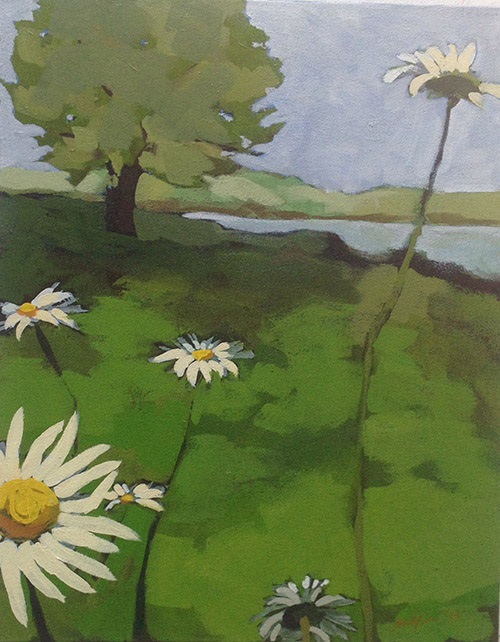
"Everything Is Relative,'' by MIMO GORDON RILEY, in her current show at the Providence Art Club.
For growers of flowers and vegetables this is a edgy time of year. On the one hand, you want to get the tomatoes, etc., in the ground, on the other, your fear a late frost. Even the more tropical parts of southern New England are vulnerable well into May. This gives a great excuse to put off the work and sleep late on weekends. Growing things is very satisfying but also very tiring, especially when the weeds get going and you can't afford yard crews of undocumented aliens.
By August, a lot of us are longing for the first frost, though that feeling doesn't last long.
You think of summer as a relaxing time but if you're growing things, there's always that pressure to get back to work, albeit outside and not in front of a computer screen. And it's politically correct to grow vegetables because that is seen as harkening back to principles of self-sufficiency, however basically bogus your ambitions in this mission may be since it's much more efficient and usually much cheaper just to buy the products of agribusiness at the supermarket. You can even get "organic'' produce there, if you believe that it actually is. (How can you really find out?)
's m
rwhitcomb51@gmail.com
cmg625.com
newenglanddiary.com
Architectural ruminations
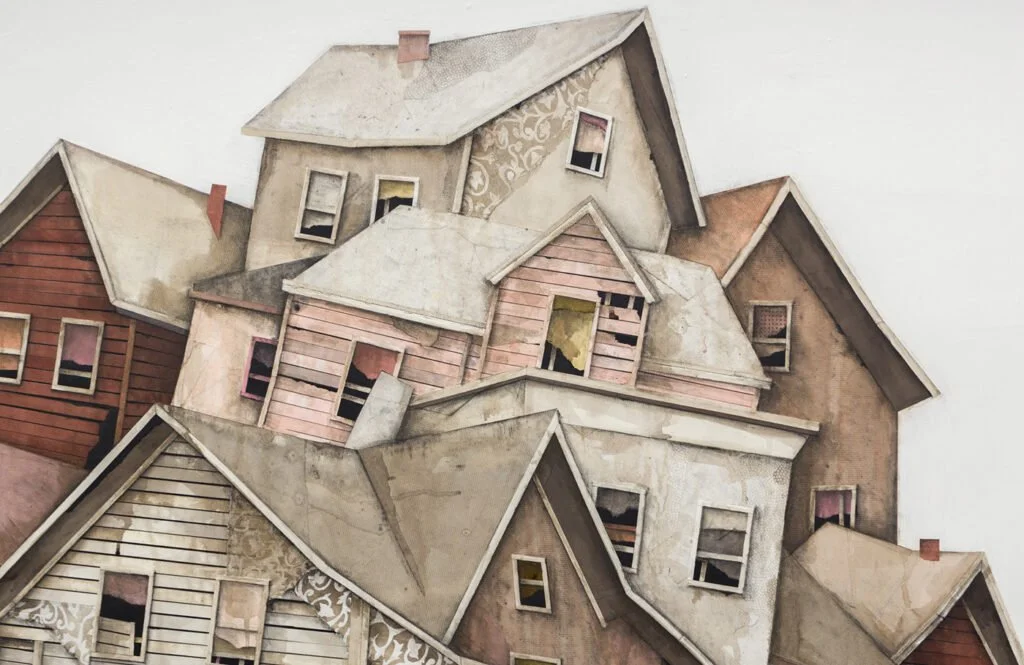
 "Atlas View'' (mixed media on wood). by MAGGIE CARBERRY in her show "Urban Escape,'' May 1-29 at Galatea Fine Art, Boston.
She says that that images in her show ''represent a portion of my 'Daydream Dwellings project,' in which she is working to "re-imagine urban landscapes, one architectural detail at a time.''
'I'd like to introduce her co-host'
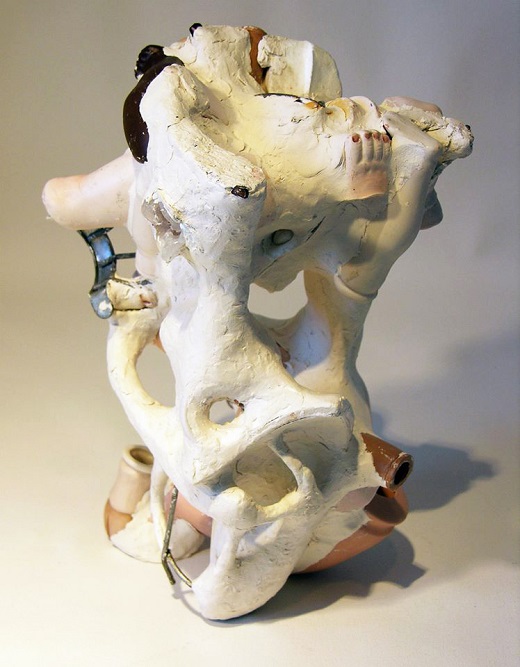
"Co-Host'' (ceramic, metal, plastic and paper clay), by LINDA LESLIE BROWN, in her show at the Kingston Gallery, Boston.
Nature is watching you
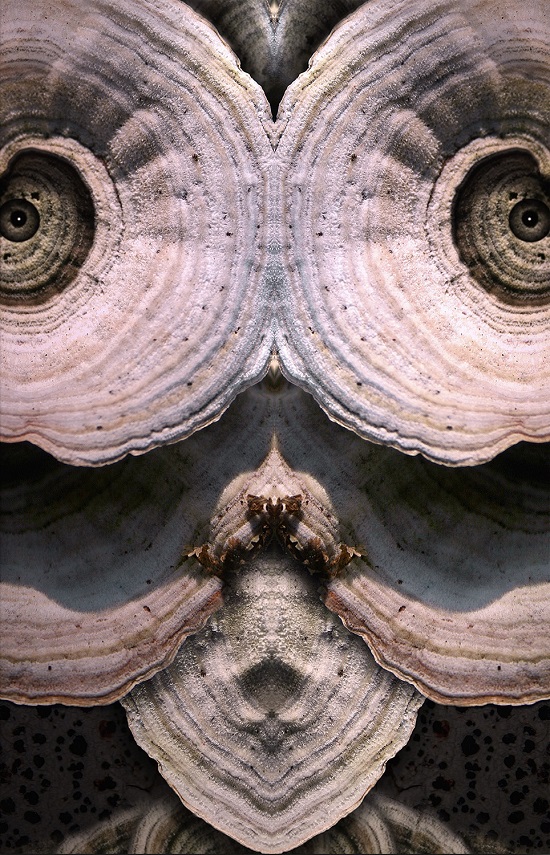 "Green-Eyed Silence'' (digital print), by HARVEY GOLDMAN, in his "Apophenia'' show at Dedee Shattuck Gallery, Westport. Mass.
Apophenia is seeing patterns or connections in seemingly random or meaningless data.
Chris Powell: Riding rails through Conn. ruins

"Appalachia'' (gelatin silver print), by MILTON ROGOVIN, at the Thompson Gallery, Weston, Mass.
By CHRIS POWELL
MANCHESTER, Conn.
Reading the governor's press releases, Connecticut might think that preservation of farmland and prevention of "suburban sprawl" are compelling issues. Riding the train from Greenwich to Hartford gives a contrary impression.
Thanks to Amtrak, such a trip is still possible for those who can deal with the bumps, shuttered washrooms, and clogged toilets. The train windows remain clear enough to reveal a stunning and almost unbroken panorama of economic collapse -- ruined and abandoned factories and commercial properties occupying what might be considered prime locations, adjacent to the railroad and highways and served by all utilities.
If there was really any money in agriculture in Connecticut, hundreds of large farms could fit on the abandoned property that is already cleared as well as inside the abandoned buildings that remain structurally sound. Of course the abandoned properties could be redeveloped as housing as well.
The ruin may be most striking in Bridgeport. While the call letters of the city's radio station, WICC, were chosen for "Industrial Capital of Connecticut," today the "I" would have to stand for "impoverished." New Haven, Meriden, and Hartford, once industrial powerhouses themselves, now consider it a triumph just to tear down a ruined building. Even fairly prosperous towns along the railroad, like Milford and Wallingford, have such embarrassing eyesores.
In any case "farmland preservation" -- government's paying farmers for the "development rights" to their property -- doesn't make agriculture profitable or even sustainable. It only lets farmers withdraw their equity from the land without having to sell it for housing, and thus makes suburban and rural towns even more residentially exclusive, restricts the housing market, and supports prices for those who have housing while driving up costs for those who don't.
Most advocates of "farmland preservation" care far less about sustaining agriculture than about keeping new people out. And while Connecticut's industrial decline is no secret, riding the rails through the core of that decline explodes the premises behind "farmland preservation" and complaints of "suburban sprawl."
The ride shows that Connecticut's problem is not preserving farms or stopping "sprawl"; instead the problem is urban rot. Since the infrastructure remains -- including the railroad, which, while creaky, is still more convenient than cars and buses for getting to New York, Boston, and Philadelphia -- what has made Connecticut's cities so unattractive to people who can afford to live elsewhere and pay taxes in support of government?
For starters are the schools, the worst in the state. But schools are only reflections of a community's population, and city populations are of course overwhelmingly poor and fatherless.
So the big policy question has to be: A half century into the "War on Poverty," with government now providing the poor with food, rent, heat, medical insurance, social workers, ever-longer unemployment compensation, disability stipends, and lately even cellphones, what is making and keeping people poor if not government itself? If the ruined factories along the rail line hint that the answer involves the loss of low-skilled, entry-level industrial jobs, couldn't government find similarly basic work for people to learn with in lieu of unearned welfare benefits? Thousands might be employed perpetually just cleaning up the trash along the rail line and the streets in every town.
Couldn't government enforce standards in school so that people emerged with enough skills to make their own way? Skilled people still might find good employment in any number of endeavors -- like modernizing the whole Northeast rail network. After all, "work, not welfare" used to be a populist and liberal objective. Right now the only consolation of riding the rails through the ruin of Connecticut may be that at least we still have the world's best imperial wars and public employee pension systems.
Chris Powell is managing editor of the Journal Inquirer, in Manchester, Conn.
Comment via rwhitcomb51@gmail.com
Wind and tree

"The Fan Tree'' (oil on canvas), by CLIFFORD ADAMS BAYARD, in the "Three Vermont Impressionists'' show at the Bennington (Vt.) Museum through June 17.
At Tuckerman's Ravine
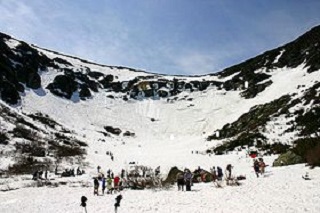
We seem to gravitate toward whatever season we're not in anymore. Thus hordes of skiers and climbers head for the glacial cirque known as Tuckerman's Ravine, on the southeast side of Mt. Washington. The howling winds blow up 60 feet of snow a year into the ravine from the upper part of the mountain, making the ravine skiable into June. On sunny days, the crowds are already congregating early in the morning to slide down its dangerously steep slopes.
Skiing in the wet, mild air of April on bouncy corn snow evokes a mellowness tinged with melancholy, and extreme sleepiness, at the end of the day. For full drug-like effects, you need to smell wood smoke from the nearest ski lodge.

Painting through pain

"Sometimes All That Is Left Is the Anvil,'' by JAMIE RIBISI-BRALEY, at Monkitree Gallery, Gardiner, Maine, through June 7.
The artist says she works through chronic pain from headaches.
Pulling on your eyes

"The Owl's Failure'' (acrylic, hand-painted collage on canvas), by IVA GUEORGUIVA, at her show at the Samson Gallery, Boston, through May 31.
Last week I heard David S
A pier onto our memory

"Departure,'' by WENDY PRELLWITZ, at the Chandler Gallery, Cambridge, Mass., in its Direct/Indirect'' show of drawing on top of prints and printing on top of drawings through May 9.
As ice out approaches

"Squam Lake'' (N.H.) , by KATE CUTLER, at Patricia Ladd Carega Gallery, Center Sandwich, N.H.
Piscatorial Pawtucket
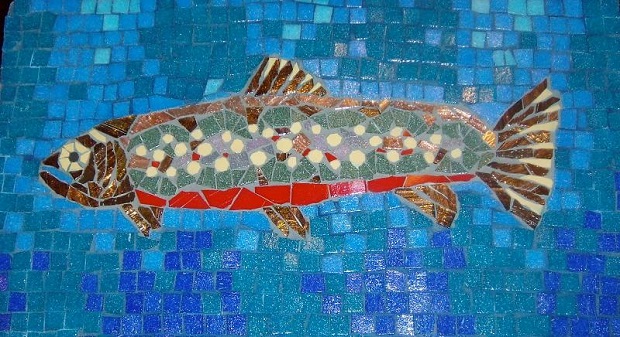 A mosaic painting by JESS REGELSON, submitted for the Fine Art and American-Made Craft Show and Sale at the Arts Market Place in Pawtucket, R.I., next Sept. 20 and 21.
Window on the web

"MiddleWay 2014'' (flo-jet cut stainless steel), by DEAN SNYDER, in his April 26-June 20 show at Cade Tompkins Projects, Providence.
High-speed evolution

"The "Bottom Falls Out'' (pastel, colored pencil), by JUDITH COOPER, at the Lexington (Mass.) Arts and Crafts Society.
Everything is animated
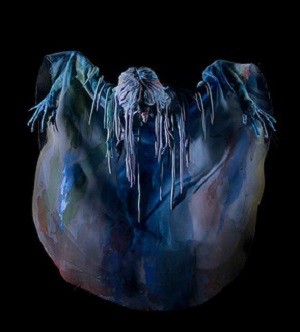 "Eager'' (video still from stop-motion, clay animation video with sound), by ALLISON SCHULNIK, in the "Allison Schulnik/Matrix 168'' show at the Wadsworth Atheneum Museum of Art, Hartford, through May 4.
What we are looking for
 "Vision with Green'' (oil on canvas), by ESTEBAN VICENTE, at Heather Gaudio Fine Art, New Canaan, Conn.
The rich in russet
 "Back Bay'' (oil on panel), by JAN McELHINNY, at Alpers Fine Art, Andover, Mass.
The island of the Unitarians

"Trap Dike, Star Island'' (oil on canvas) , by CHRIS VOLPE, at Alpers Fine Art, Andover, Mass.
Star Island is one of those tiny bodies of land off New Hampshire that comprise the Isles of Shoals. It has long been a summer retreat for Unitarians, that quintessentially New England denomination that mostly evolved from such Transcendentalists as Ralph Waldo Emerson.