
Vox clamantis in deserto

On my mother's trail
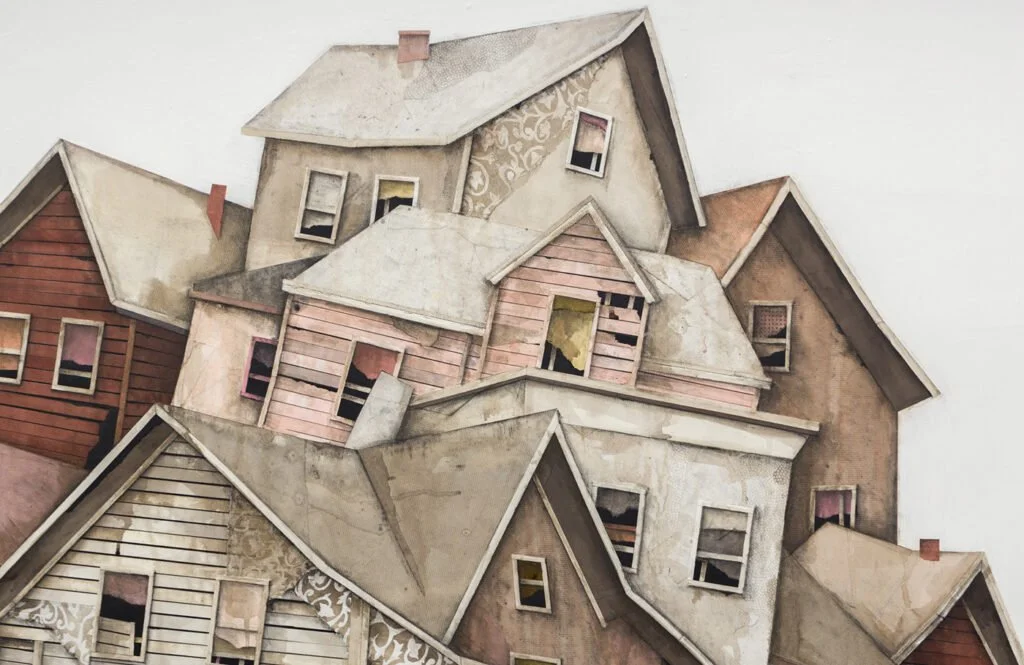
"Satellite From the Afterlife (detail from acrylic on canvas), by DAVID KINSEY, in his show "In Loving Memory of My Mother, Kathy Wooden Kinsey,'' which presents "an epic trail'' of "moments of time that occur in one's life.'' The show will be at Bromfield Gallery, Boston, March 5-3o.
rwhitcomb51@gmail.com
Bourbon and burgers
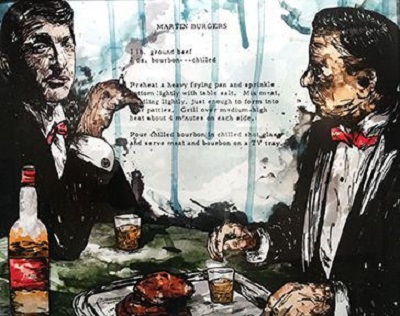 "Burgers,'' by DREW GUNDLACH, at Wedeman Gallery, Newton, Mass., through March 14.
Cold moon over Maine
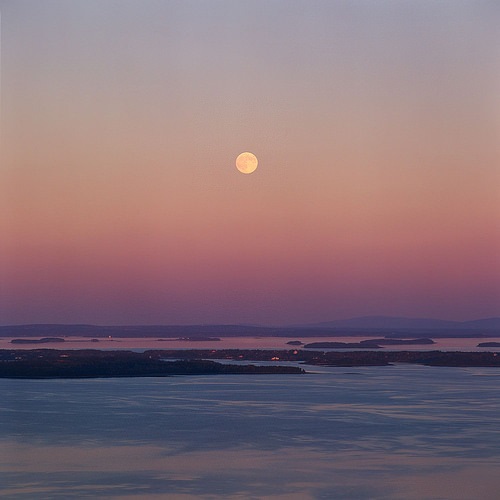
''Moonrise, Penobscot Bay'' (photo), by JIM NICKELSON, in his "Adventures in Celestial Mechanics'' show at Maine Media Gallery through March 1.
Have activities been even more difficult and frustrating to plan this winter than most? Or is it that life has become that much more complicated anyway, and a larger percentage of population is old and thus less able to deal with the seasonal mess?
A hard-won crop

"Shuckers'' (Homage to the Patricia Marie Series, 1976-2001, oil on canvas) by SALVATORE DEL DEO, at the Berta Walker Gallery, Provincetown, through March 8.
Tedious work but not nearly as unpleasant as being out on a cold wet clam flat and raking them up. No wonder they're so expensive.
Fierce floral
 "Field of Flowers'', by GILL ROSS, at the Lexington (Mass.) Arts and Crafts Society.
The ultimate respect?

"Odalisque,'' by ELMYR de HORY (1974, oil on canvas), in the style of Henri Matisse. Collection of Mark Forgy. (Photo by Robert Fogt ) at the Michele and Donald D'Amour Museum of Fine Arts, in Springfield, Mass. through April 27. It's in the "Deceive: Fakes and Forgeries in the Art World'' show.
Most of us are fakers in some way, and we build upon the work of others, albeit not usually to the point of trying to perfectly replicate it to show off and/or make money. This brilliant show will test the perceptions of authenticity and, the museum says, show how technology is used to determine fraud.
The Winslow Homer Studio

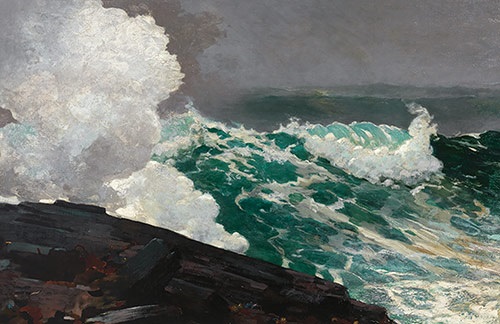
Winslow Homer's paintings have long been some of the most beloved art associated with New England. Thus many will want to visit the Winslow Homer Studio, at Prouts Neck, Maine. The studio, owned by the Portland Museum of Maine, is where the artist lived from 1883 until his death, in 1910. The museum says the studio is meant to "celebrate the artist's life, to encourage scholarship on Homer, and to educate audiences to appreciate the artistic heritage of Winslow Homer and Maine.''
Not that Homer is always that cheery. Many of his images show nature to be menacing, as in the painting "Northeaster'' below.
Survey map of surveillance
 "I See You'' (gouache/pencil marker on paper ), by BRENDA VAN DER BEEK, at Galatea Fine Art, Boston, in a Feb. 1-28 show.
Laying a glove on Seekonk

Better without the players
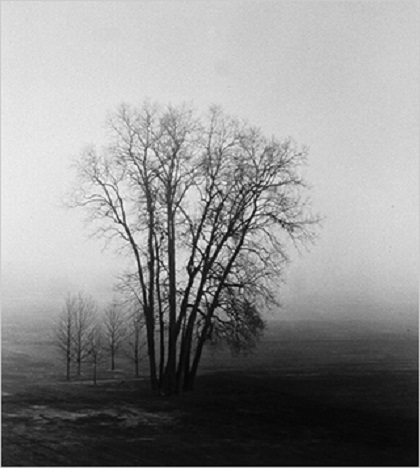
"First Tee,'' by DIANNE BUNIS, at Gallery Seven, in Maynard, Mass.
She specializes in large-format black and white photography of the New England landscape, using the Zone System.
With the decline of farming, golf courses are some of the few remaining open stretches of green (or brown) open land in much of the Northeast. That's nice, although they'd look better if they had animals grazing on them. They're wonderful to run in, in the winter.
Something to look forward to

"Redbud Tree in Bottomload,'' photo by ELIOT PORTER, at the Portland Museum of Art (but photo is copyrighted by Amon Carter Museum of American Art, Forth Worth) in the Portland Museum's show "American Vision: Photographs from the Collection of Owen and Anna Wells''.
Please comment via rwhitcomb51@gmail.com
Jan. 7, 2014
Cold morning today but far from the "polar vortex'' catastrophe that it's being made out to be by the news media because their denizens think that nothing much else is going on. Of course, lots of stuff is going on but it bores those reporters and editors who haven't yet been laid off in the ferment caused by the triumph of mostly ''free'' information on the Internet. And maybe the public doesn't care all that much either.
Most importantly, "polar vortex'' sounds like a horror-movie monster. Very sexy. More vortexes to come because global warming is screwing up the jet stream? Too early to say with scientific assurance.
It's all rather typical of January, the coldest month. But February is often the snowiest because warm wet air begins to edge north again, setting up conflict with the cold air. Great for creating Nor'easters! Arctic air and the Gulf Stream can be in explosive proximity.
As I walked the dog this morning I enjoyed the crunch of my feet on the thin layer of snow that had fallen overnight as the front swung through from Canada, bringing a snow squall or two. And the frozen trees were creaking. Too cold to be slippery! The problem in the coastal Northeast is the wind. It can make urban walking miserable. When I lived in the Upper Connecticut River Valley, the temperature could be much colder than in Boston, Providence, New York and Philadelphia but the comfort level much higher because there was much less wind and it was very, very dry. Sort of exhilarating -- bright and almost antiseptically clean.
Meanwhile, along the lines of ever-more "nurturing'' of children by parents and schools (at the ones I attended we were often called by our last names and there wasn't much open concern for our feelings), is the practice of clothing our dogs for winter walks, even outside of the Upper East Side of Manhattan. I must confess that my wife and I have adopted this habit. The dog, a rescue mutt from San Antonio (via "Alamo Rescue''), fought having a coat on at the start but has since accepted it -- especially when it's windy.
My most physically painful memories of winter are in the streets of big cities with the northwest wind squeezing between the high buildings.
When it's really, really cold, ice is so sticky that you don't even worry about driving up and down steep snow-covered hills. A few times I had to drive my drunken mother to a drying-up spa at a place called Beech Hill Farm, on top of a mountain in Dublin, N.H. -- the little town where Yankee magazine was, and is, put out and where Mark Twain spent some happy times. If it was the winter, I'd pray for very cold weather. Around freezing was the most insidious, with a thin layer of melting in the sun, then quick refreezing toward evening.
The dramatic freeze-thaw cycles in New England make skiing more, well, exciting here than on the dusty, dry "powder snow'' promoted by resorts in the Rockies. Skiing in the White and Green mountains is much more of a challenge to muscles and nerves than is skiing at, say, Taos.
Anyway, I long for late February, when sun-facing cars and rooms suddenly seem to start to warm up much faster as the sun gets stronger. Even on a very cold day last week, I found the stone on a southwest-facing wall remarkably warm. We really do need to do a lot more with passive solar heating.
Public-sector embarrassments

From HELEN PAYNE'S show "Here I Sit, Brokenhearted" at the Bromfield Gallery, Boston.
The gallery says her show is an " installation on bathroom tiles where drawings make visceral vignettes, showing moments ranging from giving birth to getting booked. A shape-shifting protagonist emerges from the tiles. She morphs in time and race and limps along at odds with expectations but at one with viscera.''
It's "about the ill fit of the body and how our most private moments can play out in the public sphere.''
Our private moments playing out in the private sphere can be bad enough.
An old-fashioned face
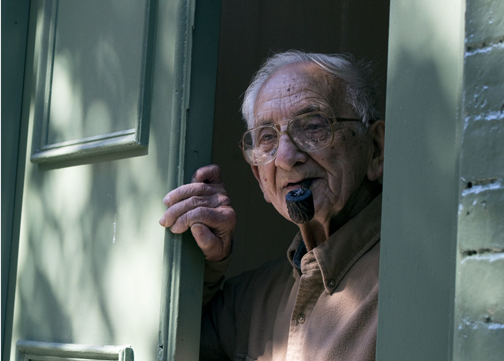 "North End Saturday" (photo), by JUDITH MONTMINY, in the "Synergies: New Gallery Artist Expo," at South Shore Art Center, Cohasset, Mass.
What a face of weathered wisdom (however misleading it might be)! Of course, he would be told not to smoke a pipe -- danger of oral cancer.
But pipe-smoking used to be considered a sign of calm, good humor and, yes, a kind of healthiness. A lot of doctors smoked pipes; it went along with their bow ties. But then, they'd do ads for cigarettes, too. Just look in a big magazine from the '40s. "Not a cough in a carload!"
Hard-wired for art

From the ''Head'' series of Mary Mead (here a woodcut intaglio monoprint), in her show at Kingston Gallery, Boston, to open Jan. 10.
The layered effect

"Winter Painting',' by DAVID BARNES, in his show at the Hess Gallery at Pine Manor College, Chestnut Hill, Mass., through Jan. 20.
When I was a kid, I couldn't sleep in gleeful anticipation of blizzards, which were particularly dramatic at our house on the top of a windy hill near the sea. Now I still can't sleep but the snow seems like a blanket of death.
How we ended 2013 and entered 2014
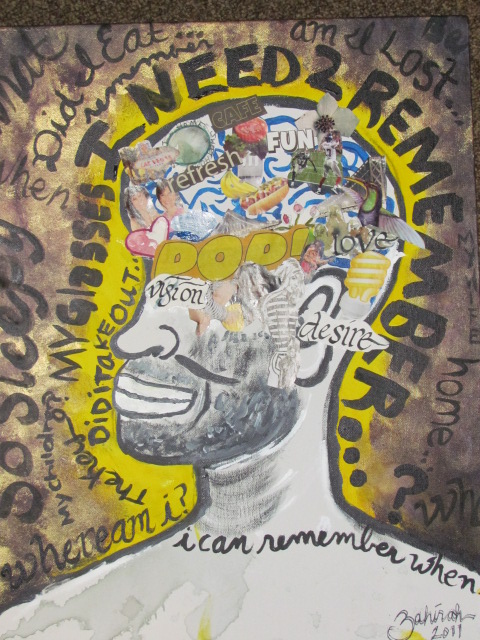
Painting by ZAHIRA TRUTH, at Roxbury Open Studios, Boston.
From the capital of New Year's Eve

"Saarinen Reflections, New York '' (digital c-print, 60 x 48 inches). by MICHAEL EASTMAN, at Heather Gaudio Fine Art, New Canaan, Conn.
Christmas morning, downtown north of Boston

Painting by JEANNIE PICCINI, in her "New England Moments'' show at 45 Memorial Circle, Augusta, Maine, via the Kennebec Valley Art Association.
Angst in Indochina

In Cambodia
In Cambodia (oil on canvas), by BEA MODISETT, in HallSpace gallery, Boston.
In woods on a nonsnowy evening
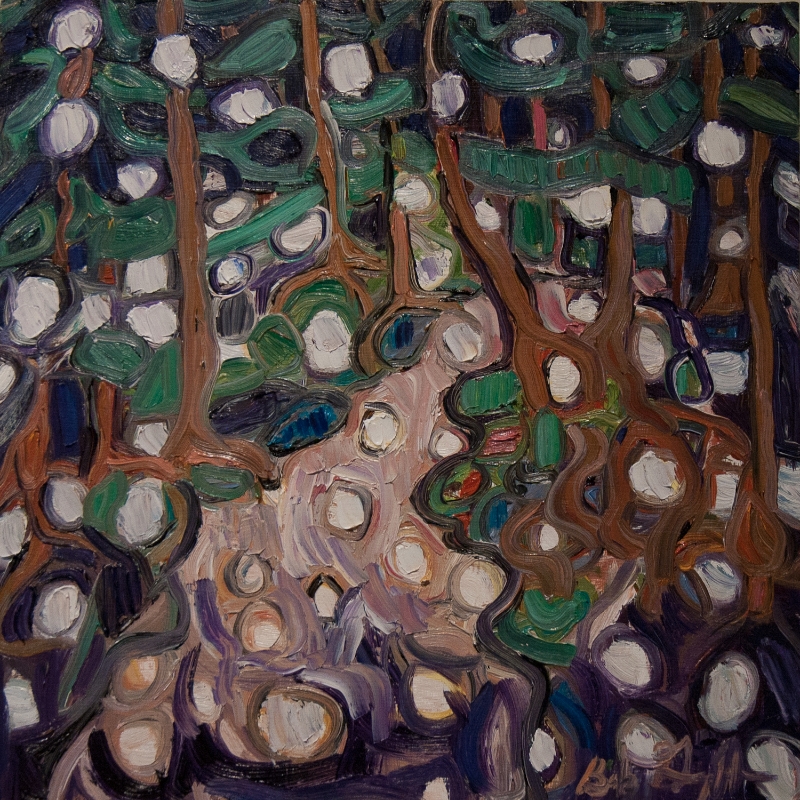 "Trail Through Old Hemlocks'' ( oil on panel), by BOB GRIGNAFFINI, at Fountain Street Fine Art, in Framingham, Mass.