


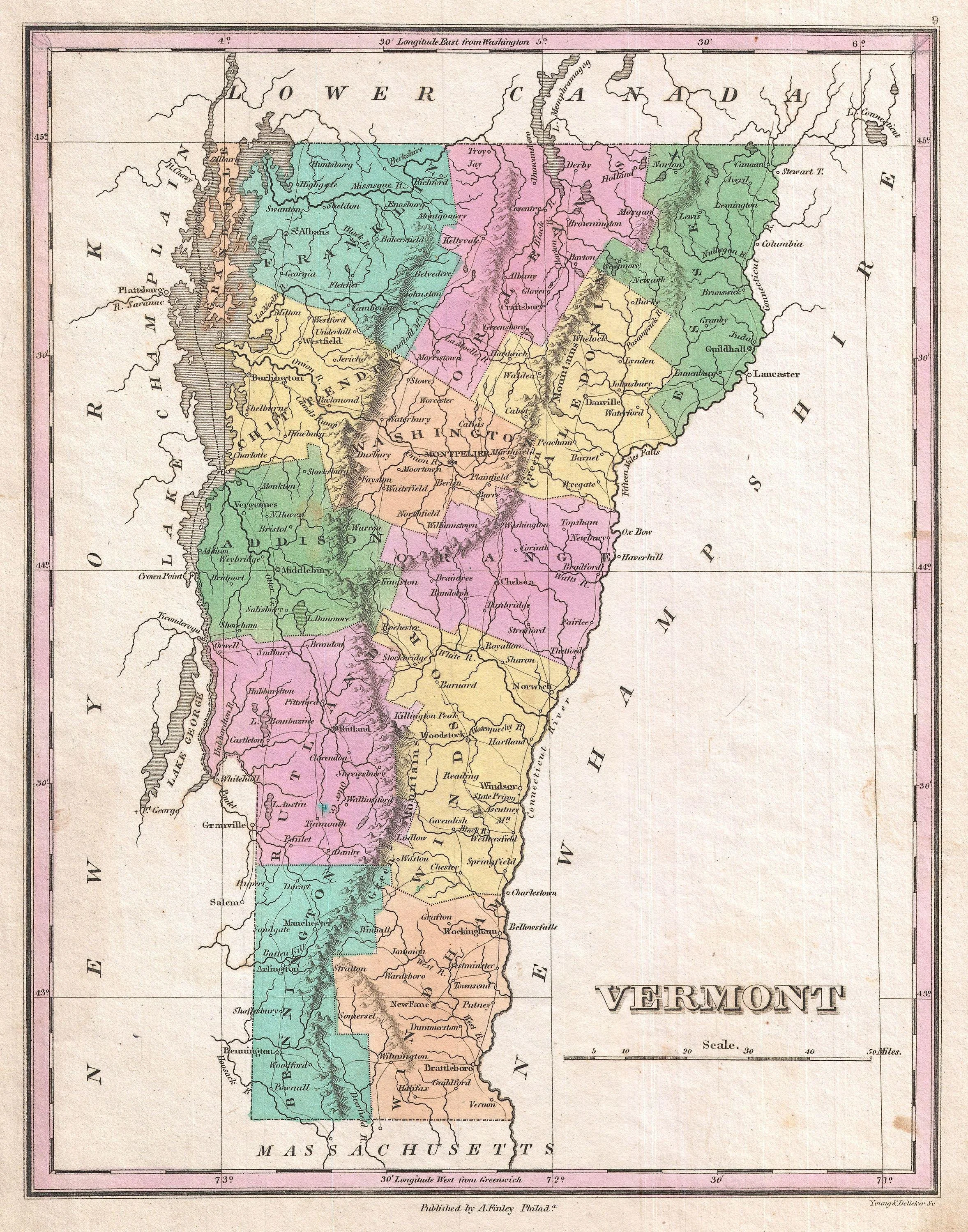
A_map_of_New_England,_being_the_first_that_ever_was_here_cut_..._places_(2675732378).jpg
Commentary Robert Whitcomb Commentary Robert Whitcomb

Chris Powell: Shakespeare, Bierce would have understood Rowland

MANCHESTER, Conn.

Having been convicted a second time on federal political corruption charges, former Connecticut Gov. John G. Rowland has people shaking their heads in wonder at why he didn't learn his lesson the first time, even as he was given a couple of pretty good jobs upon his release from prison, one doing economic development for his hometown of Waterbury, the other doing a radio talk show.

But it's hardly a mystery. Not all incorrigibles in Connecticut are fatherless young men from minority groups in the cities or boys who think they want to be girls only to end up as wards of the state Department of Children and Families. Every day Connecticut's courts are full of people amassing their umpteenth felony conviction, people who, to get into prison, had to work much harder than Rowland did -- and unlike Rowland's those cases are not compounded by the corruption inherent in political power.

The Meriden Record-Journal laments that people were "duped" twice by Rowland, "once by the young, up-and-coming Rowland and once by the older but not necessarily wiser ‘got religion' Rowland." But unless he was born corrupt and ill-motivated, there may have been no duping at all as he began his political career, just an ordinary vulnerability worsened by a ruinously expensive divorce.

Besides, it is hard to stay in politics in Connecticut for long without becoming cynical, since the very structures of government are greedy, fake, corrupt, or fostering of corruption, from binding arbitration of public employee union contracts to the control of professional regulatory agencies by the professions purportedly regulated. If Ambrose Bierce was still around he might use Connecticut as the example for his definition of "politics" in "The Devil's Dictionary": "A strife of interests masquerading as a contest of principles; the conduct of public affairs for private advantage."

It's not likely that Rowland was born corrupt, more likely that he simply did not have the moral strength to put himself at risk fighting a corrupt system, and, making his peace with that system -- putting his Republican affiliation largely aside and reaching a modus vivendi that proved even more profitable to the Democrats who controlled the General Assembly -- he became not only cynical but arrogant, and then just as venal as they already were, since they had been in power longer. He was just less careful about the details of the law.

Rowland seems to be considered unique in Connecticut for his downfall but he is not. A few decades ago U.S. Sen. Thomas J. Dodd, a Democrat, was even more corrupted by power -- taking bribes, converting campaign contributions to personal use, and evading income taxes while drinking himself into oblivion, leading to his censure by the Senate. But in his last two years in office, by selling his vote to the new national Republican administration of Richard Nixon, Dodd escaped criminal prosecution and now has a stadium named for him in Norwich and a research building and an annual prize named for him at the University of Connecticut.

Rowland, Dodd and others like them are only part of the oldest story in politics, as Shakespeare had Richard II explain:

... for within the hollow crown

That rounds the mortal temples of a king

Keeps Death his court, and there the antic sits,

Scoffing his state and grinning at his pomp,

Allowing him a breath, a little scene,

To monarchize, be fear'd and kill with looks,

Infusing him with self and vain conceit,

As if this flesh which walls about our life

Were brass impregnable, and humour'd thus

Comes at the last and with a little pin

Bores through his castle wall, and farewell, King!

-----

Chris Powell is managing editor of the Journal Inquirer, in Manchester, Conn.
Read More
Commentary Robert Whitcomb Commentary Robert Whitcomb

Community networks for transforming health care

  Video: Marc Pierson, M.D., a senior adviser at Cambridge Management Group West, sets forth a practical program for creating networks of community health workers to help transform American healthcare. Dr. Pierson, a former emergency department physician and hospital executive, has a national reputation for innovation aimed at improving care while reducing per-patient costs. He discusses how real healthcare reform must encompass far more than just the medical sector.


--- Robert Whitcomb (a colleague of Dr. Pierson)

Read More
Commentary Robert Whitcomb Commentary Robert Whitcomb

Charles Chieppo: The wrong person to head Boston schools

  BOSTON

Massachusetts  Education Secretary Matthew Malone has made no secret about wanting to become the next superintendent of Boston Public Schools.

“I’ve been training for this job all my life,” Malone told The Boston Globe. “It’s my calling.”

But there is precious little in Malone’s background to support that claim.

Before becoming secretary of education, Malone was superintendent in Brockton, the commonwealth’s fourth-largest school district. During his 2009-2012 tenure, the percentage of elementary- and secondary- school students scoring proficient or advanced on MCAS fell at every grade level but one. Eighteen months before his contract expired, the city’s school committee informed him that he would not be rehired.

Malone, who is no shrinking violet, also told The  Globe that he’s “in the arena and willing to fight and die for these kids.” Not only is there little to support that claim, but there is extensive evidence indicating it is blatantly false.

Brockton is the largest city in Massachusetts that doesn’t have a charter school. Toward the end of his tenure there, Malone’s primary focus seemed to be on ensuring the rejection of a charter school that had been proposed for the city.

The school was to be operated by Sabis, a charter-school-management company that operates two inner-city schools recently opened in Holyoke and Lowell, and a third in Springfield that has been operating for nearly 20 years. Every graduate in the history of the Springfield school has been accepted to college and it has repeatedly been recognized by Newsweek and U.S. News & World Report as one of the nation’s best high schools.

Sabis Springfield has a four-year graduation rate of more than 90 percent compared to less than 70 percent at Brockton High. On 2012 MCAS English tests, two-thirds of Sabis Springfield students scored advanced or proficient; less than half did so in Brockton. On math MCAS tests, the majority of Sabis students scored advanced or proficient compared to just over one-third in Brockton.

So did Malone “fight and die” for Brockton’s kids?

Hardly. Emails obtained by Pioneer Institute (which I am affiliated with as a senior fellow) show that he used his office and city resources to do things like craft a less-than-clever “$ABIS” logo and use his political contacts to kill the charter proposal. As Malone wrote in an email to the Brockton School Committee and several of his staff members, “It helps to have friends at [the state Department of Elementary and Secondary Education].”

It worked. The Brockton charter school proposal was rejected, and the city is worse off as a result.

Perhaps Matthew Malone’s application to be superintendent of Boston Public Schools should read that he is “willing to fight and die for these kids” — once it’s clear that the status quo is protected and the jobs of every adult in the system are secure.

Charles Chieppo is the principal of Chieppo Strategies, a public-policy writing and communication firm.

Read More
Commentary Robert Whitcomb Commentary Robert Whitcomb

'Big Data' and docs

  How much of future medical decisions will be made by individual physicians  mostly using their experience and intuition and how much by an analysis of "Big Data,''  via medical-data companies such as MediQuire, with which I have been working a bit?


-- Robert Whitcomb

Read More
art, Commentary Robert Whitcomb art, Commentary Robert Whitcomb

Chief Ricci's suicide and other Cianci regime history

 Hausrath
"Fragile Remains'' (collagraph and trace monotype print), by JOAN HAUSRATH, at the Art Complex Museum, Duxbury, Mass.
For new arrivals in Providence, and citizens with amnesia: Note  this excerpt of  an April 25, 2007 article by Bill Rodriguez in the Phoenix:
''Now that Buddy Cianci’s scheduled July 27 prison release date is approaching, Providence documentary filmmaker Cherry Arnold is getting around to a theatrical release of Buddy, following a successful victory lap on the film festival circuit....''

“'During the screenings outside of RI, in New York for instance, there were more gasps and audible reactions where people who didn’t know Buddy’s story were, I think, shocked by some of what happens, like the police chief [Robert E. Ricci] committing suicide [in 1978] and the assault details,' she notes. “'Outside of RI, lots of people ask during the Q&A why he was able to run for mayor again as a convicted felon. They’re very curious about that.”'

Then there are the sweetheart pension deals  and running City Hall as a criminal operation. But, hey!, nobody's perfect! The heavy price of statesmanship!

As H.L. Mencken's line goes:

''Democracy is the theory that the common people know what they want, and deserve to get it good and hard.''


Read More
Commentary Robert Whitcomb Commentary Robert Whitcomb

David Holahan: Past time to lower the minimum wage!

  If raising the minimum wage would hurt business, as the Republican Party insists, then it stands to reason that lowering it from $7.25 an hour would help business. And since the business of America, as President Calvin Coolidge said, is business. What are we waiting for?


How about $5, perchance $3? That would be like a steroid injection for our sluggish economy. As a college student in 1970 I spent one summer working for a vegetable farmer and earned the base pay of $1.45 an hour. The minimum wage for farm workers then was lower than that for the rest of the workforce ($1.60), presumably because we could nibble fresh produce while we worked in the blazing sun or driving rain.


Business has taken so many big hits over the years it’s a wonder there are any entrepreneurs left. The compulsory six-day, 12-hour a day workweek is long gone. One of the first strikes in American history advocated for the 10-hour workday. Good times!


Child labor is now taboo, too, at least in this country. My fraternal grandfather began earning his keep at the age of ten in a Pennsylvania coal mine. Little people worked cheap and their tiny bodies and nimble hands allowed them to get into tight places where grownups couldn’t go.


Once the minimum wage was zero, zilch, nada, nil. For centuries slavery greased the wheels of commerce here and abroad. It wasn’t simply that free labor was good for plantation owners. Enslaved people represented collateral for commercial investment, profits for insurance companies, a lucrative market for New England beef and dried cod, and a potent stimulus to expanding global trade.


As hard as it will be for some readers to believe, it was the Republican Party  that  brought this business-friendly era to a screeching halt. To be fair, the “Grand Old Party” was in its infancy back then and wasn’t nearly so Grand.  It has come a long way, blindly siding with business over labor in almost every instance since, fighting tooth and nail against most of the provisions that have shaped modern labor practices.


And the GOP is still fighting – and not just against increasing the federal minimum wage for the first time since 2009. In Maine, Republicans recently tried to loosen restrictions on longstanding child-labor laws so teenagers could work longer and later on school nights (11 p.m.) and for considerably less than the minimum wage. Talk about progress!


But mainly, Republicans are pushing back against Obama et al., who are arguing that it is time to raise the minimum wage. The Democrats anti-business rant goes something like this:


  • Inflation has effectively decreased the current minimum wage (which is not indexed to the cost of living as Social Security payments are) by more than 11 percent since 2009.
  • To equal the purchasing power of the federal minimum wage circa 1968 would mean a current figure of $10.69, according to the Congressional Research Service.
  • Lowest-wage Americans need the extra money just to survive and will spend every penny of it on goods and services, thereby stimulating the economy more than tax breaks for the rich, who already have everything money can buy.


Republicans reply pithily that businesses are people, too. If you don’t believe them just ask the U.S. Supreme Court.


My grandfather and I survived the coal mines and the farm. I went back to college. Michael Holahan was rescued from a life underground by an uncle who was a priest and put him to work for the parish.


In my grandfather’s day things were simpler and regulations were few and far between. There were states that didn’t require children to attend school but  let them  be put to work in mines and factories. Was that so bad?


David Holahan is a freelance writer who lives in East Haddam, Conn.

Read More
art, Commentary Robert Whitcomb art, Commentary Robert Whitcomb

William Morgan: A license plate worthy of Liberace

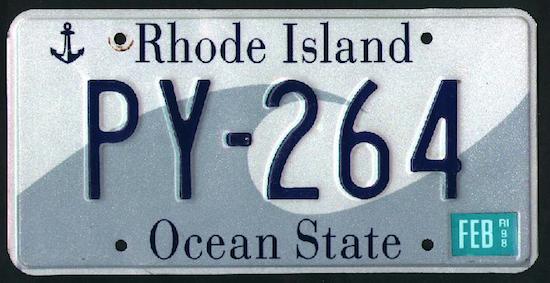
Photos (below)  and comment by WILLIAM MORGAN The State of Rhode Island and Providence Plantations has blessedly not joined the rush to offer dozens of specialty and charity license plates. And not least of all, the base Rhode Island tag was designed by a noted graphic designer, Tyler Smith, and is quite handsome.

States  such as Florida have scores, even hundreds, of affinity plates available for an extra fee. Rhode Island's paltry offering is only eight, including the Patriots and the Plum Island Lighthouse.

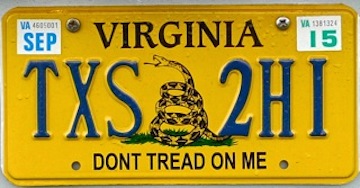
So far, Rhode Island has avoided any of the overtly religious, political and downright dumb plates that have made a mockery of the idea that a license plate is a nothing more than a way of identifying a vehicle–and not an opportunity to raise money for athletic leagues, Pro-Choice activists, or a big despoiling industry. Or as a Montana State Police captain said recently, "I need to see your number, not know what you favorite flavor of coffee is."

While one would not wish to discourage a few good charities from trying to raise money, I wonder if crowding a license plate with too much information and appalling design is really the most appropriate way to raise funds.

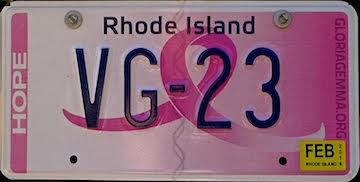
The Ocean State's latest affinity plate is for  a noble  aim  – to fight breast cancer. $20 for each tag goes to the state's women's cancer-screening program. Marvelous. But is not then the next logical specialty plate one that would raise money for prostate-cancer research? What color would the ribbon be?  The image of a little walnut-sized gland gracing the plate?

Hats off to the Gloria Gemma Breast Cancer Resources Foundation. But as an example of design from the "Creative Capital," this plate is a graphic disaster. The font for Rhode Island is too bland, for starters. Worst of all is the fading horizontal pink color scheme, as if the plate had been dipped halfway into a bucket of Pepto-Bismol. It looks like something Liberace ordered over the telephone.


rhode1


rhode2


rhode3


rhode4


rhode5


rhode6


Read More
Commentary Robert Whitcomb Commentary Robert Whitcomb

New England's most interesting music venue

  See /hear New England's most interesting music venue.


Fête is  the region's premier live-music venue, dedicated to  innovative music programming  for  an audience as diverse as New England  and in a spectacularly designed space.
Fête’s mission is to rejuvenate the relationship between music and revelry; create a haven where  artists and audiences  have a  gratifying cultural experience,  and participate in revitalizing Olneyville, a historic Providence neighborhood.
Read More
Commentary Robert Whitcomb Commentary Robert Whitcomb

Waterfront casino in Newport?

  I wish my friend Bruce Newberry and I had known about the sale of the Newport Yachting Center to developers. We could have talked about it this morning on his "Talk of the Town'' show on WADK (1540 A.M.).  Would the new owners like to put a nice,  quiet casino there?


The Yatchting  Center has been plagued with complaints about noise from concerts and other events there. Perhaps obsessive-compulsive gamblers would be better neighbors.  They, after all, have to concentrate.

Read More
Commentary Robert Whitcomb Commentary Robert Whitcomb

A streetcar named reasonable

People like to call most new large public projects boondoggles, but if politicians followed such negativism religiously,very few useful public projects would be built and the public would find life much more difficult. Yes, even Boston's Big Dig was worth it.

So it is with the idea of putting in a streetcar line in Providence. With the city's thick downtown density, large numbers of college students without cars and an aging population not driving as much these days, I think that the line would do very well in improving the city's economy and quality of life. The rich cities to our north (Boston) and south (New York) owe much of their prosperity to mass transit.

Read More
Commentary Robert Whitcomb Commentary Robert Whitcomb

Raise minimum wage and strengthen economy

It stands to reason that raising the minimum wage, by putting more money in the hands of consumers who are more likely to spend their money than are members of the rich people in the investment class would improve the still weak (for most people) U.S. economy.

-- Robert Whitcomb

Read More
Commentary Robert Whitcomb Commentary Robert Whitcomb

Peter Baker: Illegal N.E. fishing hurts future stocks

fishboat  

"Outside My Window'' (Woods Hole, Mass.), copyright Bobby Baker Photography.

An aromatic site.

This  article comes courtesy of ecoRI News

BOSTON

We’ve seen a rash of stories recently on illegal fishing in the Northeast, as enforcement officials take action on unreported catch. Some of the numbers are eye-popping. One bust involved 56,000 pounds of illegally caught and unreported summer flounder, also known as fluke. Another charge alleged 86,000 unreported pounds of the same fish over three years.

Research indicates that those figures are no fluke — pardon the pun. In fact, these recent incidents represent only a small fraction of illegal and unreported catch. Studies show that most illegal fishing in the region involves cheating on rules regarding the amount, type or size of fish allowed to be caught, misreporting in dealer reports, or fishing in places set aside to protect fish habitat and spawning areas. Few people realize the extent of illegal fishing, the harm it can do to ocean resources, and the ways in which this cheating undermines efforts to measure and sustainably manage fisheries.

For example, a study published in the journal Marine Policy in 2010 estimated that 12-24 percent of New England’s total catch of groundfish — bottom-dwelling fish such as cod, flounder and haddock — was taken illegally. How much fish is that? Well, when the authors took the midpoint of that estimate (18 percent) and applied it to the actual landings from the time the study was conducted, they found that the illegal catch would amount to more than 11 million pounds of fish, worth about $13 million.

And what if those illegally caught fish had instead been left in the water where they could grow and reproduce? The researchers give an estimate of that loss, too. Over five years those fish could have contributed some 65 million pounds to the overall biomass of the groundfish stock. That extra supply would be a welcome bounty today, when many groundfish populations are so low that the fishery has been declared a federal disaster, requiring tens of millions of dollars in taxpayer assistance.

Fisheries managers are responding to some problem areas. In the mid-Atlantic, for example, officials recently suspended use of a controversial “set-aside” program that had allegedly been exploited to hide catch that exceeded quotas. New England’s fishery managers have started looking into reports of vessels employing net-liners and other fishing-gear modifications that result in fish being caught under the legal size limit.

This “missing catch” from illegal fishing also complicates the work of scientists and managers who need an accurate picture of what’s really happening on the water. The actual mortality, or amount of fish killed, is a key piece of information for estimating fish populations and setting sustainable fishing levels.

The Marine Policy study found that even commercial fishermen assume that about 10 percent to 15 percent of their colleagues are routinely breaking the law. The researchers say that the odds of getting caught are slim, while the payoff from cheating is “nearly five times the economic value of expected penalties.”

All this illicit activity takes a toll on those fishermen who do follow the rules. The researchers surveyed fishermen and discovered that many believe that illegal fishing “will prevent them from ever benefiting from stock rebuilding programs.” This finding underscores one of the greatest damages. Hardworking fishermen who do the right thing as stewards of the public resource are cheated of their just reward of higher catches in the future. Although enforcement may be unpopular to some, it is critical for any well-managed fishery.

Peter Baker directs The Pew Charitable Trusts’ U.S. ocean-conservation efforts in the Northeast and Mid-Atlantic.

Read More
Commentary Robert Whitcomb Commentary Robert Whitcomb

James P. Freeman: Baker, Beacon Hill and Banacek

During the introductory credits of “The Three Million Dollar Piracy,” from a 1973 episode of television’s Boston-based series Banacek, there is a forgotten moment of morbid foreshadowing: Under a blue sky, as the camera pans across the golden dome of the Federalist-style statehouse, at 24 Beacon St., there looms a dark, steel skeletal structure, One Ashburton Place. More than metaphorically, it marked the time when state government as a bastion of ideas would start to be overshadowed by a bureaucracy of idols.

The 2014 Massachusetts gubernatorial election is about the very role of Beacon Hill.

Sitting down with Charlie Baker, the Republican gubernatorial candidate, at the Pilot House, after remarks he gave to the Sandwich Chamber of Commerce recently, you suddenly realize his candidacy is about balancing and restoring the role of limited government from today’s oppressive one. It is a change of approach, rethinking what government does and how it does it. Or, as one political scientist describes it, “affirming certain values and discouraging certain vices.”

One is struck with what Baker is not: a purveyor of identity politics--so carefully crafted by Democrats — where feeling is substituted for function. Instead, Baker is properly defined by action: “This is what I will do” as opposed to “This is who I am.” It is a marked contrast after eight years of Deval Patrick’s form of leadership; governor as emoticon not manager.

A theme of restoration and repair seems to be supported by residents. In polling results released earlier this month by wbur.org, primary voters overwhelmingly (89 percent of Republicans and 81 percent Democrats) indicated that managing state government effectively is a top priority. Perhaps tellingly, this “ranked higher than likability or progressive/conservative attitudes.”

Democrats display unintentional humor, therefore, when speaking of “change.” Surely, upon hearing this, sensible residents echo the sentiments of Guildenstern: “I have lost all capacity for disbelief.” Beyond, as he said, a “gentle scepticism.”

Martha Coakley, Baker’s principal challenger, has been state attorney general for nearly eight years and running for the fourth time for state-wide office. She would spend $500 million for economic recovery -- a plan modeled after Patrick’s 10-year, $1 billion life-sciences initiative, reports the AP. That's ironic, if anything, as she and fellow party members have run on a platform of change from eight years of Patrick’s grisly governance. Baker is relying upon public skepticism about Coakley’s ability to inspire and effect change.

He rightly believes his election would create a “constructive friction” between him and a de facto Democrat legislature (82 percent in the House and 90 percent in Senate) that would revive public accountability. He says that the one-party government is “more pronounced” now and hears even dissatisfied Democrats whispering about the definitive lack of leadership. Is that when the ghost of John Adams would reappear to haunt the hallowed ground on The Hill with “checks and balances” and instill discipline?

For most voters, such issues as runaway taxes, uncontrolled spending, unfunded pension obligations, massive debt burdens and assorted scandals — exacerbated by single-party politics--are accumulated barnacles below the surface of the ship of state; a seaworthy vessel, nevertheless, but slowly submerging. Baker would bring an immediacy to those issues.

Some will immediately greet the new governor.

Just 11 days after the election, on Nov. 4, 400,000 residents will begin —a gain!--enrolling for healthcare on the new Connector Web site. Its predecessor, unable to conform to myriad rules and regulations of Obamacare, was, Baker says, “an astonishing breakdown.” When, and if, fully implemented, costs may exceed $500 million. A Pioneer Institute healthcare expert called it “irresponsible to taxpayers” and described it a “‘Big Dig’ IT project.” Like its national step-cousin, it will likely not be free from trouble and require comprehensive executive engagement of the next governor.

Is this Patrick’s idea of “innovation” and “infrastructure?” It is a supreme example, certainly one of many, of the legacy migraines left over from his administration.

A considerable amount of Baker’s time was spent on the economy. Because of the saturation of codes, rules and regulations, “this is a complicated place to do business,” he asserts. Adding, the state “needs to think differently about economic development.”

Baker may be a beneficiary of a development not yet largely discernible. With Patrick and his party so aggressively progressive, the Democratic base may actually be more moderate, as evident from a Boston Globe poll conducted last July on immigration. Only 36 percent of respondents supported state spending on unaccompanied immigrant children compared to 57 percent who opposed it. The poll’s numbers overall were consistent with national poll results.

Conceivably, then, those children are not on commonwealth soil because residents questioned the veracity and competency of government supervision, not its compassion. If voters look at such factors surrounding other issues — immediate and intermediate -- it would further affirm the results of the wbur.org poll and would ensure a Baker victory.

Forty one years after George Peppard’s leisurely Beacon Hill drive inBanacek, Charlie Baker would reimagine the scenery.

James P. Freeman is a former Cape Cod Times columnist.

Read More
Commentary Robert Whitcomb Commentary Robert Whitcomb

Islamic mandate for beheadings?

Interesting paragraph from Jeff Jacoby's column today in The Boston Globe. ''There is more to the Islamist passion for decapitation than psychological warfare and a hunger for notoriety. There is also Muslim theology and history, and a mandate going back to the Koran. In a 2005 study published in Middle East Quarterly, historian Timothy Furnish quotes the famous passage at Sura 47:4: 'When you meet the unbelievers, smite their necks.' For centuries, Furnish observes, 'leading Islamic scholars have interpreted this verse literally,' and examples abound throughout Islamic history.'''

Read More
Commentary Robert Whitcomb Commentary Robert Whitcomb

Vector

RatDrawing "Plague Rat,'' by JOSHUA PRESCOTT, who has worked at the Velvet Mill artists' workplace, in Stonington, Conn.

Read More
Commentary Robert Whitcomb Commentary Robert Whitcomb

Violent NFL players? What next?!

football  

We're shocked, shocked that some NFL players turn out to be violent at home, too! People watch the NFL (and the NHL, etc.) because they want to see violence.  The players are trained (and medicated) to be violent, though many, perhaps all, the players liked a certain level of violence in the first place.


Meanwhile, the NFL continues to be treated as a ''nonprofit'' because legislators, some of them wanting anxiously to display their masculinity by showing their  real or feigned love of professional football, ignore the NFL gold mine.


Hypocrisy makes the world go round. And at some level, we're all killers.


--- Robert Whitcomb

Read More
Commentary Robert Whitcomb Commentary Robert Whitcomb

Charles Chieppo: MBTA hole gets deeper

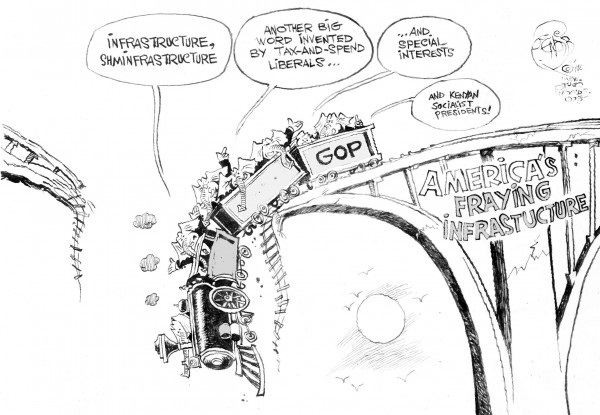
BOSTON The recent news that the estimated cost of an ongoing Boston-area subway-line extension has risen from $1.4 billion to nearly $2 billion surprised exactly no one. The more-than-two-decade history leading up to this most recent cost overrun contains a lifetime's worth of cautionary tales for state and local governments.

Almost everyone reading this should have some familiarity with Boston's "Big Dig." After all, you probably helped pay for it. The project included taking down an unsightly elevated roadway and running it underground, extending the Massachusetts Turnpike to Boston's Logan Airport and constructing a bridge over the Charles River. When it was finally completed in 2007 (nine years late), the original $2.8 billion price tag had swollen to $14.6 billion, more than a quarter of it covered by federal taxpayers.

Less attention has been paid to the court-ordered construction of 14 transit-related projects as environmental mitigation for the additional traffic the Big Dig would accommodate. Twenty-three years after the 1991 mandate, the Massachusetts Bay Transportation Authority (MBTA) owes nearly $9 billion in debt and interest, almost half of which can be attributed to the transit-mitigation requirements. If not for a series of fare hikes in recent years, the MBTA would pay more in debt service than it collects in fares.

Cost overruns on the current 4.5-mile extension of the MBTA's Green Line are a microcosm of why the mitigation requirements have been a disaster. Engineers encountered more than 500 "utility conflicts" along the corridor. Then there are the add-ons: A community path for bikers and walkers and more drainage for a river that was long ago covered by landfill but apparently still wreaks havoc during rainstorms. It's mitigation for the mitigation.

Payments to the design contractor jumped by more than half because platforms had to be extended to accommodate longer trains than had been envisioned 23 years ago. That's what you get with government by mandate.

And since the MBTA had to dedicate so much money to financing the mitigation projects, corners had to be cut elsewhere. A large concentration of MBTA vehicles are approaching or have surpassed their useful life. If you can't get down to Havana to watch the parade of pre-1959 American-made cars, just take a ride on a Boston-area commuter train. Old rolling stock means compromised reliability.

That  it's impossible to know what system priorities will be more than two decades down the road is just one lesson governments can draw from the unmitigated disaster of Boston's transit mitigation. The first lesson is that it's a spectacularly bad idea to mandate the construction of billions of dollars worth of new projects without a funding source.

But construction expenses are only part of the picture. Projects should be budgeted based on the cost of building, operating and maintaining them over their lifecycle. If that had happened in Boston, seeing more realistic numbers might well have resulted in some of the projects being eliminated.

Lifecycle budgeting also reduces the temptation to skimp on maintenance. The MBTA faces a maintenance backlog that topped $3 billion in 2009 and has only grown since. In the transit authority's fiscal 2010 budget, just six of 57 maintenance projects that received a safety rating of "critical" could be funded.

Budgeting based on transportation projects' real costs makes it less likely that government officials will be put in the position of robbing Peter to pay Paul by skimping on maintenance and not replacing assets in a timely manner. Forcing planners to take a clear-eyed look at real project costs might cut back on the ribbon-cuttings that politicians so enjoy, but it would result in infrastructure that functions better and lasts longer. And it might just avert disasters such as the one that the MBTA is facing.

Charles Chieppo is a research fellow at the Ash Center of the Harvard Kennedy School.  This originated at Governing Magazine's Web site, governing.com

Read More