A_map_of_New_England,_being_the_first_that_ever_was_here_cut_..._places_(2675732378).jpg

Vox clamantis in deserto

Commentary Robert Whitcomb Commentary Robert Whitcomb

A rich man's warning to other fat cats


Here’s an unusual super-rich guy with a strange message for his fellow 1-percent-of-the-1-percenters.

Nick Hanauer, who made billions as an Internet entrepreneur, recently wrote an open letter to his fellow über-richies.

“The true job creators are middle-class consumers, not rich businesspeople like us,” Hanauer declared a little while ago in Politico Magazine. “I earn about 1,000 times the median American annually, but I don’t buy thousands of times more stuff.”

America depends on a strong middle class, he says, for it’s their purchases that power the economy. To back this up, he points out that his family has three cars — not 3,000.

So, Hanauer says, it’s in the self-interest of America’s corporate and financial elites to do all they can to lift the earnings the rest of us take home — starting with a $15-an-hour minimum wage.

The old claim that paying workers more will destroy small businesses and job growth is simply not true, he says. It’s insidious, he adds, to claim that helping the rich get richer is good for the economy, but helping the poor get richer is bad for it.

“The two cities in the nation with the highest rate of job growth by small businesses are San Francisco and Seattle,” Hanauer points out, observing that they also have the two highest minimum-wage levels in the country.

For the Koch-headed ideologues who oppose having any minimum wage at all, this member of the billionaire’s club says that the soundest way to shrink government is to decrease the need for it. That will take paying decent wages so people don’t need Food Stamps, rent assistance, and other subsidies for life’s basics.

Hanauer concludes with this sobering warning to obtuse billionaires: No society can survive the glaring inequities permeating the American economy. Unless these feudal low-wage policies make way for efforts to bridge the widening divide, “the pitchforks are going to come for us.”

 Jim Hightower is a radio commentator, writer, and public speaker. He’s also editor of the populist newsletter The Hightower Lowdown.  This essay was distributed by OtherWords.org.

Read More
Commentary Robert Whitcomb Commentary Robert Whitcomb

Don Pesci: The 'extremists' among us

  VERNON, Conn.

Somewhere along the line, national and state Democrats discovered that most Americans do not cotton to extremists. For this reason, progressives in Connecticut – nearly all politically active Democrats -- have taken to calling “extremists” those who oppose some of their more radical political positions.
V. I. Lenin, an extremist of the first water, knew that if you effectively labeled an opponent or an idea, you would not have to argue with either. If you have successfully identified in the public mind as an extremist anyone who disagrees with you on a political or social point, you need not address his nuanced arguments. You need not bother to confront his arguments at all; the mud you throw – knowing full well that some of it will stick – will be sufficient to convince a majority of people that your position is superior to his, because you are superior to him: He is an extremist, and you are not. In cases such as these, arguments are won not through debate or the presentation of compelling evidence, but rather through the brute force of demagoguery.

We have been told through ads created outside Connecticut that the Republican candidate for governor, Tom Foley, is an extremist. Mr. Foley is an extremist principally because he is in sharp disagreement on some points with his political opponents who doubtless will gain an advantage from the ads.
Generally, we like to reserve the word “extremist” for those people who go out of their way to violate social norms.  It may come as a severe shock to out of state political ad makers who wish to boost the political prospects of Democrats by featuring Mr. Foley in their ads as an extremist to learn that Mr. Foley is a rather bland Everyman.
That, in any case, is the gravamen of the charge brought against him by some Republicans who have urged Mr. Foley to be a bit more passionate and lively in his presentations. Barry Goldwater, one of Lowell Weicker’s favorite politicians – so Mr. Weicker has often claimed -- was the guy who said about those charging him with extremism, “Let me remind you that extremism in the defense of liberty is no vice. And let me also remind you that moderation in the pursuit of justice is no virtue,” a sentiment heartily accepted by Sol Alinsky politicians on the left such as Hillary Clinton, said to be a shoe-in for president on the Democratic Party ticket in 2016, and President  Obama, organizer extraordinaire, both of whom are much more far gone in extremism than Mr. Foley or, for that matter, Peter Wolfgang, the executive director of the Family Institute of Connecticut (FIC).
Both Mr. Foley and Mr. Wolfgang have come under fire in a new campaign ad endorsed by Gov. Dan Malloy. The ad claims that Mr. Wolfgang, an orthodox Catholic who simply refuses to go quiet into Connecticut’s good secularist night, is said to be an extremist because he has been captured by what G. K. Chesterton once called “the romance of orthodoxy.” Mr. Foley is said to be an extremist because he had been endorsed by Mr. Wolfgang who, in the view of Democratic Party progressive extremists, is an extremist.
It so happens that Mr. Foley and Mr. Wolfgang part ways on some issues dear to progressives. For instance, Mr. Foley supports what progressive Democrats would call “a woman’s right to choose.” But both Mr. Foley and Mr. Wolfgang agree that a bill now before Connecticut’s General Assembly permitting assisted suicide should be aborted, and it was this agreement on a bill some might consider extreme that induced FIC to endorse Mr. Foley in the gubernatorial race.
Put another way, Mr. Wolfgang’s endorsement of a man whose views he disagrees with on issues important to him is an indication that Mr. Wolfgang may not be the right wing bomb thrower indistinctly pictured in the ad that seeks to paint him as an enemy of womankind, a difficult point to sustain: Mr. Wolfgang is the father of six children, ages 14-3, one boy and five girls, all potential women, and he has been happily married to his wife, Leslie, a woman, for 17 years. He and his family are orthodox Catholics.
Among some libertines in Connecticut, Mr. Wolfgang’s marital arrangement is considered quaint; his defense of traditional marriage is considered passé; his objections to euthanasia are thought to be extreme; and his endorsement of Mr. Foley is thought to be obscene. But it is important to understand that much of the criticism leveled at Mr. Wolfgang has been launched by groups that operate on the periphery of the great experiment in Western thought that has brought us a form of civilization highly accommodating to reasoned argument and equally impatient with those who wish to gain a political edge by caking their opponents with mud.
Don Pesci (donpesci@att.net) is a political writer who lives in Vernon.


Read More
Commentary Robert Whitcomb Commentary Robert Whitcomb

Fast-food tips instead of raises?

I've noticed in the past few months that fast-food establishments that never used to now have tip jars out for their grossly underpaid workers  to help managements  continue to avoid paying these people a  fair wage. A lot of this cash -- small amounts per worker -- will not be reported as taxable income, perhaps hurting state and federal finances over time. But then,  many rich folks are better than the poor at avoiding  taxes, at least as a  percentage  of their income. Warren Buffett likes to note this, though I don't see him  making many many charitable contributions to the U.S. Treasury.

Investment income is far better protected from the tax man than is earned income.


-- Robert Whitcomb

Read More
Commentary Robert Whitcomb Commentary Robert Whitcomb

Llewellyn King: The 'invisible hand' in your pocket

  Adam Smith’s “invisible hand,” describing the efficient operation of markets, has morphed into a something else: an invisible hand in my pocket and yours.

This woe comes now at every turn. Corporations -- possibly egged on by the battalions of MBA's they employ -- have discovered that they can con you by price legerdemain. They do this by imposing fees.

Airlines, banks and utilities play the fee game. Luxury resorts have joined in: You'll pay so much for the room, so much in taxes, and special fees if you want to do anything other than sit in it. Bottom line: You'll have pay more than you'd expect. The advertisements that lure you are disingenuous.

Take airline fees. You find an airfare and brace for the taxes. But -- Oh, surprise, surprise! -- you'll have to pay a hefty fee if you want more than one change of clothes at the other end. Want to board comfortably? Pay up. Want a seat where parts of your body don’t meet other parts of your body in unnatural ways? Pay up.

Have to change your flight? There’s a change fee. Just pay up or stay put.

You could take the train, but you might not know that the only corridor of the national rail network that approaches international standards is the Northeast, which runs between Washington, New York and Boston. The trains aren’t bad at all, but the ticket pricing is predatory and opaque. It puts the airlines to shame.

Amtrak train fares are priced according to minute-to-minute demand. On the no-frills train, a ticket from Boston to Washington can cost around $100 to $400, depending on when you buy your ticket and who else wants to travel at that moment.

The result: Amtrak – with a $1.3 billion annual subsidy from you and me –operates a railroad for the well-heeled. Between Washington and New York for corporate lawyers; ditto to Boston with the addition of academics plying the consulting trade.

If you are just in need of getting round the Northeast, take a bus. Or play airline roulette where the fare fluctuations are held down by JetBlue and Southwest.

Then there is the new trend of companies partially shifting the burden of paying workers from themselves to you. Hotels are urging their luckless guests to tip the chambermaids. (I've always tipped them. I fear this corporate move is designed to reduce their responsibility for paying their workers a living wage.)

Fast-food outlets now have tip jars (begging bowls, really), so the poor servers behind the counter can be paid less because it is becoming a tip-calculated wage.

Now, take a look at the unmitigated scandal of interns: free labor. The government and Congress, the media, think tanks, accounting and consulting firms, and many others, have found the best-and-brightest will work for free, primarily in the summer, to learn the trade. Fair enough? Not so. Unpaid interns get a leg up in their careers on their peers who can't afford to take those great jobs. If you worked hard all summer, serving ice cream to pay your tuition, your resume will be deficient and you won't make the important contacts. Interns ought to be paid the minimum wage, so all can start resume-building at the same starting line.

We are witnessing a vast change in the way we pay for things with tipping subsidizing companies, fees fattening airlines, banks and hotels against the interest – and often the foreknowledge -- of the customer.

Adam Smith -- so beloved by the people who are changing the nature of commerce with fees, concealed charges, predatory pricing, tips and free labor -- was a canny Scot who liked to know what he was getting for the money he was paying. He must be restless in his grave.

Llewellyn King (lking@kingpublishing.com) is executive producer and host of “White House Chronicle” on PBS.

Read More
Commentary Robert Whitcomb Commentary Robert Whitcomb

William Morgan: Faux Gothic at Providence College

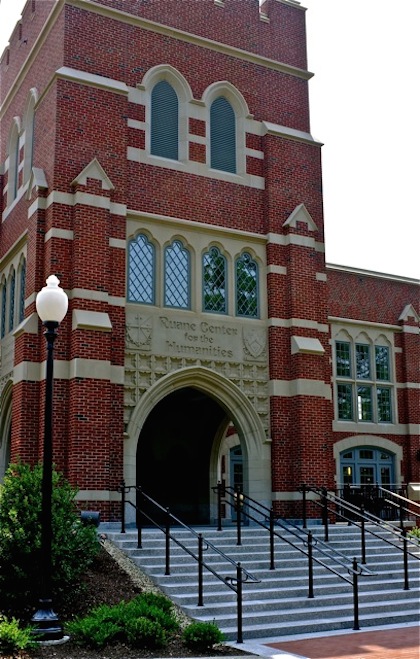
Commentary and photos by WILLIAM MORGAN "I feel to the depths of my being that this emblematic new building is not only a step for Providence College, but for our country," David McCullough declared  last October at the dedication of the Ruane Center for the Humanities at the 90-year-old Dominican school in the Rhode Island capital. Despite such noble sentiments from everyone's favorite historian and commencement speaker, the new home of P.C.'s Western Civilization program actually portends a journey into a Disney-fied architectural wilderness.


gothic1

The buttresses and arches of the Ruane Center entrance tower are not structural.


As a style, Collegiate Gothic created some memorable American campus architecture. Ruane Hall, however, falls leagues short of a credible re-creation of either the look or the spirit of Oxford and Cambridge that infused the Princetons, Yales, and Michigans at the turn of 20th Century. That Gilded Age offered architects thoroughly conversant with the past, backed up by skilled craftsmen. What we have today at Providence College is an uninspired piece of real estate wrapped with a thin veneer of brick and a few pointy details. This is the same sort of Potemkin village found in upscale shopping malls and themed suburban restaurants.


gothic2


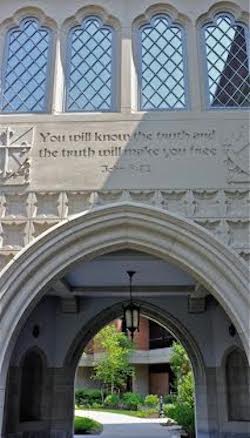
Biblical "truth" perhaps, but the Ruane Center's stage-set Gothic is something of a lie. There is no carving whatsoever, just stamped details.


The pasticheurs of this paper-thin storybook castle are the S/L/A/M Collaborative and the Boston firm of Sullivan Buckingham Architects. S/L/A/M is a large, multi-city firm that cranks out instant history for both private colleges and state universities ("Not what kind of building do you need, it's what kind of institution do you want to be").  Sullivan Buckingham, designers of the chapel and an art center at P.C., was founded to provide "traditional" institutional buildings. "Our buildings in various styles," the firm claims, "Classical, Romanesque, and Gothic, are not lifeless copies; they are historically correct." Yet, beyond the battlemented square tower, the classrooms and offices are depressingly yesteryear's high school. The aggressively bland interior is a far cry from the Rugby of Tom Brown's School Days.


gothic3


The classrooms in the Ruane Humanities Center are more bond-starved public high school than Gothic-inspired halls of learning.


In noting that the Ruane Center stands next to a "Brutalist" library, Sullivan Buckingham naively state that by employing brick and by matching the height of the library they were able to "achieve détente between the warring styles." The very term Brutalism is a bugbear to putative traditionalists, deployed as a weapon with which to excoriate a significant modern movement that they misunderstand. The neighboring Phillips Library–a superb example of Brutalism–is a 1969 work by Sasaki, Dawson and Demay. Long known simply as Sasaki Associates, the Watertown, Massachusetts firm was founded by Hideo Sasaki, one of the great modern landscape architects.


gothic4


Phillips Library by Sasaki, Dawson and Demay is similar to other bold buildings the firm did at the Universities of Rochester, Louisville and Virginia.


Brutalism is not to everyone's taste, but it deserves more respect than simply being dismissed because of an unfortunate label. This antidote to the slick glass and steel corporate style of the 1950s created some notable rugged concrete architecture, such as the Boston City Hall and the architecture school at Yale.

In seeking historical legitimacy by grasping at a very thin thread back to the Gothic cathedrals, the Dominican college ignores an exceptionally tectonic work. Sasaki's library is a not a decorated box, but a vigorous composition with the constructional logic of true Gothic. One can "read" the elements with which it was constructed, while the brick is honestly expressed here as a curtain wall supported by the reinforced concrete skeleton.

Instead of conjuring up a cheaply constructed faux medievalism, Providence College might recognize that it is the steward of an unsung masterpiece, worthy of contemporaries such Louis Kahn and Paul Rudolph. Thus the irony of the quote by the greatest American Gothicist, Ralph Adams Cram, with which Sullivan Buckingham open their website:

            A building must look like what it is, express visibly the energy that informs it, and declare its spiritual and intellectual lineage through its architectural vesture.

This is not a description of the flaccid Ruane Center, but it does fit the library.


gothic5


Although the interior of the Phillips Library has undergone a questionable decorative overlay of American craftsman detail, one can still experience the evocative raw concrete structural elements, such as these waffle coffers.

Read More
Commentary Robert Whitcomb Commentary Robert Whitcomb

Amanda Ufheil-Somers: Bombing I.S. will make matters worse


Once again, a U.S. president vows to eliminate an extremist militia in the Middle East to make the region, and Americans, safe.

And that means it’s time again for a reality check. Having failed in its bid to destroy the Taliban and al-Qaida in Afghanistan, the United States is still trying to dismantle both organizations. Over  13 years of war, that mission has spread to Syria, Iraq, Yemen, Somalia, Libya, Mali and West Africa, as militant groups on two continents have adopted the al-Qaida brand.

Contrary to normal logic, the White House wants everyone to see this failure as a badge of expertise. As President Obama vowed in an interview on Meet the Press, fighting the Islamic State forces “is something we know how to do,” mainly because we’ve been battling similar groups “for five, six, seven years.”

Years of air strikes, drone-operated killings and covert operations have brought neither peace nor safety to the region and its people. Estimates of the death toll from U.S. attacks in Pakistan, Yemen, and Somalia alone range from 3,100 to 5,400, including 570-1,200 civilians. Precise figures are impossible to obtain since the strikes remain classified, and investigating drone attacks is difficult and dangerous work.

Nor has the drone campaign halted the proliferation of groups seeking to link their — usually local — agendas to the idea of a global struggle represented by al-Qaida. Indiscriminate killing — and the constant fear of death from above — has only destroyed communities and provided easy recruitment material for extremist groups.

Obama promises that his plan to combat and destroy the Islamic State forces will also address the underlying political problems in Iraq and Syria. Such claims are tenuous, at best. What’s far more certain is that all military campaigns have unintended consequences, some of which don’t appear for many years afterward.

The Islamic State itself is largely a product of the U.S. invasion and occupation of Iraq. Dismantling the Iraqi state and rebuilding it along sectarian lines produced an authoritarian government dominated by Shiite Islamists who ignored minority grievances and often suppressed dissent with bullets. The result? An entrenched civil war with no end in sight.

Although U.S. media coverage of the violence in Iraq subsided following the withdrawal of combat troops, sectarian attacks against civilians have continued. Car bombs, street assaults, and kidnappings have transformed Baghdad into a city segregated by sect. Large parts of the country, including the Sunni majority areas in the west and north, feel abandoned by the central government.

These political tensions are the reason why the Islamic State has found some support in the areas it has taken over. Bombing Islamic State targets — especially where they are embedded in communities and liable to cause civilian casualties — carries no promise of changing this dynamic for the better. It’s more likely to change it for the worse.

The Islamic State is indeed a danger to the people of the region and to efforts to resolve the political conflicts in Iraq and Syria. Yet the past decade has shown, again and again, that American firepower doesn’t solve these problems. Even if Washington manages to help destroy this al-Qaida spinoff, the grievances that give rise to groups like it can’t be bombed out of existence.

The campaign formerly called “the War on Terror” has only proven to perpetuate both war and terror. No amount of rebranding or wishful thinking will change that reality this time around.

Amanda Ufheil-Somers is the assistant editor of Middle East Report, published by the Middle East Research and Information Project. MERIP.org. This is distributed via OtherWords.org.


Read More
Commentary Robert Whitcomb Commentary Robert Whitcomb

Wind wins on Block Island

With surprisingly little fanfare, except in the glorious Block Island Times,  what   would be  the first offshore wind farm in America has received its final major  regulatory approval, from the Army Corps of Engineers. It's on schedule to be  up and running in two years. The Block Island Wind Farm --  Deepwater Wind's five-turbine , 30-megawatt operation  --  would lower Block Island's sky-high electricity costs and  would act as an encouragement for  backers of other, much bigger projects, such as the Cape Wind project, in Nantucket Sound. That project has been held up for years by Osterville, Mass., summer resident and fossil-fuel mogul Bill Koch.

How difficult it has become to do big projects in America, especially when a few local rich people don't like them!


Read More
Commentary Robert Whitcomb Commentary Robert Whitcomb

Too much force and then too little

American voters, responding  in part to what they saw as George W. Bush's and John McCain's excessively muscular foreign policies,  decided to elect  and then re-elect Barack Obama their president. Now they seem him as excessively passive, too slow to act and too easily suckered by  the machinations of such tyrants as Vladimir Putin. Thus the electorate displays the mass of  shifting confusions that make up each individual.

Read More
Commentary Robert Whitcomb Commentary Robert Whitcomb

The Scots: Reality or romance?

For Scotland to secede from the United Kingdom would be the triumph of romance over political and economic reality. Scotland is a windy, wet and cold place. The weather will feel a lot worse if they spin themselves off.  They think they'll be able to build a bigger, better welfare state on the proceeds of North Sea oil and gas. But that stuff will run out.

And why stop there? ''Freedom'' for Wales, the Isle of Man and Cornwall! Liberate the  whole Celtic periphery! Detach Brittany from France and Galicia from Spain, too! (The Irish Republic is quite all right.)

Vladimir Putin must be happy at the prospect of these little regions in Western Europe splitting off and thus inevitably weakening the Western Alliance.

I'm a quarter Scottish ancestry myself (McKay and Simpson among the family names). There were some productive people in the crowd, including the physician James Young Simpson, but also a large quota of  crazies and alcoholics  (or, to be more precise, crazies self-medicating with booze ).

They used to recite Robert Burns ad nauseam, though I always liked his line, translated from the weird Scottish dialect:

"Oh would some power the gift give us, To see ourselves as others see us.''


-- Robert Whitcomb


Et Vive le Quebec libre!

Read More
Commentary Robert Whitcomb Commentary Robert Whitcomb

Nicole Schepker: Educating N.E.'s next manufacturers

This comes courtesy of the New England Board of Higher Education (nebhe.org)

BOSTON

Manufacturing typically conjures images of dimly lit dirty and dangerous factories crowded with workers, the kind seen in photos of New York City’s garment district in the early 1900s and in some developing countries today. But because of advances in technology, the field of manufacturing—what we make, how we make it, where and by whom—is rapidly changing. As access to technologies continues to pervade our world, the opportunity for everyone and anyone to become a “maker,” inventor, hobbyist or entrepreneur is greatly increased, changing the definition and perception of what it means to be a manufacturer.

Maker Spaces, Fabrication Labs, Hacker Spaces and Tech Shops have been popping up throughout the states and across the globe for several years, democratizing technology, education, art and design with tools such as computer aided design (CAD) software and 3D printers. The buzz has grown so loud around making that the president got involved. Last month, President Obama hosted the first-ever White House Maker Faire celebrating makers, tinkerers, inventors and entrepreneurs, declaring June 18 a National Day of Making. With science, technology, engineering and math (STEM), critical thinking and problem-solving abilities high on the president’s list of skills that must be attained by American youth to succeed in the 21st Century global economy, it is easy to see why Obama would embrace the Maker Movement, which promotes entrepreneurship, creativity, exploration, innovation, failure (yes, it’s OK to fail!), teamwork and self-directed learning.

“Alongside our partners, my administration is getting tens of thousands of young people involved in making,” wrote Obama in a presidential proclamation declaring a National Day of Making. “We are supporting an apprenticeship program for modern manufacturing and encouraging startups to build their products here at home.”

U.S. manufacturing is viewed as crucial to innovation, productivity, jobs, the economy, exports and national security. Obama has championed the manufacturing and “advanced manufacturing” sectors as viable, rewarding career paths for Americans, launching a plan to create a network of up to 15 regional Institutes for Manufacturing Innovation (IMIs) as part of a National Network for Manufacturing Innovation (NNMI).

For New England—a historical manufacturing hub that lost 60% percent of its manufacturing jobs over the past three decades—the return of American manufacturing along with the demand for advanced manufacturing solutions is a critical growth opportunity for the region, according to James Brett, president and CEO of the New England Council (NEC).

The region is not alone. A 2011 report conducted by the Manufacturing Institute and Deloitte Consulting indicated that 600,000 manufacturing jobs had gone unfilled nationwide, while 80 percent  of manufacturers interviewed for the report anticipated an increase in vacancies in senior-level staffing due to the  retirement of Baby Boomers.

NEC reports that despite the decline in manufacturing jobs across New England, Vermont, New Hampshire and Connecticut now boast manufacturing concentrations, or clusters, far exceeding the national average. And with the region’s strengths in education and research, Brett posits that New England is well-poised for resurgence in the sector, and particularly in advanced manufacturing, which has been defined as “manufacturing that entails rapid transfer of science and technology into manufacturing products and processes.”

A poll by Northeastern University as part of the report the Innovation Imperative: Enhancing the Talent Pipeline, released in April 2014, found that the vast majority of C-Suite executives surveyed believe that colleges and universities should expand opportunities for experiential learning (97 percent) and teaching about entrepreneurship (89 percent). Faced with industry’s concerns that college graduates are ill-prepared to enter the workforce, many institutions of higher education are embracing industry partnerships, while companies view investing in education as a direct action they can take to prepare future employees.

To this end, the New England Board of Higher Education  (nebhe.org) has been forging industry-education connections for over a decade. Through its Professional and Curriculum Development program, NEBHE has partnered with industry since 2006 to develop problem based learning (PBL) curricula with companies in optics and photonics, sustainable technologies, and advanced manufacturing. NEBHE’s Problem Based Learning (PBL) Projects, funded by the National Science Foundation’s Advanced Technological Education program, turn real-world problems that partner companies actually faced into multimedia case studies called "Challenges” used in secondary and postsecondary STEM courses across the U.S. The PBL Projects conduct professional development workshops with groups of high school and college STEM faculty, teaching teachers how to implement PBL in the classroom. Access to the PBL Projects’ Challenges is free and open-sourced.

Students of PBL become active participants in their own learning as they encounter new and unfamiliar learning situations where problem parameters are ill-defined and ambiguous—just like in the real world. When using the PBL approach, learning occurs collaboratively in small groups, problems are presented before any formal preparation has occurred (the problem itself drives the learning) and new information is acquired via self-directed learning. Research shows that compared with traditional lecture-based instruction, PBL improves student understanding and retention of ideas; critical thinking and problem-solving skills; motivation and learning engagement; the ability to work in teams; and the ability to transfer skills and knowledge to new situations.

NEBHE'S  Advanced Manufacturing Problem Based Learning (AM PBL) project focuses on New England’s advanced manufacturing sector, and has partnered with companies to develop Challenges in advanced quality systems, medical devices, nanotechnology, semiconductors and sheet-metal fabrication.

“Problem based learning is such an important aspect of career development and skill development, and it’s not something that is fully utilized in classroom settings,” said Kelli-Marie Vallieres, president and CEO of Sound Manufacturing, in Old Saybrook, Conn., an AM PBL Challenge partner on a sheet-metal fabrication problem.

“Students don’t always understand the practical aspects of what they’re learning—like how important the math is connected to what they are actually going to do in the workforce,” said Vallieres. “Without problem based learning, that disconnect continues, and it impedes the interest that some people have to move into certain careers.”

If we are to pursue a national mantra that says we must graduate global citizens and 21st Century learners, then educators need to graduate to a style of 21st Century teaching, leaving behind our one-size fits all, sage-on-the-stage approaches. In an age when students can access any information they choose from the palm of their hand, teachers are becoming valued more as mentors and guides than absolute fountains of knowledge.


The amount of knowledge available coupled with greater accessibility to information makes it even more imperative that educators connect what students are being taught in the classroom to the real world. This is exactly the reason that problem based learning is successful. Not only do students drive their own learning, they are exposed to new concepts, careers and real-world applications while gaining the skills needed to become lifelong learners who can succeed in a variety of fields.

“One challenge we have, as a growing technology company in a really high-growth industry, is hiring,” said Jamie Beard, counsel and director of operations for FastCAP Systems, a Boston-based AM PBL partner with whom the project developed a Challenge around manufacturing high-powered batteries using nanotechnology. “We can hire associate degrees, we can hire master’s degrees, undergraduate degrees, PhDs. We can use all of those types of people, but the one thing that they need to have is a broad science, technology, and engineering background and a good foundation of math.” She praised the program for getting kids “excited about science, technology, engineering and math,” noting those skills will underlie “the jobs of the future.”

Heather Dunn, senior director of special programs at CIRTEC Medical Devices, another AM PBL Challenge partner, echoed the sentiment: “From CIRTEC’s perspective, because we need good quality, technical personnel, anything that we can contribute to science education, and particularly local science and engineering education, is valuable to us.”

The project developed an AM PBL Challenge with CIRTEC in East Longmeadow, Mass., on dramatically increasing production of a power pack used in a lifesaving implantable medical device.

To see more of what Kelli, Jamie, Heather and other AM PBL Challenge partners had to say about the value of industry-education partnerships, visit the PBL Projects Gallery.

The Challenges developed with NEBHE’s industry partners were first used with participating educators at the AM PBL project’s weeklong professional development Institute at Boston University’s Photonics Center. Thirty-three STEM educators and teacher education faculty members from each of the six New England states were selected through a competitive process to participate in the Institute. More than half participate with a partner at a secondary or postsecondary institution to promote pathways to higher education and careers in STEM for their students.

Of course, NEBHE is not the only institution working directly with advanced manufacturers. The Connecticut College of Technology’s Regional Center for Advanced Manufacturing develops and provides resources to educators and students interested in learning new technologies in manufacturing. New Hampshire’s Advanced Manufacturing Partnerships in Education (AMPed) is also an example of a statewide program developing curriculum and training to prepare students to enter the growing advanced manufacturing sector. In Massachusetts, the online resource AMP it up! informs students, parents, guidance counselors and other stakeholders about the state’s burgeoning advanced manufacturing sector and the jobs available to graduates. Support for these kinds of direct connections  between education and industry will lead to an increase in STEM, critical thinking and problem-solving skills, and students’ pursuit of STEM careers.

Ultimately, no one knows the current and future needs of industry better than industry members themselves, making it imperative that advanced manufacturers and other STEM professionals continue to work with educators to develop curriculum, provide guidance and opportunities for students and teachers that will make STEM education relevant, while preparing students to succeed in the ever-changing workplace of tomorrow and today.

Nicole Schepker is project coordinator for the PBL Projects.

Read More
Commentary Robert Whitcomb Commentary Robert Whitcomb

Buddy's expensive entertainment

Those residents of Providence who long for a return to City Hall  of the circus barker Vincent ("Buddy'') Cianci might do well to remember his huge giveaways to public unions, which drove up taxes and sent the city to the edge of bankruptcy. They might also ruminate on the fact this felon's return to office  would discourage companies (and their jobs) from coming to Providence and  would probably drive out some of the jobs already here. Public corruption scares businesspeople, even corrupt businesspeople.

Would   four years of amusing tough-guy wisecracks be worth it?


-- Robert Whitcomb

Read More
Commentary Robert Whitcomb Commentary Robert Whitcomb

Chris Powell: In Conn., the real family problem

  VERNON, Conn.

Contriving their daily dose of campaign hysteria, leading Connecticut Democrats gathered at the state Capitol the other day to denounce the Republican nominee for governor, Tom Foley, for accepting the endorsement of the Connecticut Family Institute. 

"Candidate Foley gives few details but now we know the company he's keeping," state Sen. Beth Bye, D-West Hartford, said. 

State Comptroller Kevin Lembo added, "The endorsement of the Family Institute is or should be the kiss of political death in this state. It is outside of who we are as a people." 

Bye and Lembo are liberals and a few decades ago liberals denounced such attacks as "guilt by association." But that was when liberals were the ones guilty of associating. Foley is hardly a conservative -- Bye condemned him not just for accepting the Family Institute's endorsement but also for having few positions at all -- but his election would change the locks on the candy store Democrats have made of state government. So Foley must be demonized. 

The Democrats' problem with the Family Institute is that it opposes same-sex marriage. That is, they argue that the Family Institute should be disqualified from politics and decent society forever for taking today the same position that the country's two leading Democrats, President Obama and former Secretary of State Hillary Clinton, themselves took until a few years ago. But somehow Obama and Clinton have been forgiven. They were never going to change the locks on the candy store. 

The Family Institute says it endorsed Foley not because of his position on homosexuality and same-sex marriage -- those things don't seem to have ever bothered him and he is striving not to give offense even to those who deserve it. Rather, the institute got Foley to say he opposes legalizing assisted suicide, which the institute believes could lead to the euthanasia or murder of the disabled. 

Assisted suicide is not among Connecticut's big political issues, though if the Democratic state administration is re-elected those who work in the private sector  will  have less reason to go on living, or at least to go on living  here. 
 
But then homosexuality isn't a big issue for Connecticut either. The state decriminalized it decades ago, hadn'tprosecuted it for decades before that, and was among the first states to authorize same-sex "civil unions" and then same-sex marriage itself. 

The state long has been and remains overwhelmingly indifferent to such entirely personal matters even as homosexuals here continue to clamor as if they are somehow oppressed, since such clamor wins them political deference as a recognized special interest. As the old joke notes, what was, in the last century, "the love that dares not speak its name" cannot, in this one, shut up. 
 
The problem with the Family Institute's obsession with homosexuality is not that it has any chance of impairing anyone's rights but that it distracts from Connecticut's real family problem, which is also the state's biggest problem -- the decline of the family itself. This isn't the doing of homosexuals but of  heterosexuals,  who increasingly have children outside marriage and raise them neglectfully in fatherless homes, a catastrophically destructive phenomenon made possible mainly by the welfare system. 

The welfare system's destruction of the family is responsible for most of Connecticut's education, crime, drug, mental health and child-abuse problems  and for many of its physical illness problems. The human, financial and governmental costs are incalculable. 

But the Family Institute has little to say about this and the Democrats, so sensitive to any lack of enthusiasm for homosexuality, have nothing  to say about it, since their party, the party of government, sustains itself only by increasing dependence on government. 

Unlike the Family Institute, the Democrats are politically relevant, so their silence on the bigger issue is a far bigger threat. 

Chris Powell is managing editor of the Journal Inquirer in Manchester, Conn.
Read More
Commentary Robert Whitcomb Commentary Robert Whitcomb

Falling

sept WPA poster from 1940.


Sept. 14, 2014

A clear and cool, almost cold, morning, reminding us of how late in the year we are. Lots of late-summer flowers blooming brightly, so that it almost looks like spring, until you notice the browning leaves falling from some of the trees.   As I walk the dog, I crunch the acorns covering the sidewalks.

Read More
Commentary Robert Whitcomb Commentary Robert Whitcomb

Llewellyn King: The Hawks' Levenson and 'racial insensitivity'

By Llewellyn King Bruce Levenson, the embattled principal owner of the Atlanta Hawks, is that anomaly in business: a nice guy who has come in first. I have known Levenson since the 1970s, and have marveled at his acumen and how he and his publishing partners built their hugely successful publishing company, United Communications Group (UCG), into the Goliath of the newsletter publishers.

I published business newsletters for 33 years in Washington and was in awe of Levenson’s achievements. His capacity to understand markets and foresee trends put him way in front. UCG, for example, embraced computers when old-line news people like myself were wary of them.

As UCG grew, we, the other independent publishers, were humbled by its success. Yet we always talked of Levenson as a “sweet guy.”

He was also a philanthropist. We, his competitors, with our little businesses, were bowled over when UCG -- in the beginning of what I assume continued to be Levenson’s charity -- donated $300,000, as I recall, to a cause for African-American youth in Washington, D.C. I don’t believe any of us could have mustered a tenth of that then mighty sum. It spoke volumes about Levenson’s business success, but also about his concern for African-American youth. Later, as owner of the Hawks, he served on the advisory board of the Hoop Dreams Scholarship Fund, which provided more than 900 D.C. students with college scholarships.

When I read about Levenson’s “racially insensitive” internal memorandum, I wondered if his accusers -- that rump of the politically correct who wait to take umbrage at anything that might be construed as a racial slur – knew anything about the man and his works. They are those who would have us believe that careless words betray vile hearts, for which they must receive humiliating public opprobrium.

This comes at a time when the police shooting of an unarmed young black man in Ferguson, Mo., has led to a fresh call from people like Peniel Joseph, professor of history at Tufts University, for a new dialogue on race. But there will be no real dialogue on race while some of the participants are afraid of being branded “racist” if their speech drifts from the true north of political correctness.

This is tragic, as the changes in the work place make it harder and harder for African-American youth to find meaningful employment and when conditions in the schools, in housing, and in medical care for the African-American community are lamentable. Their plight is visible and moving to anyone who takes a bus or subway in any major city.

There should be a wake-up call for all of those with a concern with social welfare and justice from what has happened in Rotherham, in northern England, where systematic sexual abuse and gang rape of young, at-risk white girls, largely living in public-housing estates, was institutionalized by gangs of Pakistani men. Yet the social services and the police were reluctant to pursue complaints because, according to the official investigation, they were afraid of being called “racist.” A gargantuan 1,400 incidents are being investigated: the price of racial rectitude has been high.

It seems to me that Levenson’s memorandum, which dealt with the economic impact of a lack of white support for the Hawks, was the kind of memorandum we might have written in the publishing business -- like how could we attract more universities to subscribe, or why there weren’t enough law firms buying a particular title.

That doesn't mean that Atlanta doesn't have a severe racial divide and, as Levenson’s memo inadvertently points out, that the African-American community there is disproportionately impoverished.

Race and marketing are entwined, that's why there is a Black Entertainment Network and why certain liquors are marketed more to one race than another. At one level, professional sports is all about marketing.

Within a few days of Levenson’s purchase of the Hawks, I had occasion to meet with him, and he was boyishly enthusiastic. Particularly, he was happy because he was assured that the team would let him on the court during practice. He wanted, more than anything money could buy, to shoot hoops with the pros -- most of whom, of course, are African-American.

Llewellyn King is executive producer and host of “White House Chronicle” on PBS. His e-mail is lking@kingpublishing.com.

Read More
Commentary Robert Whitcomb Commentary Robert Whitcomb

Carbon tax, Putin and the Islamic State

President Obama and many other people in the West would like to think that Vladimir Putin is basically a reasonable guy. By “would like to think,’’ I mean that they fear him and so their default is appeasement. Welcome to Czechoslovakia, 1938. Some in the West even lauded the “cease-fire’’ in eastern Ukraine engineered by the Russian dictator that left in place  his occupation there, not to mention the seizure of Crimea. And  the Russian-led violence continues in eastern Ukraine. But Putin is a relentless liar and schemer driven by a thirst for power for its own sake and a longing for the Soviet Empire.

The West has failed so far to send weapons to the Ukrainians so that they can properly defend themselves from the Russian invasion. And there’s little sign that European defense budgets will be rising  substantially anytime soon to counter Putin, who can be summed up in his obscene remarks that that the collapse of “Soviet Union was the greatest geopolitical catastrophe of the 20th Century.’’ The Soviet regime killed many millions of Soviet subjects. But then, former KGB man Putin did very well under the Soviets. He also knows, as gangsters tend to know, how to manipulate his foes.

For example, he’s peddled, with some success, the lie that most Ukrainians in the Russian-invaded part of that sovereign nation want to be part of Putin’s regime.

The economic sanctions so far imposed by the West are mostly a joke to the likes of Putin and his entourage. If they cause some distress among the Russian population, who cares? Putin’s entourage will be okay.

Then there’s the Islamic State. It’s good to see that President Obama is finally trying hard to get other nations to join us in destroying it, but it will be difficult because of our Western allies’ disinclination to unduly exert themselves in military matters — the thing that counts most when it comes to the perverts staffing this “caliphate.” (As for such U.S. “allies’’ as Qatar, Kuwait and Saudi Arabia — they are deeply corrupt dictatorships some of whose people have helped finance and otherwise create the likes of the Islamic State and al-Qaida.)

For the longer term, we must defang the Middle East and the Putin regime by weaning ourselves and the world off the oil and gas that pay for their barbarism. One way would be a carbon tax to get people off fossil fuel in the United States, and thus reduce demand for it worldwide.  And, for the immediate future, we can do what Thomas Friedman of The New York Times suggested — “lift our self-imposed ban on U.S. oil exports’’ to lower the world price of a commodity that disproportionately benefits dictators.

We might make fun of those Renaissance paintings in which little devils skitter around. We don’t like to accept that there’s something like evil in the world. But you look at something like the Islamic State and the Putin regime and you realize that those people in 1500 were on to something.

 --- Robert Whitcomb

Read More
Commentary Robert Whitcomb Commentary Robert Whitcomb

Tripartite march of the thugs

While the U.S.  focuses on confronting the perverts of the Islamic State, the fascist dictatorship in Russia continues to try to eat away at adjacent states and the other big fascist dictatorship, China, continues its attempt to take over the entire South China Sea. Their  neighbors waver between appeasement and something a bit braver as the thuggery gets worse.

Francis Fukuyama's idea in the '90s of the inevitable triumph of liberal democracy seems more frayed than usual this year.


Read More
Commentary Robert Whitcomb Commentary Robert Whitcomb

Carolyn Morwick: Mass. session boosts transport, higher ed

This is one of a series of reviews of  2014 New England legislative sessions by Carolyn Morwick, writing for the New England Board of Higher Education (nebhe.org).


In 2013, Massachusetts Gov. Deval Patrick was often at loggerheads with legislators on big-ticket items, including education funding and transportation. In 2014, the atmosphere was more cordial. Just prior to the close of the 2013-14 legislative session, lawmakers sent a $36.5 billion  fiscal 2015 budget to the governor.

The governor and legislators agreed on a spending plan with no new taxes, despite a limited revenue stream. They generally agreed to make investments in the state’s transportation system, restore cuts to the higher education system and reform the system that pays for human services providers.

Patrick vetoed $16 million in line items, all but one of which legislators overrode. The governor also asked lawmakers for authority to make unilateral spending cuts if necessary. But lawmakers would not go beyond the current “9C powers” that allow a governor to make cuts in the budget without the approval of the Legislature if it’s determined that state revenues are not sufficient to support spending in the budget that's been approved.

Included in the 2015 budget:

  • a $34 million increase in early education and care programs, much of it targeting Income Eligible Child Care, which has a substantial wait lists for families
  • $1 million for the K-1 Classroom Grant program that will fund new pre-K classrooms with an emphasis on "Gateway Cities"
  • a 2.7% increase in funding for K-12 with total funding for K-12 at $155 million (still nearly $75 million below pre-recession levels)
  • a 2.3% increase in Chapter 70 education aid to cities and towns or approximately $99 million
  • a $70 million increase for public higher education
  • $4.7 billion for MassHealth Managed Care
  • $3.2 billion for MassHealth Senior Care
  • $88 million for children’s mental health services
  • $436 million for adult mental health services—a 4% increase over FY14
  • $184 million for mental health facilities—a 5% increase over FY14
  • $112 million for substance abuse and addiction services
  • an increase of $125 million over FY14 for the state’s transportation system
  • an increase of $3.6 million for library programs (even with the increase, funding for libraries fell by 46% because of $3 billion in tax cuts dating back to FY 2001
  • a provision for a Tax Amnesty Program expected to raise $35 million
  • a delay in implementing the FAS 109, a special deduction included in legislation to lower the corporate tax which was enacted in 2013. The delay postpones the loss of nearly $46 million in corporate income tax revenue.
  • an increase in salary for the state’s 11 district attorneys from $148,843 to $171, 561.

Higher Education                                                                       

The FY15 budget continues reinvestment for a third year in the public higher education system. Spending for higher education is approximately $70 million above FY14, but still 21% below the FY 2001 level.

The total amount for public higher education for FY15, is $998 million including $519 million for the five campuses of the University of Massachusetts, almost $230 million for the nine state universities and $249 million for the 15 Community Colleges.

For the second year in a row, funding in the budget for UMass will allow for freezing tuition and fees. However, the same 50/50 formula designed to split the cost between state appropriations and student tuitions was not applied to the state universities and community colleges, where officials warn that student bills will go up by several hundred dollars.

The State Scholarship Program got a $3 million increase in the FY15 budget, while the High Demand Scholarship program to encourage degree completion in disciplines that are deemed to be critical shortage was level-funded at $1 million.

The budget also funds the STEM Starter Academy at $4.7 million for community colleges, $3.2 million for the Performance Management Set Aside Incentive Grant Program to allow the Department of Higher Education to continue with grants to promote operational efficiencies at community colleges, the state universities and UMass in meeting the goals of the Vision Project.

The budget establishes a Foundation Budget Review Commission to review the state’s methodology for determining school district foundation budgets. The current foundation budget was designed more than 20 years ago and is out-of-date. The budget calls for the new commission to conduct four public hearings in different parts of the state and report back to the Legislature by June 30, 2015.

Other Legislation Passed

The Legislature continued to increase funding for the state transportation system and capital improvements on the  Massachusetts Bay Transportation Authority and Regional Transit Authorities, while working to end the practice of borrowing money to pay for the MBTA.

Near the close of the session, legislation was passed which strengthened gun laws. The new law gives police chiefs the authority to turn down a resident’s request to purchase a rifle or shotgun if they have reason to believe the person may be a danger. It also makes Massachusetts part of the National Instant Background Check System to provide a rapid response about whether a person is suitable to possess a license for a gun. Another provision of the new law requires that data be collected on all guns used in crimes or that cause injuries.

In response to the Supreme Court overturning the Massachusetts “buffer zone” law for access to reproductive health clinics—and at the urging of Atty.  Gen.  Martha Coakley—lawmakers passed legislation giving public safety officials the power to clear access to the clinics. The prior law provided a 35-foot buffer zone, which the court rejected; the new law restricts protesters to 25 feet.

An Act Establishing the Childhood Vaccine Program

Creates a stable financing framework enabling Massachusetts to guarantee that all children up to age 18 receive all the vaccines recommended by the national Advisory Committee on Immunization Practices. The legislation will allow access to all recommended vaccines for children and fund the Massachusetts Immunization Registry, which assists providers in keeping immunizations up-to-date.

An Act Restoring the Minimum Wage and Providing Unemployment Insurance Reforms

Gradually raises the minimum wage to $11 over three years, lowers unemployment insurance (UI) costs for employers across the state, strengthens safety protections for workers and makes permanent the multi-agency task force charged with combating the underground economy where tens of thousands of workers, many of them undocumented, are paid under the table, thereby avoiding payment of taxes.

An Act Establishing a Domestic Workers Bill of Rights

Extends basic work standards and labor protections to approximately 67,000 nannies, housekeepers, caregivers and other home workers in the Commonwealth.

An Act to Promote Economic Growth in the Commonwealth of Massachusetts

Provides for increased job growth and economic stability by investing in advanced manufacturing, IT workforce training and “Big Data” innovation. It will provide $15 million for a Gateway Cities Transformative Development Fund for economic revitalization and $10 million is slated for the reuse of brownfields in economically distressed areas. The legislation creates an advisory council to boost the financial services industry in Massachusetts.

An Act Relative to the Broadband Institute

Allows the Massachusetts Broadband Institute to use a $50 million bond for expanding broadband infrastructure.

An Act Relative to the Expansion of the Boston Convention and Exhibition Center

Approves borrowing $1.1 billion to accommodate a 1.3 million square foot addition to the center, which would allow Boston to be host to larger conventions.

An Act to Foster Economic Independence

Provides a pathway for low-income families to become self-sufficient, especially those who are receiving “cash assistance.” The pathway will include job readiness, the development of life skills and English-as-a-second language. Over $15 million in aggregate funding improvements to the Department of Transitional Assistance for additional caseworkers and the Department of Higher Education for program evaluations and scholarships. Additional legislation introduces a “full employment program” and more effectively identifies welfare fraud as part of a companion bill.

Carolyn Morwick handles government and community relations at the New England Board of Higher Education and is former director of the Caucus of New England State Legislatures.

Read More
Commentary Robert Whitcomb Commentary Robert Whitcomb

Llewellyn King: If only Nader had stayed at his post

Ralph Nader is to blame. It's that simple. I'm not talking about the election of 2000,  when his candidacy was enough to hand the presidency to George W. Bush and all that has followed. I’m talking about when Nader went AWOL as the nation’s consumer conscience.
In the space of a week, three U.S. flights have been diverted because of passenger disturbances over reclining seats. Would this have happened if Nader of old were on the case?
In the mid-1960s and early 1970s, Nader was the nation’s bulwark against corporate excess. He may have gotten it wrong -- as many have claimed -- about the safety of the Corvair, the rear-engine compact car, manufactured by the Chevrolet division of General Motors, that was to have rivaled the Volkswagen Beetle. No matter. Nader’s 1965 book, Unsafe at Any Speed, launched him as the consumer's knight in shining armor.
For nearly a decade, we felt that Nader was on our side and that such  big, faceless monsters as insurance companies, banks, airlines, consumer-credit outfits and appliance manufacturers could be brought to heal by invoking the one name that would strike fear, trembling and rectitude into the hearts of the titans of corporate America: Nader.
It was a halcyon time for those who wanted, like actor Peter Finch in the 1976 film Network, to shout, and be heard, “I'm mad as hell, and I'm not going to take this anymore!”
Nader was a figure of mythical omnipotence. You didn’t have to take your troubles with a faulty car or broken contract to Nader, you simply had to threaten; the words “cc Ralph Nader” at the bottom of a letter were enough. Corporations quaked, the earth moved, and restitution was forthcoming.
We delighted in learning little details about Nader the aesthete, who lived in one room somewhere in Washington, had no creature comforts, partners, or trappings, but always wore a suit. People happily believed he slept in it, ready to rush to court to slay a dragon of corporate excess.
Journalists loved Nader. We learned that he kept a secret office in the venerable National Press Building in Washington and would sneak up to the National Press Club on the 13th floor to peruse the press releases, which were then displayed near the elevators. One presumed he was looking for evidence of consumer abuse in false corporate claims.
The Vietnam War was raging, and the nation was divided on every issue except the wonder of the man who was called “consumer advocate.” The nation had never had one before and we loved it.
Oh, yes, love is not too strong a word. We went to bed at night knowing that if the mattress wasn't what had been promised by the Divine Mattress Company, Nader would fix it.
Jimmy Carter promised that when he was elected president, he would have a direct telephone line to St. Nader. That was the zenith of Nader’s consumer-advocacy power.
But Nader and his acolytes, known as Nader’s Raiders, had already begun to pursue broader political aims and to embrace the extreme reaches of the environmental movement. Nader, our beloved consumer advocate, saintly and virtuous, was becoming a partisan -- a partisan of the left.
It was an extreme blow for those who had followed along behind Nader’s standard because we believed that he was the unsullied, virtuous supporter of the individual against the institution. The voice that could be heard when, as often, politics had failed.
Over the years, I had battles with Nader. We argued most especially over nuclear power and a raft of related energy issues. I and the late physicist Ralph Lapp, together with the great mathematician Hans Bethe, put together a group of 24 Nobel laureates to support nuclear. Nader assembled 36 Nobel laureates against, and won the argument on numbers. He has always been a tough customer.
Poor Ralph. He had it all – and so did we -- when he fought for the common man against the common enemy: those who stole our money or shortchanged us.
Deep in my heart, I think he is to blame for high bank fees, pay-day loans, tiny aircraft seats, high Amtrak fares, and that corporations won’t speak to us – they have machines do that. Ralph, it could have been so different if you had just stayed at your post.
 
Llewellyn King is executive producer and host of "White House Chronicle" on PBS. His e-mail is lking@kingpublishing.com.


Read More