A_map_of_New_England,_being_the_first_that_ever_was_here_cut_..._places_(2675732378).jpg

Vox clamantis in deserto

Commentary Robert Whitcomb Commentary Robert Whitcomb

Sarah Anderson: Leaf blowers' assault on our health

Leaf blower

When new neighbors moved in next door, I didn’t hold off long before broaching the Big Question.Even though we live in Washington, D.C., this had nothing to do with politics. For me, neighborly harmony hinges on where folks stand on this divide: leaf blower vs. rake.You see, I’m one of those otherwise calm individuals who goes totally bonkers at the sound of a leaf blower. It would be different if this infernal racket served some useful purpose. When I go to the dentist, the drill doesn’t make my blood boil. I accept that without it, my teeth would rot.When a leaf blower cranks up, I can find no logical justification for my suffering. In a recent article for AlterNet, former Consumer Reports editor Cliff Weathers presents a frightening litany of their multiple hazards.

“Leaf blowers don’t just blow away leaves and lawn clippings,” Weathers wrote. “Their 180- to 200-mph air output blasts away topsoil, microbial life forms, animal waste, allergic fungi, spores, herbicides, pesticides, and even heavy metals such as arsenic, mercury, and lead.”

That’s gross and scary, but the worst part is what these gizmos do to your health. “This toxic cocktail of engine emissions and dust particulates can exacerbate allergies and asthma in children and adults, and aggravate acute pulmonary disorders,” Weathers explained.

The American Lung Association says we should all steer clear of gasoline-powered blowers, the most popular type. So why are they still in use?

For decades now, manufacturers and many landscaping companies have worked to block anti-leaf-blower efforts. A favorite tactic: Make it seem like opponents are all extremely rich, and possibly even racist. With low-income Latinos making up a large share of landscaping workers, these are sensitive charges.

It’s true that  rich white enclaves were among the first to ban blowers. In California, Carmel and Beverly Hills made the move back in the 1970s. But in most of the country, the higher-income set continues to drive demand for these dangerous beasts.

Industry lobbyists downplay the risks while claiming that regulations will lead to higher costs and fewer jobs. But good old non-motorized tools are cheaper than leaf blowers and, according to several tests, nearly as fast.

In his AlterNet article, Weathers cites a competition the Los Angeles Department of Power and Water organized that pitted a grandmother with a rake and broom against a professional landscaper with a leaf blower. Granny gave him a run for his money.

Detailed analysis of the employment impacts of blower bans is hard to find and enforcement is tough. But it’s clear that in California, where about 20 cities, including Los Angeles, have banned blowers, the landscaping industry has hardly collapsed.

About 103,000 Californians are employed in this industry, and landscapers make up a larger share of the workforce there than in other big states like Texas, New York, and Illinois. California’s median wage in this business is $13.75 per hour, more than 20 percent higher than the median in Florida and Texas.

Nationwide, the areas with the highest concentration of landscaping and groundskeeping jobs include some of the hoity-toitiest holiday and retirement spots. No. 1: Nantucket Island and Martha’s Vineyard, where the Obama family vacationed this year.

If a critical mass of these communities banned leaf blowers, it would transform the landscaping industry away from reliance on machines that are senselessly endangering health and welfare — especially for the workers who operate them.

In response to my Big Question, our new neighbors laughed and assured me I didn’t need to worry about which side they were on. This was a relief. But in a city that restricts leaf-blower hours but hasn’t banned them, I’m still dreading the fall season.

As in past years, I’ll probably hear three or four machines blasting within a few blocks of my yard, while I — quietly raking — try to maintain my sanity.

Sarah Anderson directs the Global Economy Project at the Institute for Policy Studies.    This originated at OtherWords.org.

Read More
art, Commentary Robert Whitcomb art, Commentary Robert Whitcomb

Tiny temples of responsibility

Commentary and  photos (below, after text) by WILLIAM MORGAN Though there were once  ubiquitous on city streets the country,  a Gamewell fire-alarm box is more likely these days to be seen on eBay (where they bring up to $500). This decaying beauty on the corner of Batty and Fountain streets, in Providence's Federal Hill neighborhood, fits right into its somewhat tatty surroundings (although the new North Bakery just behind sells a tasty Dan Dan meat pie).


John Gamewell was not the inventor of the telegraphic fire-alarm system, but his Gamewell Fire Alarm Telegraphic Company (founded in 1879) cornered the market, putting its distinctive red boxes on street corners everywhere. Common enough to be ignored,  this survivor still shows that Gamewell's warning- system boxes were jewels of classical design.

In the pediment of Gamewell's little temples of civic responsibility is a symbolic fist, representing modern man's ability to harness telegraphic energy .


firebox1


firebox2


firebox3


Read More
Commentary Robert Whitcomb Commentary Robert Whitcomb

Then there's the South China Sea...

  Most of Americans'   recent interest, such as they have it, in foreign affairs has been focused on the Islamic State, Russia's invasion and seizure of large parts of Ukraine and the Ebola epidemic.


But meanwhile, they hardly notice another big story -- China's attempt to gradually gain control of the whole South China Sea, with its hefty supplies of oil and natural gas and other resources. So I'm looking forward to hearing international geo-political risk analyst Anders Corr talk about the South China Sea at the monthly meeting of the Providence Committee on Foreign Relations tonight.


-- Robert Whitcomb

Read More
Commentary Robert Whitcomb Commentary Robert Whitcomb

David Warsh: The 'pie-giver' and the 'liberal' vs. 'realist' view of Russia

Perhaps the single most intriguing mystery of the Ukrainian crisis has to do with how the Foreign Service officer who served as deputy national security adviser to Vice President Dick Cheney for two years, starting on the eve of the invasion of Iraq, became the Obama administration’s point person on Russia in 2014. Victoria Nuland took office as assistant secretary of  state for European and Eurasian affairs a year ago this week.
It was Nuland who in February was secretly taped, probably by the Russians, saying “F--- the E.U.” for dragging its feet in supporting Ukrainian demonstrators seeking to displace its democratically elected pro-Russian president Viktor Yanukovych, two months after he rejected a trade agreement with the European Union in favor of one with Russia. She made a well-publicized trip to pass out food in the rebels’ encampment on Kiev’s Maidan Square in the days before Yanukovych fled to Moscow.
When Russian President Vladimir Putin said the other day, “Our Western partners, with the support of fairly radically inclined and nationalist-leaning groups, carried out a coup d'état [in Ukraine]. No matter what anyone says, we all understand what happened. There are no fools among us. We all saw the symbolic pies handed out on the Maidan,” Nuland is the pie-giver he had in mind.
Before she was nominated to her current job, Nuland was State Department spokesperson under Secretary Hillary Rodham Clinton during the congressional firestorm over the attack on the diplomatic post in Benghazi, Libya.
So how did the Obama administration manage to get her confirmed – on a voice vote with no debate?  The short answer is that she was stoutly defended by New York Times columnist David Brooks and warmly endorsed by two prominent Republican senators, Lindsey Graham, of South Carolina, and John McCain, of Arizona.
Clearly Nuland stands on one side of a major fault-line in the shifting, often-confusing tectonic plates of U.S. politics.
A good deal of light was shed on that divide by John Mearsheimer, of the University of Chicago, in an essay earlier this month in Foreign Affairs.  In “Why the Ukraine Crisis Is the West’s Fault,” Mearsheimer described the U.S.  ambitions to move Ukraine out of Russia’s orbit via expansion of the North Atlantic Treaty Organization as the taproot of the crisis.  Only after Yanukovych fled Ukraine did Putin move to annex the Crimean peninsula, with its longstanding Russian naval base.
Mearsheimer writes:
Putin’s actions should be easy to comprehend. A huge expanse of flat land that Napoleonic France, imperial Germany, and Nazi Germany all crossed to strike at Russia itself, Ukraine serves as a buffer state of enormous strategic importance to Russia. No Russian leader would tolerate a military alliance that was Moscow’s mortal enemy until recently moving into Ukraine. Nor would any Russian leader stand idly by while the West helped install a government there that was determined to integrate Ukraine into the West.
Washington may not like Moscow’s position, but it should understand the logic behind it. This is Geopolitics 101: great powers are always sensitive to potential threats near their home territory. After all, the United States does not tolerate distant great powers deploying military forces anywhere in the Western Hemisphere, much less on its borders. Imagine the outrage in Washington if China built an impressive military alliance and tried to include Canada and Mexico in it. Logic aside, Russian leaders have told their Western counterparts on many occasions that they consider NATO expansion into Georgia and Ukraine unacceptable, along with any effort to turn those countries against Russia -- a message that the 2008 Russian-Georgian war also made crystal clear.
Why does official Washington think any different? (It’s not just the Obama administration, but much of Congress as well.)  Mearsheimer delineates a “liberal” view of geopolitics that emerged at the end of the Cold War, as opposed to a more traditional “realist” stance.  He writes,
As the Cold War came to a close, Soviet leaders preferred that U.S. forces remain in Europe and NATO stay intact, an arrangement they thought would keep a reunified Germany pacified. But they and their Russian successors did not want NATO to grow any larger and assumed that Western diplomats understood their concerns. The Clinton administration evidently thought otherwise, and in the mid-1990s, it began pushing for NATO to expand.
The first round of NATO expansion took place in 1999, and brought the Czech Republic, Hungary and Poland into the treaty. A second round in 2004 incorporated Bulgaria, Estonia, Latvia, Lithuania, Romania, Slovakia and Slovenia.  None but the tiny Baltic Republics shared a border with Russia. But in 2008, in a meeting in Bucharest, the Bush administration proposed adding Georgia and Ukraine.  France and Germany demurred, but the communique in the end flatly declared, “These countries will become members of NATO.”  This time Putin issued a clear rejoinder – a five-day war in 2008 which short-circuited Georgia’s application (though Georgia apparently continues to hope).
The program of enlargement originated with key members of the Clinton  administration, according to Mearsheimer. He writes:
They believed that the end of the Cold War had fundamentally transformed international politics and that a new, post-national order had replaced the realist logic that used to govern Europe. The United States was not only the “indispensable nation,” as Secretary of State Madeleine Albright put it; it was also a benign hegemon and thus unlikely to be viewed as a threat in Moscow. The aim, in essence, was to make the entire continent look like Western Europe.
In contrast, the realists who opposed expansion did so in the belief that Russia had voluntarily joined the world trading system and was no longer much of a threat to European peace. A declining great power with an aging population and a one-dimensional economy did not, they felt, need to be contained.
 Mearsheimer writes:
And they feared that enlargement would only give Moscow an incentive to cause trouble in Eastern Europe. The U.S. diplomat George Kennan articulated this perspective in a 1998 interview, shortly after the U.S. Senate approved the first round of NATO expansion. “I think the Russians will gradually react quite adversely and it will affect their policies,” he said. “I think it is a tragic mistake. There was no reason for this whatsoever. No one was threatening anyone else.”
 
Policies devised in one administration have a way of hardening into boilerplate when embraced by the next. So thoroughly have liberals come to dominate discourse about European security that even the short war with Georgia has done little to bring realists back into the conversation. The February ouster of Yanukovych is either cited as the will of a sovereign people yearning to be free or, more frequently, simply ignored altogether.
  Mearsheimer writes:
 
The liberal worldview is now accepted dogma among U.S. officials. In March, for example, President Barack Obama delivered a speech about Ukraine in which he talked repeatedly about “the ideals” that motivate Western policy and how those ideals “have often been threatened by an older, more traditional view of power.” Secretary of State John Kerry’s response to the Crimea crisis reflected this same perspective: “You just don’t in the twenty-first century behave in nineteenth-century fashion by invading another country on completely trumped-up pretext.”
Nuland was present at the creation of the liberal view. She served for two years in the Moscow embassy, starting in 1991; by 1993 she was chief of staff to Deputy Secretary of State Strobe Talbott. She directed a study on NATO enlargement for the Council on Foreign Relations in 1996, and spent three more years at State as deputy director for Former Soviet Union Affairs.
After a couple of years  of Nuland being on the beach at the Council on Foreign Relations, President George W. Bush named her deputy ambassador to NATO, in 2001. She returned to Brussels in the top job after her service to Cheney. When Obama was elected, she cooled her heels as special envoy to the Talks on Conventional Forces in Europe for two years until Clinton elevated her to spokesperson. Secretary of State John Kerry promoted her last year.
It seems fair to say that Putin has trumped Obama at every turn in the maneuvering over Ukraine – including last week, when the Russian president concluded a truce with the humbled Ukrainian President Petro Poroshenko while leaders of the NATO nations fumed ineffectively at their biennial summit, this year in Wales. Never mind the Islamic State in Iraq and Syria; China; Israel. Even in Europe, the president’s foreign policy is in tatters.
Backing away from the liberal view is clearly going to be costly for some future presidential aspirant. The alternative is to maintain the expensive fiction of a new Cold War.
David Warsh is a longtime financial journalist and economic historian. He is proprietor of economicprincipals.com.

Read More
Commentary Robert Whitcomb Commentary Robert Whitcomb

Carolyn Morwick: New Hampshire makes healthcare progress

rake
This is one of a series on this year's New England legislative sessions written by Carolyn Morwick for the New England Board of Higher Education (nebhe.org). Our thanks to NEBHE.
Read More
art, Commentary Robert Whitcomb art, Commentary Robert Whitcomb

Lovely, dark and deep

birches "Birches,'' by RUSSELL DUPONT, in his show "A Sense of Place: Photographs by Russell duPont,'' at the James Library and Center for the Arts, Norwell, Mass., Sept. 5-Sept. 30.

Norwell is  a Boston suburb, a community with a strong sense of being on a river (the  marshy North River) and the burial site of John Cheever, who, although he spent most of his life in New York City and Westchester County, wrote hauntingly about the South Shore towns where he grew up and whose physical  beauty he cited.


I'd guess that many people readers remember this closing of Robert Frost poem "Birches'':


I'd like to go by climbing a birch tree,
And climb black branches up a snow-white trunk
Toward heaven, till the tree could bear no more,
But dipped its top and set me down again.
That would be good both going and coming back.
One could do worse than be a swinger of birches.
The photo above is beautiful  but also a bit ominous, as are many Frost poems.
Read his poem "Design''.


's


Read More
Commentary Robert Whitcomb Commentary Robert Whitcomb

Newspapers' publicly held problem

  I write as  someone who worked for several newspapers in a 43-year career in that business ,  as a finance editor at three  of them and whose generally Republican family was in the business world (no dreamy eyed professors or liberal social reformers in my upbringing).

There's been much incomplete reporting on the implosion of the newspaper business,  whose crisis  poses  grave threats to  the knowledge and  civic engagement of citizenry. Indeed, the general level of ignorance seems to rise every year commensurate with the  accelerating move of life onto the Internet.

The Internet has long  and glibly been cited as virtually the only reason for the sector's decline. But in fact, business reporters (they fear antagonizing their bosses) generally fail to note the huge and destructive  impact (to journalism anyway) of public ownership.

Most newspapers used to be closely held, often family held, enterprises. Their owners, of course, wanted to make a good profit, and in fact dominant newspapers in their areas generally made a very good profit.  Historically,   the best  metropolitan papers, with high journalistic ambitions, made about a 10-15 percent profit  margin -- more than the average of the margins of companies listed on the S&P 500 Index.  But the owners tended to want more than just money (unlike, mostly, now). They wanted influence and many even had altruistic aims -- improving their communities, etc.

But, accelerating in the '90s, came the sale of these companies at big prices to publicly held enterprises listed on stock exchanges.  Wall Street took over from  civic concerns. With the pressure to please the stock analysts, and enrich themselves,   senior execs (who also had a lot of stock in their companies) of the new owning companies pushed for ever-higher profit margins -- to astronomical levels of 30 percent or more.  Meanwhile, they had to worry about paying off the debt incurred to buy the newspaper companies.


So for years they did not reinvest in their properties, but rather laid off as many employees as they could, and made other cuts, to keep the profit margin (and thus capital gains, dividends and  senior execs' salaries) as high as possible.  The  emphasis was on meeting targets for the next quarter, and not building for the long term. Take the money and run.


As always in business, there were some notable exceptions to this money-only culture and I was fortunate to work for a couple of them. My last boss, for example, Howard Sutton, of The Providence Journal, spent innumerable hours (much of it anonymously) working for the betterment of his community.

Since a lot of these newspapers were well entrenched as virtual monopolies in their areas, this worked for a while -- until the papers were so hollowed out that their decline was probably irreversible (though the senior execs and  their pals on their boards  continued to pay themselves  gargantuan compensation for many years as  all this went on).

Indeed, the intensity of shareowners'/execs' thirst for huge and immediate payouts seems to swell every year. I am as greedy as the next fellow, and firmly  believe in capitalism and its creativity, but I've been astonished by the surge in senior executive pay since I worked in Lower Manhattan at The Wall Street Journal in the '70s.

Meanwhile, in the early and '90s, the execs made the catastrophic decision as the World Wide Web got rolling to put the journalism on papers' Web sites for free, thus encouraging many readers to cancel their paid subscriptions to the paper version (whence came and still comes most of the revenue). The magical thinking was that the new ad revenue   on their Web sites would make up for the loss of revenue from readers' subscriptions.

In fact, Web sites are generally lousy places for most  ads, especially display ads.  Those reading news media on screens,  unlike folks browsing through a newspaper, are generally irritated by ads. (The "X''  button  to close the ads gets intense use!)

There was no display-ad bonanza.  And the likes of Craig's List swiped the vast and easy money from classified ads. The Internet is great for classified ads.

And by offering all this information, collected by hardworking reporters and processed by hardworking editors, for free, the newspapers were in effect telling their readers what they thought the stuff was worth. Bad marketing!

The Internet has posed big challenges to newspapers, but that's only part of the story.  Meanwhile, those old-fashioned press lords of family own companies look good. They were in it for the money, but for other things, too.


-- Robert Whitcomb


Read More
Commentary Robert Whitcomb Commentary Robert Whitcomb

No light lifting

  I remain amazed at how many able-bodied people can't lift a rake for a few minutes every few weeks to clean leaves, etc., from their sidewalks and instead hire illegal-alien-staffed yard  crews to use leaf blowers instead.

Thus the din continues from dawn to dusk in many neighborhoods.


-- Robert Whitcomb

Read More
Commentary Robert Whitcomb Commentary Robert Whitcomb

Todd Larsen: Ditch Md. LNG unit and build wind farm

  WASHINGTON

Shortly before Congress left for its long summer vacation, Sen.  Barbara Mikulski tried to block a 150-megawatt wind farm.

The Maryland Democrat’s move would delay Pioneer Green Energy’s construction of the project in her own state until an independent study from  the Massachusetts Institute of Technology concerning the effects of wind turbines on naval radar testing at the Patuxent River Naval Base is completed.

While it’s understandable that Mikulski wouldn’t want anything to interfere with a major military installation, what makes her move inexplicable is that Pioneer Green Energy is already working with the base to ensure that its wind farm won’t disrupt the base’s radar, as required by law.

Technically, she’s seeking a delay via language inserted in a Department of Defense appropriations bill. But the postponement would potentially push the project’s timeline out past the qualifying deadline for tax credits. That could effectively end the project, no matter what the MIT study finds.

This is just one of many attempts to kill wind farms. Opponents have lodged about 50 lawsuits in this country and around the world against wind projects because they allegedly cause “wind turbine syndrome,” a discredited condition first described by a pediatrician in 2009. The alleged symptoms of the syndrome range from headaches to sleeplessness to forgetfulness. These symptoms haven’t held up in court: 48 of the 49 suits have been dismissed.

Wind power foes also object to clusters of turbines for aesthetic reasons and their potential to reduce property values. This concern doesn’t pass the sniff test either. An extensive Energy Department study found no “consistent, measurable, and significant effect on the selling prices of nearby homes.”

Other opponents fear that turbines will kill tons of birds. In reality, wind farms aren’t nearly as deadly to our feathered friends as office buildings and cats, just to name two major avian killers. And when was the last time you heard about someone trying to ban buildings and cats to save birds?

Even when the opposition to wind power fails — which it often does — the resistance hurts wind farm developers. It also sends a chilling message to an industry that lacks the deep pockets of fossil-fuel companies and lobbyists. And those oil, gas, and coal special interests are funding many of the attacks on wind and renewable energy in the first place.

What makes these assaults on wind particularly troubling is that the United States is rapidly moving forward with several projects that will ramp up domestic oil and gas production.

In fact, the United States is now on track to be the world’s top oil and natural-gas producer, and is a net oil exporter for the first time since 1995.

Much of this increased oil and gas output is being extracted through hydraulic fracturing, or “fracking.” And the toll of this method is becoming increasingly clear. From contaminated drinking water, to polluted air, to ruined infrastructure from endless trucks carting water, fracking is leaving its devastating mark on towns across the country.

Fracking, and fossil-fuel extraction in general, also contributes to boom-and-bust economies that siphon most economic benefits out of local communities, which are then left to deal with the resulting devastation on their own.

Maryland faces the same energy choices as the nation overall. While Mikulski’s legislative maneuvers may kill a major wind farm, Dominion Energy is working to build a $3.8 billion liquefied-natural-gas-export terminal on Maryland’s Eastern Shore called Cove Point. That facility would endanger local communities, increase pollution, and ramp up fracking in nearby states — potentially leading to fracking in Maryland itself — while boosting natural-gas prices in the U.S. market.

A Maryland judge recently ruled that zoning laws and the Maryland Constitution were violated in permitting Cove Point, which will slow the project. That gives the state and Cove Point’s Wall Street backers time to heed the concerns expressed by opponents of this dangerous facility.

Ideally, investors could shift the $3.8 billion going to Cove Point to wind power. That move would increase East Coast wind production by 50 percent, and create over 7,500 jobs. It would also serve as a model for the country in how to invest in a clean energy future.

Todd Larsen directs Green America’s (GreenAmerica.org) responsibility division.  This was distributed via OtherWords.org.

Addendum from Robert Whitcomb: People rarely think of the massive number of birds killed by air, water and soil pollution from fossil fuel.

Read More
Commentary Robert Whitcomb Commentary Robert Whitcomb

Chris Powell: That's so 'special needs'

MANCHESTER, Conn. 
When the Journal Inquirer reported the other day about the criminal sentencing 
of a "mildly retarded" rapist, representatives of groups serving the mentally 
retarded protested. The complaint was: "People don't use 'retarded' anymore." 

They likened it to the "N word" and the name of  Washington, D.C.'s football team, the Redskins. 
These comparisons were false, as the former was always an epithet, the latter 
always a way of evoking the supposed savagery of aboriginal people. 

But disparagement attached to "retarded" only recently. Indeed, until a few 
years ago Connecticut had the Department of Mental Retardation. What happened? 

Children began abusing the word with their peculiar cruelty. But more than that, 
society declined to enforce standards. Instead, those who behaved decently were 
told to change their terms. As usual government was the first to be intimidated 
by the special interest. 

Language evolves. Over the long term it belongs not just to the dictionary but 
to everyone who uses it. But capitulation to the slob culture is fairly resented 
and resisted. What is happening with "retarded" is only what long ago happened 
with "Jew." People heard "Jew" spoken with sneering contempt so often and were 
too meek to object that they began assuming the word itself to be disparaging. 
So now there are few Jews but lots of "Jewish people." 

The language police know perfectly well when disparagement is intended and when 
it is not, know perfectly well that a newspaper story about a rapist with mental 
retardation is different from the schoolgirl mocking a classmate as "retarded." 
But today's culture requires the decent people to change, not the miscreants. 

This has taken the country Through the Looking Glass, wherein Lewis Carroll's 
Humpty Dumpty berates Alice for doubting that words can be so flexible. 

 
"I don't know what you mean by 'glory,'" Alice said. 

Humpty Dumpty smiled contemptuously. "Of course you don't -- till I tell you. I 
meant 'there's a nice knock-down argument for you!'" 

"But 'glory' doesn't mean 'a nice knock-down argument,'" Alice objected. 

"When I use a word," Humpty Dumpty said, in rather a scornful tone, "it means 
just what I choose it to mean -- neither more nor less." 

"The question is," said Alice, "whether you can make words mean so many 
different things." 

"The question is," said Humpty Dumpty, "which is to be master --  that's all." 

Alice was too much puzzled to say anything, so after a minute Humpty Dumpty 
began again. "They've a temper, some of them -- particularly verbs, they're the 
proudest. Adjectives you can do anything with, but not verbs. However, I can 
manage the whole lot! Impenetrability! That's what I say!" 

If news organizations are to be accurate, credible, and understood, they must 
stick to descriptive reality and not be intimidated by political correctness, 
avoiding what is merely preferred by elites or euphemistic and vague, like the 
term coming into fashion for the retarded and others, "special needs," which, by 
design, conveys little and can mean anything. Old Hump would be very happy with 
that. 

And what do we do when the kids start sneering at each other, "That's so 
'special needs'"? 

There will always be cruelty. People should stand up against it, not capitulate 
to it at the expense of the language. 

The big problem for the retarded in Connecticut long has been the shortage of 
group homes for retarded people living with aging parents, who fear that upon 
their death there will be no familiar and comfortable home for their kids. Those 
who care about the retarded should worry more about that than about contriving 
euphemisms. 

Chris Powell is managing editor of the Journal Inquirer, in Manchester, Conn. 

Read More
art, Commentary Robert Whitcomb art, Commentary Robert Whitcomb

William Morgan: The Quaker Coast

  Photos (below) and commentary by WILLIAM MORGAN

It has been almost a decade since I published a book of photographs on the Cape Cod cottage. Since, then, I have been looking for another suitable topic.

My (more successful) photographer friends tell me no one is underwriting black and white photos taken with film. And my favorite publisher nixed the idea for a photographic study of what I call the Quaker Coast (the towns of Dartmouth and Westport in Massachusetts, and Little Compton, just over the border in Rhode Island), declaring  that there would be no market for such a book.

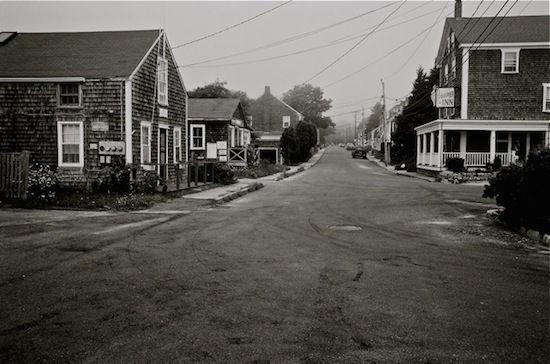
Yet there is something special – and not yet ruined – about those three towns. Fishing and agriculture still survive, if not actually thrive, there. And the mostly unspoiled landscape and the prevalence of a plain vernacular architecture, mostly wrapped in cedar shingles.

In lieu of the fantasy book, I offer the readers of New England Diary three images from the book proposal.


quaker2 quaker1

quaker3


Addendum: Much of Cape Cod, Martha's Vineyard and Nantucket were also Quaker. I went to a few family memorial services in the Quaker meeting house in West Falmouth, on the Cape.

Many whalers were of Quaker background -- but that didn't make them gentle at all. Rather, many were tough and rapacious.  Many became very successful capitalists whose investments spanned the world.

-- Robert Whitcomb


Read More
Commentary, oped Robert Whitcomb Commentary, oped Robert Whitcomb

Llewellyn King: In U.K.: Sex, booze, rock and Jihadism

  It is a simple question, but there are only fragments of an answer. The question is: Why do so many Muslims, born in Britain, turn to Jihadism?

The best numbers available show that more than 500 young, British-born Muslims have traveled to Syria to fight for the Islamic State. By comparison, an estimated 100 Americans have taken up arms for the Islamic State. As the population of the United States is 313 million, compared to 63 million for the whole of Britain, the disparity is huge.

The “the enemy within,” as the British media call these young people, has deeply disturbed the British public, as it looks to its political leaders to take action. One writer, in The Daily Telegraph, says that the government has been soft when it should have been tough, and tough when it should have been soft.

The truth is that successive British administrations have been silent on the consequences of immigration since the second Churchill government, in 1951-55. Everyone is to blame and no one is to blame.

Britain never saw a large influx of immigrants after the Norman Conquest, in 1066. In fact, it had become quite proud of its tolerance for émigrés; Karl Marx was the exemplar. The Jews were tolerated after the 1650s, but excluded from many occupations and social circles.

Past and present Britain is made up of enclaves remarkably uninterested in each other. Hence, a small island nation can support 53 distinct, regional accents and dialects.

Idealists believed that post-World War II immigration would change Britain for the better, sweeping away its imperial trappings. Actually if anything eroded the class structure, it was the great wave of pop music and fashion in the 1960s.

Surveys show that of the immigrants from the  Indian Subcontinent, the Indians, mostly Hindu, assimilated best and took to business -- and the class system -- with alacrity, many becoming millionaires. The Muslims, primarily from Pakistan, have fared the worst. They assimilated least and imported practices that are a savage affront to British values: forced and under-age marriages, honor killings, and halal butchers, opposed by many British animal-rights groups.

These same values have made life rough for young men of Pakistani descent. For working-class British youth, sex, booze, music and soccer are their safety valves. Sexual frustration is endemic all over the Muslim world; it is at work among devout, young Muslim men in Britain, where sex is celebrated in the culture.

British business had a role in the mix of immigrants in the 1960s. Businesses wanted workers for the textile mills and factories in northern England, who would do the dirty, poorly paid work nobody else wanted. The proprietor of large tire-retreading company boasted to me in 1961 how he had solved the labor problem by recruiting rural Pakistanis, who worked hard and cheaply and kept to themselves. His words have echoed with me down through the years.

This alone does not explain why, for example, a preponderance of the Jihadists are from London, or why some of them seem to be university types from the London School of Economics, King's College London, the School for Oriental and African Studies, and others. If you are young, male and Muslim, and even somewhat religious, it is easy to be convinced that you live among the infidels with their alcohol and preoccupation with coitus.

But, again, it is not explanation enough; not an explanation of why a generation of British-born young men are attracted to the life and values of their distant ancestors, or why they have shown such savagery.

Britain has comforted itself by dealing with self-identified “community leaders” in the Muslim community. Unfortunately the real leaders have been fiery, foreign-born imams who proselytize hatred in the mosques that serve Britain’s 2 million Muslims. The Muslim communities have been hidden in plain sight from the British mainstream.

Llewellyn King (lking@kingpublishing.com) is executive producer and host of "White House Chronicle," on PBS, and a long time international journalist, publisher and business consultant.


Read More
Commentary Robert Whitcomb Commentary Robert Whitcomb

Too far out for Uber

Estes


 "Water Taxi, Mount Desert'' (oil on canvas), by RICHARD ESTES, in the show "Richard Estes' Realism,'' through Sept. 7 at the Portland Museum of Art.

Collection of the Kemper Museum of Contemporary Art, Kansas City, Missouri, Bebe and Crosby Kemper Collection. Gift of the Enid and Crosby Kemper Foundation, 2002.13. © Richard Estes, courtesy Marlborough Gallery, New York)

Read More
Commentary Robert Whitcomb Commentary Robert Whitcomb

Using coastal water exchange for power

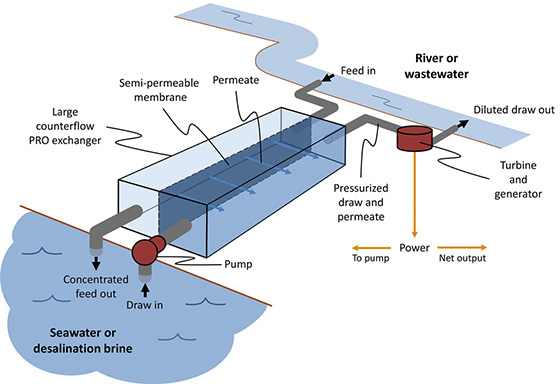
  PowerPoint Presentation


From ecoRI  news staff. Thank you.

Graphic by Leonardo Banchik/Elsevier B.V.

CAMBRIDGE


Where the river meets the sea, there is the potential to harness a significant amount of renewable energy, according to a team of mechanical engineers at MIT.

The researchers evaluated an emerging method of power generation called pressure retarded osmosis (PRO), in which two streams of different salinity are mixed to produce energy. In principle, a PRO system would take in river water and seawater on either side of a semi-permeable membrane. Through osmosis, water from the less-salty stream would cross the membrane to a prepressurized saltier side, creating a flow that can be sent through a turbine to recover power.

The MIT team has developed a model to evaluate the performance and optimal dimensions of large PRO systems. In general, the researchers found that the larger a system’s membrane, the more power can be produced, but only up to a point. Interestingly, 95 percent of a system’s maximum power output can be generated using only half or less of the maximum membrane area.

Leonardo Banchik, a graduate student in MIT’s Department of Mechanical Engineering, said reducing the size of the membrane needed to generate power would, in turn, lower much of the upfront cost of building a PRO plant.

“People have been trying to figure out whether these systems would be viable at the intersection between the river and the sea,” he said. “You can save money if you identify the membrane area beyond which there are rapidly diminishing returns.”

Banchik and his colleagues have also been able to estimate the maximum amount of power produced, given the salt concentrations of two streams. The greater the ratio of salinities, the more power can be generated. For example, they found that a mix of brine, a byproduct of desalination, and treated wastewater can produce twice as much power as a combination of seawater and river water.

Based on his calculations, Banchik said a PRO system could potentially power a coastal wastewater treatment plant by taking in seawater and combining it with treated wastewater to produce renewable energy.

“Here in Boston Harbor, at the Deer Island wastewater treatment plant, where wastewater meets the sea … PRO could theoretically supply all of the power required for treatment,” Banchik said.

He and John Lienhard, professor of water and food at MIT, along with Mostafa Sharqawy of King Fahd University of Petroleum and Minerals, in Saudi Arabia, report their results in the Journal of Membrane Science.

The team based its model on a simplified PRO system in which a large semi-permeable membrane divides a long rectangular tank. One side of the tank takes in pressurized seawater, while the other side takes in river water or wastewater. Through osmosis, the membrane lets through water, but not salt. As a result, fresh water is drawn through the membrane to balance the saltier side.

“Nature wants to find an equilibrium between these two streams,” Banchik said.

As fresh water enters the saltier side, it becomes pressurized while increasing the flow rate of the stream on the salty side of the membrane. This pressurized mixture exits the tank, and a turbine recovers energy from this flow.

Banchik said that while others have modeled the power potential of PRO systems, these models are mostly valid for laboratory-scale systems that incorporate “coupon-sized” membranes. Such models assume that the salinity and flow of incoming streams is constant along a membrane. Given such stable conditions, these models predict a linear relationship: the bigger the membrane, the more power generated.

But in flowing through a system as large as a power plant, Banchik said the streams’ salinity and flux will naturally change. To account for this variability, he and his colleagues developed a model based on an analogy with heat exchangers.

“Just as the radiator in your car exchanges heat between the air and a coolant, this system exchanges mass, or water, across a membrane,” Banchik said. “There’s a method in literature used for sizing heat exchangers, and we borrowed from that idea.”

The researchers came up with a model with which they could analyze a wide range of values for membrane size, permeability and flow rate. With this model, they observed a nonlinear relationship between power and membrane size for large systems. Instead, as the area of a membrane increases, the power generated increases to a point, after which it gradually levels off. While a system may be able to produce the maximum amount of power at a certain membrane size, it could also produce 95 percent of the power with a membrane half as large.

Still, if PRO systems were to supply power to Boston’s Deer Island treatment plant, the size of a plant’s membrane would be substantial — at least 2.5 million square meters, which Banchik noted is the membrane area of the largest operating reverse osmosis plant in the world.

“Even though this seems like a lot, clever people are figuring out how to pack a lot of membrane into a small volume,” Banchik said. “For example, some configurations are spiral-wound, with flat sheets rolled up like paper towels around a central tube. It’s still an active area of research to figure out what the modules would look like.

“Say we’re in a place that could really use desalinated water, like California, which is going through a terrible drought. They’re building a desalination plant that would sit right at the sea, which would take in seawater and give Californians water to drink. It would also produce a saltier brine, which you could mix with wastewater to produce power. More research needs to be done to see whether it can be economically viable, but the science is sound.”

Read More
Commentary Robert Whitcomb Commentary Robert Whitcomb

Labor Day morning

dew Photo from Dreamstime


Sept. 1, 2014:


A sticky morning that  reminds  me more of July than September. Very quiet, as people sleep in for the holiday, storing up energy for the frantic fall of  school, work, life in general.  Some early leaf-fall. Gardens looking dry, and ugly weeds proliferate. Hordes of squirrels  scurrying around for acorns. Automatic sprinkler systems watering the sidewalks.

It seems very American to celebrate Labor Day as part of a summer weekend rather than as a statement of working-class solidarity, as with May Day (May 1) in the rest of the world. But America is indeed increasingly a class-divided society.

I thought about   the outbreak of World War II and, as many people do, of this poem by W.H. Auden.


September 1, 1939


I sit in one of the dives On Fifty-second Street Uncertain and afraid As the clever hopes expire Of a low dishonest decade: Waves of anger and fear Circulate over the bright And darkened lands of the earth, Obsessing our private lives; The unmentionable odour of death Offends the September night.

Accurate scholarship can Unearth the whole offence From Luther until now That has driven a culture mad, Find what occurred at Linz, What huge imago made A psychopathic god: I and the public know What all schoolchildren learn, Those to whom evil is done Do evil in return.

Exiled Thucydides knew All that a speech can say About Democracy, And what dictators do, The elderly rubbish they talk To an apathetic grave; Analysed all in his book, The enlightenment driven away, The habit-forming pain, Mismanagement and grief: We must suffer them all again.

Into this neutral air Where blind skyscrapers use Their full height to proclaim The strength of Collective Man, Each language pours its vain Competitive excuse: But who can live for long In an euphoric dream; Out of the mirror they stare, Imperialism's face And the international wrong.

Faces along the bar Cling to their average day: The lights must never go out, The music must always play, All the conventions conspire To make this fort assume The furniture of home; Lest we should see where we are, Lost in a haunted wood, Children afraid of the night Who have never been happy or good.

The windiest militant trash Important Persons shout Is not so crude as our wish: What mad Nijinsky wrote About Diaghilev Is true of the normal heart; For the error bred in the bone Of each woman and each man Craves what it cannot have, Not universal love But to be loved alone.

From the conservative dark Into the ethical life The dense commuters come, Repeating their morning vow; 'I will be true to the wife, I'll concentrate more on my work,' And helpless governors wake To resume their compulsory game: Who can release them now, Who can reach the dead, Who can speak for the dumb?

All I have is a voice To undo the folded lie, The romantic lie in the brain Of the sensual man-in-the-street And the lie of Authority Whose buildings grope the sky: There is no such thing as the State And no one exists alone; Hunger allows no choice To the citizen or the police; We must love one another or die.

Defenseless under the night Our world in stupor lies; Yet, dotted everywhere, Ironic points of light Flash out wherever the Just Exchange their messages: May I, composed like them Of Eros and of dust, Beleaguered by the same Negation and despair, Show an affirming flame.


And some people, especially of a certain age, may remember the haunting old man's song, by Kurt Weill and Maxwell Anderson, "September Song,'' whose lyrics include:


"Oh, it's a long, long while from May to December "But the days grow short when you reach September "When the autumn weather turns the leaves to flame "One hasn't got time for the waiting game''


"September Song''  was written in  1938. Many sad songs were written in the late '30s, as the world, long in the Great Depression, moved toward another gigantic war.  One was "Thanks for the Memory,'' which is funny and melancholic at the same time. It became Bob Hope's theme song.


The lyrics include:


"We said goodbye with a highball Then I got as 'high' as a steeple But we were intelligent people No tears, no fuss, Hooray! For us''


 -- Robert Whitcomb


“There is no man, however wise, who has not at some period of his youth said things, or lived a life, the memory of which is unpleasant to him that he would gladly expunge it. And yet he ought not entirely regret it, because he cannot be certain that he has indeed become a wise man–so far as it is possible for any of us to be wise–unless he has passed through all the fatuous or unwholesome incarnations by which that ultimate stage must be preceded….We do not receive wisdom, we must discover it for ourselves, after a journey through the wilderness wich no one else can make for us, which no one can spare us, for our wisdom is the point of view from which we come at last to regard the world. ''


-- Marcel Proust


Read More
Commentary Robert Whitcomb Commentary Robert Whitcomb

Robert Scott: Market Basket battle as a Ancient Greek epic play

  NEWPORT, N.H.

A Market Basket movie!? Not as far-fetched as you would think. This is an epic Greek tale. If Aristophanes or Aeschylus were alive, they would be penning a play based on it called monopolion (monopoly). It has all the  elements of a compelling story.

Arthur T. Demoulas, the protagonist, and  the once and future CEO of the supermarket chain, embodies all the values and virtues of the hero or "The Great Man'' that Aristotle wrote about . He has  integrity, humility, kindness and generosity.


He's also a brilliant strategist, a truly inspiring and effective strategos (general) who had not only the loyalty of the stratou (army -- his employees) but their unfading love.  Such love for a leader is a rare thing in 2014 American society.

Yet ATD’s leadership model is not of our mainstream culture but a hybrid creation of Greek-American culture. ATD’s unwavering adherence to the high-minded standards of our grandparents and parents make this amazingly successful and wealthy man in 2014 America; a true “rock star”.  All I can think is how proud they are of him as they look down from above…. Well done, Anthanasios Telemachus.

His cousin Arthur D. Demoulas,  the antagonist, is a figure that seems cast  out of some ancient Greek epic in the image of ploutokrat pelonexia -- one driven to seek power and wealth above all.

Such a figure is reviled in American society but these ancient playwrights made comic sport of them,  Surrounding ASD is the ploutokratia, his elite Ivy League stratou, whose members believe that their education, wealth and privilege  entitle them to dominate the polis (average citizen).

The stage for the epic is set as these two diametrically opposite forces clash to have mono polein (sole control) of this most valuable entity. ASD’s stratou fires the first shot and sacks ATD and his  management team. The ATD stratou erupts and with their massive numerical advantage bring operations to a dead halt. Then they appeal to their customers to come and support them.


What is truly miraculous is that the customers  supported their neighbors, and ATD’s stratou is now not 25,000 but 2  million strong. Xerxes, the Persian emperor, watched in horror as the underestimated Athenian fleet cleaned his clock!

The playwrights would go to town mocking the hubris of elite lawyers, Wall Street bankers and Global 100 Executives in their luxurious air-conditioned offices while calling for the blessings of the gods upon the virtuous employees and customers protesting/ standing tall in the heat of the midday sun. As each side parried and thrust for six long weeks, the fate of millions  hung in the balance. Who will have mono polein? The ASD stratou of  greed or  the ATD stratou , which seeks to preserve the advantages of their beloved Market Basket.

The amount of the lutoros ( ransom) is agreed on and the painful details of the deal are forged against the backdrop of still more  nasty dialogue and hatred in the family,  as the playwrights examine the many foibles and hypocrisies of the elite.

Virtue prevails and the strategos ATD rises like a protathlitis (the champion leader) while the chorus on both side of the stage proclaim .. "nike, nike, nike''  (victory). There is no doubt in my mind that an epic struggle like this would have a play written about it to memorialize the lessons that it teaches us. It would be a way of instructing  our children and grandchildren about this golden moment  when the privilege of the few was destroyed by the unity of the many.

Is that what Gen.  John Stark meant when he said, “Live or Die” as we rejected  the privilege of monarchs and empowered the citizens of New Hampshire? No doubt in his youth he read Aristophanes and those  desires for dignity and freedom found their source.

So, yes,  I’m all in favor for a Market Basket movie. Who would play ATD?. Ah,  Nicolas Cage.

Robert Scott  is a psychologist,  consultant, writer,  Republican Party activist and former  New Hampshire state representative.  He  lives in Newport, N.H.


Read More