



A_map_of_New_England,_being_the_first_that_ever_was_here_cut_..._places_(2675732378).jpg

Vox clamantis in deserto

Commentary Robert Whitcomb Commentary Robert Whitcomb

Charles Pinning: Lessons from the Old Portagee

A couple of times each summer, the family station wagon transported us an hour or so, from Newport across the Mount Hope Bridge, through Bristol and Warren to the capital city of Providence. By Rhode Island standards, we had traveled halfway around the world.

These odysseys were generated by a visit to my Aunt Teresa in the Fox Point section, a woman with numerous ailments, none of which affected her ability to talk. I was left in the company of a pudgy, desultory cousin with greasy hair who crammed himself into a couch and stared at the TV. Nobody minded if I wandered the neighborhood by myself.

There was a drugstore I would head off to, to buy comic books or a James Bond paperback. Maybe wax lips, if they had them. On the way, I passed a cracked cement driveway shaded by trellised grape leaves. This trellis was made of the same kind of pipe that formed the top rail of the chain-link fencing that ran alongside the driveway and in front of the green, asbestos-shingled house.

In the shade of the grape leaves sat an old man in a low aluminum lawn chair with nylon webbing. He wore a beat-up straw hat and suspect trousers. At his feet to one side of the chair was a hibachi grill with sausage and peppers roasting. On the other side of the chair a radio was broadcasting the Red Sox game.

Seeing me staring, he said, “You want some chourico?”

Because he pronounced this Portuguese word for sausage in the same earthy way as my Azorean mother, I accepted. He speared me a piece  that  I plucked off the prongs of the long fork.

“Good, eh?” he said, watching me chew.

It was delicious, better than my mother made.

“It’s the coals,” he said. “Here, have another.”

He smiled at me. His teeth were good for an old man.

A young woman with a dark tan walked by. She smiled and waved and the old man nodded and tugged the brim of his hat.

“You don’t want your wife to look like leather,” he said, following her with his eyes. “That’s what she will look like one day. Look and feel like leather. You don’t want that.”

Later, in my Aunt Teresa’s kitchen, I asked my parents: “Can people turn into leather?”

“Why would you say that?” asked my father, and I told him about the man in the driveway.

“Oh,” said my Aunt Teresa. “He’s been talking to the Old Portagee. Never mind him; he just sits there all day.”

I didn’t think that was so bad. I spent many hours in the summer on my bed reading. What was the difference, really?

On subsequent trips over the years, I always stopped by to visit the Old Portagee.

“I only wear Brooks Brothers shirts,” he told me. “They wear like iron!” and he pulled at the sleeve of his faded blue shirt, basket-woven with white, the button-down collar frayed. “This one I’ve had more than 40 years!”

In addition to the chourico on his hibachi, the Old Portagee always had homemade wine to offer. Sometimes young women in the neighborhood would stop by, and he would pour them a glass or two. Rarely, I noticed, did men of any age stop by to talk to the Old Portagee.

“Men,” he said, “are lions. When they meet another lion, they know to keep their distance. If a man has a woman, a beautiful woman, then the other lions only come around for the woman, no matter what they say.”

“Do you have a woman?” I asked him.

“Once,” he said, pulling on the sleeve of his shirt. “Once the Old Portagee had the woman of all women,” and he looked up at the grape leaves shading us, and the plump red grapes ripening.

His wine was the best I’d ever tasted and he told me that he would give me the recipe before he passed.

He reached down to yank a dandelion that flourished in a crack in the cement but stopped. He caressed the yellow flower with his thumb.

“Remember,” he said, “You don’t have to go far to learn what you need to know. Just far enough.”

“And what else?” I asked.

“What else? Nothing ever changes. All change is false change.”

“But that doesn’t make any sense!” I exclaimed.

“If you say so,” smiled the Old Portagee. “But you might want to think about it.”

One night, deep in summer, the Old Portagee and I were sitting in his driveway drinking wine, blending into the evening shadows and eating fava beans out of the pod.

“Remember to keep the women happy,” he said. “Either do not let them into your life, or keep them happy. There is no middle road.”

He pulled a black and white photograph with crinkle-cut edges out of his Brooks Brothers shirt. It was a woman sitting sidesaddle on a horse. She was attired in the garb of the 1930s.

“Who is she?” I asked.

“A woman of Providence,” grinned the Old Portagee. “We’ll be riding together again soon.”

Shortly after I graduated from college, I received a hand-addressed envelope in the mail, the penmanship elegant and cursive. Inside was a folded piece of paper with the Old Portagee’s wine recipe. Beneath it was written: “The Right Woman, The Right Wine, The Right Chourico. T.O.P.”

Charles Pinning, an essayist, is the author of the Rhode Island-based novel “Irreplaceable.”
Read More
Commentary Robert Whitcomb Commentary Robert Whitcomb

Robert Whitcomb: Ignore 'inverson'; marina people; Tughill Plateau

Corporate “inversion’’ involves a previously U.S.-based company merging with a foreign one, reincorporating abroad and, by so doing, taking advantage of foreign corporate income-tax rates generally lower than ours. Many public companies are not paying anywhere near the 35 percent federal corporate income-tax rate because of assorted tax breaks; some companies pay no income tax because of loopholes. Still, all in all, our corporate rate is not competitive with our major foreign competitors’.

Some have called companies using inversion “unpatriotic.’’ I disagree. The senior executives and members of the boards of directors making these decisions are legally maximizing their and the company’s wealth in a partly capitalist system that, for all its faults, fuels innovation and prosperity for the entire country — over the long haul. Most individual taxpayers also try to optimize their tax situation.

And, as I have long argued, the corporate income tax is stupid, except for the lobbyists it enriches. It encourages maneuvers such as inversions. It sends jobs abroad. It supports a lobbying system in Washington that spawns corruption and makes the world’s most complicated tax system ever more complex and inefficient as corporations seek tax breaks from elected officials.

Anyway, in the end companies’ customers, employees and shareholders pay the corporate income tax. Companies just pass along the cost.

We need to end the corporate tax and enact a value-added (consumption-based) tax. We should also put personal earned income and capital gains on a more equal tax basis and maintain substantial estate taxes. The aim should be to help streamline and detoxify our tax system, encourage economic growth and at least mildly mitigate the growth of a permanent plutocracy based on inheritance.


* * *

Automation and information technology are now rapidly wiping out well-paying jobs. They’ve long been wiping out low-paying ones. Indeed, those automatic store checkout machines are starting to make inroads into one of the last few fallbacks for those with only a high-school education.

The line is that somehow the economy, blessed by ever-increasing productivity, will create a whole new wave of well-paying jobs to replace the ones killed. We’re still waiting.

Even upper-middle-class jobs are in peril. Consider lawyers, much of whose routine work can be done through computers and low-paid (by our standards) people, in, say, India. And medical equipment, nurse practitioners and ever-better prescription drugs will undermine physicians’ affluence.

Then there’s finance. Many college undergraduates, especially at elite institutions, career plan as if Wall Street were the only sure way to fortune. But they may be guessing wrong. Just because finance was the big thing in the last three decades doesn’t mean that it will be in the next 20. Many young people could find their Wall Street jobs as redundant as many jobs in manufacturing became in the ’70s. We tend to fight the last war.

Some futurists suggest plausibly that such service jobs as plumbers, electricians, gardeners and maids, along with home health-care and social workers and other counselors, may have the best chance of survival. In some fields, even the middle class will still demand personal service.

To reduce social disorder, will the government eventually establish a minimum income for those millions who truly can’t find work?


* * *

I just visited the gorgeous Thousand Islands, on the St. Lawrence River. We cruised for parts of two days in our host’s powerboat, which he keeps in a roofed marina in Clayton, N.Y., another one of those small Northeast towns whose downtowns seem to be regaining a bit of their old energy as big-box stores lose some allure to an aging population.

The vast majority of boats remained in their slips, rather than being taken out on the river, on a beautiful summer weekend. This can be explained in part by fuel costs but more, I think, by the marina’s social role. Most of these boat owners, whose age generally ranges from 50 to 80, primarily see the marina as their summer colony, with the boats (most with sleeping space for from two to eight people) as their summer bungalows.

During the short North Country season, they relentlessly schmooze with their neighbors and derive some meaning from endless boat maintenance. They live in a cozy waterborne village. What most of these people would not have liked back home — living cheek-by-jowl — they thrive in for a few weeks every summer.


* * *

We drove home through upstate New York’s Tughill Plateau, which has hundreds of wind turbines. The white wind turbines and the vivid green of the countryside, with its view of the Adirondacks, create a spectacular, if a bit eerie, landscape. Most of the farms are far better kept up than I remembered from years before — because of the fees paid to them by the utilities. A very green cash crop and no cash paid to the Mideast!


Robert Whitcomb (rwhitcomb51@gmail.com) oversees New England Diary. He is also a senior adviser and partner at Cambridge Management Group (www.cmg625.com), a health-care consultancy,  a former finance editor of the International Herald Tribune, a former editor at The Wall Street Journal, a former  editorial-page editor and vice president at The Providence Journal and  currently a Fellow of the Pell Center for International Relations and Public Policy.

Read More
Commentary Robert Whitcomb Commentary Robert Whitcomb

Hail and farewell, Howard Sutton

Kudos to my old boss, Howard Sutton, who is about to retire from  The Providence Journal, where he has been publisher for 15 years. He remained a quietly forceful and congenial leader of one of America's oldest journalist organizations while dealing with the   industry's vast competitive challenges  from the Internet and the move from private- and family -run newspaper companies to publicly held ones demanding much higher profit margins than before.

His good humor, unflappability and focus on the essentials of news coverage made him close to the perfect publisher for these tough times.


-- Robert Whitcomb


Read More
Commentary Robert Whitcomb Commentary Robert Whitcomb

Deeper into the mystery

  It's surprising that even as you grow older,  your eyesight dims and hearing fades ,   your excitement about the mystery,  beauty and terror of life can increase.

Read More
Commentary Robert Whitcomb Commentary Robert Whitcomb

Chris Powell: Videotape cops at work all the time

(Apologies for the format problem on  this)

MANCHESTER, Coon.

On the whole, police officers are far more sinned against than sinning, but 
that's why they're police officers, the ones with the badges and guns, the ones 
supposed to be the good guys. But it's a difficult job and indications are 
growing that many officers are not fit for it. 

Those indications -- largely the result of the new ubiquity of security and 
mobile-phone video cameras -- are getting scary. 

Several such indications have arisen from the recent rioting and demonstrations 
in Ferguson, Mo., where a white officer shot a young and unarmed black man. 

Of course, many people have rushed to judgment about the shooting. It is more 
plausible that the officer shot the young man while the young man was charging 
at the officer than that the officer shot him for fun. But rioting and 
demonstrations are no excuse for police to go wild. To the contrary, that's when 
police conduct must be most careful -- and in Missouri it hasn't been. 

The other day in Ferguson an officer was videotaped pointing his military rifle 
at peaceful demonstrators and news reporters, cursing them and threatening to 
shoot them until another officer led him away. The first officer was suspended. 

Another Missouri officer was suspended recently after  a video of a lecture he had 
given was publicized. In the lecture the officer described himself as an 
"indiscriminate killer," adding, "I'm into diversity -- I kill everybody," and, 
"If you don't want to get killed, don't show up in front of me -- it's that 
simple." 

He has been placed on desk duty pending review. 

A third Missouri officer was suspended for commenting that the protesters in 
Ferguson "should be put down like rabid dogs." 

All three officers probably will go back on the beat when the controversy fades. 
There's not enough accountability in government. 

But Connecticut residents don't have to go to Missouri to worry about police 
brutality and psychologically unfit officers. 

Two months ago two Bridgeport officers pleaded guilty to federal civil-rights 
charges for their stomping an unarmed petty criminal as he lay helpless on the 
ground following his disabling by a stun gun. The assault was captured on video 
by a passerby. The city will pay the petty criminal $198,000 in damages and the 
two officers have resigned and have promised never to seek police work again. 

Enfield's Police Department is dealing with the heavy-handedness of an officer 
who has been investigated on complaints of misconduct 17 times in seven years. 
In the most recent case, cruiser dashboard video shows him pummeling a man said 
to be resisting arrest. The state's attorney won't prosecute either man. 

And last week cell-phone and security-camera video recorded a Hartford officer 
using a stun gun on a young man who had obeyed his command to stop and was 
standing still, hands at his sides, 10 feet away. The officer continued to 
advance on the young man and shoting the stun gun at him from 4 feet away. Even 
Gov. Dannel  Malloy, speaking to a meeting of concerned citizens in Hartford, said 
he was shocked. The Hartford Police Department is investigating. 

For their protection and the public's, all police officers should be videotaped 
all the time -- and this would be easy to do, as there 
are not just dashboard cameras, already widely in use, but small cameras that 
can be affixed to uniforms and can record as much as 45 hours of image and 
sound. 

The recent death of a man who was choked to death during his arrest in New York 
City has prompted the city's public advocate, Letitia James, to propose 
equipping all city police with uniform cameras. Connecticut law should require 
this. 

If Governor Malloy really was shocked the other day, he should propose such a 
requirement before the November election. His Republican challenger, Tom Foley, 
should endorse the idea as well. It is a matter of basic accountability in 
government. 

 
Chris Powell is managing editor of the Journal Inquirer, in Manchester, Conn.
Read More
Commentary Robert Whitcomb Commentary Robert Whitcomb

Putin intensifies his invasion

  Mary McCarthy once famously said about Lillian Hellman:


"Every word [Hellman] writes is a lie, including 'and' and 'the'."


The same thing could be said about  the promises and assertions of Russia's cold, corrupt and narcissistic dictator, Vladimir Putin, whose forces continue to invade a sovereign country -- Ukraine.

We hope that U.S. and its NATO allies recognize the danger that this poses to all of eastern and central Europe and  swiftly make weapons available to the Ukrainians.

Meanwhile, Russian hackers, at the behest of Putin, have been hard at work invading account information in U.S. banks.


Read More
Commentary Robert Whitcomb Commentary Robert Whitcomb

Robert L. Borosage: Help unions help middle class

  workchart

Labor Day is supposed to be a celebration of workers, but it’s been a long time since workers have been celebrated — or for that matter, have had a reason to celebrate. That’s because the union movement that gave us this holiday is, at least numerically, a shadow of its former self.

If we really want to give workers something to cheer about, we need to revitalize unions. It’s no coincidence that prosperity was widely shared when unions were at the height of their power in the decades after World War II, and that inequality has soared as unions have been weakened.

That’s what I conclude in Inequality: Rebuilding the Middle Class Requires Reviving Strong Unions, a new Campaign for America’s Future report. My analysis tracks the simultaneous decline in the power of the labor movement and the fortunes of middle-class workers. It makes the case in simple terms.

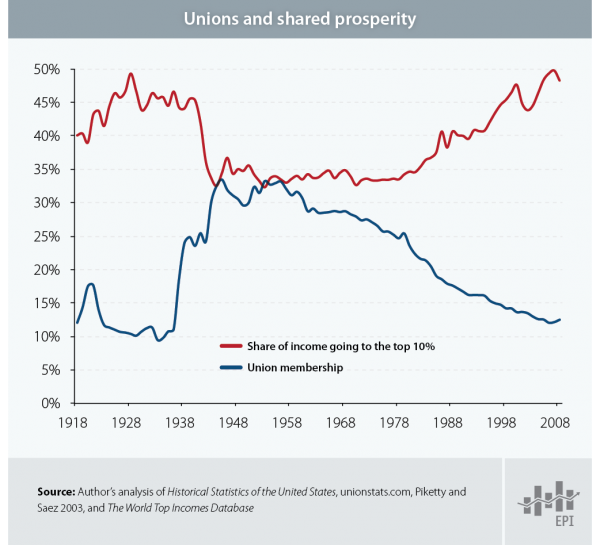
One chart reinforces the point. It compares union membership with the share of income going to the top 10 percent since the 1920s. When only one in 10 workers belonged to unions in the early 1930s, the richest 10 percent pocketed nearly half of the nation’s income.

Then President Franklin D. Roosevelt began a set of bold New Deal initiatives that dramatically increased the power of workers to join unions and bargain collectively. The share of workers who were unionized rose to about one-third by the late 1940s. At that point, the bottom 90 percent saw a significant increase in their share of national income.

Today, as union membership declines to low levels last seen in the 1920s, the share of national income going to the top 10 percent is rising — to levels not seen since then either.

Combine that with lackluster economic growth and you get the result chronicled in an August report by Sentier Research. As The New York Times reported, Sentier found that median incomes, when adjusted for inflation, had fallen 3.1 percent since 2009. They remain significantly below what they were in 2000.

A corporate-driven propaganda campaign has for decades blamed labor unions for saddling American corporations with burdens that made them uncompetitive in the global economy.

That has proven to be cover for dismantling the forces that kept corporations from rigging the economic rules in their favor. When corporate power was kept in check by union power, workers and corporations at least had a fighting chance to prosper together. Without that check, workers are losing. As wages erode, benefits disappear, work conditions become harsher and jobs themselves become more unstable.

The good news is that a combination of worker-activist movements and bold political leadership is setting the stage for a potential resurgence of the labor movement. In Los Angeles and other cities, newly elected pro-labor officials are making companies that benefit from local zoning or contracts pay a living wage and accept unions when a majority of workers indicate they want one.

Across the United States, fast-food worker strikes are fueling state and municipal minimum-wage increases while injecting new energy and ideas to worker organizing efforts.

President  Obama has used executive orders to raise the minimum wage for federal contract workers and require adherence to basic fair labor standards, including the right to organize. These orders could have effects that ripple through to private sector workers.

Labor Day would live up to its purpose if it not only gave workers a temporary respite from the rigors of their jobs, but also drove a national effort to empower workers once again to rebalance the economic scales so that we can rebuild a growing, stable middle class. It needs to be a day on, not a day off, in the effort to reclaim the American dream for working people.

Robert L. Borosage is the co-director of the Campaign for America’s Future, a center for ideas and action that works to build an enduring majority for progressive change. Distributed via OtherWords.org

Read More
art, Commentary Robert Whitcomb art, Commentary Robert Whitcomb

A factory worker's art

goidberg  


Work by ABRAHAM ISAAC GOLDBERG, at the Chandler Gallery,  Cambridge, Mass., in his show "From My Father's Hand: The Art of Abraham Isaac Goldberg,'' through Sept. 12.

Mr, Goldberg was a factory worker  and immigrant from Lithuania (in 1929) who managed to create hundreds of sketches, drawings and paintings.  He has a mordant view of capitalism.

The gallery's notes say:

''Many of Goldberg’s sketches reflect his perspective on social and political events during the Great Depression and World War II. {His son} Haim Goldberg loves the drawings he describes as 'the class-conscious, evil capitalist things with a big belly and a fistful of dollars.' One caricature of Stalin and Hitler depicts them as birds with human faces, kissing, each with a blade tucked under his wing while swastikas and hammer-and-sickles light up the sky behind them like fireworks. He also used his drawings to respond to personal crises. In 1950, Goldberg was hospitalized after a heart attack, and he filled a sketchbook with pictures both amusing and disturbing of the doctors and nurses who treated him.''

That Mr. Goldberg arrived from Lithuania in 1929, as the Depression was getting going, could not have helped his view of capitalism. Still, that American had political freedom and capitalism was a major reason he  could come here and be able to make a living.

A (somewhat regulated) capitalism is, as they say, the worst economic system except for all others.

As for the "robbery'' part of the train above, one thinks of Balzac's amusing but extreme line that ''behind every great fortune is a great crime.''


Read More
art, Commentary Robert Whitcomb art, Commentary Robert Whitcomb

At least the barber is still there, often

morgan
Photo and commentary by WILLIAM MORGAN
 
Amidst the tourists and the traffic that clog the so-called prettiest village in Maine in the summer, there is this wee reminder of simpler times, of when Wiscasset was a village.
The drugstore, the shoe store, and the hardware store are all gone. But Charlotte is still calling herself the village barber – she does not run a salon or a spa or a place to get a pedicure. She is still – when she feels up to it–just cutting hair.
You have to wish for her recovery.


Read More
Commentary Robert Whitcomb Commentary Robert Whitcomb

Llewellyn King: The medical-research crisis

  The Bermuda Triangle is where aircraft, ships and people disappear. That is as may be.

Another less-mysterious triangle swallows good ideas and great science, and leaves people vulnerable. It is the triangle that is formed by the way we conduct medical research in the United States, the role of the pharmaceutical industry in that research and the public’s perception, driven by political ideology, of how it works.

The theory is that the private sector does research, and everything else, better than the government. But the truth is the basic research that has put the United States ahead of the rest of the world -- as a laboratory for world-changing science and medicine -- has been funded by the government.

It is the government that puts social need ahead of anticipated profit. It is the government that puts money into obscure but important research. And it is the government which will keep the United States in the forefront of discovery in science and medicine.

It is no good for politicians to rant about the importance of children taking more and harder math and science courses. Before they open their mouths, they should look at the indifferent way in which we treat mathematicians and scientists. We treat them as little better than day laborers, called on to do work ordered by government, then laid off as political chiefs change their minds.

A career in research, whether in physical sciences (such as astrophysics) or medical sciences (such as cell biology) is a life of insecurity. Had we put the dollars behind Ebola research years ago (the disease was first identified in 1976), we would not now be watching what may become a tsunami of death raging across Africa, and possibly the world. Shame.

Any gifted young person going into research nowadays needs career counseling. They will be expected to give their all, with poor pay and long hours, to serve mankind. Then the funding will be cut or the research grant will not be renewed, and they will be on the fast track from idealism to joblessness.

You may have heard of the celebrated virus hunter, W. Ian Lipkin, M.D., director of the Center for Infection and Immunity at Columbia University's Mailman School of Public Health, because he has been called on for expertise in Ebola. What you might not know is that Lipkin is so starved of funding that he has had to use crowd-funding to support his research on Myalgic Encephalomyelitis, the ghastly disease commonly known as Chronic Fatigue Syndrome (CFS).

Nothing is more damaging to research than funding instability. The universities and many research laboratories -- including those run by the government -- operate like concertinas. They expand and contract according the whim of Congress, not the needs of science, public health or American leadership.

Industry is not the answer to absent government. Pharmaceutical companies spend an astonishing amount -- up to $3 billion -- to bring a new drug to market. But traditionally agencies of government, particularly the National Institutes of Health, seed research where the social need is apparent or where the discoveries, like an Ebola treatment, are defensive. Big Pharma often comes in later, as the developer of a drug, not the discoverer. Discovery starts with lowly dedication.

Sometimes the cost and risk initially is just too high for private institutions to take a therapy from the laboratory to the doctor’s office. Most drugs, contrary to legend, begin in the research hospitals, the universities and in government laboratories long before drug companies develop manufacturing techniques and shoulder the giant cost of clinical trials.

Developing new drugs has become too expensive for the private sector, according to a recent article in Nature. The magazine says the drug pipeline for new antibiotics, so vital in fighting infectious disease, has collapsed as Big Pharma has withdrawn. The latest to leave is Novartis, which has ceased work on its tuberculosis drug and handed it over to a charity coalition.

Government funding for medical research is now at a critical stage. It has flat-lined since 2000, as medical costs have ballooned. Also, congressional sequestration has hit hard.

Stop-and-start funding breaks careers, destroys institutional knowledge and sets the world back on its scientific heels. That is to say nothing of the sick, like those with Ebola or CFS, who lie in their beds waiting for someone to do something.

<em> Llewellyn King is executive producer and host of <em>White House Chronicle</em>, on PBS. His e-mail is lking@kingpublishing.com.</em>


Read More
Commentary Robert Whitcomb Commentary Robert Whitcomb

Nausea and nostalgia

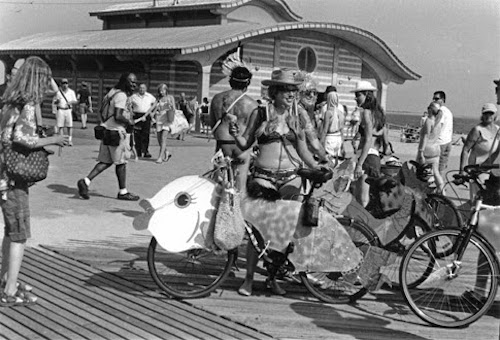
Mermaid Parade at Coney Island  


"Mermaid Parade at Coney Island,'' by EMILY CORBATO, in her show "Glorious Women,'' in the Firehouse Art Gallery, Newburyport, Mass., through Sept. 7.


Whenever I see a picture of an  oceanfront amusement park I think of the nausea produced by eating great quantities of cotton candy and riding on roller coasters that would not pass muster by the Occupational Safety and Health Administration.

--Robert Whitcomb


Firehouse Center for the Arts features Emily Corbato's photography exhibit, "Glorious Women" in the Firehouse Art Gallery through September 7. Meet the Artist during ArtWalk on Saturday, August 16, 3:30 - 5:30 PM. Corbato's black and white photography documents women from many parts of the world, all engaged in ordinary daily activities. The universality of women's lives is apparent: in a city in Peru, or New York, or Martha's Vinyeard; sewing, shopping, laughing, enjoying Plum Island, Disneyland or Coney Island, the location on the g

Read More
Commentary Robert Whitcomb Commentary Robert Whitcomb

Charles Chieppo: State tax cuts a dubious priority

BOSTON

Supply-side economics has been a subject of fierce debate ever since it came into the mainstream when Ronald Reagan was first elected president, in 1980. Do large tax cuts stimulate economic growth that makes up for the reductions in government revenue associated with lower tax rates, or do they just stimulate budget deficits?

As with so many questions, the answer is “it depends.” But in Kansas, where the administration of Gov. and former U.S. Sen. Sam Brownback has embraced the strategy, it’s looking like the result will be a whole lot of red ink.

Saying that they would provide a “shot of adrenaline” for the state economy, in 2012 Brownback pushed through a set of massive tax cuts. The income tax on small businesses was eliminated and the standard deduction for married couples filing jointly increased from $6,000 to $9,000. Three personal-income tax brackets of 3.5, 6.25 and 6.45 percent were reduced to two brackets of 3 and 4.9 percent.

Additional cuts enacted last year will push the top state income-tax rate down to 3.9 percent by 2018. By then, the total tax cut will amount to more than $4 billion. Even more cuts were passed in the waning days of the Legislature’s recent session.

So far, the results are not encouraging. In May, the Legislature’s nonpartisan research staff projected a $238 million shortfall in the approximately $15 billion state budget by July of 2017. But when tax revenues for April, May and June of this year came in a total of $334 million below benchmarks, the legislative research staff moved up the date for the projected shortfall by a year.

Moody’s downgraded the state’s bonds in May. This month, Standard & Poor's followed suit, citing Kansas’s “structurally unbalanced budget” and failure to match the tax cuts with spending cuts. By raising the cost of borrowing, the downgrades will exacerbate the failure to enact spending cuts.

S&P also said the tax cuts would leave the state with dangerously low reserves. Last month the Brownback administration said Kansas had $435 million on hand on June 30. The legislative research staff now says the number was $380 million.

And there’s little sign of adrenaline — at least so far. New business filings are up, but so are forfeitures and dissolutions. Overall, the number of net new businesses declined between 2012 and 2013.

The Reagan tax cuts did indeed provide a shot of adrenaline, helping topull the country out of its 1970s malaise and into the boom of the mid-1980s. But like the Kansas cuts, they weren’t accompanied by spending reductions and led to spiraling deficits. Supporters of the tax cuts counter that increased military spending during that time brought about the downfall of the Soviet Union and the end of the Cold War.

Whatever your view of them, there are two big differences between the Reagan tax cuts and what Gov. Brownback is doing in Kansas. The first is that federal taxes account for by far the biggest part of the overall tax burden. Changing state tax policy simply has much less economic impact.

Then there’s the magnitude of the cuts. When President Reagan took office, in 1981, the top individual income-tax rate was nearly 70 percent; by 1988 it was down to 28 percent. That kind of cut to a much larger portion of the overall tax burden had an exponentially greater impact than cutting Kansas’s top income tax rate from 6.45 to 3.9 percent over roughly the same amount of time.

Even if you believe in supply-side economics, the smaller impact that state and municipal taxes have on the overall economy and that, for the most part, the days of confiscatory tax rates are thankfully behind us make tax cuts a dubious choice as the centerpiece of local governments’ economic policy.

Charles Chieppo is the principal of Chieppo Strategies, a public-policy writing and communication firm.

Read More
art, Commentary Robert Whitcomb art, Commentary Robert Whitcomb

Dining vs. digital delirium

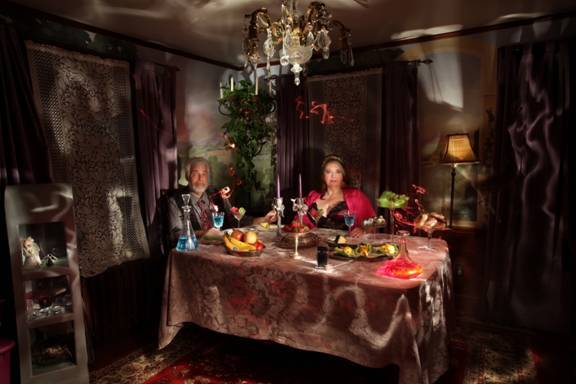
weiner  

"Sam and Don'' (digital print), by PAUL WEINER,  at Brickbottom Gallery,  in Somerville, Mass., in the show "Anxiety and Relief in the 21st Century,'' Sept. 7-Oct. 18.

The gallery asks how  we can turn anxiety into relief in our far-too-fast, churning, Internet-driven world.  We suppose having an unrushed dinner with the lights turned down helps. So, the gallery argues, does making art.

Read More
Commentary Robert Whitcomb Commentary Robert Whitcomb

Champagne weather; politics and state wealth

  This has generally been a beautiful summer in New England -- not too hot, not too cool and soothing breezes most days.

Of course, as the mutual fund companies are compelled to note in their marketing, past performance should not be taken as assurance of future success.

It's tough to think of weather that could be nicer than nice weather in this corner of the world.

xxx

The story this week about Rhode Island's unemployment rate, at 7.7 percent, now the third highest in the country, got me thinking about how little  effect state tax  and other policies may have on prosperity. Or rather, in some places, they may have effects that surprise ideologues.

For instance, Georgia,  Mississippi and, somewhat less so, Nevada have long had regressive taxes  --  disproportionately hitting the poor. They tend to be light on environmental and other regulations and to give lots of public money to companies promising to locate or expand there.

Mississippi now has the highest jobless rate in the nation, at 8 percent. Georgia is second, at 7.8 percent. Rhode Island is in third place, tied with Michigan and Nevada.

Rhode Island's median household income is ranked at 17th in the nation, Georgia's at 33th,  Michigan's 34th (post collapse of car industry), Nevada's at 27th and Mississippi's at 50th.

The governors of all the states listed except Rhode Island are conservative Republicans.

After a half century of huzzahs for the alleged prosperity-fueling effects of Sun Belt tax and regulatory policies, the states there remain at the bottom of the household-income pile. The richest states are in the Middle Atlantic and Northeast -- as they have long been. And they have high taxes and lots of regulations. But some of these states have clearer, simpler, better written regulations than others. Clarity and predictability of regulations seem to be quite important in encouraging businesses to expand.

Rhode Island lags  in wealth rankings for its region. It does that because  of its absurd smallness (which skews its numbers), slowness in moving to new industrial models, dense  and badly written regulations exacerbated by an excessive number of jurisdictions (39 cities and towns!)  that discourage business creation and expansion and corruption, or,  probably more, the perception of corruption .


Corruption is doing well in other states, too, including Connecticut and Massachusetts. It has, however, always seemed to me, from decades of observation, that Rhode Island had a disproportionately high number of  particularly petty grifters. But of course, there's no way to prove that. That the "colorful'' Vincent Cianci is considered a serious candidate for mayor of Providence may also suggest either a suicidal or a bread-and-circuses mentality in too much of the state's electorate.

Anyway, if the eastern third of Connecticut were a state, its jobless  rate and household income would look a lot like Rhode Island's.

But that Rhode Island is a "liberal'' state per  se doesn't seem to be a problem.  Other "liberal''  states in the region --- e.g., Massachusetts and Maryland --- do very well indeed.

 --- Robert Whitcomb


Read More
Commentary Robert Whitcomb Commentary Robert Whitcomb

Llewellyn King: 2 potential dam catastrophes in the making


This is a tale of two hydroelectric dams. Two dams far from each other, but either of which could produce the next great humanitarian crisis.
The first is the Mosul Dam, which stretches across the Tigris River in a valley north of Mosul, Iraq. As dams go, this one is a civil engineering horror. It was captured by the Islamic State, also known as the Islamic State of Iraq and the Levant.  But Kurdish and Iraqi forces, aided by American air power, have taken it back, at least for now.
Should the two-mile-wide dam fail, Mosul would be wiped out and the damage would extend to Baghdad. Loss of life could reach 500,000, and millions could be deprived of water and power. An immense catastrophe piled on the daily pain of Iraq.
The second dam, far away in Southern Africa, on the Zambezi River, is the Kariba. This 55-year-old dam, by some measures, is the world’s second-largest. It was a civil- engineering masterpiece and has held up well, given the spotty maintenance by its owners — Zambia, on the north bank and Zimbabwe, on the south bank.
If the Kariba Dam fails, as it is predicted to do in three years without repairs, surging water would rip a vast trench down the length of the Zambezi River on its route to the Indian Ocean. The wall of water would take out another giant dam, Cahora Bassa, in Mozambique. Loss of life could reach 3.5 million, with untold damage to wildlife. Central Southern Africa would lose 40 percent of its electric supply.
While the Mosul and Kariba dams are linked in their potential lethality, they are very different structures.
The Mosul Dam was a rush job, ordered by Saddam Hussein in the 1980s without regard to the engineering realities on the site. It is anchored in gypsum, which dissolves in water. So leaks in the foundation have to be plugged daily with “grout,” a mixture of cement and sand. The U.S. Army Corps of Engineers said the Mosul Dam is fundamentally the wrong structure for the location, and called it the “most dangerous dam in the world.”
Even with careful tending, the Mosul Dam is in danger. According to a report in The Wall Street Journal, many of the workers who have kept the dam going fled when the Islamic State arrived, and only one dedicated manager is known to have remained.
The United States spent $33 million trying to stabilize the Mosul Dam, but the money, according to an inspector general’s report, was largely wasted. Now the United States cannot bomb near the dam for fear of destabilizing it further.
Apart from general-maintenance issues, the Kariba Dam issues are a little simpler. When the dam was built, between 1955 and 1959, it was planned that the river flow would be controlled though six sluice gates set in the wall. These empty into a plunge pool before the water flows downstream.
The trouble is that the plunge pool has grown from an indentation in the riverbed to a vast crater 285 feet deep. There it swirls around with great force and is eroding the basalt rock on which the dam is anchored. The dam is eating itself alive. All the sluice gates dare not be opened at once, and have not been since 1966.
The fix is a mixture of blasting the plunge pool, so the water goes downstream without creating a whirlpool, and injecting grout — in the form of underwater concrete — to shore up the foundation.
A consortium of the World Bank, the European Union and the African Development Bank this month agreed to provide $250 million to save Kariba. Engineers say the work must be done in the next three years or it will be too late.
If Zimbabwe and Zambia can agree on the contracts and let them in time, work should begin next year. But in that part of the world, the only thing that moves fast is the Zambezi River. The future of Mosul Dam is anyone’s guess.
Llewellyn King (lking@kingpublishing.com) is executive producer and host of "White House Chronicle," on PBS.
 
Read More
Commentary Robert Whitcomb Commentary Robert Whitcomb

Raja Kamal and Arnold Podgorsky: Our steps to end Gaza war

If a biblical saw could carve Israel out of the Middle East and to drift toward Cyprus as an island, the Palestinian-Israeli conflict would disappear. As no one wields such a mighty weapon, the antagonists must learn to survive with the neighbor they have. Since modern Israel's founding, in 1948, Arabs and Israelis have gone to war numerous times. Not counting the two Intifadas and many smaller skirmishes, Israel and its neighbors fought wars in 1948, 1956, 1967, 1973, 1982, 1993, 1996, 2006, 2009, and 2014 – more than one war each decade of Israel’s short history. Over time, the faces of Israel’s adversaries have changed and Israel achieved peaceful resolutions with Egypt and Jordan.  More recently though, religious and demographic changes inside both Israel and its adversaries have produced an increasingly intractable situation.

In Israel’s first four wars, its enemies were nation-states with conventional military forces – principally Egypt, Syria and Jordan, supported by other Arab countries. Adversaries and targets were clearly defined; the conflicts were relatively brief and the strategic results were unambiguous. The Six-Day War of 1967 resulted in Israel becoming a de facto regional military superpower. In the wake of the October 1973 war, the Arab countries realized that Israel could not be defeated militarily.

Today, Israel’s most ardent enemies – Hamas in Gaza and Hezbollah in Lebanon – are driven by extreme religious ideologies.  The approach that Israeli leaders have deployed to counter these foes has offered but brief advantages.  Israel’s reliance on “hard power” has not and, in the long run, cannot pave a road to peace. As a result conflicts erupt easily and frequently.

Each time Hamas and Israel engage militarily, any peaceful solution becomes more elusive and unachievable. The repeated fighting is increasingly costly to Gaza’s trapped population as Israel and Hamas become more aggressive in the use of lethal weapons and Hamas deploys human shields. Hamas rockets targeting Israel are more sophisticated than those used in previous wars, while Israel deploys deadly, contemporary weapons, including drones. The result is tragically high casualty-counts displayed on global networks and social media.

As Israel’s enemies have grown more ideologically extreme, so too has Israel. Israel has its own religious and ideological extremists, and the current coalition government reflects no true commitment to making peace. Seeing no historical evidence that concessions produce peace, Prime Minister Benjamin Netanyahu’s own Tea Party ties his hands and limits what he can offer to the Palestinians. Leaders on both sides of the conflict dictate policies that harden attitudes and tighten the knots at the core of their disputes.

Gaza is the tragic focus of the conflict, but it could also be the crucible through which a solution is forged. Gazans often describe their home as the largest jail in the world. With 1.8 million inhabitants living in only 139 square miles, it is one of the most densely populated places on Earth. Israel’s total blockade of Gaza leaves the area’s economy in shambles, with an unemployment rate approaching 50 percent.  The latest war will surely make matters worse. With restrictions on travel, import and export, fishing rights and banking, the quality of life in Gaza has been deteriorating for a decade or more, yielding hopelessness and the rise of religious fundamentalism. To counter these trends, a paradigm shift to “soft power” and economic development is desperately needed.

The  killings of  Egyptian President Anwar Sadat and  Israeli Prime Minister Yitzhak Rabin left a vacuum in which few could move the needle toward peace. No Israeli leader since Rabin has had the creativity or mandate to advance toward peace in a meaningful way, while the refusal of many Palestinian to countenance Israel’s existence under any conditions has stifled serious discussion. Lacking vision, leadership, leaders on both sides have been mere guardians of the status quo.

As a nation-state itself, it falls to Israel to make the bold move to confirm its moral leadership and provide Gaza a path to integration as a member of the civilized world.  Netanyahu should unilaterally propose the following actions for peace:

1.            Easing significantly the blockade of Gaza.

2.            Allowing and encouraging economic activity there, including the freer movement of people in and out of Gaza, fostering employment and education.

3.            Removing restrictions on funds entering Gaza.

4.            Providing tax incentives to Israeli firms to open plants adjacent to Gaza where Gazans might seek employment.

5.            Removing restrictions on exports from Gaza.

6.            Spearheading an international “Marshall Plan” for Gaza to help rebuild the economic infrastructure.

These actions would accelerate the rebuilding of Gaza.  They would improve Gazans’ standard of living significantly, helping to reduce the hopelessness that drives many to extremism. Collectively, these actions would be a far better investment in Israel’s security than any weapon. What would Netanyahu require in return?

1.            Hamas agreement to a truce, to disarm Gaza, and to support the above package.

2.            An international plan and pledge to monitor that disarmament, including eliminating all rockets currently possessed by Hamas and eliminating tunnels.

3.            An international force of about 25,000 to oversee border security between Gaza, Israel and Egypt.

While these steps alone would not achieve a lasting peace between Israel and the Palestinians, they would significantly improve the situation on the ground and establish a framework for a future status agreement. Citizens of Gaza and Israel’s neighboring towns would have the opportunity, over time, to develop the habits of peace.  Netanyahu would emerge as a visionary leader, earning the global respect shared by Rabin and Sadat.  Netanyahu must be willing to make bold decisions to avert the next war.


Raja Kamal is senior vice  president of the Buck Institute for Research on Aging, based in Novato, Calif.  Arnold Podgorsky is an lawyer and president of Adas Israel Congregation in Washington, DC, a Conservative synagogue.  This column states their personal views and not the official views of either organization.


Read More
Commentary Robert Whitcomb Commentary Robert Whitcomb

Robert Whitcomb: All in the family

The Demoulas family fight over Market Basket, the New England supermarket chain they own, has been a spectacle.

Arthur T. Demoulas was ousted in June as the grocer’s chief executive officer by a group led by his cousin Arthur S. Demoulas. The Arthur S. side has demanded much higher dividends and wants real estate owned by the company to be transferred directly to the family. They would rather take a lot more money now than reinvest it in the enterprise. Arthur T. is greedy, too, but not so openly. He’s done some dubious self-interested stuff involving the transfer of company assets. Still, he’s more of a reinvestment guy than is Arthur S.

The drama’s centerpiece has been many employees’ love of Arthur T. The older ones seem to love him the most, in part because of a profit-sharing fund for employees that could get some employees more than $1 million each when they retire. They worry that the Arthur S. side may have other plans for that money.

Arthur T. has paid his people pretty well — for a low-wage industry — e.g., cashiers start at $12 an hour, $4 above the Massachusetts minimum wage. And there are such nice things as Christmas bonuses. But it was Arthur T.’s frequent cozy encounters with his workers that really did the PR trick. He’d go to funerals of members of employees’ families, call employees with problems to see how they were doing, introduce employees to his wife and, all in all, be a highly visible and friendly presence.

He certainly understands the value of being known as a kindly boss — in energizing his work force to be more productive, reducing the costs of worker turnover (in training, etc.) and building customer loyalty. Patrons like to see familiar faces in stores, which is  obviously more likely with low employee turnover. A little niceness goes a long way in hard-nosed American capitalism. Witness the big PR impact of a  corporate monetary contribution to  a popular charity, although cynics might note that the contribution is usually a very small percentage of the CEO' s pay.

Since Arthur T. was ousted, many employees have gone on strike and staged demonstrations to demand that he be rehired. Many have risked being fired. All of this has lost the company many millions of dollars in sales.

“We are a family and they messed with our dad [Arthur T.],” Charlene Kalivas, who has worked for Market Basket for 18 years, told Bloomberg News. Rosa Pereira, a Market Basket deli manager, told the same outlet how at an opening of a new company store, Arthur T. said to her: “Congratulations on our new store. He didn’t say ‘my store’; he said ‘our store.”’ (Of course, the “our” legally means the shareholders, not the employees.)

Family-owned-and-run businesses can have some big strengths. Some studies suggest that they perform better and last longer on average than nonfamily companies, in part because family companies’ leaders worry less about maximizing short-term profits and more about building the company for the long term. A public company CEO is apt to only hold his job for several years and tends to be heavily rewarded for making quick profits.

Still, even closely held companies such as Market Basket are not “families.” They are teams and — in the end — the majority owners  and senior execs will almost always make their calculations based on economic self-interest — maximizing profit, share price and senior executive pay. Obviously, the owners’ and senior execs’ personalities and whether they’re likely to bump into employees on a day-to-day basis can play some supporting roles in the drama. Owners and executives who live far away  understandably care less about inflicting pain on employees than do ones close by.

Workers who entrust their lives to corporate entities make a big mistake. Out of self-respect and to make a living, employees should do their jobs as best they can while realizing that companies are self-interest machines. And bear in mind some advice a new boss gave me a long time ago: “As soon as you have a new job, you’d better start looking for the next one.” We all want someone to take care of us. In the end, that someone must be us. Executives come and go, companies are bought and sold. (Another chain will probably buy Market Basket and lay off thousands to pay off the debt to buy it.)

There may be some comfort in knowing that for those who have 401(k)s and/or old-fashioned pensions, the cold, hard calculation now more dominant in American capitalism than at any time perhaps since the 1920s has expanded their retirement funds even as globalization, automation (automatic checkout machines may ultimately wipe out even most Market Basket cashier jobs) and information technology continue to hollow out the American middle class.

American public policy heavily favors capital over earned income. Those who fully realize the implications of that have done much better than people working long hours at low wages in part because a very rich boss smiles and asks after their families.

Robert Whitcomb, who oversees New England Diary (newenglanddiary.com),  is a Providence-based writer, editor and business consultant, a former finance editor of the International Herald Tribune and a former editor at The Wall Street Journal.

Read More
Commentary Robert Whitcomb Commentary Robert Whitcomb

Don Pesci: Nader's nattering in Conn.

  VERNON, Conn.

Ralph Nader once again is prowling the countryside saying things that are not so much wrong as passé. He does this because he himself is passé. Consumer advocacy, Mr. Nader’s specialty, reigns supreme everywhere in Connecticut, which only a short while ago sent to Congress the nation’s first consumer-protection senator, Dick Blumenthal, a little stiffer than Mr. Nader, but made from the same ideological cloth.


Not having kept up with the times, Mr. Nader seems to be laboring under the illusion that both major political parties in the United States “continually reject even considering cracking down on corporate crimes, crony capitalism or corporate welfare.”


Not at all true. In fact, the fight against crony capitalism may play a significant part in the Connecticut gubernatorial race this year.  Guess which one of the parties has rejected crony capitalism? Hint: It isn’t the party of Jefferson, Jackson and  the Nutmeg State's late and iconic Democratic boss, John Bailey. Is it not curious that the sharp-sighted Mr. Nader could have failed to notice that real capitalists have an aversion to fake capitalists?


In a column that appeared in The Hartford Courant, Mr. Nader, who appears to be supporting Jonathan Pelto for governor this year, asks rhetorically, “What if they [both major political parties] reject a proven, superior way to educate children? What if they refuse to consider an end to unconstitutional wars or to a grotesquely twisted tax system favoring the rich and powerful — to name a few of the major agenda items not even on the table for discussion by the two parties?”


Apparently, Mr. Nader’s “superior way to educate children” is the same as Mr. Pelto’s superior way to educate children -- which, for reasons not mysterious, is the same as the education lobby’s superior way to educate children. This method involves unlinking education outcomes and salaries, the rejection of testing to measure educational outcomes, and supporting without question or hesitation extravagant union demands, however much they strain taxpayers' ability to pay.


It may surprise Mr. Nader, but Steve Forbes -- to be sure, a successful businessman (via  his family's Forbes Magazine) and therefore suspect -- long ago supported a flat tax that even redundantly wealthy progressive tax supporters such as Warren Buffett would pay. Other Republicans favor a fair tax. The idle rich love progressive taxation because they alone are able to afford pricey tax lawyers to exploit a tax code awash in exceptions, which is why, come to think of it, Mr. Buffett’s  effective tax rate is less than that of his secretary.


Republican libertarian heartthrob Rand Paul, who most recently has called for demilitarizing the police -- police, mind you -- is the opposite of a warmonger, and the U.S.  Constitution has played a major role in Tea Party gatherings. One gasps at the thought that in some important respects Mr. Nader may be at heart a closet Randian Republican.


Mr. Nader’s fire in his column is pointed in two directions: at the Journal Inquirer newspaper,  of Manchester, which from time to time has spanked his backside, and at the notion that spoilers are spoilers.


Jon Pelto, for most of his life a Democrat, has entered this year’s gubernatorial contest as an Independent. Some reporters and commentators have noted that Mr. Pelto might well end up “spoiling” the campaign of Gov. Dannel Malloy, who prevailed over his Republican challenger, Tom Foley, in his first gubernatorial campaign by an uncomfortable razor-thin margin.

  In preference polls, Mr. Malloy noted recently, the needle hasn’t moved a jot since the first Malloy-Foley gubernatorial campaign. Mr. Foley once again is challenging the sitting  progressive Democratic governor and, marvel of marvels, the notion has been bruited about that Mr. Pelto’s Independent campaign might “spoil” Mr. Malloy’s progressive re-run against Mr. Foley – meaning that Mr. Pelto may draw a sufficient number of votes from Mr. Malloy so as to cause him to lose his gubernatorial election bid. A similar brief has been filed against Joe Visconti, once a Republican and now an Independent who is challenging Republican Party hegemony on the right.  Among some eccentrics on the left, the irascible Mr. Nader in particular, it has now become inadvisable to state the bald truth – which is this:


Jon Pelto’s presence in the gubernatorial race is designed to move Mr. Malloy further left, while Mr. Visconti’s presence in the gubernatorial race is designed to move Mr. Foley further right. Neither of them have a snowball’s chance in Hell of becoming governor. If either of them were successful in actually winning the gubernatorial contest, the victor will have been a successful spoiler.


The chief defect in Mr. Nader’s complex character is that he does not know when to stop protesting; this is the disabling defect of the entire Western World since the beginning of the Protestant Revolution, which helped lead to the Enlightenment. The protesters do not know when they have won; they continue protesting until all their gains have been lost.


Mr. Nader lives in Connecticut, the most progressive state in what used to be called, before the near total victory of the administrative state, the American Republic. He has won. He should go home, pop a beer, watch a ball game, and celebrate the destruction of the Republican Party in Connecticut.


Don Pesci (donpesci@att.net) is a  political columnist who lives in Vernon, Conn.


Read More
art, Commentary Robert Whitcomb art, Commentary Robert Whitcomb

Autumnal August morning

  mcneely


"Walking'' (oil on linen), by JUANITA McNEELY, in her show "Indomitable Spirit,'' at the Kzniznick Gallery, in Waltham, Mass., through Oct. 8.

April 16, 2014

Beautiful early-hours/late-summer morning today as I drove down Blackstone Boulevard in Providence.  Lots of walkers. Some runners.  Patches of color already appearing in the leaves of some trees. Some have already fallen and are turning crinkly on the ground.  That and the soft light through the high clouds give more  of a sense of Indian summer than real summer.

We  bring our mood  (in this case autumnal) to nature and nature reinforces it.

Sadly, none of the exercisers this morning included the lady in the picture above.

Read More