
Vox clamantis in deserto





"Puzzling' newspaper purchase deconstructed
Nice little analytical piece in Commonwealth Magazine about the "puzzling'' purchase of The Providence Journal.
Llewellyn King: Beware the armchair terrorists
Terrorism isn’t what it used to be. Disruptive technology is at work, and terrorism is much more threatening than it was.
The long-running, terrorist wars of the last century – such as those of the Palestinians, the Basques in Spain, or the Kurds in Turkey – were relatively contained, both in the fields of operation and the political motivations.
The new face of terrorism is more awful, more random, and has little of the political purpose of terrorism of the past, however terrible its consequences were.
A new generation of robots is coming, which will make remotely controlled terrorism a real threat throughout the world. Add to that threat the profound difference in terrorism motivation.
Yesterday’s terrorism, though heinous, could claim high purpose: It was wholesale terrorism with political goals to be attained by murder and destruction of civilian targets. Today’s terrorism, by contrast, is increasingly retail, motivated by hatred and revenge. Often, the motivation is more religious than nationalistic. The 9/11 attacks were the harbinger of this new terrorism.
Now take blind, irrational hatred, as in the Middle East, mix it with killer robots technology, and you have a huge global threat.
In May, the United Nations Convention on Certain Conventional Weapons convened a first-ever meeting of experts in Geneva to discuss Lethal Autonomous Weapons Systems, which could be the start of a wave of anonymous killing across continents and oceans.
These new robotic weapons can do everything that a human with a bomb or improvised explosive can do. The old brake on terrorism -- that the terrorist would be caught or, more likely, be killed in the attack -- could be over. The age of the armchair terrorist is at hand.
We have all seen the carnage from a simple bomb made from fuel oil and fertilizer. Now add to that the possibility that bombs and other weapons could be made and stored for future detonation using mobile phone technology; or that remotely operated vehicles could drive down a street with machine guns blazing.
Then there are drones. The United States has pioneered the highly sophisticated Predator -- remotely-piloted vehicles that can destroy a target across continents and oceans with precision. But non-lethal drones are doing all sorts of work, from examining pipelines to determining the views from potential skyscrapers in New York.
Not only will tomorrow’s terrorists have farther reach, but they will also have the Internet to create chaos. Imagine a Web whisper about a drone armed with biological or chemical agents flying over a big city, its effects magnified by public panic. Likewise, a drone armed with a dirty nuclear weapon – its impact is likely to be quite limited, but the public panic over radiation could cause severe incident.
Israel may have been more panicked over the appearance of a drone from Gaza than the rockets that the Iron Dome missile system took out. A slow-moving drone at rooftop level might one day be a greater threat than a fusillade of high-flying rockets.
The late James Schlesinger, a former Defense secretary and CIA director, liked to discuss with me the British Empire and how it had held together. Because I had grown up in a British colony, then Southern Rhodesia and now called Zimbabwe, he thought I could tell him.
The answer is a combination of economics, psychology and formation before the worldwide proliferation of small arms and explosives. It was fundamental after the Indian Mutiny of 1857-58 that weapons be kept strictly in the hands of the British. African regiments and police, for example, were seldom armed, and then only for special purposes.
Schlesinger emphasized that all arms developments demanded further developments, because your enemy would soon catch up with you. This has happened throughout history: The British invented the tank in World War I, the Germans perfected it in World War II and overran Europe with its Panzer divisions.
Those who hate the West may use its own technologies to attack it at random with remote-controlled weapons, mobile phones, Google maps, and vehicles invented in America. Disruptive technologies are coming to terrorism -- and that’s a horror.
Llewellyn King (king@kingpublishing.com) is executive producer and host of "White House Chronicle'' on PBS.
Charles Chieppo/Jamie Gass: Legislators do the wrong thing for students
BOSTON After losing the 1958 governor's race, George Wallace, then considered a moderate on segregation by mid-20th century Alabama standards, said he would never get "out-segged" again. Four years later, after his election by the state's virtually all white voters, it was easy for him to declare in his inaugural address, "I draw the line in the dust and toss the gauntlet before the feet of tyranny, and I say, segregation now, segregation tomorrow, segregation forever."
Five months later, it was easy for him to "stand in the schoolhouse door" and attempt to block two qualified African-American students from enrolling at the University of Alabama.
Fast forward more than half a century, and it was easy for Massachusetts state senators to appease the monied interests of the education establishment and reject legislation that would have raised the cap on charter school seats in the lowest-performing 10 percent of Massachusetts school districts from 18 percent to 23 percent of overall enrollment.
It was easy for supposed charter school "supporters" to file poison-pill amendments to the bill, then wait until it was clear that the legislation was going down before casting their votes in favor.
But in politics, what is easy is often wrong.
Despite historic educational improvements over the last two decades, nearly 100,000 largely poor and minority Massachusetts students remain trapped in chronically underperforming district schools.
In Boston, over 15,000 students vied for just 1,700 charter school seats last year. Statewide, there were over 40,000 students on charter school wait lists. For these children and their families, there are no school choices and no way out.
Charters came within two points of closing the 20-point wealth-based achievement gap on 2013 MCAS tests. The year before, 20 charter schools, including many urban charters, finished first in Massachusetts on various tests. Many inner-city charters outperform even affluent suburban schools.
A 2013 Stanford University study found that Boston charter-school students are closing the achievement gap faster than any other public schools in the country. Students learn as much from one year in a Boston charter school as they do in two years in the Boston Public Schools.
The study also found that Massachusetts has the nation's best charter schools. Statewide, charter students gain an additional month and a half of learning in English and two and a half months in math each year compared with the commonwealth's traditional public schools.
These facts build upon the findings of a 2009 Boston Foundation report that the academic impact of a year spent in a Boston charter was comparable to that of a year in one of the city's elite exam schools. In middle school math, it was equivalent to one-half of the achievement gap between black and white students.
Charter schools are also affordable. When students choose to leave a district school to attend a charter, public funding follows the student. A recent Pioneer Institute report showed that raising charter enrollment to accommodate wait-listed students up to the current spending cap of 18 percent in the commonwealth's 17 lowest-performing urban districts would only increase the funds flowing from districts to charters to 5 percent of the districts' $2.5 billion in net school spending.
Districts would get more than a quarter of that back over a decade thanks to generous state reimbursements for students the districts no longer educate.
Massachusetts' s barriers to educational opportunity were not left here by glaciers, they are man-made. Entrenched special interests with nearly limitless bank accounts lobby Beacon Hill to maintain obstacles like enrollment caps, huge wait lists, and needless red tape that deny educational opportunity to underprivileged children, but ensure the continuing comfort of adults in the system.
In the 50th anniversary edition of Simple Justice, Richard Kluger's definitive history of the U.S. Supreme Court's landmark Brown v. Board of Education ruling that struck down the doctrine of "separate but equal," he concluded that "America is a colossus of contradictions… justice of any type cannot materialize… without the binding up of its constituent elements."
In rejecting legislation that would have lifted the charter-school cap, the Massachusetts Senate blocked justice from being done and approved the 21st century version of segregation by preventing more poor and minority children from accessing high-quality educational opportunity.
It was an easy vote; it was also wrong.
Charles Chieppo is a senior fellow of and Jamie Gass directs the Center for School Reform at Pioneer Institute, a Boston-based think tank.
Mideast paradox
It's interesting that Arabs have more rights and security in Israel than they do in any Arab-run country, except maybe Tunisia.
What really is meant by 'patient engagement'?
Cambridge Management Group (cmg625.com) senior adviser <a href="http://www.cfah.org/blog/2014/what-physicians-told-us-about-patient-engagement">Marc Pierson, M.D., had some pithy things </a>to say when he and other experts were recently interviewed by the Center for Advancing Health.
Here are some of the remarks of Dr. Pierson, who is also retired vice president for clinical information and quality for PeaceHealth's St. Joseph Medical Center, Bellingham, Wash.:
<strong> CFAH: ''Here is the CFAH definition of patient engagement: 'Actions people take to support their health and benefit from their health care.' What's missing from this definition? What would you add, subtract or word differently?''</strong> <strong> Dr. Pierson:</strong> ''....Defining {patient} engagement is very much the product of who is doing the defining. If from within health care, then the key question becomes for what or for whom is 'patient' engagement primarily intended to benefit?...I would prefer thinking of 'people' engaged in their health and health care. However, I do like that this definition recognizes that both health and health care require people's active participation...Medical care is not the same as health. Health is much more than the lack of illness...We need to incorporate more perspectives from real people and ask them what they need to become more engaged with their medical conditions, their health, and their well-being.'' <strong>CFAH: ''If a person is engaged in their health and health care, what difference does that make? To whom?''</strong>
<strong>Dr. PIERSON: </strong>"Typically, engagement is defined by health care insiders as paying attention to what you are told to do and being compliant with 'orders.' The current non-system of health care plays into this by being disconnected and difficult for people to understand or navigate....
''Health care offers technology and knowledge but is set up for the people that work inside it, not for its clients' ease, safety, or affordability. Payment for health care is based on professionals managing clients' ill health, not on engaging with people to prevent illness, create well-being, or for self-care of illnesses and chronic conditions.
''People are scared of what they are not allowed to know or understand. They don't want to be more dependent. They don't want to end up going to an emergency room. Their primary relationships are with family, friends, neighborhood, and community — not professional service providers.''
But you still can't hide
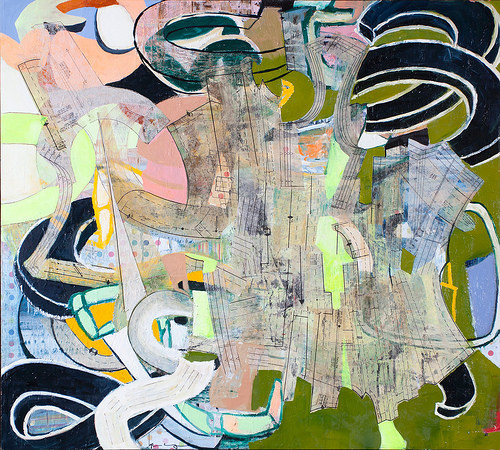
"Encrypted'' (mixed media on paper), by GALEN CHENEY, in the "Spaces In Between'' show at the Preservation Framer & Art Gallery, in North Attleboro, Mass., through July 26.
Build that gas pipeline; noisy times
Because of pollution, global warming and global geopolitics, we obviously need to move away from fossil fuels, especially coal and oil, but also natural gas. Still, our economy will primarily run on fossil fuels for a few more decades as we move too slowly away from them. The least dirty one — and quite cheap now — is gas.
New England, if it’s to remain economically competitive with the rest of the country, must have access to more gas, of which there’s lots nearby, in Pennsylvania and upstate New York. The best way to obtain it is to build a 180-mile-long pipeline from central New York to a transmission hub in Dracut, north of Boston, as proposed by Kinder Morgan, the big pipeline company. However, it’s tougher than ever to get big things done in America. Well-heeled interest groups can hold up projects indefinitely, whatever the public interest. This is happening in the northern part of western and central Massachusetts, where some big landowners are trying to keep out the project. Many people understandably don’t want a pipeline across their acres, even with generous payments from the likes of Kinder. But New England has been on the edge of disaster several times in recent years when bad weather, and that gas is used for heating, cooking and electricity-generation, forcea utilities to turn to highly polluting oil when the gas-pipeline system — built originally only for heating and cooking — can’t meet demand, notably in cold waves.
We’ve barely missed region-wide blackouts. Meanwhile, New England’s pipeline-capacity deficit makes our energy bills higher and ability to expand business lower, and undermines economic-development planning. The engineering consultants Black & Veatch, in a study for the New England States Committee on Electricity, warns that severe gas shortages threaten the reliability of our electricity grid over the next few years. Many foes of pipelines (or at least of pipelines that go through their property, who tend to be affluent and thus can own a lot of land and can afford to hire lawyers to fight public projects) say that if we must have new pipelines, then let’s run them only along big roads and existing pipeline routes.
But that would be too limiting to meet a market demand that some experts project might increase 50 percent in the next few years. And it would require digging up more land in densely populated areas, much of it inhabited by low-income people. But then, the affluent, the biggest energy consumers on a per-capita basis, have always been more than happy to have the energy infrastructure that supports their lifestyles put in places where low-income people without easy access to lawyers and politicians live. Consider comedian Bill Cosby and his wife, who own hundreds of acres of tax-favored protected land that the pipeline might cross and are vehemently fighting it.
It all recalls the old line about taxes, attribute to Russell Long: "Don't tax you, don't tax me; tax the man behind the tree''.
Pipeline foes, as have wind-turbine opponents, cite the alleged environmental dangers of such projects. In the case of Kinder proposal, Mr. Cosby complains that “flora and fauna” would be imperiled. But they’re far more threatened by the air and water pollution and climate change caused by digging up and burning oil and coal than by the relatively clean gas extracted by fracking and put into pipelines.
Then there’s the demand for the absurd promise that the pipeline would never leak or explode. But nothing is 100 percent safe. We’d have no modern civilization without risk, in the case of gas pipelines very low. And foes don’t mention the much greater dangers of tanker trucks and railroad cars carrying gas.
Regulators and political leaders should push to take by eminent domain whatever land is needed for the Kinder project so that the region’s economy and, yes, environment can benefit from long-overdue gas-pipeline expansion. *** My wife and I went to a wedding at a Brooklyn restaurant almost under the famous bridge last Saturday. It has one of the world’s great urban views.
We were New Yorkers back in the ’70s, and our visits evoke all sorts of memories.
The music at such weddings used to be mostly from “The Great American Songbook.” Now it might start out with a bit of Gershwin, et al. (which seems just perfect as you gaze at soaring Lower Manhattan), but fairly quickly move to ear-splitting, conversation-stopping hip hop, expeditiously eliminating the romance in a much richer and cleaner but in a some ways less interesting Gotham than four decades ago. (Prepare to mostly text at such functions.)
But then, some drugstores and gyms are almost as loud. It's the Culture of Cacophony. Even some post offices have bad rock blaring.
Meanwhile, the Metro-North Railroad has closed its last bar car. While “functioning alcoholics” were part of the clientele, most patrons exercised a disciplined conviviality. Worse, a study in the British Medical Journal says that even moderate drinking is bad for you, contrary to earlier researchers’ assertions. Thus we head deeper into a healthier (?), if less fun, era.
-- Robert Whitcomb
'On a darkling plain'
A friend of mine traveling on the Black Sea today sent me this famous 19th Century poem after learning that Putin's people in eastern Ukraine had shot down the Malaysian airliner. I have not read this poem for 40 years.
-- Robert Whitcomb
Dover Beach
The sea is calm tonight.The tide is full, the moon lies fairUpon the straits; on the French coast the lightGleams and is gone; the cliffs of England stand,Glimmering and vast, out in the tranquil bay.Come to the window, sweet is the night-air!Only, from the long line of sprayWhere the sea meets the moon-blanched land,Listen! you hear the grating roarOf pebbles which the waves draw back, and fling,At their return, up the high strand,Begin, and cease, and then again begin,With tremulous cadence slow, and bringThe eternal note of sadness in.Sophocles long agoHeard it on the Ægean, and it broughtInto his mind the turbid ebb and flowOf human misery; weFind also in the sound a thought,Hearing it by this distant northern sea.The Sea of FaithWas once, too, at the full, and round earth’s shoreLay like the folds of a bright girdle furled.But now I only hearIts melancholy, long, withdrawing roar,Retreating, to the breathOf the night-wind, down the vast edges drearAnd naked shingles of the world.Ah, love, let us be trueTo one another! for the world, which seemsTo lie before us like a land of dreams,So various, so beautiful, so new,Hath really neither joy, nor love, nor light,Nor certitude, nor peace, nor help for pain;And we are here as on a darkling plainSwept with confused alarms of struggle and flight,Where ignorant armies clash by night.
Spartan National Park
 "Pineland,'' by LUCINDA BLISS, at Sharon Arts Center Exhibition Gallery, Peterboro, N.H. The work is in the Graduate Programs Faculty Art Exhibition of the New Hampshire Institute of Art, though Aug. 30.
Cheap stuff shows age; put out the wood fires
Providence has lovely walkways and bridges along and over downtown rivers -- if you don't look too closely. Much of the infrastructure, whose essentials were designed by the late, great landscape architect Bill Warner, is showing its age because when the work was done, back in the '90's, they used concrete instead of real stone. The concrete is starting to flake, crumble and fade. As an alert reader reminds me, the best word for this deterioration is ''spalling.'' Very quaint. Almost Chaucerian.
He also suggests that substandard concrete might have been intentionally used. I would add: Maybe it wasn't corruption but incompetence and too-low construction budgets. In any case, stone would not have had these problems.
Such public infrastructure would once have included mostly real stone, and not cheap concrete. Consider the wonderfully sturdy and beautiful projects put up by the Works Progress Administration in the 1930's; many of them are still around.
The idea was that such public places deserved the dignity of natural materials that would last a long, long time -- that such projects would not only be be beautiful but be very long-term public investments , especially considering our rigorous four-season climate. Picking good building materials and merging them with good design was an expression of pride in our civic life together, to be enjoyed by rich and poor alike.
But now, rampant short-termism permeates all that we do and say ib the public square. And only our rich are deemed worthy of using the highest-quality materials -- with military spending the exception, where anything goes. (And Russian gangster/KGB operative/dictator Vlad Putin is working hard to force us to increase our military spending.)
xxx
These same downtown Providence rivers are also the venue for the city's WaterFire project, that clever sound, light, smell and sales show that's put on from time to time except in the winter.
If I were czar, I would stop the wasteful and polluting burning of aromatic wood that's the heart of it. There are now enough people living in, and visiting, downtown that burning wood should no longer be necessary to lure tourists and others. Music, ornamental electric lighting, performance artists, food and other vendors, and making more boats available to take visitors up and down the rivers at night are enough. Maybe (controlled!) natural-gas fires could be considered.
Let's stop fouling the air and killing more trees.
--- Robert Whitcomb
But the concrete is real

"Fictitious Force" (outdoor sculpture), by BEKA GOEDDE, in the "Exposed'' show at the Helen Day Art Center, in Stowe, Vt., through Oct. 15.
This piece is a cast-concrete tile formation of a braid rug.
Ms. Goedde says: "A fictitious force, in physics, is an apparent force; it is not due to one object or another accelerating but instead the natural frame of reference itself is accelerating. The rug is a household object I employ especially for its concentric, circular, or centripetal pattern.''
We're in the heart of New England's outdoor art season.
Chris Powell: Clinton's vast fee and UConn Foundation slush fund
MANCHESTER, Conn.
Hillary Clinton, ex-presidential spouse, former U.S. senator, secretary of state and likely presidential candidate, came to the University of Connecticut a few weeks ago and prattled about equality -- for which the university's foundation paid her $251,000.
As the extraordinary speaking fee has come under criticism, the university's defense has been that Clinton wasn't paid with state tax money or even with the university's own, that the foundation used money donated for a speakers program by a family in New Haven with various business interests. This defense is pathetic:
-- While the foundation is nominally separate from the university, it consists largely of university administrators and former students and the university pays it $8 million a year for fundraising. The foundation does nothing that the administration doesn't want it to do.
-- The foundation exists only to use the university's name and to support its mission. If the foundation does something that can be defended only by purporting to separate the foundation from the university and state taxpayers, it disparages the university as well.
-- Somebody at UConn decided that paying Clinton $251,000 for one banal presentation was better than paying $50,000 each for five lecturers or $25,000 each for 10 or $5,000 each for 50. Since UConn President Susan Herbst spent much time on the stage in conversation with Clinton, it's a fair assumption that the decision ultimately was Herbst's and that her vanity figured in it.
-- Exactly for whom was it better for UConn to use all that money for just one speaker? Was it better for UConn's students, to whom the event was limited, giving them a look at the likely Democratic presidential nominee in 2016, as if presidential candidates don't eventually hold many campaign events in public?
Or was it better mainly for the university administration, Connecticut's Democratic state administration, and Fusco family business interests, all of which got to ingratiate themselves with someone who has a good chance of becoming president, just as investment houses like Goldman Sachs and Kohlberg Kravis Roberts have ingratiated themselves with Clinton, paying millions to her and her family's foundation as advance bribes?
After The Washington Post reported this month that she recently had taken extravagant speaking fees from eight universities, including UConn, Clinton told ABC News that she had donated all the money to her family's foundation, "so it goes from a foundation at a university to another foundation."
That is, the money went from a foundation Clinton did not control to a foundation whose disbursements she can control, a foundation she can staff with her friends and campaign associates, a foundation that can be used in part as political patronage.
Clinton's speaking fee at UConn is still more evidence that the UConn Foundation is largely a slush fund for university officials, the mechanism by which they get to do what they wouldn't dare do with official government money.
Before the foundation paid Clinton's extravagant fee, it was employing two presidents at once, the old one being paid nearly a half million dollars per year while the salary of the new one was kept secret; it was spending $600,000 to buy a mansion in Hartford for Herbst so she might continue to schmooze and overawe state officials when inviting them to the president's mansion on the Storrs campus a half hour away might seem too burdensome; and it was even paying for Governor Malloy's international travel.
The foundation should be deprived of its exemption from Connecticut's freedom-of-information law and its board should be separated from university officials and made more independent.
Or else the foundation should start offering Republican presidential candidates a quarter million dollars to speak. At least some of them might be politically incorrect and thus interesting or even outrageous rather than merely banal and corrupt.
Chris Powell is managing editor of the Journal Inquirer, in Manchester, Conn.
Llewellyn King: Whether good merger or bad, the M&A kings prosper
Whether Rupert Murdoch’s 20th Century Fox ultimately succeeds in its $80-billion bid for Time Warner, rest assured the mergers and acquisitions (M&A) industry will do just fine. Very fine, actually.
There is such a thing as the M&A industry, but it is elusive. It has no trade association and cannot be looked up in the telephone directory. But this virtual organization is a power in the land and very, very rich.
It is made up of investment bankers, lawyers, economists, advertising agencies, public-relations tacticians, lobbyists and legal printing firms. They all swing into action like sharks alerted by blood in the water. They are a diverse crew with one thing in common: They do not come cheap.
At the top of the pinnacle are the investment bankers and their pals in the hedge-fund world, who are ready with ideas and capital if it is needed; ready to reap the rewards of arbitrage. These are the elite officers of the Wall Street Brigades; money is their North Star. They have been bred, in the best schools, to expect it as their entitlement, and they are keen to live up to that expectation.
They are retained by both sides in a hostile takeover and, however it goes, their fees will be enough on one transaction to keep them on Easy Street for years. They fly high, shoot high and live high. They are aristocrats in the kingdom of money.
Just below them come the lawyers, droves of them each offering advice on some aspect of the challenge. Each billing more for one hour than most people earn in a week. When working on a big merger, where there are billions and billions of dollars in play, the legal fees run into the tens of millions of dollars -- and nobody cares. Outside of the senior management, who expect to get extraordinary wealthy – hundreds of millions of dollars, at least -- in a takeover, it is the bankers and the lawyers, denizens of Fifth Avenue and the Hamptons, who make out beyond normal dreams of avarice, and do it over and over.
So it is not surprising that it is often bankers who instigate mergers either by pushing the ideas and the finance mechanism on the firm that hopes to be the acquirer, or persuading a firm that it is time to put itself on the market. Once a target is “in play,” as Time Warner is, anything can happen: A white-knight suitor can come along or the vulnerable company can become an acquisitor, as in the way Men’s Warehouse stitched up Jos. A Banks.
If there is a hostile battle, the advertising and public-relations people come in, cajoling shareholders to hold out or sell out. More millions are spent in this effort: No one is trying to save money when the transactions are so large.
The biggest winners are those at the top of the heap: the managements. They own stock options and shares, plus special deals are written to sweeten things for them.
Everyone engaged in the M&A industry makes money when the game is on, all the way down to the caterers, who provide the sustenance when the midnight oil is burning. A merger is a grueling and fun undertaking; the fun of making money under pressure, a lot of pressure and even more money.
Who loses? Certainly the staff of the lesser-partner firm. The conqueror calls the shots and decrees the layoffs, which are one of the principal savings or “efficiencies” of the takeover. There will be less duplication, fewer subsidiary businesses, and fewer facilities that can be consolidated.
The other loser, feverishly denied in advance of the nuptials, is the consumer; the poor stiff who purchases the goods and services that the new entity offers. These may be fewer and, almost certainly, they will become more expensive over time.
Not all mergers are bad. Actually, Rupert Murdoch’s takeover of The Wall Street Journal has resulted in an invigorated newspaper. But anyone, including myself, who has flown on the merged American Airlines and U.S. Airways has nothing good to report about service, pricing, or frequency. I'll venture that the M&A moguls are taking private jets -- wouldn’t you?
Llewellyn King is executive producer and host of “White House Chronicle” on PBS. His e-mail is lking@kingpublishing.com.
And forgotten

"Gone'' (photo), by REBECCA SKINNER, at Galatea Fine Art's (Boston) "New England Collective V,'' Aug. 1-30.
We used to "break into '' old houses like this (actually, you could usually just walk in via the door) , some, I suppose, abandoned during the Depression and never reoccupied. Their smell of mildew and dead animals was notably unpleasant but the yellowed copies of magazines and newspapers from the '30s were intriguing, raising my interest in the history of what was then only the half-completed and very bloody 20th Century.
--- Robert Whitcomb
Still trying to appease Putin
Russian dictator Vladimir Putin continues to send Russian troops, intelligence operatives and heavy weaponry into the eastern Ukraine to try to take it over. It's not proving quite as easy as his theft of Crimea from Ukraine, a sovereign nation, but he is patient.
The West has responded to this brazen aggression by doing virtually nothing, Meanwhile, the Germans remain profoundly cynical and corrupt as they try to work out more business and other deals with this thug. This recalls the Hitler-Stalin pact, although of course the main players are nowhere that evil!
In any case, we'll pay for this appeasement.
Our Woody Allen neighborhood
Woody Allen is making a movie in our neighborhood, in Providence, this week, and some streets are blocked off. There are an astonishingly large number of vehicles associated with the shooting, including about a dozen very large trucks and RV's. You can see that making feature movies requires one hell of a lot of infrastructure. The neighbors are torn between irritation about the inconvenience and pleasure that this celeb is making a big movie in this leafy neighborhood. (What viewers will actually see will be quiet and intimate, I'm pretty sure. Woody Allen doesn't exactly make spectacles.)
Providence is an appropriate place, culturally, for Allen to make a film. Rhode Islanders tend to be cynical and pessimistic, yet many of their surroundings are beautiful. And it's not too far from his beloved Manhattan.
How weird it seems to me. I remember watching Allen as a standup comedian in the '60's, seeing him play the clarinet at Michael's Pub, in Manhattan, in the '70's, and viewing most of his movies, usually with great pleasure. What a work ethic to get through such a long and complicated life.
And now he's around the corner.
Hide and hide
 "Ramps'' (enamel, gesso and watercolor on Stratmore paper), by JAMIE WYETH, at Adelson Galleries Boston.
Llewellyn King: Give American dogs French rights!
You are embarking on reading something that is hopelessly one-sided, patently biased and completely partisan. It is plainly and simply a call for equality.
I want dogs in the United States to be accorded the same rights and privileges as they are in France.
I say that if you want to be born a pooch, do it in France. The French dog’s life is tres bonne.
You may think I am barking mad, but I have been studying pampered pouches for decades. In Britain, people have a screw loose about all animals. But in France, the dog is the overlord of all it surveys.
British dogs may get roast beef on Sunday, if they are lucky. Their French equals drag their owners to the patisserie whenever they feel the urge for an éclair or a napoleon. British dogs get a bath infrequently in the family tub. But French dogs go to a salon. Sadly, in America, we outsource the grooming to a chain; not the same as a salon for Fifi the Pomeranian or Jacques the wolfhound. But it is really at lunch and dinner when the French dog struts his or her superior situation: They go to fine restaurants with their owners, and sometimes –Mon Dieu! -- eat their meals on the same china.
In England the lucky few four-footers can go to the pub and, with the publican’s permission, enter the hallowed premises. After some unpleasantness with the same publican’s large mongrel, which always blocks the entrance, he or she will find a spot under the table and hope for a bit of overcooked banger.
It is quite amazing how many dogs will show up in a restaurant in France and, after a few snarls, how fast they will settle down to the serious work of begging for food, or waiting in the certain knowledge that if they have the power over their owners to be taken out to lunch or dinner, delicious victuals will be provided with a loving, “Bon appetit, mon petit chien!” Last month in Paris, I saw a happy dog sitting on a banquette in a fine restaurant.
Dogs in France also are conspicuous on public transportation. You see them on the trains, local and intercity, and the intercity airplanes. Some taxi drivers feel safer with a large German shepherd or Rottweiler on the front seat. I have always though that a dog is superior to plastic dividers and other security devices in these uncivil times.
The French indulge their dogs and owners to such an extent that they have special sanitation workers who ride motorcycles equipped with vacuum cleaners, so that the good citizens do not, well, step in it.
But in America, dogs are defendu, not allowed to darken the door. They are classified as a health hazard. You can get away with dining with your best friend outdoors at some establishments. But mostly, the dear creatures must endure confinement at home while we gorge.
My fellow Americans, can this go on? Can we allow the pampered poodles of France to lord it over good ole’ American coon hounds? Liberte, egalite, fraternite for the dogs of the U.S.A.!
Llewellyn King (lking@kingpublishing.com) is executive producer and host of “White House Chronicle,” on PBS.
.
A canine summer
 "Swimdogs'' (oil on canvas), by JAMIE WYETH at the Adelson Galleries Boston.
Wet, happy and often smelly dogs are among the most memorable creatures of summer in the New England countryside.
David Warsh: Nobel Prizes and macro vs. growth
BOSTON
It was about a year ago that Paul Krugman asked, “[W]hatever happened to New Growth Theory?” The headline of the item on the blog with which the Nobel laureate supplements his twice-weekly columns for The New York Times telegraphed his answer: The New Growth Fizzle. He wrote:
''For a while, in the late 1980s and early 1990s, theories of growth with endogenous technological change were widely heralded as the Next Big Thing in economics. Textbooks were restructured to put long-run growth up front, with business cycles (who cared about those anymore?) crammed into a chapter or two at the end. David Warsh wrote a book touting NGT as the most fundamental development since Adam Smith, casting Paul Romer as a heroic figure leading economics into a brave new world.
''And here we are, a couple of decades on, and the whole thing seems to have fizzled out. Romer has had a very interesting and productive life, but not at all the kind of role Warsh imagined. The reasons some countries grow more successfully than others remain fairly mysterious, with most discussions ending, as Robert Solow remarked long ago, in a “blaze of amateur sociology”. And whaddya know, business cycles turn out still to be important.''
Krugman’s post raised eyebrows in my circles because many insiders expected that a Nobel Prize for growth theory would be announced within a few weeks. A widely noticed Nobel symposium had been held in Stockholm in the summer of 2012, the usual (though not inevitable) prelude to a prize. Its proceedings had been broadcast on Swedish educational television. Romer, of New York University, had been the leadoff speaker; Peter Howitt, of Brown University, had been his discussant; Philippe Aghion, of Harvard University and the Institute for International Studies, the moderator of the symposium.
Knowing this, I let Krugman’s gibe pass unchallenged, even though it seemed flat-out wrong. These things were best left to the Swedes in private, I reasoned; let the elaborate theater of the prize remain intact.
Then came October, and a surprise of a slightly different sort. Rather than rousing one or more of the growth theorists, the early morning phone calls went to three economists to recognize their work on trend-spotting among asset prices and the difficulty thereof – Eugene Fama, Robert Shiller and Lars Hansen. Fama’s work had been done 50 years before; Shiller’s, 35. Two big new financial industries, index funds and hedge funds, had grown up to demonstrate that the claims of both were broadly right, in differing degrees. Hansen had illuminated their differences. So old and safe and well-prepared was the award that its merit couldn’t possibly be questioned.
What happened? It’s well known that, in addition to preparing each year’s prize, prize committees work ahead on a nomination or two or even three, assembling slates of nominees for future years in order to mull them over. Scraps of evidence have emerged since last fall that a campaign was mounted last summer within the Economic Sciences Section of the Academy, sufficient to stall the growth award and bring forward the asset-pricing prize – resistance to which Krugman may have been a party.
These things happen. The fantasy aspects of the Nobel Prize – the early-morning phone call out of the blue – have been successfully enough managed over the years as to distract from the “hastily-arranged” press conferences that inevitably follow, the champagne chilled and ready-to-hand. Laureates, in general, are only too happy to play along. Sometimes innocence may even be real. Simon Kuznets, on his way to visit Wassily Leontief in New York in 1971, told friends that he overheard heard only that “some guy with a Russian name” had won, before stepping into the high-rise elevator that would carry him to his friend’s apartment. It was, he said, the longest ride of his life.
As described on the Nobel website, the committee meets in February to choose preliminary candidates, consults experts in the matter during March and April, settles on a nomination in May, writes up an extensive report over the summer, and sends it in September to the Social Science class of the Royal Swedish Academy of Sciences – around seventy professors, most of them Scandinavians – where it is widely discussed. Thus by summer, the intent of the committee is known, if very closely held, by a fairly large fraternity of scientists. The 600-member Academy then votes in October.
There is nothing obvious about the path that the economics prize award should take; even within the Academy there are at least a couple (and probably more) different versions of what the Sveriges Riksbank Prize in Economic Sciences in Memory of Alfred Nobel, established in 1969, is all about. Wide-ranging and free-wheeling discussion among the well-informed is therefore crucial to its success; so is dependable confidentiality. Nominations and surrounding documentation are sealed for 50 years, so none of this has been revealed yet since the economics prize was established less than 50 years ago.
Over the years, however, scraps of information have leaked out about struggles that have taken place behind the scenes, in areas where sharp philosophical disagreements existed. For example, Gordon Tullock, of George Mason University, a lawyer and career diplomat with no formal training in economics, told me years ago that he woke in 1986 expecting to share the prize for public choice with James Buchanan. He didn’t. In her biography of game theorist John Nash, A Beautiful Mind, Sylvia Nasar reported that Ingemar Ståhl had sought to delay an award to Nash by moving up the prize prepared for Robert Lucas. He didn’t succeed, and Lucas was honored, as had been planned, the following year. (Harold Kuhn, the Princeton mathematician who tirelessly insured that Nash’s story would be told, died last week, at 88.)
Something of the sort may actually have happened in 2003: preparations were made in Minneapolis for a press conference for Edward Prescott, then of the University of Minnesota; the prize went instead to a pair of low-key econometricians, Clive Granger and Robert Engle, both of the University of California at San Diego. Prescott and Finn Kydland, of the University of California at Santa Barbara, were cited the following year, “for their contributions to dynamic macroeconomics: the time consistency of economic policy and the driving forces behind business cycles.” The latter award remains even more controversial today than it was then.
Indeed, Krugman’s own prize may have been moved up, amidst concern in Stockholm for the bourgeoning financial crisis of 2008. As late as that October it was believed, at least in Cambridge, Mass., that the committee recommended that a prize be given for measurement economics, citing Dale Jorgenson, of Harvard University; Erwin Diewert, of the University of British Columbia; and Robert Hall, of Stanford University. It would have been the first prize for empirical economics since the award to Richard Stone, in 1984, and only the third since Kuznets was recognized, in 1971. Instead the prize was to Krugman, by then working mainly as a columnist for The Times, “for his analysis of trade patterns and location of economic activity.”
No one seriously disputes that Krugman should have been recognized at some point for the consensus-changing work he did, beginning in the late 1970s, on monopolistic competition among giant corporations engaged in international trade, though a common view in the profession is that two others, Elhanan Helpman, of Harvard University, and Gene Grossman, of Princeton University, should have shared in the award. Committees over the years have been very conscious of the emphasis conferred by a solo award – only 22 of 45 economics prizes have been “singletons.”
The deferral of the measurement prize, if that is what happened, suggests there must have been considerable tumult behind the scenes. The gravity of the global financial crisis was very clear in Stockholm in September 2008. What happened in those few months won’t be known with any certainty for another forty-four years. But the effect of the award in October 2008 was to empower Krugman as a spokesman for the tradition of Keynesian macroeconomic analysis. He responded with alacrity and has employed his bully pulpit since.
So much, then for what is known and, mostly, not quite known, about the recent politics of the prize. What about the contest between macroeconomics and growth?
Macro is the dominant culture of economics – the center ring ever since Keynes published The General Theory of Employment, Interest and Employment, in 1936. It is a way of looking at the world, “an interpretation of events, an intellectual framework, and a clear argument for government intervention,” especially in the management of the business cycle, according to Olivier Blanchard, author of an authoritative text, Macroeconomics. There are many other fields in economics, but macro is the one that seeks to give an overall narrative and analytic account of expansion and recession, of capacity and utilization, of inflation and unemployment. Macro has had its ups and downs in the years since 1936. Today anyone who studies fluctuations is a macroeconomist; but not all macroeconomists acknowledge the centrality of Keynes.
In the 1950s and ’60s, a “neoclassical synthesis” merged Keynesian contributions with all that had gone before. New standards for formal models, plus national income and product accounts and measures of the flow of funds, produced various rules of thumb for managing modern industrial economies: Okun’s Law (output related to unemployment) and the Phillips Curve (inflation to unemployment); and so on. By the end of the 1960s, many economists thought of their field as mature.
In the ’70s came the “expectations revolution,” a series of high-tech developments (most of them anticipated by low-tech Milton Friedman), in which economists sought to build accounts of forward-looking people and firms into the macro scheme of things. The effectiveness of monetary policy was debated, until the Federal Reserve Board, under Paul Volcker, gave a powerful demonstration of its effectiveness. Reputation and credibility became issues; targets and new rules emerged.
Growth theory, on the other hand, has a less clear-cut provenance. There is no doubt that it began with Adam Smith, who, in the very first sentence of The Wealth of Nations, pronounced that the greatest improvement in the productive powers of humankind stemmed from the division of labor. Smith expounded for three chapters on the sources and limits of specialization, using a mass-production pin factory as his example, before dropping the topic in order to elucidate what economists today call “the price system.” Interest in the kind of technological change that the pin factory represented faded into the background.
Karl Marx was a growth theorist (remember “Asiatic,” “ancient,” “feudal,” “bourgeois” modes of production and all that?), but he came late to economics and never found his way into the official canon. So was Joseph Schumpeter, who came closer to giving a persuasive account in economic terms but still failed to leave much of a mark. In the ’50s, MIT’s Robert Solow, a leading macroeconomist, ingeniously showed that most of the forces generating gains in wealth (gross domestic product/per capita) were exogenous, that is, outside the standard macro model, unexplained by it as the tradition stood. Macro debates continued to flourish. By end of the ’70s, interest in growth once had again faded away in technical economics.
In the ’80s, excitement over growth was suddenly rekindled in economics by three key papers, of which Romer wrote two and Robert Lucas wrote one. Romer’s primary interest was in “endogenizing” technology; that is, showing why governments, universities, corporations and entrepreneurs engaged in research. Lucas was intrigued by stories from international trade: Asian trading nations such as Japan, Hong Kong, Taiwan, Korea and Singapore grew rich quickly while communist nations stagnated. Where did the growth “miracles” come from?
As usual, the arguments of both men were intricately related to other on-going debates in technical economics. Lucas, a University of Chicago professor, was at pains to preserve, for convenience’s sake, the assumption of perfect competition. Romer, educated at both Chicago and MIT and by then teaching at the University of Rochester, was intent on writing intellectual property into the act, employing the sixty-year-old convention of monopolistic competition. Pure competition “spillovers,” meaning, roughly, the gains you reap from watching your neighbors, animated the first models that Romer and Lucas produced. Romer’s second – and final – model depended on income streams that arose from new processes and new goods. The University of Chicago hired Romer; after a year, he moved to California where his wife had obtained a better job.
It seems clear that Romer won the debate. Aghion, then at MIT, and Howitt, then at the University of Western Ontario, quickly buttressed the case for viewing growth through the lens of monopolistic competition, but without producing the same clean convention as Romer’s “non-rival goods,” that is, know-how that can be possessed by more than one person at the same time. Helpman and Grossman obtained the same result.
Once it was established formally that privately appropriable knowledge was somehow involved in the process of growth – that ideas were economically important, as well as people and things – interest shifted quickly to the institutions and norms by which knowledge and the power to protect it were diffused. A shower of interesting new work ensued. The effects on growth of patterns of suffrage, political governance, education, tax policy, land and immigration policy, laws, banking, religion and geography came under economists’ lenses.
The Nobel symposium in 2012 made it clear just how sprawling the “new” literature of growth and development has become. Presenters included a galaxy of stars, nearly every one of them players in the Nobel nomination league. They ranged from experts on technology, schooling, health, credit, geography and political and legal institutions; to empirical economists; and policy evaluation specialists. So is it true, then, as Krugman asserted last summer, that “The reasons some countries grow more successfully than others remain fairly mysterious?” Only if you take the view from macro, and an extremely narrow view at that.
This is the sort of swirl that the Nobel program in economic sciences exists to rise above. It is true that Romer, 58, hasn’t made it easy for the Swedes. He stopped writing economics in the ’90s, started an online learning company, sold it, then quit economics altogether, leaving Stanford University’s Graduate School of Business and started a movement (which he announced in a TED talk) to create “charter cities” in less-developed countries around the world.
Charter cities? By analogy to charter schools, these city-scale enterprise zones would spring up on greenfield sites, their police and legal systems guaranteed by volunteer foreign governments: perhaps Norway, for example, or Canada. “Opt-in colonialism,” say the critics. After a couple of last-minute failures, in Madagascar and Honduras, Romer seems to be trying again, this time from the Urbanization Project at New York University’s Stern School of Business.
Second careers have become more common in recent years among economists whose early work has put them into the nomination for a Nobel Prize. Some intellects become bored by the chase. A. Michael Spence became a business school dean; Krugman took up journalism. Romer has become a reformer. But before he quit, he carefully dotted his i’s and crossed his t’s. He added growth to economics’ agenda, once and for all. Its integration into macroeconomics has barely begun.
David Warsh, a longtime financial journalist and an economic historian, is proprietor of economic principals.com.