
Vox clamantis in deserto







Healing a health system together
(I have been working with Cambridge Management Group. I found this project, involving health care in some old mill cities and smaller communities in north-central Massachusetts surrounded by some lovely countryside, particularly interesting.)
-- Robert Whitcomb
By Yvonne C. Acquafredda, MBA, and Lillian J. LeBlanc, MBA
Today’s healthcare organizations face increased pressure to deliver high-quality and cost-effective care. A key element in enabling them to do this is creating work environments that encourage teamwork on all levels, from board members to all employees.
The Great Place to Work Institute, which studies organizations around the globe, notes the importance of collaboration in the workplace. Great enterprises of all sizes structure their operations to encourage employee cooperation to achieve their organizations’ goals.
Fitchburg, Mass.-based Community Health Connections (CHC), a system of outpatient clinics providing medical, dental and behavioral-health services to thousands of mostly low-income residents in 20 communities, achieved an operational turnaround through a new focus on cross-functional cooperation and clearer and more consistent management.
This was accomplished in partnership with the healthcare-sector consultancy Cambridge Management Group (CMG) and the executive-search firm ZurickDavis (ZD).
CHC is a Federally Qualified Health Center (FQHC). With changing demographics and healthcare reform, such institutions play an increasingly important role in the U.S. healthcare sector. CHC’s experience has lessons for a wide range of healthcare and other organizations across America.
Established just 10 years ago, CHC grew rapidly as it responded to urgent needs to provide primary care in north-central Massachusetts. As patient volume increased, clinicians and administrators worked diligently to meet the demand. But CHC’s organizational structure and culture acted as barriers to examining and improving business processes even as clinical demands surged. By 2013, CHC found itself near receivership. As CHC board member Gregg Buckman put it, “the financial issues were staggering.” In addition, employee morale fell to an all-time low.
Would CHC collapse in the face of the demands being put on it?
Cambridge Management Group Transforms the Organization
Fortunately, CHC’s forward-thinking board recognized the broad range of issues facing the organization and contacted CMG to find ways to stop the losses and then stabilize, focus and grow the organization.
Crucial parts of the engagement that followed were to emphasize collaboration at all levels and to clarify the institution’s needs and goals.
CMG typically operates as a partner of management, providing guidance, expertise and best practices learned over the company’s three decades. As Lia Spiliotes, a CMG partner and senior adviser, explained: “We don’t do what you do; we help you do what you do better.”
However, due to the depth of the challenges at CHC, the board and CMG agreed that interim leadership was needed. Thus Ms. Spiliotes became interim CEO and her CMG colleague Kevin Ward interim CFO.
CMG brought its corporate philosophy of servant leadership to CHC, emphasizing executive approachability and openness without all the traditional boundaries of organizational hierarchy. For example, before CMG’s arrival, CHC executive offices were in an area of CHC headquarters removed from most employees and patients. The interim leadership team established its base in a former gift shop called “The Fishbowl,” in the middle of CHC’s main building. All employees were welcomed to come by.
Another example of this approach was that Ms. Spiliotes invited CHC billing people to meet with the interim leadership team, to give the latter perspective on CHC’s billing processes and present ideas for improvement.
In the initial meetings, all employees were quiet, seemingly afraid to speak up. But over time, as staffers observed, and regularly interacted with, the interim leaders, candid discussion helped to reveal several core operational challenges. One, identified by the billing team, was a communication breakdown between the clinical and billing departments, resulting in many claims being denied. Absent cross-functional teams, the communication changes needed to capture lost revenue would never have been identified.
Over the months of CMG’s leadership, through regular communication and increased collaboration, employees identified many administrative, financial and clinical concerns. Workable solutions were designed in response as the newly collaborative process led employees to feel more empowered, energized and invested in CHC’s success. ZurickDavis Leverages Collaboration for the CEO Search
As a new culture took hold, the CHC board turned considerable attention to recruiting a long-term leadership team. Sustaining CHC’s turnaround would require leaders with the same understanding of servant leadership that CMG brought, able to relate to employees at all levels and willing to invest the skills, time and energy needed to support organization-wide collaboration to achieve operational success.
So CHC’s board reached out to a trusted business partner, the executive-search firm ZurickDavis. CMG and ZD had been familiar with each other’s work for years.
In the spirit of collaboration, so much a hallmark of the CMG-ZD engagement, the latter’s staff invested considerable time to understand the needs of the organization, including requirements for new leadership. ZD went beyond standard job descriptions and the conventional executive-search process; it approached the engagement with few assumptions. It intensely interviewed several CHC board members and the interim leadership team, letting ZD come to fully understand the organization’s evolution and needs.
Armed with this information, ZD developed a profile of the ideal CEO to maintain CHC’s momentum. Through careful listening to the stakeholders, ZD recognized that certain qualities of character would be even more important than very job-specific skills. The new leader must be someone “committed to serve, unpretentious and genuine,” ZD found. He or she should possess a “naturally respectful, consultative, collaborative and accessible leadership style,” but also show “a willingness to lead decisively, to energize and inspire.”
ZD was a full partner throughout the process. According to ZurickDavis’s Ellen Mahoney, who worked closely in the search, steady openness and collaboration informed the whole process. “Everyone was transparent. We were a part of all meetings and fully utilized as a resource.”
Jeff Zegas, ZD’s chief executive officer, said that this level of cooperation and candor, especially in hiring a new leader, is crucial to any organization wishing to strengthen its culture and thus achieve and maintain operational success over the long term.
Building a Collaborative Organization: The ROI
Although CHC’s transformation is still a work in progress, outcomes show the positive impact of the CMG-ZD engagement. CHC achieved a positive fiscal 2013 cash flow (before depreciation) of nearly $190,000, compared with a negative $1.2 million for fiscal 2011. Eligibility denials involving erroneously entered insurance claims were reduced by almost 65%. And the organization enjoyed unprecedented public support for its $20 million project to build a new Fitchburg Family Health Center.
However, much still remains to be done. CHC’s board chair, Mary Giannetti, offers this advice to other organizations that need to effect profound change. “It takes commitment at all levels, but you don’t have to do it alone. Call in the experts and place trust in those you hire.” CMG co-founder Bob Harrington sums up the process at CHC: “Give employees some autonomy and expectation of accountability and you will motivate them to succeed.”
Yvonne Acquafredda has provided broad-based marketing and communications support to several companies in consumer services and healthcare. She has extensive experience in multi-site organizations. Ms. Acquafredda has a bachelor of science degree in communications from the University of Miami, a master of business administration degree from Northeastern University and a certificate in digital marketing from Rutgers University.
Lillian LeBlanc has more than 30 years of experience in the healthcare industry, assisting organizations with cultural transformation and boosting organizational effectiveness. She has worked with healthcare systems in Boston, Maine and South Florida. Ms LeBlanc holds a bachelor of science degree in economics, summa cum laude, from Boston State College and a master of business administration degree from the University of Massachusetts. She is a guest blogger for the Great Place to Work Institute, which produces Fortune’s annual list of 100 Best Places to Work For in America.
The Age of A/C
Overall, you'd have to say that air-conditioning has been a boon. For instance, the computer revolution almost certainly would not have happened without it : Those first big main frames needed massive A/C and even the desktops and laptops that followed still don't like heat. And it allowed the rise of the South to economic power by cooling its factories and offices enough to permit Teutonic levels of efficiency through the year. Some might not be all that happy with that rise, especially with its political effects. My Southern relatives, however, were happy that an extra couple of months of comfort and productivity had been added to their year. Still, A/C's absence did have some benefits. One was that the summer heat slowed you down and made you look at the world through a somewhat different optic, giving you a more rounded sense of life and the passage of the seasons. It spawned a certain kind of imaginative rumination. Another benefit was that the enforced slowness encouraged a leisurely friendliness, a back-porch socializing.
A heat wave made cold drinks more refreshing, swimming more refreshing and the cool break of a thunderstorm more exhilarating.
Except in urban slums, there were usually ways to avoid the worst of the heat. In my family, my brother and I, who lived on the very hot third floor, would move downstairs, to the first floor, or even the cellar, with sleeping bags, where it rarely got above 65. There we'd be lulled to sleep by the drug-drip-drip of the dehumidifier. Or we and our other siblings would sleep in the backyard, although that tended to get very uncomfortable soon -- first you'd be sweaty hot and then chilled before dawn. Meanwhile, fireflies produced brief amusement.
Few people had car air-conditioning until the '70s. You'd drive with the windows down, which, besides the cooling from the wind, had the benefit of blowing away the cigarette smoke.
New Englanders used to say that they didn't need A/C because it didn't stay hot enough long enough. (Such assertions are part of New Englanders' claims to be particularly tough and resilient when compared to people from other parts of the country. )
But when it is hot in New England it's hotter than most of Florida. The great New England heat wave of early August 1975 had temperatures up to 113. My wife and I were driving back to steamy Philadelphia from seeing friends in New Castle, N.H., at the time. The sides of the roads were lined with dead cars with steaming radiators. Luckily for us, we were in a VW bug -- air-cooled (though it was to believe that the air that day could cool anything). Like flat tires, steaming radiators are rare now. Tires and cars are better.
When we got back to Center City Philly we found a note in the apartment from someone who a few days before had been camping out there while we were away. It relayed a message from one of my sisters that my father had had a heart attack driving to work in Boston. (I know the car wasn't air-conditioned. ) He had the presence of mind to drive to the hospital, but died a couple of days after his arrival; at a rather young age, I had become the family patriarch.
I never heard again from the person camping out in our apartment; he was probably too mortified by the circumstances to contact us. But hello, John Whitfield (a former Wall Street Journal colleague who had decided to go to the University of Pennsylvania Law School) --- wherever you are on the road to Social Security.
I hope that central air conditioning is giving you a long, long life.
---Robert Whitcomb
Submerging our feelings

"Cenote Azul, #1'' (acrylic on linen), by ANNE LEONE, in the show "The Contemporary Figure,'' at the Dedee Shattuck Gallery, Westport, Mass., through July 27.
Chris Powell: Infrastructure projects not enough to offset slob culture
MANCHESTER, Conn. Geographically New London is spectacular, with Long Island Sound on one side and the Thames River on the other, and a beautiful old train station downtown with passenger service north to Boston and south to New Haven, New York, and beyond. The city practically shouts of potential.
Geographically Waterbury is spectacular too, built on hills along the Naugatuck River with sweeping views, an expansive downtown green, and its own beautiful old train station, which, while now occupied by the city's newspaper, the Republican-American, remains the terminus for passenger service to New York and beyond. Potential is also Waterbury's middle name.
Unfortunately the other day both cities were not realizing any potential but just having their noses rubbed in gritty reality.
In New London, as reported by the city's newspaper, The Day, nine downtown residents complained to a City Council meeting about disgusting misbehavior in their neighborhood -- public drunkenness and drug use, panhandling, vomiting, and worse by vagrants, whom political correctness has euphemized as "the homeless." The residents said they were not just offended but fearful.
"It's very intimidating and frightening walking alone," one told the council. "I love this city. I think this city has incredible potential. But with this situation, who wants to come here?"
Crime by predatory young men has been a chronic problem in downtown New London, the most infamous incident being the murder of a pizza shop worker 3½ years ago by a wolf pack of six who, upon their apprehension, said they had set out to assault someone because they were bored.
At the council meeting a deputy police chief sympathized with the complaints but offered only the weak hope of increased police patrols if the department ever recovers from a personnel shortage.
Meanwhile Waterbury was learning from the Republican-American that the state Department of Economic and Community Development had just ranked the city as the most distressed municipality in Connecticut, displacing Hartford, which had spent years at the top of the list and dropped to No. 2. New Britain and Bridgeport ranked third and fourth, the rankings calculated from personal income, employment, education levels and property values.
The newspaper quoted local officials as saying that a municipality ranked distressed has the advantage of some preference for state government financial grants. Yet that preference has not done much for Hartford, which, as the state capital for 140 years, long has had another advantage, hosting what are now thousands of well-paid state government jobs only to fall steadily from being perhaps the richest city in the country to being among the poorest 10.
Geography gives Hartford, New Britain, and Bridgeport great potential too, but as things have turned out, such natural advantages are not decisive for quality of life. Indeed, natural advantages seem to mean less over time, as does a municipality's physical infrastructure, on which state government lately has concentrated, with new government buildings erected in Waterbury and Hartford, the bus highway being built between Hartford and New Britain, the Coast Guard museum being planned in New London, and such.
No, the decisive element of a municipality's infrastructure and potential is only what it always has been: the people who live there. Capable, self-sufficient people can accomplish much, but a half century of public policy in Connecticut purporting to raise people out of poverty has only driven them into it deeper and made them more dependent on government, policy that has correlated only with urban decline and the explosion of a demoralizing slob culture.
Much more than colleges relocated downtown, renovated theaters, convention centers and stadiums, Connecticut needs someone in authority to ask: What exactly has happened here and when is any of this stuff supposed to work?
Chris Powell is managing editor of the Journal Inquirer, in Manchester, Conn.
Story for 50 years hence

"Day's Catch'' (collage), by VARUJAN BOGHOSIAN, at Berta Walker Gallery, Provincetown.
The pastor and the pop star
See this piece about the Rev. Paul Zahl and pop star Burton Cummings
Robert Whitcomb: The Islamic State's soothing 'system'
The Islamic State being set up in parts of Iraq and Syria (still usually abbreviated in our press as ISIS, from the "Islamic State of Iraq and Syria'' -- now being given a simpler, more ambitious name) challenges the idea of the nation state as we in the West know it. The mostly young men who are the ISIS shock troops want to help swiftly impose the will of the ISIS on a swath of territory from Morocco to Pakistan in an extra-national empire that would justify its dictatorship by religion. Abu Bakr al-Baghdadi, the ISIS chief, would be its “caliph” — supreme leader.
In such utopian (or dystopian) schemes, ideology and theology are used to excuse what mostly ends up as just a power drive, often married to sadism and greed. The ISIS version of Islam promotes a totalitarian view of society in which all human activities are said to come under 7th century Koranic rules. It’s particularly attractive to frustrated and often psychopathic young men seeking the opportunity to dominate others while finding clarity amidst the unsettling ambiguities of life. One thinks of the Nazis and Bolsheviks. (If only the World Health Organization could address the problem of crazy people seizing power. Unfortunately, however, psychopaths run some U.N. member nations.)
Broad strains of Islamic culture encourage mercy, tolerance, charity, open-mindedness, hospitality and learning. But too often, violent and reactionary bigots have hijacked the name of Islam, as such people did, mostly in the past, Christianity. (Historian Bernard Lewis’s book What Went Wrong is a useful look at the Muslim world’s troubled encounter with modernity.)
The followers of ISIS and similar groups seek to address their economic, existential and even sexual anxieties and drives by embracing the kind of desert barbarism found in much of the Old Testament, albeit with modern devices. They seem desperate to avoid the stress associated with having to think and act for themselves. An all-encompassing “system” takes them by the hand.
Part of the problem is that, other than Turkey, Iran, Israel and Egypt, the Middle East lacks “real countries,” and thus the calming sense of national order and belonging that applies in, say, the United States and Europe. Iraq, Syria and so on are collections of tribes, some ethnically based, and religious groups (mostly Sunni and Shia) within borders drawn by European colonialists. (Yes, overcrowded “real country” Egypt is a mess.)
Sending back lots of U.S. troops won’t help. America cannot afford to occupy large swaths of the Mideast, where we’re generally not wanted anyway. Note, meanwhile, that ISIS has armed itself with large quantities of U.S. weapons and other equipment it seized when it took over much of western and northern Iraq. We left the stuff there for the “Iraqi government” (which mostly means Shiites) when we left at the end of the “American war” there. ...
From time to time, the United States may have to use drones and perhaps even commandos to attack “Islamic” criminal enterprises to save civilians from being massacred and to block attacks on the U.S. and our allies.
But in the long run, starving such groups of money may be the best strategy. This would include stepping up surveillance (sorry, National Security Agency foes) of international money transfers that benefit these criminals and cracking down on the Saudi, Qatari and other Persian Gulf Sunni individuals and groups that support these terrorists in the face of our too-mild complaints. After 9/11, the United States did a fine job in tracking terrorists’ money flows; we will have to ramp up again.
More generally, we can cut the cash that goes into the Mideast from oil and gas sales, much of which ends in the hands of dictators and terror groups (sometimes effectively one and the same). Places that depend on extractive industries (see Russia) tend to be more corrupt and dictatorial than those with diversified economies. Another reason to turn away from fossil fuels. The hope is to marginalize the Mideast until the passage of time, modern communication, humanitarian aid, wider travel and trade can moderate its worst aspects and encourage these tyrannies to become “normal countries.” To a point. We're in for a long struggle,
None of this is to say that the secular Western nation state is perfect. We’re commemorating this summer the opening of World War I, which drew in a Europe that in June 1914 seemed poised to climb yet further onto the broad sunlit uplands of progress. Part of the tragedy of young Serbian terrorist Gavrilo Princip’s assassination of the Archduke Franz Ferdinand, the heir to the Austro-Hungarian throne, was that the archduke was a reformer whose rise to the top would probably have meant a more democratic and humane central and eastern Europe. That mild empire, in any case, was generally better than what followed. Terrorism tends to beget more terrorism and worse tyranny. Things can get worse very quickly.
Robert Whitcomb (rwhitcomb51@gmail.com) is overseer of New England Diary, a former editorial-page editor of The Providence Journal and a former finance editor of the International Herald Tribune. He is a Fellow of the Pell Center for International Relations and Public Policy.
Richard J. August: Founders clearly meant individuals' gun rights
Robert Whitcomb once again displays his anti-gun bias when he “guesses that the Second Amendment was far more about state militias than individual possession” of firearms (“More mental hospitals, please”, June 7 Providence Journal column). To be sure, the intent of the framers of the Constitution, principally James Madison, has been the subject of numerous conflicting decisions by courts at all levels of the judicial system. However, the U.S. Supreme Court in the 2008 Heller decision clearly stated that the Second Amendment refers to the right of an individual citizen to own and carry a firearm. This, however, was not the only case in recent times that addressed this issue.
In a 1990 case involving the Fourth Amendment, Chief Justice William Rehnquist wrote for the majority in Verdugo-Urquidez that “the people” protected by the Second Amendment are “persons” and not a “well-regulated militia” as Mr. Whitcomb and other anti-gunners claim.
The Federalist Papers make clear that the Founders were wary –- some would say fearful -- of a large standing army that could be used by a tyrannical government. Hence, the Second Amendment reference to a militia involved a body of armed men at the state level that could counterbalance such a federal force. The militia in most of the states included all able-bodied males between certain ages who were required to turn out for a muster with a firearm suitable for military service and a specified amount of ammunition.
Madison made his position clear in “The Federalist Papers” number 46, where he referred to “a militia amounting to half a million men” The population of "free white males'' 16 and over in the United States in 1790 was about 808,000, out of total population of about 3.9 million.
The co-author of the Second Amendment, George Mason of Virginia, wrote “A well-regulated Militia, composed of Gentlemen, Freeholders and other Freemen was necessary to protect our ancient laws and liberty from the standing army....” In other words all able-bodied males made up the militia. Mason went on to describe the type of weapon, amount of ammunition and accoutrements that each militiaman was required to possess.
I am tired of people saying that “the militia” means the National Guard. The National Guard was created in 1903 –-more than a hundred years after the Constitution was written and ratified by the states.
I call Mr. Whitcomb’s attention to Section 22 of Article One of the Rhode Island Constitution, which reads, “The right of the people to keep and bear arms shall not be infringed”. How does he suggest one interpret that language?
The state Supreme Court wrestled with that matter and decided that “the people” referred to were indeed a militia. One wonders who the justices believe the Rhode Island Constitution refers to in its preamble, which begins, “The people of the State of Rhode Island and Providence Plantations...” Perhaps “the people” here are white, male landowners who were the only citizens allowed to vote when the document was written.
With respect to the title of Mr. Whitcomb’s piece, one wonders whether he is suggesting that the Ladd School {for the mentally disabled} and the former tuberculosis sanitarium at Zambarano State Hospital be reopened to house those who post whacky You Tube videos and disturbing messages and images on Facebook.
Richard J. August, of North Kingstown, R.I., is a cast member of the weekly radio gun talk show “Lock, Stock and Daria” on WHJJ.
Mr. Whitcomb responds: I'm not anti-gun; I even own a few guns (through inheritance). The dispute is over to what extent government can regulate their use, especially since the sort of guns available now did not exist in the Founders' day, to say the least.
From trash to treasure

Quilt in the "At Home in the Victorian Era'' show at the Saco Museum, in Saco, Maine. This sort of stuff used to be tossed out 60 years ago. My parents would leave Victorian furniture by the side of the road to be picked as trash. What idiots! Grandma Moses would not have approved.
Ready for an angry summer

"Behande Bulgarin'' (mixed media collage) by FRANZ WEST, in the Hall Collection, at the Williams College Museum of Art, Williamstown, Mass.
Quieter commerce
A beautiful fallish morning today. I noticed that many stores normally open on Saturdays were closed for the long holiday weekend. The quiet was inviting. The old "Blue Laws'' that kept stores closed on Sundays and holidays had the benefit of encouraging a weekly stretch of reflection beyond the allure and demands of commerce.
-- Robert Whitcomb
Charles Pinning: Looking for independence on Independence Day
We found the prodigious piece of driftwood on the shore, bleached bone white and tumbled smooth, once a stout tree of more than 6 feet, now our proud possession.“We can burn it at the Fourth of July fireworks party,” said Jessie. Jessie lived in Little Compton, R.I., and I lived in Newport, 45 minutes away, and we had just completed the ninth grade. We’d known each other since the fifth grade, when Jessie started taking the bus into Newport to attend the same grade school as I did, St. Michael’s. She was quiet and shy and my height. She had long, dark hair and hazel eyes, and when she opened her mouth she always said something worth listening to, in my opinion. Even my sarcastic older brother gave her the thumbs up. “Still waters run deep,” he said knowingly. She was the only girl I’d ever kissed on the lips, with intent, and she had been my girlfriend ever since. My mother approved of Jessie, which was rare, because my mother didn’t approve of any girls, especially Irish girls who lived in the Fifth Ward. She thought the Irish were big boozers. Back then, the Fifth Ward in Newport was a poor section of town and my mother felt superior, even though she was the daughter of Portuguese immigrants and had grown up on a farm. Jessie was half-Irish, but she didn’t live in the Fifth Ward and her family was old and prominent in Rhode Island. To visit Jessie, I took the bus to Portsmouth and got off before it veered toward the Mount Hope Bridge and Bristol. Her mother picked me up, Jessie waving from the passenger seat of their blue and white Ford station wagon. The three of us packed in tight on the bench seat listened to the radio that was hopefully playing a good song (Beatles, Rolling Stones, etc.), and sang along with it. Way out on West Main Road in Little Compton, we stopped at Walker’s vegetable stand for some fresh-picked strawberries and then continued out to Jessie’s big shingled house on Sakonnet Point. On Sunday, we went to church together, but it was Episcopalian and not nearly as repressive as going to a Catholic church. On the Fourth, we played catch on the broad front lawn in front of Jessie’s house, then we bicycled down along the edge of Round Pond ringed with grasses and cattails, and up the narrow road between the honeysuckle and wild roses and rosa rugosa, coasting down the packed gravel hill to Tappen’s Beach. We checked to make sure our log was okay, then we walked down to Warren’s Point where we went behind our favorite rock and made out for a while. As usual, I started coughing. “Your Catholic guilt cough” said Jessie. “Do you think you’re going to Hell when we finally have sex?” “Probably,” I laughed. “Unless we’re married.” “I really hope you don’t believe that,” she said. I smiled, as if to say of course I didn’t. But the truth was that my brain was a tangle of my parents’ fears and the thought control-power madness of the Catholic Church, corkscrewed into me from early childhood. After dunking, we gathered smaller sticks and pieces of driftwood to put under the log, which we encircled with big stones. We climbed up on a lifeguard stand and the light turned rosy on Jessie’s face. We held hands and our hands glowed. I kissed her hand upon which she wore a ring that matched mine. A flotilla of brown ducks bobbed in the light surf near the shore. Some of them were just ducklings the size of little rubber ducks. “Are they trying to make a beachhead?” I asked. “Or do you think they are feeding? Or training the babies?” “Look at the little one that’s behind. Here comes the mama to bring it back in line,” said Jess. Families began showing up and some of our friends. Picnic food and drinks were put out on folding tables and barbecues were set up. We lit the fire under the log. I wished my parents were here, but the truth was, it would be less fun. My father couldn’t relax. He was forever critical of too much noise and running around and people not doing things correctly, and my mother wanted to know where I was all the time. Honestly, Jessie’s parents didn’t ride herd on her at all. They just let her be. Our driftwood log burned impressively, snapping and sparkling and we stood with others, silhouettes in the wavering orange light of its flames. In the shorelit darkness, we drifted up into the dunes. Lying down we looked up at a skyful of stars. I wondered if God was watching us, when suddenly there was a long hissing whistle followed by a loud boom! Red and then white and then blue fireworks began exploding and lighting up the sky. I felt Jessie’s hand. “Happy Independence Day,” she whispered.
Charles Pinning, an occasional contributor, is the author of the Rhode Island-based novel “Irreplaceable.”
Llewellyn King: The rise and fading of 'The New Class'
"The New Class” was a concept in the 1970s that various writers and commentators, led by Irving Kristol, used to describe an important social and political phenomenon of the time. It represented a kind of Fifth Estate, or extra-curricular branch of government. The new class in the context of the time had nothing to do with the use of the same term (sometimes employed to describe the elite of communist-run nations), but had everything to do with what had happened in the turbulent 1960s.
Most especially, it was a manifestation of the opposition to the Vietnam War by young professionals in the United States. By the time Kristol used the phrase, he had already taken his epic journey from the left to the right and was already ensconced as the godfather of neo-conservatism. As I remember, he used his column in The Wall Street Journal to identify the New Class and to attack it. I, too, was writing about it and was leery of its effect on energy supply, but intrigued as to whether a whole new social strata was going to change things; whether we were going to see policy by the young, for the young.
The new class was a rump of disassociated and unaffiliated professionals who had been impacted by the draft and were sensitized to the other social issues of the 1960s – the civil rights, the environmental and the women’s liberation movements. The New Class was important because it was smart and it knew how to use power effectively. It did this by co-opting journalism and using – and perhaps abusing -- the court system.
They were people who had either served in Vietnam or had avoided doing so by fleeing the country, seeking deferments, or, actually rejecting the draft and going to prison. The latter, predictably, produced a surge of interest in prison reform. The draft-avoiders were drawn into the other social issues of the time. Their most profound impact was probably on the environmental movement. To this day, the environmental organizations influence public policy by the use of media and selective litigation -- tactics perfected by the new class.
The New Class was in many ways a non-political movement, leaning to the left but not exclusively. It was the result of comfortable, middle-class kids waking up to what was wrong with the society they lived in. Because they had, in their view, felt the heavy hand of government, they were appalled by conditions in black America, the criminal-justice system and the state of environmental degradation. Of course, they were appalled by the war and the institutions that supported it, including corporations, government, universities and the military. With the end of the war, came the end of the New Class; not immediately, but surprisingly fast.
Its lasting legacy is in tactics, not policy. Its members morphed into a generation of self-interested professionals; its idealism, like the war, a fading memory. As a social pressure group, the New Class has left its mark. It showed how effective a few people with literary and legal skills could redirect policy. As it was not affiliated with a political party, or even a defined philosophy, it could pick its targets. In today’s world of rigid left and right, the power of unaffiliated movements is abridged, if it exists at all. I used the term "New Class'' contemporaneously with Kristol, but I am not sure whether I had just heard it and it had seeped into my consciousness.
At the time, I thought the use of the courts was excessive and I wrote and criticized the new class. But I was fascinated by how they had gotten their hands on the levers of power outside of Congress and the presidency but powerfully affected those institutions. Looking back, one wishes the New Class were still a force: upset about the wanton cruelty of the immigration standoff, angry about income inadequacy, appalled by the surging power that mergers and acquisitions are handing to a small number of supra-national organizations, and worried about unfettered money in politics. Global warming would be a classic issue.
The New Class drew its strength from being indignant but without an organization -- just a few good writers and propagandists here and a few sharp lawyers there. They were amorphous and effective. Would they could be reprised.
Llewellyn King is executive producer and host of "White House Chronicle, ''on PBS. His e-mail is lking@kingpublishing.com.
Face mirrors the soul?

"Ang San Suu Kyi,'' by MARIANA COOK, in the show "Justice: Faces of the Human Rights Revolution,'' at the Lamont Gallery, at Phillips Exeter Academy, in Exeter, N.H., through July 31.
The Burmese human-rights advocate has a kindly face but then so have many murderous dictators, such as Stalin and Mao. Others, such as Syrian dictator/mass murderer Bashar Assad, simply look bland.
Less light, more heat; 'masterful inaction' in health care
Hot, humid and mid-summery today, with the water condensing on the windows with air conditioners sticking out of them. But I already notice that it's getting darker earlier in the evening. The older you get, the more you seem to notice such things. Meanwhile, the heat is wilting some plants that were exploding with growth a few weeks ago. They have reached their maximum prosperity for the year. And the southwest wind makes its summer sounds through the tall trees.
xxx
Effective health care depends on self-care; this fact is currently heralded as if it were a discovery....The medicalization of early diagnoses not only hampers and discourages preventive healthcare but also trains the patient-to-be to function in the meantime as an acolyte to his doctor. He learns to depend on the physician in sickness and in health. He turns into a life-long patient.
--- Ivan Illich
I was at a conference in Hanover, N.H., called the Summer Institute for Informed Patient Choice last week. It was about getting the healthcare system to help patients make better choices on their health care through encouraging and formalizing shared clinician-patient decision making. SDM, as it's called, emphasizes "evidence-based medicine'' over the more anecdotal kind that's still popular. The rise of "Big Data'' is giving a huge boost to evidence-based medicine.
The choice will often involve a patient not having a course of treatment or specific individual procedure or medication but working on lifestyle changes (or maintenance) while the clinician and patient engage in ''watchful waiting'' for problems that tests or genetics might suggest will appear.
Not quite "benign neglect'', but a relative.
Moving toward this less procedure-driven approach is an uphill battle. For one thing, doctors and hospitals are still overwhelmingly paid by volume of procedures. The more they do, the more they get paid. For another, Americans are people who traditionally seek out solutions; they are activists, or at least they want their professionals to be.
Many will find inaction frustrating, even if inaction is the healthiest way to go. (J.P. Morgan had a great phrase for avoiding bad decisions in the stock market: "Masterful inaction''. ) And too many will miss the clarity and authoritativeness of the old way -- in which the doctor would set out treatment with little give or take. Many patients will find it very difficult to take more responsibility for their own health.
-- Robert Whitcomb
Primordial wax
 "Refluence #6'' (encaustic wax, mixed media and vintage found objects on birch panel), by ROBIN LUCIANO BEATY, in a July 11-Aug. 9 show at Lanoue Gallery, Boston.
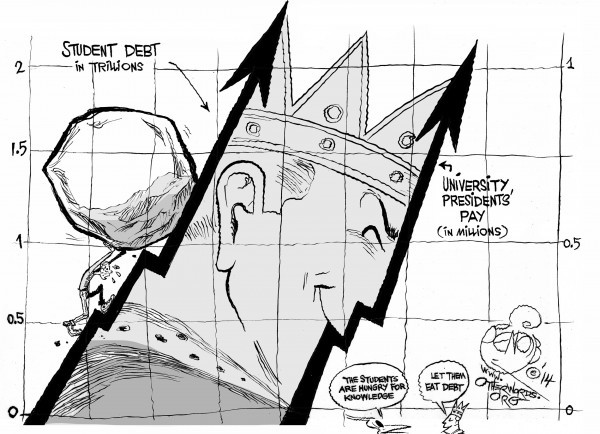
All you need is ammo

Photo by WILLIAM MORGAN
Car the other day in the parking lot of the Dunkin' Donuts in Newtown, Conn.
John O. Harney: Colleges and the 'Innovation Imperative'
BOSTON
"I was just thinking" was columnist Mike Barnicle's lazy motif in The Boston Globe. Still, it's hard not to copy a lazy motif. So … I was just thinking ...
Business leaders confirmed for the record this spring what they’ve been grousing about for years: Too few recent graduates have the skills to be good workers. That was the key finding in Northeastern University’s third annual survey on the “Innovation Imperative.” And it formed the base of a recent "summit" sponsored by Northeastern, WGBH and the New England Council.
Northeastern President Joseph E. Aoun opened the summit saying he doesn’t like using the term “customer” in higher education, but that the poll aimed to find out how CEOs, students and faculty view the university and higher ed's roles. (Infected myself by the cost-consciousness disease, I couldn’t help noticing that the handouts were on very heavy stock—relatively expensive.) The polled CEOs emphasized soft skills including communication and interpersonal skills over tech skills. They also emphasized entrepreneurship skills—not to launch a business necessarily but to think on a different level about creating an ecosystem and to learn how to fail.
Jeff Selingo of The Chronicle of Higher Education said he has wondered why more higher education institutions—HEIs as we abbreviate them now—hadn’t adopted Northeastern’s famous co-op model.
Aoun noted that during the recession, the number of co-ops actually grew because employers wanted to be sure to have a pipeline for talent.
So why not encourage dramatic expansion of the co-op idea as some in the Obama administration have suggested? One reason, worried Selingo, is that slews of new co-ops and internships might replace full-time jobs—the economy may not be able to absorb them.
Also working against co-ops, many students and parents today are looking for ways to cut a year off the overworked four-year bachelor's degree; co-ops sometimes add time to graduation. It's not a bad thing, but it could be grounds for penalties under the government’s controversial plan to introduce a new college scorecard. HEIs like Lesley University could also suffer under the new scorecard system because the university specializes in educating teachers, who still don’t earn that much money—one of the scorecard’s potential key measures of a worthwhile college.
Selingo injected a bit of sanity, noting that many faculty do not see higher ed as preparing people for jobs, but for life. Then the obligatory, but ever-shorter, tributes to the liberal arts all around.
On a different aspect of innovation, Partners HealthCare President Gary Gottlieb lamented underfunding of the National Institutes of Health, the federal research program that has played a central role in setting U.S. higher ed apart from the rest of the world. The combined effect of budget cuts and the increasing cost of biomedical research have resulted in a 12% cut between 2010 and 2013. That means less for researchers and breakthroughs in treating diseases ranging from HIV to Alzheimer’s.
All the panelists talked about the transformation of higher education and hiring. The moderator Kara Miller, host of WGBH’s Innovation Hub, quipped that if you interview to be an engineer at Facebook, they sit you down for a four-hour test to do some coding and other tasks, not to talk about your Columbia degree.
Selingo added that as more focus is directed to “outcomes” rather than “inputs,” rankings such as U.S. News and World Report will be turned on their heads.
He also mentioned that more older students are accessing education they need when they need it, not enrolling in degree programs. You'll have a foundation that may not be a four-year degree, but every couple of years, you'll access more from MOOCs and other new models.
Someone from the audience asked about a finding noted at the summit’s beginning in which more than 70% of CEOs attributed their success to their personal drive. She wanted to know, understandably, is that because higher ed is now so cast as a private good that you can attribute your success at the HEI to your own grit and determination? The answer should have been, “You didn’t build that.”
****
At the summit, Aoun briefly cited the rise of "competency-based education" as a new way to show what you’ve learned, rather than how long you’ve been in a class. CBE, as it’s called, may soon be all the rage. It seems to fit the times, offering higher-quality learning at lower prices. But I learned at a recent webinar that the concept has been around since the 70s. More than 130 institutions do it. Most of the students are in their 30s or 40s. It was noted that "academic success coaches" follow an “intrusive advising model” and can activate students who seem to be just lurking. Also that it's important for HEIs to enlist their library staffs so the students in the self-paced learning environment can find the resources they need.
One proponent of Wisconsin's CBE program says the chancellor told them they had permission to fail, which faculty don’t usually feel they have. Speaking of faculty, they tend to suffer the bruises in this larger conversation about transformation—especially tenured ones and their unions, and this while NCAA football players start using the U-word.
****
The Massachusetts Board of Higher Education approved America’s first statewide policy to make civics part of the curriculum at state colleges. Commissioner Richard Freeland, a historian, is concerned that public college graduates are focusing too much on job training and not learning the history of their own country. "For example, what is the history of our involvement in Asia, or the Middle East, or in Europe or in Latin America, and therefore not really having a context to evaluate what is going on in those regions as the United States tries to interact with them," Freeland told WGBH.
Just 21 states required a state-designed social studies test in the 2012-13 school year, down from 34 in 2001, according to a study released by the Center for Information and Research on Civic Learning & Engagement (CIRCLE), at Tufts University. To make matters worse, assessments have shifted from a combination of multiple-choice questions, essay questions, and other assignments to almost exclusively multiple-choice exams since 2000, meaning that the material tested tends to be relatively simple facts rather than the ability to apply information and skills to complex situations." That runs counter to the Common Core State Standards movement. Yet social studies as a subject has become a poor cousin, and there's little agreement on what makes sense to teach in the way of civics.
****
Gallup is always asking questions. When they asked people to rate their state as a place to live, 77% of Montanans pick theirs as good as do 77% of Alaskans. But just 18% of residents of Rhode Island did. A friend who writes in the Ocean State once unfairly and politically incorrectly damned the state as New England’s “slum.”
Another Gallup poll makes more sense though. It asked college graduates whether they're "engaged" with their work or "thriving" in all aspects of their lives. The big finding: Responses don't vary based on the prestige of their alma mater.
****
Mike Barnicle, it turns out, stole some of his “I was just thinking” material from George Carlin. The key in these gimmicky columns—as in higher education—is to think for yourself because George won’t be there with you.
John O. Harney is executive editor of The New England Journal of Higher Education (nebhe.org), where this piece originated. The editor of New England Diary is a former member of NEBHE's editorial advisory board.
Summer's 'full glow and luxuriance'
In the depth of winter, I finally learned that within me there lay an invincible summer.
-- Albert Camus
Summer has set in with its usual severity.
-- Samuel Taylor Coleridge
Summer is the time when one sheds one’s tensions with one’s clothes, and the right kind of day is jeweled balm for the battered spirit. A few of those days and you can become drunk with the belief that all’s right with the world.
-- Ada Louise Huxtable
Spring flew swiftly by, and summer came; and if the village had been beautiful at first, it was now in the full glow and luxuriance of its richness. The great trees, which had looked shrunken and bare in the earlier months, had now burst into strong life and health; and stretching forth their green arms over the thirsty ground, converted open and naked spots into choice nooks, where was a deep and pleasant shade from which to look upon the wide prospect, steeped in sunshine, which lay stretched out beyond. The earth had donned her mantle of brightest green; and shed her richest perfumes abroad. It was the prime and vigour of the year; all things were glad and flourishing.
-- Charles Dickens, in Oliver Twist