
Vox clamantis in deserto
Recent







Don Pesci: Cianci, Rowland, et al., and the politics of salvation
VERNON, Conn.
Buddy Cianci – the perhaps yet again Prince of Providence – is, to mix metaphors, the Pete Rose of Rhode Island politics.
We all know what Mr. Cianci did in office as mayor. When he was good, he was very good; when he was bad, he was very bad. A typical view of former jail bird and radio talk show host Cianci may be found, following an announcement by Mr. Cianci about running for mayor again, on LinkedIn.
The author of the piece is anxious not to be misunderstood: His post is not to be taken as an endorsement of Mr. Cianci’s political ambitions. But still…
“This is the man who took a near-literal sewer and transformed it into a center of art and culture. He stole the Providence Bruins from Maine and brought in regional hubs of tourism and commerce: WaterFire, the Providence Place Mall, and the Fleet Skating Center. Cianci would attend the opening of an envelope; he returned pride to a once great city. Buddy Cianci is Providence.” {Editor's note: Giving the endlessly self-promotional Mr. Cianci chief credit for all these things is misleading, as a perusal of history will show.}
Here in Connecticut, we have our own Ciancis, more pallid, to be sure, than The Prince of Providence, a very readable and entertaining unauthorized biography of Mr. Cianci by Mike Stanton, a former investigative reporter for The Providence Journal.
Former Connecticut Gov. John Rowland once again is chomping on a prosecution bullet. Like Mr. Cianci, Mr. Rowland spent some time cooling his heels in prison, having been pleaded guilty to a fraud charge involving the deprivation of honest services. Mr. Rowland’s plea followed an impeachment proceeding that was hampered by a federal investigation. But when Mr. Rowland was good, he was very good.
In Bridgeport, former State Sen. Ernie Newton is once again running for the General Assembly, having spent some time in the slammer for bribery in office The FBI recently sent to prison a handful of uncooperative singing canaries, all of them associated with the failed U.S. congressional campaign of former Speaker of the Connecticut House Chris Donovan, who miraculously – and some would say unaccountably -- escaped the noose.
One begins to understand a) that power is a powerful aphrodisiac that, mainlined, may get you a stretch in jail, and b) there have in the past been brilliant second acts in politics. The much loved and notorious James Michael Curley of Boston administered the affairs of Boston from a prison cell.
Why not Newton, the self-proclaimed “Moses of his peeps?” Like Mr. Curley – who kept a campaign promise to “get the washerwomen of Boston off their knees” (by furnishing his faithful voters with long handled mops) – Mr. Newton had been unusually attentive to those in the past who had voted for him.
Mr. Newton’s latest legal scrape finds him facing five counts of illegal practices. Contributors to Mr. Newton’s recent campaign have told prosecutors that they filled out cards attesting that they paid contributions of $100 each to complete a &15,000 fundraising goal that would allow Mr. Newton to tap into public campaign funds when, in fact, they had not done so. To date, no one knows where the mysterious $500 came from.
Bridgeport’s underdogs – those “lynched,” justly or not, by the state of injustice – may well have found a champion in the imperturbable Mr. Newton. At one point during his most recent campaign, Mr. Newton pointed out to an astonished reporter that a good many voters in his old district were no strangers to prison. At the molten core of crime-infested inner cities, one finds an appalling spiritual vacancy: Marriages are non-existent; fathers have fled households; young men are in prison; others go to school in gangs. Mr. Newton himself went to prison for having done poorly what Mr. Curley did well. And now aggressive prosecutors want to deprive his constituents of their democratic rights because someone – no one knows who – paid five petitioners $100 each so that they might contribute their mite to see to it that their “Moses” should be reelected to office, from which he will be able to lead them from their Babylonian captivity to a promised land of milk and honey.
This is the politics of salvation. One supposes that Mr. Curley and Mr. Barnum are spinning in their graves not because they are offended – but because they are jealous.
Don Pesci is a writer who lives in Vernon.
David Warsh: Too bad the NYT sold The Globe to Henry
BOSTON
I feel a continuing sadness at the fate of The Boston Globe. I had high hopes that the New York Times Co., after two decades of maladroit management that saw the value of its investment in New England newspaper decline from around $1.5 billion to $73 million, would sell the Globe and the Worcester Telegram & Gazette to the group of investors headed by Stephen and Benjamin Taylor, of the family that used to control The Globe. That wasn’t going to change anything I did, but I spent close to 25 years at The Globe and I love the paper and its staff. To have it and the Worcester paper back in knowledgeable local hands would have been deeply reassuring -- a happy ending to one episode and the promising beginning of another.
Instead, The Times sold the papers for cash on the barrelhead to sports magnate John Henry, its former business partner (the company made good money on its minority interest in Henry’s Red Sox). Henry replaced veteran chief executive and publisher Christopher Mayer, who had restored the paper to a reasonable semblance of its former self, with Mike Sheehan, a Boston advertising executive, and named himself publisher.
One of Henry’s first moves was to hire a prominent reporter from the National Catholic Reporter, based in Kansas City, Mo., John Allen, to write about the Vatican and Roman Catholic Church. That’s the job I used to have, except I covered economics, and more than just one sect of it!. Much as I appreciate the style of Allen’s reporting, the sheer shallowness of the paper’s play to regain readers lost during the New York ascendency irritates the hell out of me. But my moving to the Web in 2002 was the right decision and I am more than grateful to subscribers for keeping me here ever since.
David Warsh, an economic historian, is a longtime financial journalist and proprietor of economic principals.com.
david warsh
1.617.666.3365
The interior life of Mr. Cianci
I have always wondered about the interior life of people like former Providence Mayor Vincent Cianci whose self identity seems to only consist of being a celebrity -- who become husks if they don't think that the public is watching and hearing them. They get publicity; therefore, they exist.
-- Robert Whitcomb
Beth Salerno: History: The public option
MANCHESTER, N.H. If you ask Americans what is studied in history classrooms, many will answer “facts and dates.” If you ask them what people can do with a history degree, they answer “teach.”
Yet those same Americans acknowledge the power and practical relevance of history as they flock to national parks, historic sites, museums and cultural heritage sites; buy nationally best-selling biographies; see history-infused films like Twelve Years a Slave or any of documentarian Ken Burns’s epics; or research their family history within a larger context of national trends.
Among the humanities disciplines, history has a broad and positive public profile, even as the number of majors rises and falls with economic indicators. History programs are increasingly taking advantage of that public enthusiasm for the past to strengthen the discipline’s academic reach and successfully compete for majors and funding when much of the federal and institutional attention is on STEM programs or career preparation.
Public history courses and programs encourage students to take the deep content knowledge provided by traditional history classes and apply it to public problems or in public locations. It takes advantage of the increased higher- education focus on experiential or applied learning and an emphasis on practical experience and outcomes. At the national graduate level, the American Historical Association (AHA) has recognized the need to expand even traditional history graduate experience to include exposure to public history theory, methodology and areas of practice.
With a $1.6 million grant from the Mellon Foundation, the AHA will partner with four universities to broaden both the career prospects for and the impact of history PhDs. According to the AHA, “Expanding the employment horizons and qualifications of history PhDs is not just a matter of finding jobs for our students. We are also interested in widening the presence and influence of humanistic thinking in business, government, and nonprofits. Implicit assumptions about historical context inform thousands of decisions made every day in nearly every institutional context, and we believe that a substantial proportion of those decisions are made without recognition of those historical assumptions, and certainly with very little actual historical knowledge.”
Programs that prepare history master’s students for active engagement in the public application of history are not new, particularly in New England. The University of Massachusetts at Amherst has had a thriving graduate public history program since 1986. Northeastern University’s public history master’s program claims to be one of the oldest in the United States. The National Council on Public History lists 15 public history programs in New England, with nine in Massachusetts, two in New Hampshire, two Rhode Island and one each in Vermont and Connecticut, but none in Maine.
The majority of these programs offer only graduate-level courses. However a half dozen have more recently developed public history minors or concentrations within the major. For Franklin Pierce University in Rindge, N.H., a new concentration in public history stresses that “planning and completing historical research projects are also part of the curriculum.”
Project management skills are one of the most valuable job skills public history programs can provide to students. Salem State University has a public history concentration that benefits from public history projects on campus including one that is mapping the area’s Franco-American heritage and linking older Franco-American immigrants with the Dominican immigrants that now dominate the previously Franco-American neighborhoods. Public history programs make clear the powerful impact historical knowledge can have when applied to public issues, discussions and needs. Studies by scholars also suggest that public history courses increase student engagement and can increase the number of students who declare history majors.
My course at Saint Anselm College is one such recent development. It was created in 2006 in response to requests for a course that “prepared students to explore history options other than teaching.” Of course, history, like many humanities disciplines, prepares students for the widest array of careers by teaching high-quality writing, respect for detail and causation, awareness of the impact of diverse viewpoints, and the ability to make logical and careful argument. However neither students nor parents always see that, particularly in periods of economic downturn as we have experienced for half a decade.
Therefore this course introduces students to specific career paths in public history such as museum curation, the national park service or archival work. Each student completes three “history labs” getting hands-on experience completing a nomination for the historic register, or designing a museum exhibit. These practical labs serve as the training ground for their final project, a tangible public product that serves an existing need—whether for an oral history, a museum education lesson plan to accompany an exhibit, or an archival inventory of an area cemetery with walking tour brochure available on the web.
Public history courses drive collaboration between history departments and community cultural heritage institutions. They give organizations an infusion of excited, apprentice labor to complete public projects made difficult by budget cuts, while the students gain real-world experience, workplace orientation, and a chance to produce a signature project that can anchor a budding professional portfolio. Institutions of higher education generally, and history programs in particular, will continue to face pressures to produce return on investment.
Public history programs enable a humanities discipline to capitalize on engaged learning, hands-on praxis, student research and community collaborations to produce students who have, and are perceived by employers to have, employable skills, without sacrificing the deep knowledge and clear thinking that mark the best history graduates.
Beth Salerno is an associate professor of U.S. history at Saint Anselm College. This first ran on the New England Board of Higher Education's news and opinion Web site, nebhe.org.
No diving

Dashed aquatic ambitions: Perhaps discouraged by the shortness of summer in those parts or by liability-insurance rates, the owners of a motel with what had been a swimming pool behind it decided to give up and fill it in. Most of the lawn furniture seemed to refuse to accept the change.
Bridge of the fallen

This bridge in Littleton, N.H., to the west of the main White Mountains, has plaque every few feet to memorialize war dead.
Heidi Simmons: Is poetry dead? Does anyone care?
STONINGTON, Conn.
A decade ago Newsweek Magazine published an article with the provocative headline: "Poetry is Dead. Does Anybody Really Care?" The author concluded that while "poetry is the highest form of writing," it takes "work" and that our culture was becoming "intensely prosaic."
All true. But back then poetry was still alive. Sadly I believe that the answer today would be different because poetry has been dropped from the Connecticut state "Common Core" writing standards for the curriculum for kindergarten through Grade 5.
As a result, overburdened elementary school teachers have little incentive to give it much time. Today the writing focus is on opinion, explanatory texts and narratives.
But if elementary-school students never have the opportunity to explore their natural inclination for poetic expression, imagination, and word use, they will not fully develop their literary skills. Just as an artisan cannot become competent in his skill without understanding his tools, writers must become comfortable with their verbal tools. Writing poetry inspires and refines a child's use of words as tools. A fifth-grade student struggling with self-expression wrote a poem wherein he described his thoughts as a "jumbled mess of words" that were "fighting to get out by rearing, writhing, whipping, lashing, striking, and beating at his head until finally they seeped onto the paper."
The struggle of expressing an idea and the welcome relief when it is finally spread out on a page are clear in this student's poem. Words become friends and writing becomes fun. Poetry is a child's natal language, a voice with which children are born. Their engagement in the poetic elements of language begins in utero with the rhythm of the first heartbeats. The infant's poetic voice evolves into a delight of manipulating sounds. This is precursor to a child's delight in the rhythms and intonations of nursery rhymes.
A second-grade student of mine found rhythmic joy in her description of a thunderstorm. The "blunder slunder" of the storm blew hard through the trees and the "slunder dunder" of the storm rolled past her eyes as the trees were "flit blit" shaking and throwing their leaves.
Another gift of youth so apparent in elementary school is imagination. One of my fourth-grade students imagined sneakers to be alive as they reclined in the closet after a long run, "tired with their tongues hanging out" and their "shoelaces drooping" just before their "eyelets fluttered" to sleep.
Poetic imagination helps children to bridge the familiar concrete world with the strange and abstract world of adults. Children experience their physical world with a sensual scrutiny. They can see, hear, taste, and touch what has become banal and insignificant to adults. They can use the imaginative poetic tools of comparison to communicate and understand intangible concepts.
One young student of mine, in an effort to share her concept of poetry, imaginatively compared it to all the five senses. Poetry felt like a "corduroy jacket," sounded like a "whispering moon," looked like "her chubby orange crayon, dull at the tip," tasted like "summer honey," and smelled like "a lavender wand." In this way she traveled to a place where prose does not go.
These are examples of elementary school children who have had their natal gift of poetry nurtured in a K-5 literacy environment before "Common Core" standards entered the classroom. Before students address the rugged tasks directed by "Common Core" of writing something "supporting a point of view with evidence" or "examining an idea and conveying information clearly," it would seem important to sharpen their imagination and love of words through poetic wordplay.
Students who have experienced poetry writing show greater fluency and sensitivity to language in all their writing. Poetry helps writing to be fun. Surely this is good for our children's intellectual well-being. Is poetry dead? Let's hope not. Does anybody really care? We all should.
Heidi Simmons was the K-5 literacy coach at the Regional Multicultural Magnet School in New London, Conn., for 15 years before retiring this spring. She lives in Stonington. This first ran in the Journal Inquirer, of Manchester, Conn.
An app for caregivers
Please "like'' this new app to help caregivers of long-term ill people.
Ominously nice
The weather has been so beautiful around here in the last few days that it's making people nervous. When we lived in France, a particularly nice stretch of weather in late spring or early summer would lead to the newspapers saying (translating here, of course) "the loveliest weather since '40,'' when the Germans invaded.
David Warsh: The disrupted life of a business guru
BOSTON
Chances are, unless you are an MBA, you’ve never read anything by business guru Clayton Christensen, the author of a series of self-help business books beginning with The Innovator's Dilemma: When New Technologies Cause Great Firms to Fail, in 1997. Now, however, an interesting brouhaha has erupted surrounding Harvard historian Jill Lepore’s systematic evisceration of the arguments of Christensen last week in The New Yorker.
Lepore describes the Harvard Business School professor’s “disruption theory” as the product of a particular mood and moment in time – “the manufacture of an upsetting and edgy uncertainty,” as she puts it, a “competitive strategy for an age seized by terror.” In the end, she says, it turns out to be an unreliable guide to action. “Transfixed by change, it’s blind to continuity. It makes a very poor prophet.”
Christensen immediately responded in an interview he gave to Bloomberg Businessweek. “I hope you can understand why I am mad that a woman of her stature could perform such a criminal act of dishonesty—at Harvard, of all places.” The American Enterprise Institute, Paul Krugman and Salon's Andrew Leonard oeach chimed in. Harvard computer science Prof. Harry Lewis, himself something of an expert on disruptive change, added a couple of illuminating posts, "The Bogosity of Disruption Theory'' and "Clayton Christensen is Mad''. Meanwhile, Harvard Magazine dubs Christensen a "Disruptive Genius" in a lengthy story in its summer issue.
To understand the contretemps, it helps to begin with a profile by staff writer Larissa MacFarquhar that appeared in The New Yorker two years ago. To describe ''When Giants Fail: What business has learned from Clayton Christensen'' as credulous is an understatement; it is, in fact, a modern-day hagiography. It begins this way:
'“You can tell from the way I speak. I had a stroke about eighteen months ago. I’ve been learning how to speak English again, and you’ll see I still can’t come up with the right words sometimes.” The most influential business thinker on earth looked up and smiled apologetically. He stood with his hands in his pockets. His hair was neatly parted on the side. He was very tall. “I have a tendency to speak to the floor,” he said. “It’s because if I look at you, you distract me.”'
I would like to have been in the room when the magazine fact-checker asked for the source on the “the most influential business thinker on earth.” Later in the article, it turns out to depend mainly on a magazine cover story at the height of the dot.com boom:
"Andy Grove [CEO of Intel] stood up at the Comdex trade show in Las Vegas, holding a copy of The Innovator’s Dilemma, and told the audience it was the most important book he’s read in ten years. The most important book Andy Grove had read in ten years! A man from Forbes was in the audience that day, and in 1999, Grove and Christensen appeared together on the cover of Forbes, and things were never the same for Clayton Christensen again.''
Thereafter, Michael Bloomberg sent copies of the book to 50 friends. Bill Gates invited the professor to his home. Christensen partnered (for a time) with technology writer George Gilder.
By 2012, a couple of former columnists for The Times of London had invented Thinkers50, a biennial poll seeking to identify top management “thought-leaders” Christensen won twice in a row.
To that point, MacFarquhar’s article had been a chronicle of the early studies of computer disc drives and steel mini-mills (no mention of unions or foreign competition) that sparked Christensen to write The Innovator’s Dilemma, plus an account of his growing up Mormon on the wrong side of the Salt Lake City tracks. Well-managed businesses frequently remained too close to their customers’ needs to recognize, much less develop, new technologies that anticipate future needs, he had discovered; it was at the less profitable low end of the market where disruptive innovations most frequently emerged. Like his innovators, Christensen was “a low end kind of a guy,” MacFarquhar wrote, a diamond in the rough who nevertheless attended Oxford University as a Rhodes Scholar.
A key moment in MacFarquhar’s exposition came when Christensen is hired to find a way to grow the market for milkshakes at one of the big fast-food chains. Survey data were extensive, but no improvement the company made seemed to increase the market. The consultant took a different approach, asking himself “what job is a customer trying to do when he hires a milkshake?” Extensive observation and interviewing followed; it turned out that most purchasers wanted a breakfast drink, one that wouldn’t spill and that would last longer on the drive to the office. Thus more viscous, not less, was the answer, along with tiny chunks of fruit to surprise and briefly stop up the straw. The implication is that the market for milkshakes began growing again, though how much, MacFarquhar didn’t say.
Christensen concluded that the only way a big company could avoid being disrupted would be to start a “skunk works” – a small spinoff unit located far away from headquarters, staffed by out-of-the-box thinkers who are charged with entering new businesses inimical to the interests of the company’s main business. This is not exactly a new idea, but Christenson applied it with greater abandon than ever before. He told Then-Defense Secretary William Cohen his parable about mini-mills and sheet steel, whereupon the Defense Department sets up a counter-terrorism unit in Norfolk, Va., Later, Christensen himself became Harvard University’s skunk works, taping a lecture for the University of Phoenix to demonstrate the potential of massive open online courses. Harvard promptly entered into a joint venture with the Massachusetts Institute of Technology to pursue the possibilities.
So much for Christensen, New Yorker release 1.0. MacFarquhar is an accomplished writer, but in dealing with business history, she was operating outside of her comfort zone. Her Christensen article was one of a series of profiles of “moral saints,” part of a book about extreme morality that began with a 2009 New Yorker article about a series of persons who donated kidneys to others whom they did not know.
Harvard’s Lepore on the other hand, approaches her topic as a professional historian. She is the author of several well-received books, beginning Name of War: King Philip's War and the Origins of American Identity (Knopf, 1998). She is at pains to establish the sources of her background knowledge as well. For a short time at the end of the 1980s, as an assistant to an assistant, she answered phones for Harvard Business School’s Michael Porter, the business guru whom Christensen has gradually displaced. (Before Porter there was Peter Drucker, and before Drucker there was Bruce Henderson, of the Boston Consulting Group.)
Lepore does a good job of marshalling evidence against Christensen’s more sweeping claims as an industry analyst. His sources, she writes, are “often dubious and his logic questionable;” his theories lack predictive power. His stylized graphics may provide the underpinning of the analysis of The New York Times “Innovation Report.” but most of its would-be disrupters have yet to turn a profit. And his 2011 book, The Innovative University: Changing the DNA of Higher Education from the Inside Out, with Henry Eyring, contributed to a frenzy for MOOCs, which hasn’t begun to live up to expectations.
Hooray for The New Yorker for permitting one staff writer dispute another, even obliquely (MacFarquhar is married to fellow staffer Philip Gourevitch). Hooray, too, for Harvard University, for merely wincing as one professor attacks another, and, from the citadel of the faculty of arts and sciences, mocks the methods of the business school. Disruption vs. continuity? Lepore has broached an important topic. You haven’t heard the last of it.
David Warsh, a long-time financial journalist, is proprietor of economicprincipals.com and an economic historian.
xxx
'Triple A' approach to building community health
I chatted a while back with a colleague, James Marcus (Marc) Pierson, M.D., a Cambridge Management Group (cmg625.com) senior adviser. Dr. Pierson — an internist, emergency physician and past vice president of clinical information and quality for PeaceHealth St. Joseph Medical Center, in Bellingham, Wash. — is a major health-care reformer. His leadership in helping to create an integrated and patient-centered health-care system for Whatcom County, Wash., has received national attention.
As a leader of the Pursuing Perfection program in the county, he helped develop the community-based, patient-centric Shared Care health-record system and participated at the board level in the Whatcom Alliance for Healthcare Advancement (WAHA). WAHA helped lead to the recently approved Washington State Health Care Innovation Plan, which has put the power of the state government behind the many ideas arising from Whatcom County’s whole-community and patient-informed perspectives.
He told us that “the county level is the smallest appropriate geographic base for creating a coordinated-care system.’’ Whatcom County was particularly attractive for such efforts because it has attracted a lot of civic-minded and collaboration-minded physicians who “didn’t move here for the money but, among other things, for the natural beauty.’’
Dr. Pierson said that creating an integrated-care model requires first observing how the chaotic traditional “system’’ was or was not working, then trying to understand it and then writing down observations and designing changes. It was crucial to understand the inter-actions of all of the parts of the health-care system, and, crucially, to use patients’ knowledge and opinions – those too-often-neglected elements of health-care reform – in changing the individuals and institutions that serve them.
He cited the “Triple A’’ approach: 1.) research and analyze the needs and desires of the patient population; 2.) understand (clinically and financially) the other parts of the system (doctors, nurses, hospitals, insurers, etc.; 3.) design together one integrated health-care community in which patients’ decisions play the most important part.
With that, he said, we can build a health-care system whose treatment and payment system addresses the ever-changing needs of the whole community. “The quality of the entire system suffers,’’ he said, “when the focus is more on the individual parts and loses sight of the whole community health system. Perfect parts do not make perfect or even good systems. It is the interactions between the parts that must be designed….’’ In any event, the improve-the-parts approach is unsustainable.
Further, Dr. Pierson said, we need to move away from the “extractive financing model’’ of American health care, in which much of the savings from improving a community’s health care leaves the community, making it unavailable for reinvestment. And he touted the idea of setting targets for spending on health within a whole community, citing the success of Jonkoping, Sweden, which set a target of 8.3 percent of the local economy for health care and has had very good outcomes.
He said that his experience in the mid-’80’s as an ER doctor trying to pull together in an ad hoc fashion a variety of specialists to treat a young man badly injured in a motorcycle accident helped get Dr. Pierson thinking about systems and coordination.
This line of focused community building would ultimately lead to his campaign for integrated, community-wide care. Along the way, he made it a point “not to ask anyone to do anything that was against their economic self-interest.’’ And he sought out the “most respected players’’ in the Whatcom health-care community to help him carry out this vision for the county. He's a very practical (and mostly behind-the-scenes) reformer, whose recommendations would be helpful anywhere in the country.
Given the widening income gap in the U.S., we wondered about whether only the rich would have the finest sort of individualized “concierge care’’. Somewhat to our surprise, Dr. Pierson was optimistic that the use of genomic information, personal medical devices and other advances would make “concierge care’’ available to everyone in the fullness of time, aided by the doctors, nurses, social workers and other health-care ‘’navigators’’ who will increasingly see a major part of their jobs as helping to guide patients to the information they need as well as through the system.
It’s all part of his vision to have all of us see “medicine as a part of health and well-being.’’ The whole community, he says, owns its health and well-being and we must design our futures in that context.
-- Robert Whitcomb
Somali resettlement: 'Poverty on top of poverty'
The mayor of Springfield, Mass., Domenic Sarno, is angry that the federal government keeps sending Somali refugees to his city, where a third of the population is below the poverty line. I don't blame him. "I have enough urban issues to deal with. Enough is enough. You can't keep concentrating poverty on top of poverty,'' he told the Associated Press.
A lot of these people (who tend to have big families) live in overcrowded apartments that sometimes lack electricity and even heat. The mayor complained that resettlement agencies are bringing "warm-weather'' refugees into cold climates to live.
Somalis started coming to Springfield in large numbers in 2004, pushed by federal officials who directed them to places with urban infrastructure, including mass transit (essential for many people to get to jobs). The more who live there, of course, the more who come, to be with families and friends. Most of the adults have jobs. But, of course, especially with large families, many also need social services.
A Boston Globe editorial criticized the mayor for ignoring "the moral imperative to help refugees and the benefits those refugees can bring.''
But The Globe's editorial board doesn't spend a lot of time in poor communities such as Springfield. Maybe their criticism would have more weight if they pushed for such affluent towns as Wellesley to take in Somali refugees.
Niche in abstraction

"Goirko'' (painting), by DORIS CARLSON, in her show Doris Carlson/30 years/A Retrospective Painting Exhibit'' at ArtSpace Gallery, in Maynard, Mass., through July 18.
She started out as a representational painter but found her niche in abstraction.
Llewellyn King: Bring back reporters' long lunches
When I first worked at the newspaper trade in Washington, back in 1966, it
was a different journalism. I don’t mean the difference in the technology, the 24-hour news cycle, or the ramped up interest in celebrity. I mean
something more protean, more organic.
I worked at The Washington Daily News -- a tabloid in size but not in
mission -- and we covered the news in a very traditional way: whatever our
news judgment demanded. Although we were a Washington afternoon newspaper, politics was just part of the mix.
The Daily News had one full-time congressional correspondent, and we sent
reporters to Capitol Hill when there was really a lot going on. The
Washington Post -- then as now the dominant paper in town -- covered The
Hill more intensely, but not with the intensity that it does today.
In short, political coverage was more laid back; not asleep, but not as
frantic as it is now. Nobody felt it necessary to record every slip of the
tongue, or where a congressman had lunch or, for that matter, with whom.
Certainly, nobody felt they should shun the wine list -- and few did.
Covering the White House was a simple matter: once through the gate, you
could stroll through the West Wing and talk to people. Today, even if you
have a regular or so-called hard pass, you are restricted to walking down
the driveway to the press briefing room. If you have an appointment, or want to smell the flowers, you have to have an escort – usually a young
person from the press office.
Why this is, and what the purpose of this minder is, nobody has been able
to tell me. It is so dispiriting to see the equanimity with which reportersaccept their prisoner status.
It did not happen overnight, but gradually under president after president.
In my time in Washington, reporter freedom has been curtailed at the White
House to the point that unless you want to go to the briefing, there is no
point in going through the gate. No news is available because you, the
reporter, are not at liberty to collect it.
News out of the White House now has to be gained off the premises, on the
phone or by the Internet. The briefing room is a dead zone for print
reporters, with the television reporters going back and forth with the
press secretary, which is what their medium demands. No news is brokenexcept when the president saunters in and things pick up. That is not worth hanging around there day after day.
But the real change is the proliferation of political media, including the
such dedicated publications as Roll Call, The Hill, Politico, The National
Journal and the cable news networks. This means there are more reporters
chasing snippets of news. The big issues get lost as often as not while the
news hounds are baying after trivia, little non-events, misstatements, or
failure to apologize for imagined sleights.
>
Also, White House staffers and people who work on Capitol Hill have less
and less confidence in reporters and are less frank with them. I find very
little point in interviewing Congress people these days because they worry
that whatever they say will, if you like, go into their record to be
dredged up way in the future.
>
The other great organic change is in reportorial ambition. Back in the
1960s (and I must confess I started reporting in the 1950s), reporters
longed to be foreign correspondents; to go abroad and tell us about life in
faraway places. Today, with the emphasis on politics, the ambitious
reporter longs to cover politics in Washington. So if there is a big
international event, such as the Iraq-ISIS conflict, it ends up being
covered through politics. What did Obama say about it? Has John McCain been heard from?
>
This affects both our understanding of an issue, and does nothing to ameliorate propaganda narratives. Over-covering the snippets does not help:
It obscures when it should clarify.
>
A lot of news used to come out of reporters' long lunches with politicians.
Now the number of drinks served, as espied from another table, would be the
news.
Llewellyn King is executive producer and host of “White House Chronicle,”
on PBS. His e-mail is lking@kingpublishing.com.
>
Rain drops in New Hampshire

"Rain'', a woven abstract landscape by BHAKTI ZIEK, in her show at the Aidron Duckworth Museum, in Meriden, N.H.
Robert Whitcomb: The delights of density
Crowded American cities are generally healthier than less crowded ones -- usually safer, more interesting, more energetic, more convenient, more fun and more creative. Density is associated with higher rates of innovation and entrepreneurialism. Crowded urban cores spawn clusters of people who increase each other’s productivity via cross-fertilization of ideas.
As the late, great sociologist and city watcher William H. Whyte told NBC News in 1987: “What makes a city great? A lot of people pretty close together. Buying, selling, talking, looking, eating.’’ Daily excitement. Reveling in a shared civic experience. “The trouble with most smaller cities is that they don’t have enough people out on the sidewalk. What they should be doing is concentrating, concentrating to get that critical mass,’’ Mr. Whyte said. (On this topic, I particularly recommend his book “City: Rediscovering the Center’’.)
So I was happy to read a June 11 Providence Journal story headlined “Providence looks to rewrite zoning to build on a strength: Density’’. About time! As other cities have recognized, the suburban paradigm of prioritizing parking lots and rigid zoning rules that severely separate commercial and residential areas doesn’t work well for real cities. It doesn’t seem to work all that well in the suburbs either, as the increasing number of empty big-box stores there might suggest. Indeed, many suburban towns are trying to recreate their “village centers’’ of yore. (In the hometown of my boyhood, we’d walk or bike the three-quarters of a mile to such a center for just about everything, from candy to clothes to copies of Mad magazine. Then, big stores were built at a new shopping center near a divided highway on the edge of town with a windswept parking lot and soon there wasn’t much you could buy in the village center except overpriced lighthouse paperweights. About the same time (1959) commuter train service to the town was halted, a land-use disaster. Now train service is back and residents lobby for more stores that they can walk to.)
Providence’s current zoning laws, like those of many cities, were written in the automobile’s glory years, the ‘50s, when cheap gasoline and the new Interstate Highway System helped fuel the idea that all of life could be connected by a car. Of course, since then, gasoline has become much more expensive and the environmental, sociological and economic costs of car-based sprawl much clearer. That’s not to say that the door-to-door convenience of driving in those days with less-crowded roads (and better, nontexting drivers) was not often delightful. The lure of the open road was and is powerful. Kerouac was on to something. But with 310 million Americans now, that road is clogged in much of America.
Proposed new zoning for Providence and some other cities would reduce the parking-space requirements for businesses, which would be encouraged to share required parking spaces among themselves, and smaller businesses wouldn’t have to provide any parking spaces. Space would be allocated for bikes. (I realize that the new rules would formalize what has already been happening to some extent.) In a denser city, having fewer parking spaces works because fewer people have cars. They walk more, take the bus, bike and use such services as Zipcars when they need a car to, say, go out of town or to haul stuff. A city that encourages density almost by definition encourages mass transit.
And get rid of most setback rules that in some places bar store and restaurant owners from having their establishments right up against the sidewalk. The closer to the sidewalk a business is, the more it contributes to sidewalk life. Why encourage developers to put parking lots, forlorn at night, in front of sterile office buildings or chain restaurants in downtowns?
As much as possible, make places where residents can live, work and shop by foot, with lots of “third places’’ that aren’t home and aren’t workplaces, such as coffee shops, restaurants, bookstores and pubs where loyal customers regularly do business and socialize in familiar and friendly settings. Those amenities are especially popular among young adults (who tend to marry late, if at all, and have fewer kids than their parents) and retirees, who seek proximity to the cultural amenities, doctors and hospitals concentrated in cities. Current and future demographics favor the direction that Providence’s planners are heading in. Public policy, however, should be more focused than it is on accelerating these urban-planning changes. The days when most people were content to drive 25 minutes to go grocery shopping are ending.
Providence, a medium-size city (with a metro area of about 1.3 million), has not destroyed so much of its dense urban built environment fabric that it cannot again achieve a thicker, healthier density. It’s the sort of density whose attractions draw so many people to put up with the high costs of living in New York or Boston.
Robert Whitcomb, a former newspaper editor, is currently a management consultant in the health-care sector, a Fellow at the Pell Center for Public Policy and International Relations and a columnist.
Charles Chieppo: How much do states really owe?
BOSTON When it comes to getting your arms around just how much states really owe, there is no shortage of moving parts. There's bonded debt, and then there are liabilities for pensions and for other post-employment benefits such as retiree health care.
Dig deeper and you find that states set different periods over which they aim to pay down liabilities and that they assume differing rates of return on investments. Some states use fixed annual payments, but many use a gradually increasing schedule that results in payments being backloaded.
A new report from J.P. Morgan performs an important service by showing how states would stack up if all of these major variables were standardized. The study's author, Michael Cembalest, assumes a 6 percent rate of return on investments, level annual payments and a 30-year term for paying down liabilities.
Despite nearly $1.5 trillion in debts and unfunded retirement obligations, the study finds that, overall, state liabilities don't amount to the kind of national crisis that has often been portrayed. That is, unless you live in one of the states that face some very difficult choices because their debt and retirement costs are at or above a quarter of state revenues.
Cembalest finds that states with a liability-to-revenue ratio of 15 percent or less are in pretty good shape, and 36 states fall into that category. But eight states are in trouble. Given all the attention its pension problems have garnered, it's no surprise that Illinois is the worst, but wealthy Connecticut isn't far behind. Five of the eight (Delaware, Hawaii, Illinois, Kentucky and New Jersey) would have to more than double their annual payments to get their debt and retirement liabilities under control. The other two states on the watch list are Massachusetts and West Virginia.
The 6 percent rate of return Cembalest assumes on state investments is below historical averages, but it represents a much safer strategy than the 7.5-8 percent that most states assume. Such rosy assumptions result in gaping budget holes during tough economic times when states are least able to plug them.
While it might seem to make sense to increase annual retirement-liability payments each year on the assumption that inflation increases payrolls over time, too high a rate of annual escalation results in backloaded contributions that can understate long-term liabilities.
Perhaps as a result of the attention devoted to public-pension costs in recent years, 29 states made their full annual required contribution (ARC) to their pension funds in 2012. But the cost of other post-employment benefits (OPEB) is an even larger burden than pension liabilities in Hawaii and Delaware, and it is equal to pensions in Connecticut, New Jersey and West Virginia.
Despite the magnitude of the problem, just seven states made their full ARC toward paying down OPEB liabilities that year. Montana and Nebraska contributed nothing.
If the J.P. Morgan report is correct, most states have dodged a bullet. But to avoid a future crisis, they must do a better job of both calculating and addressing long-term liabilities. Massachusetts, for example, uses a debt affordability analysis calibrated to ensure that debt-service costs don't exceed 8 percent of budgeted revenue in any future year.
In addition, state taxpayers can no longer shoulder the entire downside risk for pensions. They should transition to a system under which employees have a choice between defined-contribution and cash-balance plans.
The majority of states that face manageable debt and retirement liabilities can rightfully breathe a sigh of relief. But unless they get more conscientious about long-term liabilities, they won't be so lucky in the future.
Charles Chieppo (Charlie_Chieppo@hks.harvard.edu ) is a fellow of the Ash Institute at Harvard's Kennedy School. This originated at the Web site of Governing magazine (governing.com).
Arnold Oliver: Golden Rule will again ride the waves
Back in the 1950s, the U.S. military made the Marshall Islands the primary site for its nuclear weapons testing. As you might expect, those tests in the middle of the Pacific Ocean wreaked havoc on the environment and human health. In 1958, a Quaker-inspired voyage of nonviolent protest set out from California for the Marshall Islands in a little sailing ketch called the Golden Rule to do
something about it.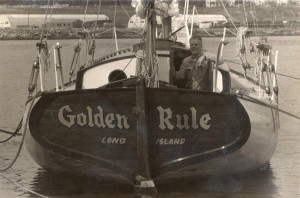 The Golden Rule and its crew never made it to their intended destination. The Coast Guard stopped the vessel in Hawaii and arrested everybody on board. But the publicity surrounding the crew’s trial and imprisonment helped ignite worldwide public outrage against atmospheric tests.By 1963, the United States, the Soviet Union, and the United Kingdom signed the Partial Nuclear Test Ban Treaty. The pact banned nuclear tests in the atmosphere, underwater, and outer space. No nuclear tests took place in the Marshall Islands after 1958.The Golden Rule was the forebear of all the peace and environmental protest boats that followed, from the Sea Shepherds to Free Gaza. The connection to Greenpeace is direct.In 1971, Golden Rule supporter Marie Bohlen attended a meeting in Vancouver, British Columbia, of people concerned about nuclear weapons testing. She suggested a voyage toward the U.S. nuclear test site in the Aleutian Islands á la the Golden Rule. Soon, the rusty trawler Phyllis Cormack was renamed the Greenpeace and headed north toward the Alaskan Archipelago. The rest, as they say, is history.Bohlen, known as the matriarch of Greenpeace, passed away earlier this year at 89.Sadly, after the 1958 voyage, the Golden Rule slipped from public view. The ship wound up in Humboldt Bay, Calif., badly neglected. A storm finally sank it in late 2010.
The Golden Rule and its crew never made it to their intended destination. The Coast Guard stopped the vessel in Hawaii and arrested everybody on board. But the publicity surrounding the crew’s trial and imprisonment helped ignite worldwide public outrage against atmospheric tests.By 1963, the United States, the Soviet Union, and the United Kingdom signed the Partial Nuclear Test Ban Treaty. The pact banned nuclear tests in the atmosphere, underwater, and outer space. No nuclear tests took place in the Marshall Islands after 1958.The Golden Rule was the forebear of all the peace and environmental protest boats that followed, from the Sea Shepherds to Free Gaza. The connection to Greenpeace is direct.In 1971, Golden Rule supporter Marie Bohlen attended a meeting in Vancouver, British Columbia, of people concerned about nuclear weapons testing. She suggested a voyage toward the U.S. nuclear test site in the Aleutian Islands á la the Golden Rule. Soon, the rusty trawler Phyllis Cormack was renamed the Greenpeace and headed north toward the Alaskan Archipelago. The rest, as they say, is history.Bohlen, known as the matriarch of Greenpeace, passed away earlier this year at 89.Sadly, after the 1958 voyage, the Golden Rule slipped from public view. The ship wound up in Humboldt Bay, Calif., badly neglected. A storm finally sank it in late 2010.
When a group of Northern California members of Veterans For Peace learned the damaged ketch was nearby and might be salvageable, they leaped at the chance to raise the vessel from the depths and restore it to its former peacemaking glory. Later, many others joined them, including me. I assist with fundraising from my home in Ohio, and have journeyed to California, mostly to sand, paint, and help however I can.
The Golden Rule’s original crew richly deserves honoring. They stood firm for peace and nonviolence before it became fashionable. Two of them, Albert Bigelow and James Peck, were among the original 13 Freedom Riders in 1961. Racist mobs beat them badly for their trouble, but they won in the end with the desegregation of interstate buses.
The other crew members were equally noteworthy. One led United Nations development programs, and another became a founder of Peace Brigades International.
All of us on the crew restoring the Golden Rule are honored to carry on this legacy as best we can by bringing that noble little ketch back to life. While sponsored by Veterans For Peace, the Golden Rule Project brings together an eclectic mix of environmentalists, peace activists, and progressives. It’s open to anyone interested in working to complete the ship’s restoration and promote its mission.
Once we finish that task, the Golden Rule will again ride the waves as a living museum and floating classroom. It will educate future generations on the risks of nuclear technology, the importance of the ocean environment, and above all, the power of peace-making.
Arnold “Skip” Oliver (soliver@heidelberg.edu) is a professor emeritus of political Science at Heidelberg University, in Tiffin, Ohio, an avid sailor, and member of Veterans For Peace and the Golden Rule Committee. This was distributed by OtherWords.org.
John H. Field: An eight-point program for reviving Conn. economy
LITCHFIELD, Conn.
“How did rich Connecticut morph into one of America’s worst-performing economies?” Forbes Magazine asked in its August 2013 edition. Connecticut has become a bottom-quartile state by almost every measure of economic performance with contraction in its economy in 2011 and again in 2012, higher unemployment than the national average, and being last in the nation to reach “Tax Freedom Day,” which was May 13 this year.
How did this happen?
Jim Powell of Forbes asserted: “During the past two decades, some 300,000 more Connecticut residents have moved out of the state than have moved in … because investors, entrepreneurs, and other productive people want to go where they are welcome … and not exploited.”
Connecticut’s current administration and legislature have continued the downward trajectory of the state’s economy with more debt-funded growth of spending, the largest increases in taxes, and a continued hostile attitude toward businesses.
We must stop doing what isn’t working.
Connecticut has an opportunity in 2014 to make changes in management of its state government that are necessary to reverse its direction. This can be done as other states have demonstrated. Needed most are the will and courage of Connecticut’s elected leaders to make the necessary changes.
For voters, the need is for a broader interest in the state’s future than in whether the state is run by one political party or the other.
The following platform principles could provide the foundation of a new compact with the people. This is a call to action to both incumbents and their prospective replacements:
1. Install professional fiscal management disciplines. Clarify the state Constitution’s mandate for a balanced budget. Establish Generally Accepted Accounting Principles accounting with external audits, comprehensive budgeting, spending control systems, and biannual, zero-based planning of all programs and budgets.
2. Reform the state tax code to orient it toward economic growth.
3. Review and reform the regulatory environment to balance being “business friendly” while protecting the health, safety and personal freedoms of individuals.
4. Enact pro-choice labor laws that enable employees to choose a union to represent their interests to employers yet protect employees’ freedom to choose not to be dues-paying union members.
5. Change funding of public-employee benefit plans from guaranteed benefits to contributions at levels consistent with practices in private businesses. Encourage individually owned, portable employee savings plans for pension and medical planning.
6. Reform public education, strengthening parental and local school district control of curriculums, hiring, and compensation. State government should let public funds be used by parents to choose their children’s schools.
7. Reconsider the state’s role under the federal Affordable Health Care Act to control Medicaid costs and services, to maintain individual choice of insurance coverage options, and to protect provider-patient relationships.
8. Sustain state laws and regulations for environmental protection. Continue current Department of Energy and Environmental Protection strategies while building a reliable and low-cost energy infrastructure that supports competitiveness of commercial consumers and needs of individuals.
Note the absence in this list of religion, abortion, contraception, women’s rights, gun control, racial issues, sexual preference, immigration, foreign affairs, and sovereignty. These are important, complicated, and long-term national issues, but in Connecticut this year the focus must be to improve management of the state’s economy, business climate, and public education. Get these right and economic and employment growth will follow.
John H. Field (Litchfield.jfield150@gmail.com) is a retired senior executive of Union Carbide Corp. and a former member of the Board of Finance in Washington, Conn., who now lives in Litchfield.