
Vox clamantis in deserto






Driving in Boston 50 years ago
What a neat idea: Here's a video, from The Boston Globe, of what it was like to drive though Boston and Cambridge half a century ago. I remember it well from summer jobs I had on the Hub's waterfront in the mid-'60's.
Those hideous cars and terrible drivers! It was rather a gritty city then. Now much of it has been Manhattanized.
'Religious extremists' or just power-hungry?
Journalists and others are always talking about "religious extremists,'' which theses days usually means people professing to be Muslims. But i think that such violent people, whether they self-identify as being driven by "religious'' or secular political "idealism'', as with Communists and Nazis, are actually driven almost entirely by the lust for power and by murderous resentment ( from a sense of shame) and often by sadism, too. We too loosely say that they're driven by religious idealism. That's their cover story. Mao, Stalin, Hitler and other mass-murderers also cited idealism when in fact they wanted power above all, especially the power to kill.
The more encompassing the theology/ideology, the easier it is to rationalize the joys of brutality.
As for quelling the "islamic'' madness in much of the Mideast, probably the best long-term solution is to stop buying the region's oil and gas, revenues from which these terrorists and police states use to procure arms and other resources necessary for their seemingly permanent wars. Marginalize the Mideast as much as possible.
John Smith's 'virtual colonization' of 'New England'
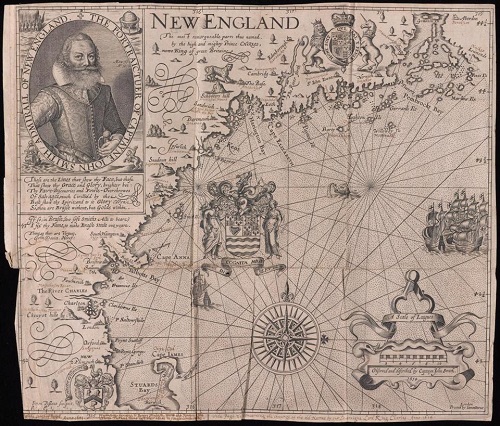
John Smith's version of New England in his 1616 map,The map is in the Beinecke Rare Book & Manuscript Library, at Yale University, in New Haven.
Michael Blanding has written a delightful piece for the June 15 Boston Globe about English explorer/entrepreneur John Smith's fantastical map of New England, published in 1616 and based on Mr. Smith's expedition of 1614. The map was the first document to call the region "New England''. Other English place names were plunked in on the order of the then crown prince of England, Charles (as in the Charles River).
You'd never know from the map that most of the region was woods and that the settlements were Indian, with, of course, Indian names. But then, Mr. Smith apparently really did think that a freer, happier version of Olde England could be planted in "New England,'' and rather rapidly.
I (Whitcomb) love the scorpion tail of "Cape James'' (named after the English king of the time, James I, Charles's father) now known as Cape Cod.
As Mr. Blanding noted: {T}he scale of Smith's fictitious landscape was an unprecedented act of virtual colonization, drawn before a single permanent English settlement had been founded'' in New England.
But by associating the region so closely with England with these names, he helped draw the English here to take over. They were lucky, if that is the word, that a series of epidemics of diseases introduced into the region by European traders and sailors, probably operating mostly along the Maine coast, about the time of the map wiped out the majority of the Indians, whose settlements had quite different names than the Plimouth, etc., that Mr. Smith gave them to drum up business. The Indians had no immunity from these Eurasian diseases, which included smallpox.
Thus southern New England has a mixture of Indian and English place names.
2nd Circle's app for caregivers
2nd Circle is a highly useful and accessible proposed Facebook app to ease the lives of caregivers in these days of health-care churn.
Richard J. Eskow: What Democrats can learn from Cantor's defeat
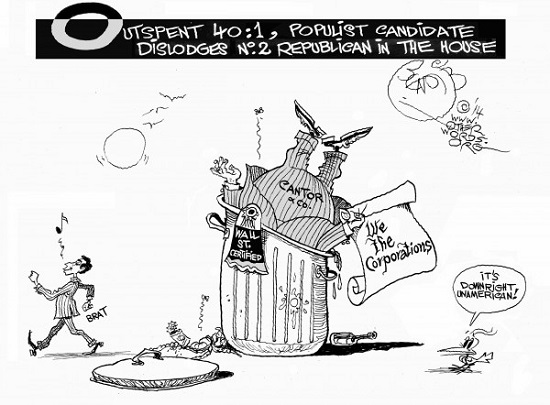
Cartoon by KALIB BENDIB for OtherWords.org
David Brat, the man who unexpectedly defeated Eric Cantor in a recent Republican primary, is an ideologue. That should be a source of encouragement for candidates on the populist left — but not for the reasons that you might think.
Brat is a professor whose college chair is endowed with libertarian money and ran a campaign rife with Tea Party slogans. Yet it would be wrong to minimize Brat’s victory, as Hillary Clinton did, as solely the result of his across-the-board opposition to immigration reform. That theory deflects attention from the populist side of Brat’s campaign, thereby minimizing a movement that presents a potential threat to Clinton and a number of other Democrats.
Brat made Cantor’s Wall Street ties a key campaign theme by tapping into a frustration with corrupt Washington politics that spans the political spectrum. “I’m an economist. I’m pro-business. I’m pro-big business making profits,” Brat declared on the campaign trail. “But what I’m absolutely against is big business in bed with big government. And that’s the problem.”
It’s no wonder that reporter Ryan Lizza described Brat in The New Yorker as “the Elizabeth Warren of the right.” When Brat says “the Republican Party has been paying way too much attention to Wall Street and not enough attention to Main Street,” he echoes the Massachusetts senator’s theme that “the system is rigged for powerful interests and against working families” — and the argument that progressive Democrats are making about their party’s dominant wing.
That’s why Brat’s candidacy doesn’t belong in the standard Tea Party basket. Cantor more closely fit this mold, with his fiery Tea Party-like rhetoric belying the fact that he was very much part of the Beltway elite, a Republican apparatchik, and a friend of the corporate class.
When Brat called Cantor out — “the crooks up on Wall Street and some of the big banks…they didn’t go to jail. They are on Eric’s Rolodex” — the underdog garnered enough votes to win a race against a top dog.
His mix of messages comes as no a surprise to people such as me who track polling data on economic issues. It’s been clear for years that anti-corporate populism appeals to voters across the political spectrum.
Inside-the-Beltway consensus thinking tends to dismiss voices on both the left and the right as unimportant to the political process. The mythical “truly undecided centrist voter” — that legendary creature situated precisely halfway between the Republican and Democratic parties on key issues — has led the political class to ignore the electoral power of ideological voices.
Many Democrats are making the mistake of embracing the same pro-corporate positions as their Republican opponents while losing touch with what’s happening back at home.
Far-right media personalities, including Laura Ingraham and Mark Levin, gave Brat a tremendous leg up among conservative-populist true believers, stoking their enthusiasm and fueling both organizational efforts and turnout.
The left has its voices, too, and insurgent Democratic politicians shouldn’t be reluctant to rely on them just because they’re afraid that the “in crowd” in Washington will marginalize them. As Brat’s victory shows, distancing yourself from the in crowd can pay off.
Ideology has gotten a bad name from members of both parties who would rather push a Washington-corporate consensus than have a real debate on the issues and principles that should drive our nation’s decision-making.
What will happen if Republicans like Brat, with their anti-immigrant populism, face off against Democrats like Elizabeth Warren imbued with a populism grounded in economic justice? We might finally have a real debate about how to break the corporate stranglehold on politics and the economy.
Richard J. Eskow is a fellow at the Campaign for America’s Future and the host of "The Zero Hour'', a nationally syndicated radio show. He wrote this for OtherWords.org.
Chris Powell: Special interest by special interest
After soliciting support Monday from the convention of the Connecticut AFL-CIO -- that is, the government-employee unions, the jobs of private-sector organized labor in Connecticut having moved away -- Tom Foley, the leading candidate for the Republican nomination for governor, said it would be a "fool's errand" to try to reduce the privileges of government-employee unions here as lately was done in Wisconsin.
Foley insisted to the delegates that when he asked a rhetorical question last year -- "When is the Wisconsin moment going to come to Connecticut?" -- he meant no challenge to collective bargaining for government employees but only to Connecticut's domination by the Democratic Party.
He promised that a Foley administration would not seek to economize at the expense of state employees -- as if the biggest cost of government in Connecticut, the compensation of state and municipal employees, could be fully insulated against any serious attempt to reverse the state's decline.
But Foley's clumsy dissembling about a "Wisconsin moment" evoked only snickering and laughter from the delegates, and their leaders declared that he wasn't to be believed.
The "fool's errand" turned out to be only Foley's pandering to the government employees, which not only earned him their contempt but also risked the contempt of people hoping for a choice in the election for governor. For Foley had essentially proclaimed that he wouldn't change much about state government at all, that no one on the payroll has anything to fear from him, and that he will compete for votes with Gov. Dannel Malloy, the Democratic nominee, special interest by special interest.
Foley accomplished nothing at the labor convention and if he is elected what he said there will get in the way of his governing.
* * *
In turn the governor pandered too, only successfully, equating government employee unions with labor generally, thereby accepting the unions' image of themselves as the vanguard of the working class rather than its overseers, what the social critic Roger Kimball called "tenured radicals."
With that remark about a "Wisconsin moment," the governor said, Foley had been "going after organized labor, which I equate to going after the middle class." Of his administration the governor added, "We are not responsible for a single layoff in a municipality because of a budget cut we made."
Of course, the governor has raised taxes dramatically on the middle class -- indeed, by a record amount -- but he gave the union convention to understand that his highest objective will remain job security for government's own employees.
"I stand with labor," Malloy said. "I always have. I always will."
The delegates, most of them representing government employees, seemed pleased that the governor did not identify himself as a manager who represents everyone in the state and who thereby is obliged to try to get maximum value out of the government. But the delegates should have been far more pleased that Foley had forsworn that idea. Now they stand to win no matter who is elected. * * * Independent gubernatorial candidate Jonathan Pelto criticized AFL-CIO leaders for refusing to let him address the convention. Pelto, the former Democratic state representative from Mansfield and longtime advocate of government-employee union supremacy, is running on a platform of punishing Malloy for having wondered aloud two years ago whether there might be more to public education than job security for teachers, a thought the governor quickly repudiated when he returned to his political senses.
Pelto said his exclusion "flies in the face of the democratic principles that are purported to be among the core values of unions." But Pelto's exclusion may have served him right for having been such an uncritical tool, and he should have known better. While he pitches ideological purity, the governor pays cash.
Chris Powell is managing editor of the Journal Inquirer in Manchester, Conn.
'Botanical archaeology'

"Highway Into the Void'' (oil on canvas), by PETER WATTS, in his June 20-July 6 show at the Berta Walker Gallery, Provincetown.
The blurb for his show says that "he is always aware of the history of human touch that nature quickly covers over.'' The gallery calls his approach "botanical archeology.''
It said that Mr. Watts, who lives in Wellfleet, "sometimes paints houses based on his knowledge of local history coupled with discoveries like a long-abandoned cellar hole....A stand of pines on top of a knoll is a former pasture returned to seed, surrounded by the oak forests that will one day conquer it.''
Of course, much of New England, especially mostly densely populated southern New England, was once farmland. Despite the overall increase in the region's population, much of it has gone back to scrub or woods, leaving layers of ghosts.
The rise of "locavore'' agriculture, whose products are targeted at affluent suburbanites and urbanites, seems unlikely to return much of this land to open farmland, as popular as those farmers' markets, heavy laden with "organic'' produce, seem to be.
Through all this are what Mr. Watts sees as "nature's changing patterns and the patterns that repeat themselves.'' He said he used to be "more interested in the landscape itself. Now I look at how an abstract element of a landscape feels.''
This reminds me (Robert Whitcomb) of Alan Weisman's eerie coffee-table book The World Without Us, a nonfiction book about what the human-built environment might look like when humans disappear.
The rise and fall of Rhode Island
Aaron M. Renn has written a fine piece for City Journal about the rise and fall of once dynamic and rich Rhode Island. You may not agree with all of Mr. Renn's policy prescriptions but I think that you'll agree that it's one hell of an engaging history of a very strange little jurisdiction.
Don Pesci: The Rock Cats Shuffle
VERNON, Conn.
Facing what is certain to be a hard-fought gubernatorial campaign, Connecticut Gov. Dannel Malloy vowed that he would not intervene (read: invest state tax money in) a pre-arranged deal between officials in Hartford and the owners of the New Britain Rock Cats to reposition the baseball team in Hartford.
Chis Powell, managing editor of the Journal Inquirer, in Manchester, and the paper’s chief political columnist, noted wryly that any such “investment” on the part of Mr. Malloy would be redundant, since state taxpayers already provide Hartford, as well as other large non-self-sustaining cities in Connecticut, with sufficient funds that more than offset any expenses involved in relocating and housing the team.
The Malloy administration certainly has sufficient experience in providing tax funds to a number of companies in Connecticut that have moved from one town in the state to another, but this time, perhaps because of the proximity of an election, Mr. Malloy has turned his face to the wall. He had already gone on record as promising no new taxes, no union giveaways and no reductions in services. Any tax money doled out to Hartford, a one-party Democratic basket case, to facilitate the Rock Cats’ move from New Britain to Hartford would, considering the campaign pledges made by Mr. Malloy, have been politically awkward.
The crowd that turned out at the Town Meeting in Hartford to oppose the Rock Cats shuffle was not concerned with the political futures of those One Party Town politicians who brokered the deal months before it was announced as a fait accompli by Hartford Mayor Pedro Segarra. Opposition to the back- room deal was vigorous – and poetic.
Hartford resident Chris Brown stepped before the microphone and said:
In a starling announcement on the sunny fourth of June, From left field came a surprise that afternoon. With dicey-looking figures and mathematical wiggle room, We saw the latest road map to efficient fiscal doom. The numbers are inflated, optimistic fuzzy math, With details twice as blurry as a fuzzy photograph. If the goal’s creating jobs, I propose a better path. Make jobs of things we use in Hartford every day, Like my wondrous local library, underfunded, overfilled, Like repairing the streets and sidewalks that are crumbling away … These lower cost investments in the things you might find dull Will be longer term solutions to our economic lull. They are all more shovel-ready than a steaming load of bull.
Mr. Brown’s poetry recital was interrupted twice by raucous applause. People in the audience were resisting the move for two reasons: 1) They felt that the priorities of the city fathers, all Democrats, were woefully misplaced. Hartford’s real needs would not be met by the relocation to the city of a baseball team; and 2) Those who arranged the deal months earlier had not consulted them concerning the move.
"People talk a lot about the declining faith in government," said Joshua King, who lives on Broad Street. "This is why. This is it."
"When the mayor came on, one of his biggest words was transparency," said Evelyn Richardson of Enfield Street. "How do you hold 18 months of [secret] meetings and call that transparency?"
Mayor Pedro Segarra issued a response through a spokeswoman: "We have understood from the beginning that this project would require public discussion, participation and dialogue. Just like tonight, there will be many opportunities to learn more about how this revitalization will be an asset to the community for years to come."
Mr. Brown touched most of these points in his poem: Public discussion should precede, not follow, major decisions. Without pre-discussion the “government of the people by the people and for the people” is thrown to the three winds. Mr. Segarra wears his arrogance well. To say in the face of such heated resistance “there will be many opportunities to learn more about how this revitalization will be an asset to the community for years to come" is to say – the only role the public may play in matters of this kind is to hear and accept supinely the decisions that have been made for you by your betters.
This is the usual posture of most political leaders in one-party political operations -- countries, states, towns or, for that matter, families ruled by stiff-necked autocrats.
The real problem with Hartford is that it is suffering all the ills of a one-party autocracy. Always and everywhere in history, the autocrat, the patron, the Jefe, is interested chiefly in maintaining his status through the abject obedience of his subjects, who receive benefits dispensed by the one party operation without their participation or consultation. Real democracy upsets his carefully constructed apple cart.
Jefe knows best.
Don Pesci (donpesci@att.net) is a writer who lives in Vernon.
Charles Pinning: My fire and my father
Dad held property in high regard, perhaps because he’d had very little of it growing up, not even a bicycle. Our bicycles were to be put on the porch at the end of the day, in case it rained. If you used a tool, you returned it to its proper place, and you certainly didn’t touch anything that didn’t belong to you.
Dad was also a belt-spanker and hand-spanker, and one could expect such punishment with varying degrees of severity, depending upon the infraction. It was a dangerous way for me to live, as every day presented so many ways to incur his wrath. My mother covered for him by calling him a perfectionist.
School just out, summer hovering on the horizon, infractions were in the air. When I was about 7, Dad and my older brother had driven from Newport up to Boston to buy my brother skis at off-season prices. I had exhausted a neighborhood friend-search and sat sullenly on my bed. My mother was somewhere around.
Between gazing at my baseball trophies and emptying my ceramic piggy bank, it occurred to me that the thing to do was to go down into the basement and try my hand at soldering. I’d never actually done it myself, but I’d watched my father solder stuff plenty of times.
How hard could it be?
Plugging in the iron, I removed a spool of solder from the cupboard beneath the workbench. Unraveling a few inches, I touched it to the iron and watched silvery globs of it fall inside the lid of a peanut butter jar. Resting the iron on the edge of the lid, I was looking for some wire to cut and solder back together when I heard my friend Ernie calling me from outside. I left the basement and went to find him.
Ernie was on my Little League team, Scotts Rug, and he’d just gotten back from Edward’s Sporting Goods down on Thames Street with a brand new baseball bat. It was a nice 26-ounce Mickey Mantle model and I swung it a few times. I told him I’d get my glove and a few balls and we could go up to Vernon Playground and hit some balls.
That’s when we smelled smoke. The soldering iron! I ran down to the basement where flames were sweeping the workbench. Somehow, the iron had rolled off the lid and fallen onto a stack of Popular Mechanics magazines. I tried putting it out with a sheet my mother had on top of a laundry basket but that caught fire too.
“Mom! Mom! Mom! Mom!” I ran outside. “Mom! Mom!”
She was visiting next door and came bolting out.
“What is it?”
She could smell smoke and called the fire department.
They showed up within five minutes, complete with Pat Reilly, my father’s tennis partner, who was a fireman, and put it out. The workbench was ruined and the cupboard beneath it and all the contents. Flames had scorched the ceiling above the workbench.
I actually heard Pat say to my mother before they left, “Your husband’s gonna love this.”
“Get into your room!” my seething mother commanded me, “and stay there until your father gets home. You could’ve burned our house down!”
“I have to go to the bathroom,” I said.
“Then go to the bathroom and then get into your room.”
I went to the bathroom. Then I threw up. I couldn’t read. I couldn’t do anything except wait. It was late in the afternoon when I heard the car pull into the driveway and doors open and close.
I started crying. I was frantic. On pure survival instinct, I took a preemptive strike and ran downstairs and burst out the front door to get to my father before my mother could.
My brother was standing alongside the car admiring his new Head skis, and my father was walking around the front of the car holding a basketball he’d bought for me, which made my crying even more frenzied.
“What happened?” He demanded. “What’s wrong?”
I couldn’t speak. All I could do was cry harder and harder.
My mother appeared in the door and just stood there with her arms crossed. My father handed me the basketball and walked up to the porch and through the front door with my mother.
“No!” I screamed. “No! No! No!”
“What the hell’s the matter with you?” my brother said. All I could do was cry. I was shaking. My brother had never seen anything like it and didn’t even have a sarcastic remark.
Finally, my father came out of the house. I tried to run away, but I couldn’t move. I was welded to the spot, shaking and crying hysterically. My father came toward me, but instead of beating me he took me up in his arms.
“It’s all right,” he said, hugging me, kissing my cheeks. “Calm down. It’s fine . . . it’s fine. You’re OK and nothing’s been damaged that can’t be fixed.”
I clung to him, sobbing, drenched in sweat, my heart racing.
Charles Pinning is the author of the Rhode Island-based novel “Irreplaceable.”
The weirdness of New Haven's Lincoln Oak
 "Vigor Code,'' by JOE SLOMBA, in the "Nothing Is Set in Stone: The Lincoln Oak and the New Haven Green'' show, at the New Haven Museum, though Nov. 2.
This is one of the strangest shows in a while.
As the museum puts it: The show combines ''contemporary art with archaeological analysis....''
"In October 2012, winds from Hurricane Sandy toppled the mighty oak — planted in 1909 to commemorate the 100th anniversary of Lincoln's birth — revealing human skeletal remains in the tree's exposed roots and creating an enigmatic narrative that captured the imagination of the entire country.''
"Artists to be featured in the exhibition were invited to use branches, limbs or pieces of the trunk of the Lincoln Oak to interpret the history of the tree and the discoveries yielded beneath it. Zeb Esselstyn, renowned for his own work in transforming fallen trees into artistic and functional furniture, distributed the wood to the artists in February 2014....''
"Jeff Slomba {above} paid tribute to the fallen Lincoln Oak through his amalgamation of oak branch, steel, 3-D printed PLA plastic and sparklers. Slomba mused that the tree's destruction by Hurricane Sandy 'revealed not only the tree's own vulnerability, but also the mortality and slippage from history's memory of those who came before us.'''
''The scientific component of the exhibition consists of the results of the on-going archaeological analysis of human remains recovered from the site. Photo panels describe the remains ... and how they were used to determine the gender and approximate ages of those whose remains were unearthed in October 2012, and offer hypotheses on health and disease issues of the interred. The contents of two time capsules found at the site of the fallen Lincoln Oak are also on display.''
Llewellyn King: Another alternative energy -- ocean power -- is coming
Tens of millions of us will flock to the beach as summer rolls on. As we frolic along the shore we will also be awed by the relentless, eternal power of the ocean. This power has been tantalizing engineers since the dawn of the electric age, in the 19th Century. Those great tidal havens, the Bay of Fundy and the Bay of Biscay, have had electrical entrepreneurs salivating down through the years.
Yet harnessing the ultimate renewable-energy resource has lagged behind its two big renewable competitors, wind and solar. Both of the latter are now mature alternative-energy generating sources, picking up an increasing part of the electricity market without producing any greenhouse gases.
Sean O’Neill, executive director of the Foundation for Ocean Renewables, says the technology has not been ready for large deployment, but it soon will be. There is increasing use of first-generation machines around the world, he adds.
In the United States there are complex legal hurdles from activists, who worry that beaches could be impaired and their recreational value diminished, to the fascinating challenge of who in government is responsible for licensing this new use of the ocean. Contenders include the Department of the Interior, the Navy, the Coast Guard, the Army Corps of Engineers and the Federal Energy Regulatory Commission, which controls the electric markets.
What about fishing? The states will want a say with their coastal commissions. What about offshore shipping lanes and even recreational boating? The oceans are vast and they already are invaded by drilling rigs, wind turbines and undersea military activity, to say nothing of such traditional marine uses as shipping, fishing and boating.
Yet, so far, the problems have been technological rather than governmental. The sea is a great resource, but it is a hostile environment for mechanical and electrical equipment. At present, the nascent ocean energy industry is still sorting through a galaxy of devices for making electricity from ocean kinetic power. These show engineering imagination run riot -- gloriously so.
As many as 100 machines for harnessing the ocean are being developed around the world. They can be described as gizmos, widgets, gadgets, devices, or dream machines.
Machine design for ocean kinetic power is at the stage that flight was in the 1920s, and the devices are spectacular in a Rube Goldberg kind of way, at least to the eye of a non-engineer. There are big hinges, designed to flap in the waves, and buoys that pop up and down with the waves, generating electricity through a mechanism like one in a self-winding wristwatch. Just as a person jiggles a wristwatch and it winds, so, too, the waves jiggle the buoy and it turns a turbine, which makes electricity.
There wildly diverse approaches including one, called an oscillating water column, that uses compressed air from wave action to turn a turbine. Another set of machines is destined to work on tides and can consist of helical turbines, which look like gigantic eggbeaters, or machines that look like wind turbines, but they are sunk in the tidal path or on strongly running rivers. The latter are being tested in New York City’s East River. Anadarko, an oil company, wants to put turbines miles deep in the Gulf Stream.
Ireland and Scotland – the latter the world leader in the ocean power race – are generating electricity from the ocean on a small scale. At Eastport and Lubec, in Maine, and Yakutat, in Alaska, small plants are being installed.
As solar power was first used in remote locations, the immediate appeal for ocean power is for remote locations, too. Settlements and villages in Alaska have the costliest electricity in the country.
The Foundation for Ocean Renewables’ O’Neill estimates that tidal will be the salvation of many of Alaska’s remote villages; unlike wind and solar, it would be there 24/7 -- in the dead of winter and in high summer.
Llewellyn King is executive producer and host of “White House Chronicle” on PBS and a former long-time publisher of newsletters for the energy sector. His e-mail is lking@kingpublishing.com.
Hospital luminary Dr. Daley speaks out on patient safety
Cambridge Management Group Senior Adviser Jennifer Daley, M.D., has held senior executive positions at Tenet Healthcare, Partners Community Healthcare and the University of Massachusetts Memorial Medical Center. She was director of the Center for Health Systems Design and Evaluation at Massachusetts General Hospital/Partners HealthCare, Boston; co-chair and director of research for the National Surgical Quality Improvement Program at the U.S. Department of Veterans Affairs, and vice president and medical director for health-care quality at Beth Israel Deaconess Hospital, Boston. We chatted with her the other day about various things and put it on the Cambridge Management Group site (cmg625.com) but I (Robert Whitcomb) thought that with hospitals so much in the news, it would be good to run it here, too. She focused on hospital-patient safety, on which she is a nationally recognized authority, and referenced the Department of Veterans Affairs situation too.
Dr. Daley said that while there have been heartening “inroads’’ in this area, much more needs to be done to prevent potentially lethal problems, especially avoidable hospital-acquired infections such as bloodstream infections, urinary-tract infections, surgical-wound infections, sepsis and pneumonia acquired from being on a ventilator. We also discussed how inadequate cross-checking by doctors and nurses can lead to perilous drug mistakes, such as with chemotherapy and anti-coagulants.
She said that not enough hospitals follow the protocols needed to dramatically reduce patient-safety issues. “Multidisciplinary groups’’ of physicians and nurses must rally around efforts in hospitals to address these problems. Tools include check-off lists and mandatory frequent repetition of oral questions: e.g., asking doctors “Have you washed your hands’’ and “Are we about to do surgery on the right side?’ ’ and asking patients “What are your allergic to? What’s your date of birth?” (Patient-ID error, of course, can lead to disaster.) And patients and their families, she said, must be further empowered to monitor their treatment and speak up when they sense that something might be wrong. She noted that particularly problematical times are when patients are “handed off’’ to other physicians and nurses during shift changes, when crucial information might fall between the boards.
She observed, meanwhile, that “The Baby Boomers {whose rapidly aging ranks are now flooding into the acute-care system} are more active in monitoring their own care’’ than older people (the “Silent Generation’’), with younger patients (heavy-laden with electronic communication devices useful in communicating with health-care providers) presumably to be even more involved in this ever-more connected world. But while patients, as they are admitted into hospitals, receive printed and oral information about their rights, all too often they are too sick and/or exhausted to fully understand this information. Thus Dr. Daley suggested that patients’ family members and other caregivers be given stronger encouragement to “speak up” and ask questions.
A major problem is that “you often don’t have the bench strength’’ of doctors, nurses and administrators in many hospitals, especially smaller community institutions, compared to academic medical centers, to ensure that more rigorous patient-safety protocols are quickly established, implemented and improved over time.
Dr. Daley said that the “Joint Commission has taken the lead’’ in patient-safety goal setting. That has helped bring along smaller hospitals. The commission, after all, has the sword of certification revocation to get their attention. She also singled out for praise the National Patient Safety Foundation and the American Medical Association.
And, she emphasized, mistakes must be brought out into the open so that providers can understand and prevent their repetition. “Everyone must be transparent about errors.’’
What other powerful weapons do patient-safety advocates have besides moral duty, the fear of license revocation and litigation?
Dr. Daley noted that, payers, most notably the Centers for Medicare and Medicaid Services, are beginning to withhold payments from hospitals with bad outcomes.
Still, the prospect of declining insurance reimbursements because of health-insurance reform and other factors may discourage many hospital senior executives from spending more, mostly on personnel and new, safer technologies, to reduce patient-care errors. They want to protect their institutions’ operating margins.
So, as Dr. Daley said, patient-safety advocates must frequently remind them that the (not very) long-term costs of failing to implement stronger patient-safety measures could be much larger than the short-term expenses of imposing more rigorous patient-safety protocols. After all, hospital-acquired illnesses and injuries do cause life-threatening illnesses and injuries.
Dr. Daley told of how at one hospital, the CFO and his colleagues were shown pictures of infected bed sores that could have been easily prevented by oversight and check-off lists “They quickly changed their minds about the short-term cost being more than worth it.’’
In any event, she noted rather drolly that new medications, technology and health-system organizational changes make it easier to keep patients out of the hospital, offsetting to some extent the expected flood of hospital-bound aging Baby Boomers. The less time that they spend in the hospital, of course, the less likely they are to get infections and other avoidable errors.
Finally, we asked her what she thought of the care-delay-and-coverup scandal at some Department of Veterans Affairs hospitals, with which she is very familiar. (See above.)
“I’m mad,’’ she said, noting “a kind of Civil Service mentality’’ that seems to imply to some incompetent VA managers that “You can’t fire me.’’ She noted that legislation in Congress would help address that problem by making it easier to dismiss problematic senior personnel. And she said the VA system clearly needs many more primary-care doctors – and higher pay for them and those running the hospitals.
James P. Freeman: Mass. Democrats in fantasyland
“Without a doubt
When it comes to ideas about everything
King Friday XIII has them”
-- King Friday XIII, from “Making and Creating,” 1986
As Gov. Deval Patrick, the commonwealth’s veritable King Friday, prepares the dissolution of his domain, Democrats, with yeomanly purpose, searching for progressivism of yore, will soon descend upon the hills of Worcester to nominate a gubernatorial candidate. Who will play Queen Sara Saturday or Prince Tuesday to Patrick’s Friday?
In 1867 (the year Republicans held majorities over Democrats of 40-0 in the Senate and 230-10 in the House) Walt Whitman first published “O Me! O Life!.” If life is “a powerful play that goes on,” distressed Democrats may wish to control-alt-delete the last eight years of verse.
Patrick may be the most supercilious (about his abilities and policies) and super-sensitive (about criticism of his abilities and policies) public servant in modern-day Massachusetts. Given the official record, it will be interesting watching his party apply a progressive pumice to the corrosive and incorrigible government he has led.
A sampling of the governor’s ideas, leadership and management efforts: Funding at the embattled Department of Children and Families has been cut by over $100 million from fiscal 2007 to 2015 (12.4 percent). Unfunded pension liabilities have grown substantially to $23.6 billion. Government spending has increased by an average of $1 billion per year. State sales tax has increased by 25 percent. The gas tax, now pegged to inflation, will increase in perpetuity. Property taxes have risen by billions.
The once vaunted health-care exchange is left in ruins — now the worst performing in the country -- with $57 million having been spent on an unworkable Web site, with 160,000 residents being placed indefinitely on Medicaid, costing uncounted millions of dollars. Bankrupt Evergreen Solar, costing residents $50 million, “wasn’t a failure.” Welfare waste and fraud (19,000 “missing” recipients) is described as “leakage” and full of “anecdotes.” The imposition of near-martial law in the wake of last year’s marathon bombings was euphemistically called “shelter in place.”
A number of Democrat candidates have cited the following: Massachusetts has ranked in the bottom 15 states over the past decade in job creation. It has the sixth highest rate in America of drug users under the age of 18 (during an “opiate epidemic”). The commonwealth ranks 8th worst in the country for income inequality. The homeless population has grown by 8.7 percent in the last year, while rates have fallen nationally; taxpayers now spend $50 million annually to place homeless in hotels.
This has all occurred with the complicity of Democrat super-majorities in the legislature.
In polite progressive circles, however, there must be unimaginably little mention of Patrick’s “accomplishments” given the sheer puerility of them. At least former governor Michael Dukakis, the last true progressive, talked about competence. Of the five major Democrat candidates for governor, none speak about progress made because of the sheer preposterousness of the suggestion.
Today’s candidates surely must be living in the Neighborhood of Make Believe given their willful ignorance of serious matters affecting the commonwealth. Each echoes a narcissistic sentimentalism for timeless and timely liberal themes; each exhibits a certain cognitive dissonance about what is important, given the absence of addressing critical issues and proposing sensible ideas in their campaigns.
State Atty. Gen. Martha Coakley, consistently leading in primary- and general-election polling, believes that citizens should have greater “access” to community health centers. She desires expansion of “learning time” for education while lowering the costs of higher education (was Elizabeth Warren’s $347,000 salary at Harvard too high?).
State Treasurer Steven Grossman, who will “combine his progressive values and business experience,” has presided over an increase in the commonwealth’s unfunded pension liabilities while at treasury. He claims to have “revolutionized the way government operates at treasury.” He is also “fully committed” to achieving the goals of the MA Global Warming Solutions Act.
Corporate executive Joseph Avellone, M.D., is convinced “our largest challenge is and will be climate change.” Yet his “highest priority” is education.
Juliette Kayyem, former assistant secretary for the federal Department of Homeland Security, “will focus on the issues that matter most to Bay Staters.” Among them: “combat[ing] climate change” and “protect[ion] of women’s reproductive rights.”
Finally, Donald Berwick, M.D., former Obamacare administrator, also believes climate change is the “most pressing concern to the health of our planet.” He sees Massachusetts leading the charge to have 3.3 million electric vehicles on our roads by 2025.
Here is a real pressing problem: The last time a Democrat succeeded a two-term Democrat governor was November 1934 when James Michael Curly was elected after Joseph B. Ely (1931-1935), when terms were two years. It has never occurred in the modern era when terms were extended to four years in 1966.
What should be clear in 2014, regardless, is that whomever the nominee, he or she may need a magical Boomerang-Toomerang-Zoomerang to ensure the neighborhood corner office remains in control of a Democrat.
James P. Freeman is a Cape Cod-based columnist.
--30--
Wenonah Hauter: Field day for fracking
U.S. and European Union negotiators recently began a new round of negotiations on the Transatlantic Free Trade Agreement. Because the talks are happening behind closed doors, the public is left largely in the dark about the nature of the discussions over a deal also known as the Transatlantic Trade and Investment Partnership.
So what, exactly, do we know?
Officially, not much. But an E.U. negotiation position “on raw materials and energy” was leaked to the Huffington Post in May. The text amounts to a wish list of demands from Big Oil and Gas that would lock in any of their investments in fossil fuels in general, and shale gas and fracking in particular.
Article C of the document states that no restrictions should apply to the “exports of energy goods” between the transatlantic trade partners. Any request, for example, for an export license to ship natural gas from the United States to the E.U. would be approved “automatically.”
That means no questions asked, even if this arrangement could lead to environmental damage from widespread use of fracking, increased gas prices for U.S. consumers, increased import dependency, and other problems.
This trade deal would lock in our mutual dependence on unsustainable fossil fuels at the expense of our climate. While it would bode well for the quarterly profits that oil and gas companies earn, this arrangement wouldn’t serve the public interest.
Largely unregulated energy commerce between the United States and E.U. would also be a frontal assault on the possibility for governments to impose a “public service obligation.” It could bar mandates for utility companies to deliver natural gas at certain prices to consumers, for example.
Any such public service obligation should be “clearly defined and of limited duration” and no “more burdensome than necessary,” according to the leaked draft. With such vague wording, lawyers will have a field day attacking any price regulation in the energy sector.
This leak shows that civil-society groups on both sides of the Atlantic have been right all along to be suspicious about what’s being negotiated behind closed doors. The expression “No news is good news” clearly doesn’t apply to the transatlantic free trade deal. The more we learn about the ongoing negotiations, the less we like it. Wenonah Hauter is the executive director of Food & Water Watch and author of Foodopoly: The Future of Food and Farming in America. Foodopoly.org This is distributed via OtherWords (OtherWords.org).


Chris Powell: A bridge too far for Malloy?
MANCHESTER, Conn.
Connecticut Gov. Dan Malloy's prospects for a second term may be determined by how many more times before Nov. 4 that troublesome 118-year-old railroad drawbridge in Norwalk malfunctions and stops traffic on the busiest commuter rail line in the country, Metro-North. Accidents and other breakdowns on Metro-North in the last year have discredited state government more than anything else has.
While Metro-North is a New York state agency, Connecticut is responsible for the maintenance of its own tracks and rail cars, whose neglect is acknowledged and arises far more from the administrations of Malloy's predecessors than from his own.
While the railroad was being neglected, Gov. Lowell P. Weicker Jr. found millions of dollars for subsidizing a professional hockey team in Hartford and buying the Bridgeport zoo. Gov. John G. Rowland found hundreds of millions for the Adriaen's Landing project, in Hartford, and the Rentschler Field football stadium, in East Hartford. And Gov. Jodi Rell found hundreds of millions for the ineffectual bloat she called education and for stem-cell research. Now the financial and political bills have come due under Malloy.
But the current governor isn't entirely innocent. For he found hundreds of millions for the bus highway from New Britain to Hartford, and its imminent completion is corresponding embarrassingly with the trouble on Metro-North. The governor also has found hundreds of millions for what he calls economic development, grants to politically favored corporations, what others call corporate welfare. And he has worsened the education scam.
The obsolescence of the Norwalk drawbridge has been known for many years. So if upon taking office the governor had decided that fixing the railroad rather than building the busway would be his signature transportation project, Connecticut would not now be facing a problem he admits is outrageous.
And just as Malloy is getting stuck with the financial and political costs of his predecessors, he will bestow on his successors his own financial and political costs, like the foregone taxes and loan repayments from the politically favored companies; the operational expense of the busway, whose buses likely will run mostly empty even if New Britain's minor-league baseball team leaves for the $60 million stadium proposed by Hartford officials; and worsening social promotion from elementary school to college.
Governors are not really peculiar this way. Municipal officials neglect basic maintenance of everything from schools to sewers so that money can be diverted to increasing the compensation of unionized municipal employees. The assumption is that roofs will leak and heating systems fail on someone else's watch, or at least after the next election.
There is just nothing glamorous about maintenance and there is no fun in budgeting for it, nothing shiny to put one's name on, no heroism in proclaiming that something that long has worked and has been taken for granted will continue working because it was properly cared for. What has been taken for granted will continue to be.
Dazzled by office and the deference of supplicants, politicians need the public to keep them grounded in the real world, even as civic engagement in Connecticut, as measured by voter participation, long has been declining.
But at least a few dozen Hartford residents turned up at this week's City Council meeting to scold Mayor Pedro Segarra and council members for their stadium scheme. The people complained that stadiums never produce municipal revenue, that they amuse mainly outsiders, and that the urgent needs of the city are prosaic --such as maintenance of schools and roads.
Having arrogantly pronounced the stadium a "done deal" just a few days earlier, the mayor and City Council President Shawn T. Wooden quickly backtracked to say that more communication about the project is needed. This got them out of the meeting alive but scrutiny can only kill the stadium plan.
Chris Powell is managing editor of the Journal Inquirer, in Manchester, Conn.
Showing of 'I Remember Better When I Paint'
See this announcement of a showing of the film "I Remember Better When I Paint'' on June 19 at the Wenham Museum, Wenham, Mass. The film shows how the arts can be used to alleviate the symptoms of dementia.
Charles Chieppo: Boston convention centers follies
By CHARLES CHIEPPO
BOSTON
Rarely is Massachusetts state government’s dysfunction on display more than in the waning days of a legislative session. This time around, exhibit A is the rush to approve a $1.1 billion expansion of the Boston Convention and Exhibition Center (BCEC) despite enough red flags to fill the quarter-mile-long building.
Apparently the $620 million the Massachusetts Convention Center Authority claims the BCEC and the Hynes Convention centers pumped into the local economy last year makes it easy to set aside doubts. But a closer look at how the MCCA arrives at that estimate makes you realize why there are no real numbers in the convention industry.
Convention centers are designed to attract people from outside the area who wouldn’t otherwise spend money here. But one thing the industry doesn’t want you do know is that about half of convention attendees — whether in Boston or elsewhere — are generally locals who’d be spending their dollars at a nearby mall if they weren’t eating in a Seaport District restaurant. It’s no accident that the number of hotel room nights generated by the BCEC and the Hynes is less than the number of people who attend events at the facilities; many of the attendees sleep in their own beds at night.
Yet when Pioneer Institute obtained a description of the methodology by which the MCCA derives its economic impact number, we discovered that it includes a “dollars saved” category and assumes “the in-state attendee would have attended the event regardless of location.” Believe it or not, the MCCA actually pretends that every local attendee at a BCEC or Hynes convention would still have gone if it were held in Las Vegas or Orlando, and the authority includes the savings as part of its “economic impact.”
Did that $620 million number just lose a zero?
The economic-impact follies are just the latest in a line of troubling revelations about the expansion proposal. First came word that, contrary to MCCA claims, taxpayers would indeed pay a price for expansion. Receipts from taxes that flow into the Convention Center Fund and support the authority could revert to the commonwealth’s general fund once BCEC bonds are paid off in 2034. Expansion of the facility would keep that money flowing to the MCCA until about 2050, siphoning off at least $5 billion from state coffers.
Next we learned that the expansion bill doesn’t require the MCCA to go back to the Legislature if it wants to take more money from the Convention Center Fund. The waiver is akin to a blank check when it comes to the hefty public subsidy that will be needed for the 1,200 to 1,500 room headquarters hotel that is part of the expansion plan.
Finally we learned that the legislation exempts the project from state procurement and public disclosure laws. That means we might never find out how large a subsidy that new hotel will require.
Thankfully, as the Herald recently reported, Senate Bonding Committee Chairman Brian Joyce (D-Milton) thinks the BCEC expansion question requires more thought and deliberation. Let’s hope this is one time when lawmakers won’t pass a bill to find out what’s in it.
Charles Chieppo is a senior fellow at Pioneer Institute. He is a former vice chair of the Massachusetts Convention Center Authority.